MOOI Theme 4:
HR and Open Innovation
Prof. Henry Chesbrough, University of California, Berkeley & ESADE
Prof. Wim Vanhaverbeke, Hasselt University, ESADE & National
University of Singapore
Dr. Nadine Roijakkers, Hasselt University
March 4, 2013 We would like to acknowledge the efforts of
Svenja Paul for providing input to this presentation
on the basis of her master thesis.
Big gap in the (academic) literature
•
Very little has been written in the academic
literature concerning HR practices and the
role of HR professionals in Open Innovation
•
Golightly (2012) states that “(…) there is
considerable potential for further research
into the people side of Open Innovation,
including (…) human resource practices (…)”
2
The importance of HR practices
•
Open Innovation is a people-driven business:
– “(…) Fundamentally, Open Innovation is
about people dealing with people (…)”
(Harwood, 2010)
•
Its therefore highly important to learn how HR
practices related to both internal and
external talent management can drive
Open Innovation success
3
Quotes
4
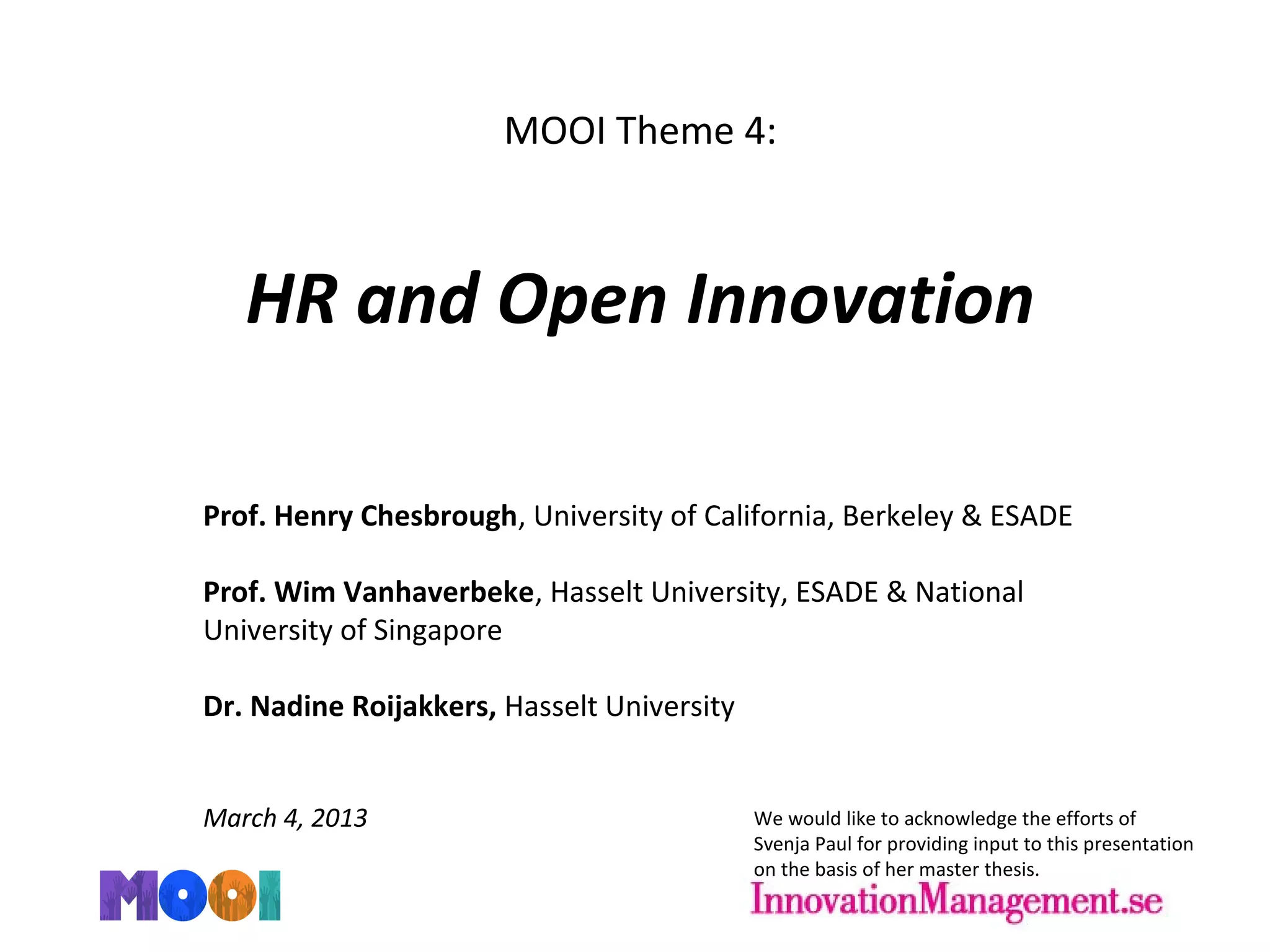
„You can create followers, but you can‘t create leaders“
- Tom Coen, Founder and Managing Director at Induct
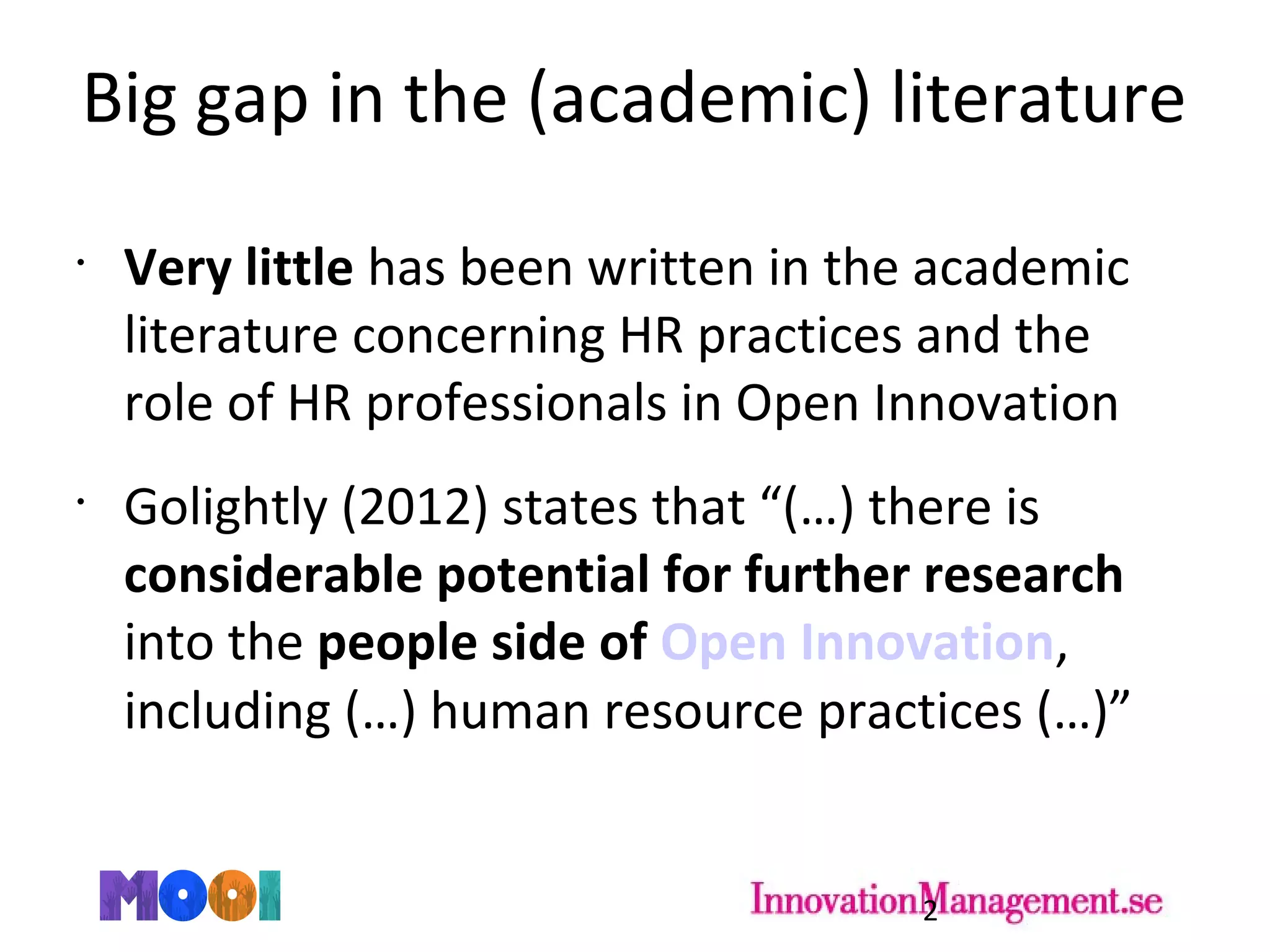
„Openness exists in many people but it is buried“
- Harry Berry, Founder of Brightstar Innovations
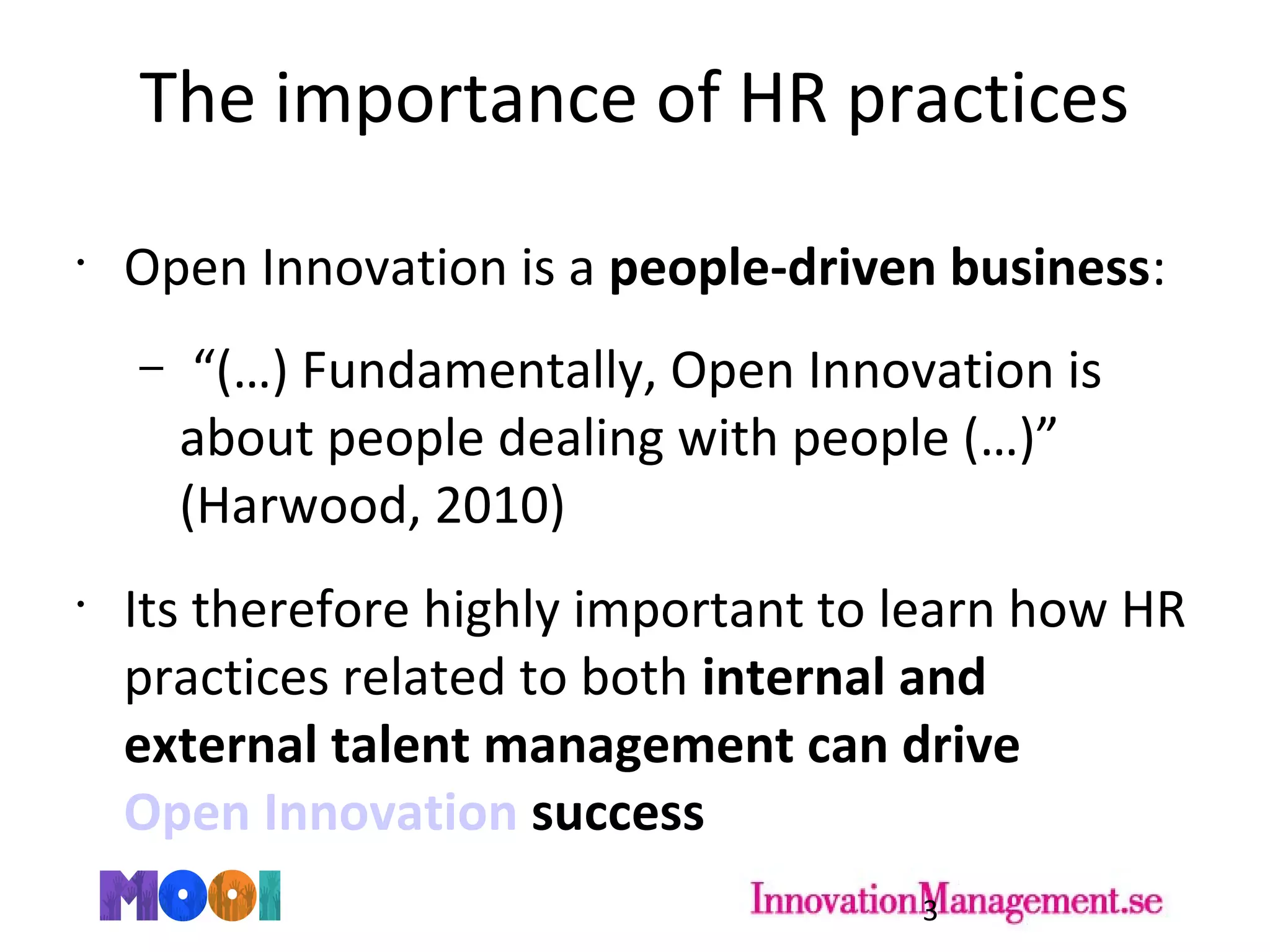
„People can be trained to be more open“
- Lucienne van der Werff, VP HRM at DSM Innovation Center
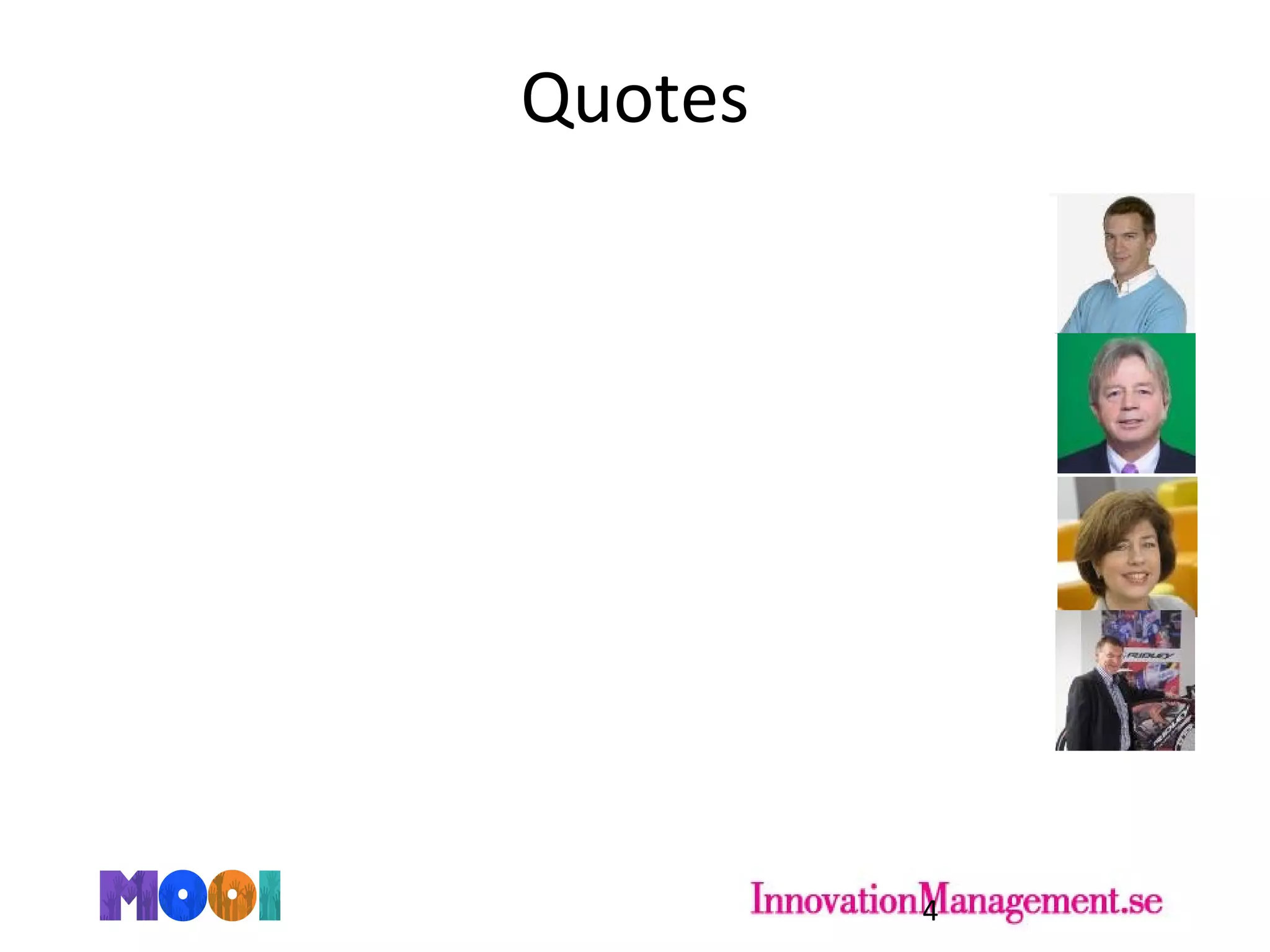
„People should be a lot more proactive than average in order to make quick
changes“
- Marc Hufkens, HRM and Deputy CEO at Ridley Bikes
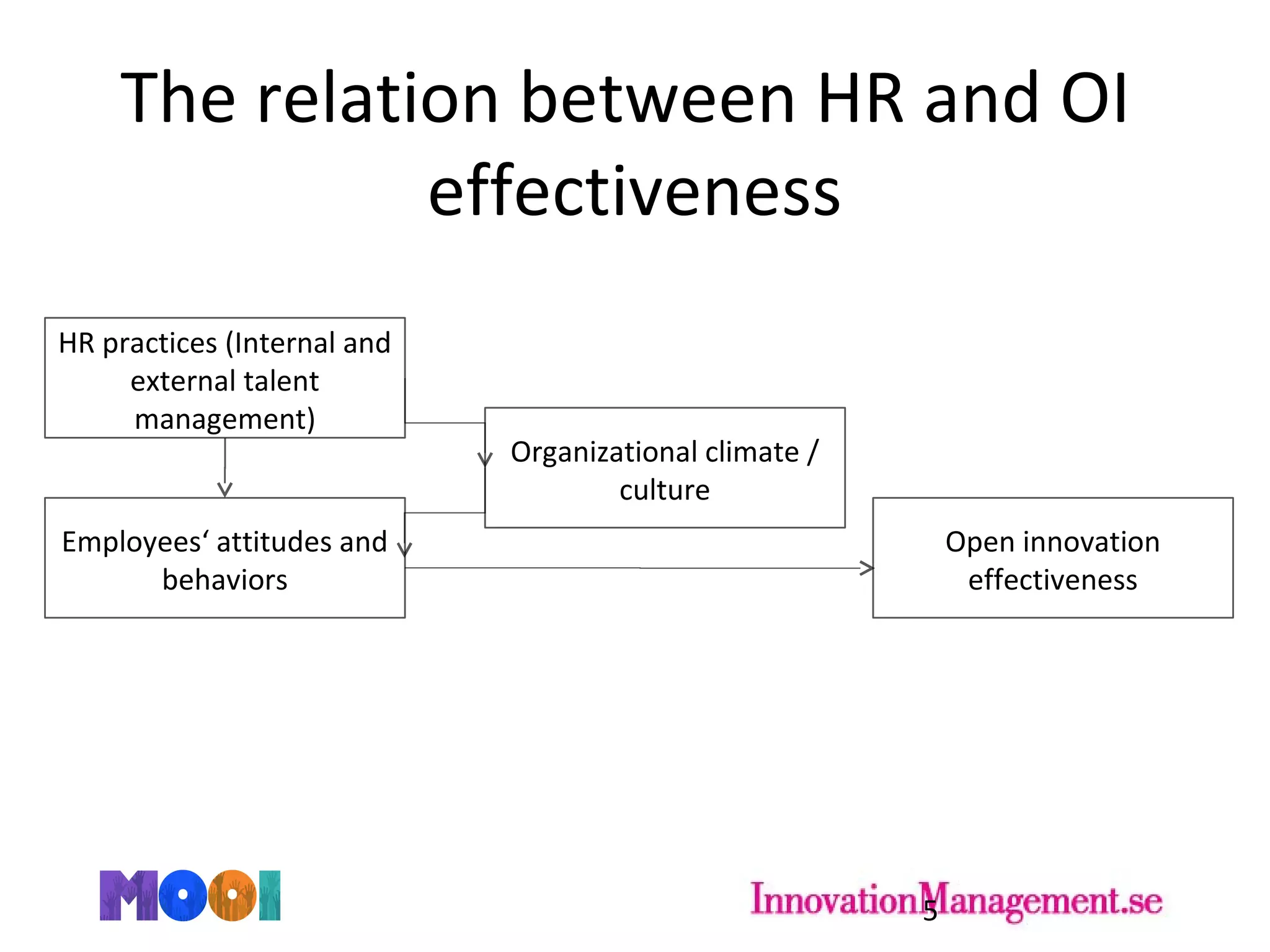
The relation between HR and OI
effectiveness
5
HR practices (Internal and
external talent
management)
Employees‘ attitudes and
behaviors
Organizational climate /
culture
Open innovation
effectiveness
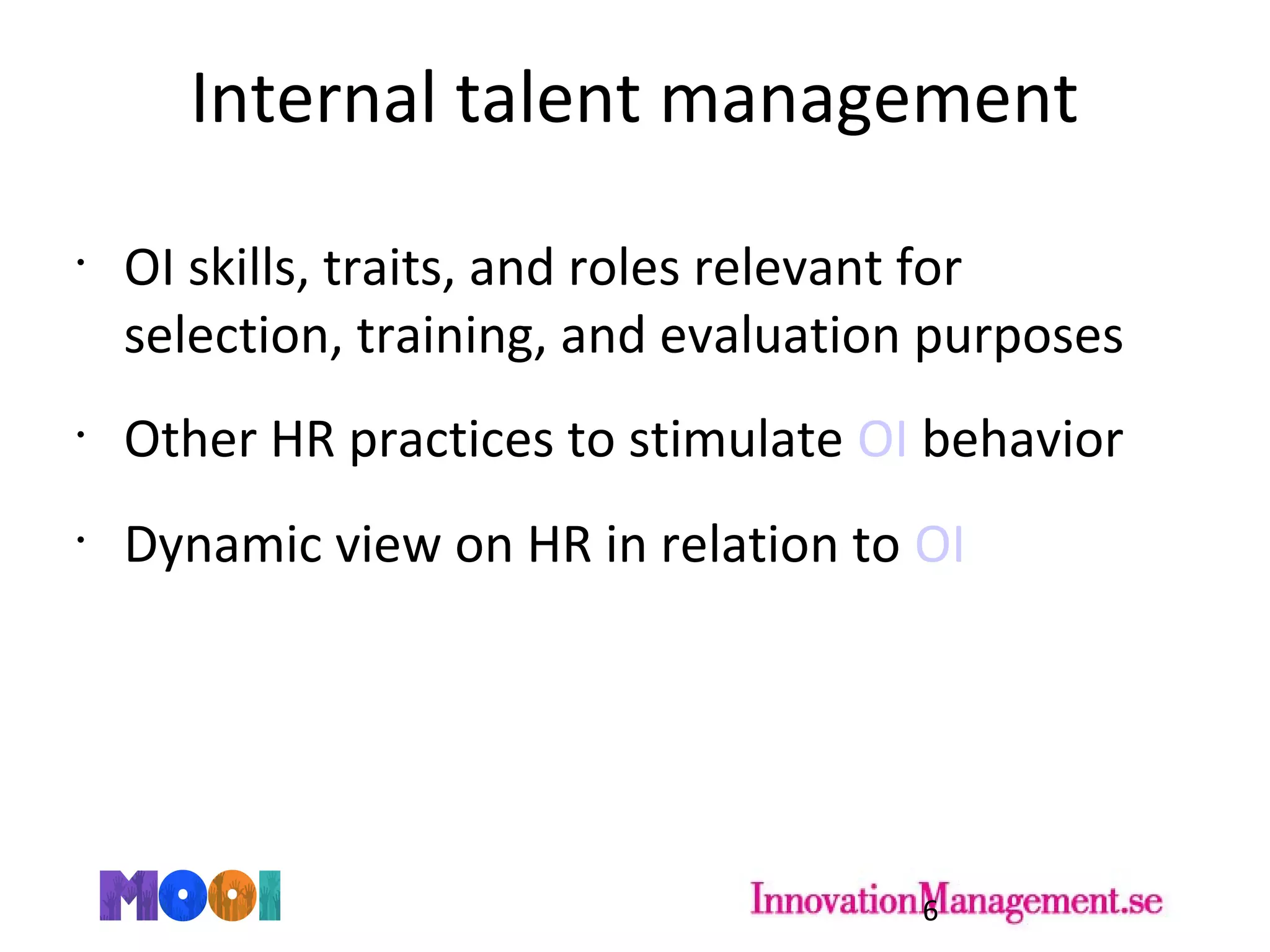
Internal talent management
•
OI skills, traits, and roles relevant for
selection, training, and evaluation purposes
•
Other HR practices to stimulate OI behavior
•
Dynamic view on HR in relation to OI
6
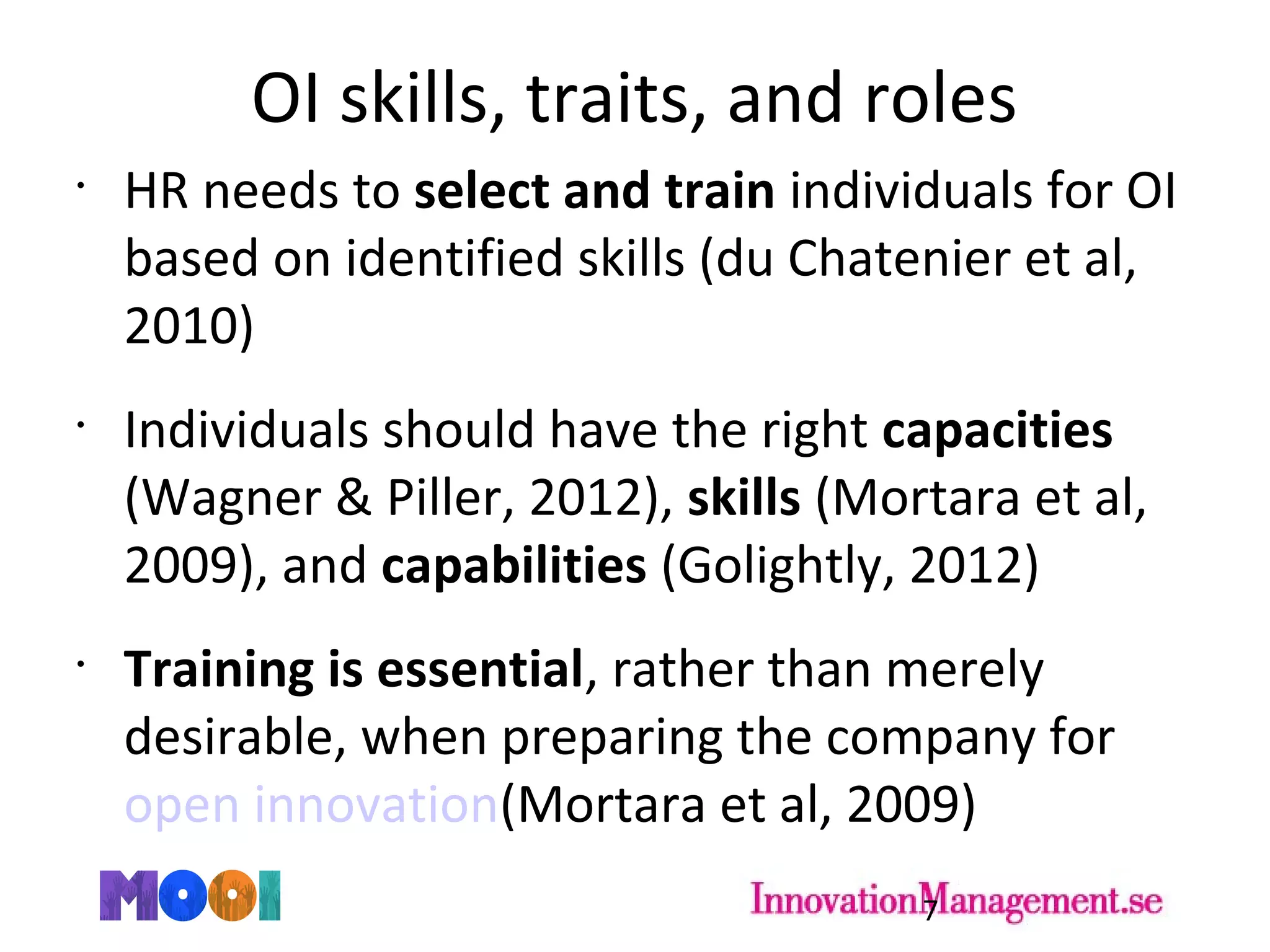
OI skills, traits, and roles
•
HR needs to select and train individuals for OI
based on identified skills (du Chatenier et al,
2010)
•
Individuals should have the right capacities
(Wagner & Piller, 2012), skills (Mortara et al,
2009), and capabilities (Golightly, 2012)
•
Training is essential, rather than merely
desirable, when preparing the company for
open innovation(Mortara et al, 2009)
7
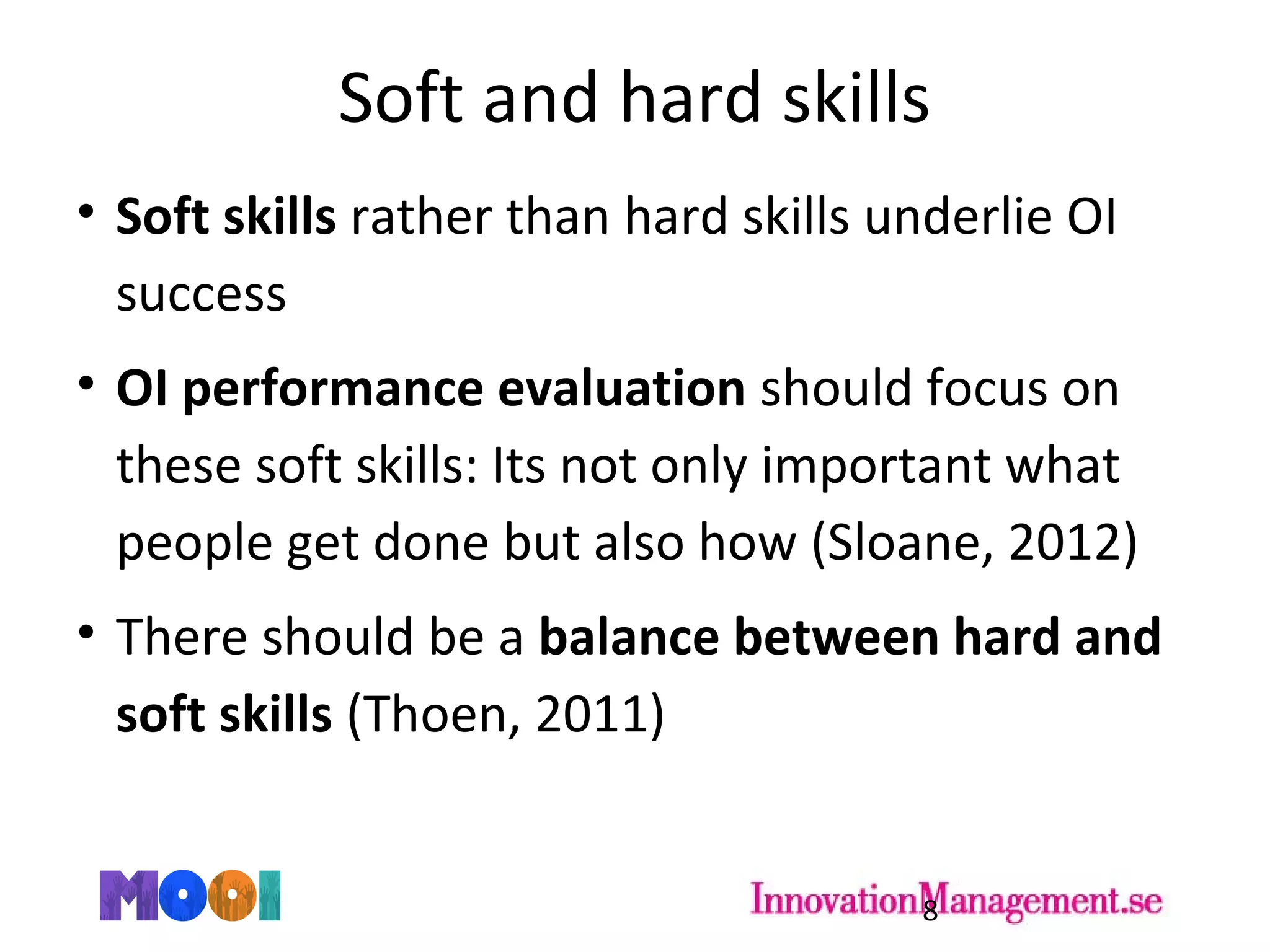
Soft and hard skills
• Soft skills rather than hard skills underlie OI
success
• OI performance evaluation should focus on
these soft skills: Its not only important what
people get done but also how (Sloane, 2012)
• There should be a balance between hard and
soft skills (Thoen, 2011)
8
Necessary OI skills
General (based on Thoen, 2011):
• T profile: Breadth and depth fusing
specialisation and generalisation
• Three legged stool: The technical
mastery, the organizational mastery,
and the business mastery
9
Listing of specific OI skills
•
Entrepreneurship
•
Internal and external networking
•
Belief in change, bring about change, faciliate
change, question status quo
•
Tolerance of uncertainty and risk taking
•
Need to learn, open to learn, and quick to learn
•
Optimism, passion, and energy
•
Able to grasp the big picture
•
Team player 10
Interactive poll 1
What are the three most important skills for Open
Innovation?
•
Entrepreneurship
•
Internal and external networking
•
Belief in change, bring about change, faciliate change,
question status quo
•
Tolerance of uncertainty and risk taking
•
Need to learn, open to learn, and quick to learn
•
Optimism, passion, and energy
•
Able to grasp the big picture 11
HR practices
•
Strategic challenge exchange to stimulate
change, creation of relations, exchange of
ideas, acquisition of external knowledge,
create interdisciplinary knowledge in
employees, etc. (Donkor and Monti, 2010)
•
Leads to high motivation and retention of staff
•
Examples: Google and P&G swapping
employees and network of four Swiss MNCs
strategically exchanging staff frequently
12
HR practices
• ‘Open choice of career paths and researcher
mobility‘ within the firm (Petroni et al, 2012)
• Ideally all talents and future managers start in
the R&D department and then move further,
so that R&D knowledge is integrated in all
departments (Petroni et al, 2012; Harryson,
1997)
13
A dynamic approach
• Different skills are needed in different phases
of the innovation process (Lindegaard, 2010)
• It is very rare for one person to possess all the
ideal skills for OI; different people may need to
be involved in the OI activity at different
points in time (Mortara et al, 2009)
14
External talent management
• From 'talent ownership' to 'talent attraction’
• Talents need to be kept connected even when not
internally employed
• ‚Attract and manage external talent‘ in addition to
‚finding the best internal talent‘
• ‚Build and curate talent pools‘
• Create value for the external talent pool in order for
them to want to stay connected
• Philips example on spinoffs
15
People-driven OI
• Individuals and their attitudes are the driving force behind
the success of OI (Du Chatenier et al, 2010; Lichtenthaler et
al, 2011).
• Focus first on getting individuals to realize the potential
value of Open Innovation, so that they can then put in place
practices that realize its actual value (Golightly, 2012).
• The ability of an organization to increase the absorptive
capacity of its individuals has come through strongly as a
crucial step in realising OI value (Golightly, 2012).
• With respect to absorptive capacity “people may be in a
certain role today but have the expertise we're looking for
because of previous experience. We often forget people are
in their second and third careers” (Byrum, 2012)16
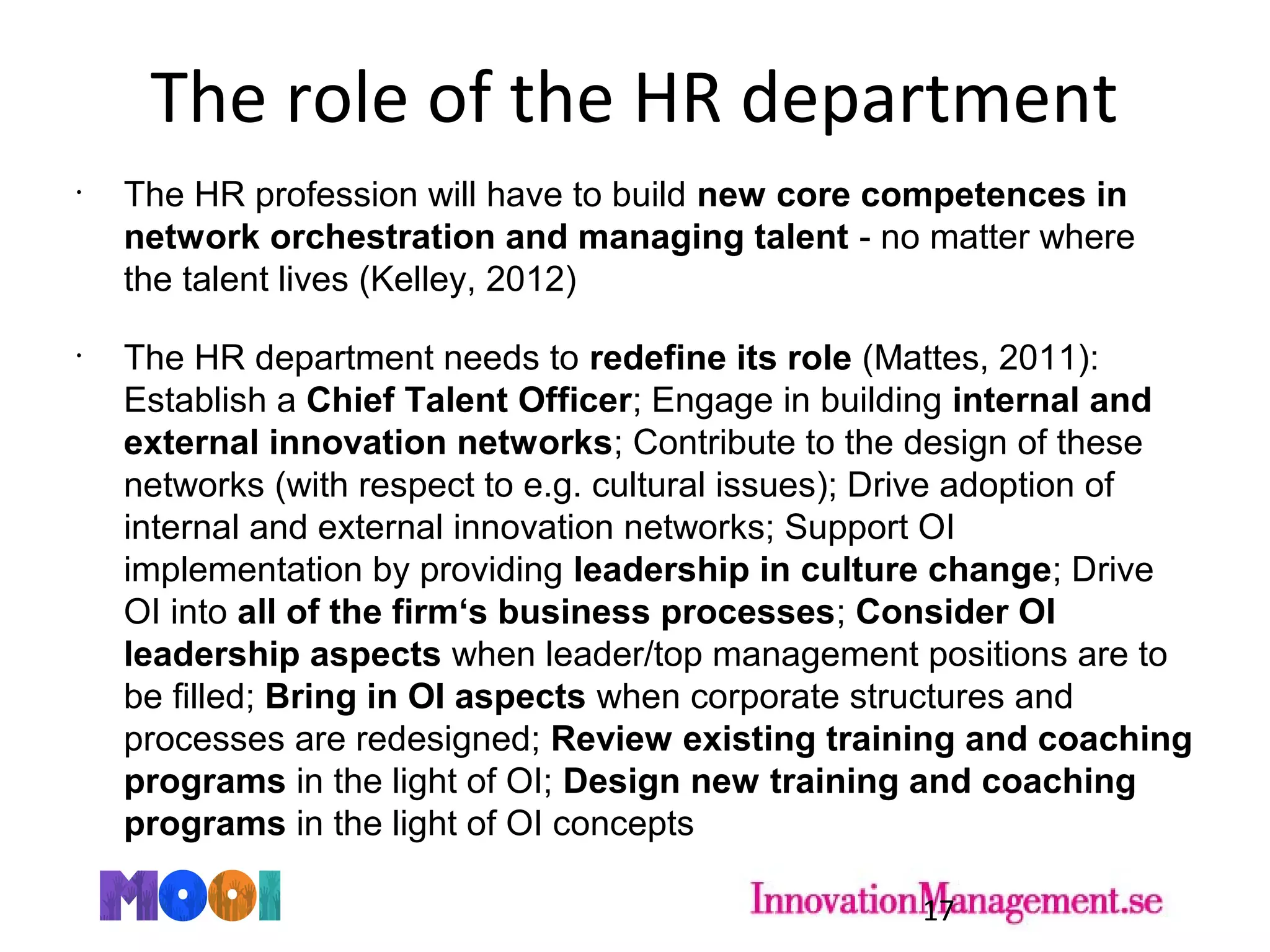
The role of the HR department
•
The HR profession will have to build new core competences in
network orchestration and managing talent - no matter where
the talent lives (Kelley, 2012)
•
The HR department needs to redefine its role (Mattes, 2011):
Establish a Chief Talent Officer; Engage in building internal and
external innovation networks; Contribute to the design of these
networks (with respect to e.g. cultural issues); Drive adoption of
internal and external innovation networks; Support OI
implementation by providing leadership in culture change; Drive
OI into all of the firm‘s business processes; Consider OI
leadership aspects when leader/top management positions are to
be filled; Bring in OI aspects when corporate structures and
processes are redesigned; Review existing training and coaching
programs in the light of OI; Design new training and coaching
programs in the light of OI concepts
17
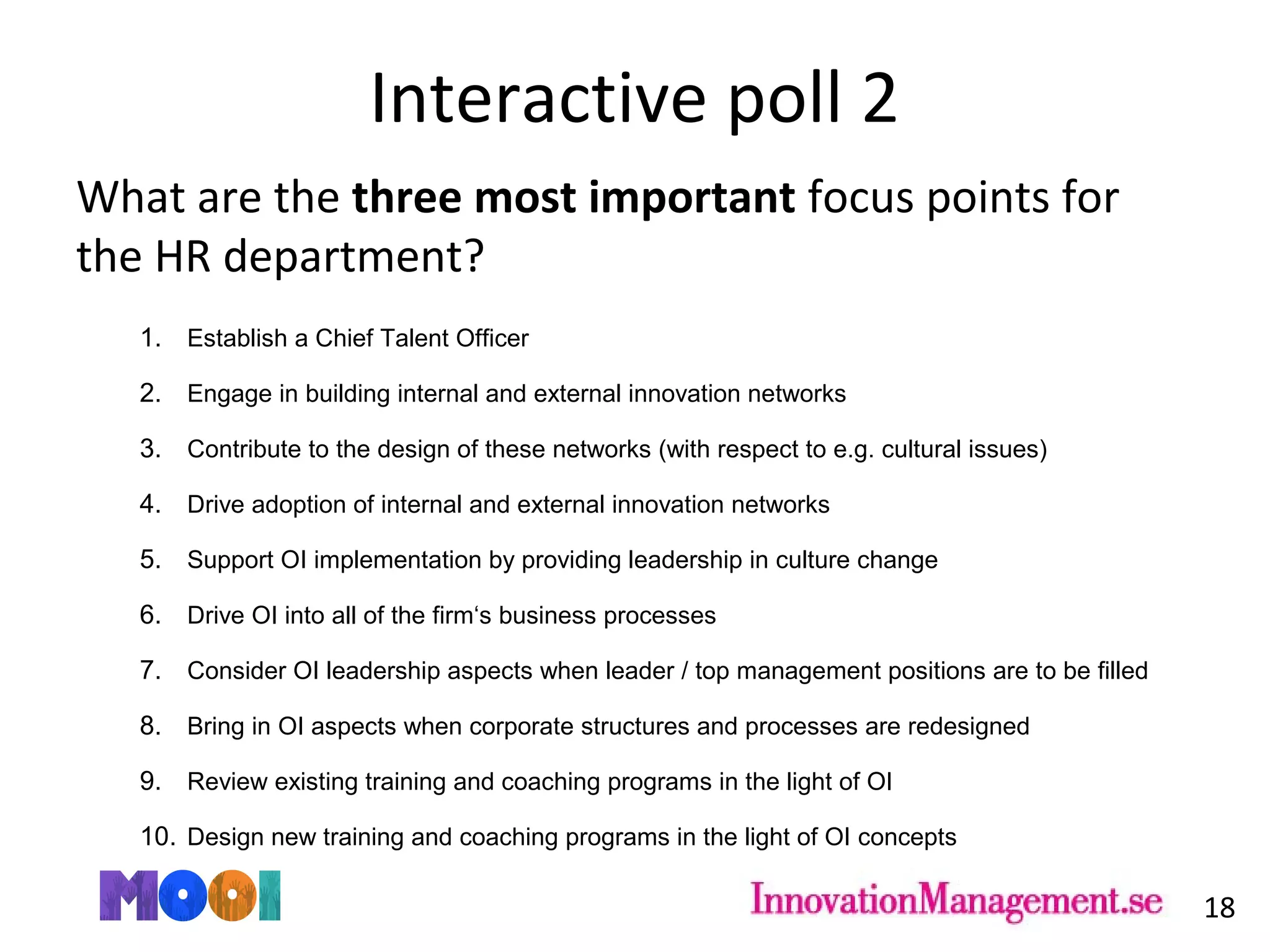
Interactive poll 2
What are the three most important focus points for
the HR department?
1. Establish a Chief Talent Officer
2. Engage in building internal and external innovation networks
3. Contribute to the design of these networks (with respect to e.g. cultural issues)
4. Drive adoption of internal and external innovation networks
5. Support OI implementation by providing leadership in culture change
6. Drive OI into all of the firm‘s business processes
7. Consider OI leadership aspects when leader / top management positions are to be filled
8. Bring in OI aspects when corporate structures and processes are redesigned
9. Review existing training and coaching programs in the light of OI
10. Design new training and coaching programs in the light of OI concepts
18
References
•
Golightly, J. (2012): Realising the value of Open Innovation
• Blog entry (2011a): innovation-3, Mattes, F.: HR departments take the driver‘s seat in
Open Innovation
• Blog entry (2011b): innovation-3, Mattes, F.: Report from the German flagship
conference on Open Innovation
• White paper (2012): innocentive, Kelley, B.: Harnessing the global talent pool to
accelerate innovation
• Harwood, R. (2010): Motivation in Open Innovation, University of Cambridge (audio
interview)
• Du Chatenier, E. (2010): Identification of competencies for professionals in OI teams,
R&D Management, 30, 3
• Sloane, P. (2012): A guide to Open Innovation and crowdsourcing
• Interview Chris Thoen (2011): Chris Thoen on Open Innovation part II
• Lindegaard, S. (2010): The open innovation revolution
19
References
• Donkor, C. and Monti, F. (2010): Strategischer Talentaustausch als Erfolgsfaktor für
Innovationen
• Mack, J. (2008): Google, P&G swapping employees, Direct Marketing News
• Byron, E. (2008): A new odd couple: Google, P&G swap workers to spur innovation,
The Wall Street Journal
• Wupperman, A. (2011): Kann man ‚Talente tauschen‘? – Open Innovation im Bereich
Human Resources, Presseanzeiger
• Petroni, G. et al (2012): Open Innovation and new issues in R&D organization and
personnel management,
The Int. Journal of Human Resources Management, 23, 1, 147-173
• Palensky, F. (2011): 3M’s Open Innovation, strategy+business (Interview)
• Harryson, S. (1997): How Canon and Sony drive product innovation through
networking and application- focused R&D, Journal of Product Innovation, 14, 288-295
• Bingham A; - Spradlin D. (2011): The open innovation marketplace
20
References
•
Interview with Byrum, J. (Global Head of Soybean Seeds and Traits R&D,
Syngenta) (May 2012). From: Syngenta Thoughtseeders, IdeaConnection. Retrieved
from; http://www.ideaconnection.com/interviews/00304-Syngenta-
Thoughtseeders.html
• White paper (2012): innocentive, Kelley, B.: Harnessing the global talent pool to
accelerate innovation
• Lichtenthaler, U.; Hoegl, M.; Muethel, M. (2011). Is your company ready for open
innovation? In: MIT Sloan Management Review, Vol. 53, no.1.
21

Hr and open innovation

  • 1.
    MOOI Theme 4: HRand Open Innovation Prof. Henry Chesbrough, University of California, Berkeley & ESADE Prof. Wim Vanhaverbeke, Hasselt University, ESADE & National University of Singapore Dr. Nadine Roijakkers, Hasselt University March 4, 2013 We would like to acknowledge the efforts of Svenja Paul for providing input to this presentation on the basis of her master thesis.
  • 2.
    Big gap inthe (academic) literature • Very little has been written in the academic literature concerning HR practices and the role of HR professionals in Open Innovation • Golightly (2012) states that “(…) there is considerable potential for further research into the people side of Open Innovation, including (…) human resource practices (…)” 2
  • 3.
    The importance ofHR practices • Open Innovation is a people-driven business: – “(…) Fundamentally, Open Innovation is about people dealing with people (…)” (Harwood, 2010) • Its therefore highly important to learn how HR practices related to both internal and external talent management can drive Open Innovation success 3
  • 4.
    Quotes 4 „You can createfollowers, but you can‘t create leaders“ - Tom Coen, Founder and Managing Director at Induct „Openness exists in many people but it is buried“ - Harry Berry, Founder of Brightstar Innovations „People can be trained to be more open“ - Lucienne van der Werff, VP HRM at DSM Innovation Center „People should be a lot more proactive than average in order to make quick changes“ - Marc Hufkens, HRM and Deputy CEO at Ridley Bikes
  • 5.
    The relation betweenHR and OI effectiveness 5 HR practices (Internal and external talent management) Employees‘ attitudes and behaviors Organizational climate / culture Open innovation effectiveness
  • 6.
    Internal talent management • OIskills, traits, and roles relevant for selection, training, and evaluation purposes • Other HR practices to stimulate OI behavior • Dynamic view on HR in relation to OI 6
  • 7.
    OI skills, traits,and roles • HR needs to select and train individuals for OI based on identified skills (du Chatenier et al, 2010) • Individuals should have the right capacities (Wagner & Piller, 2012), skills (Mortara et al, 2009), and capabilities (Golightly, 2012) • Training is essential, rather than merely desirable, when preparing the company for open innovation(Mortara et al, 2009) 7
  • 8.
    Soft and hardskills • Soft skills rather than hard skills underlie OI success • OI performance evaluation should focus on these soft skills: Its not only important what people get done but also how (Sloane, 2012) • There should be a balance between hard and soft skills (Thoen, 2011) 8
  • 9.
    Necessary OI skills General(based on Thoen, 2011): • T profile: Breadth and depth fusing specialisation and generalisation • Three legged stool: The technical mastery, the organizational mastery, and the business mastery 9
  • 10.
    Listing of specificOI skills • Entrepreneurship • Internal and external networking • Belief in change, bring about change, faciliate change, question status quo • Tolerance of uncertainty and risk taking • Need to learn, open to learn, and quick to learn • Optimism, passion, and energy • Able to grasp the big picture • Team player 10
  • 11.
    Interactive poll 1 Whatare the three most important skills for Open Innovation? • Entrepreneurship • Internal and external networking • Belief in change, bring about change, faciliate change, question status quo • Tolerance of uncertainty and risk taking • Need to learn, open to learn, and quick to learn • Optimism, passion, and energy • Able to grasp the big picture 11
  • 12.
    HR practices • Strategic challengeexchange to stimulate change, creation of relations, exchange of ideas, acquisition of external knowledge, create interdisciplinary knowledge in employees, etc. (Donkor and Monti, 2010) • Leads to high motivation and retention of staff • Examples: Google and P&G swapping employees and network of four Swiss MNCs strategically exchanging staff frequently 12
  • 13.
    HR practices • ‘Openchoice of career paths and researcher mobility‘ within the firm (Petroni et al, 2012) • Ideally all talents and future managers start in the R&D department and then move further, so that R&D knowledge is integrated in all departments (Petroni et al, 2012; Harryson, 1997) 13
  • 14.
    A dynamic approach •Different skills are needed in different phases of the innovation process (Lindegaard, 2010) • It is very rare for one person to possess all the ideal skills for OI; different people may need to be involved in the OI activity at different points in time (Mortara et al, 2009) 14
  • 15.
    External talent management •From 'talent ownership' to 'talent attraction’ • Talents need to be kept connected even when not internally employed • ‚Attract and manage external talent‘ in addition to ‚finding the best internal talent‘ • ‚Build and curate talent pools‘ • Create value for the external talent pool in order for them to want to stay connected • Philips example on spinoffs 15
  • 16.
    People-driven OI • Individualsand their attitudes are the driving force behind the success of OI (Du Chatenier et al, 2010; Lichtenthaler et al, 2011). • Focus first on getting individuals to realize the potential value of Open Innovation, so that they can then put in place practices that realize its actual value (Golightly, 2012). • The ability of an organization to increase the absorptive capacity of its individuals has come through strongly as a crucial step in realising OI value (Golightly, 2012). • With respect to absorptive capacity “people may be in a certain role today but have the expertise we're looking for because of previous experience. We often forget people are in their second and third careers” (Byrum, 2012)16
  • 17.
    The role ofthe HR department • The HR profession will have to build new core competences in network orchestration and managing talent - no matter where the talent lives (Kelley, 2012) • The HR department needs to redefine its role (Mattes, 2011): Establish a Chief Talent Officer; Engage in building internal and external innovation networks; Contribute to the design of these networks (with respect to e.g. cultural issues); Drive adoption of internal and external innovation networks; Support OI implementation by providing leadership in culture change; Drive OI into all of the firm‘s business processes; Consider OI leadership aspects when leader/top management positions are to be filled; Bring in OI aspects when corporate structures and processes are redesigned; Review existing training and coaching programs in the light of OI; Design new training and coaching programs in the light of OI concepts 17
  • 18.
    Interactive poll 2 Whatare the three most important focus points for the HR department? 1. Establish a Chief Talent Officer 2. Engage in building internal and external innovation networks 3. Contribute to the design of these networks (with respect to e.g. cultural issues) 4. Drive adoption of internal and external innovation networks 5. Support OI implementation by providing leadership in culture change 6. Drive OI into all of the firm‘s business processes 7. Consider OI leadership aspects when leader / top management positions are to be filled 8. Bring in OI aspects when corporate structures and processes are redesigned 9. Review existing training and coaching programs in the light of OI 10. Design new training and coaching programs in the light of OI concepts 18
  • 19.
    References • Golightly, J. (2012):Realising the value of Open Innovation • Blog entry (2011a): innovation-3, Mattes, F.: HR departments take the driver‘s seat in Open Innovation • Blog entry (2011b): innovation-3, Mattes, F.: Report from the German flagship conference on Open Innovation • White paper (2012): innocentive, Kelley, B.: Harnessing the global talent pool to accelerate innovation • Harwood, R. (2010): Motivation in Open Innovation, University of Cambridge (audio interview) • Du Chatenier, E. (2010): Identification of competencies for professionals in OI teams, R&D Management, 30, 3 • Sloane, P. (2012): A guide to Open Innovation and crowdsourcing • Interview Chris Thoen (2011): Chris Thoen on Open Innovation part II • Lindegaard, S. (2010): The open innovation revolution 19
  • 20.
    References • Donkor, C.and Monti, F. (2010): Strategischer Talentaustausch als Erfolgsfaktor für Innovationen • Mack, J. (2008): Google, P&G swapping employees, Direct Marketing News • Byron, E. (2008): A new odd couple: Google, P&G swap workers to spur innovation, The Wall Street Journal • Wupperman, A. (2011): Kann man ‚Talente tauschen‘? – Open Innovation im Bereich Human Resources, Presseanzeiger • Petroni, G. et al (2012): Open Innovation and new issues in R&D organization and personnel management, The Int. Journal of Human Resources Management, 23, 1, 147-173 • Palensky, F. (2011): 3M’s Open Innovation, strategy+business (Interview) • Harryson, S. (1997): How Canon and Sony drive product innovation through networking and application- focused R&D, Journal of Product Innovation, 14, 288-295 • Bingham A; - Spradlin D. (2011): The open innovation marketplace 20
  • 21.
    References • Interview with Byrum,J. (Global Head of Soybean Seeds and Traits R&D, Syngenta) (May 2012). From: Syngenta Thoughtseeders, IdeaConnection. Retrieved from; http://www.ideaconnection.com/interviews/00304-Syngenta- Thoughtseeders.html • White paper (2012): innocentive, Kelley, B.: Harnessing the global talent pool to accelerate innovation • Lichtenthaler, U.; Hoegl, M.; Muethel, M. (2011). Is your company ready for open innovation? In: MIT Sloan Management Review, Vol. 53, no.1. 21

Editor's Notes

  • #3 Golightly, J. (2012): Realising the value of Open Innovation
  • #4 Blog entry (2011a): innovation-3, Mattes, F.: HR departments take the driver‘s seat in Open Innovation Blog entry (2011b): innovation-3, Mattes, F.: Report from the German flagship conference on Open Innovation White paper (2012): innocentive, Kelley, B.: Harnessing the global talent pool to accelerate innovation Harwood, R. (2010): Motivation in Open Innovation, University of Cambridge (audio interview)
  • #8 Du Chatenier, E. (2010): Identification of competencies for professionals in OI teams, R&D Management, 30, 3 Mortara, L. et al. (2009) How to implement open innovation: Lessons from studying large multinational companies. From: Centre for Technology Management, Institute for Manufacturing, Cambridge. Wagner, P.; Piller, F. (2012), Increasing innovative capacity: is your company ready to benefit from open innovation processes?. In: Performance, Vol. 4, issue 2. Golightly, J. (Sept. 2012), Realising the value of Open Innovation. Published by: Big Innovation Centre .
  • #9 Sloane, P. (2012): A guide to Open Innovation and crowdsourcing Interview Chris Thoen (2011): Chris Thoen on Open Innovation part II
  • #11 Lindegaard, S. (2010): The open innovation revolution Lindegaard S. (2011): Making Open Innovation work Sloane, P. (2012): A guide to Open Innovation and crowdsourcing Interview Chris Thoen (2011): Chris Thoen on Open Innovation part II
  • #13 Donkor, C. and Monti, F. (2010): Strategischer Talentaustausch als Erfolgsfaktor für Innovationen Mack, J. (2008): Google, P&G swapping employees, Direct Marketing News Byron, E. (2008): A new odd couple: Google, P&G swap workers to spur innovation, The Wall Street Journal Wupperman, A. (2011): Kann man ‚Talente tauschen‘? – Open Innovation im Bereich Human Resources, Presseanzeiger
  • #14 Petroni, G. et al (2012): Open Innovation and new issues in R&D organization and personnel management, The Int. Journal of Human Resources Management, 23, 1, 147-173 Palensky, F. (2011): 3M’s Open Innovation, strategy+business (Interview) Harryson, S. (1997): How Canon and Sony drive product innovation through networking and application- focused R&D, Journal of Product Innovation, 14, 288-295
  • #15 Bingham A; - Spradlin D. (2011): The open innovation marketplace Lindegaard, S. (2010): The open innovation revolution
  • #16 White paper (2012): innocentive, Kelley, B.: Harnessing the global talent pool to accelerate innovation
  • #17 du Chatenier, E. et al. (2010), Identification of competencies for professionals in open innovation teams. In: R&D Management 40, 3. Golightly, J. (Sept. 2012), Realising the value of Open Innovation. Published by: Big Innovation Centre. Lichtenthaler, U.; Hoegl, M.; Muethel, M. (2011). Is your company ready for open innovation? In: MIT Sloan Management Review, Vol. 53, no.1. Interview with Byrum, J. (Global Head of Soybean Seeds and Traits R&D, Syngenta) (May 2012). From: Syngenta Thoughtseeders, IdeaConnection. Retrieved from; http://www.ideaconnection.com/interviews/00304-Syngenta-Thoughtseeders.html