INTRODUCTION TO
TECHNOPRENEURSHIP
INTRODUCTION TO
TECHNOPRENEURSHIP
CHAPTER 1
 Explain the definitions of entrepreneurship,
intrapreneurship and technopreneurship.
 Describe the similarities and differences
between entrepreneurship and
technopreneurship.
 Discuss technopreneurship development in
Malaysia.
Entrepreneur Are Made and Not Born
“The entrepreneurial mystique? It’s not
magic, it’s not mysterious and it has
nothing to do with the genes. It is a
discipline. And like any discipline, it can
be learned.”
…Peter Drucker
DEFINING
An innovator or developer who
recognizes and seizes opportunities;
converts these opportunities into
workable/marketable ideas; adds value
through time, effort, money or skills;
assumes the risks of the competitive
marketplace to implement these ideas;
realizes the rewards from these efforts.
(Kuratko & Hodgetts,2007)
DEFINING
 Entrepreneurship is the practice of
embarking on a new business or
reviving an existing business by pooling
together a bunch of resources in order
to exploit new found opportunities
DEFINING
 An entrepreneur who uses cutting-edge
technology to develop new business.
(Daniel Mankani, 2003)
 Is an entrepreneur who involves himself in
technological changes in producing goods and
services for his organization.
(Sarimah Hanim & Abd. Rashid,2008)
 They are entrepreneurs who used “technology”
as their driven factor in transforming resources
into goods and services, creating an environment
conducive to industrial growth”…
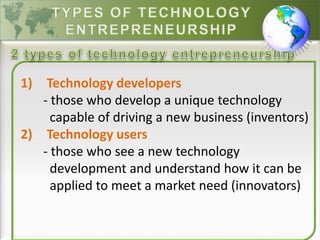
1) Technology developers
- those who develop a unique technology
capable of driving a new business (inventors)
2) Technology users
- those who see a new technology
development and understand how it can be
applied to meet a market need (innovators)
DEFINING
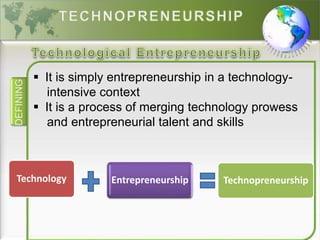
 It is simply entrepreneurship in a technology-
intensive context
 It is a process of merging technology prowess
and entrepreneurial talent and skills
Technology Entrepreneurship Technopreneurship
A technology-based enterprise is one that derives a
competitive advantage from direct or indirect use of
technology
Example 1: Apple iPod
- it has a number of innovations
- the most significant of which is 160Gb 1.8 inch
harddisk drive ( smaller than average harddisk 3.5
inch a 40Gb capacity )
- Many people, even techies was fascinate by this
and wonder how Apple able to do that
Example 2: UPS (United Parcel Services)
- able to offer one day delivery anywhere in
the world
- They have their sorting and delivery facility
that could process up to 1,000,000,000
parcels a year
• It doesn’t limit technopreneurship to really
high-tech stuff or to business we normally relate
to as ‘technology-based’.
• For example, an internet café is not considered
a technology-based enterprise even if it uses
computers in its business operation.
• However, it could be considered a technology-
based enterprise if the computers and or the
computer network is configured much differently
than ordinary internet café businesses
DEFINING
 Are individuals in organizations with
high entrepreneurial characteristics.
(Pinchot 1985)
 Is an entrepreneur within a large organization
with high entrepreneurial characteristics who
strongly believes in his talent and ability and
has a strong desire to create something using
his own initiative and creativity.
(Sarimah Hanim & Abd. Rashid,2008)
DEFINING
 In the world corporate business,
intrapreneurs emerge as that breed who
is a cross between managers and
entrepreneurs
 They work for the corporation but are
given the task of starting new ventures
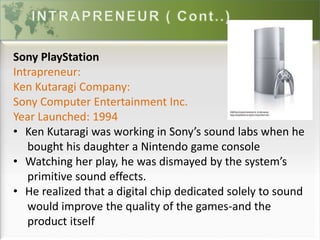
Sony PlayStation
Intrapreneur:
Ken Kutaragi Company:
Sony Computer Entertainment Inc.
Year Launched: 1994
• Ken Kutaragi was working in Sony’s sound labs when he
bought his daughter a Nintendo game console
• Watching her play, he was dismayed by the system’s
primitive sound effects.
• He realized that a digital chip dedicated solely to sound
would improve the quality of the games-and the
product itself
• Keeping his job at Sony, Kutaragi developed the SPC7000 for
the next generation of Nintendo machines.
• Sony execs nearly fired him after discovering his sideline
project, but then-CEO Norio Ohga realized the value
of his innovation and encouraged Kutaragi’s efforts
• With Sony’s blessing, Kutaragi worked with Nintendo to
develop a CD-ROM-based Nintendo
• Kutaragi helped Sony develop its own gaming system, which
became the PlayStation.
• He first PlayStation made Sony a major player in the games
market, but the PlayStation 2 did even better,
becoming the best-selling game console of all time.
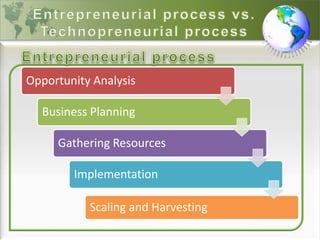
Opportunity Analysis
Business Planning
Gathering Resources
Implementation
Scaling and Harvesting
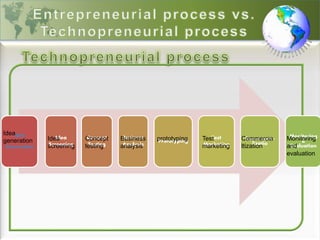
Idea
Generation
Idea
Screening
Concept
Testing
Business
Analysis
Prototyping
Test
Marketing
Commercia-
lizatio
Monitoring
&
Evaluation
Idea
generation Idea
screening
Concept
testing
Business
analysis
prototyping Test
marketing
Commercia
ltization
Monitoring
and
evaluation
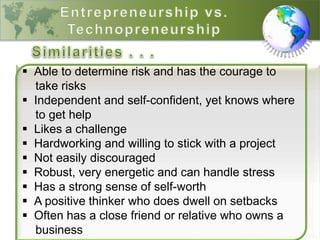
 Able to determine risk and has the courage to
take risks
 Independent and self-confident, yet knows where
to get help
 Likes a challenge
 Hardworking and willing to stick with a project
 Not easily discouraged
 Robust, very energetic and can handle stress
 Has a strong sense of self-worth
 A positive thinker who does dwell on setbacks
 Often has a close friend or relative who owns a
business
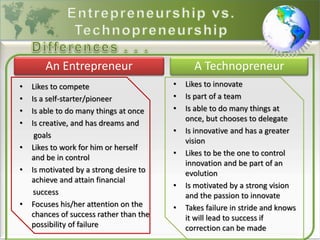
An Entrepreneur A Technopreneur
• Likes to innovate
• Is part of a team
• Is able to do many things at
once, but chooses to delegate
• Is innovative and has a greater
vision
• Likes to be the one to control
innovation and be part of an
evolution
• Is motivated by a strong vision
and the passion to innovate
• Takes failure in stride and knows
it will lead to success if
correction can be made
• Likes to compete
• Is a self-starter/pioneer
• Is able to do many things at once
• Is creative, and has dreams and
goals
• Likes to work for him or herself
and be in control
• Is motivated by a strong desire to
achieve and attain financial
success
• Focuses his/her attention on the
chances of success rather than the
possibility of failure
• Since 1996, one of the MSC Malaysia's
key strategic thrusts has been the
development of Malaysian ICT Small and
Medium Enterprises (SMEs). Its approach
has been to catalyze a highly competitive
cluster of Malaysian ICT / Multimedia and
other strategic high technology companies
which can become world-class over time
• The SMEs are seen as substantial contributors
and job opportunities in the knowledge-based
economy.
• As a result of MSC Malaysia initiatives, as of
31 July 2005, there were 3,413 Malaysian ICT
SMEs compared to fewer than 300 in 1996.
 In recognising the need to further enhance
the MSC Malaysia’s efforts to develop Malaysian
SMEs in strategic high technology industries,
such as ICT, Multimedia, Biotechnology and
other life science industries, the Government
launched the Development Flagship (TDF) in
November 2001
 The lead agency driving the Flagship
is the Ministry of Energy,
Communications and Multimedia with
Multimedia Development Corporation
acting as the implementing agency for
the Flagship.
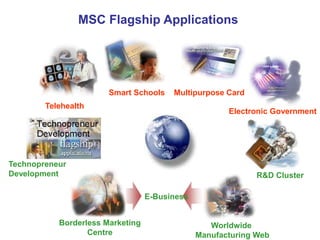
MSC Flagship Applications
E-Business
Telehealth
Smart Schools Multipurpose Card
R&D Cluster
Electronic Government
Worldwide
Manufacturing Web
Borderless Marketing
Centre
Technopreneur
Development
The core objectives of the Flagship are:
i. To spawn and nurture a critical mass of
strategic high technology industries such
as ICT, Multimedia, Biotechnology and
other life science start-ups.
ii. To facilitate the growth of existing ICT
SMEs into world-class companies.
 In order to create more Technopreneurs in
Malaysia, on December 2006 MSC started a
RM80million (approx USD 25 million) where
MSC offers up to RM150k of conditional
funding to develop viable business plans into
commercially focused ICT projects with
prototype and detailed business plans suitable
for venture funding and commercialization.
Thank You…
TOPIC 1 - INTRO TECHNOPRENEURSHIP.ppt

TOPIC 1 - INTRO TECHNOPRENEURSHIP.ppt

  • 1.
  • 2.
     Explain thedefinitions of entrepreneurship, intrapreneurship and technopreneurship.  Describe the similarities and differences between entrepreneurship and technopreneurship.  Discuss technopreneurship development in Malaysia.
  • 3.
    Entrepreneur Are Madeand Not Born “The entrepreneurial mystique? It’s not magic, it’s not mysterious and it has nothing to do with the genes. It is a discipline. And like any discipline, it can be learned.” …Peter Drucker
  • 4.
    DEFINING An innovator ordeveloper who recognizes and seizes opportunities; converts these opportunities into workable/marketable ideas; adds value through time, effort, money or skills; assumes the risks of the competitive marketplace to implement these ideas; realizes the rewards from these efforts. (Kuratko & Hodgetts,2007)
  • 5.
    DEFINING  Entrepreneurship isthe practice of embarking on a new business or reviving an existing business by pooling together a bunch of resources in order to exploit new found opportunities
  • 6.
    DEFINING  An entrepreneurwho uses cutting-edge technology to develop new business. (Daniel Mankani, 2003)  Is an entrepreneur who involves himself in technological changes in producing goods and services for his organization. (Sarimah Hanim & Abd. Rashid,2008)  They are entrepreneurs who used “technology” as their driven factor in transforming resources into goods and services, creating an environment conducive to industrial growth”…
  • 7.
    1) Technology developers -those who develop a unique technology capable of driving a new business (inventors) 2) Technology users - those who see a new technology development and understand how it can be applied to meet a market need (innovators)
  • 9.
    DEFINING  It issimply entrepreneurship in a technology- intensive context  It is a process of merging technology prowess and entrepreneurial talent and skills Technology Entrepreneurship Technopreneurship
  • 10.
    A technology-based enterpriseis one that derives a competitive advantage from direct or indirect use of technology Example 1: Apple iPod - it has a number of innovations - the most significant of which is 160Gb 1.8 inch harddisk drive ( smaller than average harddisk 3.5 inch a 40Gb capacity ) - Many people, even techies was fascinate by this and wonder how Apple able to do that
  • 11.
    Example 2: UPS(United Parcel Services) - able to offer one day delivery anywhere in the world - They have their sorting and delivery facility that could process up to 1,000,000,000 parcels a year
  • 12.
    • It doesn’tlimit technopreneurship to really high-tech stuff or to business we normally relate to as ‘technology-based’. • For example, an internet café is not considered a technology-based enterprise even if it uses computers in its business operation. • However, it could be considered a technology- based enterprise if the computers and or the computer network is configured much differently than ordinary internet café businesses
  • 13.
    DEFINING  Are individualsin organizations with high entrepreneurial characteristics. (Pinchot 1985)  Is an entrepreneur within a large organization with high entrepreneurial characteristics who strongly believes in his talent and ability and has a strong desire to create something using his own initiative and creativity. (Sarimah Hanim & Abd. Rashid,2008)
  • 14.
    DEFINING  In theworld corporate business, intrapreneurs emerge as that breed who is a cross between managers and entrepreneurs  They work for the corporation but are given the task of starting new ventures
  • 15.
    Sony PlayStation Intrapreneur: Ken KutaragiCompany: Sony Computer Entertainment Inc. Year Launched: 1994 • Ken Kutaragi was working in Sony’s sound labs when he bought his daughter a Nintendo game console • Watching her play, he was dismayed by the system’s primitive sound effects. • He realized that a digital chip dedicated solely to sound would improve the quality of the games-and the product itself
  • 16.
    • Keeping hisjob at Sony, Kutaragi developed the SPC7000 for the next generation of Nintendo machines. • Sony execs nearly fired him after discovering his sideline project, but then-CEO Norio Ohga realized the value of his innovation and encouraged Kutaragi’s efforts • With Sony’s blessing, Kutaragi worked with Nintendo to develop a CD-ROM-based Nintendo • Kutaragi helped Sony develop its own gaming system, which became the PlayStation. • He first PlayStation made Sony a major player in the games market, but the PlayStation 2 did even better, becoming the best-selling game console of all time.
  • 17.
    Opportunity Analysis Business Planning GatheringResources Implementation Scaling and Harvesting
  • 18.
  • 19.
     Able todetermine risk and has the courage to take risks  Independent and self-confident, yet knows where to get help  Likes a challenge  Hardworking and willing to stick with a project  Not easily discouraged  Robust, very energetic and can handle stress  Has a strong sense of self-worth  A positive thinker who does dwell on setbacks  Often has a close friend or relative who owns a business
  • 20.
    An Entrepreneur ATechnopreneur • Likes to innovate • Is part of a team • Is able to do many things at once, but chooses to delegate • Is innovative and has a greater vision • Likes to be the one to control innovation and be part of an evolution • Is motivated by a strong vision and the passion to innovate • Takes failure in stride and knows it will lead to success if correction can be made • Likes to compete • Is a self-starter/pioneer • Is able to do many things at once • Is creative, and has dreams and goals • Likes to work for him or herself and be in control • Is motivated by a strong desire to achieve and attain financial success • Focuses his/her attention on the chances of success rather than the possibility of failure
  • 21.
    • Since 1996,one of the MSC Malaysia's key strategic thrusts has been the development of Malaysian ICT Small and Medium Enterprises (SMEs). Its approach has been to catalyze a highly competitive cluster of Malaysian ICT / Multimedia and other strategic high technology companies which can become world-class over time
  • 22.
    • The SMEsare seen as substantial contributors and job opportunities in the knowledge-based economy. • As a result of MSC Malaysia initiatives, as of 31 July 2005, there were 3,413 Malaysian ICT SMEs compared to fewer than 300 in 1996.
  • 23.
     In recognisingthe need to further enhance the MSC Malaysia’s efforts to develop Malaysian SMEs in strategic high technology industries, such as ICT, Multimedia, Biotechnology and other life science industries, the Government launched the Development Flagship (TDF) in November 2001
  • 24.
     The leadagency driving the Flagship is the Ministry of Energy, Communications and Multimedia with Multimedia Development Corporation acting as the implementing agency for the Flagship.
  • 25.
    MSC Flagship Applications E-Business Telehealth SmartSchools Multipurpose Card R&D Cluster Electronic Government Worldwide Manufacturing Web Borderless Marketing Centre Technopreneur Development
  • 26.
    The core objectivesof the Flagship are: i. To spawn and nurture a critical mass of strategic high technology industries such as ICT, Multimedia, Biotechnology and other life science start-ups. ii. To facilitate the growth of existing ICT SMEs into world-class companies.
  • 27.
     In orderto create more Technopreneurs in Malaysia, on December 2006 MSC started a RM80million (approx USD 25 million) where MSC offers up to RM150k of conditional funding to develop viable business plans into commercially focused ICT projects with prototype and detailed business plans suitable for venture funding and commercialization.
  • 28.