DEMYSTIFYING:
Gynecologic Cancer Screenings
Ashley Haggerty, MD MSCE
Gynecologic Oncology
University of Pennsylvania
September 13th 2016
Penn Women’s Lecture Series
Gynecologic Cancer Screening Recommendations
 Cervical Cancer
• Pap Tests
• What is co-testing?
• Review of new guidelines
• HPV Vaccination
 Ovarian Cancer Screening
• Current recommendations
• Future directions
Annual Pelvic Exam
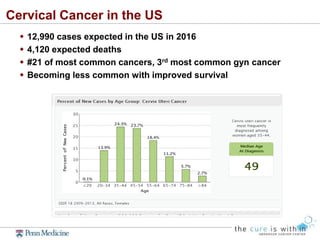
Cervical Cancer in the US
 12,990 cases expected in the US in 2016
 4,120 expected deaths
 #21 of most common cancers, 3rd most common gyn cancer
 Becoming less common with improved survival
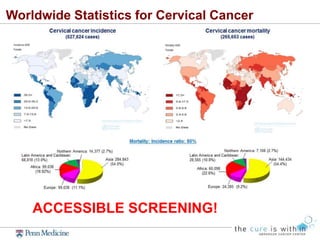
Worldwide Statistics for Cervical Cancer
ACCESSIBLE SCREENING!
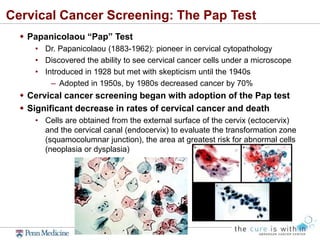
Cervical Cancer Screening: The Pap Test
 Papanicolaou “Pap” Test
• Dr. Papanicolaou (1883-1962): pioneer in cervical cytopathology
• Discovered the ability to see cervical cancer cells under a microscope
• Introduced in 1928 but met with skepticism until the 1940s
– Adopted in 1950s, by 1980s decreased cancer by 70%
 Cervical cancer screening began with adoption of the Pap test
 Significant decrease in rates of cervical cancer and death
• Cells are obtained from the external surface of the cervix (ectocervix)
and the cervical canal (endocervix) to evaluate the transformation zone
(squamocolumnar junction), the area at greatest risk for abnormal cells
(neoplasia or dysplasia)
Human Papilloma Virus (HPV) and Cervical Cancer
 One of THE MOST COMMON STDs
 75-80% of all people will be infected with HPV at some point
 Among those ages 15-49, only one in four Americans has not had a
genital HPV infection.
 Major cause of cervical dysplasia (abnormal cells on the cervix) and
cervical cancer is infection with High Risk HPV (HRHPV)
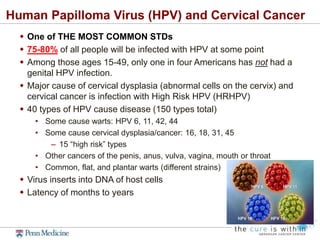
 40 types of HPV cause disease (150 types total)
• Some cause warts: HPV 6, 11, 42, 44
• Some cause cervical dysplasia/cancer: 16, 18, 31, 45
– 15 “high risk” types
• Other cancers of the penis, anus, vulva, vagina, mouth or throat
• Common, flat, and plantar warts (different strains)
 Virus inserts into DNA of host cells
 Latency of months to years
Types of Pap Tests
 Conventional pap smear
• Cells placed on a microscope slide
 Liquid-based thin-prep cytology
• Cells swirled into liquid
• Can use the same specimen for HPV testing
 Myths of Pap Tests:
• “I can’t get a pap test since I’m on my period”
• “I don’t need a pap test if I’m in a same-sex relationship”
• “An abnormal pap test means someone has cheated”
• “I don’t need a pap test because I have not been sexually active
recently”
• “I don’t need a pap smear anymore since I’m in menopause”
• “I need a pap smear every year” ***
• “I still need a pap smear after my total hysterectomy”
What is “Co-Testing”???
 Testing for “High Risk” HPV types + Pap test
 HPV testing used as a “co-test” with a pap smear or “reflex”
testing after an abnormal pap (i.e. ASCUS)
 2 types of available HPV tests
• +/- for HR HPV subtypes
– Doesn’t report which type, “negative” if no cells
• HPV genotyping to report +/- HPV 16/18 or + for other HR types
 HPV testing (alone or with pap) better able to detect
abnormalities and decreases rate of cancer development
 0.16% risk of high-grade dysplasia/cancer in 5 years if co-test
negative
 Primary HPV testing alone as “promising” screening?
• 2014, the U.S. FDA approved the Cobas® HPV Test
• Age >25: can be an option, used every 3 years
• But unclear if best option
Guideline Recommendations
New Recommendations for Screening
 Is there any harm in more testing???
• YES: abnormalities may clear without intervention, leads to
unnecessary treatment that has risks
 Begin NO EARLIER than age 21
• Regardless of age of initiation of sexual activity
• Risk of cancer <1/1 million
• Rates of low grade abnormalities higher but 95% clear
 Women <30: Pap test alone every 3 years
• More likely to have transient HPV infections
• Randomized trials 100,000 women: 27% more unnecessary procedures
 Women >30:
• Pap test alone every 3 years
• Co-testing (Pap + HPV) every 5 years (if both negative) *Preferred
– No significant change in cancer, 2-3x risk of procedure vs annual
– Rate of detection of high-grade abnormality similar to annual
• Co-testing may detect abnormalities earlier than pap alone, but does
increase rates of follow-up testing
When should I stop screening?
 In women >65yo with adequate prior screening, may discontinue
• American College of Obstetrics and Gynecology (ACOG)
 ?Can continue if good life expectancy or risk factors
• Smoker, new partners, prior abnormal pap or HPV disease
• US Preventive Services Task Force (USPTF): up to age 70-75
– No data to support a specific stopping age, >15% of cases >65
 Older women who have never been screened before may have
the MOST benefit (75% possible decrease in risk of death)
 Not applicable if diseases affecting the immune system
• Should have ANNUAL screening
 If you have a “total” hysterectomy and no history of dysplasia
• If history of high-grade dysplasia: vaginal pap smear for 20 years
 Daughters of women who took DES in pregnancy can have
yearly screening but unclear how much risk is increased
HPV Vaccination
 2 Types: Gardasil (4), newer Gardasil 9 (12/2014) and Ceravex (2)
 If 70% of the world is vaccinated, would see a decrease of 340,000
new cases and avoid 178,000 deaths/YEAR
 Latency of 10-15 years between HPV exposure and cancer
• Will take years to see improvement
• Australia: already seen 38% decrease in high grade dysplasia
 Significantly less benefit if already exposed to HPV
 Recommended to males/females age 9-26 (9-13 best), 3 doses
 NO change in recommendation for screening if vaccinated
 Vaccine effect is expected to be life-long
 7 high-risk HPV types in the nonavalent vaccine can potentially
prevent over 90% of cervical cancers in the US
• And a similarly high number of other HPV-associated cancers
 CDC and FDA has monitored the safety of the HPV vaccines since
the FDA licensed them in 2006 and 2009.
• In the 57 million doses administered since June 2006, there were no new
or unusual patterns of adverse events to suggest any safety concerns.
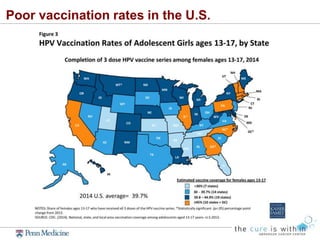
Poor vaccination rates in the U.S.
HPV Vaccination
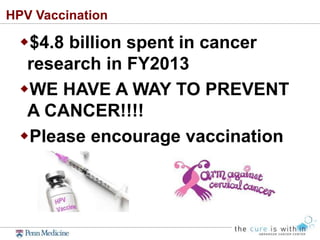
$4.8 billion spent in cancer
research in FY2013
WE HAVE A WAY TO PREVENT
A CANCER!!!!
Please encourage vaccination
Ovarian Cancer Screening
 Screening if genetic risk
• BRCA mutation, Lynch syndrome (HNPCC)
• Risk of ovarian cancer 10-50%
 Different from “family history of ovarian cancer”
• Families with isolated members with an ovarian cancer
 If concerned, genetic testing!
 Potential benefit of screening to catch at an earlier stage
 But a problem of false positive tests
• CA-125 tumor marker or other serologic markers
• Ultrasound
• Combination of these (multimodal screening)
 UK Collaborative Trial of Ovarian Cancer Screening (UKCTOCS)
• Largest trial (202,638 women): no screening vs annual US vs MMS
• Followed for an average of 11 years
• NO change in mortality (?decrease after 7-14 years)
• Plan to re-evaluate in 3 years
 Other studies showed increase risk of significant harm
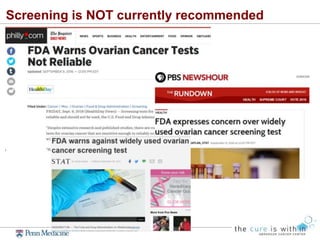
Screening is NOT currently recommended
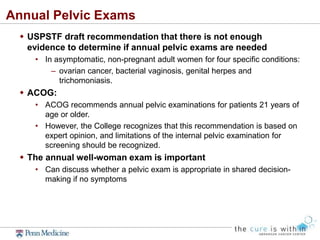
Annual Pelvic Exams
 USPSTF draft recommendation that there is not enough
evidence to determine if annual pelvic exams are needed
• In asymptomatic, non-pregnant adult women for four specific conditions:
– ovarian cancer, bacterial vaginosis, genital herpes and
trichomoniasis.
 ACOG:
• ACOG recommends annual pelvic examinations for patients 21 years of
age or older.
• However, the College recognizes that this recommendation is based on
expert opinion, and limitations of the internal pelvic examination for
screening should be recognized.
 The annual well-woman exam is important
• Can discuss whether a pelvic exam is appropriate in shared decision-
making if no symptoms
QUESTIONS?

Demystifying Gynecologic Cancer Screenings

  • 1.
    DEMYSTIFYING: Gynecologic Cancer Screenings AshleyHaggerty, MD MSCE Gynecologic Oncology University of Pennsylvania September 13th 2016 Penn Women’s Lecture Series
  • 2.
    Gynecologic Cancer ScreeningRecommendations  Cervical Cancer • Pap Tests • What is co-testing? • Review of new guidelines • HPV Vaccination  Ovarian Cancer Screening • Current recommendations • Future directions Annual Pelvic Exam
  • 3.
    Cervical Cancer inthe US  12,990 cases expected in the US in 2016  4,120 expected deaths  #21 of most common cancers, 3rd most common gyn cancer  Becoming less common with improved survival
  • 4.
    Worldwide Statistics forCervical Cancer ACCESSIBLE SCREENING!
  • 5.
    Cervical Cancer Screening:The Pap Test  Papanicolaou “Pap” Test • Dr. Papanicolaou (1883-1962): pioneer in cervical cytopathology • Discovered the ability to see cervical cancer cells under a microscope • Introduced in 1928 but met with skepticism until the 1940s – Adopted in 1950s, by 1980s decreased cancer by 70%  Cervical cancer screening began with adoption of the Pap test  Significant decrease in rates of cervical cancer and death • Cells are obtained from the external surface of the cervix (ectocervix) and the cervical canal (endocervix) to evaluate the transformation zone (squamocolumnar junction), the area at greatest risk for abnormal cells (neoplasia or dysplasia)
  • 6.
    Human Papilloma Virus(HPV) and Cervical Cancer  One of THE MOST COMMON STDs  75-80% of all people will be infected with HPV at some point  Among those ages 15-49, only one in four Americans has not had a genital HPV infection.  Major cause of cervical dysplasia (abnormal cells on the cervix) and cervical cancer is infection with High Risk HPV (HRHPV)  40 types of HPV cause disease (150 types total) • Some cause warts: HPV 6, 11, 42, 44 • Some cause cervical dysplasia/cancer: 16, 18, 31, 45 – 15 “high risk” types • Other cancers of the penis, anus, vulva, vagina, mouth or throat • Common, flat, and plantar warts (different strains)  Virus inserts into DNA of host cells  Latency of months to years
  • 7.
    Types of PapTests  Conventional pap smear • Cells placed on a microscope slide  Liquid-based thin-prep cytology • Cells swirled into liquid • Can use the same specimen for HPV testing  Myths of Pap Tests: • “I can’t get a pap test since I’m on my period” • “I don’t need a pap test if I’m in a same-sex relationship” • “An abnormal pap test means someone has cheated” • “I don’t need a pap test because I have not been sexually active recently” • “I don’t need a pap smear anymore since I’m in menopause” • “I need a pap smear every year” *** • “I still need a pap smear after my total hysterectomy”
  • 8.
    What is “Co-Testing”??? Testing for “High Risk” HPV types + Pap test  HPV testing used as a “co-test” with a pap smear or “reflex” testing after an abnormal pap (i.e. ASCUS)  2 types of available HPV tests • +/- for HR HPV subtypes – Doesn’t report which type, “negative” if no cells • HPV genotyping to report +/- HPV 16/18 or + for other HR types  HPV testing (alone or with pap) better able to detect abnormalities and decreases rate of cancer development  0.16% risk of high-grade dysplasia/cancer in 5 years if co-test negative  Primary HPV testing alone as “promising” screening? • 2014, the U.S. FDA approved the Cobas® HPV Test • Age >25: can be an option, used every 3 years • But unclear if best option
  • 9.
  • 10.
    New Recommendations forScreening  Is there any harm in more testing??? • YES: abnormalities may clear without intervention, leads to unnecessary treatment that has risks  Begin NO EARLIER than age 21 • Regardless of age of initiation of sexual activity • Risk of cancer <1/1 million • Rates of low grade abnormalities higher but 95% clear  Women <30: Pap test alone every 3 years • More likely to have transient HPV infections • Randomized trials 100,000 women: 27% more unnecessary procedures  Women >30: • Pap test alone every 3 years • Co-testing (Pap + HPV) every 5 years (if both negative) *Preferred – No significant change in cancer, 2-3x risk of procedure vs annual – Rate of detection of high-grade abnormality similar to annual • Co-testing may detect abnormalities earlier than pap alone, but does increase rates of follow-up testing
  • 11.
    When should Istop screening?  In women >65yo with adequate prior screening, may discontinue • American College of Obstetrics and Gynecology (ACOG)  ?Can continue if good life expectancy or risk factors • Smoker, new partners, prior abnormal pap or HPV disease • US Preventive Services Task Force (USPTF): up to age 70-75 – No data to support a specific stopping age, >15% of cases >65  Older women who have never been screened before may have the MOST benefit (75% possible decrease in risk of death)  Not applicable if diseases affecting the immune system • Should have ANNUAL screening  If you have a “total” hysterectomy and no history of dysplasia • If history of high-grade dysplasia: vaginal pap smear for 20 years  Daughters of women who took DES in pregnancy can have yearly screening but unclear how much risk is increased
  • 12.
    HPV Vaccination  2Types: Gardasil (4), newer Gardasil 9 (12/2014) and Ceravex (2)  If 70% of the world is vaccinated, would see a decrease of 340,000 new cases and avoid 178,000 deaths/YEAR  Latency of 10-15 years between HPV exposure and cancer • Will take years to see improvement • Australia: already seen 38% decrease in high grade dysplasia  Significantly less benefit if already exposed to HPV  Recommended to males/females age 9-26 (9-13 best), 3 doses  NO change in recommendation for screening if vaccinated  Vaccine effect is expected to be life-long  7 high-risk HPV types in the nonavalent vaccine can potentially prevent over 90% of cervical cancers in the US • And a similarly high number of other HPV-associated cancers  CDC and FDA has monitored the safety of the HPV vaccines since the FDA licensed them in 2006 and 2009. • In the 57 million doses administered since June 2006, there were no new or unusual patterns of adverse events to suggest any safety concerns.
  • 13.
  • 14.
    HPV Vaccination $4.8 billionspent in cancer research in FY2013 WE HAVE A WAY TO PREVENT A CANCER!!!! Please encourage vaccination
  • 15.
    Ovarian Cancer Screening Screening if genetic risk • BRCA mutation, Lynch syndrome (HNPCC) • Risk of ovarian cancer 10-50%  Different from “family history of ovarian cancer” • Families with isolated members with an ovarian cancer  If concerned, genetic testing!  Potential benefit of screening to catch at an earlier stage  But a problem of false positive tests • CA-125 tumor marker or other serologic markers • Ultrasound • Combination of these (multimodal screening)  UK Collaborative Trial of Ovarian Cancer Screening (UKCTOCS) • Largest trial (202,638 women): no screening vs annual US vs MMS • Followed for an average of 11 years • NO change in mortality (?decrease after 7-14 years) • Plan to re-evaluate in 3 years  Other studies showed increase risk of significant harm
  • 16.
    Screening is NOTcurrently recommended
  • 17.
    Annual Pelvic Exams USPSTF draft recommendation that there is not enough evidence to determine if annual pelvic exams are needed • In asymptomatic, non-pregnant adult women for four specific conditions: – ovarian cancer, bacterial vaginosis, genital herpes and trichomoniasis.  ACOG: • ACOG recommends annual pelvic examinations for patients 21 years of age or older. • However, the College recognizes that this recommendation is based on expert opinion, and limitations of the internal pelvic examination for screening should be recognized.  The annual well-woman exam is important • Can discuss whether a pelvic exam is appropriate in shared decision- making if no symptoms
  • 18.