Prepared by
Sumon Dey
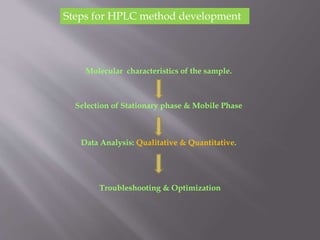
Molecular characteristics of the sample.
Selection of Stationary phase & Mobile Phase
Troubleshooting & Optimization
Data Analysis: Qualitative & Quantitative.
Steps for HPLC method development
What are the molecular characteristics
of the analyte or sample?
CHASM
1. Charge
Positive/negative
2. Hydrophobicity
3. Affinity
“lock and key” sites
4. Solubility & stability
pH, ionic strength, organic solvents
5. Molecular weight
Bulk (SiO2)x Bulk (SiO2)xSurface Surface
Selection of Stationary Phase
Normal Phase Reverse Phase
SurfaceBulk (SiO2)x
Ion Exchange
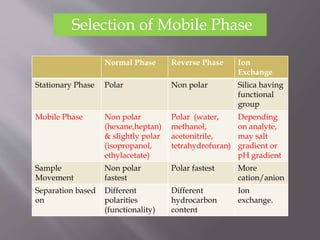
Normal Phase Reverse Phase Ion
Exchange
Stationary Phase Polar Non polar Silica having
functional
group
Mobile Phase Non polar
(hexane,heptan)
& slightly polar
(isopropanol,
ethylacetate)
Polar (water,
methanol,
acetonitrile,
tetrahydrofuran)
Depending
on analyte,
may salt
gradient or
pH gradient
Sample
Movement
Non polar
fastest
Polar fastest More
cation/anion
Separation based
on
Different
polarities
(functionality)
Different
hydrocarbon
content
Ion
exchange.
Selection of Mobile Phase
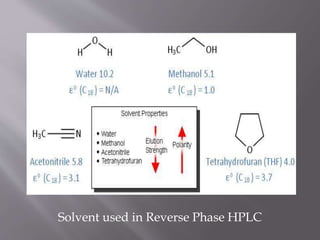
Characteristics of Solvent
Solvent used in Reverse Phase HPLC
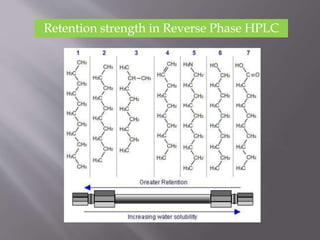
Retention strength in Reverse Phase HPLC
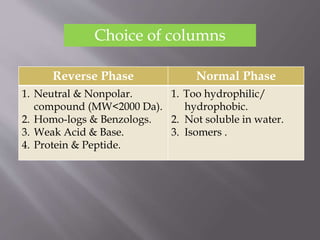
Reverse Phase Normal Phase
1. Neutral & Nonpolar.
compound (MW<2000 Da).
2. Homo-logs & Benzologs.
3. Weak Acid & Base.
4. Protein & Peptide.
1. Too hydrophilic/
hydrophobic.
2. Not soluble in water.
3. Isomers .
Choice of columns
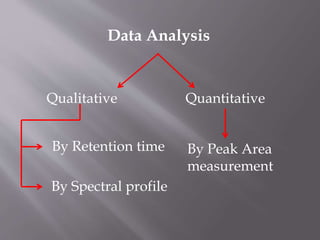
Data Analysis
Qualitative Quantitative
By Retention time
By Spectral profile
By Peak Area
measurement
Use of reference standards for peak identification
Use of spectral detectors
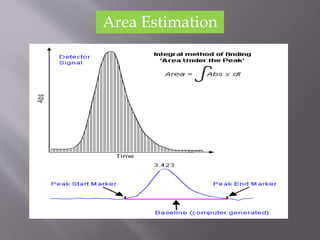
Area Estimation
Amount of analyte
Peak Area
Response Factor
Amount (Std.)
Response Factor
Peak Area (Std.)
Calculation
Std. Amount = 2,000 µg/ml
Std. Peak Area = 100,000
Analyte Peak Area = 57,000
Amount (analyte) = ?
Response Factor = 100,000/2,000 = 50
Amount (analyte) = 57,000/50 = 1,140 µg/ml
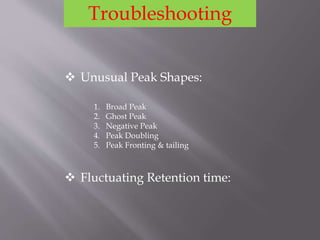
Troubleshooting
 Unusual Peak Shapes:
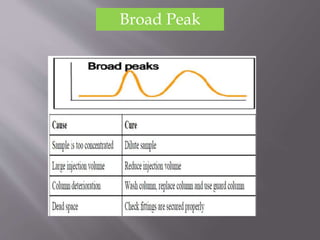
1. Broad Peak
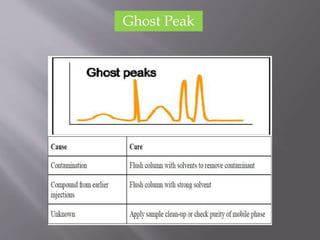
2. Ghost Peak
3. Negative Peak
4. Peak Doubling
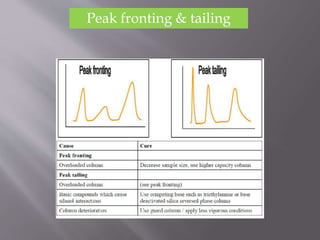
5. Peak Fronting & tailing
 Fluctuating Retention time:
Broad Peak
Ghost Peak
Negative peak
Peak doubling
Peak fronting & tailing
Fluctuating retention time
HPLC method development and  data analysis

HPLC method development and data analysis

  • 1.
  • 2.
    Molecular characteristics ofthe sample. Selection of Stationary phase & Mobile Phase Troubleshooting & Optimization Data Analysis: Qualitative & Quantitative. Steps for HPLC method development
  • 3.
    What are themolecular characteristics of the analyte or sample? CHASM 1. Charge Positive/negative 2. Hydrophobicity 3. Affinity “lock and key” sites 4. Solubility & stability pH, ionic strength, organic solvents 5. Molecular weight
  • 4.
    Bulk (SiO2)x Bulk(SiO2)xSurface Surface Selection of Stationary Phase Normal Phase Reverse Phase SurfaceBulk (SiO2)x Ion Exchange
  • 5.
    Normal Phase ReversePhase Ion Exchange Stationary Phase Polar Non polar Silica having functional group Mobile Phase Non polar (hexane,heptan) & slightly polar (isopropanol, ethylacetate) Polar (water, methanol, acetonitrile, tetrahydrofuran) Depending on analyte, may salt gradient or pH gradient Sample Movement Non polar fastest Polar fastest More cation/anion Separation based on Different polarities (functionality) Different hydrocarbon content Ion exchange. Selection of Mobile Phase
  • 6.
  • 7.
    Solvent used inReverse Phase HPLC
  • 8.
    Retention strength inReverse Phase HPLC
  • 9.
    Reverse Phase NormalPhase 1. Neutral & Nonpolar. compound (MW<2000 Da). 2. Homo-logs & Benzologs. 3. Weak Acid & Base. 4. Protein & Peptide. 1. Too hydrophilic/ hydrophobic. 2. Not soluble in water. 3. Isomers . Choice of columns
  • 10.
    Data Analysis Qualitative Quantitative ByRetention time By Spectral profile By Peak Area measurement
  • 11.
    Use of referencestandards for peak identification
  • 12.
    Use of spectraldetectors
  • 13.
  • 14.
    Amount of analyte PeakArea Response Factor Amount (Std.) Response Factor Peak Area (Std.) Calculation Std. Amount = 2,000 µg/ml Std. Peak Area = 100,000 Analyte Peak Area = 57,000 Amount (analyte) = ? Response Factor = 100,000/2,000 = 50 Amount (analyte) = 57,000/50 = 1,140 µg/ml
  • 15.
    Troubleshooting  Unusual PeakShapes: 1. Broad Peak 2. Ghost Peak 3. Negative Peak 4. Peak Doubling 5. Peak Fronting & tailing  Fluctuating Retention time:
  • 16.
  • 17.
  • 18.
  • 19.
  • 20.
  • 21.