
SCIENTIFIC PUBLISHING MODULES
1. Searching PubMed & Beyond
2. Saving & Organizing Your References
3. 4 Simple Steps to an effective literature review
4. Maintain Academic Integrity in Your Writing
5. Ensuring Article Discoverability and Attention
6. Journal Selection, Style, and Formatting
7. Submitting Your Manuscript
8. The Peer Review Process
9. How to Promote Your Article
GO BEYOND PUBMED
1. Using your library databases to identify relevant literature [Robin]
1. PubMed
2.Scopus
3.Web of Science
2. Tips for literature review searches using Scopus
 Define keywords
 Begin with a simple search
 Survey the latest publications
 Survey references
 Look at highly cited papers
 Survey citing articles
 Look for review papers (if there are any)

SAVE & ORGANIZE YOUR FINDINGS – IT MAKES A
DIFFERENCE!
Using reference managers to save, annotate, summarize and organize your
findings
** EndNote highlights – Barnaby Nicolas :
*** REfWorks – Barnaby Nicolas
*** Mendeley, Zotero and other social ref managers
Collect your annotations from each article and construct a summary per each
publication and ask yourself the following questions
 What is important in the selected article?
 Why should it be included in the literature review?
 How is it relevant to your findings / study framework
BEFORE YOU BEGIN
Define which literature review you need to write:
 What type of literature review am I conducting?
 Am I looking at issues of theory? methodology? policy? quantitative research?
What is the scope of my literature review?
 What types of publications am I using (e.g., journals, books, government
documents, popular media)?
 What discipline am I working in?
 Is this should be a selective or comprehensive review?
Why?
Because a well defined and scoped review will make it easier to find the right
resources and construct a good argument for your paper.
REVIEW YOUR FINDINGS
Once you searched and selected the resources that you would like to use
1. Critically analyze and summarize each one for better organization
2. Review your summaries and check if they answer the following questions:
 Do they capture the specific thesis, problem, or research question that
my literature review helps to define?
 How good was my information seeking? Has my search been wide enough
to ensure I've found all the relevant material?
 Have I critically analyzed the literature I use? Have I cited and discussed
studies contrary to my perspective?
 Will the reader find my literature review relevant, appropriate, and
useful?
CATEGORIZE YOUR FINDINGS
Organize the articles you deem important in logical groups and ask yourself
the following:
 Should I present prior findings / studies by year?
 Should I present prior findings / studies by methodology?
 Should I present prior findings by theme as they pertain to my study?
The answer depends on the type of review you are writing for example:
 A review article will benefit from a chronological presentation
 A methodological study will benefit from a review organized by methodologies
 An article describing the results of an experiment will benefit from a review
organized by themed findings by year
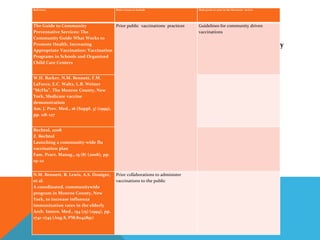
CREATE A SUMMARY TABLE
Create a separate document / table with the articles you found organized by
Groups
Reference Main reason to include Main point to note in the literature review
The Guide to Community
Preventative Services: The
Community Guide What Works to
Promote Health. Increasing
Appropriate Vaccination: Vaccination
Programs in Schools and Organized
Child Care Centers
Prior public vaccinations practices Guidelines for community driven
vaccinations
W.H. Barker, N.M. Bennett, F.M.
LaForce, E.C. Waltz, L.B. Weiner
“McFlu”. The Monroe County, New
York, Medicare vaccine
demonstration
Am. J. Prev. Med., 16 (Suppl. 3) (1999),
pp. 118–127
Bechtol, 2008
Z. Bechtol
Launching a community-wide flu
vaccination plan
Fam. Pract. Manag., 15 (8) (2008), pp.
19–22
N.M. Bennett, B. Lewis, A.S. Doniger,
et al.
A coordinated, communitywide
program in Monroe County, New
York, to increase influenza
immunization rates in the elderly
Arch. Intern. Med., 154 (15) (1994), pp.
1741–1745 (Aug 8, PM:8042891)
Prior collaborations to administer
vaccinations to the public
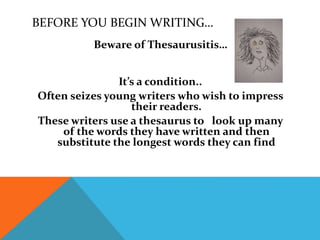
BEFORE YOU BEGIN WRITING…
Beware of Thesaurusitis…
It’s a condition..
Often seizes young writers who wish to impress
their readers.
These writers use a thesaurus to look up many
of the words they have written and then
substitute the longest words they can find
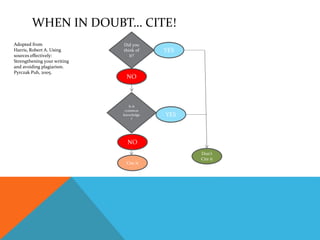
WHEN IN DOUBT… CITE!
Did you
think of
it?
YES
Don’t
Cite it
NO
Is it
common
knowledge
?
YES
NO
Cite it
Adopted from
Harris, Robert A. Using
sources effectively:
Strengthening your writing
and avoiding plagiarism.
Pyrczak Pub, 2005.
CHOOSING ONE OR MORE OF THE ACTIVITIES BELOW WILL
ENSURE YOUR WRITING INTEGRITY
Paraphrasing
Citing
Quoting
PARAPHRASING - EXPRESSING THE MEANING OF A WRITING IN
YOUR OWN WORDS
You should consider paraphrasing when you need to:
 Create an emphasis
 Simplify the material
 Clarify the material
Best ways to paraphrase
1. Read the source passage several times
2. Outline the passage
3. Rearrange the outline to align with your writing goal
4. Use the same number of words (more or less)
5. Make sure you preserve the meaning
CITING.. . YOU WILL WANT THAT FOR
YOURSELF
You have to cite someone else’s :
 Words you quote, summarize or paragraph
 Interpretation of ideas, opinions or conclusions
 Data, graphs, photographs, drawings,
 Experiment, methodologies, surveys or concepts
There are several citation styles that are used in the academic arena for example:
 APA
 MLA
 Chicago
** be familiar with the journal’s style and edit your document accordingly
QUOTING
If you use someone’s exact words, remember to quote them by using
quotation marks and referencing the source
You should use quotation when
 Embedding an expert declaration
 Reinforcing a point
 Giving a specific example
Don’t ..
 Use quotes too often – it will cloud your own ideas
 Quote one source too many times
 Use too long quotes
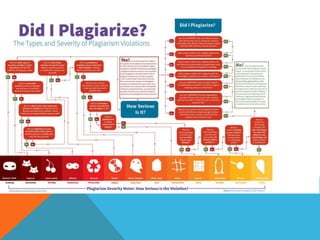
DID YOU KNOW YOU CAN PLAGIARIZE
YOURSELF?
It happens when
an author reuses portions of their previous writings in subsequent research papers.
Occasionally, the derived paper is simply a re-titled and reformatted version of
the original one, but more frequently it is assembled from bits and pieces of
previous work. (keble.ox.ac.uk)
It’s also called ‘self recycling
TOOLS TO HELP YOU CHECK YOUR TEXT INTEGRITY
iThenticate http://www.ithenticate.com/
Some Free tools
 Anti-Plagiarism
 DupliChecker
 PaperRater
 Plagiarisma.net
 PlagiarismChecker
WRITING A TITLE
Choose an effective title:
 Condenses the paper’s content in a few words
 Captures the readers’ attention - Differentiates the paper from other papers of
the same subject area
Tips to keep in mind while writing a title:
 Keep it simple, brief and attractive: The primary function of a title is to provide a
precise summary of the paper’s content. So keep the title brief and clear.
 Use active verbs instead of complex noun-based phrases, and avoid unnecessary
details.
 Keep the title to 10 to 12 words long. A lengthy title may seem unfocused and take
the readers’ attention away from an important point.
KEYWORDS- - THE KEY TO BEING DISCOVERED
Tips to choosing the right keywords for your paper:
 Read through your paper and list down the terms/phrases that are used
repeatedly in the text.
 Ensure that this list includes all your main key terms/phrases
 Include variants of a term/phrase (e.g., kidney and renal), drug names,
procedures, etc.
 Include common abbreviations of terms (e.g., HIV).
 Before you submit your article, type your keywords into a search engine and
check if the results that show up match the subject of your paper.
 Ensure that your title, abstract, and any images/graphics make use of
relevant keywords.
 Read similar articles and consult the keywords
MeSh on Demand http://www.nlm.nih.gov/mesh/MeSHonDemand.html
MeSH Browser http://www.nlm.nih.gov/mesh/mbinfo.html
WRITING A ‘MARKETABLE” ABSTRACT IN 5
SIMPLE STEPS
The abstract should work like a marketing tool: It should help the reader
decide “whether there is something in the body of the paper worth reading by providing
a quick and accurate summary of the entire paper explaining why the research was
conducted, what the aims were, how these were met, and what the main findings were.
 Pick out the major objectives/hypotheses and conclusions from your Introduction and
Conclusion sections.
 Select key sentences and phrases from your Methods section.
 Reveal your findings by listing the major results from your Results section.
 State a major implication of your findings
 Arrange the sentences and phrases selected in steps 2, 3, 4, and 5 into a single paragraph in
the following sequence: Introduction, Methods, Results, and Conclusions.
Make sure that this paragraph is self-contained
SELECTING THE RIGHT JOURNAL DEPENDS ON
YOUR GOAL
To get published quickly:
 Check the journal website for average peer review time, average speed of
publication and whether they offer online pre-publication option. If you cant
find any of this information, use the pre-submission inquiries process and send a
cover letter and abstract to the editor asking whether the journal will review your
article
To be published in the highest possible impact factor journal
 Check the journal website for its impact factor score and compare it to others in
your field
To reach the largest possible audience
 Check the open access options available, promotional tools offered and the
readership and circulation statistics if available
TIPS & TOOLS TO HELP YOU SELECT A
JOURNAL
Tips for selecting a journal:
 Look at the references you used – these journals are the closest to your area of study
 Examine the citations these articles received
 Perform a search on scientific databases using keywords that describe your study and examine
the journals they are published in
Tools to help you select a journal:
 Edanz Journal Selector =http://www.edanzediting.com/journal_selector
 PubMed Reminer http://hgserver2.amc.nl/cgi-bin/miner/miner2.cgi
 Journal Article Name Estimator (Jane) =http://www.biosemantics.org/jane/
 Cofactor Journal selector = http://cofactorscience.com/journal-selector
CONSULT THE JOURNAL WEBPAGE
 Scope & goals
 Before submitting an article make sure its goals and scope fit your publication
 Editorial board
 Familiarize yourself with the editorial board and make sure they have the
credentials stated
 Read previously published papers and see if your publication fits
 Preparing the article according to the guidelines saves time!
 Read the guidelines for authors – each journal publisher has different
formatting requirements.
 Journal style
 Formatting requirements
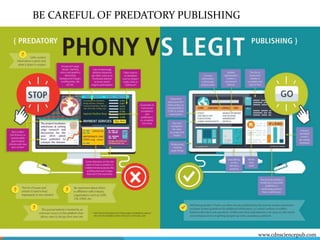
BE CAREFUL OF PREDATORY PUBLISHING
www.cdnsciencepub.com
PREPARING YOUR MANUSCRIPT
Using reference managers to help you format your bibliography – EndNote &
REFWORKS for bibliography management
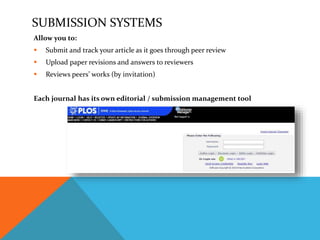
SUBMISSION SYSTEMS
Allow you to:
 Submit and track your article as it goes through peer review
 Upload paper revisions and answers to reviewers
 Reviews peers’ works (by invitation)
Each journal has its own editorial / submission management tool
TO MAKE SUBMISSION SMOOTHER
 Read the instructions carefully – some journals will ask you to submit tables
and figures separately from the main document for example
 Submit only to one journal at a time
 Write a cover letter to the editor – let the editor know:
 Title and name/s of the author/s
 Why you believe the article fits the scope of the journal
 Highlight some specific points to reinforce the novelty and significance of
the research
 Your hope that it will be accepted and say you look forward to the reviewers
comments
Be brief – cover letters should not be more than 4 short paragraphs
GET READY…
After the editor considers your manuscript for inclusion, he/she will send it
to a few reviewers. Then you should expect one of the following decisions
 Paper accepted – (lets get real… it almost never happens)
 Accepted Pending Minor Revisions
 These are usually minor edits and / or formatting
 Accepted Pending Major Revisions
 These usually include revisions to the datasets, methodology or major re-
writing
 Rejected
 This could be a result of major deficiencies in the article, poor writing or
out of scope for the journal
And most importantly …..
WHEN RESUBMITTING A REVISED DOCUMENT
 Address every comment raised by the editor or by the reviewers
 Correct, edit or rewrite any parts you were asked to
 Usually it is not a good idea to argue or be defensive unless it’s an obvious
mistake on their part
 Create a new document where you list the comment of the reviewer and
how you addressed it
 Do not waste time to figure out who your reviewers were
 Have your co-authors or peers review your revised article and give you
feedback or comments before resubmitting
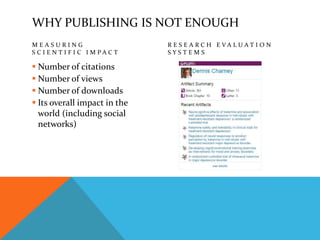
WHY PUBLISHING IS NOT ENOUGH
M E A S U R I N G
S C I E N T I F I C I M P A C T
 Number of citations
 Number of views
 Number of downloads
 Its overall impact in the
world (including social
networks)
R E S E A R C H E V A L U A T I O N
S Y S T E M S
STRATEGIES TO GET YOUR ARTICLE NOTICED
 Submit your paper to conferences – even as a poster!
 conferences organizers list presentations and posters online and those are
discoverable via search engines
 Use Publishers’ Email signature Tools
 Email signature
http://journalauthors.tandf.co.uk/beyondpublication/promotearticle.asp
 Consider Open access options
 Deposit to Repositories
 Between 50-80% of traffic to institutional repositories come from Google
(remember your keywords?)
WORK THE SOCIAL NETWORKS
 Twitter and Facebook: authors are increasingly promoting their content via Twitter and
Facebook so it can be picked up by other researchers and practitioners
 LinkedIn: If you have created a LinkedIn profile that summarizes your professional expertise and
accomplishments, why not include a mention of your articles?
 Join academic social networking sites such as Academia.edu, where you can also post details of
your publications.
 Discussion lists: post a short message to any discussion list.
 Blogs: if you blog, don't forget to inform other users about your article.
 Post presentation slides on Slideshare or Figshare
 YouTube: Consider producing a short video or audio recording in which you briefly outline the scope
of your paper.
THE IMPORTANCE OF PUBLIC PROFILES
Your academic and professional profiles help you promote you and your
Work
We recommend using ORCID since it’s directly linked and updates through
Scopus and PLUM Analytics
Contact us…

Principles of scientific publishing

  • 2.
    SCIENTIFIC PUBLISHING MODULES 1.Searching PubMed & Beyond 2. Saving & Organizing Your References 3. 4 Simple Steps to an effective literature review 4. Maintain Academic Integrity in Your Writing 5. Ensuring Article Discoverability and Attention 6. Journal Selection, Style, and Formatting 7. Submitting Your Manuscript 8. The Peer Review Process 9. How to Promote Your Article
  • 4.
    GO BEYOND PUBMED 1.Using your library databases to identify relevant literature [Robin] 1. PubMed 2.Scopus 3.Web of Science 2. Tips for literature review searches using Scopus  Define keywords  Begin with a simple search  Survey the latest publications  Survey references  Look at highly cited papers  Survey citing articles  Look for review papers (if there are any)
  • 6.
    SAVE & ORGANIZEYOUR FINDINGS – IT MAKES A DIFFERENCE! Using reference managers to save, annotate, summarize and organize your findings ** EndNote highlights – Barnaby Nicolas : *** REfWorks – Barnaby Nicolas *** Mendeley, Zotero and other social ref managers Collect your annotations from each article and construct a summary per each publication and ask yourself the following questions  What is important in the selected article?  Why should it be included in the literature review?  How is it relevant to your findings / study framework
  • 8.
    BEFORE YOU BEGIN Definewhich literature review you need to write:  What type of literature review am I conducting?  Am I looking at issues of theory? methodology? policy? quantitative research? What is the scope of my literature review?  What types of publications am I using (e.g., journals, books, government documents, popular media)?  What discipline am I working in?  Is this should be a selective or comprehensive review? Why? Because a well defined and scoped review will make it easier to find the right resources and construct a good argument for your paper.
  • 9.
    REVIEW YOUR FINDINGS Onceyou searched and selected the resources that you would like to use 1. Critically analyze and summarize each one for better organization 2. Review your summaries and check if they answer the following questions:  Do they capture the specific thesis, problem, or research question that my literature review helps to define?  How good was my information seeking? Has my search been wide enough to ensure I've found all the relevant material?  Have I critically analyzed the literature I use? Have I cited and discussed studies contrary to my perspective?  Will the reader find my literature review relevant, appropriate, and useful?
  • 10.
    CATEGORIZE YOUR FINDINGS Organizethe articles you deem important in logical groups and ask yourself the following:  Should I present prior findings / studies by year?  Should I present prior findings / studies by methodology?  Should I present prior findings by theme as they pertain to my study? The answer depends on the type of review you are writing for example:  A review article will benefit from a chronological presentation  A methodological study will benefit from a review organized by methodologies  An article describing the results of an experiment will benefit from a review organized by themed findings by year
  • 11.
    CREATE A SUMMARYTABLE Create a separate document / table with the articles you found organized by Groups Reference Main reason to include Main point to note in the literature review The Guide to Community Preventative Services: The Community Guide What Works to Promote Health. Increasing Appropriate Vaccination: Vaccination Programs in Schools and Organized Child Care Centers Prior public vaccinations practices Guidelines for community driven vaccinations W.H. Barker, N.M. Bennett, F.M. LaForce, E.C. Waltz, L.B. Weiner “McFlu”. The Monroe County, New York, Medicare vaccine demonstration Am. J. Prev. Med., 16 (Suppl. 3) (1999), pp. 118–127 Bechtol, 2008 Z. Bechtol Launching a community-wide flu vaccination plan Fam. Pract. Manag., 15 (8) (2008), pp. 19–22 N.M. Bennett, B. Lewis, A.S. Doniger, et al. A coordinated, communitywide program in Monroe County, New York, to increase influenza immunization rates in the elderly Arch. Intern. Med., 154 (15) (1994), pp. 1741–1745 (Aug 8, PM:8042891) Prior collaborations to administer vaccinations to the public
  • 12.
    BEFORE YOU BEGINWRITING… Beware of Thesaurusitis… It’s a condition.. Often seizes young writers who wish to impress their readers. These writers use a thesaurus to look up many of the words they have written and then substitute the longest words they can find
  • 14.
    WHEN IN DOUBT…CITE! Did you think of it? YES Don’t Cite it NO Is it common knowledge ? YES NO Cite it Adopted from Harris, Robert A. Using sources effectively: Strengthening your writing and avoiding plagiarism. Pyrczak Pub, 2005.
  • 15.
    CHOOSING ONE ORMORE OF THE ACTIVITIES BELOW WILL ENSURE YOUR WRITING INTEGRITY Paraphrasing Citing Quoting
  • 16.
    PARAPHRASING - EXPRESSINGTHE MEANING OF A WRITING IN YOUR OWN WORDS You should consider paraphrasing when you need to:  Create an emphasis  Simplify the material  Clarify the material Best ways to paraphrase 1. Read the source passage several times 2. Outline the passage 3. Rearrange the outline to align with your writing goal 4. Use the same number of words (more or less) 5. Make sure you preserve the meaning
  • 17.
    CITING.. . YOUWILL WANT THAT FOR YOURSELF You have to cite someone else’s :  Words you quote, summarize or paragraph  Interpretation of ideas, opinions or conclusions  Data, graphs, photographs, drawings,  Experiment, methodologies, surveys or concepts There are several citation styles that are used in the academic arena for example:  APA  MLA  Chicago ** be familiar with the journal’s style and edit your document accordingly
  • 18.
    QUOTING If you usesomeone’s exact words, remember to quote them by using quotation marks and referencing the source You should use quotation when  Embedding an expert declaration  Reinforcing a point  Giving a specific example Don’t ..  Use quotes too often – it will cloud your own ideas  Quote one source too many times  Use too long quotes
  • 19.
    DID YOU KNOWYOU CAN PLAGIARIZE YOURSELF? It happens when an author reuses portions of their previous writings in subsequent research papers. Occasionally, the derived paper is simply a re-titled and reformatted version of the original one, but more frequently it is assembled from bits and pieces of previous work. (keble.ox.ac.uk) It’s also called ‘self recycling
  • 21.
    TOOLS TO HELPYOU CHECK YOUR TEXT INTEGRITY iThenticate http://www.ithenticate.com/ Some Free tools  Anti-Plagiarism  DupliChecker  PaperRater  Plagiarisma.net  PlagiarismChecker
  • 23.
    WRITING A TITLE Choosean effective title:  Condenses the paper’s content in a few words  Captures the readers’ attention - Differentiates the paper from other papers of the same subject area Tips to keep in mind while writing a title:  Keep it simple, brief and attractive: The primary function of a title is to provide a precise summary of the paper’s content. So keep the title brief and clear.  Use active verbs instead of complex noun-based phrases, and avoid unnecessary details.  Keep the title to 10 to 12 words long. A lengthy title may seem unfocused and take the readers’ attention away from an important point.
  • 24.
    KEYWORDS- - THEKEY TO BEING DISCOVERED Tips to choosing the right keywords for your paper:  Read through your paper and list down the terms/phrases that are used repeatedly in the text.  Ensure that this list includes all your main key terms/phrases  Include variants of a term/phrase (e.g., kidney and renal), drug names, procedures, etc.  Include common abbreviations of terms (e.g., HIV).  Before you submit your article, type your keywords into a search engine and check if the results that show up match the subject of your paper.  Ensure that your title, abstract, and any images/graphics make use of relevant keywords.  Read similar articles and consult the keywords MeSh on Demand http://www.nlm.nih.gov/mesh/MeSHonDemand.html MeSH Browser http://www.nlm.nih.gov/mesh/mbinfo.html
  • 25.
    WRITING A ‘MARKETABLE”ABSTRACT IN 5 SIMPLE STEPS The abstract should work like a marketing tool: It should help the reader decide “whether there is something in the body of the paper worth reading by providing a quick and accurate summary of the entire paper explaining why the research was conducted, what the aims were, how these were met, and what the main findings were.  Pick out the major objectives/hypotheses and conclusions from your Introduction and Conclusion sections.  Select key sentences and phrases from your Methods section.  Reveal your findings by listing the major results from your Results section.  State a major implication of your findings  Arrange the sentences and phrases selected in steps 2, 3, 4, and 5 into a single paragraph in the following sequence: Introduction, Methods, Results, and Conclusions. Make sure that this paragraph is self-contained
  • 27.
    SELECTING THE RIGHTJOURNAL DEPENDS ON YOUR GOAL To get published quickly:  Check the journal website for average peer review time, average speed of publication and whether they offer online pre-publication option. If you cant find any of this information, use the pre-submission inquiries process and send a cover letter and abstract to the editor asking whether the journal will review your article To be published in the highest possible impact factor journal  Check the journal website for its impact factor score and compare it to others in your field To reach the largest possible audience  Check the open access options available, promotional tools offered and the readership and circulation statistics if available
  • 28.
    TIPS & TOOLSTO HELP YOU SELECT A JOURNAL Tips for selecting a journal:  Look at the references you used – these journals are the closest to your area of study  Examine the citations these articles received  Perform a search on scientific databases using keywords that describe your study and examine the journals they are published in Tools to help you select a journal:  Edanz Journal Selector =http://www.edanzediting.com/journal_selector  PubMed Reminer http://hgserver2.amc.nl/cgi-bin/miner/miner2.cgi  Journal Article Name Estimator (Jane) =http://www.biosemantics.org/jane/  Cofactor Journal selector = http://cofactorscience.com/journal-selector
  • 29.
    CONSULT THE JOURNALWEBPAGE  Scope & goals  Before submitting an article make sure its goals and scope fit your publication  Editorial board  Familiarize yourself with the editorial board and make sure they have the credentials stated  Read previously published papers and see if your publication fits  Preparing the article according to the guidelines saves time!  Read the guidelines for authors – each journal publisher has different formatting requirements.  Journal style  Formatting requirements
  • 30.
    BE CAREFUL OFPREDATORY PUBLISHING www.cdnsciencepub.com
  • 31.
    PREPARING YOUR MANUSCRIPT Usingreference managers to help you format your bibliography – EndNote & REFWORKS for bibliography management
  • 33.
    SUBMISSION SYSTEMS Allow youto:  Submit and track your article as it goes through peer review  Upload paper revisions and answers to reviewers  Reviews peers’ works (by invitation) Each journal has its own editorial / submission management tool
  • 34.
    TO MAKE SUBMISSIONSMOOTHER  Read the instructions carefully – some journals will ask you to submit tables and figures separately from the main document for example  Submit only to one journal at a time  Write a cover letter to the editor – let the editor know:  Title and name/s of the author/s  Why you believe the article fits the scope of the journal  Highlight some specific points to reinforce the novelty and significance of the research  Your hope that it will be accepted and say you look forward to the reviewers comments Be brief – cover letters should not be more than 4 short paragraphs
  • 36.
    GET READY… After theeditor considers your manuscript for inclusion, he/she will send it to a few reviewers. Then you should expect one of the following decisions  Paper accepted – (lets get real… it almost never happens)  Accepted Pending Minor Revisions  These are usually minor edits and / or formatting  Accepted Pending Major Revisions  These usually include revisions to the datasets, methodology or major re- writing  Rejected  This could be a result of major deficiencies in the article, poor writing or out of scope for the journal And most importantly …..
  • 37.
    WHEN RESUBMITTING AREVISED DOCUMENT  Address every comment raised by the editor or by the reviewers  Correct, edit or rewrite any parts you were asked to  Usually it is not a good idea to argue or be defensive unless it’s an obvious mistake on their part  Create a new document where you list the comment of the reviewer and how you addressed it  Do not waste time to figure out who your reviewers were  Have your co-authors or peers review your revised article and give you feedback or comments before resubmitting
  • 39.
    WHY PUBLISHING ISNOT ENOUGH M E A S U R I N G S C I E N T I F I C I M P A C T  Number of citations  Number of views  Number of downloads  Its overall impact in the world (including social networks) R E S E A R C H E V A L U A T I O N S Y S T E M S
  • 40.
    STRATEGIES TO GETYOUR ARTICLE NOTICED  Submit your paper to conferences – even as a poster!  conferences organizers list presentations and posters online and those are discoverable via search engines  Use Publishers’ Email signature Tools  Email signature http://journalauthors.tandf.co.uk/beyondpublication/promotearticle.asp  Consider Open access options  Deposit to Repositories  Between 50-80% of traffic to institutional repositories come from Google (remember your keywords?)
  • 41.
    WORK THE SOCIALNETWORKS  Twitter and Facebook: authors are increasingly promoting their content via Twitter and Facebook so it can be picked up by other researchers and practitioners  LinkedIn: If you have created a LinkedIn profile that summarizes your professional expertise and accomplishments, why not include a mention of your articles?  Join academic social networking sites such as Academia.edu, where you can also post details of your publications.  Discussion lists: post a short message to any discussion list.  Blogs: if you blog, don't forget to inform other users about your article.  Post presentation slides on Slideshare or Figshare  YouTube: Consider producing a short video or audio recording in which you briefly outline the scope of your paper.
  • 42.
    THE IMPORTANCE OFPUBLIC PROFILES Your academic and professional profiles help you promote you and your Work We recommend using ORCID since it’s directly linked and updates through Scopus and PLUM Analytics
  • 43.

Editor's Notes

  • #5 Scopus, WOS and PubMed quick demo: hand out page 5 – Robin Searching Saving lists Exporting to EndNote
  • #7 Handout – endnote, refworks, mendeley – Exrecises - Barnaby
  • #9 Handout – good/bad literature review. Pages 2-4 Exercise – customize – article selection and literature review / introduction analysis RACHEL TO RE-WORK
  • #10 Handout – writing scientific research articles pages 44-45
  • #12 Handout – writing scientific research articles – page 53
  • #13 Using sources effectively - Page 78
  • #14 Handout: open access plagiarism guide
  • #15 Handout – what is common knowledge – page 85-86
  • #17 Page 64 Hand out – using resources effectively - examples page 65-66
  • #18 Handout – examples – using resources effectively - page 98-100 (link back to reference managers if module is used alone)
  • #19 Handout quoting strategies – using resources effectively - page 50-53
  • #20 Handout – did I plagiarize in next slide
  • #21 Handout – chapter 5 review page 79
  • #22 Exercise – try one of these tools
  • #24 Handout– page 8 – word doc Exercise – provide blind abstracts and write titles reveal real titles
  • #25 Demo – activity tools to help you identify the right keywords Handout -scientific writing and communications Hoffman Pages 330-334 Exercise – same abstracts to be used in the tools and reveal real keywords
  • #26 Handout - The abstract checklist + exercise Scientific writing and communications Hoffman page 321-324
  • #29 Demo / activity - try one of these tools
  • #30 Activity : select a journal, find the home page and go over the guidelines for authors
  • #31 Hand out – phony vs legit
  • #32 Exercise – conduct a short search Export citations to endnote / reworks – Barnaby Create bibliography
  • #34 Activity – create an account on a submission management tool
  • #35 Hand out - Examples of cover letters – scientific writing and communications pages 348-349
  • #38 Handout – examples of responses. Scientific writing pages 352-354
  • #42 Demo – we will create a user profile on PLUM using a few of these media and public profiles
  • #43 Demo – we will create a user profile on PLUM using a few of these media and public profiles