Model – B.Tech./M. Tech./Ph.D.
Thesis
Dr. Basavaraju Manu
Associate Professor
Department of Civil Engineering,
NITK, Surathkal
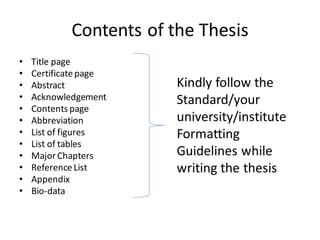
Contents of the Thesis
• Title page
• Certificatepage
• Abstract
• Acknowledgement
• Contentspage
• Abbreviation
• List of figures
• List of tables
• MajorChapters
• ReferenceList
• Appendix
• Bio-data
Kindly follow the
Standard/your
university/institute
Formatting
Guidelines while
writing the thesis
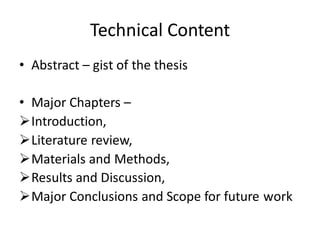
Technical Content
• Abstract – gist of the thesis
• Major Chapters –
Introduction,
Literature review,
Materials and Methods,
Results and Discussion,
Major Conclusions and Scope for future work
Abstract
• What is the problem
• What others have done to solve the problem
• What and how you have tried to solve the
problem
• What are the major outcomes of the present
study and under what conditions they were
observed.
• Your comments on your study
Major Chapters - Introduction
• Need / Background of the present study
• Objective/s and Scope of the present work
• Organisation of the thesis
Major Chapters – Literature Review
• Problem – description, india, global, facts, figures,
tables,
• State-of-the-artliterature on how to solve the
problem
• Outcome of the literature review –
Helps to fix the objectiveand scope of the
presentstudy
Major Chapters – Materials and
Methods
• Materials – Analytical/laboratory grade chemicals and
their list. Source/Procurementof other materials
• Experimental Methodology – Details of the
experimental procedure, environmental conditions
(pH, temperature, dosage, etc.), photographs/line
diagram of the experimental setup, materials, etc.
• Analytical procedure – Standard Methods and
procedure analyse variuos parameters – pH,
COD/BOD,cations, anions, pollutants, etc.
Major Chapters – Results and
Discussion
• Heart and Soul of the thesis
• Presentation and discussion of results in
figures or tables.
• Discussion of results amongst your results
obtained under various experimental
conditions.
• Discussion of results with the published
literature/studies (comparing apples to apples
but not apples to oranges)
Major Chapters – Major Conclusions of the
Present Study and Scope for Future Works
• Major conclusions of the present study
 3-4 major results of their values and descriptionof the
same.
 Your thoughts and comments on the above obtained
results.
• Scope for future work
 2-3 related and realistic experimental work
 Pilot scale studies, actual water/wastewatersamples
List of Reference
• Standard format or prescribedformat
• Journal (SCI/ESCI indexed) papers of 8-10 years
old.
• Conferenceproceedings of repute
• Books
• Standards
• Encylopaedia
• Newspapers/website(author,date on which
visited or read)
Appendix
• Supporting tables and figures derived from
the anaylsis not carried out by you directly but
done for your samples.
• 2-3 appendices
Bio-Data
• Personal information (name, date of birth,
father’s name, Permanent address, etc)
• Educational qualification
• Achievements (Academic, co-curricular, etc.)

How to write an excellent outstanding b.tech., m.tech. and ph.d. thesis

  • 1.
    Model – B.Tech./M.Tech./Ph.D. Thesis Dr. Basavaraju Manu Associate Professor Department of Civil Engineering, NITK, Surathkal
  • 2.
    Contents of theThesis • Title page • Certificatepage • Abstract • Acknowledgement • Contentspage • Abbreviation • List of figures • List of tables • MajorChapters • ReferenceList • Appendix • Bio-data Kindly follow the Standard/your university/institute Formatting Guidelines while writing the thesis
  • 3.
    Technical Content • Abstract– gist of the thesis • Major Chapters – Introduction, Literature review, Materials and Methods, Results and Discussion, Major Conclusions and Scope for future work
  • 4.
    Abstract • What isthe problem • What others have done to solve the problem • What and how you have tried to solve the problem • What are the major outcomes of the present study and under what conditions they were observed. • Your comments on your study
  • 5.
    Major Chapters -Introduction • Need / Background of the present study • Objective/s and Scope of the present work • Organisation of the thesis
  • 6.
    Major Chapters –Literature Review • Problem – description, india, global, facts, figures, tables, • State-of-the-artliterature on how to solve the problem • Outcome of the literature review – Helps to fix the objectiveand scope of the presentstudy
  • 7.
    Major Chapters –Materials and Methods • Materials – Analytical/laboratory grade chemicals and their list. Source/Procurementof other materials • Experimental Methodology – Details of the experimental procedure, environmental conditions (pH, temperature, dosage, etc.), photographs/line diagram of the experimental setup, materials, etc. • Analytical procedure – Standard Methods and procedure analyse variuos parameters – pH, COD/BOD,cations, anions, pollutants, etc.
  • 8.
    Major Chapters –Results and Discussion • Heart and Soul of the thesis • Presentation and discussion of results in figures or tables. • Discussion of results amongst your results obtained under various experimental conditions. • Discussion of results with the published literature/studies (comparing apples to apples but not apples to oranges)
  • 9.
    Major Chapters –Major Conclusions of the Present Study and Scope for Future Works • Major conclusions of the present study  3-4 major results of their values and descriptionof the same.  Your thoughts and comments on the above obtained results. • Scope for future work  2-3 related and realistic experimental work  Pilot scale studies, actual water/wastewatersamples
  • 10.
    List of Reference •Standard format or prescribedformat • Journal (SCI/ESCI indexed) papers of 8-10 years old. • Conferenceproceedings of repute • Books • Standards • Encylopaedia • Newspapers/website(author,date on which visited or read)
  • 11.
    Appendix • Supporting tablesand figures derived from the anaylsis not carried out by you directly but done for your samples. • 2-3 appendices
  • 12.
    Bio-Data • Personal information(name, date of birth, father’s name, Permanent address, etc) • Educational qualification • Achievements (Academic, co-curricular, etc.)