Running Head: Title
1
Title
3
Title
Name
SCI 207: Dependence of man on the environment
Instructor
Date
*This template will provide you with the details necessary to
finalize a quality Final Lab Report. Utilize this template to
complete the Week 5 Final Lab Report and ensure that you are
providing all of the necessary information and proper format for
the assignment. Before you begin, please note the following
important information:
1. Carefully review the Final Lab Report instructions before you
begin this assignment.
2. The Final Lab Report should cover all 3 experiments from
your Week Two Lab.
3. Review instructor feedback from the Week Three outline of
the Final Lab Report and make changes as necessary.
4. Review the Sample Final Lab Report for an example of a
final product on a different topic. Your format should look like
this sample report before submission.
5. Run your Final Lab Report through Turnitin using the student
folder to ensure protection from accidental plagiarism
Title
Abstract
The abstract should provide a brief summary of the methods,
results, and conclusions. It should very briefly allow the reader
to see what was done, how it was done, and the results. It
should not exceed 200 words and should be the last part written
(although it should still appear right after the title page).
Introduction
The introduction should describe the background of water
quality and related issues using cited examples. You should
include scholarly sources in this section to help explain why
water quality research is important to society. When writing
this section, make sure to cite all resources in APA format.
The introduction should also contain the objective for your
study. This objective is the reason why the experiment is being
done. Your final report should provide an objective that
describes why we want to know the answer to the questions we
are asking.
Finally, the introduction should end with your hypotheses. This
section should include a hypothesis for each one of the three
experiments. These hypotheses should be the same ones posed
before you began your experiments. You may reword them
following feedback from your instructor to illustrate a proper
hypothesis, however, you should not adjust them to reflect the
“right” answer. You do not lose points for an inaccurate
hypothesis; scientists often revise their hypotheses based on
scientific evidence following an experiment.
Materials and Methods
The materials and methods section should provide a brief
description of the specialized materials used in your experiment
and how they were used. This section needs to summarize the
instructions with enough detail so that an outsider who does not
have a copy of the lab instructions knows what you did.
However, this does not mean writing every little step like “dip
the pH test strip in the water, then shake the test strips,” these
steps can be simplified to read “we used pH test strips to
measure water pH”, etc. Additionally, this section should be
written in the past tense and in your own words and not copied
and pasted from the lab manual.
Results
The results section should include all tables used in your
experiments. All values within the tables or graphs should be in
numerical form and contain units. For instance, if measuring
the amount of chloride in water you should report as 2 mg/L or
0 mg/L, not as two or none.
The results section should also highlight the important results in
paragraph form, referring to the appropriate tables when
mentioned. This section should only state the results as no
personal opinions should be included. A description of what the
results really mean should be saved for the discussion. For
example, you may report, 0mg/L of chlorine were found in the
water, but should avoid personal opinions and interpretations of
the data (e.g., “No chlorine was found in the water showing it is
cleaner than the others samples”).
Discussion
The discussion section should interpret your data and provide
conclusions. Start by discussing if each hypothesis was
confirmed or denied and how you know this.
The discussion should also relate your results to the bigger
water concerns and challenges. For example, based on your
experiments you might discuss how various bottled water
companies use different filtrations systems. Or, you could
discuss the billion dollar bottled water industry. For example,
do you think it is worth it to buy bottled water? Why or why
not? Your final lab report should utilize resources to put your
results into context.
Finally, the results section should also address any possible
factors that affected your results, such as possible
contamination in the experiments or any outside factors (e.g.,
temperature, contaminants, time of day) that affected your
results? If so, how could you control for these in the future?
You should also propose some new questions that have arisen
from your results and what kind of experiment might be
proposed to answer these questions.
Conclusions
The conclusion section should briefly summarize the key points
of your experiments. What main message would you like
people to have from this report?
References
Include at least four scholarly references and your lab manual in
APA format.
Name:
Date:
Instructor’s Name:
Assignment: SCIE211 Phase 5 Lab Report
Title: Identifying Environmental Hazards
Instructions: You will write a 1-page lab report using the
scientific method to answer the following questions:
· Why do you see increases and decreases in the invasive
species population?
· What are the implications associated with these alterations to
the ecosystem as a whole?
When your lab report is complete, post it in Submitted
Assignment files.
Part I: Using the lab animation, fill in the data table below to
help you generate your hypothesis, outcomes, and analysis.
Years
Zebra and Quagga Mussel (density/m2)
Phytoplankton (µg/ml)
Zooplankton (µg/ml)
Cladophora Biomass (g/m2)
Foraging Fish (kilotons)
Lake Trout (kilotons)
0
100
3
2
10
150
15
4
1,000
2.5
1
100
100
10
7
2,500
2
0.5
200
80
8
10
7,500
1.5
0.25
600
50
5
13
15,000
1
0.1
700
25
2.5
15
7,500
1.5
0.2
243
40
4
20
5,000
1.75
0.4
136
60
6
Part II: Write a 1-page lab report using the following scientific
method sections:
· Purpose
· State the purpose of the lab.
· Introduction
· This is an investigation of what is currently known about the
question being asked. Use background information from
credible references to write a short summary about concepts in
the lab. List and cite references in APA style.
· Hypothesis/Predicted Outcome
· A hypothesis is an educated guess. Based on what you have
learned and written about in the Introduction, state what you
expect to be the results of the lab procedures.
· Methods
· Summarize the procedures that you used in the lab. The
Methods section should also state clearly how data (numbers)
were collected during the lab; this will be reported in the
Results/Outcome section.
· Results/Outcome
· Provide here any results or data that were generated while
doing the lab procedure.
· Discussion/Analysis
· In this section, state clearly whether you obtained the expected
results, and if the outcome was as expected.
· Note: You can use the lab data to help you discuss the results
and what you learned.
Provide references in APA format. This includes a reference list
and in-text citations for references used in the Introduction
section.
Give your paper a title and number, and identify each section as
specified above. Although the hypothesis will be a 1-sentence
answer, the other sections will need to be paragraphs to
adequately explain your experiment.
When your lab report is complete, post it in Submitted
Assignment files.
Running Head: SAMPLE FINAL LAB REPORT 1
Sample Lab Report (The Optimal Foraging Theory)
Name
SCI 207 Dependence of Man on the Environment
Instructor
Date
SAMPLE FINAL LAB REPORT 2
Sample Lab Report
Abstract
The theory of optimal foraging and its relation to
central foraging was examined by using
the beaver as a model. Beaver food choice was examined by
noting the species of woody
vegetation, status (chewed vs. not-chewed), distance from the
water, and circumference of trees
near a beaver pond in North Carolina. Beavers avoided certain
species of trees and preferred
trees that were close to the water. No preference for tree
circumference was noted. These data
suggest that beaver food choice concurs with the optimal
foraging theory.
Introduction
In this lab, we explore the theory of optimal foraging and the
theory of central place
foraging using beavers as the model animal. Foraging refers to
the mammalian behavior
associated with searching for food. The optimal foraging theory
assumes that animals feed in a
way that maximizes their net rate of energy intake per unit time
(Pyke et al., 1977). An animal
may either maximize its daily energy intake (energy maximizer)
or minimize the time spent
feeding (time minimizer) in order to meet minimum
requirements. Herbivores commonly behave
as energy maximizers (Belovsky, 1986) and accomplish this
maximizing behavior by choosing
food that is of high quality and has low-search and low-
handling time (Pyke et al., 1977).
The central place theory is used to describe animals that
collect food and store it in a
fixed location in their home range, the central place (Jenkins,
1980). The factors associated with
the optimal foraging theory also apply to the central place
theory. The central place theory
predicts that retrieval costs increase linearly with distance of
the resource from the central place
SAMPLE FINAL LAB REPORT 3
(Rockwood and Hubbell, 1987). Central place feeders are very
selective when choosing food
that is far from the central place since they have to spend time
and energy hauling it back to the
storage site (Schoener, 1979).
The main objective of this lab was to determine beaver
(Castor canadensis) food selection
based on tree species, size, and distance. Since beavers are
energy maximizers (Jenkins, 1980;
Belovsky, 1984) and central place feeders (McGinley &
Whitam, 1985), they make an excellent
test animal for the optimal foraging theory. Beavers eat several
kinds of herbaceous plants as
well as the leaves, twigs, and bark of most species of woody
plants that grow near water (Jenkins
& Busher, 1979). By examining the trees that are chewed or
not-chewed in the beavers' home
range, an accurate assessment of food preferences among tree
species may be gained (Jenkins,
1975). The purpose of this lab was to learn about the optimal
foraging theory. We wanted to
know if beavers put the optimal foraging theory into action
when selecting food.
We hypothesized that the beavers in this study will
choose trees that are small in
circumference and closest to the water. Since the energy yield
of tree species may vary
significantly, we also hypothesized that beavers will show a
preference for some species of trees
over others regardless of circumference size or distance from
the central area. The optimal
foraging theory and central place theory lead us to predict that
beavers, like most herbivores,
will maximize their net rate of energy intake per unit time. In
order to maximize energy, beavers
will choose trees that are closest to their central place (the
water) and require the least retrieval
cost. Since beavers are trying to maximize energy, we
hypothesized that they will tend to select
some species of trees over others on the basis of nutritional
value.
Methods
This study was conducted at Yates Mill Pond, a research area
owned by the North
SAMPLE FINAL LAB REPORT 4
Carolina State University, on October 25th, 1996. Our research
area was located along the edge
of the pond and was approximately 100 m in length and 28 m in
width. There was no beaver
activity observed beyond this width. The circumference, the
species, status (chewed or not-
chewed), and distance from the water were recorded for each
tree in the study area. Due to the
large number of trees sampled, the work was evenly divided
among four groups of students
working in quadrants. Each group contributed to the overall
data collected.
We conducted a chi-squared test to analyze the data with
respect to beaver selection of
certain tree species. We conducted t-tests to determine (1) if
avoided trees were significantly
farther from the water than selected trees, and (2) if chewed
trees were significantly larger or
smaller than not chewed trees. Mean tree distance from the
water and mean tree circumference
were also recorded.
Results
SAMPLE FINAL LAB REPORT 5
Overall, beavers showed a preference for certain species of
trees, and their preference
was based on distance from the central place. Measurements
taken at the study site show that
SAMPLE FINAL LAB REPORT 6
beavers avoided oaks and musclewood (Fig. 1) and show a
significant food preference. No
avoidance or particular preference was observed for the other
tree species. The mean distance of
8.42 m away from the water for not-chewed trees was
significantly greater than the mean
distance of 6.13 m for chewed trees (Fig. 2). The tree species
that were avoided were not
significantly farther from the water than selected trees. For the
selected tree species, no
significant difference in circumference was found between trees
that were not chewed
(mean=16.03 cm) and chewed (mean=12.80 cm) (Fig. 3).
Discussion
Although beavers are described as generalized herbivores, the
finding in this study
related to species selection suggests that beavers are selective
in their food choice. This finding
agrees with our hypothesis that beavers are likely to show a
preference for certain tree species.
Although beaver selection of certain species of trees may be
related to the nutritional value,
additional information is needed to determine why beavers
select some tree species over others.
Other studies suggested that beavers avoid trees that have
chemical defenses that make the tree
unpalatable to beavers (Muller-Schawarze et al., 1994). These
studies also suggested that
beavers prefer trees with soft wood, which could possibly
explain the observed avoidance of
musclewood and oak in our study.
The result that chewed trees were closer to the water accounts
for the time and energy
spent gathering and hauling. This is in accordance with the
optimal foraging theory and agrees
with our hypothesis that beavers will choose trees that are close
to the water. As distance from
the water increases, a tree's net energy yield decreases because
food that is farther away is more
likely to increase search and retrieval time. This finding is
similar to Belovskyís finding of an
SAMPLE FINAL LAB REPORT 7
inverse relationship between distance from the water and
percentage of plants cut.
The lack of any observed difference in mean circumference
between chewed and not
chewed trees does not agree with our hypothesis that beavers
will prefer smaller trees to larger
ones. Our hypothesis was based on the idea that branches from
smaller trees will require less
energy to cut and haul than those from larger trees. Our finding
is in accordance with other
studies (Schoener, 1979), which have suggested that the value
of all trees should decrease with
distance from the water but that beavers would benefit from
choosing large branches from large
trees at all distances. This would explain why there was no
significant difference in
circumference between chewed and not-chewed trees.
This lab gave us the opportunity to observe how a specific
mammal selects foods that
maximize energy gains in accordance with the optimal foraging
theory. Although beavers adhere
to the optimal foraging theory, without additional information
on relative nutritional value of
tree species and the time and energy costs of cutting certain tree
species, no optimal diet
predictions may be made. Other information is also needed
about predatory risk and its role in
food selection. Also, due to the large number of students taking
samples in the field, there may
have been errors which may have affected the accuracy and
precision of our measurements. In
order to corroborate our findings, we suggest that this study be
repeated by others.
Conclusion
The purpose of this lab was to learn about the optimal foraging
theory by measuring tree
selection in beavers. We now know that the optimal foraging
theory allows us to predict food-
seeking behavior in beavers with respect to distance from their
central place and, to a certain
extent, to variations in tree species. We also learned that
foraging behaviors and food selection is
SAMPLE FINAL LAB REPORT 8
not always straightforward. For instance, beavers selected large
branches at any distance from
the water even though cutting large branches may increase
energy requirements. There seems to
be a fine line between energy intake and energy expenditure in
beavers that is not so easily
predicted by any given theory.
SAMPLE FINAL LAB REPORT 9
References
Belovsky, G.E. (1984). Summer diet optimization by beaver.
The American Midland Naturalist.
111: 209-222.
Belovsky, G.E. (1986). Optimal foraging and community
structure: implications for a guild of
generalist grassland herbivores. Oecologia. 70: 35-52.
Jenkins, S.H. (1975). Food selection by beavers:› a
multidimensional contingency table analysis.
Oecologia. 21: 157-173.
Jenkins, S.H. (1980). A size-distance relation in food selection
by beavers. Ecology. 61: 740-
746.
Jenkins, S.H., & P.E. Busher. (1979). Castor canadensis.
Mammalian Species. 120: 1-8.
McGinly, M.A., & T.G. Whitham. (1985). Central place
foraging by beavers (Castor
Canadensis): a test of foraging predictions and the
impact of selective feeding on the
growth form of cottonwoods (Populus fremontii).
Oecologia. 66: 558-562.
Muller-Schwarze, B.A. Schulte, L. Sun, A. Muller-Schhwarze,
& C. Muller-Schwarze. (1994).
Red Maple (Acer rubrum) inhibits feeding behavior by
beaver (Castor canadensis).
Journal of Chemical Ecology. 20: 2021-2033.
Pyke, G.H., H.R. Pulliman, E.L. Charnov. (1977). Optimal
foraging. The Quarterly Review of
Biology. 52: 137-154.
Rockwood, L.L., & S.P. Hubbell. (1987). Host-plant selection,
diet diversity, and optimal
foraging in a tropical leaf-cutting ant. Oecologia. 74:
55-61.
Schoener, T.W. (1979). Generality of the size-distance relation
in models of optimal feeding.
The American Naturalist. 114: 902-912.
SAMPLE FINAL LAB REPORT 10
*Note: This document was modified from the work of Selena
Bauer, Miriam Ferzli, and Vanessa
Sorensen, NCSU.
Environmental Science Table of Contents
21
Lab 2
Water Quality and Contamination
Concepts to Explore
• Usable water
• Ground water
• Surface water
• Ground water contaminates
• Water treatment
• Drinking water quality
Figure 1: At any given moment, 97% of the planet’s water is in
the oceans. Only a small fraction
of the remaining freshwater is usable by humans, underscoring
the importance of treating our
water supplies with care.
Introduction
It is no secret that water is one of the most valuable resources
on planet Earth. Every plant and animal re-
quires water to survive, not only for drinking, but also for food
production, shelter creation and many other ne-
cessities. Water has also played a major role in transforming the
earth’s surface into the varied topography we
see today.
While more than 70% of our planet is covered in water, only a
small percent of this water is usable freshwater.
The other 99% of the water is composed primarily of salt water,
with a small percentage being composed of
23
Water Quality and Contamination
glaciers. Due to the high costs involved in transforming salt
water into freshwater, the Earth’s population sur-
vives off the less than 1% of freshwater available. Humans
obtain freshwater from either surface water or
groundwater.
Surface water is the water that collects on the ground as a result
of precipitation. The water that does not
evaporate back into the atmosphere or infiltrate into the ground
is typically collected in rivers, lakes, reser-
voirs, and other bodies of water and is easily accessible.
Precipitation
Precipitation Precipitation
Cloud formation
Transpiration
Evaporation
Evaporation
Groundwater
Figure 2: Water is a renewable source, purified and
delivered across the planet by the hydrological cycle.
Groundwater, on the other hand, is precisely as the name
suggests; water located underneath the ground.
This water is stored in pores, fractures and other spaces within
the soil and rock underneath the ground’s sur-
face. Precipitation, along with snowmelt, infiltrates through the
ground and accumulates in available under-
ground spaces.
Aquifers are areas in which water collects in sand, gravel, or
permeable rock from which it can be extracted
for usable freshwater. The depth of aquifers vary from less than
50 feet to well over 1,500 feet below the sur-
face of the ground. The water within an aquifer typically does
not flow through as it would through a river or
stream, but instead soaks into the underground material, similar
to a sponge. As aquifers are depleted by hu-
man use, they are also recharged from precipitation seeping into
the ground and restoring the water level.
However, many times the recharge of the aquifers does not
equal the amount of water that has been extract-
ed. If that cycle continues, the aquifer will eventually dry up
and will no longer be a viable source of groundwa-
ter.
24
Water Quality and Contamination
Water is the only substance
that is found naturally in
three forms: solid, liquid,
and gas
If the entire world’s supply
of water could fit into a one-
gallon jug, the fresh water
available to use would equal
less than one tablespoon
Approximately 66% of the
human body consists of wa-
ter - it exists within every
organ and is essential for its
function
While the water that precipitates down in the form of rain is
relatively pure, it does not take long for water to
pick up contaminants. There are natural, animal, and human-
made sources of water pollutants. They can
travel freely from one location to another via streams, rivers,
and even groundwater. Pollutants can also trav-
el from land or air into the water. Groundwater contamination
most often occurs when human-made products
such as motor oil, gasoline, acidic chemicals and other
substances leak into aquifers and other groundwater
storage areas. The most common source of contaminants come
from leaking storage tanks, poorly main-
tained landfills, and septic tanks, hazardous waste sites and the
common use of chemicals such as pesti-
cides and road salts.
The dangers of consuming contaminated water are
high. Many deadly diseases, poisons and toxins can
reside in the contaminated water supplies and severely
affect the health of those who drink the water. It is also
believed that an increased risk of cancer may result
from ingesting contaminated groundwater.
With the many contaminants that can infiltrate our wa-
ter supply, it is crucial that there be a thorough water
treatment plan in place to purify the water and make it
drinkable. While each municipality has its own water
treatment facility, the process is much the same at each
location.
Figure 3: Sedimentation tanks, such as those shown
above, are used to settle the sludge and remove oils
and fats in sewage. This step can remove a good por-
tion of the biological oxygen demand from the sew-
age, a key step before progressing with the treat-
ments and eventually releasing into the ground or
body of water.
25
Water Quality and Contamination
The process begins with aeration in which air is added to the
water to let trapped gases escape while increasing the
amount of oxygen within the water. The next step is called
coagulation or flocculation, in which chemicals, such as filter
alum, are added to the incoming water and then stirred vigor-
ously in a powerful mixer. The alum causes compounds such
as carbonates and hydroxides to form tiny, sticky clumps
called floc that attract dirt and other small particles. When the
sticky clumps combine with the dirt they become heavy and
sink to the bottom. In the next step, known as sedimentation,
the heavy particles that sank to the bottom during coagula-
tion are separated out and the remaining water is sent on to
filtration. During filtration, the water passes through filters
made of layers of sand, charcoal, gravel and pebbles that
help filter out the smaller particles that have passed through
until this point. The last step is called disinfection in which
chlorine and/or other disinfectants are added to kill any bac-
Figure 4: Fresh water is essen-
tial to humans and other land-
based life. Contaminated water
must be treated before it can be
released into the water supply.
teria that may still be in the water. At this point the water is
stored until it is distributed through
various pipes to city residents and businesses.
After the water goes through the treatment process, it must also
pass the guidelines stated in
the Safe Drinking Water Act in which various components are
tested to ensure that the quality
of the water is sufficient for drinking. There are currently over
65 contaminants that must be
monitored and maintained on a regular basis to keep local
drinking water safe for the public.
Some of these chemical regulations include lead, chromium,
selenium and arsenic. Other com-
ponents such as smell, color, pH and metals are also monitored
to ensure residents are provid-
ed clean and safe drinking water.
26
Water Quality and Contamination
Experiment 1: Effects of Groundwater Contamination
In this lab you will test the effects of common pollutants on
groundwater. When mixed with water, everyday
items such as laundry detergent, oil, and vinegar can alter the
color, smell, and taste of water. You have likely
observed these changes through everyday activities such as
adding laundry detergent to water in the washing
machine, or noticing oil within a puddle on the street. Many of
these chemicals end up dispersing throughout
our environment, and while soil bacteria can reduce many of
these contaminants, they may not be able to
stop them from reaching our groundwater sources located
beneath the soil. In Experiment 1 you will test the
ability of soil to remove oil, vinegar, and laundry detergent
from the environment before it reaches groundwa-
ter. Follow the procedure below to complete Experiment 1 on
the effects of groundwater contamination.
Materials
(8) 250 mL Beakers
Permanent marker
3 Wooden stir sticks
100 mL Graduated cylinder
10 mL Vegetable oil
10 mL Vinegar
10 mL Liquid laundry detergent
100 mL Beaker
240 mL Soil
Funnel
Cheesecloth
*Scissors
*Water
*You must provide
Procedure
1. Download the Week 2 Lab Reporting Form from the course
instructions. As you conduct all 3 experi-
ments, record hypotheses, observations, and data on that form.
2. Read through the Experiment 1 procedure and then record
your hypotheses on the ability of oil, vinegar,
and laundry detergent to contaminate groundwater on the Week
2 Lab Reporting Form. You should pro-
vide one hypothesis for each situation.
3. Use the permanent marker to label the beakers 1 - 8.
4. Set Beakers 5 - 8 aside. Fill Beakers 1 - 4 with 100 mL of
water using your 100 mL graduated cylinder.
5. Record your observations of the water in Beaker 1 in Table 1
on the Week 2 Lab Reporting Form. Re-
member to use a safe wafting technique to smell the solutions.
27
Water Quality and Contamination
6. Add 10 mL of vegetable oil to Beaker 2. Mix thoroughly with
a wooden stir stick. Record your observations
of the water in Beaker 2 in Table 1 on your Week 2 Lab
Reporting Form. (Don’t forget to wash the gradu-
ated cylinder between use!)
7. Add 10 mL vinegar to beaker 3. Mix thoroughly with a
wooden stir stick. Record your observations of the
water in Beaker 3 in Table 1 on your Week 2 Lab Reporting
Form.
8. Add 10 mL of liquid laundry detergent to beaker 4. Mix
thoroughly with a wooden stir stick. Record your
observations of the water in Beaker 4 in Table 1 on your Week
2 Lab Reporting Form.
9. Cut your piece of cheesecloth into five different pieces
(reserve one piece for the next experiment). Fold
one piece of the cheesecloth so that you have a piece 4 layers
thick and big enough to line the funnel.
Place it inside the funnel.
10. Measure out 60 mL of soil using the 100 mL beaker and
place it into the cheesecloth-lined funnel.
11. Place the funnel inside Beaker 5.
12. Pour the contents of Beaker 1 (water) through the funnel so
that it filters into Beaker 5 for one minute.
Record your observations of the filtered water in the beaker in
Table 1 on your Week 2 Lab Reporting
Form.
13. Discard the cheesecloth and soil from the funnel.
14. Repeat Steps 9 - 13 for Beakers 2, 3, and 4 and complete the
Post-Lab questions on the Week 2 Lab Re-
porting Form. (Filter the contents of Beaker 2 into Beaker 6, the
contents of Beaker 3 into Beaker 7, and
the contents of Beaker 4 into Beaker 8).
28
Water Quality and Contamination
Experiment 2: Water Treatment
With the many pollutants that are added to our water supply
from daily human activity, it is important that we
have a way to filter our water to make it safe for drinking.
Wastewater treatment plants use sophisticated
techniques to make water potable. In Experiment 2, you will use
a similar technique to test the effectiveness
of one filtering method on the ability to purify contaminated
water. Follow the procedure below to complete
Experiment 2 on the effects of one method of water treatment.
Materials
100 mL Potting soil
(2) 250 mL Beakers
(2) 100 mL Beakers
100 mL Graduated cylinder
40 mL Sand
20 mL Activated charcoal
60 mL Gravel
1 Wooden stir stick
Alum
Funnel
Cheesecloth
Bleach
Stopwatch
*Water
*You must provide
Procedure
1. Read through the Experiment 2 procedure and then record
your hypothesis on the ability of your filtration
technique to remove contaminants on your Week 2 Lab
Reporting Form.
2. Add 100 mL of soil to the 250 mL beaker. Fill to the 200 mL
mark with water.
3. Pour the soil solution back and forth between the two 250 mL
beakers for a total of 15 times.
4. After the solution is created, pour 10 mL of the now
“contaminated” water into a clean 100 mL beaker.
This sample will be used to compare to the “treated” water at
the end of the filtration process.
5. Add 10 grams of alum (all of the contents in the bag you have
been given) to the 250 mL beaker contain-
ing the “contaminated” water. Slowly stir the mixture with a
wooden stir stick for 1-2 minutes. Let the so-
lution sit for 15 minutes.
6. In the meantime, rinse out the empty 250 mL beaker. Place
the funnel into the clean 250 mL beaker. Fold
a piece of cheesecloth so that you have a piece 4 layers thick
that is big enough to line the funnel. Place
29
Water Quality and Contamination
it inside the funnel.
7. Begin layering the funnel, starting by pouring 40 mL of sand
into the cheesecloth-lined funnel, then 20 mL
activated charcoal, then 40 mL gravel. Use a 100 mL beaker to
measure these amounts.
8. To solidify the filter, slowly pour clean tap water through the
filter until the funnel is full. Discard the rinse
water from the beaker and repeat four more times. Return the
funnel to the top of the beaker and let sit for
5 minutes before emptying the beaker and continuing the
experiment.
9. Now, without mixing up the current sediment in the
“contaminated” water jar, pour about 3/4 of the
“contaminated” water into the funnel. Let it filter through the
funnel into the beaker for 5 minutes.
10. Note the smell of the filtered water, comparing it to the 10
mL sample taken from the mixture in Step 3.
11. Remove the filter and add a few drops of bleach solution to
the filtered water within the beaker. Stir the
water and bleach combination slowly for about 1 minute.
12. The “contaminated” water has now been filtered. Compare
the newly created “treated” water with the 10
mL sample of the initial “contaminated” water and answer the
Post-Lab questions on the Week 2 Lab Re-
porting Form.
30
Water Quality and Contamination
Experiment 3: Drinking Water Quality
Bottled water is a billion dollar industry within the United
States alone. Still, various reports have shown that
many bottled water products contain the same chemical
contaminants as our tap water. In Experiment 3, you
will test the quality of two separate bottled waters and your tap
water by measuring a variety of chemical com-
ponents within the water. Follow the procedure below to
complete Experiment 3 on drinking water quality.
Materials
Dasani® bottled water
Fiji® bottled water
Ammonia test strips
Chloride test strips
4 in 1 test strips
Phosphate test strips
Iron test strips
(3) 250 mL Beakers
Permanent marker
Stopwatch
Parafilm®
Pipettes
(3) Foil packets of reducing powder
*Tap water
*You must provide
Procedure
1. Read through the Experiment 3 procedure and then record
your hypothesis on which water source you
believe will have the most and least contaminants on the Week
2 Lab Reporting Form.
2. Label three 250 mL beakers Tap Water, Dasani® and Fiji®.
Pour 100 mL of the each type of water into
the corresponding beakers.
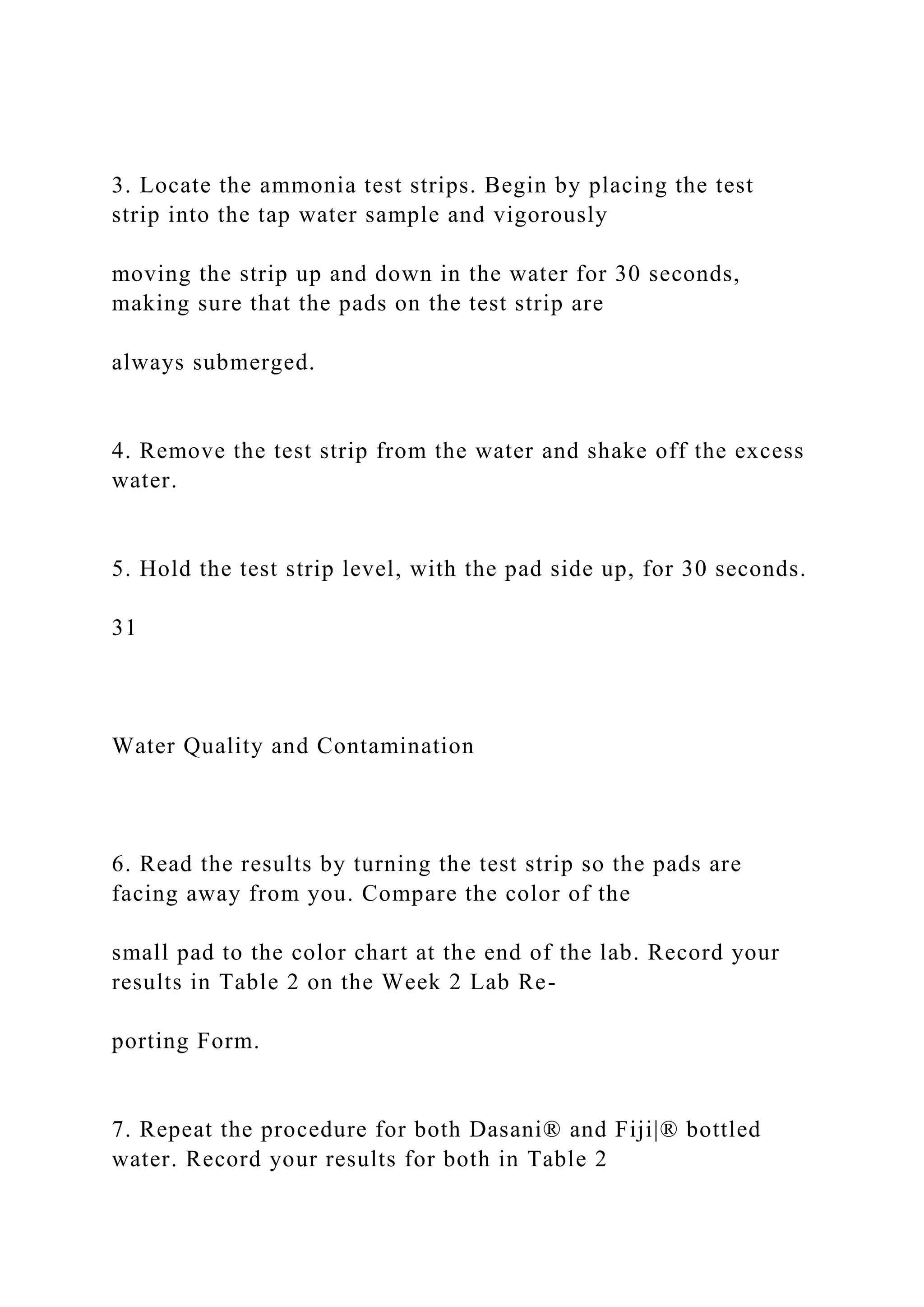
Ammonia Test Strip
3. Locate the ammonia test strips. Begin by placing the test
strip into the tap water sample and vigorously
moving the strip up and down in the water for 30 seconds,
making sure that the pads on the test strip are
always submerged.
4. Remove the test strip from the water and shake off the excess
water.
5. Hold the test strip level, with the pad side up, for 30 seconds.
31
Water Quality and Contamination
6. Read the results by turning the test strip so the pads are
facing away from you. Compare the color of the
small pad to the color chart at the end of the lab. Record your
results in Table 2 on the Week 2 Lab Re-
porting Form.
7. Repeat the procedure for both Dasani® and Fiji|® bottled
water. Record your results for both in Table 2
on the Week 2 Lab Reporting Form.
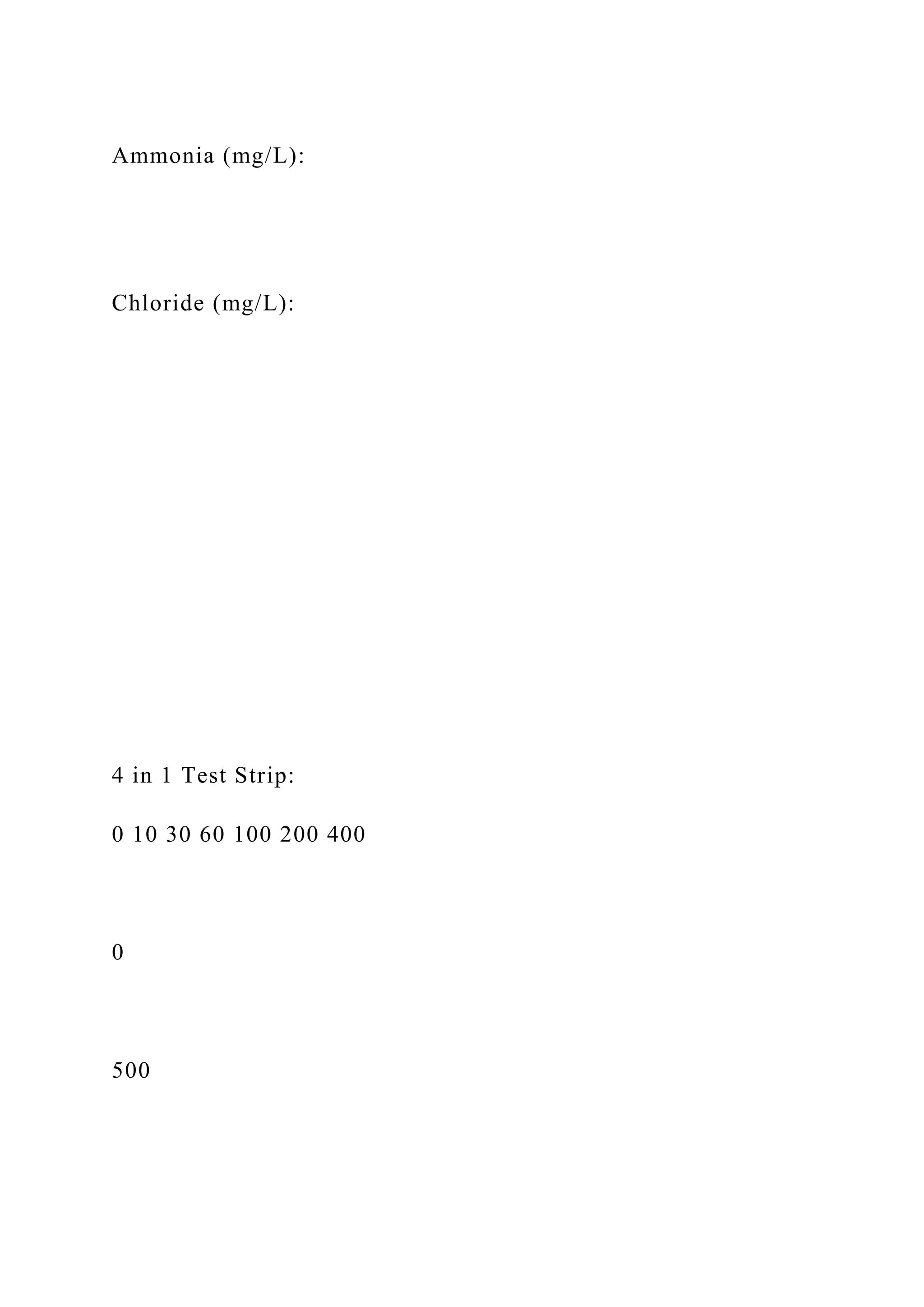
Chloride Test Strip
8. Locate the chloride test strips. Begin by immersing all the
reaction zones (the pads) of the test strip in to
the tap water sample for 1 second.
9. Shake off the excess liquid from the test strip and after 1
minute, determine which color row the test strip
most noticeably coincides with on the color chart at the end of
the lab. Record your results in Table 3 on
the Week 2 Lab Reporting Form.
10. Repeat the procedure for both Dasani® and Fiji® Bottled
Water. Record your results for both in Table 3.
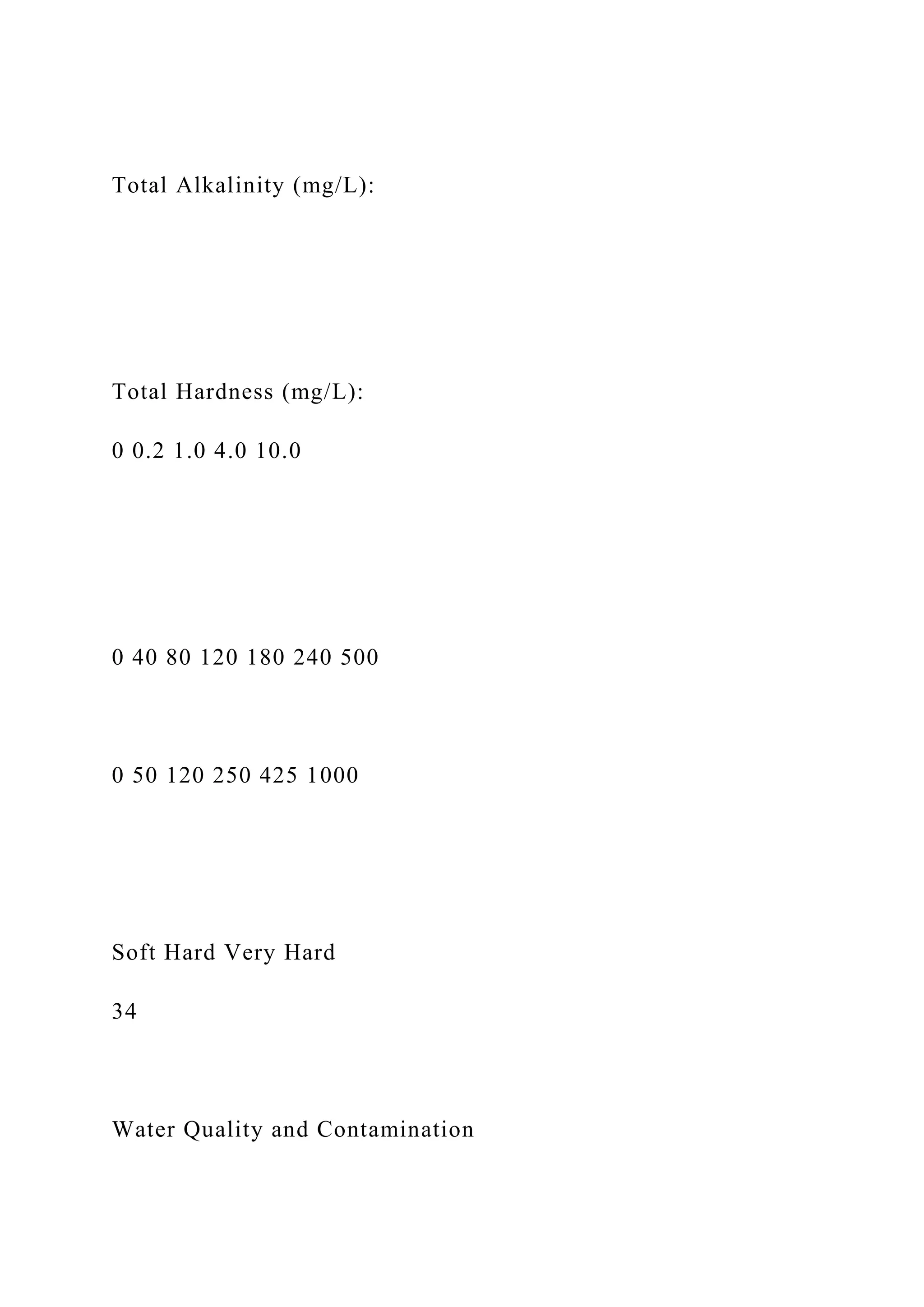
4 in 1 Test Strip
11. Locate the 4 in 1 test strips. Begin by dipping the test strip
in the tap water for 5 seconds with a gentle
back and forth motion.
12. Remove the test strip from the water and shake once,
briskly, to remove the excess water.
13. Wait 20 seconds and then using the color chart at the end of
this lab, match the test strip to the pH, Total
Alkalinity, Total Chlorine, and Total Hardness on the color
chart. Be sure to do all of the readings within
seconds of each other. Record your results in Table 4 on the
Week 2 Lab Reporting Form.
14. Repeat the procedure for both Dasani® and Fiji® Bottled
Water. Record your results for both in Table
4.
Phosphate Test Strip
15. Locate the phosphate test strips. Being by dipping the test
strip into the tap water for 5 seconds.
16. Remove the test strip from the water and hold horizontal,
with the pad side up, for 45 seconds. Do not
shake the excess water from the test strip.
32
Water Quality and Contamination
17. Compare the results on the pad of the test strip with the
color chart at the end of this lab. Record your
results in Table 5 on the Week 2 Lab Reporting Form.
18. Repeat the procedure for both Dasani® and Fiji® bottled
water. Record your results for both in Table 5.
Iron Test Strip
19. Locate the iron test strips. Begin by removing 70 mL of
water from each beaker and discarding it, leaving
a total of 30 mL within each of the three beakers.
20. Beginning with the tap water, open one foil packet and add
the powder contents to the beaker. Cover the
beaker with a piece of Parafilm® and shake the beaker
vigorously for 15 seconds.
21. Remove the Parafilm® and dip the test pad of the iron test
strip into the tap water sample, rapidly moving
it back and forth under the water for 5 seconds.
22. Remove the strip and shake the excess water off. After 10
seconds, compare the test pad to the color
chart at the end of this lab. If the color falls between two colors
in the color chart, estimate your result.
Record your results in Table 6 on the Week 2 Lab Reporting
Form.
23. Repeat the procedure for both Dasani® and Fiji® Bottled
Water. Record your results for both in Table 6
on the Week 2 Lab Reporting Form and then answer all of the
post lab questions on the Week 2 Lab Re-
porting Form.
33
Water Quality and Contamination
Test Strip Key:
Ammonia (mg/L):
Chloride (mg/L):
4 in 1 Test Strip:
0 10 30 60 100 200 400
0
500
1000
1500
2000
≥3000
*Note there are four pads on this test strip. From top to bottom
(with the bottom of the strip being the handle),
the pads test for pH, Chlorine, Alkalinity, and Hardness.
Example:
pH:
pH Chlor. Alk. Hard
(test strip handle)
Total Chlorine (mg/L):
Total Alkalinity (mg/L):
Total Hardness (mg/L):
0 0.2 1.0 4.0 10.0
0 40 80 120 180 240 500
0 50 120 250 425 1000
Soft Hard Very Hard
34
Water Quality and Contamination
Test Strip Key (cont.):
Phosphate (ppm):
0 10 25 50 100
Total Iron (ppm): 0 0.15 0.3 0.6 1 2 5
1. Form based on your observations.
35
Weather and Climate Change
Appendix
Good Lab Techniques
36
Good Lab Techniques
Good Laboratory Techniques
Science labs, whether at universities or in your home, are places
of adventure and discovery. One of the first
things scientists learn is how exciting experiments can be.
However, they must also realize science can be
dangerous without some instruction on good laboratory
practices.
• Read the protocol thoroughly before starting any new
experiment.
You should be familiar with the action required every step of
the
way.
• Keep all work spaces free from clutter and dirty dishes.
• Read the labels on all chemicals, and note the chemical safety
rating
on each container. Read all Material Safety Data Sheets
(provided
on www.eScienceLabs.com).
• Thoroughly rinse lab ware (test tubes, beakers, etc.) between
experi-
ments. To do so, wash with a soap and hot water solution using
a
bottle brush to scrub. Rinse completely at least four times. Let
air
dry
• Use a new pipet for each chemical dispensed.
• Wipe up any chemical spills immediately. Check MSDSs for
special
handling instructions (provided on www.eScienceLabs.com).
• Use test tube caps or stoppers to cover test tubes when shaking
or
mixing – not your finger!
A B C
Figure 1: A underpad will
prevent any spilled liquids
from contaminating the sur-
face you work on.
Figure 2: Special measuring tools in make experimentation
easier and more accu- rate in
the lab. A shows a beaker, B graduated cylinders, and C test
tubes in a test tube rack.
67
Good Lab Techniques
• When preparing a solution, refer to a protocol for any specific
instructions on preparation. Weigh out the desired amount of
chemicals, and transfer to a beaker or graduated cylinder.
Add LESS than the required amount of water. Swirl or stir to
dissolve the chemical (you can also pour the solution back
and forth between two test tubes), and once dissolved, trans-
fer to a graduated cylinder and add the required amount of
liquid to achieve the final volume.
• A molar solution is one in which one liter (1L) of solution
con-
tains the number of grams equal to its molecular weight.
For example:
1M = 110 g CaCl x 110 g CaCl/mol CaCl
(The formula weight of CaCl is 110 g/mol)
Figure 3: Disposable pipettes aid in ac-
curate measuring of small volumes of
liquids. It is important to use a new pi-
pette for each chemical to avoid con-
tamination.
• A percent solution can be prepared by percentage of weight of
chemical to 100ml of solvent (w/v) , or
volume of chemical in 100ml of solvent (v/v).
For example:
20 g NaCl + 80 mL H2O = 20% w/v NaCl solution
• Concentrated solutions, such as 10X, or ten times the normal
strength, are diluted such that the final
concentration of the solution is 1X.
For example:
To make a 100 mL solution of 1X TBE from a 10X solution:
10 mL 10X TBE + 90 mL water = 100ml 1X TBE
• Always read the MSDS before disposing of a chemical to
insure it does not require extra measures.
(provided on www.eScienceLabs.com)
• Avoid prolonged exposure of chemicals to direct sunlight and
extreme temperatures. Immediately se-
cure the lid of a chemical after use.
• Prepare a dilution using the following equation:
c1v1 = c2v2
Where c1 is the concentration of the original solution, v1 is the
volume of the original solution, and
c2 and v2 are the corresponding concentration and volume of
the final solution. Since you know c1,
68
Good Lab Techniques
c2, and v2, you solve for v1 to figure out how much of the
original solution is needed to make a cer-
tain volume of a diluted concentration.
• If you are ever required to smell a chemical, always waft a gas
toward you, as shown in the figure
below.. This means to wave your hand over the chemical
towards you. Never directly smell a
chemical. Never smell a gas that is toxic or otherwise
dangerous.
• Use only the chemicals needed for the activity.
• Keep lids closed when a chemical is not being used.
• When diluting an acid, always slowly pour the acid into the
water. Never pour water into an acid,
as this could cause both splashing and/or an explosion.
• Never return excess chemical back to the original bottle. This
can contaminate the chemical sup-
ply.
• Be careful not to interchange lids between different chemical
bottles.
• When pouring a chemical, always hold the lid of the chemical
bottle between your fingers. Never
lay the lid down on a surface. This can contaminate the
chemical supply.
• When using knives or blades, always cut away from yourself.
69
© 2012 eScience Labs, LLC - All rights reserved
68
Lab 2Concepts to ExploreIntroductionExperiment 1: Effects
of Groundwater ContaminationProcedureExperiment 2: Water
TreatmentMaterialsProcedureExperiment 3: Drinking Water
QualityMaterialsProcedureAmmonia Test StripChloride Test
Strip4 in 1 Test StripPhosphate Test StripIron Test
StripAmmonia (mg/L):pH:Total Chlorine (mg/L):Test Strip Key
(cont.):Phosphate (ppm):AppendixA B C© 2012 eScience Labs,
LLC - All rights reserved

Running Head Title1Title3TitleNameSCI 207 De.docx

  • 1.
    Running Head: Title 1 Title 3 Title Name SCI207: Dependence of man on the environment Instructor Date *This template will provide you with the details necessary to finalize a quality Final Lab Report. Utilize this template to complete the Week 5 Final Lab Report and ensure that you are providing all of the necessary information and proper format for the assignment. Before you begin, please note the following important information: 1. Carefully review the Final Lab Report instructions before you begin this assignment. 2. The Final Lab Report should cover all 3 experiments from your Week Two Lab. 3. Review instructor feedback from the Week Three outline of the Final Lab Report and make changes as necessary. 4. Review the Sample Final Lab Report for an example of a final product on a different topic. Your format should look like this sample report before submission. 5. Run your Final Lab Report through Turnitin using the student folder to ensure protection from accidental plagiarism Title Abstract
  • 2.
    The abstract shouldprovide a brief summary of the methods, results, and conclusions. It should very briefly allow the reader to see what was done, how it was done, and the results. It should not exceed 200 words and should be the last part written (although it should still appear right after the title page). Introduction The introduction should describe the background of water quality and related issues using cited examples. You should include scholarly sources in this section to help explain why water quality research is important to society. When writing this section, make sure to cite all resources in APA format. The introduction should also contain the objective for your study. This objective is the reason why the experiment is being done. Your final report should provide an objective that describes why we want to know the answer to the questions we are asking. Finally, the introduction should end with your hypotheses. This section should include a hypothesis for each one of the three experiments. These hypotheses should be the same ones posed before you began your experiments. You may reword them following feedback from your instructor to illustrate a proper hypothesis, however, you should not adjust them to reflect the “right” answer. You do not lose points for an inaccurate hypothesis; scientists often revise their hypotheses based on scientific evidence following an experiment. Materials and Methods The materials and methods section should provide a brief description of the specialized materials used in your experiment and how they were used. This section needs to summarize the instructions with enough detail so that an outsider who does not have a copy of the lab instructions knows what you did. However, this does not mean writing every little step like “dip the pH test strip in the water, then shake the test strips,” these steps can be simplified to read “we used pH test strips to measure water pH”, etc. Additionally, this section should be
  • 3.
    written in thepast tense and in your own words and not copied and pasted from the lab manual. Results The results section should include all tables used in your experiments. All values within the tables or graphs should be in numerical form and contain units. For instance, if measuring the amount of chloride in water you should report as 2 mg/L or 0 mg/L, not as two or none. The results section should also highlight the important results in paragraph form, referring to the appropriate tables when mentioned. This section should only state the results as no personal opinions should be included. A description of what the results really mean should be saved for the discussion. For example, you may report, 0mg/L of chlorine were found in the water, but should avoid personal opinions and interpretations of the data (e.g., “No chlorine was found in the water showing it is cleaner than the others samples”). Discussion The discussion section should interpret your data and provide conclusions. Start by discussing if each hypothesis was confirmed or denied and how you know this. The discussion should also relate your results to the bigger water concerns and challenges. For example, based on your experiments you might discuss how various bottled water companies use different filtrations systems. Or, you could discuss the billion dollar bottled water industry. For example, do you think it is worth it to buy bottled water? Why or why not? Your final lab report should utilize resources to put your results into context. Finally, the results section should also address any possible factors that affected your results, such as possible contamination in the experiments or any outside factors (e.g., temperature, contaminants, time of day) that affected your results? If so, how could you control for these in the future? You should also propose some new questions that have arisen from your results and what kind of experiment might be
  • 4.
    proposed to answerthese questions. Conclusions The conclusion section should briefly summarize the key points of your experiments. What main message would you like people to have from this report? References Include at least four scholarly references and your lab manual in APA format. Name: Date: Instructor’s Name: Assignment: SCIE211 Phase 5 Lab Report Title: Identifying Environmental Hazards Instructions: You will write a 1-page lab report using the scientific method to answer the following questions: · Why do you see increases and decreases in the invasive species population? · What are the implications associated with these alterations to the ecosystem as a whole? When your lab report is complete, post it in Submitted Assignment files. Part I: Using the lab animation, fill in the data table below to help you generate your hypothesis, outcomes, and analysis. Years Zebra and Quagga Mussel (density/m2) Phytoplankton (µg/ml) Zooplankton (µg/ml) Cladophora Biomass (g/m2)
  • 5.
    Foraging Fish (kilotons) LakeTrout (kilotons) 0 100 3 2 10 150 15 4 1,000 2.5 1 100 100 10 7 2,500 2 0.5 200 80 8 10 7,500 1.5 0.25 600 50 5 13 15,000 1 0.1 700 25
  • 6.
    2.5 15 7,500 1.5 0.2 243 40 4 20 5,000 1.75 0.4 136 60 6 Part II: Writea 1-page lab report using the following scientific method sections: · Purpose · State the purpose of the lab. · Introduction · This is an investigation of what is currently known about the question being asked. Use background information from credible references to write a short summary about concepts in the lab. List and cite references in APA style. · Hypothesis/Predicted Outcome · A hypothesis is an educated guess. Based on what you have learned and written about in the Introduction, state what you expect to be the results of the lab procedures. · Methods · Summarize the procedures that you used in the lab. The Methods section should also state clearly how data (numbers) were collected during the lab; this will be reported in the
  • 7.
    Results/Outcome section. · Results/Outcome ·Provide here any results or data that were generated while doing the lab procedure. · Discussion/Analysis · In this section, state clearly whether you obtained the expected results, and if the outcome was as expected. · Note: You can use the lab data to help you discuss the results and what you learned. Provide references in APA format. This includes a reference list and in-text citations for references used in the Introduction section. Give your paper a title and number, and identify each section as specified above. Although the hypothesis will be a 1-sentence answer, the other sections will need to be paragraphs to adequately explain your experiment. When your lab report is complete, post it in Submitted Assignment files. Running Head: SAMPLE FINAL LAB REPORT 1
  • 8.
    Sample Lab Report(The Optimal Foraging Theory) Name SCI 207 Dependence of Man on the Environment Instructor Date SAMPLE FINAL LAB REPORT 2 Sample Lab Report Abstract The theory of optimal foraging and its relation to central foraging was examined by using
  • 9.
    the beaver asa model. Beaver food choice was examined by noting the species of woody vegetation, status (chewed vs. not-chewed), distance from the water, and circumference of trees near a beaver pond in North Carolina. Beavers avoided certain species of trees and preferred trees that were close to the water. No preference for tree circumference was noted. These data suggest that beaver food choice concurs with the optimal foraging theory. Introduction In this lab, we explore the theory of optimal foraging and the theory of central place foraging using beavers as the model animal. Foraging refers to the mammalian behavior associated with searching for food. The optimal foraging theory assumes that animals feed in a way that maximizes their net rate of energy intake per unit time (Pyke et al., 1977). An animal may either maximize its daily energy intake (energy maximizer) or minimize the time spent feeding (time minimizer) in order to meet minimum requirements. Herbivores commonly behave
  • 10.
    as energy maximizers(Belovsky, 1986) and accomplish this maximizing behavior by choosing food that is of high quality and has low-search and low- handling time (Pyke et al., 1977). The central place theory is used to describe animals that collect food and store it in a fixed location in their home range, the central place (Jenkins, 1980). The factors associated with the optimal foraging theory also apply to the central place theory. The central place theory predicts that retrieval costs increase linearly with distance of the resource from the central place SAMPLE FINAL LAB REPORT 3 (Rockwood and Hubbell, 1987). Central place feeders are very selective when choosing food that is far from the central place since they have to spend time and energy hauling it back to the storage site (Schoener, 1979). The main objective of this lab was to determine beaver (Castor canadensis) food selection based on tree species, size, and distance. Since beavers are energy maximizers (Jenkins, 1980;
  • 11.
    Belovsky, 1984) andcentral place feeders (McGinley & Whitam, 1985), they make an excellent test animal for the optimal foraging theory. Beavers eat several kinds of herbaceous plants as well as the leaves, twigs, and bark of most species of woody plants that grow near water (Jenkins & Busher, 1979). By examining the trees that are chewed or not-chewed in the beavers' home range, an accurate assessment of food preferences among tree species may be gained (Jenkins, 1975). The purpose of this lab was to learn about the optimal foraging theory. We wanted to know if beavers put the optimal foraging theory into action when selecting food. We hypothesized that the beavers in this study will choose trees that are small in circumference and closest to the water. Since the energy yield of tree species may vary significantly, we also hypothesized that beavers will show a preference for some species of trees over others regardless of circumference size or distance from the central area. The optimal foraging theory and central place theory lead us to predict that beavers, like most herbivores,
  • 12.
    will maximize theirnet rate of energy intake per unit time. In order to maximize energy, beavers will choose trees that are closest to their central place (the water) and require the least retrieval cost. Since beavers are trying to maximize energy, we hypothesized that they will tend to select some species of trees over others on the basis of nutritional value. Methods This study was conducted at Yates Mill Pond, a research area owned by the North SAMPLE FINAL LAB REPORT 4 Carolina State University, on October 25th, 1996. Our research area was located along the edge of the pond and was approximately 100 m in length and 28 m in width. There was no beaver activity observed beyond this width. The circumference, the species, status (chewed or not- chewed), and distance from the water were recorded for each tree in the study area. Due to the large number of trees sampled, the work was evenly divided
  • 13.
    among four groupsof students working in quadrants. Each group contributed to the overall data collected. We conducted a chi-squared test to analyze the data with respect to beaver selection of certain tree species. We conducted t-tests to determine (1) if avoided trees were significantly farther from the water than selected trees, and (2) if chewed trees were significantly larger or smaller than not chewed trees. Mean tree distance from the water and mean tree circumference were also recorded. Results SAMPLE FINAL LAB REPORT 5 Overall, beavers showed a preference for certain species of trees, and their preference was based on distance from the central place. Measurements taken at the study site show that
  • 14.
    SAMPLE FINAL LABREPORT 6 beavers avoided oaks and musclewood (Fig. 1) and show a significant food preference. No avoidance or particular preference was observed for the other tree species. The mean distance of 8.42 m away from the water for not-chewed trees was significantly greater than the mean distance of 6.13 m for chewed trees (Fig. 2). The tree species that were avoided were not significantly farther from the water than selected trees. For the selected tree species, no significant difference in circumference was found between trees that were not chewed (mean=16.03 cm) and chewed (mean=12.80 cm) (Fig. 3). Discussion Although beavers are described as generalized herbivores, the finding in this study related to species selection suggests that beavers are selective in their food choice. This finding agrees with our hypothesis that beavers are likely to show a preference for certain tree species.
  • 15.
    Although beaver selectionof certain species of trees may be related to the nutritional value, additional information is needed to determine why beavers select some tree species over others. Other studies suggested that beavers avoid trees that have chemical defenses that make the tree unpalatable to beavers (Muller-Schawarze et al., 1994). These studies also suggested that beavers prefer trees with soft wood, which could possibly explain the observed avoidance of musclewood and oak in our study. The result that chewed trees were closer to the water accounts for the time and energy spent gathering and hauling. This is in accordance with the optimal foraging theory and agrees with our hypothesis that beavers will choose trees that are close to the water. As distance from the water increases, a tree's net energy yield decreases because food that is farther away is more likely to increase search and retrieval time. This finding is similar to Belovskyís finding of an SAMPLE FINAL LAB REPORT 7
  • 16.
    inverse relationship betweendistance from the water and percentage of plants cut. The lack of any observed difference in mean circumference between chewed and not chewed trees does not agree with our hypothesis that beavers will prefer smaller trees to larger ones. Our hypothesis was based on the idea that branches from smaller trees will require less energy to cut and haul than those from larger trees. Our finding is in accordance with other studies (Schoener, 1979), which have suggested that the value of all trees should decrease with distance from the water but that beavers would benefit from choosing large branches from large trees at all distances. This would explain why there was no significant difference in circumference between chewed and not-chewed trees. This lab gave us the opportunity to observe how a specific mammal selects foods that maximize energy gains in accordance with the optimal foraging theory. Although beavers adhere to the optimal foraging theory, without additional information on relative nutritional value of
  • 17.
    tree species andthe time and energy costs of cutting certain tree species, no optimal diet predictions may be made. Other information is also needed about predatory risk and its role in food selection. Also, due to the large number of students taking samples in the field, there may have been errors which may have affected the accuracy and precision of our measurements. In order to corroborate our findings, we suggest that this study be repeated by others. Conclusion The purpose of this lab was to learn about the optimal foraging theory by measuring tree selection in beavers. We now know that the optimal foraging theory allows us to predict food- seeking behavior in beavers with respect to distance from their central place and, to a certain extent, to variations in tree species. We also learned that foraging behaviors and food selection is SAMPLE FINAL LAB REPORT 8 not always straightforward. For instance, beavers selected large branches at any distance from
  • 18.
    the water eventhough cutting large branches may increase energy requirements. There seems to be a fine line between energy intake and energy expenditure in beavers that is not so easily predicted by any given theory. SAMPLE FINAL LAB REPORT 9 References Belovsky, G.E. (1984). Summer diet optimization by beaver.
  • 19.
    The American MidlandNaturalist. 111: 209-222. Belovsky, G.E. (1986). Optimal foraging and community structure: implications for a guild of generalist grassland herbivores. Oecologia. 70: 35-52. Jenkins, S.H. (1975). Food selection by beavers:› a multidimensional contingency table analysis. Oecologia. 21: 157-173. Jenkins, S.H. (1980). A size-distance relation in food selection by beavers. Ecology. 61: 740- 746. Jenkins, S.H., & P.E. Busher. (1979). Castor canadensis. Mammalian Species. 120: 1-8. McGinly, M.A., & T.G. Whitham. (1985). Central place foraging by beavers (Castor Canadensis): a test of foraging predictions and the impact of selective feeding on the growth form of cottonwoods (Populus fremontii). Oecologia. 66: 558-562. Muller-Schwarze, B.A. Schulte, L. Sun, A. Muller-Schhwarze, & C. Muller-Schwarze. (1994). Red Maple (Acer rubrum) inhibits feeding behavior by beaver (Castor canadensis).
  • 20.
    Journal of ChemicalEcology. 20: 2021-2033. Pyke, G.H., H.R. Pulliman, E.L. Charnov. (1977). Optimal foraging. The Quarterly Review of Biology. 52: 137-154. Rockwood, L.L., & S.P. Hubbell. (1987). Host-plant selection, diet diversity, and optimal foraging in a tropical leaf-cutting ant. Oecologia. 74: 55-61. Schoener, T.W. (1979). Generality of the size-distance relation in models of optimal feeding. The American Naturalist. 114: 902-912. SAMPLE FINAL LAB REPORT 10 *Note: This document was modified from the work of Selena Bauer, Miriam Ferzli, and Vanessa Sorensen, NCSU.
  • 21.
    Environmental Science Tableof Contents 21 Lab 2 Water Quality and Contamination Water Quality and Contamination Concepts to Explore • Usable water • Ground water • Surface water • Ground water contaminates • Water treatment
  • 22.
    • Drinking waterquality Figure 1: At any given moment, 97% of the planet’s water is in the oceans. Only a small fraction of the remaining freshwater is usable by humans, underscoring the importance of treating our water supplies with care. Introduction It is no secret that water is one of the most valuable resources on planet Earth. Every plant and animal re- quires water to survive, not only for drinking, but also for food production, shelter creation and many other ne- cessities. Water has also played a major role in transforming the earth’s surface into the varied topography we see today. While more than 70% of our planet is covered in water, only a small percent of this water is usable freshwater. The other 99% of the water is composed primarily of salt water, with a small percentage being composed of 23 Water Quality and Contamination
  • 23.
    glaciers. Due tothe high costs involved in transforming salt water into freshwater, the Earth’s population sur- vives off the less than 1% of freshwater available. Humans obtain freshwater from either surface water or groundwater. Surface water is the water that collects on the ground as a result of precipitation. The water that does not evaporate back into the atmosphere or infiltrate into the ground is typically collected in rivers, lakes, reser- voirs, and other bodies of water and is easily accessible. Precipitation Precipitation Precipitation Cloud formation Transpiration Evaporation Evaporation Groundwater
  • 24.
    Figure 2: Wateris a renewable source, purified and delivered across the planet by the hydrological cycle. Groundwater, on the other hand, is precisely as the name suggests; water located underneath the ground. This water is stored in pores, fractures and other spaces within the soil and rock underneath the ground’s sur- face. Precipitation, along with snowmelt, infiltrates through the ground and accumulates in available under- ground spaces. Aquifers are areas in which water collects in sand, gravel, or permeable rock from which it can be extracted for usable freshwater. The depth of aquifers vary from less than 50 feet to well over 1,500 feet below the sur- face of the ground. The water within an aquifer typically does not flow through as it would through a river or stream, but instead soaks into the underground material, similar to a sponge. As aquifers are depleted by hu- man use, they are also recharged from precipitation seeping into the ground and restoring the water level. However, many times the recharge of the aquifers does not
  • 25.
    equal the amountof water that has been extract- ed. If that cycle continues, the aquifer will eventually dry up and will no longer be a viable source of groundwa- ter. 24 Water Quality and Contamination Water is the only substance that is found naturally in three forms: solid, liquid, and gas If the entire world’s supply of water could fit into a one- gallon jug, the fresh water available to use would equal less than one tablespoon Approximately 66% of the human body consists of wa- ter - it exists within every organ and is essential for its function
  • 26.
    While the waterthat precipitates down in the form of rain is relatively pure, it does not take long for water to pick up contaminants. There are natural, animal, and human- made sources of water pollutants. They can travel freely from one location to another via streams, rivers, and even groundwater. Pollutants can also trav- el from land or air into the water. Groundwater contamination most often occurs when human-made products such as motor oil, gasoline, acidic chemicals and other substances leak into aquifers and other groundwater storage areas. The most common source of contaminants come from leaking storage tanks, poorly main- tained landfills, and septic tanks, hazardous waste sites and the common use of chemicals such as pesti- cides and road salts. The dangers of consuming contaminated water are high. Many deadly diseases, poisons and toxins can reside in the contaminated water supplies and severely affect the health of those who drink the water. It is also believed that an increased risk of cancer may result from ingesting contaminated groundwater. With the many contaminants that can infiltrate our wa- ter supply, it is crucial that there be a thorough water treatment plan in place to purify the water and make it drinkable. While each municipality has its own water treatment facility, the process is much the same at each location.
  • 27.
    Figure 3: Sedimentationtanks, such as those shown above, are used to settle the sludge and remove oils and fats in sewage. This step can remove a good por- tion of the biological oxygen demand from the sew- age, a key step before progressing with the treat- ments and eventually releasing into the ground or body of water. 25 Water Quality and Contamination The process begins with aeration in which air is added to the water to let trapped gases escape while increasing the amount of oxygen within the water. The next step is called coagulation or flocculation, in which chemicals, such as filter alum, are added to the incoming water and then stirred vigor- ously in a powerful mixer. The alum causes compounds such as carbonates and hydroxides to form tiny, sticky clumps called floc that attract dirt and other small particles. When the sticky clumps combine with the dirt they become heavy and sink to the bottom. In the next step, known as sedimentation, the heavy particles that sank to the bottom during coagula- tion are separated out and the remaining water is sent on to filtration. During filtration, the water passes through filters made of layers of sand, charcoal, gravel and pebbles that help filter out the smaller particles that have passed through
  • 28.
    until this point.The last step is called disinfection in which chlorine and/or other disinfectants are added to kill any bac- Figure 4: Fresh water is essen- tial to humans and other land- based life. Contaminated water must be treated before it can be released into the water supply. teria that may still be in the water. At this point the water is stored until it is distributed through various pipes to city residents and businesses. After the water goes through the treatment process, it must also pass the guidelines stated in the Safe Drinking Water Act in which various components are tested to ensure that the quality of the water is sufficient for drinking. There are currently over 65 contaminants that must be monitored and maintained on a regular basis to keep local drinking water safe for the public. Some of these chemical regulations include lead, chromium, selenium and arsenic. Other com- ponents such as smell, color, pH and metals are also monitored to ensure residents are provid- ed clean and safe drinking water. 26 Water Quality and Contamination
  • 29.
    Experiment 1: Effectsof Groundwater Contamination In this lab you will test the effects of common pollutants on groundwater. When mixed with water, everyday items such as laundry detergent, oil, and vinegar can alter the color, smell, and taste of water. You have likely observed these changes through everyday activities such as adding laundry detergent to water in the washing machine, or noticing oil within a puddle on the street. Many of these chemicals end up dispersing throughout our environment, and while soil bacteria can reduce many of these contaminants, they may not be able to stop them from reaching our groundwater sources located beneath the soil. In Experiment 1 you will test the ability of soil to remove oil, vinegar, and laundry detergent from the environment before it reaches groundwa- ter. Follow the procedure below to complete Experiment 1 on the effects of groundwater contamination. Materials (8) 250 mL Beakers Permanent marker 3 Wooden stir sticks 100 mL Graduated cylinder 10 mL Vegetable oil 10 mL Vinegar
  • 30.
    10 mL Liquidlaundry detergent 100 mL Beaker 240 mL Soil Funnel Cheesecloth *Scissors *Water *You must provide Procedure 1. Download the Week 2 Lab Reporting Form from the course instructions. As you conduct all 3 experi- ments, record hypotheses, observations, and data on that form. 2. Read through the Experiment 1 procedure and then record your hypotheses on the ability of oil, vinegar,
  • 31.
    and laundry detergentto contaminate groundwater on the Week 2 Lab Reporting Form. You should pro- vide one hypothesis for each situation. 3. Use the permanent marker to label the beakers 1 - 8. 4. Set Beakers 5 - 8 aside. Fill Beakers 1 - 4 with 100 mL of water using your 100 mL graduated cylinder. 5. Record your observations of the water in Beaker 1 in Table 1 on the Week 2 Lab Reporting Form. Re- member to use a safe wafting technique to smell the solutions. 27 Water Quality and Contamination 6. Add 10 mL of vegetable oil to Beaker 2. Mix thoroughly with a wooden stir stick. Record your observations of the water in Beaker 2 in Table 1 on your Week 2 Lab Reporting Form. (Don’t forget to wash the gradu- ated cylinder between use!) 7. Add 10 mL vinegar to beaker 3. Mix thoroughly with a
  • 32.
    wooden stir stick.Record your observations of the water in Beaker 3 in Table 1 on your Week 2 Lab Reporting Form. 8. Add 10 mL of liquid laundry detergent to beaker 4. Mix thoroughly with a wooden stir stick. Record your observations of the water in Beaker 4 in Table 1 on your Week 2 Lab Reporting Form. 9. Cut your piece of cheesecloth into five different pieces (reserve one piece for the next experiment). Fold one piece of the cheesecloth so that you have a piece 4 layers thick and big enough to line the funnel. Place it inside the funnel. 10. Measure out 60 mL of soil using the 100 mL beaker and place it into the cheesecloth-lined funnel. 11. Place the funnel inside Beaker 5. 12. Pour the contents of Beaker 1 (water) through the funnel so that it filters into Beaker 5 for one minute. Record your observations of the filtered water in the beaker in Table 1 on your Week 2 Lab Reporting
  • 33.
    Form. 13. Discard thecheesecloth and soil from the funnel. 14. Repeat Steps 9 - 13 for Beakers 2, 3, and 4 and complete the Post-Lab questions on the Week 2 Lab Re- porting Form. (Filter the contents of Beaker 2 into Beaker 6, the contents of Beaker 3 into Beaker 7, and the contents of Beaker 4 into Beaker 8). 28 Water Quality and Contamination Experiment 2: Water Treatment With the many pollutants that are added to our water supply from daily human activity, it is important that we have a way to filter our water to make it safe for drinking. Wastewater treatment plants use sophisticated techniques to make water potable. In Experiment 2, you will use a similar technique to test the effectiveness of one filtering method on the ability to purify contaminated water. Follow the procedure below to complete Experiment 2 on the effects of one method of water treatment. Materials
  • 34.
    100 mL Pottingsoil (2) 250 mL Beakers (2) 100 mL Beakers 100 mL Graduated cylinder 40 mL Sand 20 mL Activated charcoal 60 mL Gravel 1 Wooden stir stick Alum Funnel Cheesecloth Bleach Stopwatch *Water
  • 35.
    *You must provide Procedure 1.Read through the Experiment 2 procedure and then record your hypothesis on the ability of your filtration technique to remove contaminants on your Week 2 Lab Reporting Form. 2. Add 100 mL of soil to the 250 mL beaker. Fill to the 200 mL mark with water. 3. Pour the soil solution back and forth between the two 250 mL beakers for a total of 15 times. 4. After the solution is created, pour 10 mL of the now “contaminated” water into a clean 100 mL beaker. This sample will be used to compare to the “treated” water at the end of the filtration process. 5. Add 10 grams of alum (all of the contents in the bag you have been given) to the 250 mL beaker contain-
  • 36.
    ing the “contaminated”water. Slowly stir the mixture with a wooden stir stick for 1-2 minutes. Let the so- lution sit for 15 minutes. 6. In the meantime, rinse out the empty 250 mL beaker. Place the funnel into the clean 250 mL beaker. Fold a piece of cheesecloth so that you have a piece 4 layers thick that is big enough to line the funnel. Place 29 Water Quality and Contamination it inside the funnel. 7. Begin layering the funnel, starting by pouring 40 mL of sand into the cheesecloth-lined funnel, then 20 mL activated charcoal, then 40 mL gravel. Use a 100 mL beaker to measure these amounts. 8. To solidify the filter, slowly pour clean tap water through the filter until the funnel is full. Discard the rinse water from the beaker and repeat four more times. Return the funnel to the top of the beaker and let sit for
  • 37.
    5 minutes beforeemptying the beaker and continuing the experiment. 9. Now, without mixing up the current sediment in the “contaminated” water jar, pour about 3/4 of the “contaminated” water into the funnel. Let it filter through the funnel into the beaker for 5 minutes. 10. Note the smell of the filtered water, comparing it to the 10 mL sample taken from the mixture in Step 3. 11. Remove the filter and add a few drops of bleach solution to the filtered water within the beaker. Stir the water and bleach combination slowly for about 1 minute. 12. The “contaminated” water has now been filtered. Compare the newly created “treated” water with the 10 mL sample of the initial “contaminated” water and answer the Post-Lab questions on the Week 2 Lab Re- porting Form. 30 Water Quality and Contamination Experiment 3: Drinking Water Quality
  • 38.
    Bottled water isa billion dollar industry within the United States alone. Still, various reports have shown that many bottled water products contain the same chemical contaminants as our tap water. In Experiment 3, you will test the quality of two separate bottled waters and your tap water by measuring a variety of chemical com- ponents within the water. Follow the procedure below to complete Experiment 3 on drinking water quality. Materials Dasani® bottled water Fiji® bottled water Ammonia test strips Chloride test strips 4 in 1 test strips Phosphate test strips Iron test strips (3) 250 mL Beakers Permanent marker Stopwatch Parafilm®
  • 39.
    Pipettes (3) Foil packetsof reducing powder *Tap water *You must provide Procedure 1. Read through the Experiment 3 procedure and then record your hypothesis on which water source you believe will have the most and least contaminants on the Week 2 Lab Reporting Form. 2. Label three 250 mL beakers Tap Water, Dasani® and Fiji®. Pour 100 mL of the each type of water into the corresponding beakers. Ammonia Test Strip
  • 40.
    3. Locate theammonia test strips. Begin by placing the test strip into the tap water sample and vigorously moving the strip up and down in the water for 30 seconds, making sure that the pads on the test strip are always submerged. 4. Remove the test strip from the water and shake off the excess water. 5. Hold the test strip level, with the pad side up, for 30 seconds. 31 Water Quality and Contamination 6. Read the results by turning the test strip so the pads are facing away from you. Compare the color of the small pad to the color chart at the end of the lab. Record your results in Table 2 on the Week 2 Lab Re- porting Form. 7. Repeat the procedure for both Dasani® and Fiji|® bottled water. Record your results for both in Table 2
  • 41.
    on the Week2 Lab Reporting Form. Chloride Test Strip 8. Locate the chloride test strips. Begin by immersing all the reaction zones (the pads) of the test strip in to the tap water sample for 1 second. 9. Shake off the excess liquid from the test strip and after 1 minute, determine which color row the test strip most noticeably coincides with on the color chart at the end of the lab. Record your results in Table 3 on the Week 2 Lab Reporting Form. 10. Repeat the procedure for both Dasani® and Fiji® Bottled Water. Record your results for both in Table 3. 4 in 1 Test Strip 11. Locate the 4 in 1 test strips. Begin by dipping the test strip in the tap water for 5 seconds with a gentle
  • 42.
    back and forthmotion. 12. Remove the test strip from the water and shake once, briskly, to remove the excess water. 13. Wait 20 seconds and then using the color chart at the end of this lab, match the test strip to the pH, Total Alkalinity, Total Chlorine, and Total Hardness on the color chart. Be sure to do all of the readings within seconds of each other. Record your results in Table 4 on the Week 2 Lab Reporting Form. 14. Repeat the procedure for both Dasani® and Fiji® Bottled Water. Record your results for both in Table 4. Phosphate Test Strip 15. Locate the phosphate test strips. Being by dipping the test strip into the tap water for 5 seconds. 16. Remove the test strip from the water and hold horizontal, with the pad side up, for 45 seconds. Do not shake the excess water from the test strip.
  • 43.
    32 Water Quality andContamination 17. Compare the results on the pad of the test strip with the color chart at the end of this lab. Record your results in Table 5 on the Week 2 Lab Reporting Form. 18. Repeat the procedure for both Dasani® and Fiji® bottled water. Record your results for both in Table 5. Iron Test Strip 19. Locate the iron test strips. Begin by removing 70 mL of water from each beaker and discarding it, leaving a total of 30 mL within each of the three beakers. 20. Beginning with the tap water, open one foil packet and add the powder contents to the beaker. Cover the beaker with a piece of Parafilm® and shake the beaker vigorously for 15 seconds.
  • 44.
    21. Remove theParafilm® and dip the test pad of the iron test strip into the tap water sample, rapidly moving it back and forth under the water for 5 seconds. 22. Remove the strip and shake the excess water off. After 10 seconds, compare the test pad to the color chart at the end of this lab. If the color falls between two colors in the color chart, estimate your result. Record your results in Table 6 on the Week 2 Lab Reporting Form. 23. Repeat the procedure for both Dasani® and Fiji® Bottled Water. Record your results for both in Table 6 on the Week 2 Lab Reporting Form and then answer all of the post lab questions on the Week 2 Lab Re- porting Form. 33 Water Quality and Contamination Test Strip Key:
  • 45.
    Ammonia (mg/L): Chloride (mg/L): 4in 1 Test Strip: 0 10 30 60 100 200 400 0 500
  • 46.
    1000 1500 2000 ≥3000 *Note there arefour pads on this test strip. From top to bottom (with the bottom of the strip being the handle), the pads test for pH, Chlorine, Alkalinity, and Hardness. Example: pH: pH Chlor. Alk. Hard (test strip handle) Total Chlorine (mg/L):
  • 47.
    Total Alkalinity (mg/L): TotalHardness (mg/L): 0 0.2 1.0 4.0 10.0 0 40 80 120 180 240 500 0 50 120 250 425 1000 Soft Hard Very Hard 34 Water Quality and Contamination
  • 48.
    Test Strip Key(cont.): Phosphate (ppm): 0 10 25 50 100 Total Iron (ppm): 0 0.15 0.3 0.6 1 2 5 1. Form based on your observations. 35 Weather and Climate Change Appendix Good Lab Techniques 36 Good Lab Techniques
  • 49.
    Good Laboratory Techniques Sciencelabs, whether at universities or in your home, are places of adventure and discovery. One of the first things scientists learn is how exciting experiments can be. However, they must also realize science can be dangerous without some instruction on good laboratory practices. • Read the protocol thoroughly before starting any new experiment. You should be familiar with the action required every step of the way. • Keep all work spaces free from clutter and dirty dishes. • Read the labels on all chemicals, and note the chemical safety rating on each container. Read all Material Safety Data Sheets (provided on www.eScienceLabs.com). • Thoroughly rinse lab ware (test tubes, beakers, etc.) between experi- ments. To do so, wash with a soap and hot water solution using a bottle brush to scrub. Rinse completely at least four times. Let
  • 50.
    air dry • Use anew pipet for each chemical dispensed. • Wipe up any chemical spills immediately. Check MSDSs for special handling instructions (provided on www.eScienceLabs.com). • Use test tube caps or stoppers to cover test tubes when shaking or mixing – not your finger! A B C Figure 1: A underpad will prevent any spilled liquids from contaminating the sur- face you work on. Figure 2: Special measuring tools in make experimentation easier and more accu- rate in the lab. A shows a beaker, B graduated cylinders, and C test tubes in a test tube rack. 67
  • 51.
    Good Lab Techniques •When preparing a solution, refer to a protocol for any specific instructions on preparation. Weigh out the desired amount of chemicals, and transfer to a beaker or graduated cylinder. Add LESS than the required amount of water. Swirl or stir to dissolve the chemical (you can also pour the solution back and forth between two test tubes), and once dissolved, trans- fer to a graduated cylinder and add the required amount of liquid to achieve the final volume. • A molar solution is one in which one liter (1L) of solution con- tains the number of grams equal to its molecular weight. For example: 1M = 110 g CaCl x 110 g CaCl/mol CaCl (The formula weight of CaCl is 110 g/mol) Figure 3: Disposable pipettes aid in ac- curate measuring of small volumes of liquids. It is important to use a new pi- pette for each chemical to avoid con- tamination.
  • 52.
    • A percentsolution can be prepared by percentage of weight of chemical to 100ml of solvent (w/v) , or volume of chemical in 100ml of solvent (v/v). For example: 20 g NaCl + 80 mL H2O = 20% w/v NaCl solution • Concentrated solutions, such as 10X, or ten times the normal strength, are diluted such that the final concentration of the solution is 1X. For example: To make a 100 mL solution of 1X TBE from a 10X solution: 10 mL 10X TBE + 90 mL water = 100ml 1X TBE • Always read the MSDS before disposing of a chemical to insure it does not require extra measures. (provided on www.eScienceLabs.com) • Avoid prolonged exposure of chemicals to direct sunlight and extreme temperatures. Immediately se- cure the lid of a chemical after use. • Prepare a dilution using the following equation:
  • 53.
    c1v1 = c2v2 Wherec1 is the concentration of the original solution, v1 is the volume of the original solution, and c2 and v2 are the corresponding concentration and volume of the final solution. Since you know c1, 68 Good Lab Techniques c2, and v2, you solve for v1 to figure out how much of the original solution is needed to make a cer- tain volume of a diluted concentration. • If you are ever required to smell a chemical, always waft a gas toward you, as shown in the figure below.. This means to wave your hand over the chemical towards you. Never directly smell a chemical. Never smell a gas that is toxic or otherwise dangerous. • Use only the chemicals needed for the activity.
  • 54.
    • Keep lidsclosed when a chemical is not being used. • When diluting an acid, always slowly pour the acid into the water. Never pour water into an acid, as this could cause both splashing and/or an explosion. • Never return excess chemical back to the original bottle. This can contaminate the chemical sup- ply. • Be careful not to interchange lids between different chemical bottles. • When pouring a chemical, always hold the lid of the chemical bottle between your fingers. Never lay the lid down on a surface. This can contaminate the chemical supply. • When using knives or blades, always cut away from yourself. 69 © 2012 eScience Labs, LLC - All rights reserved
  • 55.
    68 Lab 2Concepts toExploreIntroductionExperiment 1: Effects of Groundwater ContaminationProcedureExperiment 2: Water TreatmentMaterialsProcedureExperiment 3: Drinking Water QualityMaterialsProcedureAmmonia Test StripChloride Test Strip4 in 1 Test StripPhosphate Test StripIron Test StripAmmonia (mg/L):pH:Total Chlorine (mg/L):Test Strip Key (cont.):Phosphate (ppm):AppendixA B C© 2012 eScience Labs, LLC - All rights reserved