How to Write a Case Report
By
Dr Nuaman Ahmad Danawar
General surgeon
Security forces hospital -Dammam
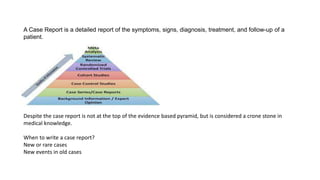
A Case Report is a detailed report of the symptoms, signs, diagnosis, treatment, and follow-up of a
patient.
Despite the case report is not at the top of the evidence based pyramid, but is considered a crone stone in
medical knowledge.
When to write a case report?
New or rare cases
New events in old cases
The general format of research paper:
The research paper to be accepted should be written in scientific format:
IMRaD
Abstract
I= introduction
M= method.
R= result.
D= discussion
Conclusion
References
Title
•Your case.
•Should contain the “case report” statement.
•Focus and interest.
•Novel or unusual.
•Should be written in a Title Style.
Key Words
•Usually are 2 to 5 key words which enable readers to find your paper.
•One of them is (case report).
•amniotic fluid, vernix caseosa, peritonitis, vernix caseosa peritonitis, caesarean
section, pregnancy, acute abdomen, laparotomy, laparoscopy, case report
Abstract – (structured or unstructured)
(Is the summary of your paper)
Introduction:
Briefly indicate why your case is novel.
Indicate the importance of your case I.e. What does it contribute to medical knowledge?
Case presentation:
The most relevant patient’s profile.
The most important keys in the history, clinical examination, labs, diagnostic imaging, diagnosis, treatment,
outcome and follow up.
Discussion
The key points in the discussion part.
Conclusion
One or more of learned lessons from this case.
Introduction
(Is means what is your idea, thesis, and research problem)
•General background
• Shortly indicate why your case is important
•What is new? Or a knowledge gap.
•In this section you need references.
Case presentation/ report
•patient identification: age, gender, and ….
•The presenting complaint and its details.
•Past medical and surgical history.
•Drug and allergy history.
•Familial and social history.
•Clinical examination: signs and symptoms.
•Diagnosis and differential diagnosis.
•Laboratory results.
•Imaging findings.
•Histopathology report.
•Figures, table, and photos.
•Treatment.
•Complications.
•Follow up.
Discussion
(summarizing and interpretation the main findings in the case report)
A-Widen the importance of the case
(in the introduction it was short)
B-Linking the case with the current literature:
-Compare and contrast (similarities and differences in the key points between your case and what was already
published).
-Indicate the power of your case:
Importance, uniqueness, and what will add to the literature?
-Indicate the limitations in your case:
C-Giving a result, explanation, or clinical implications, should be very cautious.
-In this section you need references.
Conclusion
(Is the take home massage)
•One paragraph.
•It is NOT the summary of your paper
•What are the lesson/lessons learned from this case?
•Raise a non-answered question:
•to stimulate the researchers in trying to solve the question.
•Recommendation for further research.
Informed Consent
The patient should be counselled and sign the consent.
references:
 Vancouver style (the most common):
 authors, title, journal, year, page/issue, DOI.
 Maximum 15-20 references.
thank you

How to Write a Case Report.pptx

  • 1.
    How to Writea Case Report By Dr Nuaman Ahmad Danawar General surgeon Security forces hospital -Dammam
  • 2.
    A Case Reportis a detailed report of the symptoms, signs, diagnosis, treatment, and follow-up of a patient. Despite the case report is not at the top of the evidence based pyramid, but is considered a crone stone in medical knowledge. When to write a case report? New or rare cases New events in old cases
  • 3.
    The general formatof research paper: The research paper to be accepted should be written in scientific format: IMRaD Abstract I= introduction M= method. R= result. D= discussion Conclusion References
  • 4.
    Title •Your case. •Should containthe “case report” statement. •Focus and interest. •Novel or unusual. •Should be written in a Title Style.
  • 5.
    Key Words •Usually are2 to 5 key words which enable readers to find your paper. •One of them is (case report). •amniotic fluid, vernix caseosa, peritonitis, vernix caseosa peritonitis, caesarean section, pregnancy, acute abdomen, laparotomy, laparoscopy, case report
  • 6.
    Abstract – (structuredor unstructured) (Is the summary of your paper) Introduction: Briefly indicate why your case is novel. Indicate the importance of your case I.e. What does it contribute to medical knowledge? Case presentation: The most relevant patient’s profile. The most important keys in the history, clinical examination, labs, diagnostic imaging, diagnosis, treatment, outcome and follow up. Discussion The key points in the discussion part. Conclusion One or more of learned lessons from this case.
  • 7.
    Introduction (Is means whatis your idea, thesis, and research problem) •General background • Shortly indicate why your case is important •What is new? Or a knowledge gap. •In this section you need references.
  • 8.
    Case presentation/ report •patientidentification: age, gender, and …. •The presenting complaint and its details. •Past medical and surgical history. •Drug and allergy history. •Familial and social history. •Clinical examination: signs and symptoms. •Diagnosis and differential diagnosis. •Laboratory results. •Imaging findings. •Histopathology report. •Figures, table, and photos. •Treatment. •Complications. •Follow up.
  • 9.
    Discussion (summarizing and interpretationthe main findings in the case report) A-Widen the importance of the case (in the introduction it was short) B-Linking the case with the current literature: -Compare and contrast (similarities and differences in the key points between your case and what was already published). -Indicate the power of your case: Importance, uniqueness, and what will add to the literature? -Indicate the limitations in your case: C-Giving a result, explanation, or clinical implications, should be very cautious. -In this section you need references.
  • 10.
    Conclusion (Is the takehome massage) •One paragraph. •It is NOT the summary of your paper •What are the lesson/lessons learned from this case? •Raise a non-answered question: •to stimulate the researchers in trying to solve the question. •Recommendation for further research.
  • 11.
    Informed Consent The patientshould be counselled and sign the consent.
  • 12.
    references:  Vancouver style(the most common):  authors, title, journal, year, page/issue, DOI.  Maximum 15-20 references.
  • 13.