Workshop on Medical Writing
and Publication
Bangladesh Society of Medicine
Dhaka, Bangladesh
10–14 December 2011
Writing a Case Report
Barbara Gastel, MD, MPH
Texas A&M University
bgastel@cvm.tamu.edu
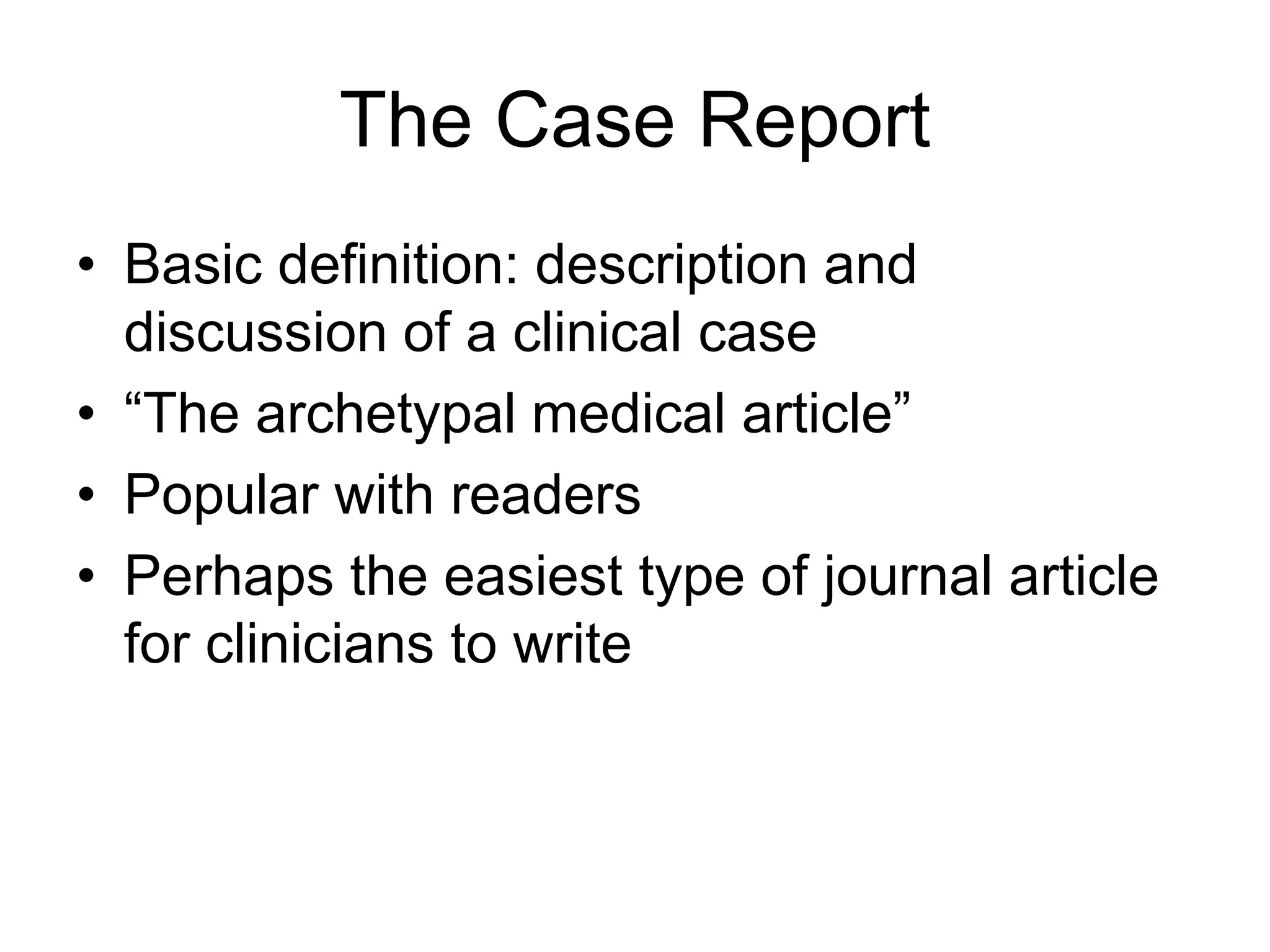
The Case Report
• Basic definition: description and
discussion of a clinical case
• “The archetypal medical article”
• Popular with readers
• Perhaps the easiest type of journal article
for clinicians to write
Functions
• Presenting newly found
– Conditions
– Manifestations
– Disease mechanisms
– Effects of drugs
– Etc
• Teaching
– Students
– Health professionals
Potential Publication Sites
• Research-oriented medical journals
– General medical journals
– Specialty and subspecialty journals
– (Note: sometimes include cases as letters)
• Teaching-oriented publications
– Journals
– Textbooks etc
• Journals specializing in case reports
Examples of Case-Report
Journals
• BMJ Case Reports
(http://casereports.bmj.com/)
• Journal of Medical Case Reports
(http://www.jmedicalcasereports.com/)
• Case Reports in Gastroenterology
(http://content.karger.com/ProdukteDB/pro
dukte.asp?Aktion=JournalHome&Produkt
Nr=232833)
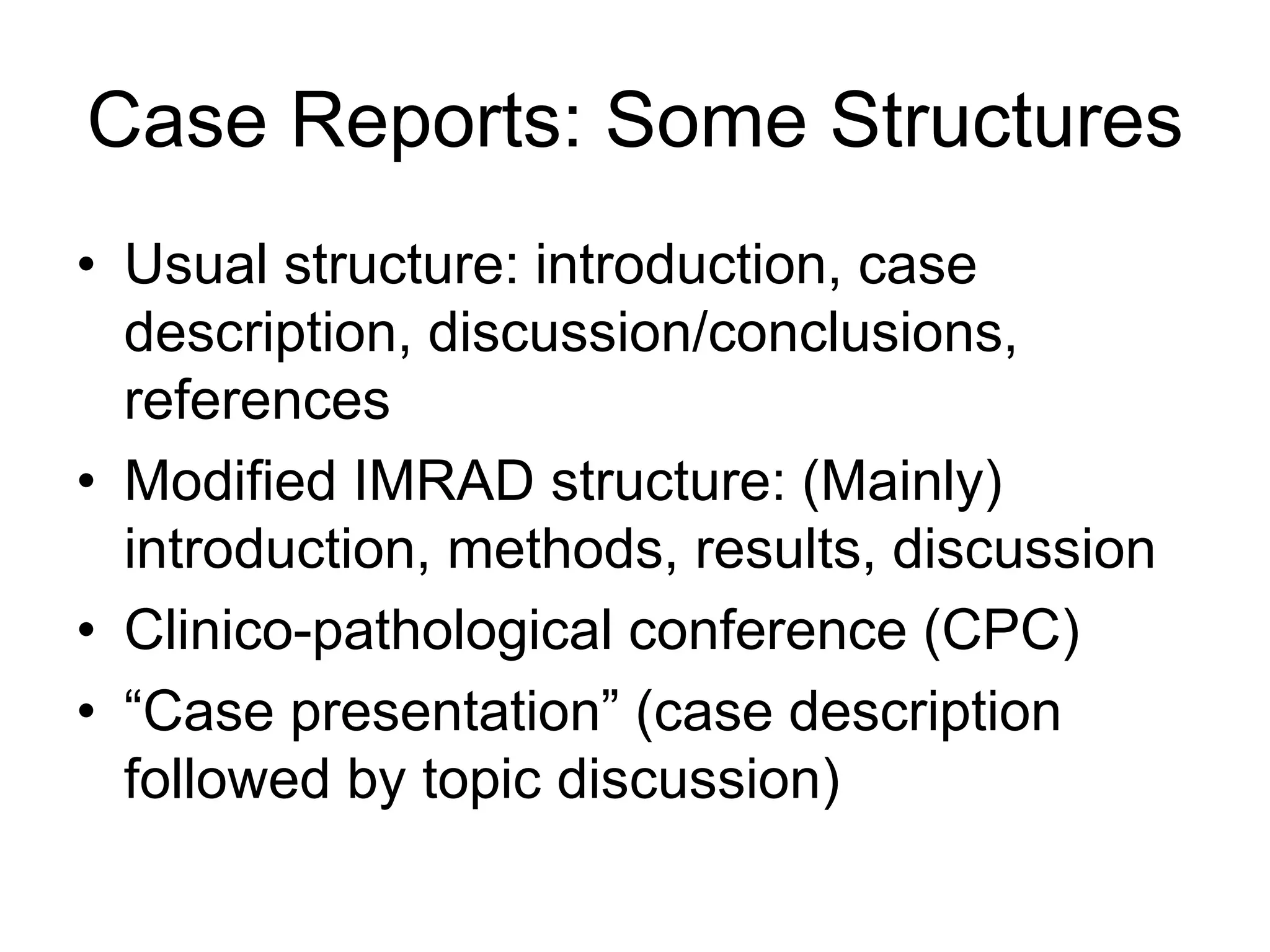
Case Reports: Some Structures
• Usual structure: introduction, case
description, discussion/conclusions,
references
• Modified IMRAD structure: (Mainly)
introduction, methods, results, discussion
• Clinico-pathological conference (CPC)
• “Case presentation” (case description
followed by topic discussion)
General Pointers
• Consult the journal’s instructions to authors.
• Use other case reports in the same journal as
models.
• Review the literature.
• Cite the literature selectively. (Case reports
generally have short reference lists.)
• Consider including one or more figures or tables.
• Provide an informative title.
• Write in a style that clinicians will find readable.
Section-by-Section Advice
• Introduction:
– Provide background to help readers
appreciate the case.
– Note why the case is being reported.
• Case description:
– Focus on aspects relating to why the case is
being reported.
– Therefore include mainly pertinent positives
and negatives.
Section-by-Section Advice
(cont)
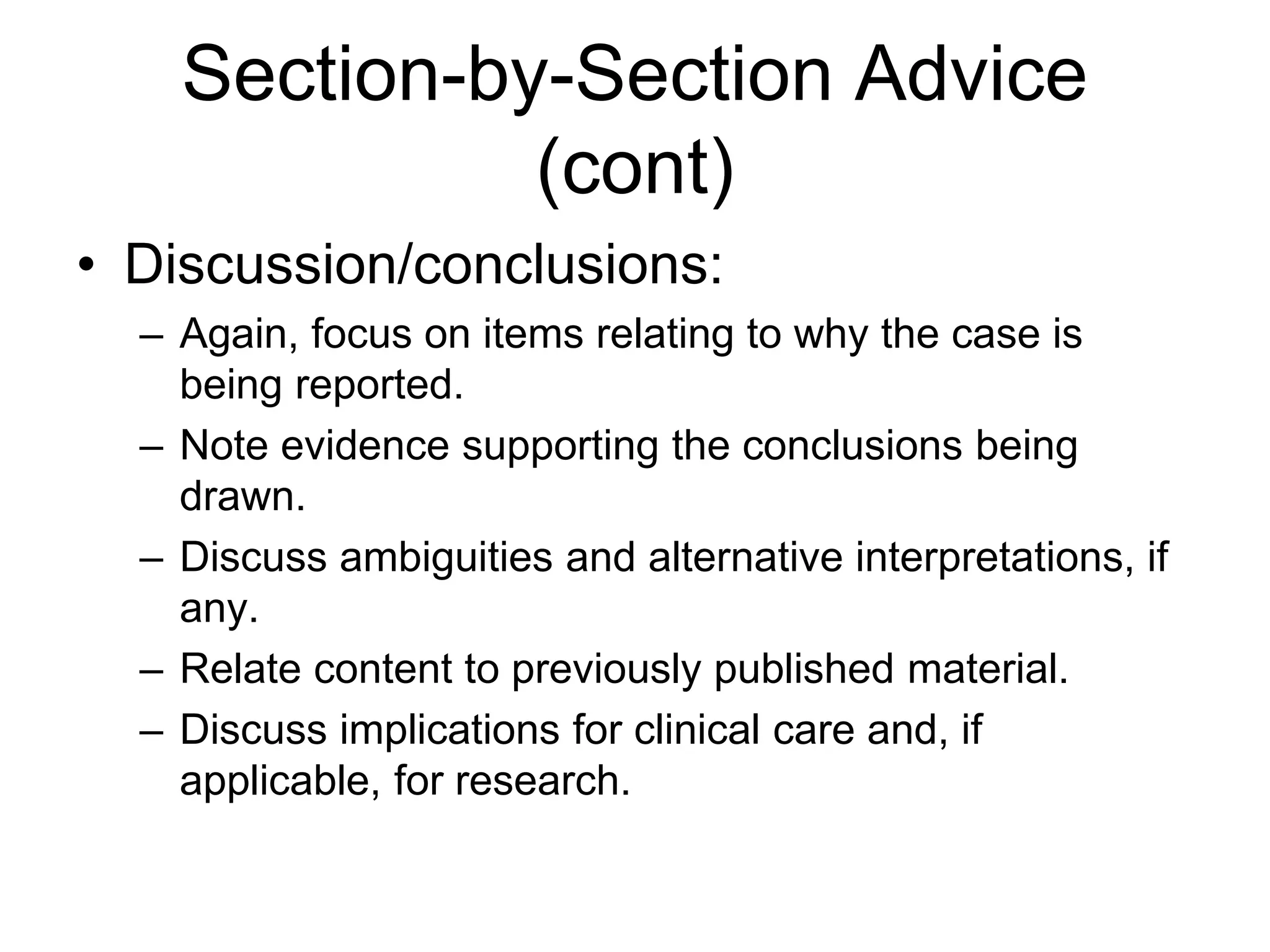
• Discussion/conclusions:
– Again, focus on items relating to why the case is
being reported.
– Note evidence supporting the conclusions being
drawn.
– Discuss ambiguities and alternative interpretations, if
any.
– Relate content to previously published material.
– Discuss implications for clinical care and, if
applicable, for research.
Case Reports: Some Issues
• Obtaining data and documentation on
potentially publishable cases
• Confidentiality of information and photos
• Sensitivity of wording
• Style Points
– “Case” versus “patient”
– Drug names (generic or trade, capitalization)
– Avoiding excessive capitalization of disease
names

writing-case-reports.ppt

  • 1.
    Workshop on MedicalWriting and Publication Bangladesh Society of Medicine Dhaka, Bangladesh 10–14 December 2011
  • 2.
    Writing a CaseReport Barbara Gastel, MD, MPH Texas A&M University bgastel@cvm.tamu.edu
  • 3.
    The Case Report •Basic definition: description and discussion of a clinical case • “The archetypal medical article” • Popular with readers • Perhaps the easiest type of journal article for clinicians to write
  • 4.
    Functions • Presenting newlyfound – Conditions – Manifestations – Disease mechanisms – Effects of drugs – Etc • Teaching – Students – Health professionals
  • 5.
    Potential Publication Sites •Research-oriented medical journals – General medical journals – Specialty and subspecialty journals – (Note: sometimes include cases as letters) • Teaching-oriented publications – Journals – Textbooks etc • Journals specializing in case reports
  • 6.
    Examples of Case-Report Journals •BMJ Case Reports (http://casereports.bmj.com/) • Journal of Medical Case Reports (http://www.jmedicalcasereports.com/) • Case Reports in Gastroenterology (http://content.karger.com/ProdukteDB/pro dukte.asp?Aktion=JournalHome&Produkt Nr=232833)
  • 7.
    Case Reports: SomeStructures • Usual structure: introduction, case description, discussion/conclusions, references • Modified IMRAD structure: (Mainly) introduction, methods, results, discussion • Clinico-pathological conference (CPC) • “Case presentation” (case description followed by topic discussion)
  • 8.
    General Pointers • Consultthe journal’s instructions to authors. • Use other case reports in the same journal as models. • Review the literature. • Cite the literature selectively. (Case reports generally have short reference lists.) • Consider including one or more figures or tables. • Provide an informative title. • Write in a style that clinicians will find readable.
  • 9.
    Section-by-Section Advice • Introduction: –Provide background to help readers appreciate the case. – Note why the case is being reported. • Case description: – Focus on aspects relating to why the case is being reported. – Therefore include mainly pertinent positives and negatives.
  • 10.
    Section-by-Section Advice (cont) • Discussion/conclusions: –Again, focus on items relating to why the case is being reported. – Note evidence supporting the conclusions being drawn. – Discuss ambiguities and alternative interpretations, if any. – Relate content to previously published material. – Discuss implications for clinical care and, if applicable, for research.
  • 11.
    Case Reports: SomeIssues • Obtaining data and documentation on potentially publishable cases • Confidentiality of information and photos • Sensitivity of wording • Style Points – “Case” versus “patient” – Drug names (generic or trade, capitalization) – Avoiding excessive capitalization of disease names