REVIEW OF LITERATURE
NISHA CLEMENT
Vice-Principal
VSS College of Nursing
Introduction
Review is……………………….
• Nutshell information of entire research
process
• Gain knowledge from old to new
• It is a “map” which guides to obtain
‘Knowledge treasure’
Why review?
Establish links to the proposed study
Theoretical background to the study
Contextualize the findings
Bring clarity and focus the research problem
Strengthen methodology
Broaden knowledge base in research area
Searching the unknown with what is known
How and what to review?
Why talk about lit reviews?
“…I don’t even know
what to research, yet!”
“…I still need to do more
reading before I can
actually think about
writing a literature
review!”
My experience ………..
Definition
• As a broad, comprehensive, in depth,
systematic and critical review of scholarly
publications, unpublished scholarly print
materials, audio-visual materials, and
personal publications.
• It IS an analysis and synthesis of primary
source materials, written in a specific style
which flows from broad to narrow, and
takes into account both the theoretical and
empirical issues of the problem without
over citing any source or sources.
The term “literature” refers to activities
Involved in identifying , searching for
information on a topic in order to
develop a comprehensive picture to
gain knowledge on that topic
The term also designate a written
summary of state of art on a research
problem
• What should I research?
• What should I read?
• Where can I find more on …?
• What have others done?
• Is there anything left for me to research?
• How do I know this hasn’t been done before?
• When should I start to write?
•What should I write about?
•How do I write a literature review
Important questions
Purpose
• Delimiting the problem
• Seek new approaches
• Avoid duplication
• Provide insight about the methodology
• Recommendations for further research
• Sampling current opinion
objectives :…..
-Identify research problem, develop hypothesis,
research questions
-orientation to what is known and not?
-determine the gaps, inconsistencies
-identify innovative clinical interventions via empirical
testing
-identify suitable designs , data collection methods for
the study
-recognize the experts in the field, find out funding
resources
-helps to assist in interpreting the findings, develop
implications and recommendations for further study
Uses :
• In Research :
For applying qualitative design in
-phenomenological study- compare and combine
the findings
-grounded theory- to explain, support and extend
the theory generated
-ethnography- provides a background for
conducting study
-historical studies-to develop research questions,
forms a source of data in the study
Uses :
• Use quantitative designs in all the steps of the
research process i.e.
-identify problem
-Need significance
-question/hypothesis
-theoretical/conceptual framework
-design/methodology-tools, data collection
methods and type of analysis
-Findings
-simplification of findings
-recommendations
Other uses
• Help to prepare Oral presentations,
debates on a topic or issue
• Implement research based nursing
interventions.
• Help to sort out and develop hospital
specific nursing protocol related patient
care
• Develop practice guidelines to ensure
continues quality assurance
Sources:
• Primary: they are research reports which are
descriptions of studies done by the researcher
who conducted them e.g. thesis, articles
published in journal, books
For e.g. An original qualitative study on patient
experiences in ICU: Hupcep, J.E(2000),
Feeling safe: The psychosocial needs of ICU
patients .Journal of nursing scholarship, 32,
361-367
Secondary source:
they are the research documents ,
descriptions of studies prepared by
someone other than the original researcher.
For e.g. a review of literature on patient
experience in ICU: stein- parbury, (2000)
patient’s experience of being in ICU care : a
select literature review
note: secondary source cannot be a
substitute always, if primary source is not
located it , secondary source provides ideas
about the concept that is searched
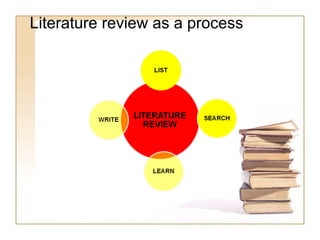
Literature review as a process
Skills required to do review:
•
1.critical thinking skill- researcher need to
engage with
• -Art of thinking which should be clear, precise,
accurate, relevant, consistent and fair
• -Art of constructive skepticism
• -Art of clarifying what to understand, what is
not known
• Art of identifying , removing bias, prejudice and
one-sided thought
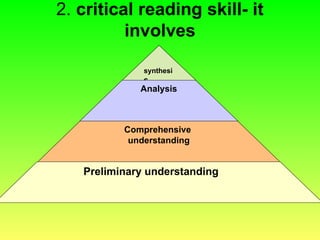
2. critical reading skill- it
involves
synthesi
s
Analysis
Comprehensive
understanding
Preliminary understanding
Preliminary understanding:
• -orientation on main steps of research
process
• Making notes on the photo copied article
• Mention the key variable on the top of
photo copied article
• Underline the unfamiliar terms
• Reviewing the old and the new terms
before next reading
• Keep the research text and dictionary
Comprehensive understanding
• Review the unfamiliar terms for the second
time
• Clarify any additional terms
• Reading the additional sources
• Requesting other faculty member to read
the photocopy of the annotated attitude
• Stating the main theme of the article in
own words
Analysis understanding
This stage help to critique the review
• be familiar with the critique strategies
• analyze whether comprehensive reading
meets critiquing criteria
• Consult with an expert to analyze contents
with same criteria and compare the results
• Make a note on what correction made, find
how?each step measures up established
criteria
Synthesis understanding
• Review the article on each step measured up
against established criteria
• Briefly summarize the study in your own words
-components
-overall strength and weakness
Limit the summary in one page
Include the citation at the top of the page
Staple the summary to the top of the photocopied
article
Guidelines to critique the review:
identify the primary data-base cited in the review
are the references current?
Are relevant studies and theories identified?
Are Relevant landmark described in the studies?
Are the sources paraphrased to promote the flow
of content presented?
Is current knowledge about the research problem
described?
Is the review of literature clearly, logically
developed ,written concisely?
Steps :To kept in mind
• Step-1
Select a pertinent book or article from the
general review of literature- read preface
Rapidly to determine author purpose, then
thumb through the chapter quickly asses
the substance- retain sound and pertinent
literature to do the critique
Step-2
• Summarize and record the information,
note the following:
• Author name
- Year of publications
- Title
- Journal name
-Volume. No,
-Issue number, page number-all are
needed to find an article
Step-3
Record the information in following order:
• Problem statement
• Definition of the concept
• Hypothesis if any
• Theories or assumptions
• Research methodology, samples
• Instruments and the scales used
• Type of research conducted
• Methods, findings of data analysis
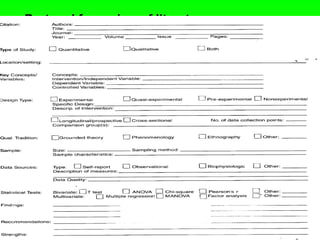
• interpretation of the data- hypothesis accepted or rejected
• Recommendations and suggestions for further research
• Make a special note on implications for nursing practice and
theory
Step-4
• Note the data that is not included, such as
limitations, means of establishing the
validity and the reliability of the instrument
Types of research reviews….
Identified in the form of research
reports written as
Abstracts:
brief description of the study
-about 200words
-research questions, variables, place of
study conducted
-methodology used, samples ,data
collection methods, instrument used
implications for nursing practice
for example:
ASSESSMENT OF EFFECTIVENESS OF STRUCTURED TEACHING
PROGRAMME ON SELF CARE MANAGEMENT OF HEMODIALYSIS
AMONG PATIENTS WITH END STAGE RENAL DISEASE
Abstract
The study was conducted at Khivraj Chordia Memorial Dialysis Centre,
Mylapore, and Chennai, to assess the effectiveness of structured
teaching programme on self care management of Hemodialysis among
patients with End Stage Renal Disease. Thirty patients were selected
as study samples. The existing level of knowledge was assessed with
the help of structured questionnaire followed by the structured teaching
of self care management of Hemodialysis. The post test level of
knowledge was assessed after 3 days using the same structured
questionnaire. The analysis showed that majority of them had
inadequate knowledge in pretest where as in post test majority of them
had adequate knowledge.
Research report has four
main section:
1) introduction
2) method
3) result
4)discussion
Introduction:
after abstract follows the introduction section- main points include are:
1) the central phenomenon, concepts or variables under study
2) the statement of the purpose, research questions, or hypothesis to
be tested
3) a review of related literature
4)the theoretical frame work
5) the significance and the need for the study
For e.g. INTRODUCTION:
Historically the age of patients developing End Stage Renal Disease
steadily rose each year, but it appears to have stabilized since 1993 at
a mean age of 60 years. Kidney damage goes unnoticed in the early
stages, as there are no alarming symptoms. Chronic and maintenance
dialysis is indicated in End Stage Renal Disease which is very
expensive. It is estimated that 100,000 people are developing End
Stage Renal Disease each year. For patients with End Stage Renal
disease, depending on hemodialysis the self care management plays a
vital role in extending their life span
BACKGROUND OF THE STUDY: End Stage Renal Disease is a
major cause of morbidity and mortality. Currently 60- 70% of patients
are treated with maintenance dialysis. The five years survival rate for
the patients undergoing dialysis is approximately 35%. Patients with
End Stage Renal Disease on Hemodialysis have demanding treatment
regimen that includes dietary management, fluid regulation, and care of
vascular access site. But they often fail to follow the prescribed diet
and fluid regimen, which undermines the effectiveness of care and
leads to unpredictable progression of the disease and greater
livelihood of complications. Patient’s education is an important
component in management of End Stage Renal Disease to maintain a
quality life.
OBJECTIVES:
1. To assess the existing level of knowledge on self care management
of hemodialysis among patients with End Stage Renal Disease.
2. To assess the post level of knowledge oneself care management of
hemodialysis among patients with End Stage Renal Disease.
3. To assess the effectiveness of structured teaching programme on
self care management of hemodialysis among patients with End Stage
Renal Disease.
4. To associate the post test level of knowledge on self care
management of
hemodialysis among patients with their demographic variables
2) Method section: it includes
-the research design
-the subjects
-measures and data collection
-study procedures
FOR e.g.: METHODOLOGY: A pre experimental one group pre test
post test study was conducted Khivraj Chordia Memorial Dialysis
Centre. Mylapore, Chennai, to assess the effectiveness of structured
teaching programme of knowledge on self care management of
hemodialysis among patients with end stage renal disease.
Sample
The sample comprised of thirty (30) patients receiving
hemodialysis. .Convenient sampling technique was used.
Inclusion Criteria
1. Patients diagnosed to have End Stage Renal Disease within 3 years
2. Patients in the age group of 20-60 years
3. Patients receiving dialysis twice in a week
4. Patients who can speak and understand English and Tamil
Exclusion Criteria
1. Patients not willing to participate in the study.
2. Critically ill patients.
Instrument
The instrument used had four sections.
Section 1: Multiple choice questions to assess the level of knowledge
on End Stage Renal Disease and complication.
Section 2: Questions related to dietary management.
Section 3: Questions related to fluid regulation (oral).
Section 4: Questions related to care of vascular access site.
ETHICAL CONSIDERATION: The study was
conducted after the approval of dissertation
committee research. Permission from the head of
the institution and the dialysis in charge were
obtained, to conduct the pilot study and the main
study. Informed verbal consent was obtained from
each patient. Confidentiality was maintained
throughout the study.
DATA COLLECTION PROCEDURE: Thirty
patients were selected for the study and the
information were collected from them using the
structured questionnaire followed by the structured
teaching programme. After three days post test
was conducted with the same questionnaire for the
same group.
RESULTS section :
it presents the research findings, often
accompanied by tables, figures, has
statistical information, values of statistics,
level of significance-
for example:
Data finding revealed that the pre test
knowledge mean value 34.67 with S.D of
15.33 whereas post test knowledge mean
value 79.11 with S.D of 7.97. Paired ‘C test
value was 15.18 which was highly significant
Discussion section:
it includes interpretation of the
results, implications, study
limitations
Type of review…………..
In the research proposal :
A review in the proposal provides knowledge about
the context, confirms the need for significance of
new research
It demonstrates writer’s commands of the literature
In thesis or dissertation:
Thorough review is made covering the topic,
directly, indirectly related to the problem area
Type of review……….
Free - standing literature review
• Nurses prepare review that are critically
appraised, summarize the body of
research about the topic useful in the
development of evidence based practice
• Research Experts perform integrative
review contribute to evidence based
practice
Covers 15-pages
Style of research journal articles:
- four factors contribute:
1) compactness- compress ideas in short
space
2) jargon- specific vocabulary used- not
used by every one-
3) objectivity-use of passive voice
4) statistical information- require knowledge
to understand mathematics
Performing the review:
1) using the library
2) identifying relevant research
sources
3) locating the relevant sources
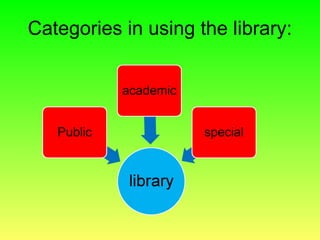
Categories in using the library:
Library departments:
library personal
interlibrary loan -department
circulation-department
reference-department
computer-
photocopy service-department
resources include:
journals
conference proceedings
master thesis
doctoral dissertations
2) identifying relevant research source
Search two types:
a) manual- brief examination, clarify, narrow
the topic, make a catalog list, indexes,
which help to direct computer search
b) computer search- scan the citations of
different data base, help to identify sources
relevant
Selection of database to search:
a bibliographical database is compilation of
citations
citations provide information to locate the
references
for e.g.
-Author name
- Year of publications
- Title
- Journal name
-Volume. No,
-Issue number, page number-all are needed
to find an article
selecting database for nursing:
• 1) CINHAL- Cumulative Index to Nursing
and Allied Health Literature accessible at
http://www.cinahl.com
-contains citations of nursing literature
published after 1955
- more than 800 journals, 21500 records
-initiated from 1983
-updated every month
-require payment for membership
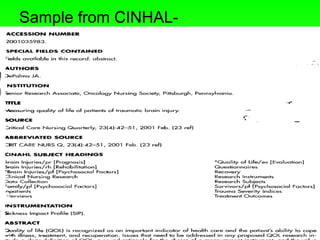
Sample from CINHAL-
MEDLINE
• 2)MEDLINE-Medical Literature Analysis and
Retrieval System accessible at
http://www.ncbi.nih.gov/entrez/.query.fcgi
-database offered by national library of medicine
-more than 40 databases
commonly used is the MEDLINE-online
has 6 million articles from 3500 journals
has separate file called “special list nursing”-has
citation from 260 nursing journals gives information
about Author name, Year of publications, Title,
Journal name ,Volume. No, Issue number, and
abstracts
AVLINE
• Audiovisual catalog on line
• 11000 a. v packages supplied by national library
medicine gives information on
• nurse patient relationships, nursing care , nursing
audit and legal aspects of nursing
• information’s are updated every month
• Information about- title, media type, authorship,
physical description, indexing terms, run time,
audience level review rating/date, reviewer, learning
method, abstract
• Continuing education credit note, price and source for
purchase loan
BIOETHICSLINE:
deals with the ethical questions arising in the
health scenario, biomedical research on the
humans, patients rights, death and dying
suppliers by the national library of medicine and
Kennedy institute of ethics
include citation from the year 1973 updated 3
times a year
gives information about –author, title, source,
indexing terms, language and type of publication
CANCERLIT:
contains more than 68000 citations from
3000 journals, books conference
proceedings , thesis and reports
suppliers by national library of medicine and
cancer institute
covers all the aspects of cancer from the
year 1963
updated monthly
databases includes –author, authors
affiliation, title, abstract, language, type of
publication and indexing terms
Combined information database: CHID
contains more than 44000 citations and
abstract information for health
professionals , patients and general public
covers the topic on- Alzheimer's ,AIDS-
education, blood pressure and cholesterol
education
initiated in the year 1973
updated 4 times a year
CATLINE:
this database contains about 500,000
reference for the books , serial
cataloged at national library of
medicine
information include: author, title,
source, language, indexing terms
originated at in the year 1965
updated weekly
Electronic literature search: to sort out the relevant
database
bibliographic files :
1) Aries knowledge-www.ariessys.com
2) EBSCO information system-www.ebsco.com
3) Ovid technologies-www.ovid.com
4) paper chase-www.paperchase.com
5) sliver platter information-www.sliverplatter.com
Reference management software:
it make easy to track the references
that obtained through the searches
commonly used package:
http://www.isirese
archsoft.com/pc/pchome.asp
http://www.endnote.com
Use of key words :
a) name the database used
b) date the search performed
c) exact search strategy is used
d)record number of articles noted
e) percentage of relevant article
found
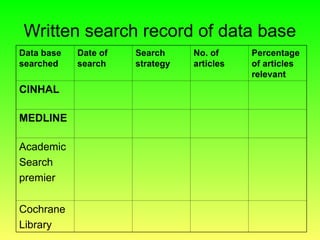
Written search record of data base
Data base
searched
Date of
search
Search
strategy
No. of
articles
Percentage
of articles
relevant
CINHAL
MEDLINE
Academic
Search
premier
Cochrane
Library
locating the relevant sources:
steps-
1) organizing the list of identified sources
2) searching the internet and library for
those sources
3) systematically recording references
Organizing list of the sources
identified:
a) journal source by author name, year
b) library catalog-books, conference,
publication by author name or subject
c) eliminate the duplicate reference
2)searching the library and internet for
the sources:
full version of the article can be obtained should
be saved in the HTML or PDF version
-Sigma Theta Tau International-they are online
journal of knowledge synthesis for nursing-
www.nursingknowledgeinternational.com
-need computer + modem + network + internet-
OCLC- online computer library center
needs subscription online -journal
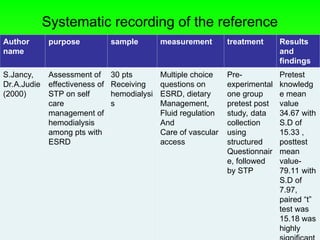
Systematic recording of the reference
Author
name
purpose sample measurement treatment Results
and
findings
S.Jancy,
Dr.A.Judie
(2000)
Assessment of
effectiveness of
STP on self
care
management of
hemodialysis
among pts with
ESRD
30 pts
Receiving
hemodialysi
s
Multiple choice
questions on
ESRD, dietary
Management,
Fluid regulation
And
Care of vascular
access
Pre-
experimental
one group
pretest post
study, data
collection
using
structured
Questionnair
e, followed
by STP
Pretest
knowledg
e mean
value
34.67 with
S.D of
15.33 ,
posttest
mean
value-
79.11 with
S.D of
7.97,
paired “t”
test was
15.18 was
highly
Protocol for review of literature
Writing the review of literature :
begins with-
1) introduction
2) presentation of the relevant
studies
3) conclude with summary of the
current knowledge
Introduction: indicates focus, purpose, describes
organization of sources, should be brief,
interesting to capture the attention
rewritten several times
content- for each study write the purpose, sample,
size, design, specific findings should be presented
with a scholarly ,brief and concise, include strength
and weakness
six typical ways of organizing the
sources into a review:
Chronological
By publication
By trend
Thematic
Methodological
Question for Further Research
critique should be clear, concise, context best paraphrased
in own words
short direct quotation used to promote the flow of ideas,
ethical issues to be considered, honest representation of
weakness of the study in a neutral way
Summary: concise presentation of
research knowledge about the selected
d topic, include what was known and
not known, once finalized take decision
whether obtained review gives
adequate knowledge
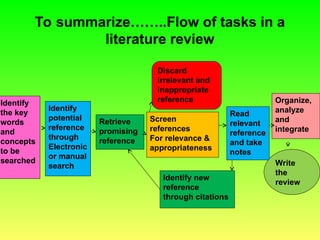
To summarize……..Flow of tasks in a
literature review
Identify
the key
words
and
concepts
to be
searched
Identify
potential
reference
through
Electronic
or manual
search
Retrieve
promising
reference
Discard
irrelevant and
inappropriate
reference
Screen
references
For relevance &
appropriateness
Identify new
reference
through citations
Read
relevant
reference
and take
notes
Organize,
analyze
and
integrate
Write
the
review
Conclusion:
reviewing the literature is an art, which
needs patience, nurse should possess
the skill in critical thinking, reading,
writing, clarifying the facts with the
expert, critiquing the research articles
will help the student to reach the
treasure of knowledge that is searched
Thank you

Nursing Research Methodology123x45678910

  • 1.
    REVIEW OF LITERATURE NISHACLEMENT Vice-Principal VSS College of Nursing
  • 2.
    Introduction Review is………………………. • Nutshellinformation of entire research process • Gain knowledge from old to new • It is a “map” which guides to obtain ‘Knowledge treasure’
  • 3.
    Why review? Establish linksto the proposed study Theoretical background to the study Contextualize the findings Bring clarity and focus the research problem Strengthen methodology Broaden knowledge base in research area Searching the unknown with what is known
  • 4.
    How and whatto review? Why talk about lit reviews? “…I don’t even know what to research, yet!” “…I still need to do more reading before I can actually think about writing a literature review!”
  • 5.
  • 6.
    Definition • As abroad, comprehensive, in depth, systematic and critical review of scholarly publications, unpublished scholarly print materials, audio-visual materials, and personal publications. • It IS an analysis and synthesis of primary source materials, written in a specific style which flows from broad to narrow, and takes into account both the theoretical and empirical issues of the problem without over citing any source or sources.
  • 7.
    The term “literature”refers to activities Involved in identifying , searching for information on a topic in order to develop a comprehensive picture to gain knowledge on that topic The term also designate a written summary of state of art on a research problem
  • 8.
    • What shouldI research? • What should I read? • Where can I find more on …? • What have others done? • Is there anything left for me to research? • How do I know this hasn’t been done before? • When should I start to write? •What should I write about? •How do I write a literature review Important questions
  • 9.
    Purpose • Delimiting theproblem • Seek new approaches • Avoid duplication • Provide insight about the methodology • Recommendations for further research • Sampling current opinion
  • 10.
    objectives :….. -Identify researchproblem, develop hypothesis, research questions -orientation to what is known and not? -determine the gaps, inconsistencies -identify innovative clinical interventions via empirical testing -identify suitable designs , data collection methods for the study -recognize the experts in the field, find out funding resources -helps to assist in interpreting the findings, develop implications and recommendations for further study
  • 11.
    Uses : • InResearch : For applying qualitative design in -phenomenological study- compare and combine the findings -grounded theory- to explain, support and extend the theory generated -ethnography- provides a background for conducting study -historical studies-to develop research questions, forms a source of data in the study
  • 12.
    Uses : • Usequantitative designs in all the steps of the research process i.e. -identify problem -Need significance -question/hypothesis -theoretical/conceptual framework -design/methodology-tools, data collection methods and type of analysis -Findings -simplification of findings -recommendations
  • 13.
    Other uses • Helpto prepare Oral presentations, debates on a topic or issue • Implement research based nursing interventions. • Help to sort out and develop hospital specific nursing protocol related patient care • Develop practice guidelines to ensure continues quality assurance
  • 14.
    Sources: • Primary: theyare research reports which are descriptions of studies done by the researcher who conducted them e.g. thesis, articles published in journal, books For e.g. An original qualitative study on patient experiences in ICU: Hupcep, J.E(2000), Feeling safe: The psychosocial needs of ICU patients .Journal of nursing scholarship, 32, 361-367
  • 15.
    Secondary source: they arethe research documents , descriptions of studies prepared by someone other than the original researcher. For e.g. a review of literature on patient experience in ICU: stein- parbury, (2000) patient’s experience of being in ICU care : a select literature review note: secondary source cannot be a substitute always, if primary source is not located it , secondary source provides ideas about the concept that is searched
  • 16.
  • 17.
    Skills required todo review: • 1.critical thinking skill- researcher need to engage with • -Art of thinking which should be clear, precise, accurate, relevant, consistent and fair • -Art of constructive skepticism • -Art of clarifying what to understand, what is not known • Art of identifying , removing bias, prejudice and one-sided thought
  • 18.
    2. critical readingskill- it involves synthesi s Analysis Comprehensive understanding Preliminary understanding
  • 19.
    Preliminary understanding: • -orientationon main steps of research process • Making notes on the photo copied article • Mention the key variable on the top of photo copied article • Underline the unfamiliar terms • Reviewing the old and the new terms before next reading • Keep the research text and dictionary
  • 20.
    Comprehensive understanding • Reviewthe unfamiliar terms for the second time • Clarify any additional terms • Reading the additional sources • Requesting other faculty member to read the photocopy of the annotated attitude • Stating the main theme of the article in own words
  • 21.
    Analysis understanding This stagehelp to critique the review • be familiar with the critique strategies • analyze whether comprehensive reading meets critiquing criteria • Consult with an expert to analyze contents with same criteria and compare the results • Make a note on what correction made, find how?each step measures up established criteria
  • 22.
    Synthesis understanding • Reviewthe article on each step measured up against established criteria • Briefly summarize the study in your own words -components -overall strength and weakness Limit the summary in one page Include the citation at the top of the page Staple the summary to the top of the photocopied article
  • 23.
    Guidelines to critiquethe review: identify the primary data-base cited in the review are the references current? Are relevant studies and theories identified? Are Relevant landmark described in the studies? Are the sources paraphrased to promote the flow of content presented? Is current knowledge about the research problem described? Is the review of literature clearly, logically developed ,written concisely?
  • 24.
    Steps :To keptin mind • Step-1 Select a pertinent book or article from the general review of literature- read preface Rapidly to determine author purpose, then thumb through the chapter quickly asses the substance- retain sound and pertinent literature to do the critique
  • 25.
    Step-2 • Summarize andrecord the information, note the following: • Author name - Year of publications - Title - Journal name -Volume. No, -Issue number, page number-all are needed to find an article
  • 26.
    Step-3 Record the informationin following order: • Problem statement • Definition of the concept • Hypothesis if any • Theories or assumptions • Research methodology, samples • Instruments and the scales used • Type of research conducted • Methods, findings of data analysis • interpretation of the data- hypothesis accepted or rejected • Recommendations and suggestions for further research • Make a special note on implications for nursing practice and theory
  • 27.
    Step-4 • Note thedata that is not included, such as limitations, means of establishing the validity and the reliability of the instrument
  • 28.
    Types of researchreviews…. Identified in the form of research reports written as Abstracts: brief description of the study -about 200words -research questions, variables, place of study conducted -methodology used, samples ,data collection methods, instrument used implications for nursing practice
  • 29.
    for example: ASSESSMENT OFEFFECTIVENESS OF STRUCTURED TEACHING PROGRAMME ON SELF CARE MANAGEMENT OF HEMODIALYSIS AMONG PATIENTS WITH END STAGE RENAL DISEASE Abstract The study was conducted at Khivraj Chordia Memorial Dialysis Centre, Mylapore, and Chennai, to assess the effectiveness of structured teaching programme on self care management of Hemodialysis among patients with End Stage Renal Disease. Thirty patients were selected as study samples. The existing level of knowledge was assessed with the help of structured questionnaire followed by the structured teaching of self care management of Hemodialysis. The post test level of knowledge was assessed after 3 days using the same structured questionnaire. The analysis showed that majority of them had inadequate knowledge in pretest where as in post test majority of them had adequate knowledge.
  • 30.
    Research report hasfour main section: 1) introduction 2) method 3) result 4)discussion
  • 31.
    Introduction: after abstract followsthe introduction section- main points include are: 1) the central phenomenon, concepts or variables under study 2) the statement of the purpose, research questions, or hypothesis to be tested 3) a review of related literature 4)the theoretical frame work 5) the significance and the need for the study For e.g. INTRODUCTION: Historically the age of patients developing End Stage Renal Disease steadily rose each year, but it appears to have stabilized since 1993 at a mean age of 60 years. Kidney damage goes unnoticed in the early stages, as there are no alarming symptoms. Chronic and maintenance dialysis is indicated in End Stage Renal Disease which is very expensive. It is estimated that 100,000 people are developing End Stage Renal Disease each year. For patients with End Stage Renal disease, depending on hemodialysis the self care management plays a vital role in extending their life span
  • 32.
    BACKGROUND OF THESTUDY: End Stage Renal Disease is a major cause of morbidity and mortality. Currently 60- 70% of patients are treated with maintenance dialysis. The five years survival rate for the patients undergoing dialysis is approximately 35%. Patients with End Stage Renal Disease on Hemodialysis have demanding treatment regimen that includes dietary management, fluid regulation, and care of vascular access site. But they often fail to follow the prescribed diet and fluid regimen, which undermines the effectiveness of care and leads to unpredictable progression of the disease and greater livelihood of complications. Patient’s education is an important component in management of End Stage Renal Disease to maintain a quality life. OBJECTIVES: 1. To assess the existing level of knowledge on self care management of hemodialysis among patients with End Stage Renal Disease. 2. To assess the post level of knowledge oneself care management of hemodialysis among patients with End Stage Renal Disease. 3. To assess the effectiveness of structured teaching programme on self care management of hemodialysis among patients with End Stage Renal Disease. 4. To associate the post test level of knowledge on self care management of hemodialysis among patients with their demographic variables
  • 33.
    2) Method section:it includes -the research design -the subjects -measures and data collection -study procedures
  • 34.
    FOR e.g.: METHODOLOGY:A pre experimental one group pre test post test study was conducted Khivraj Chordia Memorial Dialysis Centre. Mylapore, Chennai, to assess the effectiveness of structured teaching programme of knowledge on self care management of hemodialysis among patients with end stage renal disease. Sample The sample comprised of thirty (30) patients receiving hemodialysis. .Convenient sampling technique was used. Inclusion Criteria 1. Patients diagnosed to have End Stage Renal Disease within 3 years 2. Patients in the age group of 20-60 years 3. Patients receiving dialysis twice in a week 4. Patients who can speak and understand English and Tamil Exclusion Criteria 1. Patients not willing to participate in the study. 2. Critically ill patients. Instrument The instrument used had four sections. Section 1: Multiple choice questions to assess the level of knowledge on End Stage Renal Disease and complication. Section 2: Questions related to dietary management. Section 3: Questions related to fluid regulation (oral). Section 4: Questions related to care of vascular access site.
  • 35.
    ETHICAL CONSIDERATION: Thestudy was conducted after the approval of dissertation committee research. Permission from the head of the institution and the dialysis in charge were obtained, to conduct the pilot study and the main study. Informed verbal consent was obtained from each patient. Confidentiality was maintained throughout the study. DATA COLLECTION PROCEDURE: Thirty patients were selected for the study and the information were collected from them using the structured questionnaire followed by the structured teaching programme. After three days post test was conducted with the same questionnaire for the same group.
  • 36.
    RESULTS section : itpresents the research findings, often accompanied by tables, figures, has statistical information, values of statistics, level of significance- for example: Data finding revealed that the pre test knowledge mean value 34.67 with S.D of 15.33 whereas post test knowledge mean value 79.11 with S.D of 7.97. Paired ‘C test value was 15.18 which was highly significant
  • 37.
    Discussion section: it includesinterpretation of the results, implications, study limitations
  • 38.
    Type of review………….. Inthe research proposal : A review in the proposal provides knowledge about the context, confirms the need for significance of new research It demonstrates writer’s commands of the literature In thesis or dissertation: Thorough review is made covering the topic, directly, indirectly related to the problem area
  • 39.
    Type of review………. Free- standing literature review • Nurses prepare review that are critically appraised, summarize the body of research about the topic useful in the development of evidence based practice • Research Experts perform integrative review contribute to evidence based practice Covers 15-pages
  • 40.
    Style of researchjournal articles: - four factors contribute: 1) compactness- compress ideas in short space 2) jargon- specific vocabulary used- not used by every one- 3) objectivity-use of passive voice 4) statistical information- require knowledge to understand mathematics
  • 41.
    Performing the review: 1)using the library 2) identifying relevant research sources 3) locating the relevant sources
  • 42.
    Categories in usingthe library:
  • 43.
    Library departments: library personal interlibraryloan -department circulation-department reference-department computer- photocopy service-department resources include: journals conference proceedings master thesis doctoral dissertations
  • 44.
    2) identifying relevantresearch source Search two types: a) manual- brief examination, clarify, narrow the topic, make a catalog list, indexes, which help to direct computer search b) computer search- scan the citations of different data base, help to identify sources relevant
  • 45.
    Selection of databaseto search: a bibliographical database is compilation of citations citations provide information to locate the references for e.g. -Author name - Year of publications - Title - Journal name -Volume. No, -Issue number, page number-all are needed to find an article
  • 46.
    selecting database fornursing: • 1) CINHAL- Cumulative Index to Nursing and Allied Health Literature accessible at http://www.cinahl.com -contains citations of nursing literature published after 1955 - more than 800 journals, 21500 records -initiated from 1983 -updated every month -require payment for membership
  • 47.
  • 48.
    MEDLINE • 2)MEDLINE-Medical LiteratureAnalysis and Retrieval System accessible at http://www.ncbi.nih.gov/entrez/.query.fcgi -database offered by national library of medicine -more than 40 databases commonly used is the MEDLINE-online has 6 million articles from 3500 journals has separate file called “special list nursing”-has citation from 260 nursing journals gives information about Author name, Year of publications, Title, Journal name ,Volume. No, Issue number, and abstracts
  • 49.
    AVLINE • Audiovisual catalogon line • 11000 a. v packages supplied by national library medicine gives information on • nurse patient relationships, nursing care , nursing audit and legal aspects of nursing • information’s are updated every month • Information about- title, media type, authorship, physical description, indexing terms, run time, audience level review rating/date, reviewer, learning method, abstract • Continuing education credit note, price and source for purchase loan
  • 50.
    BIOETHICSLINE: deals with theethical questions arising in the health scenario, biomedical research on the humans, patients rights, death and dying suppliers by the national library of medicine and Kennedy institute of ethics include citation from the year 1973 updated 3 times a year gives information about –author, title, source, indexing terms, language and type of publication
  • 51.
    CANCERLIT: contains more than68000 citations from 3000 journals, books conference proceedings , thesis and reports suppliers by national library of medicine and cancer institute covers all the aspects of cancer from the year 1963 updated monthly databases includes –author, authors affiliation, title, abstract, language, type of publication and indexing terms
  • 52.
    Combined information database:CHID contains more than 44000 citations and abstract information for health professionals , patients and general public covers the topic on- Alzheimer's ,AIDS- education, blood pressure and cholesterol education initiated in the year 1973 updated 4 times a year
  • 53.
    CATLINE: this database containsabout 500,000 reference for the books , serial cataloged at national library of medicine information include: author, title, source, language, indexing terms originated at in the year 1965 updated weekly
  • 54.
    Electronic literature search:to sort out the relevant database bibliographic files : 1) Aries knowledge-www.ariessys.com 2) EBSCO information system-www.ebsco.com 3) Ovid technologies-www.ovid.com 4) paper chase-www.paperchase.com 5) sliver platter information-www.sliverplatter.com
  • 55.
    Reference management software: itmake easy to track the references that obtained through the searches commonly used package: http://www.isirese archsoft.com/pc/pchome.asp http://www.endnote.com
  • 56.
    Use of keywords : a) name the database used b) date the search performed c) exact search strategy is used d)record number of articles noted e) percentage of relevant article found
  • 57.
    Written search recordof data base Data base searched Date of search Search strategy No. of articles Percentage of articles relevant CINHAL MEDLINE Academic Search premier Cochrane Library
  • 58.
    locating the relevantsources: steps- 1) organizing the list of identified sources 2) searching the internet and library for those sources 3) systematically recording references
  • 59.
    Organizing list ofthe sources identified: a) journal source by author name, year b) library catalog-books, conference, publication by author name or subject c) eliminate the duplicate reference
  • 60.
    2)searching the libraryand internet for the sources: full version of the article can be obtained should be saved in the HTML or PDF version -Sigma Theta Tau International-they are online journal of knowledge synthesis for nursing- www.nursingknowledgeinternational.com -need computer + modem + network + internet- OCLC- online computer library center needs subscription online -journal
  • 61.
    Systematic recording ofthe reference Author name purpose sample measurement treatment Results and findings S.Jancy, Dr.A.Judie (2000) Assessment of effectiveness of STP on self care management of hemodialysis among pts with ESRD 30 pts Receiving hemodialysi s Multiple choice questions on ESRD, dietary Management, Fluid regulation And Care of vascular access Pre- experimental one group pretest post study, data collection using structured Questionnair e, followed by STP Pretest knowledg e mean value 34.67 with S.D of 15.33 , posttest mean value- 79.11 with S.D of 7.97, paired “t” test was 15.18 was highly
  • 62.
    Protocol for reviewof literature
  • 63.
    Writing the reviewof literature : begins with- 1) introduction 2) presentation of the relevant studies 3) conclude with summary of the current knowledge
  • 64.
    Introduction: indicates focus,purpose, describes organization of sources, should be brief, interesting to capture the attention rewritten several times content- for each study write the purpose, sample, size, design, specific findings should be presented with a scholarly ,brief and concise, include strength and weakness
  • 65.
    six typical waysof organizing the sources into a review: Chronological By publication By trend Thematic Methodological Question for Further Research critique should be clear, concise, context best paraphrased in own words short direct quotation used to promote the flow of ideas, ethical issues to be considered, honest representation of weakness of the study in a neutral way
  • 66.
    Summary: concise presentationof research knowledge about the selected d topic, include what was known and not known, once finalized take decision whether obtained review gives adequate knowledge
  • 67.
    To summarize……..Flow oftasks in a literature review Identify the key words and concepts to be searched Identify potential reference through Electronic or manual search Retrieve promising reference Discard irrelevant and inappropriate reference Screen references For relevance & appropriateness Identify new reference through citations Read relevant reference and take notes Organize, analyze and integrate Write the review
  • 68.
    Conclusion: reviewing the literatureis an art, which needs patience, nurse should possess the skill in critical thinking, reading, writing, clarifying the facts with the expert, critiquing the research articles will help the student to reach the treasure of knowledge that is searched
  • 69.