TED
    ROGERS
  SCHOOL OF RYERSON
MANAGEMENT UNIVERSITY


           Business Plan Seminar
                     Dr. Dave Valliere
                Entrepreneurship & Strategy
Investor’s Screening Criteria
•    How much money can be made?
•    How quickly can it be made?
•    How will it be made?
•    How much investment is required?
•    How liquid is the investment?
•    How involved do I have to get?
•    Who else is involved?

Valliere
What Investors Like
• Large and rapidly expanding market
• Complete team of “stars”, with proven
  track records
• “10X” improvement
• Compelling strategy, competitive
  advantage, and business model
• Sustainability

Valliere
What Scares Them Off
• High risk, relative to the expected returns
• Seeking too much capital, or too little
       – High tides hide the rocks
• Quibbling over deal terms
• Lack of commitment, integrity, realism
• Weak managers
       – Poorly thought out Bizplans
       – Lack of Investor’s Perspective


Valliere
Your Business Opportunities
• An opportunity is not just an idea
       – “it can be done” is insufficient
       – “is it worth doing?”
• Think big, high-potential
       – Not “what can I do with what I have?”
       – Instead, “what will it take to do the right
         thing, and how can I get it?”
       – People like to back winners

Valliere
Opportunity Evaluation
•   What product or service will be sold?
•   Who will it be sold to?
•   How much will it cost to produce? Average selling?
•   How big is the target market?
•   What percentage of that market must be penetrated to
    reach $50 million in sales?
•   Who is the direct and indirect competition?
•   What is the sustainable competitive advantage?
•   Who is on the team?
•   Is the product complete? If not, when?


Valliere
DEVELOPING THE PLAN
• It doesn’t matter how flashy the document
  or the presentation, if the ideas are lame
  or half-baked
• You should want to wirebrush it more than
  anyone else
       – Not the case? Then you are wasting your time


Valliere
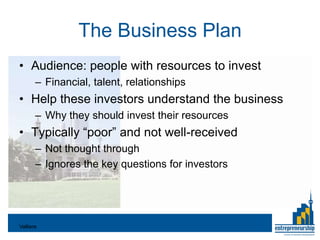
The Business Plan
• Audience: people with resources to invest
       – Financial, talent, relationships
• Help these investors understand the business
       – Why they should invest their resources
• Typically “poor” and not well-received
       – Not thought through
       – Ignores the key questions for investors


Valliere
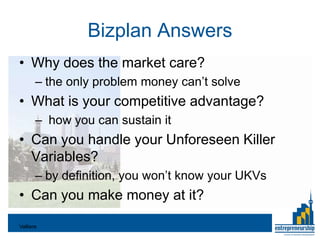
Bizplan Answers
• Why does the market care?
       – the only problem money can’t solve
• What is your competitive advantage?
       – how you can sustain it
• Can you handle your Unforeseen Killer
  Variables?
       – by definition, you won’t know your UKVs
• Can you make money at it?

Valliere
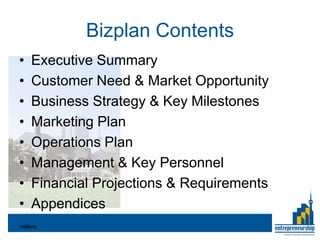
Bizplan Contents
•    Executive Summary
•    Customer Need & Market Opportunity
•    Business Strategy & Key Milestones
•    Marketing Plan
•    Operations Plan
•    Management & Key Personnel
•    Financial Projections & Requirements
•    Appendices
Valliere
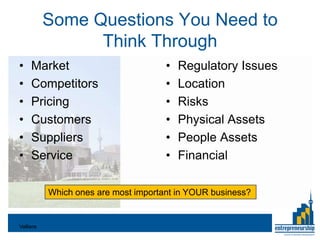
Some Questions You Need to
                 Think Through
•    Market                           •   Regulatory Issues
•    Competitors                      •   Location
•    Pricing                          •   Risks
•    Customers                        •   Physical Assets
•    Suppliers                        •   People Assets
•    Service                          •   Financial

           Which ones are most important in YOUR business?


Valliere
Financial Forecasting
• Project your expected sales
• Associated COS
• Infrastructure ramp-up, staff, and G&A
• Working capital policy implications
• Fixed asset requirements
• Adjust for
  timings, depreciation, interest, taxes
• Cashflow with negative balance
• Impact of various financing scenarios


Valliere
Sensitivity Analysis
• What assumptions in your business are
  reasonable to vary?
       – Pricing trends
       – Duration of sale cycle
       – Magnitude and timing of revenues
       – Launch expenses
       – Cost of key supplies
       – Lead time to hire staff
       – Working capital days
       – Cost and lead time for financing…
Valliere
Scenarios
• Monthly for first 1 or 2 years
• Yearly for 5 years
• Most likely case
       – Credibility test: how realistic are you?
• Best case
       – Credibility test: how good can it get without
         dreaming in Technicolor?
• Worst case
       – Credibility test: can you face up squarely?
Valliere
General Tips
• Model the dependencies
       – COS= f(sales), G&A = f(staff), Pricing = f(time)
• Avoid specious precision
       – Use $000s
       – Follow GAAP
• Summarize into charts
       – Sales hockey stick
       – Cashflow and profit J-curves
       – Key ratios (which ones do you think?)
• Investors love/hate hockey sticks
       – Watch for synchronization

Valliere
PACKAGING THE PLAN
• The most important sales document you
  will ever produce
• Understand the how/why of the reader
• What does the artifact signal about you?


Valliere
How to Read a Bizplan
• Executive summary
       – 2 pages max
       – Are they out to lunch?
• Team bios at the end
       – Any credibility?
• Market description
       – Real need?
• Everything else

Valliere
Appearances Matter
•    How many pages?
•    Binding?
•    Colour?
•    Multimedia?


Valliere
Details Matter
•    Spelling, grammar
•    Page numbers, TOC
•    Organization, headings
•    Consistency between figures and text
•    What belongs in an appendix?


Valliere
LIFE’S A PITCH
• What are you really selling?
• What does your ability to pitch say about other
  important things?
       –   Communicate
       –   Connect with people
       –   Persuade and convince
       –   Understand the audience
       –   Anticipate objections
       –   Handle unforeseen problems


Valliere
Understand the Investor
                    Perspective
• Understand the judges as your customer – your product
  is your company
       – Judges are sophisticated, BS-proof sounding boards
• The judges want to help you to
       –   See the truth, for better or worse
       –   Iron out the bugs in your plan/pitch
       –   Avoid going after the wrong opportunity
       –   Survive after the $25k runs out
       –   Raise even more money from professional sources
       –   Become rich and famous (remember those who helped you :)


Valliere
The Basic Idea…
• You are a group of people who
       – Have identified something that solves a
         problem for somebody willing to pay
       – Have a plan to
           •   Create the company
           •   Build and market the solution
           •   Use an initial investment wisely
           •   Protect yourselves from competitors
       – Can adapt to changing situations
       – Are smart and get things done
Valliere
Be Prepared
• Complete, concise business plan with good
  executive summary
• Be prepared to market your company to the
  judges
• Be “Up” and show the “Fire in the Belly”
• Be realistic in terms of your requirements
• Anticipate additional information which may be
  required – and be ready!
• Don’t BS judges, or yourself…

Valliere
Be Realistic
Have a realistic idea of:
• Your strengths and weaknesses
• The amount of money you will need to achieve
  your objectives
       – Seeking too little is worse than seeking too much!
• The amount of time required to fill the gaps in
  your plan
       – Raising more money, hiring good people, landing
         reference customers

Valliere
Judges Ask Themselves
• Screening Criteria
       – Is it worth it?
• Use of proceeds
       – VA or overhead?
• Spending enough to ensure success
       – Thinking big but realistically?
• Depth of market knowledge
       – How do people buy?
Valliere
Judges Evaluate You
• How good is the selected Opportunity?
       – Should we encourage this student to go for it,
         or think of something even better?
• How good is the Plan?
       – Has this student really thought it through?
• How likely is this business to survive?
       – What happens when the prize is spent?


Valliere
Go for the Close
• Recap your main messages
• Ask for what you want!
       – There’s more available than just the $25k
• Mine the valuable feedback
       – Pay attention to what questions get asked
       – Hot leads and referrals


Valliere

How to write a business plan

  • 1.
    TED ROGERS SCHOOL OF RYERSON MANAGEMENT UNIVERSITY Business Plan Seminar Dr. Dave Valliere Entrepreneurship & Strategy
  • 2.
    Investor’s Screening Criteria • How much money can be made? • How quickly can it be made? • How will it be made? • How much investment is required? • How liquid is the investment? • How involved do I have to get? • Who else is involved? Valliere
  • 3.
    What Investors Like •Large and rapidly expanding market • Complete team of “stars”, with proven track records • “10X” improvement • Compelling strategy, competitive advantage, and business model • Sustainability Valliere
  • 4.
    What Scares ThemOff • High risk, relative to the expected returns • Seeking too much capital, or too little – High tides hide the rocks • Quibbling over deal terms • Lack of commitment, integrity, realism • Weak managers – Poorly thought out Bizplans – Lack of Investor’s Perspective Valliere
  • 5.
    Your Business Opportunities •An opportunity is not just an idea – “it can be done” is insufficient – “is it worth doing?” • Think big, high-potential – Not “what can I do with what I have?” – Instead, “what will it take to do the right thing, and how can I get it?” – People like to back winners Valliere
  • 6.
    Opportunity Evaluation • What product or service will be sold? • Who will it be sold to? • How much will it cost to produce? Average selling? • How big is the target market? • What percentage of that market must be penetrated to reach $50 million in sales? • Who is the direct and indirect competition? • What is the sustainable competitive advantage? • Who is on the team? • Is the product complete? If not, when? Valliere
  • 7.
    DEVELOPING THE PLAN •It doesn’t matter how flashy the document or the presentation, if the ideas are lame or half-baked • You should want to wirebrush it more than anyone else – Not the case? Then you are wasting your time Valliere
  • 8.
    The Business Plan •Audience: people with resources to invest – Financial, talent, relationships • Help these investors understand the business – Why they should invest their resources • Typically “poor” and not well-received – Not thought through – Ignores the key questions for investors Valliere
  • 9.
    Bizplan Answers • Whydoes the market care? – the only problem money can’t solve • What is your competitive advantage? – how you can sustain it • Can you handle your Unforeseen Killer Variables? – by definition, you won’t know your UKVs • Can you make money at it? Valliere
  • 10.
    Bizplan Contents • Executive Summary • Customer Need & Market Opportunity • Business Strategy & Key Milestones • Marketing Plan • Operations Plan • Management & Key Personnel • Financial Projections & Requirements • Appendices Valliere
  • 11.
    Some Questions YouNeed to Think Through • Market • Regulatory Issues • Competitors • Location • Pricing • Risks • Customers • Physical Assets • Suppliers • People Assets • Service • Financial Which ones are most important in YOUR business? Valliere
  • 12.
    Financial Forecasting • Projectyour expected sales • Associated COS • Infrastructure ramp-up, staff, and G&A • Working capital policy implications • Fixed asset requirements • Adjust for timings, depreciation, interest, taxes • Cashflow with negative balance • Impact of various financing scenarios Valliere
  • 13.
    Sensitivity Analysis • Whatassumptions in your business are reasonable to vary? – Pricing trends – Duration of sale cycle – Magnitude and timing of revenues – Launch expenses – Cost of key supplies – Lead time to hire staff – Working capital days – Cost and lead time for financing… Valliere
  • 14.
    Scenarios • Monthly forfirst 1 or 2 years • Yearly for 5 years • Most likely case – Credibility test: how realistic are you? • Best case – Credibility test: how good can it get without dreaming in Technicolor? • Worst case – Credibility test: can you face up squarely? Valliere
  • 15.
    General Tips • Modelthe dependencies – COS= f(sales), G&A = f(staff), Pricing = f(time) • Avoid specious precision – Use $000s – Follow GAAP • Summarize into charts – Sales hockey stick – Cashflow and profit J-curves – Key ratios (which ones do you think?) • Investors love/hate hockey sticks – Watch for synchronization Valliere
  • 16.
    PACKAGING THE PLAN •The most important sales document you will ever produce • Understand the how/why of the reader • What does the artifact signal about you? Valliere
  • 17.
    How to Reada Bizplan • Executive summary – 2 pages max – Are they out to lunch? • Team bios at the end – Any credibility? • Market description – Real need? • Everything else Valliere
  • 18.
    Appearances Matter • How many pages? • Binding? • Colour? • Multimedia? Valliere
  • 19.
    Details Matter • Spelling, grammar • Page numbers, TOC • Organization, headings • Consistency between figures and text • What belongs in an appendix? Valliere
  • 20.
    LIFE’S A PITCH •What are you really selling? • What does your ability to pitch say about other important things? – Communicate – Connect with people – Persuade and convince – Understand the audience – Anticipate objections – Handle unforeseen problems Valliere
  • 21.
    Understand the Investor Perspective • Understand the judges as your customer – your product is your company – Judges are sophisticated, BS-proof sounding boards • The judges want to help you to – See the truth, for better or worse – Iron out the bugs in your plan/pitch – Avoid going after the wrong opportunity – Survive after the $25k runs out – Raise even more money from professional sources – Become rich and famous (remember those who helped you :) Valliere
  • 22.
    The Basic Idea… •You are a group of people who – Have identified something that solves a problem for somebody willing to pay – Have a plan to • Create the company • Build and market the solution • Use an initial investment wisely • Protect yourselves from competitors – Can adapt to changing situations – Are smart and get things done Valliere
  • 23.
    Be Prepared • Complete,concise business plan with good executive summary • Be prepared to market your company to the judges • Be “Up” and show the “Fire in the Belly” • Be realistic in terms of your requirements • Anticipate additional information which may be required – and be ready! • Don’t BS judges, or yourself… Valliere
  • 24.
    Be Realistic Have arealistic idea of: • Your strengths and weaknesses • The amount of money you will need to achieve your objectives – Seeking too little is worse than seeking too much! • The amount of time required to fill the gaps in your plan – Raising more money, hiring good people, landing reference customers Valliere
  • 25.
    Judges Ask Themselves •Screening Criteria – Is it worth it? • Use of proceeds – VA or overhead? • Spending enough to ensure success – Thinking big but realistically? • Depth of market knowledge – How do people buy? Valliere
  • 26.
    Judges Evaluate You •How good is the selected Opportunity? – Should we encourage this student to go for it, or think of something even better? • How good is the Plan? – Has this student really thought it through? • How likely is this business to survive? – What happens when the prize is spent? Valliere
  • 27.
    Go for theClose • Recap your main messages • Ask for what you want! – There’s more available than just the $25k • Mine the valuable feedback – Pay attention to what questions get asked – Hot leads and referrals Valliere