Wayne State University Public Relations: Maximizing Your  PR Potential
What is  Public Relations?
Is it relating  to the public?
Or enabling your school  or college to relate  to all its  publics  –
–  the stakeholders whose  perceptions influence  your “image” and impact the reality of your  reputation?
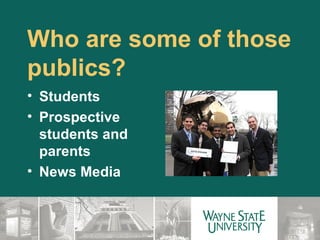
Who are some of those publics? Students Prospective students and parents News Media
Who are some of those publics? State Legislators Faculty/staff City/State/Federal  officials
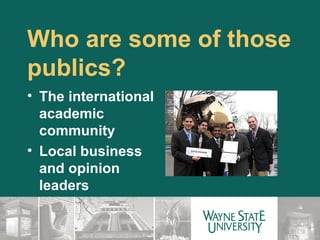
Who are some of those publics? The international  academic  community Local business  and opinion  leaders
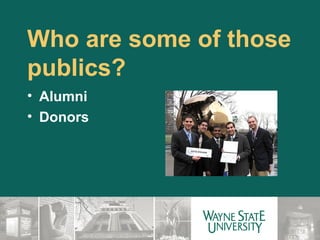
Who are some of those publics? Alumni Donors
What is the  overarching goal  of public relations for a  communications officer for Wayne State University?
To  heighten  the visibility of the university,  raise  its stature and positively  reinforce  its reputation.
What are the benefits of a well-executed PR strategy? Brand equity  underscored by prestige and a reputation for academic excellence and quality
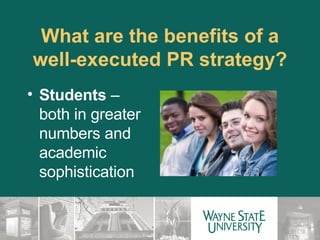
What are the benefits of a well-executed PR strategy? Students  – both in greater numbers and academic sophistication
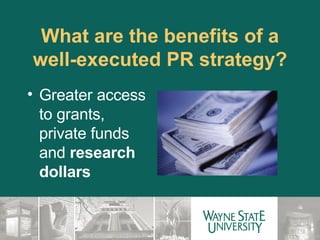
What are the benefits of a well-executed PR strategy? Greater access to grants, private funds and  research dollars
What is the best way to  build brand, enhance image, increase name recognition, prestige and visibility  locally, nationally and internationally?
Proactive media relations
(Play DVD)
How do we define our vision of the image we want “stakeholders” to have of Wayne State?
The President’s 2006-2011 Strategic Plan
How else?  Start with who we want to be – not with how we may believe people see us.
Can Wayne State be  the NYU of Detroit?
Can Midtown be like  Soho or the East Village?
Wayne State is a  premier academic institution  distinguished by its international  leadership in technology and research.
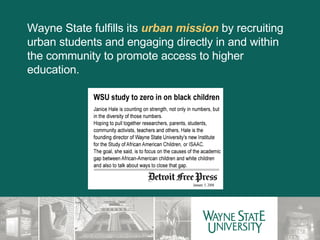
Wayne State fulfills its  urban mission  by recruiting urban students and engaging directly in and within the community to promote access to higher education.
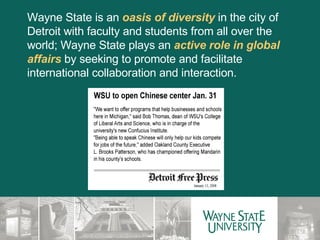
Wayne State is an  oasis of diversity  in the city of Detroit with faculty and students from all over the world; Wayne State plays an  active role in global affairs  by seeking to promote and facilitate international collaboration and interaction.
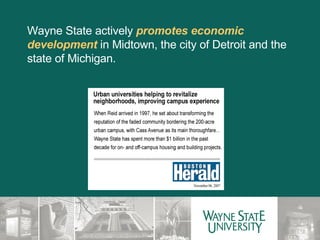
Wayne State actively  promotes economic development  in Midtown, the city of Detroit and the state of Michigan.
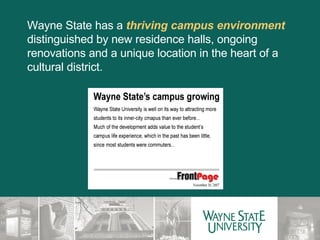
Wayne State has a  thriving campus environment  distinguished by new residence halls, ongoing renovations and a unique location in the heart of a cultural district.
What is the WSU Public Relations landscape?
Wayne State University PR–  News that pertains to the University as a whole. Office of the President University-sponsored events University position statements Board of Governors’ issues
Wayne State University PR–  News that pertains to the University as a whole. University “news” – e.g. South University Village, appointments, etc. New buildings Capital Campaign
Wayne State University PR–  News that pertains to the University as a whole. Technology Research enterprise Tech Transfer State and local economic development
Wayne State University PR–  News that pertains to the University as a whole. Role as a catalyst for urban renewal and leader in addressing urban social, educational and economic issues.
Questions to ask yourself?
How can I plug into “university” PR opportunities to reinforce key messages and heighten  the visibility of my school  or college?
Can I add substance, credibility, research, support?
PR for Individual Schools, Colleges and Centers/Institutes –  News that highlights the academic excellence, research, technology and learning/career opportunities afforded by your school/college.
Reinforce WSU image with “news” that support key messages Star faculty appointments, honors Star students – awards, honors, achievements Events Research National acclaim Partnerships to help the community Global engagement and leadership Local, state, national economic impact
What are your guiding principles to maximize exposure and enhance the image of your school/college?
Indentify key audiences/stakeholders  for each school and college and identify the best vehicles for communication with them (e.g., Life@Wayne, alumni e-mails, etc.)
Develop specific messages for your school/college that align with and support “university messaging”  delineated above (e.g., the College of Engineering’s achievements are a shining example of Wayne State’s leadership in technology and research.)
Communicate publicity/achievements internally  to faculty, staff, students, alumni, donors, etc.
Generate local, national and international news coverage  about or related to stories that reinforce the Wayne State image.
Identify trends and how schools/colleges can capitalize upon their unique areas of expertise to promote Wayne State.
Identify research by individual schools/colleges – pitch local and national angles to targeted local and national media.
Indentify “faculty all stars,” who can speak to the media about most issues related to a specific school/college and establish them as national media experts who actively promote Wayne State and reinforce key messages.
Seek to forge and publicize partnerships with other organizations (nationally recognized and/or community-based) that fulfill Wayne State’s strategic goals and support the WSU image.
How can we work together? Getting on the Same Page (Aligning our Messages) Creating a Pipeline of Information Synergistic Brainstorming Identifying Opportunities For Cross Promotion/Reaching Mutual Audiences
Tips for Tipping off the News Media: Strategies for Being Proactive
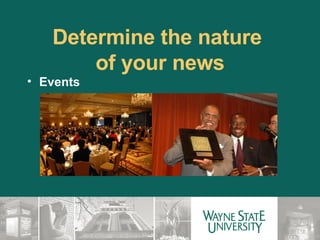
Determine the nature  of your news Events
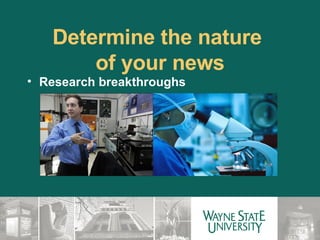
Determine the nature  of your news Research breakthroughs
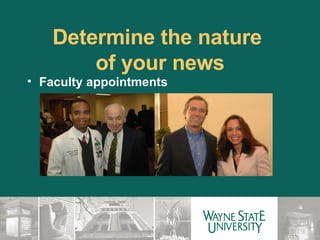
Determine the nature  of your news Faculty appointments
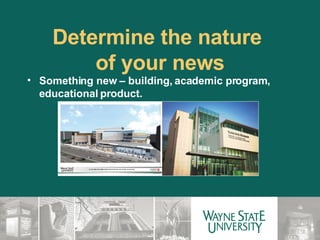
Determine the nature  of your news Something new – building, academic program, educational product.
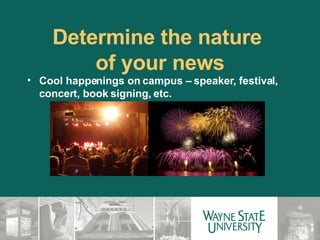
Determine the nature  of your news Cool happenings on campus – speaker, festival, concert, book signing, etc.
 
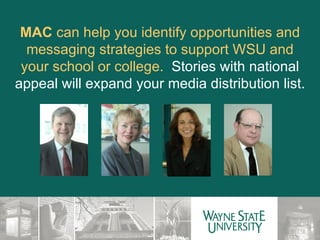
MAC  can help you identify opportunities and messaging strategies to support WSU and your school or college.  Stories with national appeal will expand your media distribution list.
 
3-4 weeks ahead  Notify  MAC, Public Safety, Special Events, President’s Office ASAP.  MAC PR office can help to identify news angles and themes as well as creative opportunities to maximize PR efficacy.
3-4 weeks ahead  Identify  spokespersons, brief them, prepare talking points of key messages if appropriate, and have their contact information available.
3-4 weeks ahead  Determine  whether you will have a special “media availability” at the event and incorporate notice of that special session into your press materials.
3-4 weeks ahead  Notify  calendar sections of local media. Work with MAC to identify a “national” story angle if appropriate and key messages.
3-4 weeks ahead  Create a media plan:  Identify key outlets to which the story should be pitched (e.g., technical engineering trade publications vs. the West Bloomfield Eagle) and the angle(s) on which you plan to focus to generate coverage.  Don’t forget “fringe” publications, hometown weeklies, monthlies, papers published quarterly, etc.
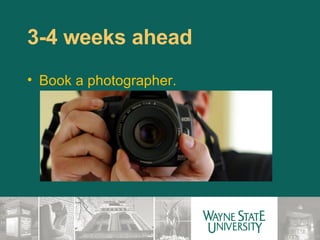
3-4 weeks ahead  Book a photographer.
3-4 weeks ahead  Draft key message points for interviews  by event participants.  Messages should reinforce the positive image you want to project about your school/college and the overarching strategic themes of the university.
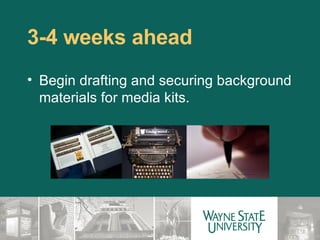
3-4 weeks ahead  Begin drafting and securing background materials for media kits.
2-3 weeks ahead  Confirm details.  Create and distribute media advisory and/or press release announcing the who, what, where, when of event.  Highlight “media availability” session if appropriate as an exclusive, one-on-one interview opportunity.
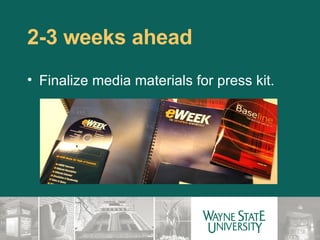
2-3 weeks ahead  Finalize media materials for press kit.
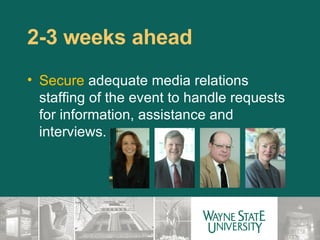
2-3 weeks ahead  Secure  adequate media relations staffing of the event to handle requests for information, assistance and interviews.
1 week ahead  Create and send out a news release on event, which provides a more in-depth explanation of the “news” and its significance with respect to the university, local community and other stakeholders.  Prepare “press kit” including the news release, bios of key speakers/participants, a backgrounder on your school/college/program, etc. and “frequently asked questions and answers” if you deem appropriate.
Pre-event publicity (Day of or day before)  Pitch story using key messages to local print, radio and TV reporters.  Attempt to secure print and radio (possibly TV) coverage to run promotional stories highlighting upcoming event.
Day of publicity Morning drive radio interviews of key participants highlighting event, its purpose, the link to your school or college (the positive message point you are trying to reinforce) and the link to Wayne State University’s image and identity. 
Day of publicity Reminder phone calls to targeted media to secure attendance and reinforce timeliness and news value of event/story.   
Day of publicity Make sure to have adequate media relations staffing at the event. Have a media sign-in table at the entrance. Capture names and business cards of media attendees to whom you provide media kits and background materials.  For certain high profiles events you may need to check press credentials.
Day of publicity Ask in advance if they desire a one-on-one interview with any of the participants and attempt to arrange as soon as possible. If the event requires higher security measures, such as major political candidates or officeholders, inform the media that press credentials will be available and required to access the event.   
Day of publicity Notify participants as early as possible about possible interview opportunities at the event, stressing key university/school/college messages.   
Day of publicity Arrange for photographer to capture specific “media friendly” photos that can be sent to local/hometown newspapers with a cutline after the event.   
After event publicity Send out photo release with cut-line to appropriate weekly and monthly publications based upon the subject matter.
After event publicity Follow up with reporters in attendance to gauge possible coverage and determine if they need additional information.
After event publicity Leverage positive news coverage on the Web, through You-Tube and any other on-line vehicles.
After event publicity E-mail blast positive news coverage to your school/college’s internal constituencies:  Faculty, students, Board of Visitors, donors, alumni, etc.
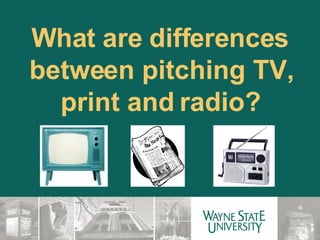
What are differences between pitching TV, print and radio?
Television Has limited live crews to do remote interviews.  Deadline is usually 3 p.m. for 5 p.m. or 6 p.m. broadcast.
Television Morning interviews 6 a.m. – 7 a.m. are a good time slot for in-studio interviews on a topic that has high “news value.”  News value is timeliness as a story and relevancy to people’s lives.
Television TV reporters will rarely cover an event unless there is a “celebrity” factor or a topic with high news value.
Radio Lots of airtime to fill and thus an easier medium to secure coverage.
Radio For “talk stations” pitch news desks as well as producers of specific talk show programs.
Radio Can use “interview alert” to establish a faculty member/event participant as an expert on a particular topic of high news value. He/she can promote event in context of interview.
Print Daily newspapers are fundamentally different than smaller papers.  More ground to cover and angles to develop.
Print Possible avenues include: Higher Ed Reporter Reporter covering beat specific to your event focus Columnists reputed for taking an interest in your subject area Editorial page staff (can your lead spokesperson write an op-ed taking a position on the issue and, in the process, state key message points that support PR goals?) City desk if appropriate Features department if appropriate
Tips for pitching (to the media)
Ask the important questions.  Not why would a reporter be interested?  Rather, why would his/her readers/viewers be interested?
Localize the story.  How does what you are doing affect students, residents, the community at large in Detroit?
Link the story to a national trend or bigger story. New nursing program…how does it address the national nursing shortage?
Be creative.  Highlight the unusual, unexpected or counterintuitive information.
Find partners to help elevate your visibility.  Institute of Gerontology…maybe co-host event with the AARP
Don’t forget about news outlets not considered mainstream and tailor to their audiences. Technical and trade journals. You-Tube Blogs City rags like “Strut” and “The Metro Times” Web sites that focus on subjects related to the focus of your event National media outlets if appropriate
Understand the differences in traditional mediums and how those mediums are changing .  In addition to securing traditional coverage, leverage interactive news put on the Web by radio, print and TV outlets to maximize exposure.
Be articulate, confident, compelling and clear.  Making a pitch on the phone you have 20-30 seconds to seize the moment.  Hit your mark the first time.
Do your research. Call to find out who you need to speak to about your topic and update contact information.  Media lists are a starting point; not an end point.
Don’t take rejection personally; learn f r om it and explore alternate pitches. If the reporter shoots you down, ask what might make the story more compelling and see if you can find a connection.
Tools of the Trade Media Advisory Press Release Interview Alert Tip Sheet Biographies Backgrounders FAQ Sheets

How to work with Public Relations

  • 1.
    Wayne State UniversityPublic Relations: Maximizing Your PR Potential
  • 2.
    What is Public Relations?
  • 3.
    Is it relating to the public?
  • 4.
    Or enabling yourschool or college to relate to all its publics –
  • 5.
    – thestakeholders whose perceptions influence your “image” and impact the reality of your reputation?
  • 6.
    Who are someof those publics? Students Prospective students and parents News Media
  • 7.
    Who are someof those publics? State Legislators Faculty/staff City/State/Federal officials
  • 8.
    Who are someof those publics? The international academic community Local business and opinion leaders
  • 9.
    Who are someof those publics? Alumni Donors
  • 10.
    What is the overarching goal of public relations for a communications officer for Wayne State University?
  • 11.
    To heighten the visibility of the university, raise its stature and positively reinforce its reputation.
  • 12.
    What are thebenefits of a well-executed PR strategy? Brand equity underscored by prestige and a reputation for academic excellence and quality
  • 13.
    What are thebenefits of a well-executed PR strategy? Students – both in greater numbers and academic sophistication
  • 14.
    What are thebenefits of a well-executed PR strategy? Greater access to grants, private funds and research dollars
  • 15.
    What is thebest way to build brand, enhance image, increase name recognition, prestige and visibility locally, nationally and internationally?
  • 16.
  • 17.
  • 18.
    How do wedefine our vision of the image we want “stakeholders” to have of Wayne State?
  • 19.
  • 20.
    How else? Start with who we want to be – not with how we may believe people see us.
  • 21.
    Can Wayne Statebe the NYU of Detroit?
  • 22.
    Can Midtown belike Soho or the East Village?
  • 23.
    Wayne State isa premier academic institution distinguished by its international leadership in technology and research.
  • 24.
    Wayne State fulfillsits urban mission by recruiting urban students and engaging directly in and within the community to promote access to higher education.
  • 25.
    Wayne State isan oasis of diversity in the city of Detroit with faculty and students from all over the world; Wayne State plays an active role in global affairs by seeking to promote and facilitate international collaboration and interaction.
  • 26.
    Wayne State actively promotes economic development in Midtown, the city of Detroit and the state of Michigan.
  • 27.
    Wayne State hasa thriving campus environment distinguished by new residence halls, ongoing renovations and a unique location in the heart of a cultural district.
  • 28.
    What is theWSU Public Relations landscape?
  • 29.
    Wayne State UniversityPR– News that pertains to the University as a whole. Office of the President University-sponsored events University position statements Board of Governors’ issues
  • 30.
    Wayne State UniversityPR– News that pertains to the University as a whole. University “news” – e.g. South University Village, appointments, etc. New buildings Capital Campaign
  • 31.
    Wayne State UniversityPR– News that pertains to the University as a whole. Technology Research enterprise Tech Transfer State and local economic development
  • 32.
    Wayne State UniversityPR– News that pertains to the University as a whole. Role as a catalyst for urban renewal and leader in addressing urban social, educational and economic issues.
  • 33.
  • 34.
    How can Iplug into “university” PR opportunities to reinforce key messages and heighten the visibility of my school or college?
  • 35.
    Can I addsubstance, credibility, research, support?
  • 36.
    PR for IndividualSchools, Colleges and Centers/Institutes – News that highlights the academic excellence, research, technology and learning/career opportunities afforded by your school/college.
  • 37.
    Reinforce WSU imagewith “news” that support key messages Star faculty appointments, honors Star students – awards, honors, achievements Events Research National acclaim Partnerships to help the community Global engagement and leadership Local, state, national economic impact
  • 38.
    What are yourguiding principles to maximize exposure and enhance the image of your school/college?
  • 39.
    Indentify key audiences/stakeholders for each school and college and identify the best vehicles for communication with them (e.g., Life@Wayne, alumni e-mails, etc.)
  • 40.
    Develop specific messagesfor your school/college that align with and support “university messaging” delineated above (e.g., the College of Engineering’s achievements are a shining example of Wayne State’s leadership in technology and research.)
  • 41.
    Communicate publicity/achievements internally to faculty, staff, students, alumni, donors, etc.
  • 42.
    Generate local, nationaland international news coverage about or related to stories that reinforce the Wayne State image.
  • 43.
    Identify trends andhow schools/colleges can capitalize upon their unique areas of expertise to promote Wayne State.
  • 44.
    Identify research byindividual schools/colleges – pitch local and national angles to targeted local and national media.
  • 45.
    Indentify “faculty allstars,” who can speak to the media about most issues related to a specific school/college and establish them as national media experts who actively promote Wayne State and reinforce key messages.
  • 46.
    Seek to forgeand publicize partnerships with other organizations (nationally recognized and/or community-based) that fulfill Wayne State’s strategic goals and support the WSU image.
  • 47.
    How can wework together? Getting on the Same Page (Aligning our Messages) Creating a Pipeline of Information Synergistic Brainstorming Identifying Opportunities For Cross Promotion/Reaching Mutual Audiences
  • 48.
    Tips for Tippingoff the News Media: Strategies for Being Proactive
  • 49.
    Determine the nature of your news Events
  • 50.
    Determine the nature of your news Research breakthroughs
  • 51.
    Determine the nature of your news Faculty appointments
  • 52.
    Determine the nature of your news Something new – building, academic program, educational product.
  • 53.
    Determine the nature of your news Cool happenings on campus – speaker, festival, concert, book signing, etc.
  • 54.
  • 55.
    MAC canhelp you identify opportunities and messaging strategies to support WSU and your school or college. Stories with national appeal will expand your media distribution list.
  • 56.
  • 57.
    3-4 weeks ahead Notify MAC, Public Safety, Special Events, President’s Office ASAP. MAC PR office can help to identify news angles and themes as well as creative opportunities to maximize PR efficacy.
  • 58.
    3-4 weeks ahead Identify spokespersons, brief them, prepare talking points of key messages if appropriate, and have their contact information available.
  • 59.
    3-4 weeks ahead Determine whether you will have a special “media availability” at the event and incorporate notice of that special session into your press materials.
  • 60.
    3-4 weeks ahead Notify calendar sections of local media. Work with MAC to identify a “national” story angle if appropriate and key messages.
  • 61.
    3-4 weeks ahead Create a media plan: Identify key outlets to which the story should be pitched (e.g., technical engineering trade publications vs. the West Bloomfield Eagle) and the angle(s) on which you plan to focus to generate coverage. Don’t forget “fringe” publications, hometown weeklies, monthlies, papers published quarterly, etc.
  • 62.
    3-4 weeks ahead Book a photographer.
  • 63.
    3-4 weeks ahead Draft key message points for interviews by event participants. Messages should reinforce the positive image you want to project about your school/college and the overarching strategic themes of the university.
  • 64.
    3-4 weeks ahead Begin drafting and securing background materials for media kits.
  • 65.
    2-3 weeks ahead Confirm details. Create and distribute media advisory and/or press release announcing the who, what, where, when of event. Highlight “media availability” session if appropriate as an exclusive, one-on-one interview opportunity.
  • 66.
    2-3 weeks ahead Finalize media materials for press kit.
  • 67.
    2-3 weeks ahead Secure adequate media relations staffing of the event to handle requests for information, assistance and interviews.
  • 68.
    1 week ahead Create and send out a news release on event, which provides a more in-depth explanation of the “news” and its significance with respect to the university, local community and other stakeholders. Prepare “press kit” including the news release, bios of key speakers/participants, a backgrounder on your school/college/program, etc. and “frequently asked questions and answers” if you deem appropriate.
  • 69.
    Pre-event publicity (Dayof or day before) Pitch story using key messages to local print, radio and TV reporters. Attempt to secure print and radio (possibly TV) coverage to run promotional stories highlighting upcoming event.
  • 70.
    Day of publicityMorning drive radio interviews of key participants highlighting event, its purpose, the link to your school or college (the positive message point you are trying to reinforce) and the link to Wayne State University’s image and identity. 
  • 71.
    Day of publicityReminder phone calls to targeted media to secure attendance and reinforce timeliness and news value of event/story.  
  • 72.
    Day of publicityMake sure to have adequate media relations staffing at the event. Have a media sign-in table at the entrance. Capture names and business cards of media attendees to whom you provide media kits and background materials. For certain high profiles events you may need to check press credentials.
  • 73.
    Day of publicityAsk in advance if they desire a one-on-one interview with any of the participants and attempt to arrange as soon as possible. If the event requires higher security measures, such as major political candidates or officeholders, inform the media that press credentials will be available and required to access the event.  
  • 74.
    Day of publicityNotify participants as early as possible about possible interview opportunities at the event, stressing key university/school/college messages.  
  • 75.
    Day of publicityArrange for photographer to capture specific “media friendly” photos that can be sent to local/hometown newspapers with a cutline after the event.  
  • 76.
    After event publicitySend out photo release with cut-line to appropriate weekly and monthly publications based upon the subject matter.
  • 77.
    After event publicityFollow up with reporters in attendance to gauge possible coverage and determine if they need additional information.
  • 78.
    After event publicityLeverage positive news coverage on the Web, through You-Tube and any other on-line vehicles.
  • 79.
    After event publicityE-mail blast positive news coverage to your school/college’s internal constituencies: Faculty, students, Board of Visitors, donors, alumni, etc.
  • 80.
    What are differencesbetween pitching TV, print and radio?
  • 81.
    Television Has limitedlive crews to do remote interviews. Deadline is usually 3 p.m. for 5 p.m. or 6 p.m. broadcast.
  • 82.
    Television Morning interviews6 a.m. – 7 a.m. are a good time slot for in-studio interviews on a topic that has high “news value.” News value is timeliness as a story and relevancy to people’s lives.
  • 83.
    Television TV reporterswill rarely cover an event unless there is a “celebrity” factor or a topic with high news value.
  • 84.
    Radio Lots ofairtime to fill and thus an easier medium to secure coverage.
  • 85.
    Radio For “talkstations” pitch news desks as well as producers of specific talk show programs.
  • 86.
    Radio Can use“interview alert” to establish a faculty member/event participant as an expert on a particular topic of high news value. He/she can promote event in context of interview.
  • 87.
    Print Daily newspapersare fundamentally different than smaller papers. More ground to cover and angles to develop.
  • 88.
    Print Possible avenuesinclude: Higher Ed Reporter Reporter covering beat specific to your event focus Columnists reputed for taking an interest in your subject area Editorial page staff (can your lead spokesperson write an op-ed taking a position on the issue and, in the process, state key message points that support PR goals?) City desk if appropriate Features department if appropriate
  • 89.
    Tips for pitching(to the media)
  • 90.
    Ask the importantquestions. Not why would a reporter be interested? Rather, why would his/her readers/viewers be interested?
  • 91.
    Localize the story. How does what you are doing affect students, residents, the community at large in Detroit?
  • 92.
    Link the storyto a national trend or bigger story. New nursing program…how does it address the national nursing shortage?
  • 93.
    Be creative. Highlight the unusual, unexpected or counterintuitive information.
  • 94.
    Find partners tohelp elevate your visibility. Institute of Gerontology…maybe co-host event with the AARP
  • 95.
    Don’t forget aboutnews outlets not considered mainstream and tailor to their audiences. Technical and trade journals. You-Tube Blogs City rags like “Strut” and “The Metro Times” Web sites that focus on subjects related to the focus of your event National media outlets if appropriate
  • 96.
    Understand the differencesin traditional mediums and how those mediums are changing . In addition to securing traditional coverage, leverage interactive news put on the Web by radio, print and TV outlets to maximize exposure.
  • 97.
    Be articulate, confident,compelling and clear. Making a pitch on the phone you have 20-30 seconds to seize the moment. Hit your mark the first time.
  • 98.
    Do your research.Call to find out who you need to speak to about your topic and update contact information. Media lists are a starting point; not an end point.
  • 99.
    Don’t take rejectionpersonally; learn f r om it and explore alternate pitches. If the reporter shoots you down, ask what might make the story more compelling and see if you can find a connection.
  • 100.
    Tools of theTrade Media Advisory Press Release Interview Alert Tip Sheet Biographies Backgrounders FAQ Sheets