DR SAJID MALIK
B.Sc., MBBS, FCPS (PAK), MRCS(Glasg.), FMIS (Singapore)
ASSISTANT PROFESSSOR OF SURGERY
ALLAMA IQBAL MEDICAL COLLEGE / JINNAH HOSPITAL LAHORE
PAKISTAN
How to Use SPSS for Statistical Analysis
Without data, all you are just another
person with an opinion.
Unknown
Population and Sample
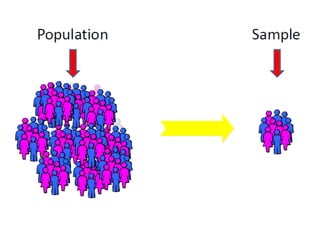
Population
is the set of all measurements of
interest to the researcher.
Sample
is any subset of measurements selected
from the population.
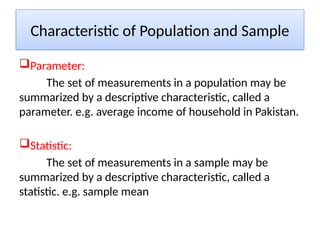
Characteristic of Population and Sample
Parameter:
The set of measurements in a population may be
summarized by a descriptive characteristic, called a
parameter. e.g. average income of household in Pakistan.
Statistic:
The set of measurements in a sample may be
summarized by a descriptive characteristic, called a
statistic. e.g. sample mean
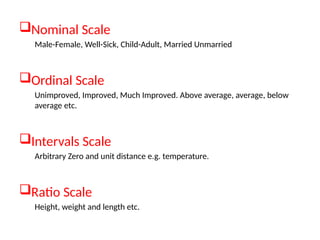
Nominal Scale
Male-Female, Well-Sick, Child-Adult, Married Unmarried
Ordinal Scale
Unimproved, Improved, Much Improved. Above average, average, below
average etc.
Intervals Scale
Arbitrary Zero and unit distance e.g. temperature.
Ratio Scale
Height, weight and length etc.
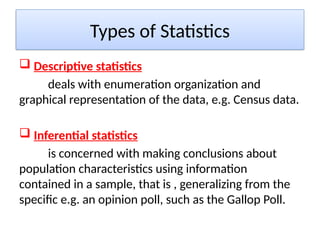
Types of Statistics
 Descriptive statistics
deals with enumeration organization and
graphical representation of the data, e.g. Census data.
 Inferential statistics
is concerned with making conclusions about
population characteristics using information
contained in a sample, that is , generalizing from the
specific e.g. an opinion poll, such as the Gallop Poll.
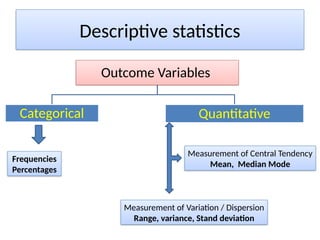
Descriptive statistics
Outcome Variables
Categorical Quantitative
Frequencies
Percentages
Measurement of Central Tendency
Mean, Median Mode
Measurement of Variation / Dispersion
Range, variance, Stand deviation
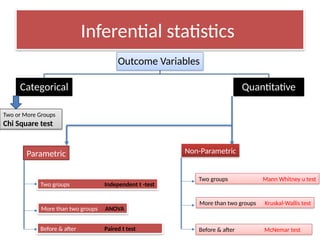
Inferential statistics
Outcome Variables
Categorical Quantitative
Two or More Groups
Chi Square test
Parametric Non-Parametric
Two groups Independent t -test
More than two groups ANOVA
Before & after Paired t test
Two groups Mann Whitney u test
More than two groups Kruskal-Wallis test
Before & after McNemar test

how to use SPSS and analysis scoring system

  • 1.
    DR SAJID MALIK B.Sc.,MBBS, FCPS (PAK), MRCS(Glasg.), FMIS (Singapore) ASSISTANT PROFESSSOR OF SURGERY ALLAMA IQBAL MEDICAL COLLEGE / JINNAH HOSPITAL LAHORE PAKISTAN How to Use SPSS for Statistical Analysis
  • 2.
    Without data, allyou are just another person with an opinion. Unknown
  • 3.
    Population and Sample Population isthe set of all measurements of interest to the researcher. Sample is any subset of measurements selected from the population.
  • 5.
    Characteristic of Populationand Sample Parameter: The set of measurements in a population may be summarized by a descriptive characteristic, called a parameter. e.g. average income of household in Pakistan. Statistic: The set of measurements in a sample may be summarized by a descriptive characteristic, called a statistic. e.g. sample mean
  • 7.
    Nominal Scale Male-Female, Well-Sick,Child-Adult, Married Unmarried Ordinal Scale Unimproved, Improved, Much Improved. Above average, average, below average etc. Intervals Scale Arbitrary Zero and unit distance e.g. temperature. Ratio Scale Height, weight and length etc.
  • 9.
    Types of Statistics Descriptive statistics deals with enumeration organization and graphical representation of the data, e.g. Census data.  Inferential statistics is concerned with making conclusions about population characteristics using information contained in a sample, that is , generalizing from the specific e.g. an opinion poll, such as the Gallop Poll.
  • 10.
    Descriptive statistics Outcome Variables CategoricalQuantitative Frequencies Percentages Measurement of Central Tendency Mean, Median Mode Measurement of Variation / Dispersion Range, variance, Stand deviation
  • 11.
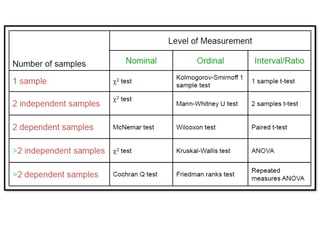
    Inferential statistics Outcome Variables CategoricalQuantitative Two or More Groups Chi Square test Parametric Non-Parametric Two groups Independent t -test More than two groups ANOVA Before & after Paired t test Two groups Mann Whitney u test More than two groups Kruskal-Wallis test Before & after McNemar test