Cost Efficiencies Work Group
Summary of Final Report
October 30, 2015
Michael Parkhurst, Program Officer
Affordable Housing Initiative
MMT Affordable Housing Initiative
Five year effort beginning in 2014; nearly $16 million
committed to eight strategies, focused on:
– “Strengthen the Foundation” – preserve existing
affordable housing
– “Foster Innovation” – fund new approaches to promoting
affordable housing and residents’ success
– “Secure the Future” – resources and policy change
supportive of affordable housing
2
MMT Cost Efficiencies Work Group
The “Cost Efficiencies” Strategy grew out of:
• Intense interest in rising costs of producing
new subsidized affordable housing
• Gap between growing need and available
funds for new housing
3
MMT Cost Efficiencies Work Group
• Mike Andrews, Home Forward
• David Bachman, Cascade Management Inc.
• Robin Boyce, Housing Development Center
• David Carboneau, Home First Development
• Brian Carleton, Carleton Hart Architecture
• Chris Duffin, LMC Construction
• Abe Farkas, ECONorthwest
• Kristen Karle, St. Vincent de Paul Society of Lane County
• Roy Kim, Central Bethany Development Co.
• Stephen McMurtrey, Northwest Housing Alternatives
• Gina León, US Bank
• Sharon Nielson, The Nielson Group
• Jill Sherman, Gerding Edlen
• Mike Steffen, Walsh Construction
• Bill Van Vliet, Network for Oregon Affordable Housing
• Jessica Woodruff, REACH Community Development
4
MMT Cost Efficiencies Work Group
Charge:
 Explain factors driving costs of affordable housing
 Recommend policy or systems changes to reduce
costs
 Advise MMT on pilot or demonstration projects to
explore new approaches to lower-cost development
5
MMT Cost Efficiencies Work Group
Process:
 Monthly meetings Fall 2014 – Summer 2015
 Collected and read other reports from around the
country
 Invited outside experts to present to the Group
 Additional outreach to Group members and others
 Conferring with state and local funders
6
Key Findings
Key Findings
1. Comparing costs between different kinds of projects is
difficult and complex.
2. Subsidized affordable housing development differs from
market-rate development in fundamental ways that tend to
add cost.
3. Affordable housing provides more than just a place to live.
8
Subsidies Add to Costs
Current system relies on public subsidies that tend to add to
costs (public goals and requirements):
 Prevailing wage, MWESB, green-building requirements,
etc.
Pursuing and using subsidy itself adds cost – especially for
federal tax credits:
 Cost to apply for tax credits
 Complex, layered financing -> many partners -> complexity
 Ongoing compliance and reporting
9
Key Findings
4. The current delivery system prioritizes other goals over the
lowest possible upfront cost.
 Affordable projects are built to last: quality and durability
high priorities
 Points systems for both state and local funding reward cost
efficiency, but only as one factor among many
5. Funders could do more to help reduce costs, but dramatic
reductions are probably unattainable without new sources.
10
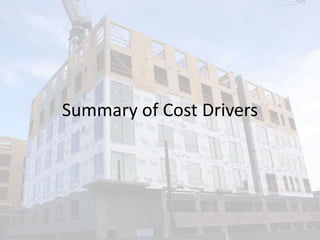
Summary of Cost Drivers
Cost Drivers: Hard and Soft Costs
Hard Costs: fairly comparable for similar market rate vs
affordable projects (except for prevailing wage).
Biggest differences are in “Soft” Costs:
 Architecture/engineering
 Legal fees
 Developer fee
 Capitalized reserves
 Other soft costs (studies, reports, etc.)
12
A Note About Scale
(Dis-)Economy of Scale:
Affordable projects tend to be small. Spreading fixed costs over
fewer units = higher per-unit costs
Barriers to building larger affordable projects:
 Larger projects not appropriate everywhere
 Larger developments = fewer projects
13
Cost Drivers: Design
How good is “Good Enough”?
 Learned from past mistakes – building in quality and durability
 Life cycle vs upfront costs
 “Beauty contest” for funding drives decisions that push costs
up
 Design Review and local approval processes
14
Summary of Recommendations
Important Caveats
An exclusive focus on lowering costs could be counterproductive:
 Could exclude high opportunity neighborhoods in favor of
less expensive locations
 Cutting corners up front can cost us more down the road
(avoid subsidizing projects twice)
 Very low income and high-needs households are hard to
serve without deep subsidy
 Projects built on the cheap may feed NIMBY resistance
16
Recommendations
1. Funders should reward cost-efficient development
without compromising other important goals like
long-term affordability and financial sustainability.
 Put more emphasis in funding decisions on the cost-
efficient use of public subsidies.
 Enlist the creativity of development teams to find more
cost efficient strategies and approaches to development.
17
Recommendations
2. Funders should revisit funding processes and
criteria to reduce unnecessary complexity, delay,
and costs.
3. Lenders and investors should explore alternatives to
capitalized operating reserves.
4. Developers and funders should identify ways to
promote more cost-effective acquisition of existing
housing.
18
Recommendations
5. Bureau of Labor and Industries (BOLI) should better
align its prevailing wage practices with the needs of
affordable housing.
6. Local governments should revisit the impact of
design review and other public requirements on
housing affordability.
19
Recommendations
7. Explore new, more flexible sources of capital for
development.
Ideally:
Fewer sources + increased flexibility = reduced complexity
= lower costs
20
MMT Cost Efficiencies Work Group
Next Steps
 Convene Financial Innovation Work Group
 Assist NOAH with operating reserves
 Convene discussion on green standard
 Discuss recommendations with BOLI
 Engage local jurisdictions
 Meyer RFP for innovative cost-efficient approaches
21
Innovation Pilot RFP – November 2015
Predevelopment funds for innovative approaches to design,
finance, and/or construction. Aiming to fund projects that are:
 Innovative
 Replicable
 Able to meet minimum standards of affordability, durability
and financial sustainability
 Leading to real project(s) completed by 2018
Looking to align with State and local efforts to promote more
cost-effective development.
22
www.mmt.org
michael@mmt.org

What does it cost to create housing opportunity?

  • 1.
    Cost Efficiencies WorkGroup Summary of Final Report October 30, 2015 Michael Parkhurst, Program Officer Affordable Housing Initiative
  • 2.
    MMT Affordable HousingInitiative Five year effort beginning in 2014; nearly $16 million committed to eight strategies, focused on: – “Strengthen the Foundation” – preserve existing affordable housing – “Foster Innovation” – fund new approaches to promoting affordable housing and residents’ success – “Secure the Future” – resources and policy change supportive of affordable housing 2
  • 3.
    MMT Cost EfficienciesWork Group The “Cost Efficiencies” Strategy grew out of: • Intense interest in rising costs of producing new subsidized affordable housing • Gap between growing need and available funds for new housing 3
  • 4.
    MMT Cost EfficienciesWork Group • Mike Andrews, Home Forward • David Bachman, Cascade Management Inc. • Robin Boyce, Housing Development Center • David Carboneau, Home First Development • Brian Carleton, Carleton Hart Architecture • Chris Duffin, LMC Construction • Abe Farkas, ECONorthwest • Kristen Karle, St. Vincent de Paul Society of Lane County • Roy Kim, Central Bethany Development Co. • Stephen McMurtrey, Northwest Housing Alternatives • Gina León, US Bank • Sharon Nielson, The Nielson Group • Jill Sherman, Gerding Edlen • Mike Steffen, Walsh Construction • Bill Van Vliet, Network for Oregon Affordable Housing • Jessica Woodruff, REACH Community Development 4
  • 5.
    MMT Cost EfficienciesWork Group Charge:  Explain factors driving costs of affordable housing  Recommend policy or systems changes to reduce costs  Advise MMT on pilot or demonstration projects to explore new approaches to lower-cost development 5
  • 6.
    MMT Cost EfficienciesWork Group Process:  Monthly meetings Fall 2014 – Summer 2015  Collected and read other reports from around the country  Invited outside experts to present to the Group  Additional outreach to Group members and others  Conferring with state and local funders 6
  • 7.
  • 8.
    Key Findings 1. Comparingcosts between different kinds of projects is difficult and complex. 2. Subsidized affordable housing development differs from market-rate development in fundamental ways that tend to add cost. 3. Affordable housing provides more than just a place to live. 8
  • 9.
    Subsidies Add toCosts Current system relies on public subsidies that tend to add to costs (public goals and requirements):  Prevailing wage, MWESB, green-building requirements, etc. Pursuing and using subsidy itself adds cost – especially for federal tax credits:  Cost to apply for tax credits  Complex, layered financing -> many partners -> complexity  Ongoing compliance and reporting 9
  • 10.
    Key Findings 4. Thecurrent delivery system prioritizes other goals over the lowest possible upfront cost.  Affordable projects are built to last: quality and durability high priorities  Points systems for both state and local funding reward cost efficiency, but only as one factor among many 5. Funders could do more to help reduce costs, but dramatic reductions are probably unattainable without new sources. 10
  • 11.
  • 12.
    Cost Drivers: Hardand Soft Costs Hard Costs: fairly comparable for similar market rate vs affordable projects (except for prevailing wage). Biggest differences are in “Soft” Costs:  Architecture/engineering  Legal fees  Developer fee  Capitalized reserves  Other soft costs (studies, reports, etc.) 12
  • 13.
    A Note AboutScale (Dis-)Economy of Scale: Affordable projects tend to be small. Spreading fixed costs over fewer units = higher per-unit costs Barriers to building larger affordable projects:  Larger projects not appropriate everywhere  Larger developments = fewer projects 13
  • 14.
    Cost Drivers: Design Howgood is “Good Enough”?  Learned from past mistakes – building in quality and durability  Life cycle vs upfront costs  “Beauty contest” for funding drives decisions that push costs up  Design Review and local approval processes 14
  • 15.
  • 16.
    Important Caveats An exclusivefocus on lowering costs could be counterproductive:  Could exclude high opportunity neighborhoods in favor of less expensive locations  Cutting corners up front can cost us more down the road (avoid subsidizing projects twice)  Very low income and high-needs households are hard to serve without deep subsidy  Projects built on the cheap may feed NIMBY resistance 16
  • 17.
    Recommendations 1. Funders shouldreward cost-efficient development without compromising other important goals like long-term affordability and financial sustainability.  Put more emphasis in funding decisions on the cost- efficient use of public subsidies.  Enlist the creativity of development teams to find more cost efficient strategies and approaches to development. 17
  • 18.
    Recommendations 2. Funders shouldrevisit funding processes and criteria to reduce unnecessary complexity, delay, and costs. 3. Lenders and investors should explore alternatives to capitalized operating reserves. 4. Developers and funders should identify ways to promote more cost-effective acquisition of existing housing. 18
  • 19.
    Recommendations 5. Bureau ofLabor and Industries (BOLI) should better align its prevailing wage practices with the needs of affordable housing. 6. Local governments should revisit the impact of design review and other public requirements on housing affordability. 19
  • 20.
    Recommendations 7. Explore new,more flexible sources of capital for development. Ideally: Fewer sources + increased flexibility = reduced complexity = lower costs 20
  • 21.
    MMT Cost EfficienciesWork Group Next Steps  Convene Financial Innovation Work Group  Assist NOAH with operating reserves  Convene discussion on green standard  Discuss recommendations with BOLI  Engage local jurisdictions  Meyer RFP for innovative cost-efficient approaches 21
  • 22.
    Innovation Pilot RFP– November 2015 Predevelopment funds for innovative approaches to design, finance, and/or construction. Aiming to fund projects that are:  Innovative  Replicable  Able to meet minimum standards of affordability, durability and financial sustainability  Leading to real project(s) completed by 2018 Looking to align with State and local efforts to promote more cost-effective development. 22
  • 23.

Editor's Notes

  • #2 Intro MP, PO @ MMT Pleased to present overview of a year-long effort by Meyer to examine factors influencing cost of AH, and Opps to create AH at a lower cost Today = Overview of the key findings and recommendations a few words about upcoming Request for Proposals from Meyer that builds on this work – 20 mins, welcome questions afterward PDF of report online SKIP to ROSTER!
  • #3 AHI – looking for ways to assist with system-wide issues affecting AH around the state; - not so much assisting the industry with what it already does well, but strategic opportunities to advance AH broadly AHI e-mail update List
  • #4 MMT Intensely interested in reducing unmet need for affordable housing around the state a good example of the kind of impact we hope to have with AHI Saw this work as an opportunity for MMT to leverage its role as a neutral convener able to ask some basic questions without a stake in the answers, and say some things that may not be heard otherwise
  • #5 Opened an Invitation to participate, and ultimately asked 16 diverse experts to participate, rep = developers, contractors, architects, lenders, and other pros with deep expertise in these issue MMT’s thanks to every member of the group – a lot of time, attention and thought into this work MP background – - prior to MMT, managed local and federal funds in local government - not a technical expert, but understand the basic dynamics of development, comf with pro forma etc.
  • #6 Again, really a statewide lens here – believe results of this work apply, allowing for regional market difference, across OR
  • #7 Report distills all this work; not nec consensus on every point, but Meyer’s attempt to weigh what we heard and give a fair summary, taking into account all perspectives.
  • #8 Very complex thicket of topics, difficult to organize and categorize. Still, although came in believing I knew a bit about these issues, learned quite a lot on the nuances of dynamics that tend to affect costs
  • #9 Sums up a year of very complex and challenging work on a few slides… 1: Nuance matters! land, unit mix, unit sizes, const type, non hsg space Right metric? $TDC per unit, per BR, per sf? Or lifecycle acctg – “per-bedroom year”? Helps explain why we opted not to try and answer the question: “what should AH cost?” – too many variables to make a simple standard meaningful 2: business model: customers can’t cover the cost Limited rents = gap = subsidy AH relies heavily on public subsidies like LIHTC & often many sources rent limits drive more expensive projects: Not just about K stack – also operating and replcmt reserves 3: Social ROI mission may drive decisions on features and amenities that add to costs that can’t be covered by incr rent ambo analogy
  • #10 NON-HOUSING costs – must be paid generally with scarce housing subsidy; social goals ARE worthy, affordable developers support these things! But these are public goals or requirements that tend to add costs but don’t come with funding. (housing funds are paying for non-housing goals) LAND another good example – where “opportunity” neighborhoods will tend to cost more Complexity – many partners, each with different concerns and risk management practices (the CYA premium). Also can lead to additional costs to duplicate studies, appraisals, etc. Introduces potential for delay and conflict that tends to push costs higher
  • #11 #4 all partners though in an affordable deal are intent on quality and durability – owner, funders, lenders and investors Learned the hard-way not to cut corners up front NOT saying there aren’t high quality market-rate apartment buildings; Market-rate developers can choose a variety of different strategies on a continuum of quality and cost – Any re-focusing around prioritizing cost would need to be done in a thoughtful way. where federal TC = best significant equity, high costs probably not going away – constraints pushing a high-cost model are baked into government dollar, especially TC dollar. #5 That’s one lesson of what Home First has done in East Portland. By not taking govt money, able to move quickly to buy land, design very basic housing, And critically: whole categories of soft costs they can avoid or reduce doing that.
  • #12 While we weren’t trying to duplicate the good work already done by an array of reports on the topic, we do - devote big chunk of the report to summarizing cost drivers for non-expert audience. Distinguish HC, SC & issues related to design that span both categories
  • #13 Hard costs – the direct cost of building the building - are not where the big different lives. “If you’re building the same thing, it should cost the same” Prevailing wage seems to be far and away the biggest issue here; 10% res, <= 20% for commercial A more subtle issue is how the requirements of working on a public project can limit pool of contractors and subs Re: Developer fees – report emphasizes - With rents limited, the only upside in affordable development (market profit doesn’t show up in pro forma in same way) - Support nonprofit developers’ organizations (and fund predevelopment of the next project) - often not fully paid out as cash to developer
  • #14 Legal fees example: $75,000 over a 40 unit affordable project = nearly $1,900 per unit just for legal costs. Over 150 units amounts to $500/unit Aside from scale … another factor = length of the development process for typical AH – exposes to variety of risks for rising costs
  • #15 This is where developers have the most control over costs. Decisions - with architect and design team – on appearance and shape of project, and on materials Decisions not made in a vacuum quality, durability, appeal public process, incl both public involv and DR Big question: Can we attain an acceptable level of quality and durability at a lower cost?
  • #16 There are 17 total recommendations in the report, on issues large and small – highlighting here the ones the Group felt were most important and had the highest realistic potential to impact costs.
  • #17 Remember what we said about cost comparisons – details and nuances matter Benefits – learn more all the time about the compounding benefits of stable affordable housing, – in health, education, income, etc - especially when sited in opportunity-rich neighborhoods
  • #18 All parties could make different decisions. Funders Lenders Developers Local Jurisdictions Reluctant to lay down very specific and rigid advice on capping fees, enforcing a maximum cost limit, etc. Little resistance in the system containing the multitude of factors that have driven costs up over time - Resignation to high-cost way of doing things Best way forward – turn developers loose on cost as a problem. Incentives + flexibility = will find a way.
  • #19 #2 - Encourage better coordination and cooperation among OHCS, local funders, and lenders and investors – if complexity, rigidity, redundancy are driving costs up, let’s examine where we can reduce those things. #3: pooled reserves, insurance-like approach, etc. NOAH interested in leading this conversation #4: Enthusiasm for acq/rehab varies; some think current finance tools (and policies) make this harder than it needs to be.
  • #20 #5 – (BOLI) specifically split determination; more timely and reliable determinations #6 – complex and sensitive issue, and several distinct strands: DR process applies to certain areas in larger cities incl Portland design advice/direction from boards of volunteer experts issue – v. late in the process, can force costly re-designs and delays, and sometimes expectations disconnected from economic realities pub involvement – similar to DR – and where some devs feel AH held to a higher std other requirements that fall on all developers, but are esp tough for affl = PARKING! Also required mixed-use space REC? look for ways to lower barriers in land use processes – by-right dev, incentives for AH, etc.
  • #21  NOT just the usual plea for more resources – affordable developers could really use some different kinds of resources.
  • #23 Focusing around defining a challenge that’s as simple as possible (subsidy required per-unit/BR), max flexibility for developers Expect to fund more than one development team that can bring in a thoughtful proposal that could be developed into a full scale proof-of concept. Anticipate capital grants as follow-on for successful predevelopment pilots. Could pair well with LIFT too!
  • #24 That concludes our report. Thanks everyone who advised us on this work Qs?