1
A QMS aims to be as easy as possible, as sophisticated as needed, easily
accessible, scalable and always up to date.
IMPLEMENTATION OF ISO 9001:2015 & ISO 13485:2016
Realizing a QMS as a Startup
2
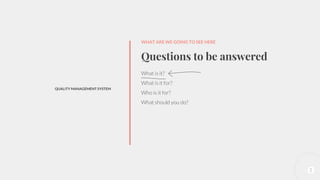
What is it?
What is it for?
Who is it for?
What should you do?
QUALITY MANAGEMENT SYSTEM
WHAT ARE WE GOING TO SEE HERE
Questions to be answered
3
Really, what is it all about?
4
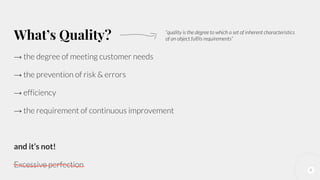
What’s Quality?
→ the degree of meeting customer needs
→ the prevention of risk & errors
→ efficiency
→ the requirement of continuous improvement
and it’s not!
Excessive perfection
“quality is the degree to which a set of inherent characteristics
of an object fulfils requirements”
5
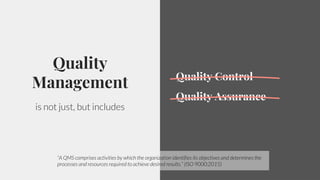
Quality
Management
is not just, but includes
Quality Control
Quality Assurance
“A QMS comprises activities by which the organization identifies its objectives and determines the
processes and resources required to achieve desired results.” (ISO 9000:2015)
6
Quality management, as we see it today,
- has developed from quality control in the first place,
- goes beyond quality assurance and
- aims at ensuring quality from the beginning,
- while including processes not directly influencing quality.
7
What should you focus on?
8
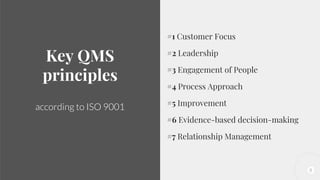
Key QMS
principles
according to ISO 9001
#1 Customer Focus
#2 Leadership
#3 Engagement of People
#4 Process Approach
#5 Improvement
#6 Evidence-based decision-making
#7 Relationship Management
9
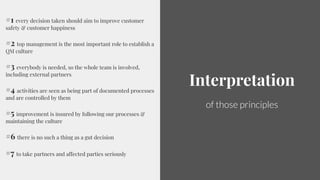
Interpretation
of those principles
#1 every decision taken should aim to improve customer
safety & customer happiness
#2 top management is the most important role to establish a
QM culture
#3 everybody is needed, so the whole team is involved,
including external partners
#4 activities are seen as being part of documented processes
and are controlled by them
#5 improvement is insured by following our processes &
maintaining the culture
#6 there is no such a thing as a gut decision
#7 to take partners and affected parties seriously
10
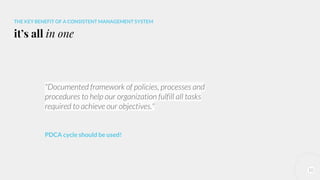
THE KEY BENEFIT OF A CONSISTENT MANAGEMENT SYSTEM
it’s all in one
"Documented framework of policies, processes and
procedures to help our organization fulfill all tasks
required to achieve our objectives."
PDCA cycle should be used!
11
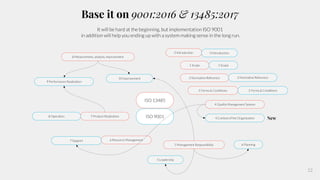
Structure
12
ISO 13485
0 Introduction
1 Scope
2 Normative Reference
3 Terms & Conditions
4 Quality Management System
5 Management Responsibility
6 Resource Management
7 Product Realization
8 Measurement, analysis, improvement
ISO 9001
0 Introduction
1 Scope
2 Normative Reference
3 Terms & Conditions
5 Leadership
4 Context of the Organization
6 Planning
7 Support
8 Operation
9 Performance Realization
10 Improvement
New
Base it on 9001:2016 & 13485:2017
It will be hard at the beginning, but implementation ISO 9001
in addition will help you ending up with a system making sense in the long run.
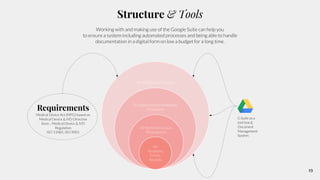
01 IMS Manual (Policies)
02 Departmental Handbooks
(Processes)Requirements
Medical Device Act (MPG) based on
Medical Device & IVD Directive
Soon .. Medical Device & IVD
Regulation
ISO 13485, ISO 9001
G Suite as a
tool box &
Document
Management
System
03 Work Instructions
(Procedures)
04
Templates,
Forms,
Records
Structure & Tools
Working with and making use of the Google Suite can help you
to ensure a system including automated processes and being able to handle
documentation in a digital form on low a budget for a long time.
14
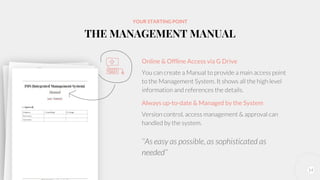
YOUR STARTING POINT
THE MANAGEMENT MANUAL
Online & Offline Access via G Drive
You can create a Manual to provide a main access point
to the Management System. It shows all the high level
information and references the details.
Always up-to-date & Managed by the System
Version control, access management & approval can
handled by the system.
‘‘As easy as possible, as sophisticated as
needed’’
15
What is it?
What is it for?
Who is it for?
What should you do?
QUALITY MANAGEMENT SYSTEM
16
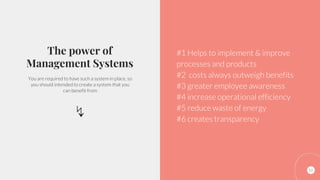
The power of
Management Systems
#1 Helps to implement & improve
processes and products
#2 costs always outweigh benefits
#3 greater employee awareness
#4 increase operational efficiency
#5 reduce waste of energy
#6 creates transparency
You are required to have such a system in place, so
you should intended to create a system that you
can benefit from
↯
17
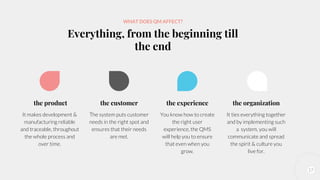
WHAT DOES QM AFFECT?
Everything, from the beginning till
the end
the product
It makes development &
manufacturing reliable
and traceable, throughout
the whole process and
over time.
the customer
The system puts customer
needs in the right spot and
ensures that their needs
are met.
the experience
You know how to create
the right user
experience, the QMS
will help you to ensure
that even when you
grow.
the organization
It ties everything together
and by implementing such
a system, you will
communicate and spread
the spirit & culture you
live for.
18
What is it?
What is it for?
Who is it for?
What should you do?
QUALITY MANAGEMENT SYSTEM
19
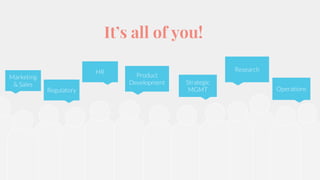
It’s all of you!
Marketing
& Sales
Product
Development
Research
Operations
Strategic
MGMTRegulatory
HR
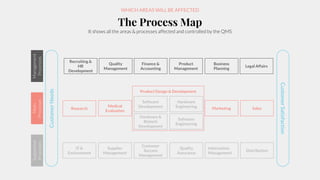
WHICH AREAS WILL BE AFFECTED
The Process Map
It shows all the areas & processes affected and controlled by the QMS
Product Design & Development
SalesResearch
Medical
Evaluation
Hardware
Engineering
Software
Engineering
Marketing
Supportive
Processes
Main
Processes
Supplier
Management
Management
Processes
Recruiting &
HR
Development
Quality
Management
Finance &
Accounting
Business
Planning
Customer
Success
Management
CustomerNeeds
CustomerSatisfaction
Legal Affairs
Distribution
Quality
Assurance
IT &
Environment
Software
Development
Hardware &
Biotech
Development
Product
Management
Information
Management
21
What is it?
What is it for?
Who is it for?
What should you do?
QUALITY MANAGEMENT SYSTEM
22
The plan
23
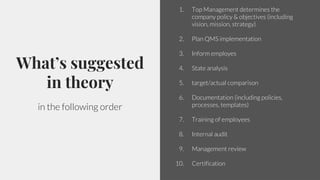
What’s suggested
in theory
in the following order
1. Top Management determines the
company policy & objectives (including
vision, mission, strategy)
2. Plan QMS implementation
3. Inform employes
4. State analysis
5. target/actual comparison
6. Documentation (including policies,
processes, templates)
7. Training of employees
8. Internal audit
9. Management review
10. Certification
24
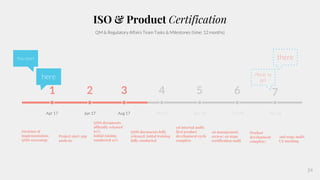
Product
development
complete;
1st management
review; 1st stage
certification audit
1st internal audit;
first product
development cycle
complete
QMS documents fully
released; initial training
fully conducted
ISO & Product Certification
QMS documents
officially released
60%
Initial raining
conducted 30%
QM & Regulatory Affairs Team Tasks & Milestones (time: 12 months)
3 4 5 6 7
Aug 17 Okt 17 Dez 18 Feb 18 Apr 18
1 2
Decision of
implementation;
QMS screening;
2nd stage audit;
CE marking
Project start; gap
analysis
Apr 17 Jun 17
here
You start
Planb to
get
there
25
“.. so far so good.."
26
Reality
Product
development
complete;
1st management
review; 1st stage
certification audit
1st internal audit;
first product
development cycle
complete
QMS documents fully
released; initial training
fully conducted
QMS documents
officially released
60%
Initial raining
conducted 30%
3 4 5 6 7
Aug 17 Okt 17 Dez 18 Feb 18 Apr 18
1 2
Decision of
implementation;
QMS screening;
2nd stage audit;
CE marking
Project start; gap
analysis
Apr 17 Jun 17
27
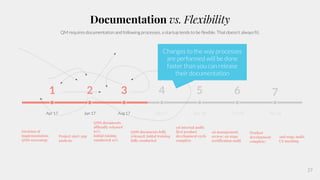
Documentation vs. Flexibility
QM requires documentation and following processes, a startup tends to be flexible. That doesn’t always fit.
Changes to the way processes
are performed will be done
faster than you can release
their documentation
28
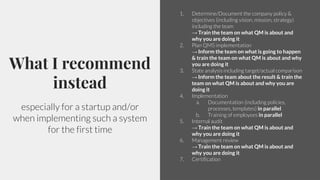
What I recommend
instead
especially for a startup and/or
when implementing such a system
for the first time
1. Determine/Document the company policy &
objectives (including vision, mission, strategy)
including the team
→ Train the team on what QM is about and
why you are doing it
2. Plan QMS implementation
→ Inform the team on what is going to happen
& train the team on what QM is about and why
you are doing it
3. State analysis including target/actual comparison
→ Inform the team about the result & train the
team on what QM is about and why you are
doing it
4. Implementation
a. Documentation (including policies,
processes, templates) in parallel
b. Training of employees in parallel
5. Internal audit
→ Train the team on what QM is about and
why you are doing it
6. Management review
→ Train the team on what QM is about and
why you are doing it
7. Certification
29
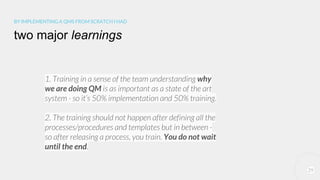
BY IMPLEMENTING A QMS FROM SCRATCH I HAD
two major learnings
1. Training in a sense of the team understanding why
we are doing QM is as important as a state of the art
system - so it’s 50% implementation and 50% training.
2. The training should not happen after defining all the
processes/procedures and templates but in between -
so after releasing a process, you train. You do not wait
until the end.
30
Always keep in mind
31
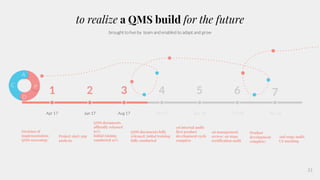
to realize a QMS build for the future
brought to live by team and enabled to adapt and grow
3 4 5 6 71 2
A
C P
D
Product
development
complete;
1st management
review; 1st stage
certification audit
1st internal audit;
first product
development cycle
complete
QMS documents fully
released; initial training
fully conducted
QMS documents
officially released
60%
Initial raining
conducted 30%
Decision of
implementation;
QMS screening;
2nd stage audit;
CE marking
Project start; gap
analysis
Aug 17 Okt 17 Dez 18 Feb 18 Apr 18Apr 17 Jun 17
32
the world is waiting for more and better implementations of Quality
Management Systems and the time to start is right now
IMPLEMENTATION OF ISO 9001:2015 & ISO 13485:2016
Your Turn Is, Now!

How to realize Quality Management System as a Startup

  • 1.
    1 A QMS aimsto be as easy as possible, as sophisticated as needed, easily accessible, scalable and always up to date. IMPLEMENTATION OF ISO 9001:2015 & ISO 13485:2016 Realizing a QMS as a Startup
  • 2.
    2 What is it? Whatis it for? Who is it for? What should you do? QUALITY MANAGEMENT SYSTEM WHAT ARE WE GOING TO SEE HERE Questions to be answered
  • 3.
    3 Really, what isit all about?
  • 4.
    4 What’s Quality? → thedegree of meeting customer needs → the prevention of risk & errors → efficiency → the requirement of continuous improvement and it’s not! Excessive perfection “quality is the degree to which a set of inherent characteristics of an object fulfils requirements”
  • 5.
    5 Quality Management is not just,but includes Quality Control Quality Assurance “A QMS comprises activities by which the organization identifies its objectives and determines the processes and resources required to achieve desired results.” (ISO 9000:2015)
  • 6.
    6 Quality management, aswe see it today, - has developed from quality control in the first place, - goes beyond quality assurance and - aims at ensuring quality from the beginning, - while including processes not directly influencing quality.
  • 7.
  • 8.
    8 Key QMS principles according toISO 9001 #1 Customer Focus #2 Leadership #3 Engagement of People #4 Process Approach #5 Improvement #6 Evidence-based decision-making #7 Relationship Management
  • 9.
    9 Interpretation of those principles #1every decision taken should aim to improve customer safety & customer happiness #2 top management is the most important role to establish a QM culture #3 everybody is needed, so the whole team is involved, including external partners #4 activities are seen as being part of documented processes and are controlled by them #5 improvement is insured by following our processes & maintaining the culture #6 there is no such a thing as a gut decision #7 to take partners and affected parties seriously
  • 10.
    10 THE KEY BENEFITOF A CONSISTENT MANAGEMENT SYSTEM it’s all in one "Documented framework of policies, processes and procedures to help our organization fulfill all tasks required to achieve our objectives." PDCA cycle should be used!
  • 11.
  • 12.
    12 ISO 13485 0 Introduction 1Scope 2 Normative Reference 3 Terms & Conditions 4 Quality Management System 5 Management Responsibility 6 Resource Management 7 Product Realization 8 Measurement, analysis, improvement ISO 9001 0 Introduction 1 Scope 2 Normative Reference 3 Terms & Conditions 5 Leadership 4 Context of the Organization 6 Planning 7 Support 8 Operation 9 Performance Realization 10 Improvement New Base it on 9001:2016 & 13485:2017 It will be hard at the beginning, but implementation ISO 9001 in addition will help you ending up with a system making sense in the long run.
  • 13.
    01 IMS Manual(Policies) 02 Departmental Handbooks (Processes)Requirements Medical Device Act (MPG) based on Medical Device & IVD Directive Soon .. Medical Device & IVD Regulation ISO 13485, ISO 9001 G Suite as a tool box & Document Management System 03 Work Instructions (Procedures) 04 Templates, Forms, Records Structure & Tools Working with and making use of the Google Suite can help you to ensure a system including automated processes and being able to handle documentation in a digital form on low a budget for a long time.
  • 14.
    14 YOUR STARTING POINT THEMANAGEMENT MANUAL Online & Offline Access via G Drive You can create a Manual to provide a main access point to the Management System. It shows all the high level information and references the details. Always up-to-date & Managed by the System Version control, access management & approval can handled by the system. ‘‘As easy as possible, as sophisticated as needed’’
  • 15.
    15 What is it? Whatis it for? Who is it for? What should you do? QUALITY MANAGEMENT SYSTEM
  • 16.
    16 The power of ManagementSystems #1 Helps to implement & improve processes and products #2 costs always outweigh benefits #3 greater employee awareness #4 increase operational efficiency #5 reduce waste of energy #6 creates transparency You are required to have such a system in place, so you should intended to create a system that you can benefit from ↯
  • 17.
    17 WHAT DOES QMAFFECT? Everything, from the beginning till the end the product It makes development & manufacturing reliable and traceable, throughout the whole process and over time. the customer The system puts customer needs in the right spot and ensures that their needs are met. the experience You know how to create the right user experience, the QMS will help you to ensure that even when you grow. the organization It ties everything together and by implementing such a system, you will communicate and spread the spirit & culture you live for.
  • 18.
    18 What is it? Whatis it for? Who is it for? What should you do? QUALITY MANAGEMENT SYSTEM
  • 19.
    19 It’s all ofyou! Marketing & Sales Product Development Research Operations Strategic MGMTRegulatory HR
  • 20.
    WHICH AREAS WILLBE AFFECTED The Process Map It shows all the areas & processes affected and controlled by the QMS Product Design & Development SalesResearch Medical Evaluation Hardware Engineering Software Engineering Marketing Supportive Processes Main Processes Supplier Management Management Processes Recruiting & HR Development Quality Management Finance & Accounting Business Planning Customer Success Management CustomerNeeds CustomerSatisfaction Legal Affairs Distribution Quality Assurance IT & Environment Software Development Hardware & Biotech Development Product Management Information Management
  • 21.
    21 What is it? Whatis it for? Who is it for? What should you do? QUALITY MANAGEMENT SYSTEM
  • 22.
  • 23.
    23 What’s suggested in theory inthe following order 1. Top Management determines the company policy & objectives (including vision, mission, strategy) 2. Plan QMS implementation 3. Inform employes 4. State analysis 5. target/actual comparison 6. Documentation (including policies, processes, templates) 7. Training of employees 8. Internal audit 9. Management review 10. Certification
  • 24.
    24 Product development complete; 1st management review; 1ststage certification audit 1st internal audit; first product development cycle complete QMS documents fully released; initial training fully conducted ISO & Product Certification QMS documents officially released 60% Initial raining conducted 30% QM & Regulatory Affairs Team Tasks & Milestones (time: 12 months) 3 4 5 6 7 Aug 17 Okt 17 Dez 18 Feb 18 Apr 18 1 2 Decision of implementation; QMS screening; 2nd stage audit; CE marking Project start; gap analysis Apr 17 Jun 17 here You start Planb to get there
  • 25.
    25 “.. so farso good.."
  • 26.
  • 27.
    Product development complete; 1st management review; 1ststage certification audit 1st internal audit; first product development cycle complete QMS documents fully released; initial training fully conducted QMS documents officially released 60% Initial raining conducted 30% 3 4 5 6 7 Aug 17 Okt 17 Dez 18 Feb 18 Apr 18 1 2 Decision of implementation; QMS screening; 2nd stage audit; CE marking Project start; gap analysis Apr 17 Jun 17 27 Documentation vs. Flexibility QM requires documentation and following processes, a startup tends to be flexible. That doesn’t always fit. Changes to the way processes are performed will be done faster than you can release their documentation
  • 28.
    28 What I recommend instead especiallyfor a startup and/or when implementing such a system for the first time 1. Determine/Document the company policy & objectives (including vision, mission, strategy) including the team → Train the team on what QM is about and why you are doing it 2. Plan QMS implementation → Inform the team on what is going to happen & train the team on what QM is about and why you are doing it 3. State analysis including target/actual comparison → Inform the team about the result & train the team on what QM is about and why you are doing it 4. Implementation a. Documentation (including policies, processes, templates) in parallel b. Training of employees in parallel 5. Internal audit → Train the team on what QM is about and why you are doing it 6. Management review → Train the team on what QM is about and why you are doing it 7. Certification
  • 29.
    29 BY IMPLEMENTING AQMS FROM SCRATCH I HAD two major learnings 1. Training in a sense of the team understanding why we are doing QM is as important as a state of the art system - so it’s 50% implementation and 50% training. 2. The training should not happen after defining all the processes/procedures and templates but in between - so after releasing a process, you train. You do not wait until the end.
  • 30.
  • 31.
    31 to realize aQMS build for the future brought to live by team and enabled to adapt and grow 3 4 5 6 71 2 A C P D Product development complete; 1st management review; 1st stage certification audit 1st internal audit; first product development cycle complete QMS documents fully released; initial training fully conducted QMS documents officially released 60% Initial raining conducted 30% Decision of implementation; QMS screening; 2nd stage audit; CE marking Project start; gap analysis Aug 17 Okt 17 Dez 18 Feb 18 Apr 18Apr 17 Jun 17
  • 32.
    32 the world iswaiting for more and better implementations of Quality Management Systems and the time to start is right now IMPLEMENTATION OF ISO 9001:2015 & ISO 13485:2016 Your Turn Is, Now!