by
PRANEET SURTI
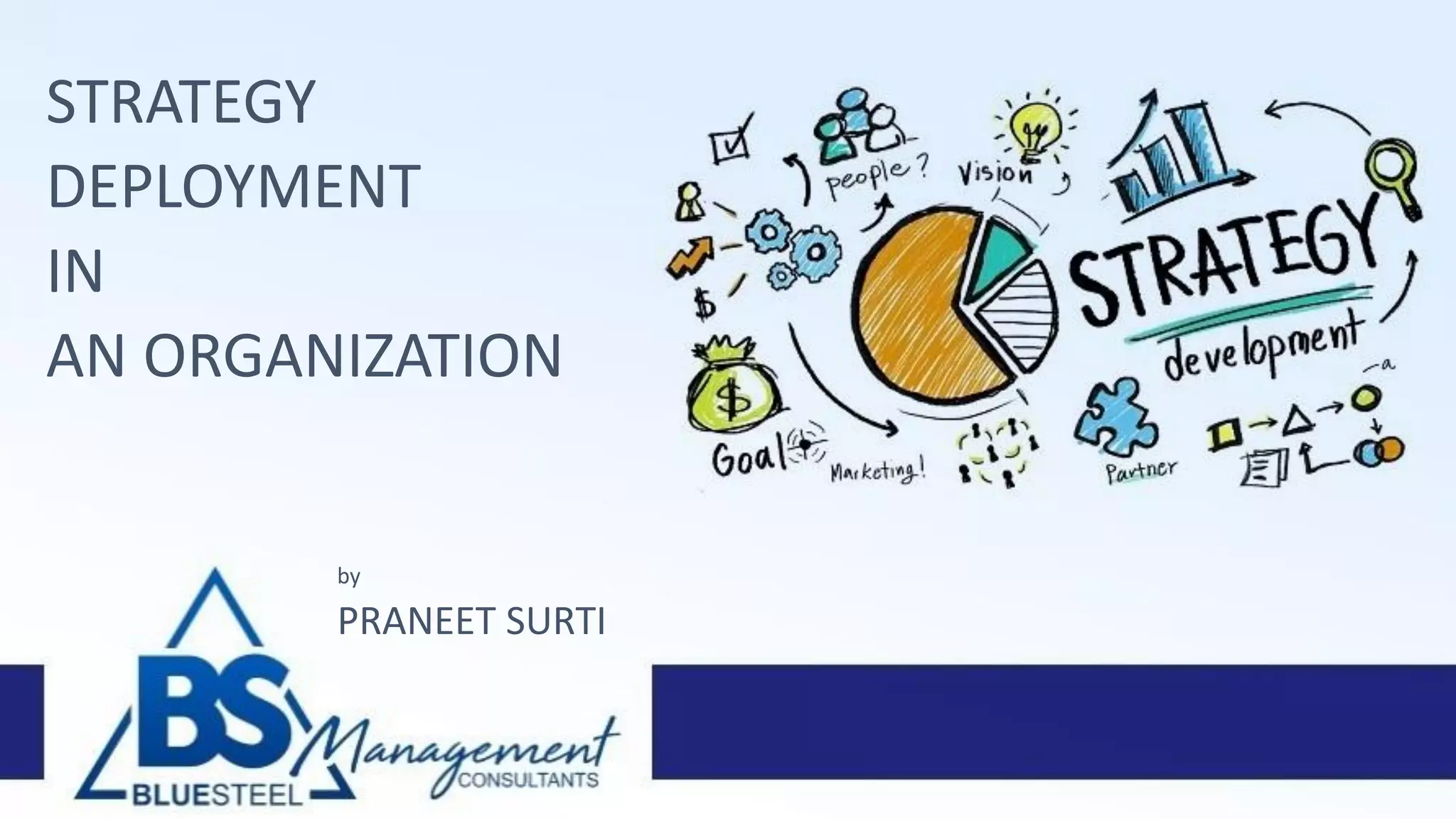
STRATEGY
DEPLOYMENT
IN
AN ORGANIZATION
Of all the functions involved in management, planning is the most important.
As the old saying goes,
“Failing to plan is planning to fail”.
Setting Vision, Mission Followed by Policy and Objectives are very critical steps in
the Strategic planning process. An organization needs to be sure as in how to set
these important performance measurements.
INTRODUCTION
At the close of this session, you will be able to know about:
 What is a Vision, Mission & Quality Policy
 Recognize the difference between Goals and Objectives
 Understand the importance of setting Goals and Objectives
 Describe how Goals and Objectives are set
 State what SMART Objectives are
 Requirement of Objectives in ISO 9001:2015 Standard
 Target
OBJECTIVES OF THE SESSION
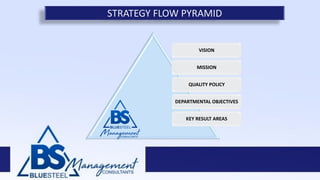
STRATEGY FLOW PYRAMID
VISION
MISSION
QUALITY POLICY
DEPARTMENTAL OBJECTIVES
KEY RESULT AREAS
VISION: The ability to think about or plan the future with imagination or wisdom.
Example: To become a global leader in XYZ Manufacturing Machines
VISION & MISSION
MISSION: It defines the company’s business, its measurable objectives and
its approach to reach them, It is derived from the Vision Statement
Example: To achieve sales of 50 Cr by sourcing products in India & abroad
with 100% customer Satisfaction
POLICY
Intentions and direction of an organization as formally expressed by its top
management, derived from its Vision & Mission
POLICY IN ISO 9001:2015
5.2.1 Establishing the quality policy
Top management shall ESTABLISH, IMPLEMENT AND MAINTAIN a quality
policy that:
a) is appropriate to the PURPOSE AND CONTEXT of the organization and
supports its STRATEGIC DIRECTION;
b) provides a FRAMEWORK for SETTING QUALITY OBJECTIVES;
c) includes a COMMITMENT to SATISFY APPLICABLE REQUIREMENTS;
d) includes a COMMITMENT to CONTINUAL IMPROVEMENT of the
QUALITY MANAGEMENT SYSTEM.
5.2.2 Communicating the quality policy
The quality policy shall:
a) be available and be maintained as
DOCUMENTED INFORMATION
b) be COMMUNICATED, UNDERSTOOD and
APPLIED WITHIN THE ORGANIZATION
c) BE AVAILABLE to relevant interested parties, as
appropriate.
CLAUSE 5.2 POLICY
Although the terms “goals” and “objectives” are often used interchangeably,
there is a difference between them:
GOALS Vs. OBJECTIVES
GOALS
• General
• Intangible
• Broad
• Abstract
• Strategic – long-range direction, set by top
executives
OBJECTIVES
• Specific
• Measurable
• Narrow
• Concrete
• Tactical – short-range, set by managers to
accomplish goals
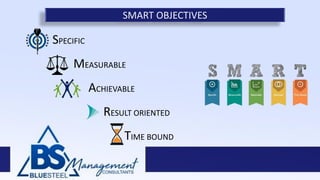
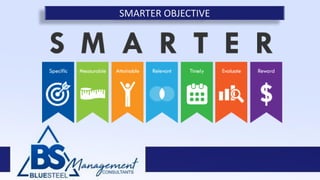
SMART OBJECTIVES
SPECIFIC
MEASURABLE
ACHIEVABLE
RESULT ORIENTED
TIME BOUND
Specific objectives are:
 Concrete
 Detailed
 Focused
 Well-defined
 Straight-forward
 Action-oriented
SPECIFIC OBJECTIVES
When setting objectives that are SPECIFIC, ask:
 What am I going to do? Use action verbs such
as develop, execute, conduct, build
 Why is it important to do this?
 Who is going to be involved?
 When do I want this to be completed?
 How am I going to do this?
 Measurements for objectives help you
know when you have accomplished
them.
 If you set an objective that is
measurable, when you complete it you
have tangible evidence of completion.
MEASURABLE OBJECTIVES
When setting objectives that are MEASURABLE, ask:
 How will I know when this objective has been
achieved?
 What measurements can I use?
 Achievable objectives are those that you can actually accomplish (something
you can really do within the time frame set) and not an aspiration or vision.
 Achievable objectives need to challenge you but not so much so as to be
unattainable or to cause frustration in being unable to complete.
ACHIEVABLE OBJECTIVES
Realistic objectives are those that you have
the resources to accomplish including:
 Skills
 Funding
 Equipment
 Staff
REALISTIC OBJECTIVES
When setting objectives that are REALISTIC, ask:
 Do I have the resources to accomplish?
 Do I need to rearrange my priorities to
accomplish?
 Is it possible to complete this objective?
 Time-oriented objectives are those which
have deadlines for completion.
 The time frames create sufficient urgency
and lead to action.
 The deadlines, just as with overall
objectives, must be achievable and
realistic.
 For a complex objective, break into small
parts with a date for completion for each.
TIME BOUND
When setting objectives that are TIME-BOUND,
ask:
 What is the earliest yet achievable and
realistic date for this objective to be
completed?
 Have I included this date in the statement of
the objective?
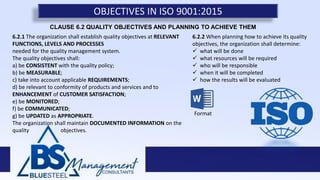
OBJECTIVES IN ISO 9001:2015
6.2.1 The organization shall establish quality objectives at RELEVANT
FUNCTIONS, LEVELS AND PROCESSES
needed for the quality management system.
The quality objectives shall:
a) be CONSISTENT with the quality policy;
b) be MEASURABLE;
c) take into account applicable REQUIREMENTS;
d) be relevant to conformity of products and services and to
ENHANCEMENT of CUSTOMER SATISFACTION;
e) be MONITORED;
f) be COMMUNICATED;
g) be UPDATED as APPROPRIATE.
The organization shall maintain DOCUMENTED INFORMATION on the
quality objectives.
6.2.2 When planning how to achieve its quality
objectives, the organization shall determine:
 what will be done
 what resources will be required
 who will be responsible
 when it will be completed
 how the results will be evaluated
CLAUSE 6.2 QUALITY OBJECTIVES AND PLANNING TO ACHIEVE THEM
Format
Specific and (where possible) measurable performance requirements set for the
organization, internal departments, groups or individuals, that will lead to the
achievement of an Objective
Example:
Identify and record all sources of ABC manufacturing area by the end of August 2019
16
TARGETS
SMARTER OBJECTIVE
ACTIVITY
Each members to come out with 5 Extraordinary Ideas for Setting Strategy
In the following Heads
 EASE FOR CUSTOMER - YELLOW
 INCREASE SALES & EXPLORING NEW MARKETS - ORANGE
 NEW IDEAS FOR GROWTH - GREEN
 ENHANCING QUALITY & UPGRADE DESIGN - PINK
 DECREASE LEAD TIME & COST - WHITE
CORRECTIVE
& PREVENTIVE ACTION
About the Trainer
PRANEET SURTI
Management Consultant
[Lead Auditor ISO 9001:2015, B.E Mechanical Engineering]
BLUE STEEL MANAGEMENT CONSULTANTS
Cell : +918347008127; +91 8109773774
Email: praneetsurti20@gmail.com
LinkedIn: http://in.linkedin.com/in/praneetsurti
Diversified consulting Solutions, Unvarying Sustainable Quality
“Strategy is style of thinking, a conscious and deliberate process, an
intensive implementation system, the science of insuring future
success.”
— Pete Johnson

Strategy Deployment in an Organization

  • 1.
  • 2.
    Of all thefunctions involved in management, planning is the most important. As the old saying goes, “Failing to plan is planning to fail”. Setting Vision, Mission Followed by Policy and Objectives are very critical steps in the Strategic planning process. An organization needs to be sure as in how to set these important performance measurements. INTRODUCTION
  • 3.
    At the closeof this session, you will be able to know about:  What is a Vision, Mission & Quality Policy  Recognize the difference between Goals and Objectives  Understand the importance of setting Goals and Objectives  Describe how Goals and Objectives are set  State what SMART Objectives are  Requirement of Objectives in ISO 9001:2015 Standard  Target OBJECTIVES OF THE SESSION
  • 4.
    STRATEGY FLOW PYRAMID VISION MISSION QUALITYPOLICY DEPARTMENTAL OBJECTIVES KEY RESULT AREAS
  • 5.
    VISION: The abilityto think about or plan the future with imagination or wisdom. Example: To become a global leader in XYZ Manufacturing Machines VISION & MISSION MISSION: It defines the company’s business, its measurable objectives and its approach to reach them, It is derived from the Vision Statement Example: To achieve sales of 50 Cr by sourcing products in India & abroad with 100% customer Satisfaction
  • 6.
    POLICY Intentions and directionof an organization as formally expressed by its top management, derived from its Vision & Mission
  • 7.
    POLICY IN ISO9001:2015 5.2.1 Establishing the quality policy Top management shall ESTABLISH, IMPLEMENT AND MAINTAIN a quality policy that: a) is appropriate to the PURPOSE AND CONTEXT of the organization and supports its STRATEGIC DIRECTION; b) provides a FRAMEWORK for SETTING QUALITY OBJECTIVES; c) includes a COMMITMENT to SATISFY APPLICABLE REQUIREMENTS; d) includes a COMMITMENT to CONTINUAL IMPROVEMENT of the QUALITY MANAGEMENT SYSTEM. 5.2.2 Communicating the quality policy The quality policy shall: a) be available and be maintained as DOCUMENTED INFORMATION b) be COMMUNICATED, UNDERSTOOD and APPLIED WITHIN THE ORGANIZATION c) BE AVAILABLE to relevant interested parties, as appropriate. CLAUSE 5.2 POLICY
  • 8.
    Although the terms“goals” and “objectives” are often used interchangeably, there is a difference between them: GOALS Vs. OBJECTIVES GOALS • General • Intangible • Broad • Abstract • Strategic – long-range direction, set by top executives OBJECTIVES • Specific • Measurable • Narrow • Concrete • Tactical – short-range, set by managers to accomplish goals
  • 9.
  • 10.
    Specific objectives are: Concrete  Detailed  Focused  Well-defined  Straight-forward  Action-oriented SPECIFIC OBJECTIVES When setting objectives that are SPECIFIC, ask:  What am I going to do? Use action verbs such as develop, execute, conduct, build  Why is it important to do this?  Who is going to be involved?  When do I want this to be completed?  How am I going to do this?
  • 11.
     Measurements forobjectives help you know when you have accomplished them.  If you set an objective that is measurable, when you complete it you have tangible evidence of completion. MEASURABLE OBJECTIVES When setting objectives that are MEASURABLE, ask:  How will I know when this objective has been achieved?  What measurements can I use?
  • 12.
     Achievable objectivesare those that you can actually accomplish (something you can really do within the time frame set) and not an aspiration or vision.  Achievable objectives need to challenge you but not so much so as to be unattainable or to cause frustration in being unable to complete. ACHIEVABLE OBJECTIVES
  • 13.
    Realistic objectives arethose that you have the resources to accomplish including:  Skills  Funding  Equipment  Staff REALISTIC OBJECTIVES When setting objectives that are REALISTIC, ask:  Do I have the resources to accomplish?  Do I need to rearrange my priorities to accomplish?  Is it possible to complete this objective?
  • 14.
     Time-oriented objectivesare those which have deadlines for completion.  The time frames create sufficient urgency and lead to action.  The deadlines, just as with overall objectives, must be achievable and realistic.  For a complex objective, break into small parts with a date for completion for each. TIME BOUND When setting objectives that are TIME-BOUND, ask:  What is the earliest yet achievable and realistic date for this objective to be completed?  Have I included this date in the statement of the objective?
  • 15.
    OBJECTIVES IN ISO9001:2015 6.2.1 The organization shall establish quality objectives at RELEVANT FUNCTIONS, LEVELS AND PROCESSES needed for the quality management system. The quality objectives shall: a) be CONSISTENT with the quality policy; b) be MEASURABLE; c) take into account applicable REQUIREMENTS; d) be relevant to conformity of products and services and to ENHANCEMENT of CUSTOMER SATISFACTION; e) be MONITORED; f) be COMMUNICATED; g) be UPDATED as APPROPRIATE. The organization shall maintain DOCUMENTED INFORMATION on the quality objectives. 6.2.2 When planning how to achieve its quality objectives, the organization shall determine:  what will be done  what resources will be required  who will be responsible  when it will be completed  how the results will be evaluated CLAUSE 6.2 QUALITY OBJECTIVES AND PLANNING TO ACHIEVE THEM Format
  • 16.
    Specific and (wherepossible) measurable performance requirements set for the organization, internal departments, groups or individuals, that will lead to the achievement of an Objective Example: Identify and record all sources of ABC manufacturing area by the end of August 2019 16 TARGETS
  • 17.
  • 18.
    ACTIVITY Each members tocome out with 5 Extraordinary Ideas for Setting Strategy In the following Heads  EASE FOR CUSTOMER - YELLOW  INCREASE SALES & EXPLORING NEW MARKETS - ORANGE  NEW IDEAS FOR GROWTH - GREEN  ENHANCING QUALITY & UPGRADE DESIGN - PINK  DECREASE LEAD TIME & COST - WHITE
  • 19.
    CORRECTIVE & PREVENTIVE ACTION Aboutthe Trainer PRANEET SURTI Management Consultant [Lead Auditor ISO 9001:2015, B.E Mechanical Engineering] BLUE STEEL MANAGEMENT CONSULTANTS Cell : +918347008127; +91 8109773774 Email: praneetsurti20@gmail.com LinkedIn: http://in.linkedin.com/in/praneetsurti Diversified consulting Solutions, Unvarying Sustainable Quality “Strategy is style of thinking, a conscious and deliberate process, an intensive implementation system, the science of insuring future success.” — Pete Johnson