Lively Lunch
Charleston
November 2014
Simon Thomson
Open Access Key
Open Access Report : Market Size,
Share, Forecast, and Trends
Published 2013
Open Access Key – “one to watch”
successfully introduced services to reduce friction
and create a more efficient marketplace
Background to OAK
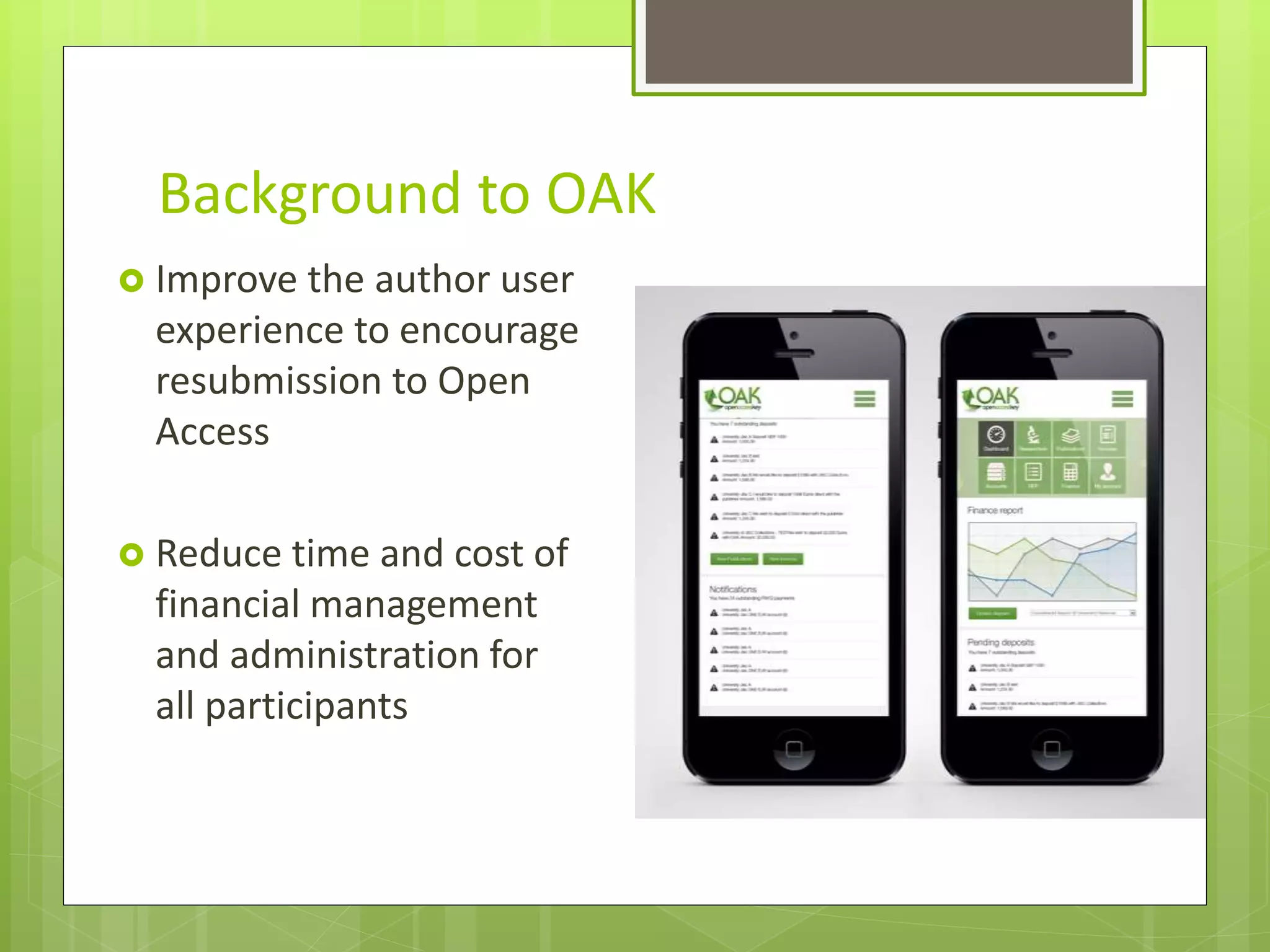
 Improve the author user
experience to encourage
resubmission to Open
Access
 Reduce time and cost of
financial management
and administration for
all participants
Challenges
 Administration
 Individual Authors
 Universities and Funders
 Payment management
 Data Collection and Reporting
 .........Cost
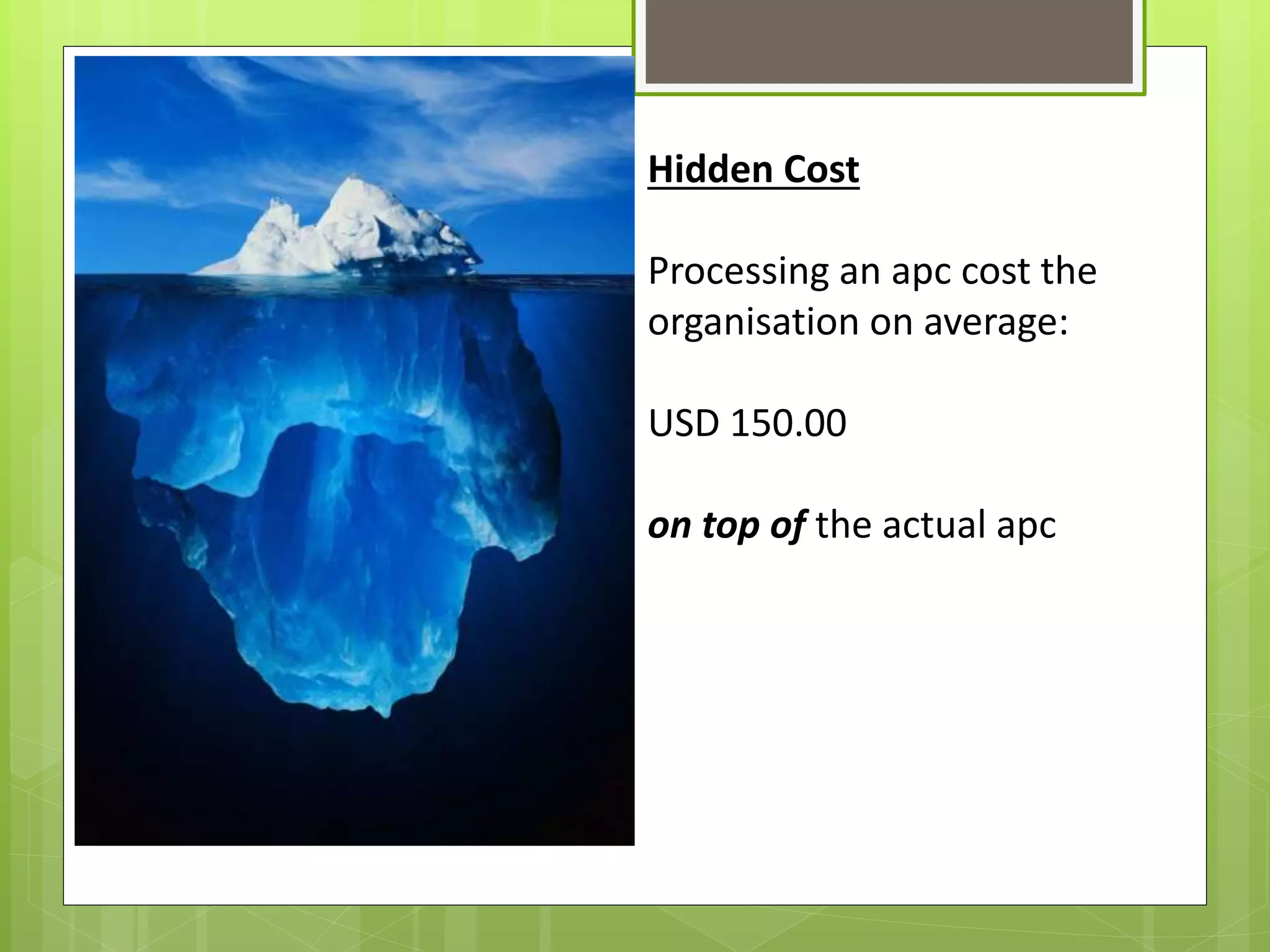
Hidden Cost
Processing an apc cost the
organisation on average:
USD 150.00
on top of the actual apc
If you want to go there, I
wouldn't start from here
OAK Platform focus
 Ease of Use
 Connectivity
 Control and oversight
 Cost
University Account
 Enables central online management of publication fees
 An automated workflow and communication tool
 Provides consolidated payments dramatically reducing
finance management costs
 Provides online live and searchable data on
expenditure and publications
 Provides reporting and financial account management
 Provides budget caps to automatically track individual
authors or projects
 Provides metadata feeds to institutional repository
systems
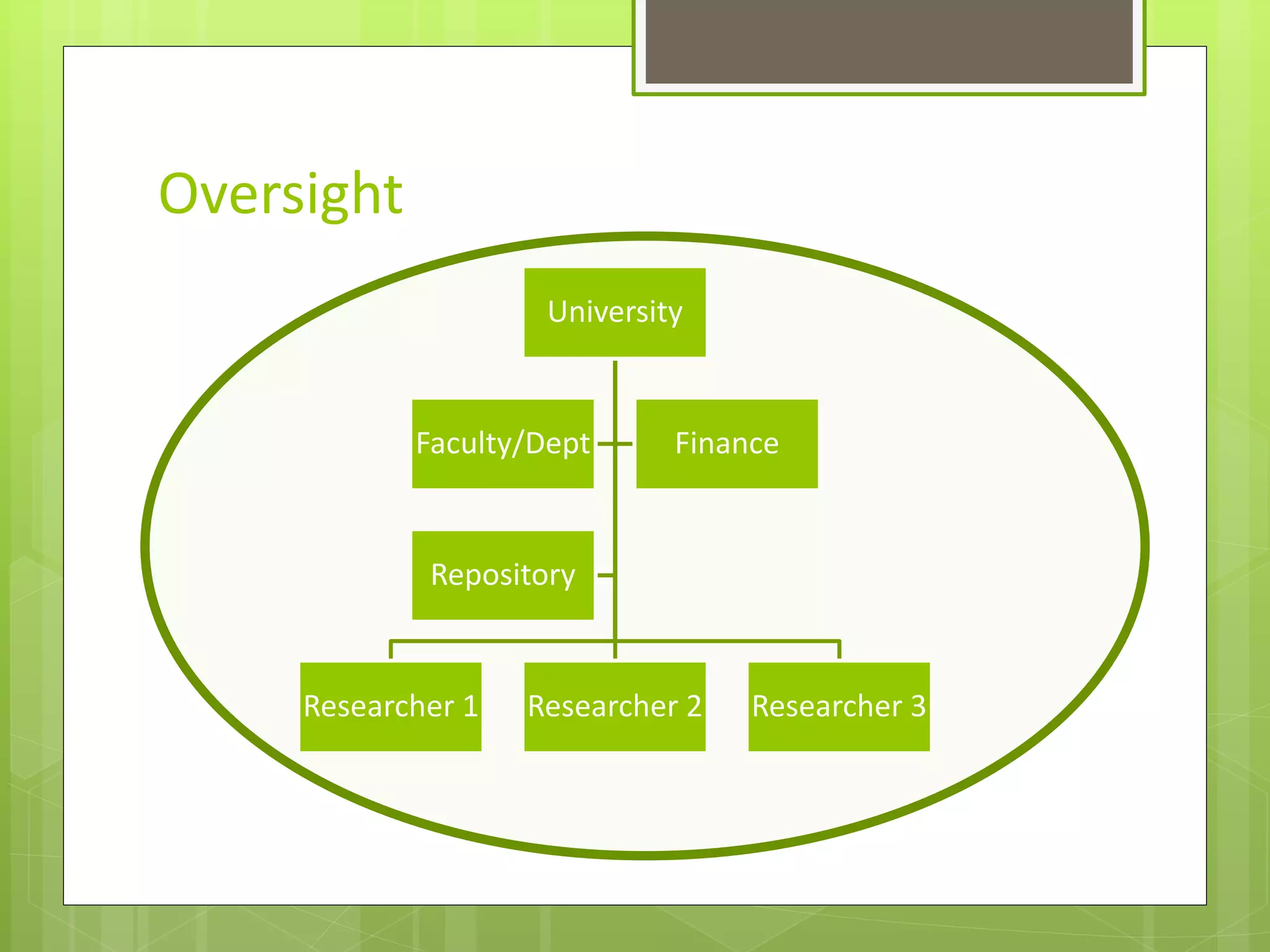
Oversight
University
Researcher 1 Researcher 2 Researcher 3
Faculty/Dept Finance
Repository
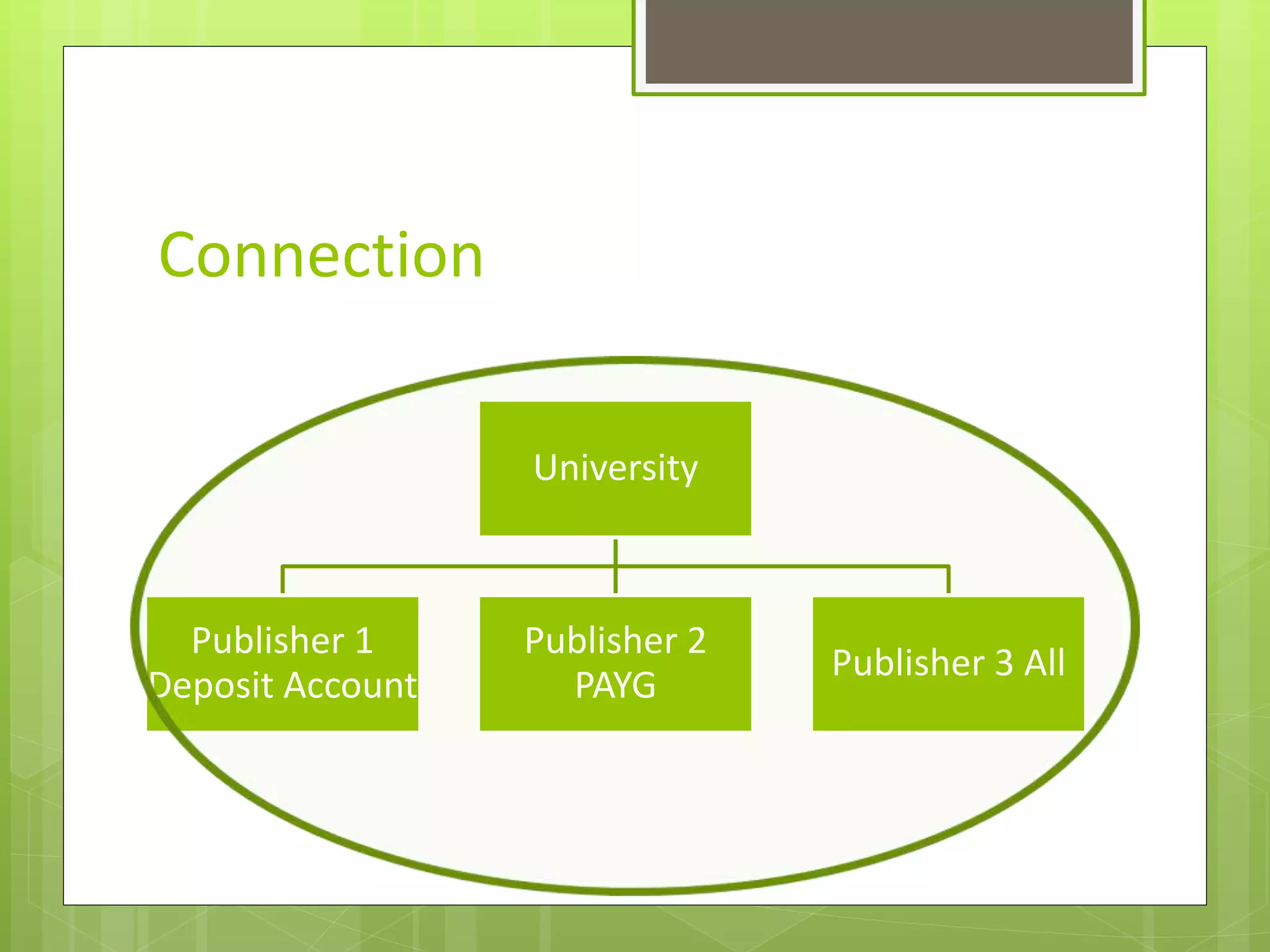
Connection
University
Publisher 1
Deposit Account
Publisher 2
PAYG
Publisher 3 All
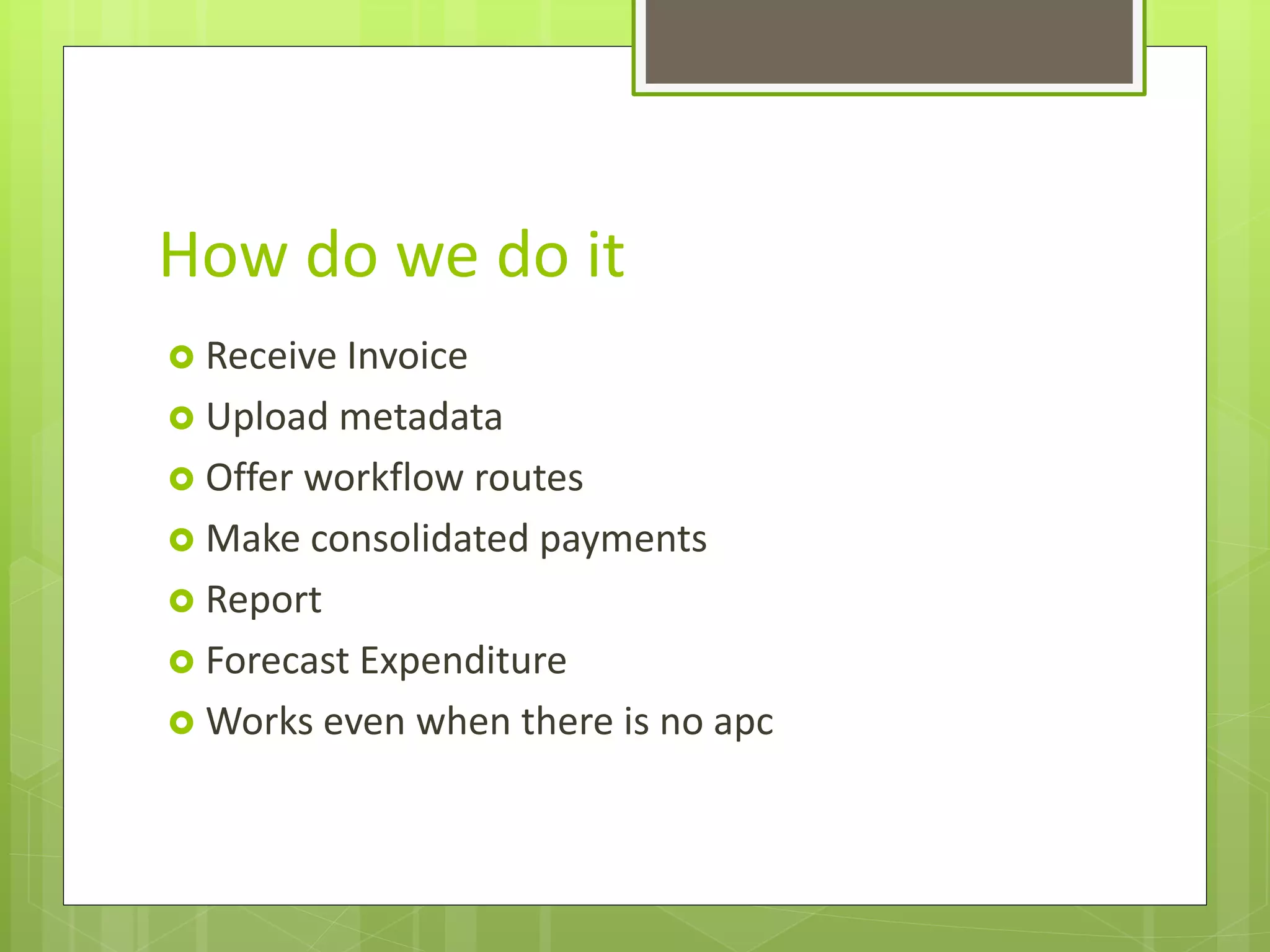
How do we do it
 Receive Invoice
 Upload metadata
 Offer workflow routes
 Make consolidated payments
 Report
 Forecast Expenditure
 Works even when there is no apc
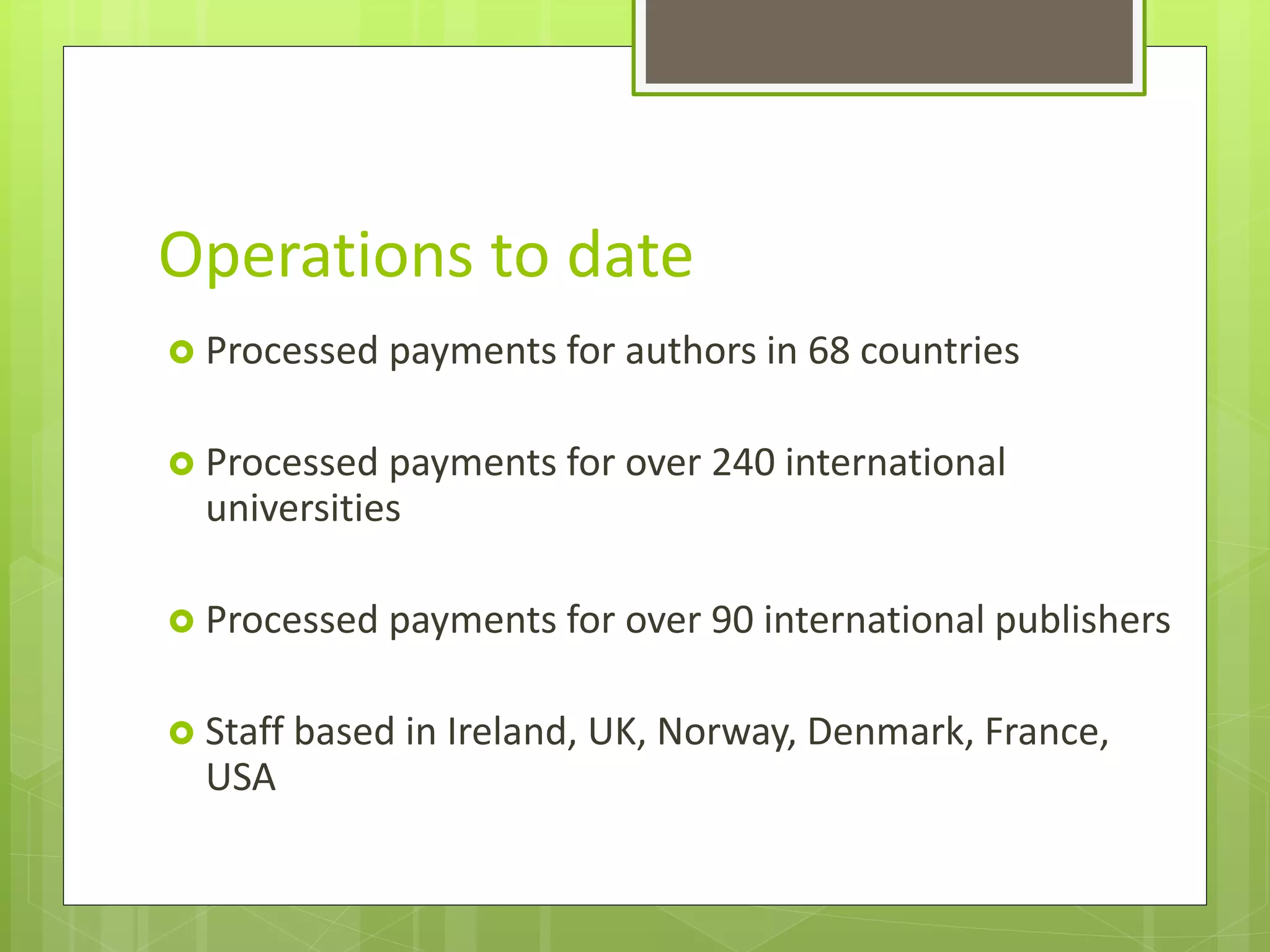
Operations to date
 Processed payments for authors in 68 countries
 Processed payments for over 240 international
universities
 Processed payments for over 90 international publishers
 Staff based in Ireland, UK, Norway, Denmark, France,
USA
Set up and Cost
 Select desired workflow
 Create budgets
 Select publishers/Journals
 Structure report templates
 University Account – Annual Fee starts from
$2000
enable researchers and universities
spend their time and money on
research and
not on administration
Future Development
 Journal selection and submission tool
 Aid to find journals which are compliant to funder
mandates/requirements
 links to submission and payment process
 Automated repository data management
 New OA functionality
 Reviewer payment
 Receive cash or pass cash credit to their university
Thank you
Contact us for a demonstration and
more details at
inbox@openaccesskey.com

How to Handle Article Processing Charges: Introduction to Open Access Key

  • 1.
  • 2.
    Open Access Report: Market Size, Share, Forecast, and Trends Published 2013 Open Access Key – “one to watch” successfully introduced services to reduce friction and create a more efficient marketplace
  • 3.
    Background to OAK Improve the author user experience to encourage resubmission to Open Access  Reduce time and cost of financial management and administration for all participants
  • 5.
    Challenges  Administration  IndividualAuthors  Universities and Funders  Payment management  Data Collection and Reporting  .........Cost
  • 6.
    Hidden Cost Processing anapc cost the organisation on average: USD 150.00 on top of the actual apc
  • 8.
    If you wantto go there, I wouldn't start from here
  • 9.
    OAK Platform focus Ease of Use  Connectivity  Control and oversight  Cost
  • 10.
    University Account  Enablescentral online management of publication fees  An automated workflow and communication tool  Provides consolidated payments dramatically reducing finance management costs  Provides online live and searchable data on expenditure and publications  Provides reporting and financial account management  Provides budget caps to automatically track individual authors or projects  Provides metadata feeds to institutional repository systems
  • 11.
    Oversight University Researcher 1 Researcher2 Researcher 3 Faculty/Dept Finance Repository
  • 12.
  • 13.
    How do wedo it  Receive Invoice  Upload metadata  Offer workflow routes  Make consolidated payments  Report  Forecast Expenditure  Works even when there is no apc
  • 14.
    Operations to date Processed payments for authors in 68 countries  Processed payments for over 240 international universities  Processed payments for over 90 international publishers  Staff based in Ireland, UK, Norway, Denmark, France, USA
  • 15.
    Set up andCost  Select desired workflow  Create budgets  Select publishers/Journals  Structure report templates  University Account – Annual Fee starts from $2000
  • 16.
    enable researchers anduniversities spend their time and money on research and not on administration
  • 17.
    Future Development  Journalselection and submission tool  Aid to find journals which are compliant to funder mandates/requirements  links to submission and payment process  Automated repository data management  New OA functionality  Reviewer payment  Receive cash or pass cash credit to their university
  • 18.
    Thank you Contact usfor a demonstration and more details at inbox@openaccesskey.com

Editor's Notes

  • #3 Hopefully you have all heard of OAK. The Outsell Open Access Report published last year ranked as one to watch / after we had successfully introduced services to reduce friction and create a more efficient marketplace. If not – hopefully I can provide you with a bit more information
  • #4 Anthony has very astutely organised this session not to discuss or debate open access publishing, but to create a forum to discuss what you and your colleagues are managing today as a consequence on the growth of the gold oa publishing model At heart, OA publishing is to the benefit of the research community and beyond. The business model has been a great development for the academic publishing community. But like all good ideas -
  • #5 Including the quasi OA publishing slash self promotion by Apple and U2 who deliveried their new album for free whether you wanted it or not! Sometimes new developments create new challenges in daily use!
  • #6 Oak was created in 2011 and we spent a year talking to academics, universities, librarians, finance managers, research funders and publishers. What we could see at that time was obvious to all. The new apc fee micropayment model had heaped additional responsibility and burden onto authors and university administrators and the way it was being handled was not efficient or scaleable. Payments were restricted to credit cards, or single publisher members schemes. Data collection and reporting were reliant on researchers completing internal documents and remembering to send them. And reports were incomplete. Oh yes and the cost
  • #7 We carried out time and motion studies with researchers and their universities. With the time and processing charges it was working out that on average the additional cost for processing an apc fee was $150 per publication fee. That is on top of the actual apc fee. And in most cases, this cost was hidden as librarians and finance managers were having to cope with the increase in oa publications from their existing resources. It was often the library who were taking charge over coordinating both payment and publication admin. It was clear to us, we had to build a worflow tool that was unobtrusive, flexible and could deliver control to administrators
  • #8 I come from Ireland, and we have a common expression when asked for directions. Spent a full year analysing the market and collecting business requirements from all participants We discovered there was Little or no connection between publishers, authors, universities and funders in apc and metadata submission management Little or no oversight from universities and funders on OA expenditure Reporting was inaccurate and costly to perform For OA submissions to continue to grow, researchers should have minimal (if any) role in the apc management.
  • #10 We had to start from scratch. We decided to concentrate on 4 key factors. The system had to be easy to use and accessible to all It had to connect individual researchers to their faculty, to their library, to finance, to their funders and to publishers Administrators had to gain control and oversight of costs and publication data And we had to do this and save all participants the costs of their current proccesses
  • #11 Today if you logged into your university account, you would be able to browse, search, create reports in your browser and download to excel. You can set up budget and expenditure caps on faculty, departments and individuals. You can manage both publisher deposit accounts and your own direct payments You have access to all financial and publication metadata details in one place
  • #12 From your OAK account it provided oversight and access for all levels at the university
  • #13 And the OAK account brought all your publisher accounts into one system
  • #14 How do we do it We receive an invoice from a researcher, a university, a publisher It is logged and registered and we add article metadata from the publisher – article title, doi, url etc We can tag or request further payment details from users We can then work via the author to his administrator or by pass the author completely Once the payment is approved – we make payment And report on it We can forecast expenditure And we have users logging articles even if there is no apc as it is a great way for faculty, library and repository managers to gain data from one location
  • #15 We have processed payments in almost 70 countries for over 240 universities and to 90 publishers. We have staff based in Ireland, Uk, Norway, Denmark, France and USA
  • #16 Set up is easy – select your workflow – create budgets, select the publishers and structure your reporting An annual fee is charged – starting from $2000.
  • #17 OAK’s mission is to enable researchers to spend their time and money on research and not on administration
  • #18 Future development/ new launches for 2015
  • #19 Many thanks