How to give a presentation
This file is not intended to be shown to the audience but rather loaded onto a tablet and used as
presenter notes.
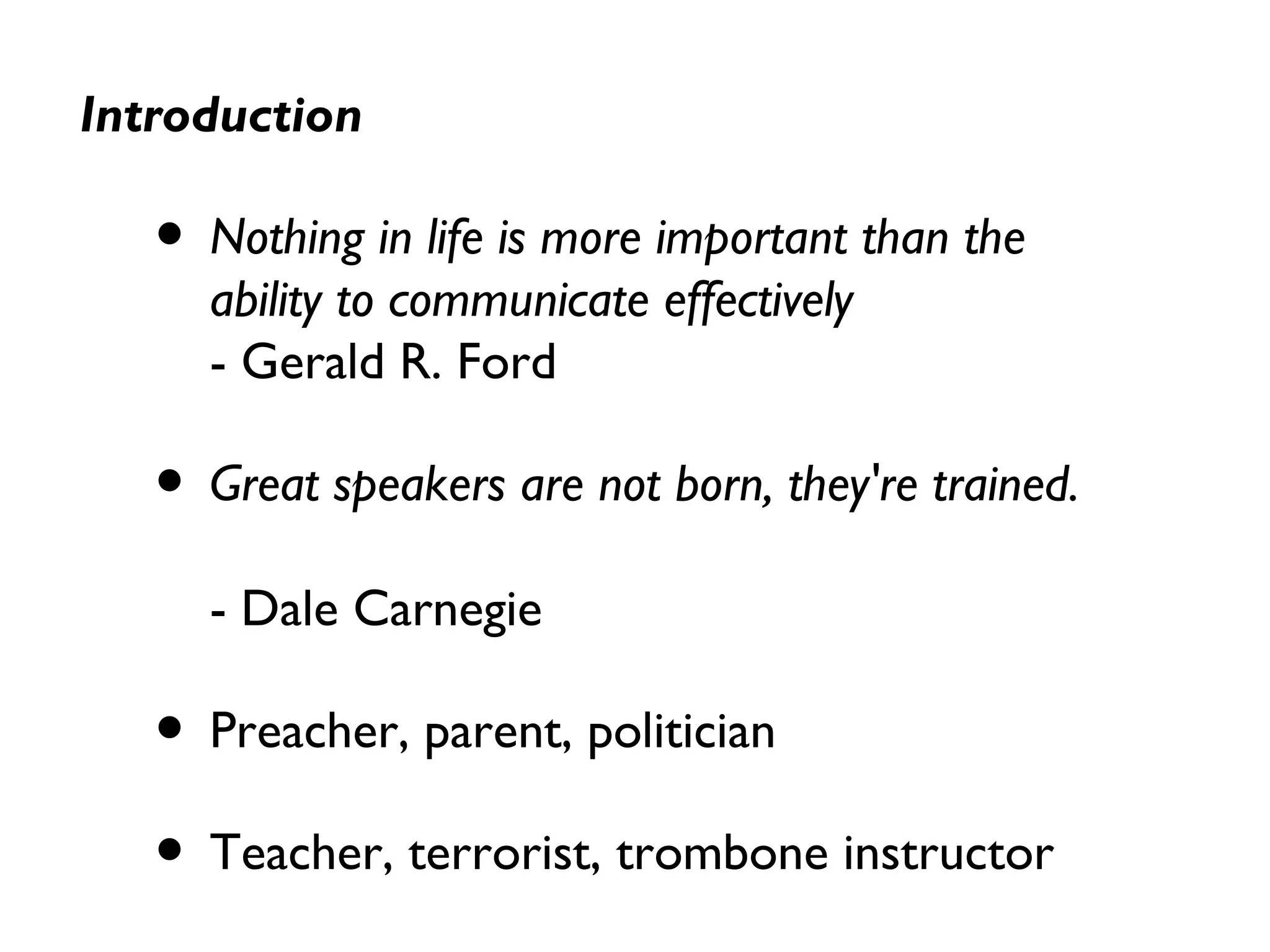
Introduction
• Nothing in life is more important than the
ability to communicate effectively
- Gerald R. Ford
• Great speakers are not born, they're trained.
- Dale Carnegie
• Preacher, parent, politician
• Teacher, terrorist, trombone instructor
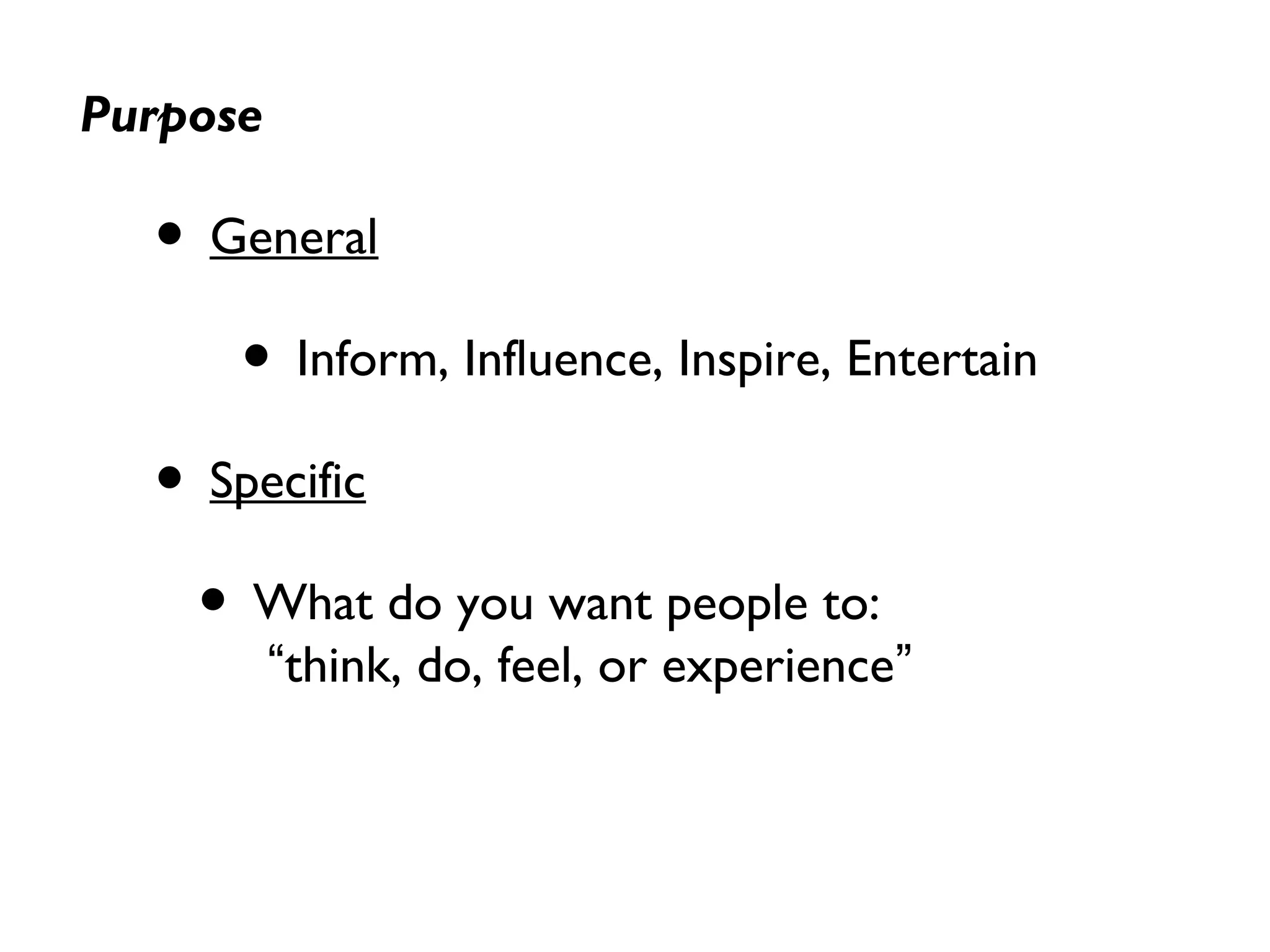
Purpose
• General
• Inform, Influence, Inspire, Entertain
• Specific
• What do you want people to:
“think, do, feel, or experience”
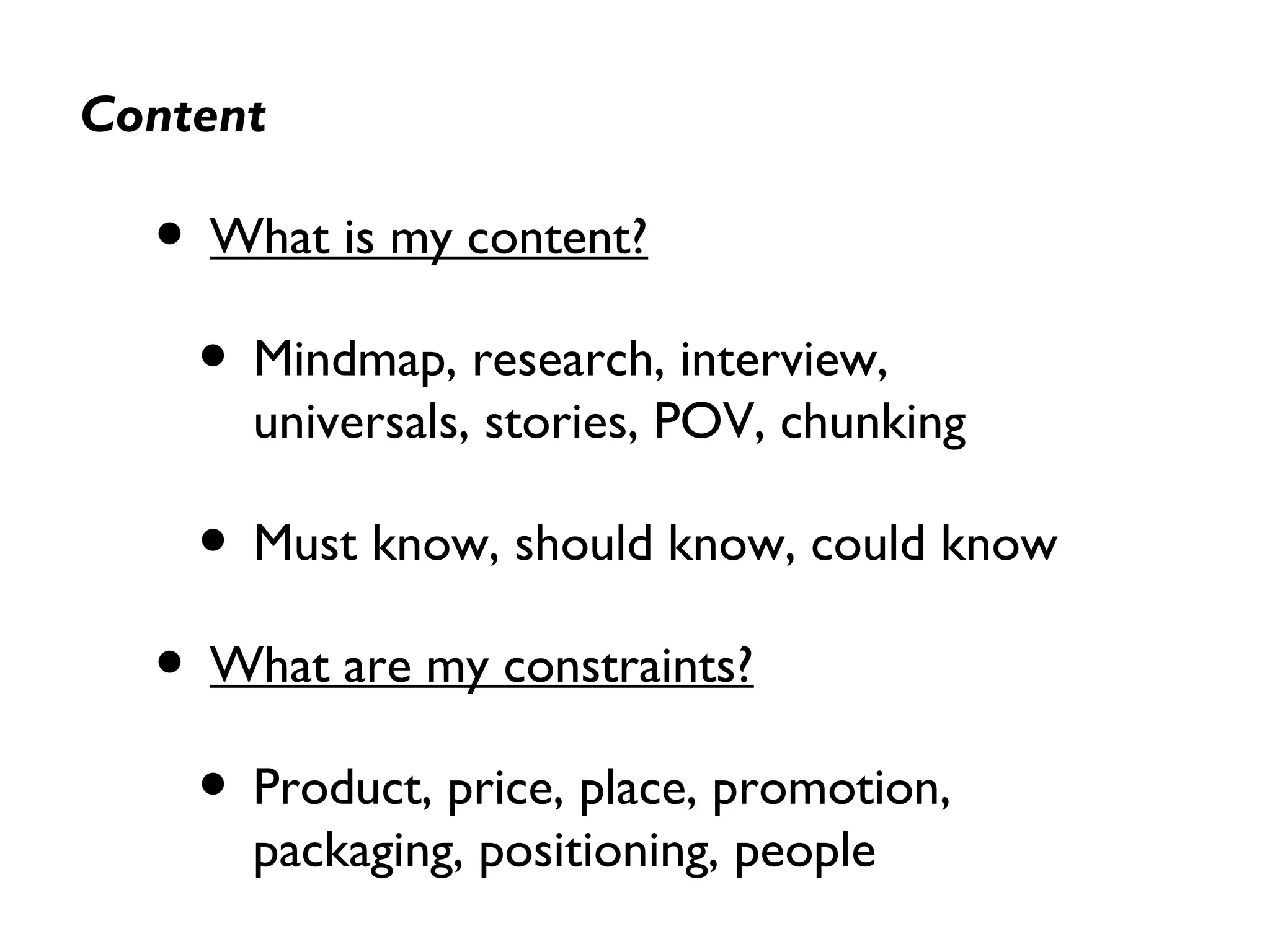
Content
• What is my content?
• Mindmap, research, interview,
universals, stories, POV, chunking
• Must know, should know, could know
• What are my constraints?
• Product, price, place, promotion,
packaging, positioning, people
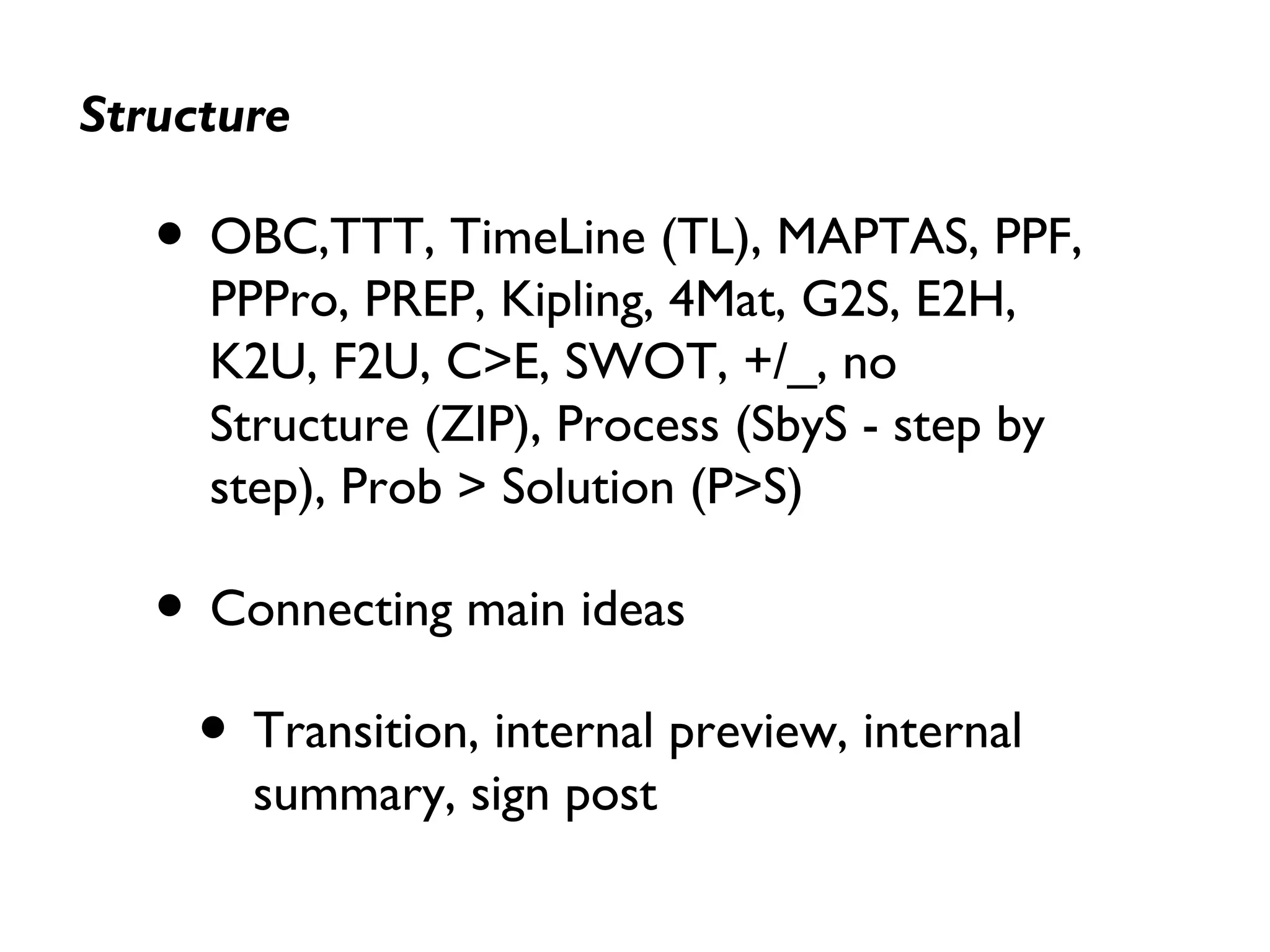
Structure
• OBC,TTT, TimeLine (TL), MAPTAS, PPF,
PPPro, PREP, Kipling, 4Mat, G2S, E2H,
K2U, F2U, C>E, SWOT, +/_, no
Structure (ZIP), Process (SbyS - step by
step), Prob > Solution (P>S)
• Connecting main ideas
• Transition, internal preview, internal
summary, sign post
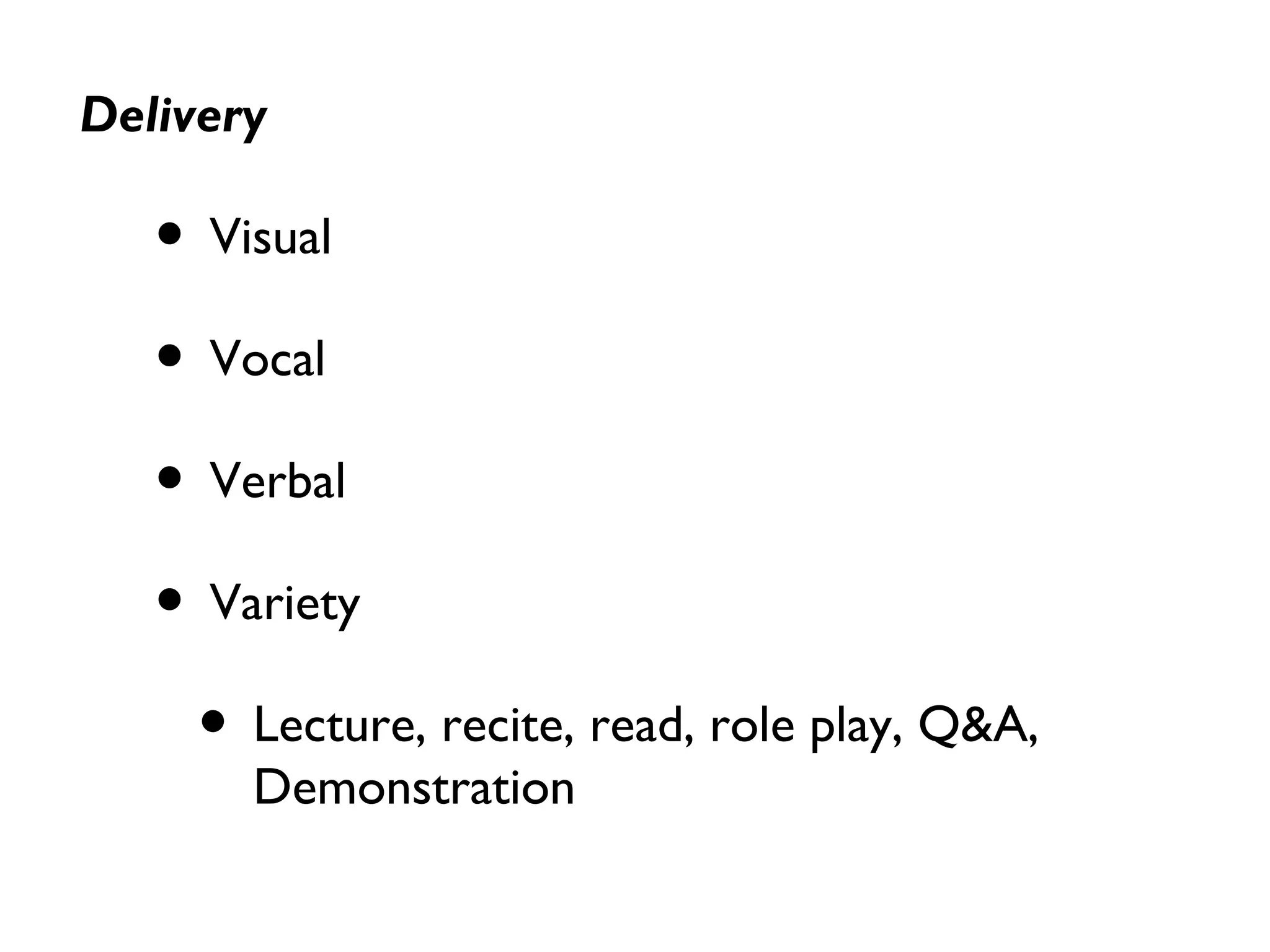
Delivery
• Visual
• Vocal
• Verbal
• Variety
• Lecture, recite, read, role play, Q&A,
Demonstration
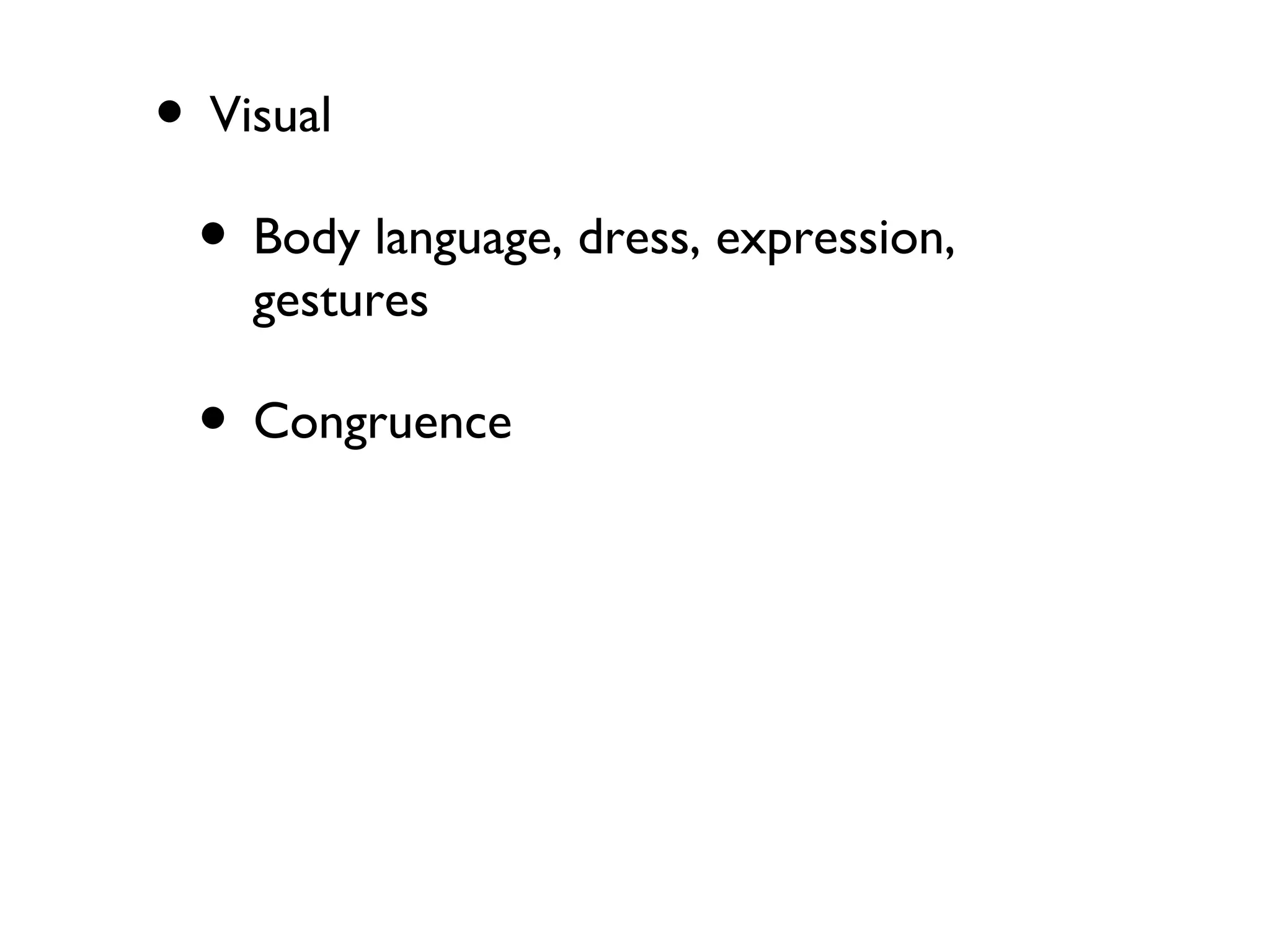
• Visual
• Body language, dress, expression,
gestures
• Congruence
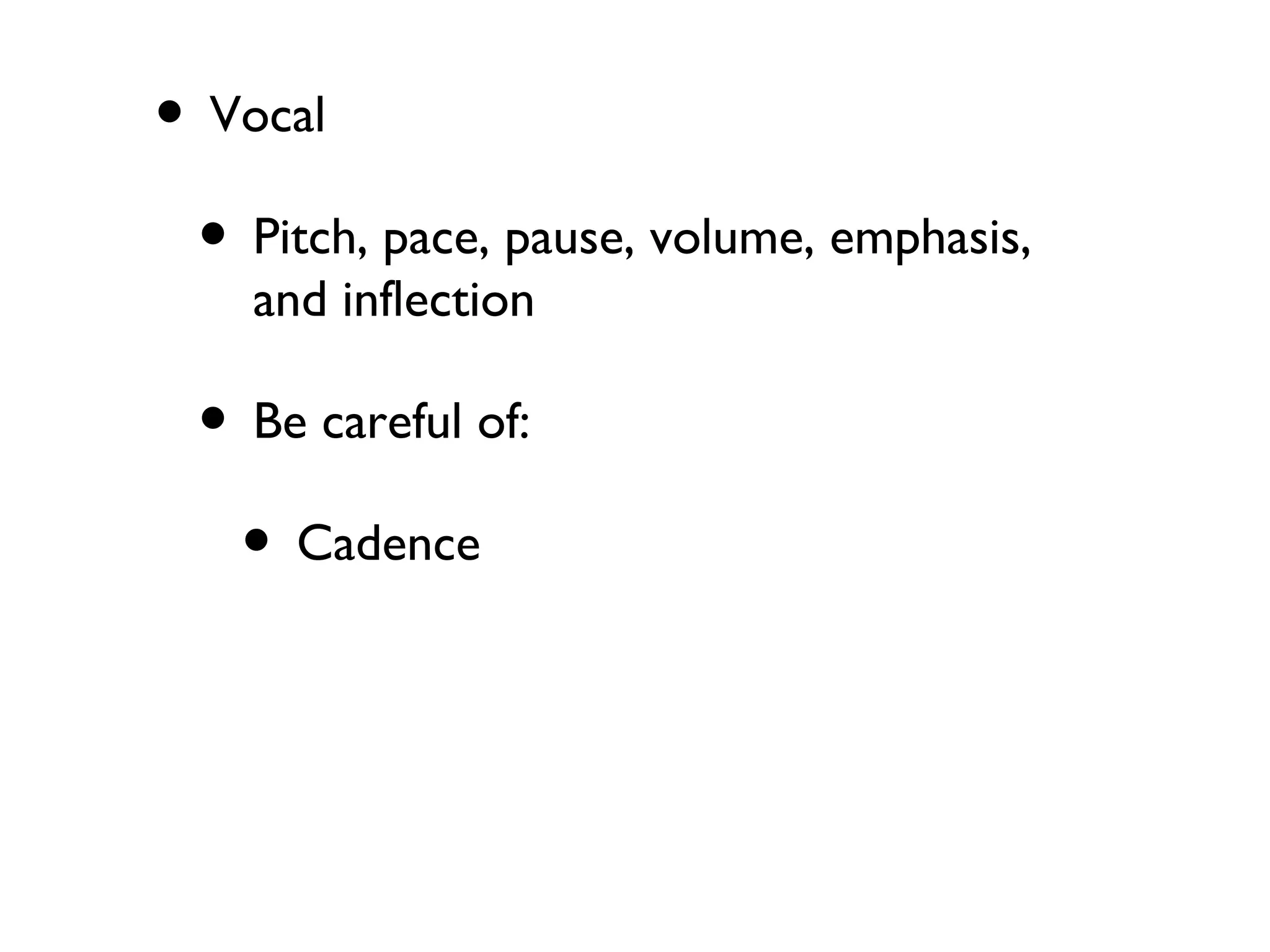
• Vocal
• Pitch, pace, pause, volume, emphasis,
and inflection
• Be careful of:
• Cadence
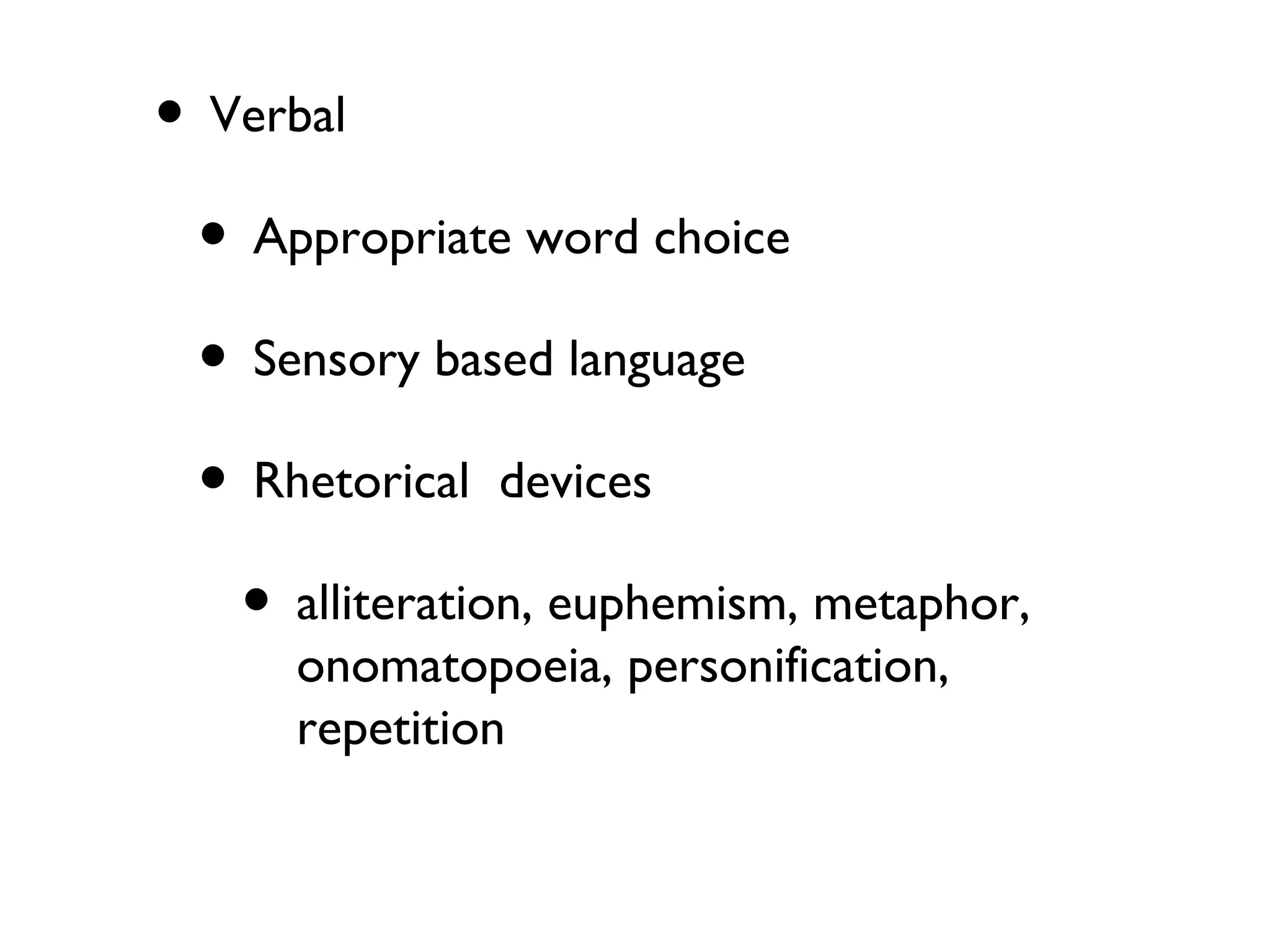
• Verbal
• Appropriate word choice
• Sensory based language
• Rhetorical devices
• alliteration, euphemism, metaphor,
onomatopoeia, personification,
repetition
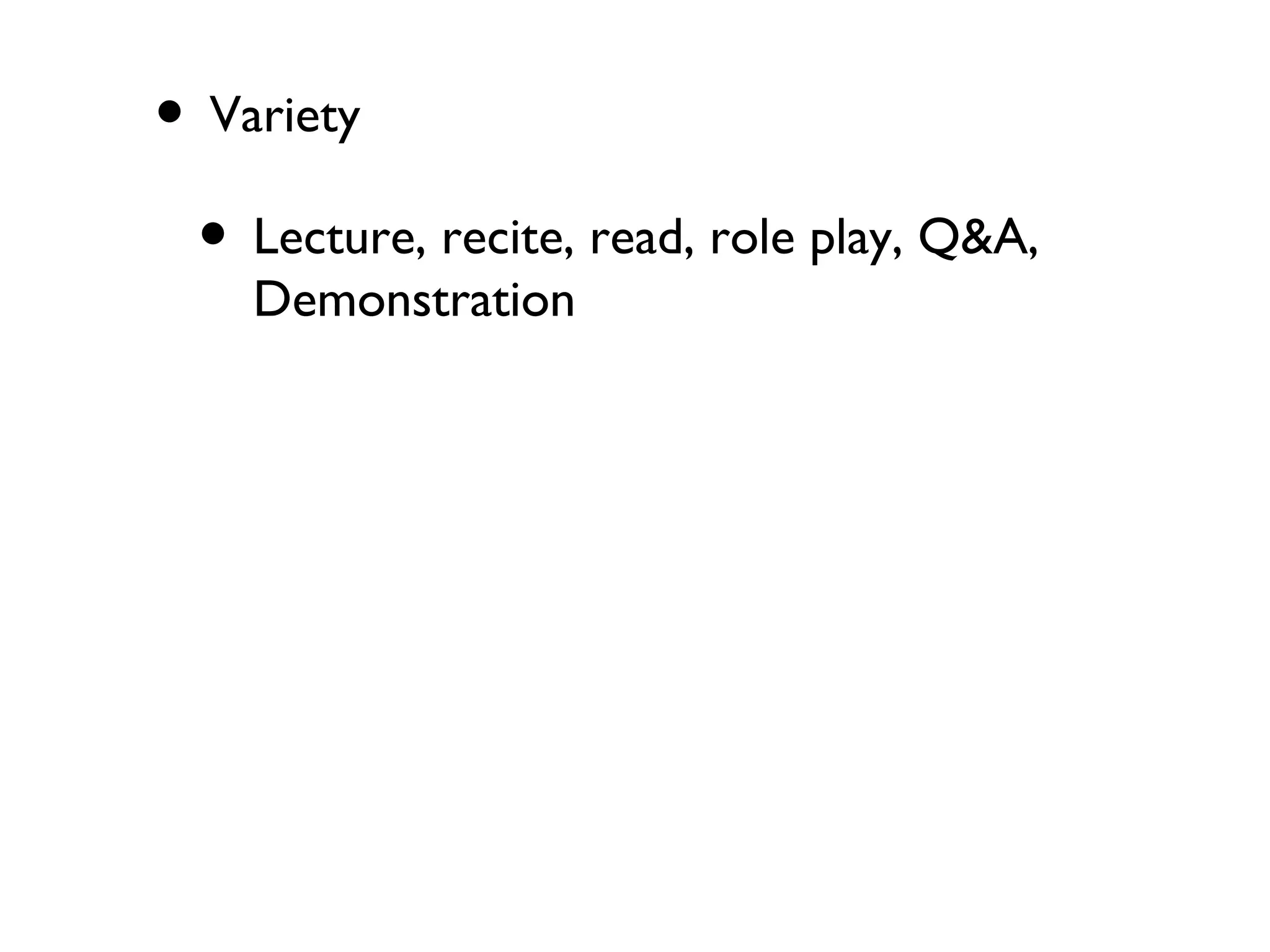
• Variety
• Lecture, recite, read, role play, Q&A,
Demonstration
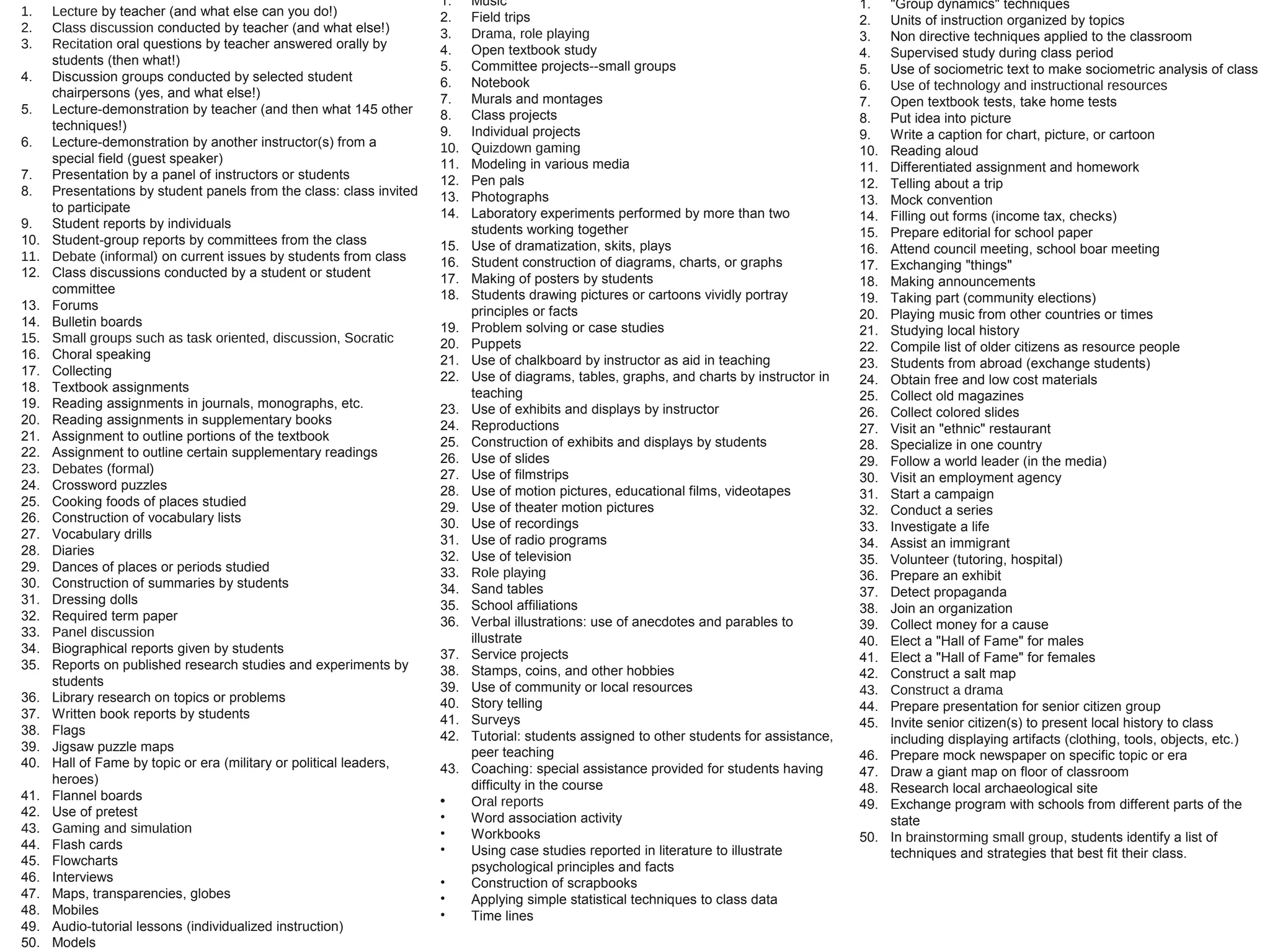
1. Lecture by teacher (and what else can you do!)
2. Class discussion conducted by teacher (and what else!)
3. Recitation oral questions by teacher answered orally by
students (then what!)
4. Discussion groups conducted by selected student
chairpersons (yes, and what else!)
5. Lecture-demonstration by teacher (and then what 145 other
techniques!)
6. Lecture-demonstration by another instructor(s) from a
special field (guest speaker)
7. Presentation by a panel of instructors or students
8. Presentations by student panels from the class: class invited
to participate
9. Student reports by individuals
10. Student-group reports by committees from the class
11. Debate (informal) on current issues by students from class
12. Class discussions conducted by a student or student
committee
13. Forums
14. Bulletin boards
15. Small groups such as task oriented, discussion, Socratic
16. Choral speaking
17. Collecting
18. Textbook assignments
19. Reading assignments in journals, monographs, etc.
20. Reading assignments in supplementary books
21. Assignment to outline portions of the textbook
22. Assignment to outline certain supplementary readings
23. Debates (formal)
24. Crossword puzzles
25. Cooking foods of places studied
26. Construction of vocabulary lists
27. Vocabulary drills
28. Diaries
29. Dances of places or periods studied
30. Construction of summaries by students
31. Dressing dolls
32. Required term paper
33. Panel discussion
34. Biographical reports given by students
35. Reports on published research studies and experiments by
students
36. Library research on topics or problems
37. Written book reports by students
38. Flags
39. Jigsaw puzzle maps
40. Hall of Fame by topic or era (military or political leaders,
heroes)
41. Flannel boards
42. Use of pretest
43. Gaming and simulation
44. Flash cards
45. Flowcharts
46. Interviews
47. Maps, transparencies, globes
48. Mobiles
49. Audio-tutorial lessons (individualized instruction)
50. Models
1. Music
2. Field trips
3. Drama, role playing
4. Open textbook study
5. Committee projects--small groups
6. Notebook
7. Murals and montages
8. Class projects
9. Individual projects
10. Quizdown gaming
11. Modeling in various media
12. Pen pals
13. Photographs
14. Laboratory experiments performed by more than two
students working together
15. Use of dramatization, skits, plays
16. Student construction of diagrams, charts, or graphs
17. Making of posters by students
18. Students drawing pictures or cartoons vividly portray
principles or facts
19. Problem solving or case studies
20. Puppets
21. Use of chalkboard by instructor as aid in teaching
22. Use of diagrams, tables, graphs, and charts by instructor in
teaching
23. Use of exhibits and displays by instructor
24. Reproductions
25. Construction of exhibits and displays by students
26. Use of slides
27. Use of filmstrips
28. Use of motion pictures, educational films, videotapes
29. Use of theater motion pictures
30. Use of recordings
31. Use of radio programs
32. Use of television
33. Role playing
34. Sand tables
35. School affiliations
36. Verbal illustrations: use of anecdotes and parables to
illustrate
37. Service projects
38. Stamps, coins, and other hobbies
39. Use of community or local resources
40. Story telling
41. Surveys
42. Tutorial: students assigned to other students for assistance,
peer teaching
43. Coaching: special assistance provided for students having
difficulty in the course
• Oral reports
• Word association activity
• Workbooks
• Using case studies reported in literature to illustrate
psychological principles and facts
• Construction of scrapbooks
• Applying simple statistical techniques to class data
• Time lines
1. "Group dynamics" techniques
2. Units of instruction organized by topics
3. Non directive techniques applied to the classroom
4. Supervised study during class period
5. Use of sociometric text to make sociometric analysis of class
6. Use of technology and instructional resources
7. Open textbook tests, take home tests
8. Put idea into picture
9. Write a caption for chart, picture, or cartoon
10. Reading aloud
11. Differentiated assignment and homework
12. Telling about a trip
13. Mock convention
14. Filling out forms (income tax, checks)
15. Prepare editorial for school paper
16. Attend council meeting, school boar meeting
17. Exchanging "things"
18. Making announcements
19. Taking part (community elections)
20. Playing music from other countries or times
21. Studying local history
22. Compile list of older citizens as resource people
23. Students from abroad (exchange students)
24. Obtain free and low cost materials
25. Collect old magazines
26. Collect colored slides
27. Visit an "ethnic" restaurant
28. Specialize in one country
29. Follow a world leader (in the media)
30. Visit an employment agency
31. Start a campaign
32. Conduct a series
33. Investigate a life
34. Assist an immigrant
35. Volunteer (tutoring, hospital)
36. Prepare an exhibit
37. Detect propaganda
38. Join an organization
39. Collect money for a cause
40. Elect a "Hall of Fame" for males
41. Elect a "Hall of Fame" for females
42. Construct a salt map
43. Construct a drama
44. Prepare presentation for senior citizen group
45. Invite senior citizen(s) to present local history to class
including displaying artifacts (clothing, tools, objects, etc.)
46. Prepare mock newspaper on specific topic or era
47. Draw a giant map on floor of classroom
48. Research local archaeological site
49. Exchange program with schools from different parts of the
state
50. In brainstorming small group, students identify a list of
techniques and strategies that best fit their class.
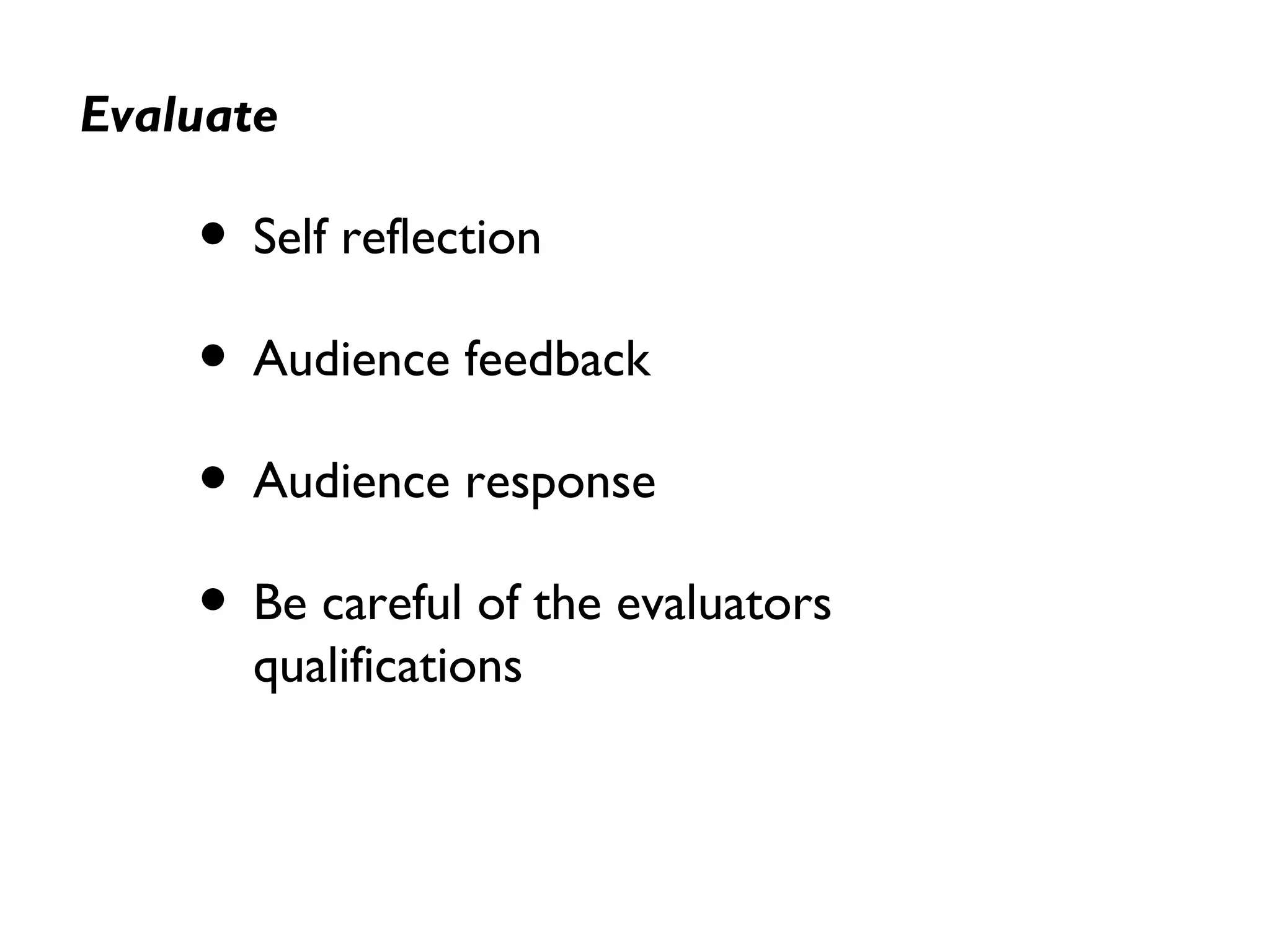
Evaluate
• Self reflection
• Audience feedback
• Audience response
• Be careful of the evaluators
qualifications
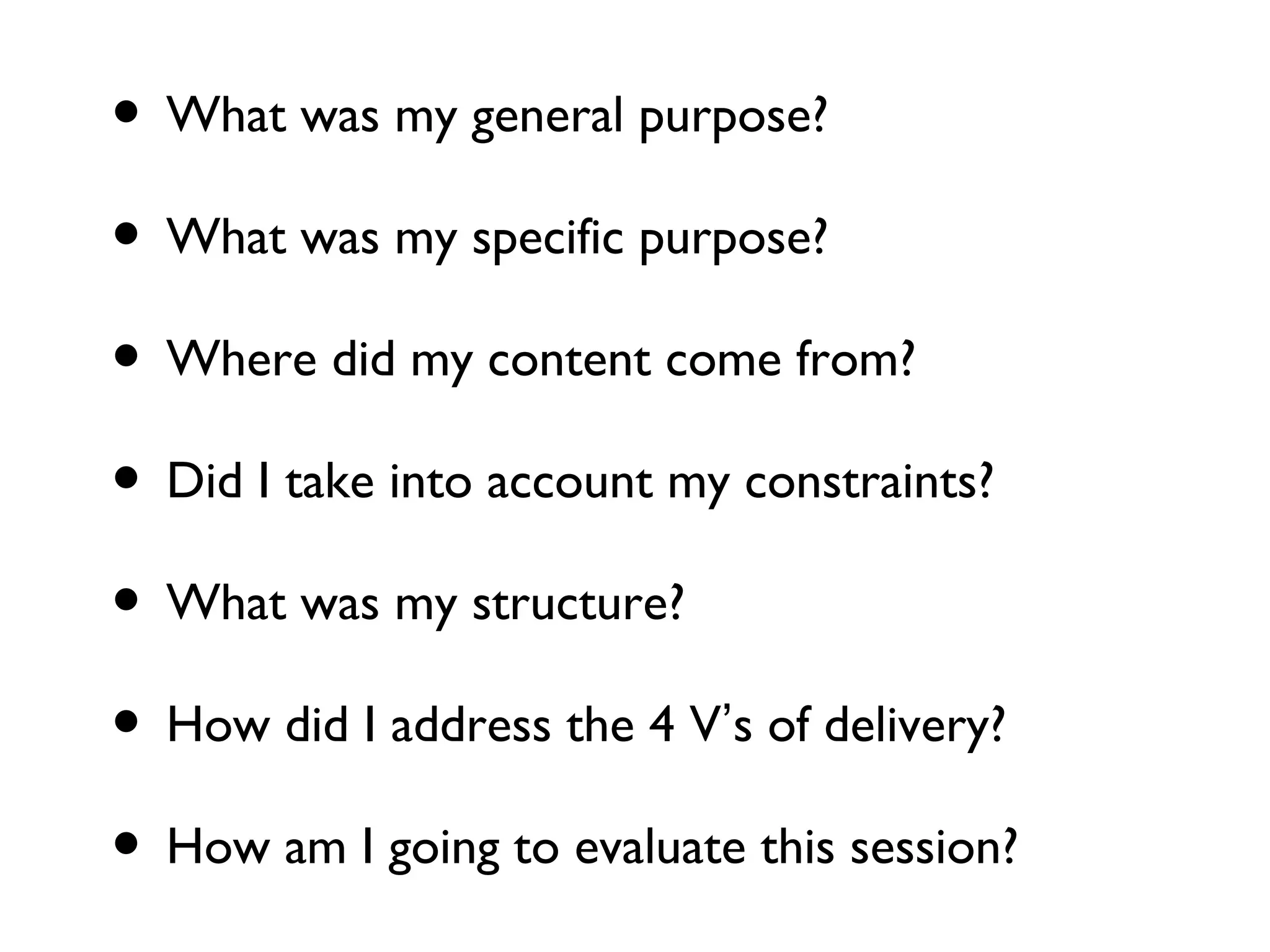
• What was my general purpose?
• What was my specific purpose?
• Where did my content come from?
• Did I take into account my constraints?
• What was my structure?
• How did I address the 4 V’s of delivery?
• How am I going to evaluate this session?

How To Give A Presentation

  • 1.
    How to givea presentation This file is not intended to be shown to the audience but rather loaded onto a tablet and used as presenter notes.
  • 2.
    Introduction • Nothing inlife is more important than the ability to communicate effectively - Gerald R. Ford • Great speakers are not born, they're trained. - Dale Carnegie • Preacher, parent, politician • Teacher, terrorist, trombone instructor
  • 3.
    Purpose • General • Inform,Influence, Inspire, Entertain • Specific • What do you want people to: “think, do, feel, or experience”
  • 4.
    Content • What ismy content? • Mindmap, research, interview, universals, stories, POV, chunking • Must know, should know, could know • What are my constraints? • Product, price, place, promotion, packaging, positioning, people
  • 5.
    Structure • OBC,TTT, TimeLine(TL), MAPTAS, PPF, PPPro, PREP, Kipling, 4Mat, G2S, E2H, K2U, F2U, C>E, SWOT, +/_, no Structure (ZIP), Process (SbyS - step by step), Prob > Solution (P>S) • Connecting main ideas • Transition, internal preview, internal summary, sign post
  • 6.
    Delivery • Visual • Vocal •Verbal • Variety • Lecture, recite, read, role play, Q&A, Demonstration
  • 7.
    • Visual • Bodylanguage, dress, expression, gestures • Congruence
  • 8.
    • Vocal • Pitch,pace, pause, volume, emphasis, and inflection • Be careful of: • Cadence
  • 9.
    • Verbal • Appropriateword choice • Sensory based language • Rhetorical devices • alliteration, euphemism, metaphor, onomatopoeia, personification, repetition
  • 10.
    • Variety • Lecture,recite, read, role play, Q&A, Demonstration
  • 11.
    1. Lecture byteacher (and what else can you do!) 2. Class discussion conducted by teacher (and what else!) 3. Recitation oral questions by teacher answered orally by students (then what!) 4. Discussion groups conducted by selected student chairpersons (yes, and what else!) 5. Lecture-demonstration by teacher (and then what 145 other techniques!) 6. Lecture-demonstration by another instructor(s) from a special field (guest speaker) 7. Presentation by a panel of instructors or students 8. Presentations by student panels from the class: class invited to participate 9. Student reports by individuals 10. Student-group reports by committees from the class 11. Debate (informal) on current issues by students from class 12. Class discussions conducted by a student or student committee 13. Forums 14. Bulletin boards 15. Small groups such as task oriented, discussion, Socratic 16. Choral speaking 17. Collecting 18. Textbook assignments 19. Reading assignments in journals, monographs, etc. 20. Reading assignments in supplementary books 21. Assignment to outline portions of the textbook 22. Assignment to outline certain supplementary readings 23. Debates (formal) 24. Crossword puzzles 25. Cooking foods of places studied 26. Construction of vocabulary lists 27. Vocabulary drills 28. Diaries 29. Dances of places or periods studied 30. Construction of summaries by students 31. Dressing dolls 32. Required term paper 33. Panel discussion 34. Biographical reports given by students 35. Reports on published research studies and experiments by students 36. Library research on topics or problems 37. Written book reports by students 38. Flags 39. Jigsaw puzzle maps 40. Hall of Fame by topic or era (military or political leaders, heroes) 41. Flannel boards 42. Use of pretest 43. Gaming and simulation 44. Flash cards 45. Flowcharts 46. Interviews 47. Maps, transparencies, globes 48. Mobiles 49. Audio-tutorial lessons (individualized instruction) 50. Models 1. Music 2. Field trips 3. Drama, role playing 4. Open textbook study 5. Committee projects--small groups 6. Notebook 7. Murals and montages 8. Class projects 9. Individual projects 10. Quizdown gaming 11. Modeling in various media 12. Pen pals 13. Photographs 14. Laboratory experiments performed by more than two students working together 15. Use of dramatization, skits, plays 16. Student construction of diagrams, charts, or graphs 17. Making of posters by students 18. Students drawing pictures or cartoons vividly portray principles or facts 19. Problem solving or case studies 20. Puppets 21. Use of chalkboard by instructor as aid in teaching 22. Use of diagrams, tables, graphs, and charts by instructor in teaching 23. Use of exhibits and displays by instructor 24. Reproductions 25. Construction of exhibits and displays by students 26. Use of slides 27. Use of filmstrips 28. Use of motion pictures, educational films, videotapes 29. Use of theater motion pictures 30. Use of recordings 31. Use of radio programs 32. Use of television 33. Role playing 34. Sand tables 35. School affiliations 36. Verbal illustrations: use of anecdotes and parables to illustrate 37. Service projects 38. Stamps, coins, and other hobbies 39. Use of community or local resources 40. Story telling 41. Surveys 42. Tutorial: students assigned to other students for assistance, peer teaching 43. Coaching: special assistance provided for students having difficulty in the course • Oral reports • Word association activity • Workbooks • Using case studies reported in literature to illustrate psychological principles and facts • Construction of scrapbooks • Applying simple statistical techniques to class data • Time lines 1. "Group dynamics" techniques 2. Units of instruction organized by topics 3. Non directive techniques applied to the classroom 4. Supervised study during class period 5. Use of sociometric text to make sociometric analysis of class 6. Use of technology and instructional resources 7. Open textbook tests, take home tests 8. Put idea into picture 9. Write a caption for chart, picture, or cartoon 10. Reading aloud 11. Differentiated assignment and homework 12. Telling about a trip 13. Mock convention 14. Filling out forms (income tax, checks) 15. Prepare editorial for school paper 16. Attend council meeting, school boar meeting 17. Exchanging "things" 18. Making announcements 19. Taking part (community elections) 20. Playing music from other countries or times 21. Studying local history 22. Compile list of older citizens as resource people 23. Students from abroad (exchange students) 24. Obtain free and low cost materials 25. Collect old magazines 26. Collect colored slides 27. Visit an "ethnic" restaurant 28. Specialize in one country 29. Follow a world leader (in the media) 30. Visit an employment agency 31. Start a campaign 32. Conduct a series 33. Investigate a life 34. Assist an immigrant 35. Volunteer (tutoring, hospital) 36. Prepare an exhibit 37. Detect propaganda 38. Join an organization 39. Collect money for a cause 40. Elect a "Hall of Fame" for males 41. Elect a "Hall of Fame" for females 42. Construct a salt map 43. Construct a drama 44. Prepare presentation for senior citizen group 45. Invite senior citizen(s) to present local history to class including displaying artifacts (clothing, tools, objects, etc.) 46. Prepare mock newspaper on specific topic or era 47. Draw a giant map on floor of classroom 48. Research local archaeological site 49. Exchange program with schools from different parts of the state 50. In brainstorming small group, students identify a list of techniques and strategies that best fit their class.
  • 12.
    Evaluate • Self reflection •Audience feedback • Audience response • Be careful of the evaluators qualifications
  • 13.
    • What wasmy general purpose? • What was my specific purpose? • Where did my content come from? • Did I take into account my constraints? • What was my structure? • How did I address the 4 V’s of delivery? • How am I going to evaluate this session?