Start your own business Programme Market Research Session Ciara MacNeice brilliant red  Consulting
Structure of evening Ciara MacNeice Tea/Coffee break @ 7.30 Close at 9.00 – 9.30
Objectives of session Understand the importance of market research  Understand the types of research Understand areas to research  Where to find information
Contents Introduction to market research Definition Why bother? Types of market research What to research?  Macro environment - PEST Micro environment - Customers/Competitors/Suppliers/Dists
Contents cont. Low cost research sources, where? Specialist market research sources  Databases  Government sites Where cont? Competitor information Dublin city library, Invest NI  Databases –search competitors Test competitor products
Philip Kotler, Professor of International Marketing said; “ There are three types of company;  those who make things happen,  those who watch things happen,  and those who wonder what on earth happened. ”
Small business in Ireland that make things happen
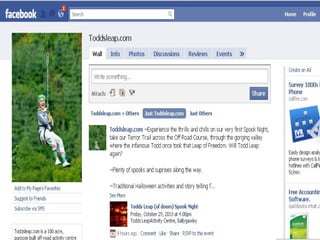
Todds Leap, Ballygawley
 
“ Marketing research provides practical,  unbiased  Information, (which) helps firms avoid assumptions & misunderstandings  that could result in poor marketing  performance ” Dibb, Simkin, Pride & Farrell
Why bother  with market research?
Why bother? Unwise to develop a product & then look for market where it can be sold  Market research helps firms understand customers, competitors, market trends, and aspects of the marketing environment Market research provides information on which firms can make more informed decisions
Why you should bother! Business success involves meeting the needs of the customer  To understand the needs you need to research Identify new product/service opportunities Keep your finger on the industry pulse
 
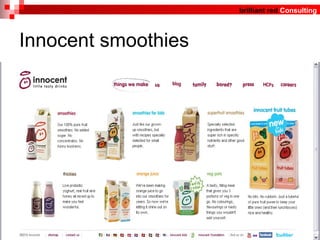
Innocent smoothies
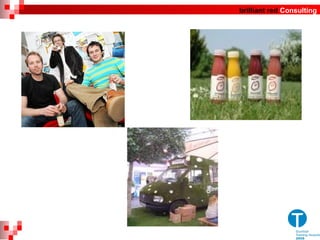
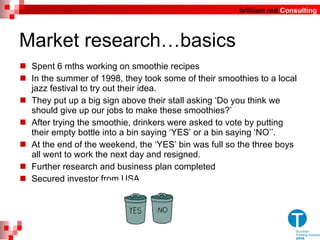
Market research…basics Spent 6 mths working on smoothie recipes In the summer of 1998, they took some of their smoothies to a local jazz festival to try out their idea. They put up a big sign above their stall asking  ‘ Do you think we should give up our jobs to make these smoothies? ’   After trying the smoothie, drinkers were asked to vote by putting their empty bottle into a bin saying  ‘ YES ’  or a bin saying  ‘ NO ’’ . At the end of the weekend, the  ‘ YES ’  bin was full so the three boys all went to work the  next day and resigned. Further research and business plan completed Secured investor from USA
Where are they now Revenues of £128 m Have 70% stake of smoothie market In April 2010 Coca-Cola increased its stake in the company to 58% from 18% for about £65 million.
Areas to research   Macro environment  Micro environment
“ Change is the only constant ” (A. Toffler)
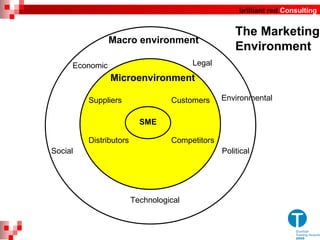
SME Suppliers Microenvironment Customers Distributors Competitors Macro environment Economic Social Technological Political Legal The Marketing Environment Environmental
Scanning the Environment  No business exists in a vacuum Environment changes continuously Need to look outwards Marketing mix is dependent on marketing environment
Typical PESTEL factors Political  e.g. such as  tax policy ,  labour law ,  environmental law ,  trade restrictions ,  tariffs , and political stability Economic  e.g. factors include  economic growth ,  interest rates ,  exchange rates  and the  inflation rate  - factors have major impacts on how businesses operate and make decisions Social  e.g. attitudes to work, health, trends, fashions – Day spas Technological  e.g. innovation, new product development e.g. MP3 player Environmental  e.g. global warming, environmental issues  - waste mgt sector Legal  e.g. competition law, health and safety, employment law
Microenvironmental Factors Current & Potential Customers Essential that firm finds out what they want Competitors monitor what competition are doing now & try to anticipate what they will do in future
Microenvironmental Factors Suppliers Can lead to firm failing to meet promises to customer Choice of suppliers important
Question – 10 mins Key players in  your  macroenvironment? Key players in  your  microenvironment? Insert into action plan
How Toyota reacted to its macro & micro environment?
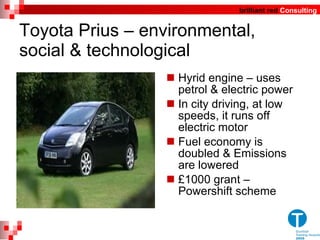
Toyota Prius – environmental, social & technological Hyrid engine – uses petrol & electric power In city driving, at low speeds, it runs off electric motor Fuel economy is doubled & Emissions are lowered £1000 grant – Powershift scheme
Question? 5 mins What marketing environment forces was Toyota responding to?
Break for Tea/Coffee
Types of Market Research Split into 2 broad areas: Primary research ‘ Field research ’  for specific purpose, undertaken from scratch  Secondary research  Consists of data and info that already exist Less time consuming, efficient, quick to access, can be in-expensive
Primary research Economical and timely  richness of data - attitudes, beliefs, emotions and perceptions.  Examples include: Surveys FOCUS Groups Observational research – mystery shopping  Customer feedback forms In-depth interviews
Secondary research usually easy to find Time and cost economies associated with secondary data. Examples include: Market research Reports Databases Trade publications/magazines Trade associations
Data generated from research 2 main types of data generated: Qualitative research Quantitative research
Qualitative characteristics  Focuses on developing an understanding of things rather than measuring them Uses small numbers  Can result in rich and detailed data Range includes: Survey research Questionnaires Focus groups In-depth interviews Observational techniques
Quantitative characteristics Results are expressed numerically Data such as sales figures, market size, market share, demographic information Uses large samples Mail questionnaires Telephone interviews Face to face interviews
Secondary research Types of data you can find from secondary research? Where to find secondary research locally?
What can you find out from secondary sources Market size Is your market in growth or decline?  What are the trends? What are the forecasts? Have you a niche? Have you a business?
Get grasp on Economic Influences General Economic climate  Interest rates Economic recession in 1980 ’ s caused increase in unemployment and affected customers willingness to buy
Get grasp on socio-cultural Influences Environmental issues – green society Heath concerns – food products/organic
Sir Clive Sinclair…. Member of British Mensa!  High marks for innovation, low marks for marketing 1981 – Sinclair computers formed ZX Spectrum (1982)  http://en.wikipedia.org/wiki/Clive_Sinclair Selling 12,000  a week Company made £8.55 m profit with turnover of £27m 1986 – sold to Amstrad for £5m Then……in the 1980 ’ s
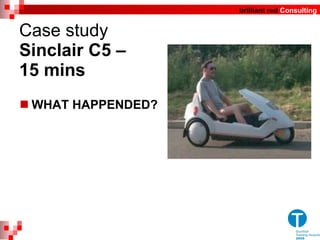
Case study  Sinclair C5 – 15 mins  WHAT HAPPENDED?
 
Where do we access this information?
Check out…. Invest NI Library,  Bedford Square Bedford Street,  Belfast European Info Centre 90 239090 Call  before going  and make an appointment.
Invest NI library services  Mintel Keynote Euromonitor Vision net Kompass Ireland Irish times online archive Access to Business magazines online
Excellent Secondary Information Sources Mintel/Keynote Produce Market intelligence reports on various market sectors providing extensive info on: Market size – growth or decline Typical Customer profile PEST analysis Competitors/share of the market and profiles Market forecasts
Mintel & Keynote Reports Based on: Exclusive consumer research  Key trade interviews an up-to-date overview of the marketplace, looking at changing trends in an industry  Backed up by formal desk research from trade and government sources
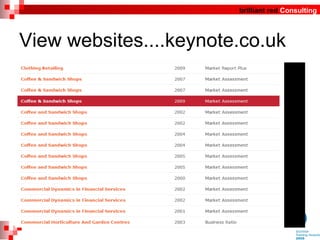
View websites....keynote.co.uk
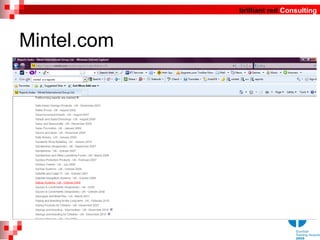
Mintel.com
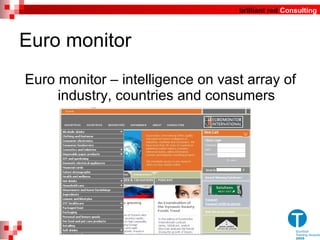
Euro monitor Euro monitor – intelligence on vast array of industry, countries and consumers
Databases Kompass Ireland Major database directory of businesses or suppliers throughout Ireland by product/service, location, no of employees   Vision net online – companies reg office Profit/loss, address
Relevant Trade associations/bodies Irish Tourist Industry Confederation Tourism Ireland www.itic.ie www.ireland.ie
Tap into useful websites  Central Statistics Office  -  www.cso.ie Economy statistics  Population statistics Census information & percentage change Household budget
5 mins....What do you need to know about competitors?
Why  monitor competitors? Extremely important Key piece of the market research jigsaw Customer's usually know the differences between companies - They know that  company A  is cheaper than  company B
Competitor Analysis Who are they? What are their strengths? What are their weaknesses? Do you have up-to-date information on their products, services etc.
Classifications of competitive data Recorded data Secondary Trade press  Annual reports  Government sector reports Observable data Competitors promotions Competitors advertising Mystery shopping
Sources of competitive data Suppliers Customers Conferences Trade shows
Other sources of info. Go to exhibitions At exhibitions and trade fairs check which of your competitors are also exhibiting. Note how busy they are and who visits them.
Organise the info Put the information into three categories: what you can learn from and do better   what they're doing worse than you  what they're doing the same as you
Where to get info? Answer…. First Port of Call Databases Specify top 5-10 in terms of size, by county etc. Business Name, addresses, area of business, if available, turnover etc
Answer…. Where? Invest NI
Case study Bladonmore
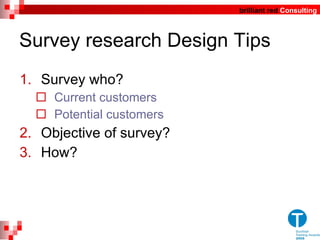
Survey research Design Tips Survey who? Current customers Potential customers Objective of survey? How?
Me or an agency?? Market research professionals are likely to get better results. They have experience in designing survey questionnaires, running focus groups and asking the right questions.  For small-scale field research, your best option may be a freelance researcher
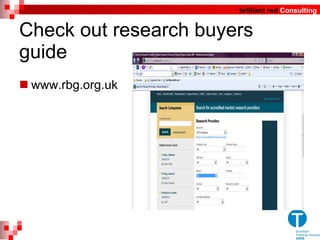
Check out research buyers guide www.rbg.org.uk
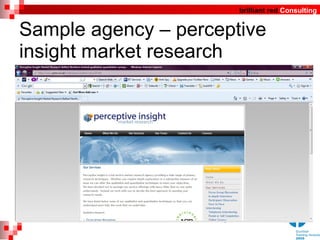
Sample agency – perceptive insight market research
Be careful Important to be clear regarding the potential sample and to define the population E.g. do we interview purchasing managers in all textiles companies or only those that employ more than 50 people in NI
Surveys Surveys
Exercise  Who would you like to survey & where?
Survey research Design Tips cont. Objectives - What do you want to discover? Satisfaction with current product/service, Suggested product  or service improvements, Competitor information e.g. who and why, Price points Continue to Purchase in the future
Exercise  What do you want to discover?
Sampling Method Telephone  Postal One to one Internet
Survey format Planning is important Needs to be well structured and flowing Concise  3 types of questions: (best to use a combination)  Yes/no multiple choice  open questions Pilot survey with a small sample Amend if necessary
Sample multiple choice question What factors do you consider to be influential when purchasing services? What price point do you think is reasonable for this product? £10-20 £30-40
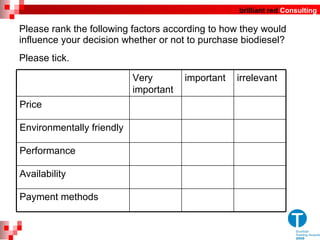
Please rank the following factors according to how they would influence your decision whether or not to purchase biodiesel? Please tick.   Very important  important irrelevant Price Environmentally friendly   Performance Availability Payment methods
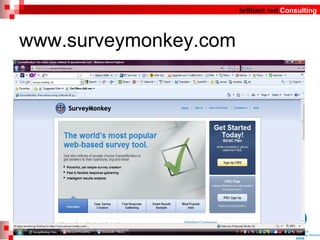
www.surveymonkey.com
Survey monkey Worlds most popular web based survey tool 1. Customer Insights Whether you want to measure customer satisfaction. Get feedback on a new product or learn more about purchase behaviours, Survey Monkey can get you answers fast. 2. Research Our survey tool is as powerful as it is simple. It can be used for all types of research for marketers and entrepreneurs.
Sample open ended questions  From the list below what type of services/products do you buy in this sector? Name suppliers you use and their strengths/weaknesses What trade shows do you attend?
Exercise – 5-10mins Write down survey questions appropriate to your business/idea
Key learning outcomes? Key points learnt tonight Action plan development

Market Research

  • 1.
    Start your ownbusiness Programme Market Research Session Ciara MacNeice brilliant red Consulting
  • 2.
    Structure of eveningCiara MacNeice Tea/Coffee break @ 7.30 Close at 9.00 – 9.30
  • 3.
    Objectives of sessionUnderstand the importance of market research Understand the types of research Understand areas to research Where to find information
  • 4.
    Contents Introduction tomarket research Definition Why bother? Types of market research What to research? Macro environment - PEST Micro environment - Customers/Competitors/Suppliers/Dists
  • 5.
    Contents cont. Lowcost research sources, where? Specialist market research sources Databases Government sites Where cont? Competitor information Dublin city library, Invest NI Databases –search competitors Test competitor products
  • 6.
    Philip Kotler, Professorof International Marketing said; “ There are three types of company; those who make things happen, those who watch things happen, and those who wonder what on earth happened. ”
  • 7.
    Small business inIreland that make things happen
  • 8.
  • 9.
  • 10.
    “ Marketing researchprovides practical, unbiased Information, (which) helps firms avoid assumptions & misunderstandings that could result in poor marketing performance ” Dibb, Simkin, Pride & Farrell
  • 11.
    Why bother with market research?
  • 12.
    Why bother? Unwiseto develop a product & then look for market where it can be sold Market research helps firms understand customers, competitors, market trends, and aspects of the marketing environment Market research provides information on which firms can make more informed decisions
  • 13.
    Why you shouldbother! Business success involves meeting the needs of the customer To understand the needs you need to research Identify new product/service opportunities Keep your finger on the industry pulse
  • 14.
  • 15.
  • 16.
    Market research…basics Spent6 mths working on smoothie recipes In the summer of 1998, they took some of their smoothies to a local jazz festival to try out their idea. They put up a big sign above their stall asking ‘ Do you think we should give up our jobs to make these smoothies? ’ After trying the smoothie, drinkers were asked to vote by putting their empty bottle into a bin saying ‘ YES ’ or a bin saying ‘ NO ’’ . At the end of the weekend, the ‘ YES ’ bin was full so the three boys all went to work the next day and resigned. Further research and business plan completed Secured investor from USA
  • 17.
    Where are theynow Revenues of £128 m Have 70% stake of smoothie market In April 2010 Coca-Cola increased its stake in the company to 58% from 18% for about £65 million.
  • 18.
    Areas to research Macro environment Micro environment
  • 19.
    “ Change isthe only constant ” (A. Toffler)
  • 20.
    SME Suppliers MicroenvironmentCustomers Distributors Competitors Macro environment Economic Social Technological Political Legal The Marketing Environment Environmental
  • 21.
    Scanning the Environment No business exists in a vacuum Environment changes continuously Need to look outwards Marketing mix is dependent on marketing environment
  • 22.
    Typical PESTEL factorsPolitical e.g. such as tax policy , labour law , environmental law , trade restrictions , tariffs , and political stability Economic e.g. factors include economic growth , interest rates , exchange rates and the inflation rate - factors have major impacts on how businesses operate and make decisions Social e.g. attitudes to work, health, trends, fashions – Day spas Technological e.g. innovation, new product development e.g. MP3 player Environmental e.g. global warming, environmental issues - waste mgt sector Legal e.g. competition law, health and safety, employment law
  • 23.
    Microenvironmental Factors Current& Potential Customers Essential that firm finds out what they want Competitors monitor what competition are doing now & try to anticipate what they will do in future
  • 24.
    Microenvironmental Factors SuppliersCan lead to firm failing to meet promises to customer Choice of suppliers important
  • 25.
    Question – 10mins Key players in your macroenvironment? Key players in your microenvironment? Insert into action plan
  • 26.
    How Toyota reactedto its macro & micro environment?
  • 27.
    Toyota Prius –environmental, social & technological Hyrid engine – uses petrol & electric power In city driving, at low speeds, it runs off electric motor Fuel economy is doubled & Emissions are lowered £1000 grant – Powershift scheme
  • 28.
    Question? 5 minsWhat marketing environment forces was Toyota responding to?
  • 29.
  • 30.
    Types of MarketResearch Split into 2 broad areas: Primary research ‘ Field research ’ for specific purpose, undertaken from scratch Secondary research Consists of data and info that already exist Less time consuming, efficient, quick to access, can be in-expensive
  • 31.
    Primary research Economicaland timely richness of data - attitudes, beliefs, emotions and perceptions. Examples include: Surveys FOCUS Groups Observational research – mystery shopping Customer feedback forms In-depth interviews
  • 32.
    Secondary research usuallyeasy to find Time and cost economies associated with secondary data. Examples include: Market research Reports Databases Trade publications/magazines Trade associations
  • 33.
    Data generated fromresearch 2 main types of data generated: Qualitative research Quantitative research
  • 34.
    Qualitative characteristics Focuses on developing an understanding of things rather than measuring them Uses small numbers Can result in rich and detailed data Range includes: Survey research Questionnaires Focus groups In-depth interviews Observational techniques
  • 35.
    Quantitative characteristics Resultsare expressed numerically Data such as sales figures, market size, market share, demographic information Uses large samples Mail questionnaires Telephone interviews Face to face interviews
  • 36.
    Secondary research Typesof data you can find from secondary research? Where to find secondary research locally?
  • 37.
    What can youfind out from secondary sources Market size Is your market in growth or decline? What are the trends? What are the forecasts? Have you a niche? Have you a business?
  • 38.
    Get grasp onEconomic Influences General Economic climate Interest rates Economic recession in 1980 ’ s caused increase in unemployment and affected customers willingness to buy
  • 39.
    Get grasp onsocio-cultural Influences Environmental issues – green society Heath concerns – food products/organic
  • 40.
    Sir Clive Sinclair….Member of British Mensa! High marks for innovation, low marks for marketing 1981 – Sinclair computers formed ZX Spectrum (1982) http://en.wikipedia.org/wiki/Clive_Sinclair Selling 12,000 a week Company made £8.55 m profit with turnover of £27m 1986 – sold to Amstrad for £5m Then……in the 1980 ’ s
  • 41.
    Case study Sinclair C5 – 15 mins WHAT HAPPENDED?
  • 42.
  • 43.
    Where do weaccess this information?
  • 44.
    Check out…. InvestNI Library, Bedford Square Bedford Street, Belfast European Info Centre 90 239090 Call before going and make an appointment.
  • 45.
    Invest NI libraryservices Mintel Keynote Euromonitor Vision net Kompass Ireland Irish times online archive Access to Business magazines online
  • 46.
    Excellent Secondary InformationSources Mintel/Keynote Produce Market intelligence reports on various market sectors providing extensive info on: Market size – growth or decline Typical Customer profile PEST analysis Competitors/share of the market and profiles Market forecasts
  • 47.
    Mintel & KeynoteReports Based on: Exclusive consumer research Key trade interviews an up-to-date overview of the marketplace, looking at changing trends in an industry Backed up by formal desk research from trade and government sources
  • 48.
  • 49.
  • 50.
    Euro monitor Euromonitor – intelligence on vast array of industry, countries and consumers
  • 51.
    Databases Kompass IrelandMajor database directory of businesses or suppliers throughout Ireland by product/service, location, no of employees Vision net online – companies reg office Profit/loss, address
  • 52.
    Relevant Trade associations/bodiesIrish Tourist Industry Confederation Tourism Ireland www.itic.ie www.ireland.ie
  • 53.
    Tap into usefulwebsites Central Statistics Office - www.cso.ie Economy statistics Population statistics Census information & percentage change Household budget
  • 54.
    5 mins....What doyou need to know about competitors?
  • 55.
    Why monitorcompetitors? Extremely important Key piece of the market research jigsaw Customer's usually know the differences between companies - They know that company A is cheaper than company B
  • 56.
    Competitor Analysis Whoare they? What are their strengths? What are their weaknesses? Do you have up-to-date information on their products, services etc.
  • 57.
    Classifications of competitivedata Recorded data Secondary Trade press Annual reports Government sector reports Observable data Competitors promotions Competitors advertising Mystery shopping
  • 58.
    Sources of competitivedata Suppliers Customers Conferences Trade shows
  • 59.
    Other sources ofinfo. Go to exhibitions At exhibitions and trade fairs check which of your competitors are also exhibiting. Note how busy they are and who visits them.
  • 60.
    Organise the infoPut the information into three categories: what you can learn from and do better  what they're doing worse than you what they're doing the same as you
  • 61.
    Where to getinfo? Answer…. First Port of Call Databases Specify top 5-10 in terms of size, by county etc. Business Name, addresses, area of business, if available, turnover etc
  • 62.
  • 63.
  • 64.
    Survey research DesignTips Survey who? Current customers Potential customers Objective of survey? How?
  • 65.
    Me or anagency?? Market research professionals are likely to get better results. They have experience in designing survey questionnaires, running focus groups and asking the right questions. For small-scale field research, your best option may be a freelance researcher
  • 66.
    Check out researchbuyers guide www.rbg.org.uk
  • 67.
    Sample agency –perceptive insight market research
  • 68.
    Be careful Importantto be clear regarding the potential sample and to define the population E.g. do we interview purchasing managers in all textiles companies or only those that employ more than 50 people in NI
  • 69.
  • 70.
    Exercise Whowould you like to survey & where?
  • 71.
    Survey research DesignTips cont. Objectives - What do you want to discover? Satisfaction with current product/service, Suggested product or service improvements, Competitor information e.g. who and why, Price points Continue to Purchase in the future
  • 72.
    Exercise Whatdo you want to discover?
  • 73.
    Sampling Method Telephone Postal One to one Internet
  • 74.
    Survey format Planningis important Needs to be well structured and flowing Concise 3 types of questions: (best to use a combination) Yes/no multiple choice open questions Pilot survey with a small sample Amend if necessary
  • 75.
    Sample multiple choicequestion What factors do you consider to be influential when purchasing services? What price point do you think is reasonable for this product? £10-20 £30-40
  • 76.
    Please rank thefollowing factors according to how they would influence your decision whether or not to purchase biodiesel? Please tick. Very important important irrelevant Price Environmentally friendly Performance Availability Payment methods
  • 77.
  • 78.
    Survey monkey Worldsmost popular web based survey tool 1. Customer Insights Whether you want to measure customer satisfaction. Get feedback on a new product or learn more about purchase behaviours, Survey Monkey can get you answers fast. 2. Research Our survey tool is as powerful as it is simple. It can be used for all types of research for marketers and entrepreneurs.
  • 79.
    Sample open endedquestions From the list below what type of services/products do you buy in this sector? Name suppliers you use and their strengths/weaknesses What trade shows do you attend?
  • 80.
    Exercise – 5-10minsWrite down survey questions appropriate to your business/idea
  • 81.
    Key learning outcomes?Key points learnt tonight Action plan development

Editor's Notes

  • #7 Kotler has consulted many major U.S. and foreign companies, including IBM, Michelin, Bank of America, Merck, General Electric, Honeywell, and Motorola - in the areas of marketing strategy, planning and organization, and international marketing.
  • #13 Market is key…major failure is to look for the market after the product has been developed. Example is the failure of McDonalds fast food restaurants to pick up on the change in eating habits, towards healthier options resulting in a decrease in sales in 2001.
  • #14 Businesses are part of the macro environment and the micro environment All influence the business and its proposed products and services If these aren't researched you could be creating a product that there is no demand for or no market for.
  • #32 Major advantage of primary research is that it is economical and timely. Leads to rich data such as “ I would purchase biofuel because I believe the environmental issue is so important
  • #33 Such resources include Mintel and Keynote market research reports
  • #42 hand out case study. Basically failed to research the market resulting in £7million loss. Didn ’ t think he needed to conduct market research…only research was surrounding the positioning of hand controls on the C5.