Ed Adkins Marketing Manager, M3 Planning [email_address] STRATEGY ON A SHOESTRING How to Evaluate Your Opportunities Strategically
Given a projected continuance of the economic slowdown,  how are you: 1. Focusing on the future 2. Deciding where to invest your resources?
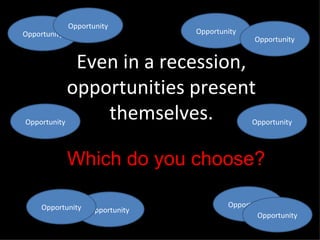
Even in a recession, opportunities present themselves. Opportunity Opportunity Opportunity Opportunity Opportunity Opportunity Opportunity Opportunity Opportunity Opportunity Which do you choose?
Choosing your opportunities Is about Framing
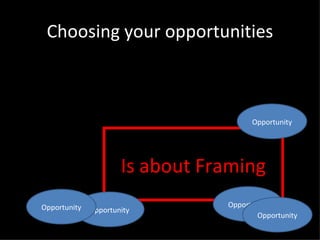
Choosing your opportunities Is about Framing Opportunity Opportunity Opportunity Opportunity Opportunity
So it’s  2010 ?   How have you dealt with the uncertain economic landscape? Did you reach your goals?
HOW WELL YOU MADE IT  THROUGH HAD A LOT TO DO WITH YOUR  FRAMING
HOW WELL YOU DID OR DIDN’T DO HAS A LOT TO DO WITH  But first let’s talk about  STRATEGY
WHAT IS  STRATEGY?   (and why it matters, even though  we pretty much know)
Strategy means leading your resources. Planning your business.
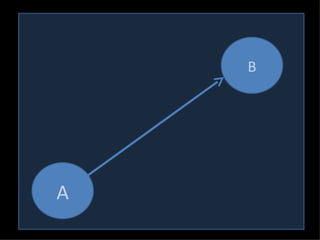
A B
A B
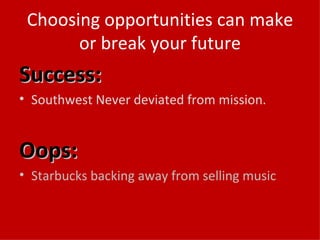
Choosing opportunities can make or break your future Success: Southwest Never deviated from mission. Oops: Starbucks backing away from selling music
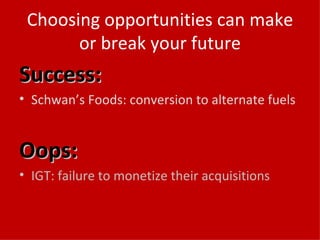
Choosing opportunities can make or break your future Success: Schwan’s Foods: conversion to alternate fuels Oops: IGT: failure to monetize their acquisitions
How do you frame   your strategic goals?
THE GOOD NEWS IS… You can do this now and it’s not rocket science
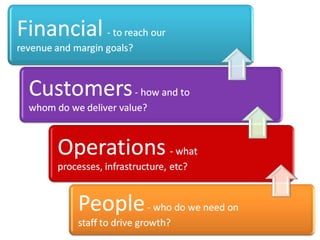
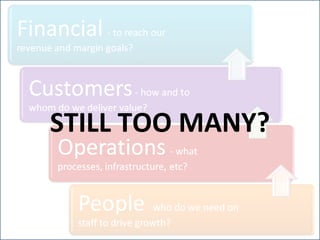
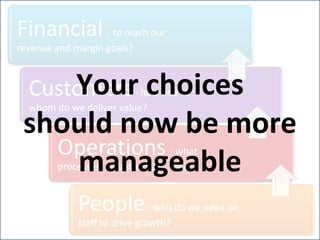
There are four perspectives  that you need to be aware of
who do we need on staff to drive growth?
Operations what processes, infrastructure, etc?
Customers how and to whom do we deliver value?
Financial to reach our revenue and margin goals?
 
SO, WHICH OF THESE DESERVES THE MOST OF YOUR RESOURCES?
STRATEGICALLY How to  FRAME Your Opportunities
FIRST… You have to know what your opportunities are.
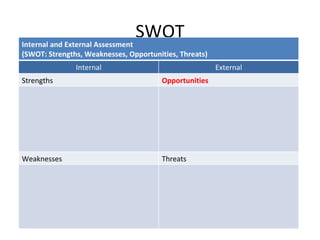
SWOT Internal and External Assessment (SWOT: Strengths, Weaknesses, Opportunities, Threats) Internal External Strengths Opportunities Weaknesses Threats
NEXT… You have to set some rules.
Priority rule . With this rule, you prioritize some opportunities over others based on their connection to reaching your vision.
Timing rule .  This financial rule helps you prioritize opportunities based on how much money you want to see returned within what time period.
Boundary rule .  This rule says that every opportunity is evaluated based on whether it’s within your mission.
How - to rule .  If you can’t clearly define an action plan for the opportunity, then you know that trying to execute it will also go poorly.
IT’S A GOOD IDEA… To include staff and customer input in this process.
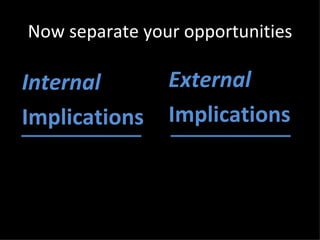
Now separate your opportunities External Implications Internal Implications
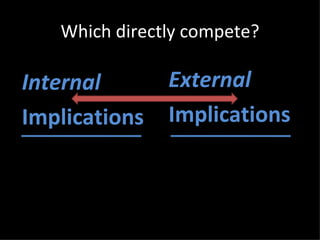
Which directly compete? External Implications Internal Implications
STILL TOO MANY?
HERE’S A TOOL: Paired Comparison Analysis
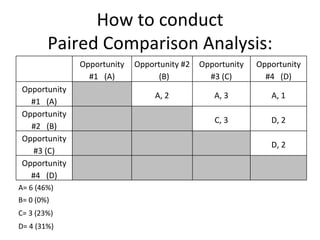
How to conduct Paired Comparison Analysis:   Opportunity #1  (A) Opportunity #2  (B) Opportunity #3 (C) Opportunity #4  (D) Opportunity #1  (A)   A, 2 A, 3 A, 1 Opportunity #2  (B)     C, 3 D, 2 Opportunity #3 (C)       D, 2 Opportunity #4  (D)         A= 6 (46%)   B= 0 (0%)   C= 3 (23%)   D= 4 (31%)  
How to conduct Paired Comparison Analysis: First,  make sure that you have already eliminated opportunities using the previously mentioned rules. Ideally,  you want to have  3-5   internal  and externally focused opportunities to choose between.
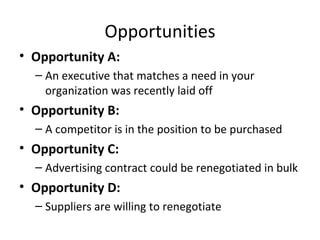
Opportunities Opportunity A: An executive that matches a need in your organization was recently laid off Opportunity B: A competitor is in the position to be purchased Opportunity C: Advertising contract could be renegotiated in bulk Opportunity D: Suppliers are willing to renegotiate
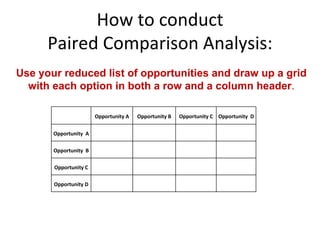
How to conduct Paired Comparison Analysis: Use your reduced list of opportunities and draw up a grid with each option in both a row and a column header .   Opportunity A Opportunity B Opportunity C Opportunity  D Opportunity  A   Opportunity  B     Opportunity C       Opportunity D              
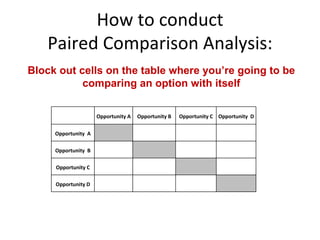
How to conduct Paired Comparison Analysis: Block out cells on the table where you’re going to be comparing an option with itself   Opportunity A Opportunity B Opportunity C Opportunity  D Opportunity  A   Opportunity  B     Opportunity C       Opportunity D                
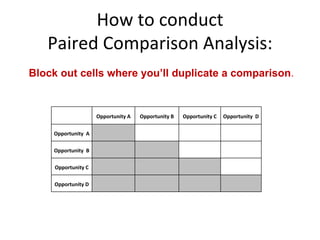
How to conduct Paired Comparison Analysis: Block out cells where you’ll duplicate a comparison .   Opportunity A Opportunity B Opportunity C Opportunity  D Opportunity  A   Opportunity  B     Opportunity C       Opportunity D              
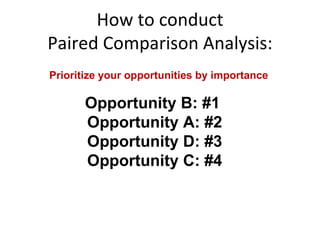
How to conduct Paired Comparison Analysis: Prioritize your opportunities by importance Opportunity B: #1  Opportunity A: #2 Opportunity D: #3 Opportunity C: #4
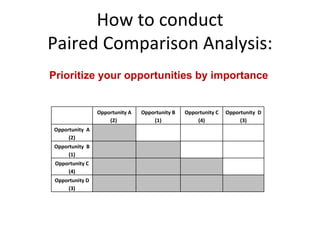
How to conduct Paired Comparison Analysis: Prioritize your opportunities by importance   Opportunity A (2)  Opportunity B (1) Opportunity C (4) Opportunity  D (3) Opportunity  A (2)   Opportunity  B (1)     Opportunity C (4)       Opportunity D (3)                
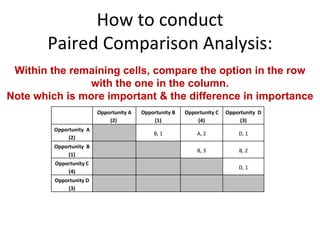
How to conduct Paired Comparison Analysis: Within the remaining cells, compare the option in the row with the one in the column. Note which is more important & the difference in importance   Opportunity A (2)  Opportunity B (1) Opportunity C (4) Opportunity  D (3) Opportunity  A (2)   B, 1 A, 2 D, 1 Opportunity  B (1)     B, 3 B, 2 Opportunity C (4)       D, 1 Opportunity D (3)                
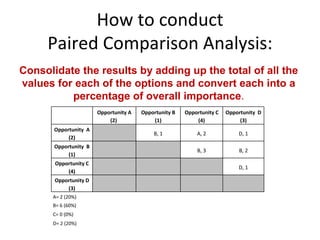
How to conduct Paired Comparison Analysis: Consolidate the results by adding up the total of all the values for each of the options and convert each into a percentage of overall importance .   Opportunity A (2)  Opportunity B (1) Opportunity C (4) Opportunity  D (3) Opportunity  A (2)   B, 1 A, 2 D, 1 Opportunity  B (1)     B, 3 B, 2 Opportunity C (4)       D, 1 Opportunity D (3)         A= 2 (20%)   B= 6 (60%)   C= 0 (0%)   D= 2 (20%)  
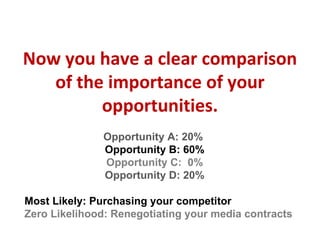
Now you have a clear comparison of the importance of your opportunities. Opportunity A: 20%  Opportunity B: 60% Opportunity C:  0% Opportunity D: 20% Most Likely: Purchasing your competitor Zero Likelihood: Renegotiating your media contracts
SEE, IT’S NOT ROCKET SCIENCE. Framing limits your choices  in a good way.
Your choices should now be more manageable
Your Next Steps Read more: MyStrategicPlan.com/resources More webinars Articles Blog Posts Instructional Videos Tools, Books Strategic Planning For Dummies
Your Next Steps Automate it Use MyStrategicPlan to develop and execute a sound strategy for 2009 and beyond.
Thank  You . [email_address]

How to Evaluate your Opportunites Strategically

  • 1.
    Ed Adkins MarketingManager, M3 Planning [email_address] STRATEGY ON A SHOESTRING How to Evaluate Your Opportunities Strategically
  • 2.
    Given a projectedcontinuance of the economic slowdown, how are you: 1. Focusing on the future 2. Deciding where to invest your resources?
  • 3.
    Even in arecession, opportunities present themselves. Opportunity Opportunity Opportunity Opportunity Opportunity Opportunity Opportunity Opportunity Opportunity Opportunity Which do you choose?
  • 4.
  • 5.
    Choosing your opportunitiesIs about Framing Opportunity Opportunity Opportunity Opportunity Opportunity
  • 6.
    So it’s 2010 ? How have you dealt with the uncertain economic landscape? Did you reach your goals?
  • 7.
    HOW WELL YOUMADE IT THROUGH HAD A LOT TO DO WITH YOUR FRAMING
  • 8.
    HOW WELL YOUDID OR DIDN’T DO HAS A LOT TO DO WITH But first let’s talk about STRATEGY
  • 9.
    WHAT IS STRATEGY? (and why it matters, even though we pretty much know)
  • 10.
    Strategy means leadingyour resources. Planning your business.
  • 11.
  • 12.
  • 13.
    Choosing opportunities canmake or break your future Success: Southwest Never deviated from mission. Oops: Starbucks backing away from selling music
  • 14.
    Choosing opportunities canmake or break your future Success: Schwan’s Foods: conversion to alternate fuels Oops: IGT: failure to monetize their acquisitions
  • 15.
    How do youframe your strategic goals?
  • 16.
    THE GOOD NEWSIS… You can do this now and it’s not rocket science
  • 17.
    There are fourperspectives that you need to be aware of
  • 18.
    who do weneed on staff to drive growth?
  • 19.
    Operations what processes,infrastructure, etc?
  • 20.
    Customers how andto whom do we deliver value?
  • 21.
    Financial to reachour revenue and margin goals?
  • 22.
  • 23.
    SO, WHICH OFTHESE DESERVES THE MOST OF YOUR RESOURCES?
  • 24.
    STRATEGICALLY How to FRAME Your Opportunities
  • 25.
    FIRST… You haveto know what your opportunities are.
  • 26.
    SWOT Internal andExternal Assessment (SWOT: Strengths, Weaknesses, Opportunities, Threats) Internal External Strengths Opportunities Weaknesses Threats
  • 27.
    NEXT… You haveto set some rules.
  • 28.
    Priority rule .With this rule, you prioritize some opportunities over others based on their connection to reaching your vision.
  • 29.
    Timing rule . This financial rule helps you prioritize opportunities based on how much money you want to see returned within what time period.
  • 30.
    Boundary rule . This rule says that every opportunity is evaluated based on whether it’s within your mission.
  • 31.
    How - torule . If you can’t clearly define an action plan for the opportunity, then you know that trying to execute it will also go poorly.
  • 32.
    IT’S A GOODIDEA… To include staff and customer input in this process.
  • 33.
    Now separate youropportunities External Implications Internal Implications
  • 34.
    Which directly compete?External Implications Internal Implications
  • 35.
  • 36.
    HERE’S A TOOL:Paired Comparison Analysis
  • 37.
    How to conductPaired Comparison Analysis:   Opportunity #1 (A) Opportunity #2 (B) Opportunity #3 (C) Opportunity #4 (D) Opportunity #1 (A)   A, 2 A, 3 A, 1 Opportunity #2 (B)     C, 3 D, 2 Opportunity #3 (C)       D, 2 Opportunity #4 (D)         A= 6 (46%)   B= 0 (0%)   C= 3 (23%)   D= 4 (31%)  
  • 38.
    How to conductPaired Comparison Analysis: First, make sure that you have already eliminated opportunities using the previously mentioned rules. Ideally, you want to have 3-5 internal and externally focused opportunities to choose between.
  • 39.
    Opportunities Opportunity A:An executive that matches a need in your organization was recently laid off Opportunity B: A competitor is in the position to be purchased Opportunity C: Advertising contract could be renegotiated in bulk Opportunity D: Suppliers are willing to renegotiate
  • 40.
    How to conductPaired Comparison Analysis: Use your reduced list of opportunities and draw up a grid with each option in both a row and a column header .   Opportunity A Opportunity B Opportunity C Opportunity D Opportunity A   Opportunity B     Opportunity C       Opportunity D              
  • 41.
    How to conductPaired Comparison Analysis: Block out cells on the table where you’re going to be comparing an option with itself   Opportunity A Opportunity B Opportunity C Opportunity D Opportunity A   Opportunity B     Opportunity C       Opportunity D                
  • 42.
    How to conductPaired Comparison Analysis: Block out cells where you’ll duplicate a comparison .   Opportunity A Opportunity B Opportunity C Opportunity D Opportunity A   Opportunity B     Opportunity C       Opportunity D              
  • 43.
    How to conductPaired Comparison Analysis: Prioritize your opportunities by importance Opportunity B: #1 Opportunity A: #2 Opportunity D: #3 Opportunity C: #4
  • 44.
    How to conductPaired Comparison Analysis: Prioritize your opportunities by importance   Opportunity A (2) Opportunity B (1) Opportunity C (4) Opportunity D (3) Opportunity A (2)   Opportunity B (1)     Opportunity C (4)       Opportunity D (3)                
  • 45.
    How to conductPaired Comparison Analysis: Within the remaining cells, compare the option in the row with the one in the column. Note which is more important & the difference in importance   Opportunity A (2) Opportunity B (1) Opportunity C (4) Opportunity D (3) Opportunity A (2)   B, 1 A, 2 D, 1 Opportunity B (1)     B, 3 B, 2 Opportunity C (4)       D, 1 Opportunity D (3)                
  • 46.
    How to conductPaired Comparison Analysis: Consolidate the results by adding up the total of all the values for each of the options and convert each into a percentage of overall importance .   Opportunity A (2) Opportunity B (1) Opportunity C (4) Opportunity D (3) Opportunity A (2)   B, 1 A, 2 D, 1 Opportunity B (1)     B, 3 B, 2 Opportunity C (4)       D, 1 Opportunity D (3)         A= 2 (20%)   B= 6 (60%)   C= 0 (0%)   D= 2 (20%)  
  • 47.
    Now you havea clear comparison of the importance of your opportunities. Opportunity A: 20% Opportunity B: 60% Opportunity C: 0% Opportunity D: 20% Most Likely: Purchasing your competitor Zero Likelihood: Renegotiating your media contracts
  • 48.
    SEE, IT’S NOTROCKET SCIENCE. Framing limits your choices in a good way.
  • 49.
    Your choices shouldnow be more manageable
  • 50.
    Your Next StepsRead more: MyStrategicPlan.com/resources More webinars Articles Blog Posts Instructional Videos Tools, Books Strategic Planning For Dummies
  • 51.
    Your Next StepsAutomate it Use MyStrategicPlan to develop and execute a sound strategy for 2009 and beyond.
  • 52.
    Thank You. [email_address]