










































Create your strategy on 1 page
Best practices based on research and 20 years of
real world consulting to RESULTS.com client firms
Presenter: Stephen Lynch
Role: Head of Strategy & Consulting at RESULTS.com
Email: Stephen.Lynch@Results.com
Linkedin: linkedin.com/in/stephengeoffreylynch
Slides: results.com/slides
Software Demo: results.com/demo
Thank you for your time!
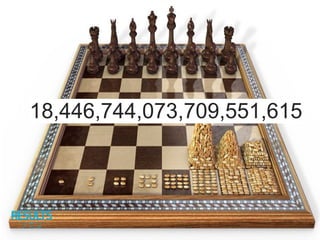
18,446,744,073,709,551,615
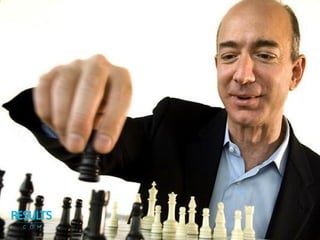
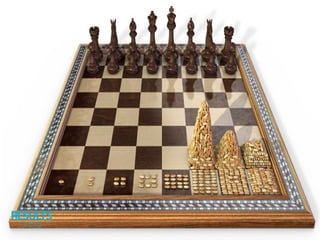
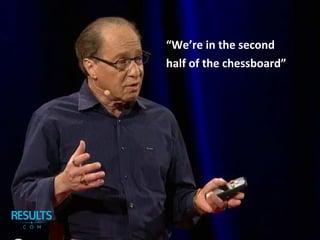
“We’re in the second
half of the chessboard”
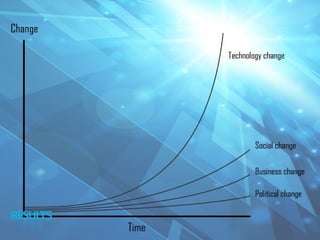
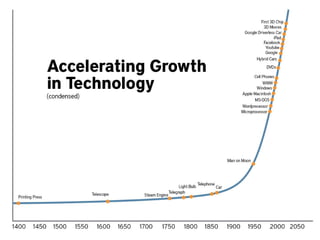
“In short, software is eating the world.”
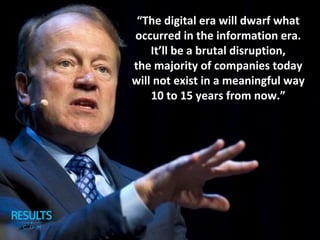
“The digital era will dwarf what
occurred in the information era.
It’ll be a brutal disruption,
the majority of companies today
will not exist in a meaningful way
10 to 15 years from now.”
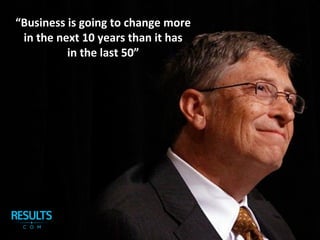
“Business is going to change more
in the next 10 years than it has
in the last 50”
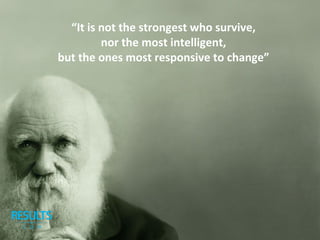
“It is not the strongest who survive,
nor the most intelligent,
but the ones most responsive to change”
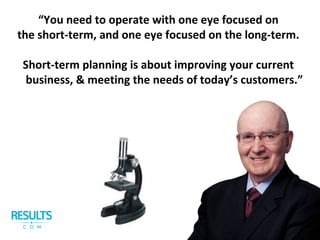
“You need to operate with one eye focused on
the short-term, and one eye focused on the long-term.
Short-term planning is about improving your current
business, & meeting the needs of today’s customers.”
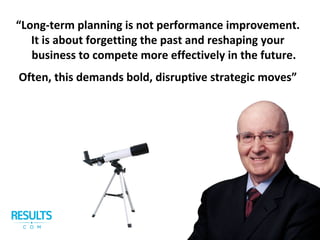
Often, this demands bold, disruptive strategic moves”
“Long-term planning is not performance improvement.
It is about forgetting the past and reshaping your
business to compete more effectively in the future.
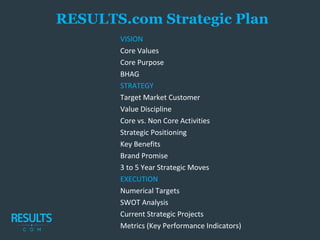
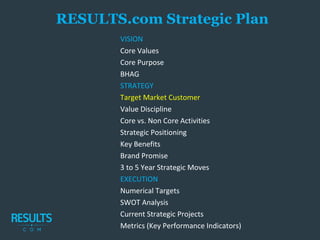
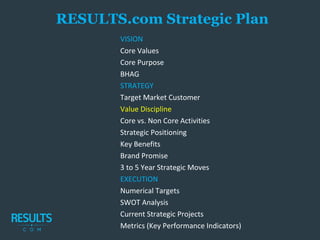
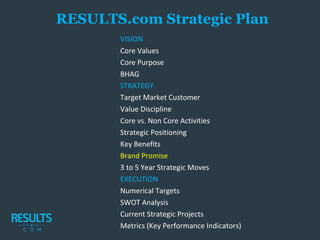
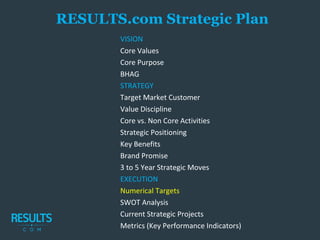
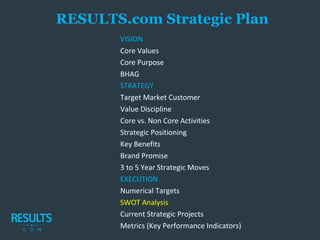
VISION
Core Values
Core Purpose
BHAG
STRATEGY
Target Market Customer
Value Discipline
Core vs. Non Core Activities
Strategic Positioning
Key Benefits
Brand Promise
3 to 5 Year Strategic Moves
EXECUTION
Numerical Targets
SWOT Analysis
Current Strategic Projects
Metrics (Key Performance Indicators)
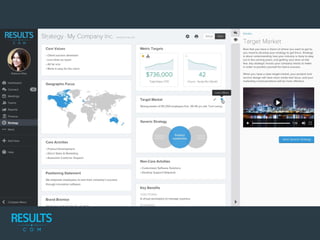
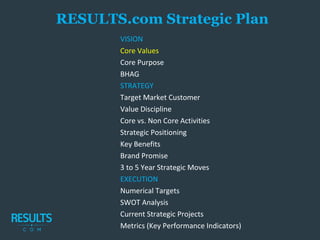
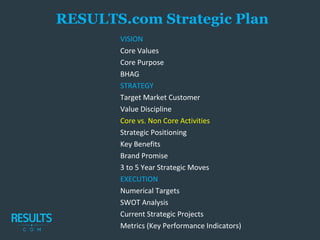
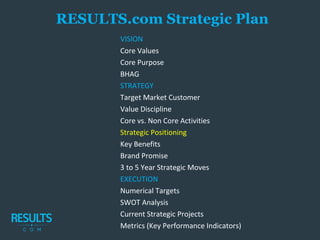
RESULTS.com Strategic Plan
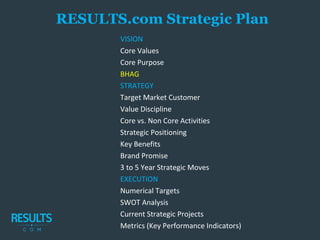
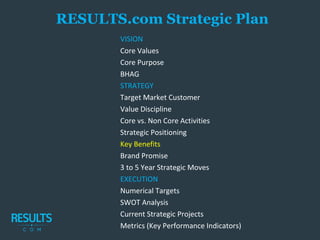
VISION
Core Values
Core Purpose
BHAG
STRATEGY
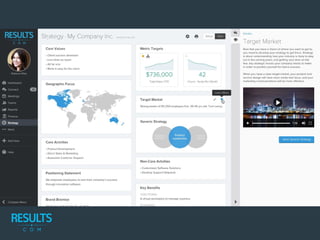
Target Market Customer
Value Discipline
Core vs. Non Core Activities
Strategic Positioning
Key Benefits
Brand Promise
3 to 5 Year Strategic Moves
EXECUTION
Numerical Targets
SWOT Analysis
Current Strategic Projects
Metrics (Key Performance Indicators)
RESULTS.com Strategic Plan
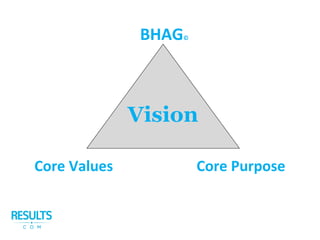
BHAG©
Core Values Core Purpose
Vision
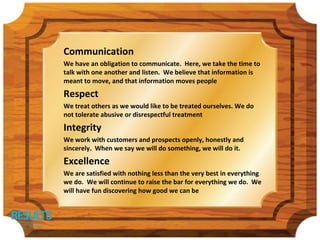
Core Values
Communication
We have an obligation to communicate. Here, we take the time to
talk with one another and listen. We believe that information is
meant to move, and that information moves people
Respect
We treat others as we would like to be treated ourselves. We do
not tolerate abusive or disrespectful treatment
Integrity
We work with customers and prospects openly, honestly and
sincerely. When we say we will do something, we will do it.
Excellence
We are satisfied with nothing less than the very best in everything
we do. We will continue to raise the bar for everything we do. We
will have fun discovering how good we can be
“3 coats means 3 coats”
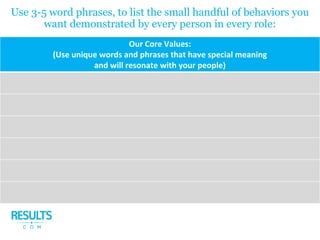
Use 3-5 word phrases, to list the small handful of behaviors you
want demonstrated by every person in every role:
Our Core Values:
(Use unique words and phrases that have special meaning
and will resonate with your people)
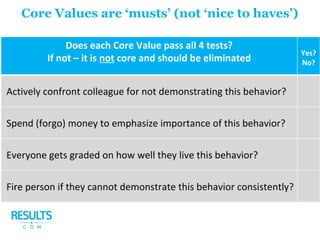
Core Values are ‘musts’ (not ‘nice to haves’)
Does each Core Value pass all 4 tests?
If not – it is not core and should be eliminated
Yes?
No?
Actively confront colleague for not demonstrating this behavior?
Spend (forgo) money to emphasize importance of this behavior?
Everyone gets graded on how well they live this behavior?
Fire person if they cannot demonstrate this behavior consistently?
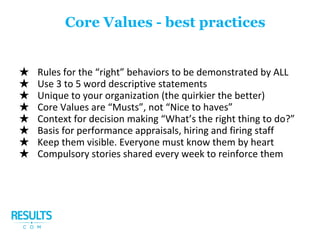
★ Rules for the “right” behaviors to be demonstrated by ALL
★ Use 3 to 5 word descriptive statements
★ Unique to your organization (the quirkier the better)
★ Core Values are “Musts”, not “Nice to haves”
★ Context for decision making “What’s the right thing to do?”
★ Basis for performance appraisals, hiring and firing staff
★ Keep them visible. Everyone must know them by heart
★ Compulsory stories shared every week to reinforce them
Core Values - best practices
VISION
Core Values
Core Purpose
BHAG
STRATEGY
Target Market Customer
Value Discipline
Core vs. Non Core Activities
Strategic Positioning
Key Benefits
Brand Promise
3 to 5 Year Strategic Moves
EXECUTION
Numerical Targets
SWOT Analysis
Current Strategic Projects
Metrics (Key Performance Indicators)
RESULTS.com Strategic Plan
Core Purpose
“To give ordinary folk the chance to buy
the same things as rich people”
“To make people happy”
State your Core Purpose
State your Core Purpose: (in <140 characters)
To …..
★ Not about making money.
★ It’s about “the difference you want to make” in the world
★ Transcends your current product / service offering
★ Core Purpose describes “the why” not “the how”
★ “How” will change over time. “Why” remains constant
★ Inspires all your people, not just the management team
★ Context for strategic decision making
★ Ask, “Will doing this help us to fulfill our Core Purpose?”
Core Purpose - best practices
VISION
Core Values
Core Purpose
BHAG
STRATEGY
Target Market Customer
Value Discipline
Core vs. Non Core Activities
Strategic Positioning
Key Benefits
Brand Promise
3 to 5 Year Strategic Moves
EXECUTION
Numerical Targets
SWOT Analysis
Current Strategic Projects
Metrics (Key Performance Indicators)
RESULTS.com Strategic Plan
BHAG©
Big Hairy Audacious Goal
(Copyright: Jim Collins)
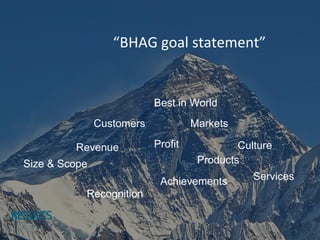
“BHAG goal statement”
Size & Scope
Revenue
Customers Markets
Products
Best in World
Culture
Achievements
Profit
Recognition
Services
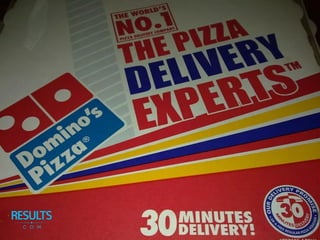
“The world’s #1 brand for house cleaning robots,
(expression of category leadership)
with annual sales of 15,000,000 units by 2025”
(tangible measure you can use to
track your progress every month)
Example BHAG© Goal Statement
State your BHAG©
State your BHAG© (in <140 characters)
★ Medium to long timeframe (5 to 10 years typical)
★ Non linear. Beyond current capabilities of the organization
★ Not about being “big” it’s about being “great”
★ A measurable goal with a deadline. No woolly words
★ Easy to understand and quantify
★ Measure progress each quarter
★ Inspires all your people, not just the management team
★ Your team will believe it to the extent the leader believes it
★ “Here’s where we are going” “Here’s what we need to do next”
★ Can outlive the involvement of the current leadership
BHAG© - best practices
VISION
Core Values
Core Purpose
BHAG
STRATEGY
Target Market Customer
Value Discipline
Core vs. Non Core Activities
Strategic Positioning
Key Benefits
Brand Promise
3 to 5 Year Strategic Moves
EXECUTION
Numerical Targets
SWOT Analysis
Current Strategic Projects
Metrics (Key Performance Indicators)
RESULTS.com Strategic Plan
Target Market Customer
(Includes Geographic area)
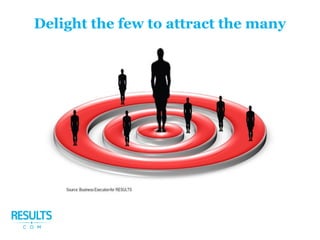
Delight the few to attract the many
“There is only 1 winning strategy.
Carefully define
the target market,
and direct a superior offering
to that target market”
Your product / service offerings have more clarity & focus
(you know who you are building it for)
Marketing communications are more effective
(you know who you are talking to)
Target customer perceives you as the expert at meeting
their needs - “This company is talking to me”
(they are more likely to choose you)
When you have a clearly defined Target Market
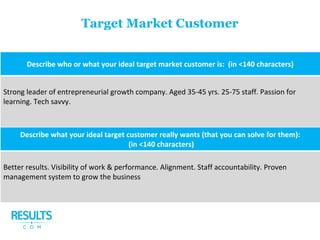
Target Market Customer
Describe who or what your ideal target market customer is: (in <140 characters)
Strong leader of entrepreneurial growth company. Aged 35-45 yrs. 25-75 staff. Passion for
learning. Tech savvy.
Describe what your ideal target customer really wants (that you can solve for them):
(in <140 characters)
Better results. Visibility of work & performance. Alignment. Staff accountability. Proven
management system to grow the business
Geographic Focus: Now? Within 3 to 5 Years?
Describe the Geographies you will spend money to market or sell to: (in <140 characters)
★ Delight the few to attract the many
★ Describe your “ideal” customer at the center of bull’s-eye
★ “Who” you want to delight and excite the most with your offer
★ “Who” you think of when you design your product / service
★ “Who” you think of when you write your marketing messages
★ Not necessarily who makes up majority of your sales volume
★ Stay focused. Don’t try to be all things to all people.
Target Market - best practices
VISION
Core Values
Core Purpose
BHAG
STRATEGY
Target Market Customer
Value Discipline
Core vs. Non Core Activities
Strategic Positioning
Key Benefits
Brand Promise
3 to 5 Year Strategic Moves
EXECUTION
Numerical Targets
SWOT Analysis
Current Strategic Projects
Metrics (Key Performance Indicators)
RESULTS.com Strategic Plan
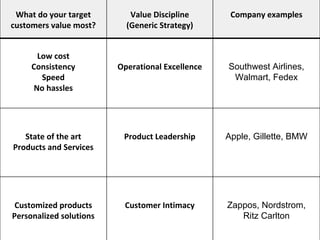
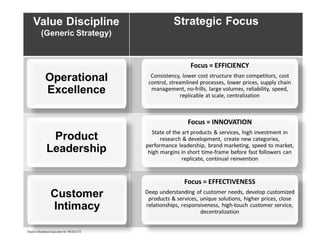
Value Discipline
Strategic Focus
What do your target
customers value most?
Value Discipline
(Generic Strategy)
Company examples
Low cost
Consistency
Speed
No hassles
Operational Excellence Southwest Airlines,
Walmart, Fedex
State of the art
Products and Services
Product Leadership Apple, Gillette, BMW
Customized products
Personalized solutions
Customer Intimacy Zappos, Nordstrom,
Ritz Carlton
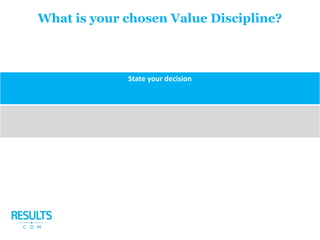
What is your chosen Value Discipline?
State your decision
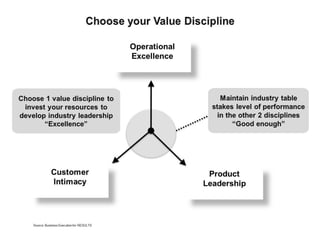
★ Focus. Don’t try to be all things to all people
★ Each value discipline requires a different operating model
★ Invest resources to develop true excellence in 1 discipline
★ Aim to be “good enough” in the other 2 disciplines
★ Lack of focus will doom you to mediocrity
Value Discipline - best practices
VISION
Core Values
Core Purpose
BHAG
STRATEGY
Target Market Customer
Value Discipline
Core vs. Non Core Activities
Strategic Positioning
Key Benefits
Brand Promise
3 to 5 Year Strategic Moves
EXECUTION
Numerical Targets
SWOT Analysis
Current Strategic Projects
Metrics (Key Performance Indicators)
RESULTS.com Strategic Plan
Core vs. Non Core
Activities
“The difference between successful people
and very successful people
is that very successful people say "no"
to almost everything”
Warren Buffett
“Strategy is resource allocation.
When you strip away all the noise,
that’s what it comes down to.
Strategy means making clear cut
choices about how to compete.
You cannot be everything
to everybody.
You have to figure out
what to say NO to”
“Many managers do not
understand the importance
of having a clear strategy.
Strategy is about
making trade-offs.
The essence of strategy
is choosing what NOT to do.”
“The difference between successful people
and very successful people
is that very successful people say "no"
to almost everything”
Warren Buffett
“The temptation of business
is always to feed yesterday
and to starve tomorrow”
“The difference between successful people
and very successful people
is that very successful people say "no"
to almost everything”
Warren Buffett
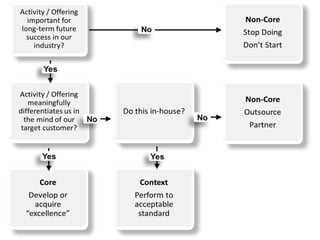
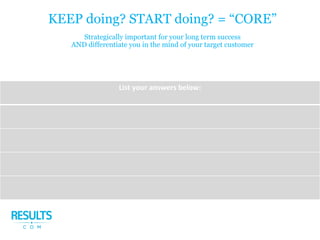
KEEP doing? START doing? = “CORE”
Strategically important for your long term success
AND differentiate you in the mind of your target customer
List your answers below:
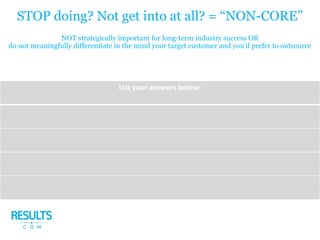
STOP doing? Not get into at all? = “NON-CORE”
NOT strategically important for long-term industry success OR
do not meaningfully differentiate in the mind your target customer and you’d prefer to outsource
List your answers below:
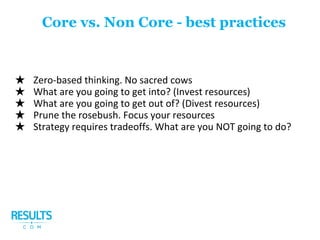
★ Zero-based thinking. No sacred cows
★ What are you going to get into? (Invest resources)
★ What are you going to get out of? (Divest resources)
★ Prune the rosebush. Focus your resources
★ Strategy requires tradeoffs. What are you NOT going to do?
Core vs. Non Core - best practices
VISION
Core Values
Core Purpose
BHAG
STRATEGY
Target Market Customer
Value Discipline
Core vs. Non Core Activities
Strategic Positioning
Key Benefits
Brand Promise
3 to 5 Year Strategic Moves
EXECUTION
Numerical Targets
SWOT Analysis
Current Strategic Projects
Metrics (Key Performance Indicators)
RESULTS.com Strategic Plan
Strategic Positioning
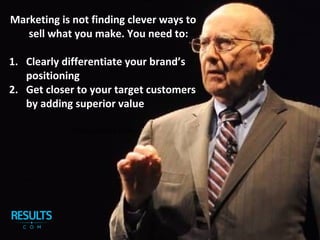
Marketing is not finding clever ways to
sell what you make. You need to:
1. Clearly differentiate your brand’s
positioning
2. Get closer to your target customers
by adding superior value
Professor Philip Kotler
Seth Godin
Stake out a “position” in your industry
(or create a new category) in which you can authentically claim
your “leadership” or “meaningful point of difference”
Leadership does not necessarily mean being first or biggest:
• You can lead a niche category in your industry
• You can lead in a geographic location
• You can lead by having a meaningful point of difference
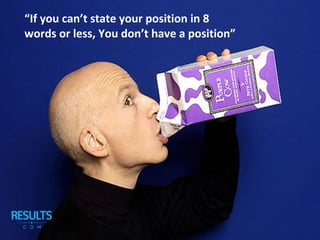
“If you can’t state your position in 8
words or less, You don’t have a position”
State your Strategic Position
State your Strategic Position (in 8 words or less)
★ A concept you can “own” in the target customer’s mind
★ An industry category or niche that no one else owns
★ Meaningful and remarkable to your target customer
★ Position your leadership, or meaningful point of difference
★ Authentic. No BS. Your customers must experience it
★ Narrow your focus. Stand for one thing
★ Don’t try to be all things to all people
★ Delight the few to attract the many
★ Sustainable even if product/service evolves over time
Strategic Positioning - best practices
VISION
Core Values
Core Purpose
BHAG
STRATEGY
Target Market Customer
Value Discipline
Core vs. Non Core Activities
Strategic Positioning
Key Benefits
Brand Promise
3 to 5 Year Strategic Moves
EXECUTION
Numerical Targets
SWOT Analysis
Current Strategic Projects
Metrics (Key Performance Indicators)
RESULTS.com Strategic Plan
Key Benefits
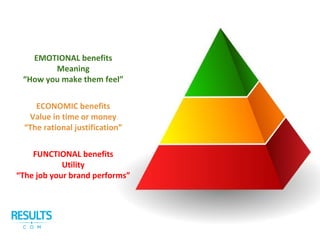
ECONOMIC benefits
Value in time or money
“The rational justification”
FUNCTIONAL benefits
Utility
“The job your brand performs”
EMOTIONAL benefits
Meaning
“How you make them feel”
Functional Benefit:
– Hybrid car = uses less petrol = better for the environment
Economic Benefit:
– More expensive to purchase, but more economical to run
Emotional benefit:
– Tells the world - “I’m a good person”
What is your #1 benefit in each category?
Type of Benefit The #1 Benefit our brand offers in each category
Functional
Economic
Emotional
VISION
Core Values
Core Purpose
BHAG
STRATEGY
Target Market Customer
Value Discipline
Core vs. Non Core Activities
Strategic Positioning
Key Benefits
Brand Promise
3 to 5 Year Strategic Moves
EXECUTION
Numerical Targets
SWOT Analysis
Current Strategic Projects
Metrics (Key Performance Indicators)
RESULTS.com Strategic Plan
Brand Promise
Your blunt, overt, compelling offer
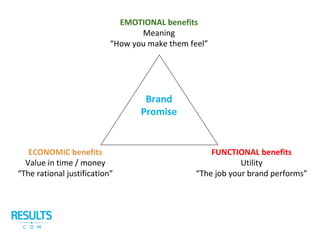
EMOTIONAL benefits
Meaning
“How you make them feel”
Brand
Promise
ECONOMIC benefits
Value in time / money
“The rational justification”
FUNCTIONAL benefits
Utility
“The job your brand performs”
State your Brand Promise
State your brand promise (in <140 characters)
★ Designed to delight your ideal target customer
★ Blunt and obvious to as to what they can expect to receive
★ Authentic. No BS. Your customers must experience it
★ Back up your promise with real reasons to believe
★ Sustainable even if product/service evolves over time
★ Brand promise should be hard for your competitors to copy
operationally (because you have built a unique operating
model to deliver brand promise in a truly excellent fashion)
Key Benefits & Brand Promise
best practices
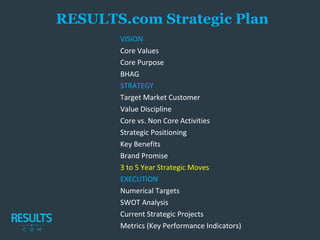
VISION
Core Values
Core Purpose
BHAG
STRATEGY
Target Market Customer
Value Discipline
Core vs. Non Core Activities
Strategic Positioning
Key Benefits
Brand Promise
3 to 5 Year Strategic Moves
EXECUTION
Numerical Targets
SWOT Analysis
Current Strategic Projects
Metrics (Key Performance Indicators)
RESULTS.com Strategic Plan
3 to 5 Year Strategic Moves
(includes industry analysis)
"If you’re planning over a 3 year time horizon,
you're competing against a lot of people.
But if you're willing to invest on a 7 year time
horizon, you're competing against a fraction of
those people, because very few companies are
willing to do that.
We can't realize our potential as people or as
companies unless we plan for the long term."
Industry Analysis
Questions / Answers:
#RealStrategy || @RESULTSdotcom
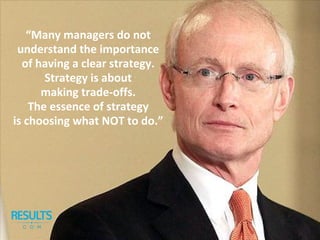
“Many managers do not
understand the importance
of having a clear strategy.
Strategy is about
making trade-offs.
The essence of strategy
is choosing what NOT to do.”
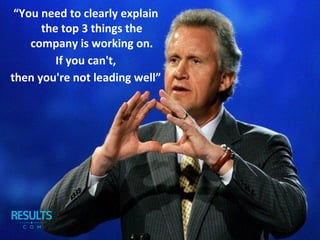
“You need to clearly explain
the top 3 things the
company is working on.
If you can't,
then you're not leading well”
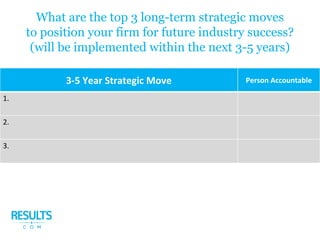
What are the top 3 long-term strategic moves
to position your firm for future industry success?
(will be implemented within the next 3-5 years)
3-5 Year Strategic Move Person Accountable
1.
2.
3.
Could someone do the opposite,
and would that be a valid strategy?”
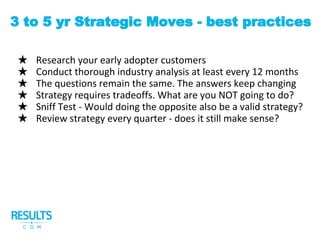
★ Research your early adopter customers
★ Conduct thorough industry analysis at least every 12 months
★ The questions remain the same. The answers keep changing
★ Strategy requires tradeoffs. What are you NOT going to do?
★ Sniff Test - Would doing the opposite also be a valid strategy?
★ Review strategy every quarter - does it still make sense?
3 to 5 yr Strategic Moves - best practices
VISION
Core Values
Core Purpose
BHAG
STRATEGY
Target Market Customer
Value Discipline
Core vs. Non Core Activities
Strategic Positioning
Key Benefits
Brand Promise
3 to 5 Year Strategic Moves
EXECUTION
Numerical Targets
SWOT Analysis
Current Strategic Projects
Metrics (Key Performance Indicators)
RESULTS.com Strategic Plan
Numerical Targets
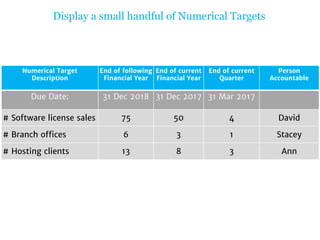
Display a small handful of Numerical Targets
Numerical Target
Description
End of following
Financial Year
End of current
Financial Year
End of current
Quarter
Person
Accountable
Due Date: 31 Dec 2018 31 Dec 2017 31 Mar 2017
# Software license sales 75 50 4 David
# Branch offices 6 3 1 Stacey
# Hosting clients 13 8 3 Ann
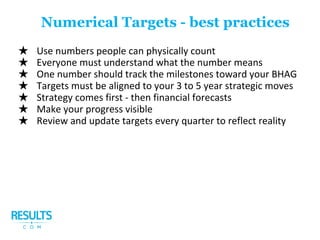
★ Use numbers people can physically count
★ Everyone must understand what the number means
★ One number should track the milestones toward your BHAG
★ Targets must be aligned to your 3 to 5 year strategic moves
★ Strategy comes first - then financial forecasts
★ Make your progress visible
★ Review and update targets every quarter to reflect reality
Numerical Targets - best practices
VISION
Core Values
Core Purpose
BHAG
STRATEGY
Target Market Customer
Value Discipline
Core vs. Non Core Activities
Strategic Positioning
Key Benefits
Brand Promise
3 to 5 Year Strategic Moves
EXECUTION
Numerical Targets
SWOT Analysis
Current Strategic Projects
Metrics (Key Performance Indicators)
RESULTS.com Strategic Plan
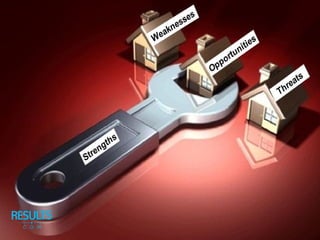
SWOT Analysis
Be specific with your SWOT: Use 3-5 word statements
“Our People” is not a strength
What is it about your people that makes your team strong?
E.g. “Highly qualified software engineers”
“Marketing” is not a weakness
What is it about marketing that is weak currently?
E.g. “Cost of Customer acquisition too high”
“Communication” is not a weakness
What is not being communicated?
E.g. “Strategy not well understood”
Think like an investor. Would they agree with you?
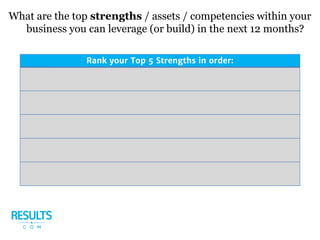
What are the top strengths / assets / competencies within your
business you can leverage (or build) in the next 12 months?
Rank your Top 5 Strengths in order:
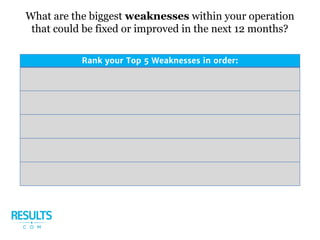
What are the biggest weaknesses within your operation
that could be fixed or improved in the next 12 months?
Rank your Top 5 Weaknesses in order:
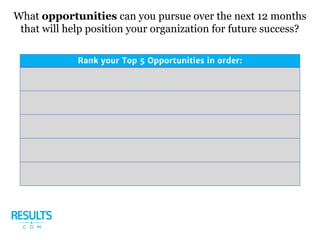
What opportunities can you pursue over the next 12 months
that will help position your organization for future success?
Rank your Top 5 Opportunities in order:
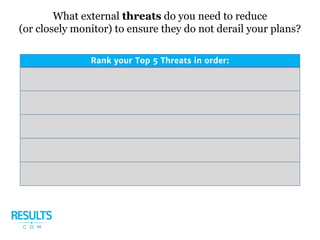
What external threats do you need to reduce
(or closely monitor) to ensure they do not derail your plans?
Rank your Top 5 Threats in order:
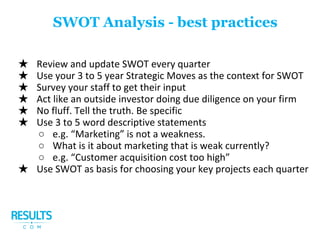
★ Review and update SWOT every quarter
★ Use your 3 to 5 year Strategic Moves as the context for SWOT
★ Survey your staff to get their input
★ Act like an outside investor doing due diligence on your firm
★ No fluff. Tell the truth. Be specific
★ Use 3 to 5 word descriptive statements
○ e.g. “Marketing” is not a weakness.
○ What is it about marketing that is weak currently?
○ e.g. “Customer acquisition cost too high”
★ Use SWOT as basis for choosing your key projects each quarter
SWOT Analysis - best practices
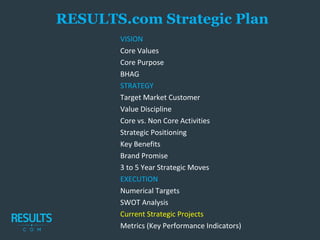
VISION
Core Values
Core Purpose
BHAG
STRATEGY
Target Market Customer
Value Discipline
Core vs. Non Core Activities
Strategic Positioning
Key Benefits
Brand Promise
3 to 5 Year Strategic Moves
EXECUTION
Numerical Targets
SWOT Analysis
Current Strategic Projects
Metrics (Key Performance Indicators)
RESULTS.com Strategic Plan
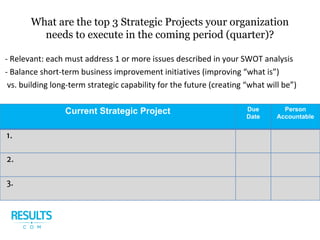
Current Strategic Projects
What are the top 3 Strategic Projects your organization
needs to execute in the coming period (quarter)?
- Relevant: each must address 1 or more issues described in your SWOT analysis
- Balance short-term business improvement initiatives (improving “what is”)
vs. building long-term strategic capability for the future (creating “what will be”)
Current Strategic Project Due
Date
Person
Accountable
1.
2.
3.
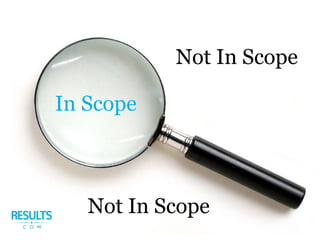
In Scope
Not In Scope
Not In Scope
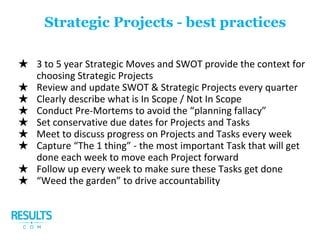
★ 3 to 5 year Strategic Moves and SWOT provide the context for
choosing Strategic Projects
★ Review and update SWOT & Strategic Projects every quarter
★ Clearly describe what is In Scope / Not In Scope
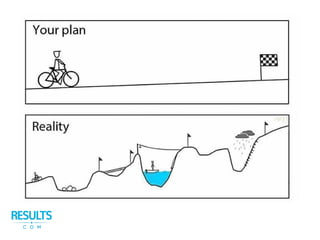
★ Conduct Pre-Mortems to avoid the “planning fallacy”
★ Set conservative due dates for Projects and Tasks
★ Meet to discuss progress on Projects and Tasks every week
★ Capture “The 1 thing” - the most important Task that will get
done each week to move each Project forward
★ Follow up every week to make sure these Tasks get done
★ “Weed the garden” to drive accountability
Strategic Projects - best practices
VISION
Core Values
Core Purpose
BHAG
STRATEGY
Target Market Customer
Value Discipline
Core vs. Non Core Activities
Strategic Positioning
Key Benefits
Brand Promise
3 to 5 Year Strategic Moves
EXECUTION
Numerical Targets
SWOT Analysis
Current Strategic Projects
Metrics (Key Performance Indicators)
RESULTS.com Strategic Plan
Metrics
(Key Performance Indicators)
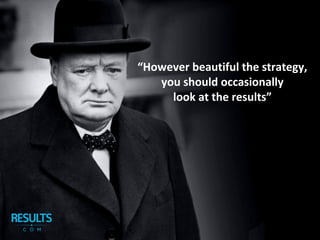
“However beautiful the strategy,
you should occasionally
look at the results”
“However beautiful the strategy,
you should occasionally
look at the results”
92% of companies don’t measure KPIs [3]
Questions to identify your Key Metrics
1. What are the functional areas of our operating model?
2. What result or outcome are we looking for in each area?
3. What “activities” or “actions” drive this outcome?
4. What “effectiveness” measures let us know how well these
activities are being performed?
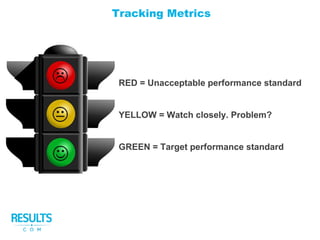
RED = Unacceptable performance standard
YELLOW = Watch closely. Problem?
GREEN = Target performance standard
Questions / Answers:
#realKPIs || @RESULTSdotcom
Tracking Metrics
- You are the CEO, and you are on holiday on a remote tropical island….
- All you can receive is a once weekly email that contains a small handful of
numbers (5 max) to tell you how well your overall organization is performing
- If the Metrics are “green” you can go back to reading your book
- If the Metrics are “yellow” you need to ring the office to see what is going on
- If the Metrics are “red” you need to cut your holiday short and return home
- What 5 Metrics are the “critical success factors” for your organization?
Imagine this…
★ Metrics drive “business as usual” (your current operating model)
★ Don’t just track outcomes or currency measures
★ Focus on activity & effectiveness measures that drive outcomes
★ Make performance visible on a dashboard
★ Weekly team and 1 on 1 meetings to discuss performance
★ Adjust thresholds every quarter to ensure relevance
Metrics (KPIs) - best practices
Thank you for your time!
Create your strategy on 1 page
Presenter: Stephen Lynch
Role: Head of Strategy & Consulting at RESULTS.com
Email: Stephen.Lynch@Results.com
Linkedin: linkedin.com/in/stephengeoffreylynch
Slides: results.com/slides
Software Demo: results.com/demo
Best practices based on research and 20 years of
real world consulting to RESULTS.com client firms

How to create your strategy on 1 page

  • 1.
    Create your strategyon 1 page Best practices based on research and 20 years of real world consulting to RESULTS.com client firms Presenter: Stephen Lynch Role: Head of Strategy & Consulting at RESULTS.com Email: Stephen.Lynch@Results.com Linkedin: linkedin.com/in/stephengeoffreylynch Slides: results.com/slides Software Demo: results.com/demo
  • 3.
    Thank you foryour time!
  • 14.
  • 17.
    “We’re in thesecond half of the chessboard”
  • 18.
    “In short, softwareis eating the world.”
  • 19.
    “The digital erawill dwarf what occurred in the information era. It’ll be a brutal disruption, the majority of companies today will not exist in a meaningful way 10 to 15 years from now.”
  • 20.
    “Business is goingto change more in the next 10 years than it has in the last 50”
  • 21.
    “It is notthe strongest who survive, nor the most intelligent, but the ones most responsive to change”
  • 23.
    “You need tooperate with one eye focused on the short-term, and one eye focused on the long-term. Short-term planning is about improving your current business, & meeting the needs of today’s customers.”
  • 24.
    Often, this demandsbold, disruptive strategic moves” “Long-term planning is not performance improvement. It is about forgetting the past and reshaping your business to compete more effectively in the future.
  • 29.
    VISION Core Values Core Purpose BHAG STRATEGY TargetMarket Customer Value Discipline Core vs. Non Core Activities Strategic Positioning Key Benefits Brand Promise 3 to 5 Year Strategic Moves EXECUTION Numerical Targets SWOT Analysis Current Strategic Projects Metrics (Key Performance Indicators) RESULTS.com Strategic Plan
  • 31.
    VISION Core Values Core Purpose BHAG STRATEGY TargetMarket Customer Value Discipline Core vs. Non Core Activities Strategic Positioning Key Benefits Brand Promise 3 to 5 Year Strategic Moves EXECUTION Numerical Targets SWOT Analysis Current Strategic Projects Metrics (Key Performance Indicators) RESULTS.com Strategic Plan
  • 32.
  • 33.
  • 34.
    Communication We have anobligation to communicate. Here, we take the time to talk with one another and listen. We believe that information is meant to move, and that information moves people Respect We treat others as we would like to be treated ourselves. We do not tolerate abusive or disrespectful treatment Integrity We work with customers and prospects openly, honestly and sincerely. When we say we will do something, we will do it. Excellence We are satisfied with nothing less than the very best in everything we do. We will continue to raise the bar for everything we do. We will have fun discovering how good we can be
  • 36.
    “3 coats means3 coats”
  • 37.
    Use 3-5 wordphrases, to list the small handful of behaviors you want demonstrated by every person in every role: Our Core Values: (Use unique words and phrases that have special meaning and will resonate with your people)
  • 38.
    Core Values are‘musts’ (not ‘nice to haves’) Does each Core Value pass all 4 tests? If not – it is not core and should be eliminated Yes? No? Actively confront colleague for not demonstrating this behavior? Spend (forgo) money to emphasize importance of this behavior? Everyone gets graded on how well they live this behavior? Fire person if they cannot demonstrate this behavior consistently?
  • 39.
    ★ Rules forthe “right” behaviors to be demonstrated by ALL ★ Use 3 to 5 word descriptive statements ★ Unique to your organization (the quirkier the better) ★ Core Values are “Musts”, not “Nice to haves” ★ Context for decision making “What’s the right thing to do?” ★ Basis for performance appraisals, hiring and firing staff ★ Keep them visible. Everyone must know them by heart ★ Compulsory stories shared every week to reinforce them Core Values - best practices
  • 40.
    VISION Core Values Core Purpose BHAG STRATEGY TargetMarket Customer Value Discipline Core vs. Non Core Activities Strategic Positioning Key Benefits Brand Promise 3 to 5 Year Strategic Moves EXECUTION Numerical Targets SWOT Analysis Current Strategic Projects Metrics (Key Performance Indicators) RESULTS.com Strategic Plan
  • 41.
  • 46.
    “To give ordinaryfolk the chance to buy the same things as rich people”
  • 47.
  • 49.
    State your CorePurpose State your Core Purpose: (in <140 characters) To …..
  • 50.
    ★ Not aboutmaking money. ★ It’s about “the difference you want to make” in the world ★ Transcends your current product / service offering ★ Core Purpose describes “the why” not “the how” ★ “How” will change over time. “Why” remains constant ★ Inspires all your people, not just the management team ★ Context for strategic decision making ★ Ask, “Will doing this help us to fulfill our Core Purpose?” Core Purpose - best practices
  • 51.
    VISION Core Values Core Purpose BHAG STRATEGY TargetMarket Customer Value Discipline Core vs. Non Core Activities Strategic Positioning Key Benefits Brand Promise 3 to 5 Year Strategic Moves EXECUTION Numerical Targets SWOT Analysis Current Strategic Projects Metrics (Key Performance Indicators) RESULTS.com Strategic Plan
  • 52.
    BHAG© Big Hairy AudaciousGoal (Copyright: Jim Collins)
  • 55.
    “BHAG goal statement” Size& Scope Revenue Customers Markets Products Best in World Culture Achievements Profit Recognition Services
  • 56.
    “The world’s #1brand for house cleaning robots, (expression of category leadership) with annual sales of 15,000,000 units by 2025” (tangible measure you can use to track your progress every month) Example BHAG© Goal Statement
  • 57.
    State your BHAG© Stateyour BHAG© (in <140 characters)
  • 58.
    ★ Medium tolong timeframe (5 to 10 years typical) ★ Non linear. Beyond current capabilities of the organization ★ Not about being “big” it’s about being “great” ★ A measurable goal with a deadline. No woolly words ★ Easy to understand and quantify ★ Measure progress each quarter ★ Inspires all your people, not just the management team ★ Your team will believe it to the extent the leader believes it ★ “Here’s where we are going” “Here’s what we need to do next” ★ Can outlive the involvement of the current leadership BHAG© - best practices
  • 59.
    VISION Core Values Core Purpose BHAG STRATEGY TargetMarket Customer Value Discipline Core vs. Non Core Activities Strategic Positioning Key Benefits Brand Promise 3 to 5 Year Strategic Moves EXECUTION Numerical Targets SWOT Analysis Current Strategic Projects Metrics (Key Performance Indicators) RESULTS.com Strategic Plan
  • 60.
  • 62.
    Delight the fewto attract the many
  • 63.
    “There is only1 winning strategy. Carefully define the target market, and direct a superior offering to that target market”
  • 64.
    Your product /service offerings have more clarity & focus (you know who you are building it for) Marketing communications are more effective (you know who you are talking to) Target customer perceives you as the expert at meeting their needs - “This company is talking to me” (they are more likely to choose you) When you have a clearly defined Target Market
  • 65.
    Target Market Customer Describewho or what your ideal target market customer is: (in <140 characters) Strong leader of entrepreneurial growth company. Aged 35-45 yrs. 25-75 staff. Passion for learning. Tech savvy. Describe what your ideal target customer really wants (that you can solve for them): (in <140 characters) Better results. Visibility of work & performance. Alignment. Staff accountability. Proven management system to grow the business
  • 66.
    Geographic Focus: Now?Within 3 to 5 Years? Describe the Geographies you will spend money to market or sell to: (in <140 characters)
  • 67.
    ★ Delight thefew to attract the many ★ Describe your “ideal” customer at the center of bull’s-eye ★ “Who” you want to delight and excite the most with your offer ★ “Who” you think of when you design your product / service ★ “Who” you think of when you write your marketing messages ★ Not necessarily who makes up majority of your sales volume ★ Stay focused. Don’t try to be all things to all people. Target Market - best practices
  • 68.
    VISION Core Values Core Purpose BHAG STRATEGY TargetMarket Customer Value Discipline Core vs. Non Core Activities Strategic Positioning Key Benefits Brand Promise 3 to 5 Year Strategic Moves EXECUTION Numerical Targets SWOT Analysis Current Strategic Projects Metrics (Key Performance Indicators) RESULTS.com Strategic Plan
  • 69.
  • 70.
    Strategic Focus What doyour target customers value most? Value Discipline (Generic Strategy) Company examples Low cost Consistency Speed No hassles Operational Excellence Southwest Airlines, Walmart, Fedex State of the art Products and Services Product Leadership Apple, Gillette, BMW Customized products Personalized solutions Customer Intimacy Zappos, Nordstrom, Ritz Carlton
  • 73.
    What is yourchosen Value Discipline? State your decision
  • 74.
    ★ Focus. Don’ttry to be all things to all people ★ Each value discipline requires a different operating model ★ Invest resources to develop true excellence in 1 discipline ★ Aim to be “good enough” in the other 2 disciplines ★ Lack of focus will doom you to mediocrity Value Discipline - best practices
  • 75.
    VISION Core Values Core Purpose BHAG STRATEGY TargetMarket Customer Value Discipline Core vs. Non Core Activities Strategic Positioning Key Benefits Brand Promise 3 to 5 Year Strategic Moves EXECUTION Numerical Targets SWOT Analysis Current Strategic Projects Metrics (Key Performance Indicators) RESULTS.com Strategic Plan
  • 76.
    Core vs. NonCore Activities
  • 77.
    “The difference betweensuccessful people and very successful people is that very successful people say "no" to almost everything” Warren Buffett
  • 78.
    “Strategy is resourceallocation. When you strip away all the noise, that’s what it comes down to. Strategy means making clear cut choices about how to compete. You cannot be everything to everybody. You have to figure out what to say NO to”
  • 79.
    “Many managers donot understand the importance of having a clear strategy. Strategy is about making trade-offs. The essence of strategy is choosing what NOT to do.”
  • 80.
    “The difference betweensuccessful people and very successful people is that very successful people say "no" to almost everything” Warren Buffett
  • 81.
    “The temptation ofbusiness is always to feed yesterday and to starve tomorrow”
  • 82.
    “The difference betweensuccessful people and very successful people is that very successful people say "no" to almost everything” Warren Buffett
  • 83.
    KEEP doing? STARTdoing? = “CORE” Strategically important for your long term success AND differentiate you in the mind of your target customer List your answers below:
  • 84.
    STOP doing? Notget into at all? = “NON-CORE” NOT strategically important for long-term industry success OR do not meaningfully differentiate in the mind your target customer and you’d prefer to outsource List your answers below:
  • 85.
    ★ Zero-based thinking.No sacred cows ★ What are you going to get into? (Invest resources) ★ What are you going to get out of? (Divest resources) ★ Prune the rosebush. Focus your resources ★ Strategy requires tradeoffs. What are you NOT going to do? Core vs. Non Core - best practices
  • 86.
    VISION Core Values Core Purpose BHAG STRATEGY TargetMarket Customer Value Discipline Core vs. Non Core Activities Strategic Positioning Key Benefits Brand Promise 3 to 5 Year Strategic Moves EXECUTION Numerical Targets SWOT Analysis Current Strategic Projects Metrics (Key Performance Indicators) RESULTS.com Strategic Plan
  • 87.
  • 88.
    Marketing is notfinding clever ways to sell what you make. You need to: 1. Clearly differentiate your brand’s positioning 2. Get closer to your target customers by adding superior value Professor Philip Kotler
  • 90.
  • 93.
    Stake out a“position” in your industry (or create a new category) in which you can authentically claim your “leadership” or “meaningful point of difference” Leadership does not necessarily mean being first or biggest: • You can lead a niche category in your industry • You can lead in a geographic location • You can lead by having a meaningful point of difference
  • 94.
    “If you can’tstate your position in 8 words or less, You don’t have a position”
  • 95.
    State your StrategicPosition State your Strategic Position (in 8 words or less)
  • 96.
    ★ A conceptyou can “own” in the target customer’s mind ★ An industry category or niche that no one else owns ★ Meaningful and remarkable to your target customer ★ Position your leadership, or meaningful point of difference ★ Authentic. No BS. Your customers must experience it ★ Narrow your focus. Stand for one thing ★ Don’t try to be all things to all people ★ Delight the few to attract the many ★ Sustainable even if product/service evolves over time Strategic Positioning - best practices
  • 97.
    VISION Core Values Core Purpose BHAG STRATEGY TargetMarket Customer Value Discipline Core vs. Non Core Activities Strategic Positioning Key Benefits Brand Promise 3 to 5 Year Strategic Moves EXECUTION Numerical Targets SWOT Analysis Current Strategic Projects Metrics (Key Performance Indicators) RESULTS.com Strategic Plan
  • 98.
  • 99.
    ECONOMIC benefits Value intime or money “The rational justification” FUNCTIONAL benefits Utility “The job your brand performs” EMOTIONAL benefits Meaning “How you make them feel”
  • 101.
    Functional Benefit: – Hybridcar = uses less petrol = better for the environment Economic Benefit: – More expensive to purchase, but more economical to run Emotional benefit: – Tells the world - “I’m a good person”
  • 102.
    What is your#1 benefit in each category? Type of Benefit The #1 Benefit our brand offers in each category Functional Economic Emotional
  • 103.
    VISION Core Values Core Purpose BHAG STRATEGY TargetMarket Customer Value Discipline Core vs. Non Core Activities Strategic Positioning Key Benefits Brand Promise 3 to 5 Year Strategic Moves EXECUTION Numerical Targets SWOT Analysis Current Strategic Projects Metrics (Key Performance Indicators) RESULTS.com Strategic Plan
  • 104.
    Brand Promise Your blunt,overt, compelling offer
  • 105.
    EMOTIONAL benefits Meaning “How youmake them feel” Brand Promise ECONOMIC benefits Value in time / money “The rational justification” FUNCTIONAL benefits Utility “The job your brand performs”
  • 109.
    State your BrandPromise State your brand promise (in <140 characters)
  • 110.
    ★ Designed todelight your ideal target customer ★ Blunt and obvious to as to what they can expect to receive ★ Authentic. No BS. Your customers must experience it ★ Back up your promise with real reasons to believe ★ Sustainable even if product/service evolves over time ★ Brand promise should be hard for your competitors to copy operationally (because you have built a unique operating model to deliver brand promise in a truly excellent fashion) Key Benefits & Brand Promise best practices
  • 111.
    VISION Core Values Core Purpose BHAG STRATEGY TargetMarket Customer Value Discipline Core vs. Non Core Activities Strategic Positioning Key Benefits Brand Promise 3 to 5 Year Strategic Moves EXECUTION Numerical Targets SWOT Analysis Current Strategic Projects Metrics (Key Performance Indicators) RESULTS.com Strategic Plan
  • 112.
    3 to 5Year Strategic Moves (includes industry analysis)
  • 114.
    "If you’re planningover a 3 year time horizon, you're competing against a lot of people. But if you're willing to invest on a 7 year time horizon, you're competing against a fraction of those people, because very few companies are willing to do that. We can't realize our potential as people or as companies unless we plan for the long term."
  • 116.
  • 120.
  • 122.
    “Many managers donot understand the importance of having a clear strategy. Strategy is about making trade-offs. The essence of strategy is choosing what NOT to do.”
  • 123.
    “You need toclearly explain the top 3 things the company is working on. If you can't, then you're not leading well”
  • 124.
    What are thetop 3 long-term strategic moves to position your firm for future industry success? (will be implemented within the next 3-5 years) 3-5 Year Strategic Move Person Accountable 1. 2. 3.
  • 125.
    Could someone dothe opposite, and would that be a valid strategy?”
  • 127.
    ★ Research yourearly adopter customers ★ Conduct thorough industry analysis at least every 12 months ★ The questions remain the same. The answers keep changing ★ Strategy requires tradeoffs. What are you NOT going to do? ★ Sniff Test - Would doing the opposite also be a valid strategy? ★ Review strategy every quarter - does it still make sense? 3 to 5 yr Strategic Moves - best practices
  • 128.
    VISION Core Values Core Purpose BHAG STRATEGY TargetMarket Customer Value Discipline Core vs. Non Core Activities Strategic Positioning Key Benefits Brand Promise 3 to 5 Year Strategic Moves EXECUTION Numerical Targets SWOT Analysis Current Strategic Projects Metrics (Key Performance Indicators) RESULTS.com Strategic Plan
  • 129.
  • 130.
    Display a smallhandful of Numerical Targets Numerical Target Description End of following Financial Year End of current Financial Year End of current Quarter Person Accountable Due Date: 31 Dec 2018 31 Dec 2017 31 Mar 2017 # Software license sales 75 50 4 David # Branch offices 6 3 1 Stacey # Hosting clients 13 8 3 Ann
  • 131.
    ★ Use numberspeople can physically count ★ Everyone must understand what the number means ★ One number should track the milestones toward your BHAG ★ Targets must be aligned to your 3 to 5 year strategic moves ★ Strategy comes first - then financial forecasts ★ Make your progress visible ★ Review and update targets every quarter to reflect reality Numerical Targets - best practices
  • 132.
    VISION Core Values Core Purpose BHAG STRATEGY TargetMarket Customer Value Discipline Core vs. Non Core Activities Strategic Positioning Key Benefits Brand Promise 3 to 5 Year Strategic Moves EXECUTION Numerical Targets SWOT Analysis Current Strategic Projects Metrics (Key Performance Indicators) RESULTS.com Strategic Plan
  • 133.
  • 135.
    Be specific withyour SWOT: Use 3-5 word statements “Our People” is not a strength What is it about your people that makes your team strong? E.g. “Highly qualified software engineers” “Marketing” is not a weakness What is it about marketing that is weak currently? E.g. “Cost of Customer acquisition too high” “Communication” is not a weakness What is not being communicated? E.g. “Strategy not well understood”
  • 136.
    Think like aninvestor. Would they agree with you?
  • 137.
    What are thetop strengths / assets / competencies within your business you can leverage (or build) in the next 12 months? Rank your Top 5 Strengths in order:
  • 138.
    What are thebiggest weaknesses within your operation that could be fixed or improved in the next 12 months? Rank your Top 5 Weaknesses in order:
  • 139.
    What opportunities canyou pursue over the next 12 months that will help position your organization for future success? Rank your Top 5 Opportunities in order:
  • 140.
    What external threatsdo you need to reduce (or closely monitor) to ensure they do not derail your plans? Rank your Top 5 Threats in order:
  • 141.
    ★ Review andupdate SWOT every quarter ★ Use your 3 to 5 year Strategic Moves as the context for SWOT ★ Survey your staff to get their input ★ Act like an outside investor doing due diligence on your firm ★ No fluff. Tell the truth. Be specific ★ Use 3 to 5 word descriptive statements ○ e.g. “Marketing” is not a weakness. ○ What is it about marketing that is weak currently? ○ e.g. “Customer acquisition cost too high” ★ Use SWOT as basis for choosing your key projects each quarter SWOT Analysis - best practices
  • 142.
    VISION Core Values Core Purpose BHAG STRATEGY TargetMarket Customer Value Discipline Core vs. Non Core Activities Strategic Positioning Key Benefits Brand Promise 3 to 5 Year Strategic Moves EXECUTION Numerical Targets SWOT Analysis Current Strategic Projects Metrics (Key Performance Indicators) RESULTS.com Strategic Plan
  • 143.
  • 145.
    What are thetop 3 Strategic Projects your organization needs to execute in the coming period (quarter)? - Relevant: each must address 1 or more issues described in your SWOT analysis - Balance short-term business improvement initiatives (improving “what is”) vs. building long-term strategic capability for the future (creating “what will be”) Current Strategic Project Due Date Person Accountable 1. 2. 3.
  • 146.
    In Scope Not InScope Not In Scope
  • 152.
    ★ 3 to5 year Strategic Moves and SWOT provide the context for choosing Strategic Projects ★ Review and update SWOT & Strategic Projects every quarter ★ Clearly describe what is In Scope / Not In Scope ★ Conduct Pre-Mortems to avoid the “planning fallacy” ★ Set conservative due dates for Projects and Tasks ★ Meet to discuss progress on Projects and Tasks every week ★ Capture “The 1 thing” - the most important Task that will get done each week to move each Project forward ★ Follow up every week to make sure these Tasks get done ★ “Weed the garden” to drive accountability Strategic Projects - best practices
  • 153.
    VISION Core Values Core Purpose BHAG STRATEGY TargetMarket Customer Value Discipline Core vs. Non Core Activities Strategic Positioning Key Benefits Brand Promise 3 to 5 Year Strategic Moves EXECUTION Numerical Targets SWOT Analysis Current Strategic Projects Metrics (Key Performance Indicators) RESULTS.com Strategic Plan
  • 154.
  • 155.
    “However beautiful thestrategy, you should occasionally look at the results” “However beautiful the strategy, you should occasionally look at the results”
  • 156.
    92% of companiesdon’t measure KPIs [3]
  • 157.
    92% of companiesdon’t measure KPIs [3]
  • 158.
    92% of companiesdon’t measure KPIs [3]
  • 162.
    Questions to identifyyour Key Metrics 1. What are the functional areas of our operating model? 2. What result or outcome are we looking for in each area? 3. What “activities” or “actions” drive this outcome? 4. What “effectiveness” measures let us know how well these activities are being performed?
  • 164.
    RED = Unacceptableperformance standard YELLOW = Watch closely. Problem? GREEN = Target performance standard Questions / Answers: #realKPIs || @RESULTSdotcom Tracking Metrics
  • 165.
    - You arethe CEO, and you are on holiday on a remote tropical island…. - All you can receive is a once weekly email that contains a small handful of numbers (5 max) to tell you how well your overall organization is performing - If the Metrics are “green” you can go back to reading your book - If the Metrics are “yellow” you need to ring the office to see what is going on - If the Metrics are “red” you need to cut your holiday short and return home - What 5 Metrics are the “critical success factors” for your organization? Imagine this…
  • 166.
    ★ Metrics drive“business as usual” (your current operating model) ★ Don’t just track outcomes or currency measures ★ Focus on activity & effectiveness measures that drive outcomes ★ Make performance visible on a dashboard ★ Weekly team and 1 on 1 meetings to discuss performance ★ Adjust thresholds every quarter to ensure relevance Metrics (KPIs) - best practices
  • 173.
    Thank you foryour time!
  • 174.
    Create your strategyon 1 page Presenter: Stephen Lynch Role: Head of Strategy & Consulting at RESULTS.com Email: Stephen.Lynch@Results.com Linkedin: linkedin.com/in/stephengeoffreylynch Slides: results.com/slides Software Demo: results.com/demo Best practices based on research and 20 years of real world consulting to RESULTS.com client firms