How to Give a4-H SpeechKim Butler, Adult 4-H Volunteer4-H Paws N Pals4-H Firing Fanatics
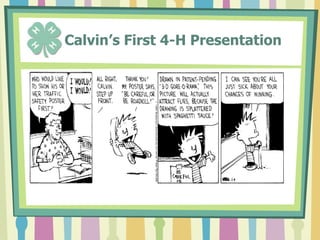
Calvin’s First 4-H Presentation
Learn to express yourself clearlyWhy Should 4-H’ers Participate? Learn how to gather information
 Learn to organize your ideas
 Learn to speak in front of a group
 Learn a life skill that you need
 Show an “I Can Do It!” attitudeContest FlowClub Contest – March 25th at meetingAny 4-H’er can participate You can participate in multiple categoriesCounty Contest – Fri, April 16 at 7 PM, Co Fair.Any 4-H’er can participateYou can participate in multiple categoriesMD State Contest – Sat, April 24 at Univ of MD4-H’er must win the county contestYou can only participate in one category
Contest AwardsClub Contest Blue (1st place), Red (2nd place), White (3rd place), and Participation (recognition for participating)Each contestant judged individually, no winnerCounty ContestBlue (1st place), Red (2nd place), White (3rd place), and Participation (recognition for participating)Grand Champion (overall winner) & Reserve Grand ChampionState ContestGrand Champion (overall winner) & Reserve Grand Champion
General RulesVisual aids are not permittedAppropriate gestures are encouraged, but judges may deduct points for excessive movements or hand gestures that distractState Champions may not enter the same category & age group a 2nd timeState contest can compete in 1 category
Age Categories Clovers: 5 to 7 years of ageJuniors: 8 to 10 years of ageIntermediates: 11 to 13 years of ageSeniors: 14 to 18 years of ageAges are as of January 1st of the current year
Types of 4-H SpeechesRadio SpotPrepared SpeechInterpretationExtemporaneous4-H Pledge – Clovers only
4-H PledgeFor Clover age group onlyPledge is not judged – participation ribbon is givenAppropriate hand gestures should be usedDo not introduce yourself
Radio SpotsTime Limit – exactly 30 secondsCan include musical background/effectsMust provide a written script to judgesRadio spot should relate to 4-H, be original, and be created by 4-H’erGiven behind a screen, you don’t look at the audience
Prepared SpeechTime LimitJuniors: 3 to 5 minutesIntermediates & Seniors: 4 to 6 minutesContestants may speak on any topic.Note cards containing an outline allowedNote cards given to judges at the endDo not introduce yourselfJudges may ask questions
InterpretationsTime LimitJunior: 1.5 to 3 minutesIntermediates: 2 to 4 minutesSeniors: 3 to 5 minutesMemorized oral interpretations or selection of narratives from a given workFrom plays or books – not TV shows
Interpretations3 Types of InterpretationsDramaticPoetryHumorousBring 2 copies of the script for judgesJudges may ask questionsFor dramatic interpretations, 4-H’ers may wear a costume and opt to sit
Extemporaneous SpeechTime LimitJuniors & Intermediates: 2 to 3 minutesSeniors: 3 to 5 minutesDraw 3 topics – choose 1 Write speech – use 4 5x8 cards one sideJuniors & Intermediates have 30 minutesSeniors have 15 minutesJudges may ask questions
What topic will I give my speech about?
Speech TopicsA topic you know something aboutA topic you are interested inA topic you are willing to research and find out more aboutA topic your audience will be interested in
       Organization of SpeechCatchy theme and titleIntroductionBody – main part of speechSummary / Conclusion
     Catchy Theme / TitleAttention Grabber!Dogs – The Best Adventure a Dog Ever Had!Electric - saving power saves money  (super hero)Egg Cookery - EGGS-citing    Fisheries & Aquatic Resources - The  CATCH to fishing with flysSmall Engines - Get your MOTOR  running (song lyric)
IntroductionAttract the audience’s attention with a quotation, startling question or statement of factUse a catchy themeState the purpose of your speech and what you hope to accomplish
BodyThis is the “meat” of your talkPresent info in one of the following waysTime pattern: arrange historically around the past, present, or futureSpace sequence: arrange geographicallyProblem-effect-solution: state the problem, describe its effects, suggest ways to solve it (ex: oven too hot, biscuits burned, fed them to dog)Narrative sequence: story from beginning to end
       Summary / ConclusionBriefly summarize your main points Appeal for specific action (if that is the intent of your speech)Close with the idea you most want the audience to rememberSummarize the main pointsLeave the audience smiling or laughing
      Writing Your SpeechUse the 4-H Public Speaking WorksheetDecide on a topicCreate an outline Research your topicOrganize your points and decide on a sequenceCreate a friendly, catchy, memorable introductionSum up your talk in your summaryWrite your speech out on 3 x 5 cards to practice
Be PreparedPractice, practice, practiceEye contact with total audienceLoud, clear, friendly, natural voiceNeat appearanceGestures, Posture, Body LanguageVoice dynamics/articulationHandling questionsHandling distractionsSmile and enjoy
        The Day of the SpeechGet plenty of rest the night beforeDon’t eat too much before your speechArrive 10 to 15 minutes early to survey the room where you will be talking and to find out the orderIf you are nervous, breathe deeply and slowly several times just before you are introducedDress appropriately. Be neat and clean.Make sure you have 3 copies of your speech
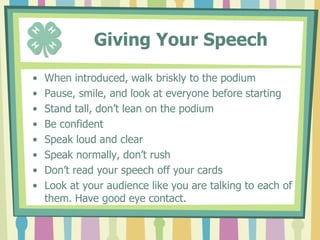
        Giving Your SpeechWhen introduced, walk briskly to the podiumPause, smile, and look at everyone before startingStand tall, don’t lean on the podiumBe confidentSpeak loud and clearSpeak normally, don’t rushDon’t read your speech off your cards Look at your audience like you are talking to each of them. Have good eye contact.
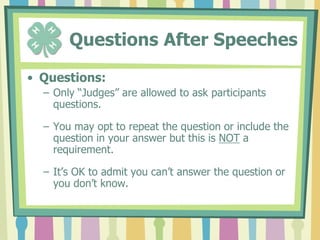
         Questions After SpeechesQuestions: Only “Judges” are allowed to ask participants questions.You may opt to repeat the question or include the question in your answer but this is NOT a requirement.It’s OK to admit you can’t answer the question or you don’t know.
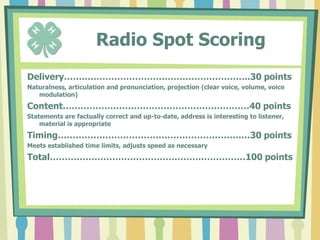
        Radio Spot ScoringDelivery…….………………………………………………..30 pointsNaturalness, articulation and pronunciation, projection (clear voice, volume, voice modulation)Content………………………………………………………40 pointsStatements are factually correct and up-to-date, address is interesting to listener, material is appropriateTiming………………….………………………………….…30 pointsMeets established time limits, adjusts speed as necessaryTotal…………………………………………………………100 points
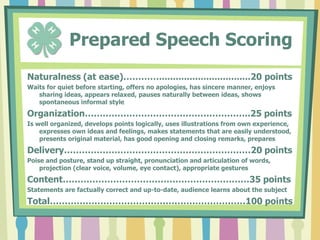
        Prepared Speech ScoringNaturalness (at ease)………….................................20 pointsWaits for quiet before starting, offers no apologies, has sincere manner, enjoys sharing ideas, appears relaxed, pauses naturally between ideas, shows spontaneous informal styleOrganization………………………………………………..25 pointsIs well organized, develops points logically, uses illustrations from own experience, expresses own ideas and feelings, makes statements that are easily understood, presents original material, has good opening and closing remarks, preparesDelivery………………………………………………………20 pointsPoise and posture, stand up straight, pronunciation and articulation of words, projection (clear voice, volume, eye contact), appropriate gesturesContent………………………………………………………35 pointsStatements are factually correct and up-to-date, audience learns about the subjectTotal…………………………………………………………100 points

How to Give a 4-H Speech

  • 1.
    How to Givea4-H SpeechKim Butler, Adult 4-H Volunteer4-H Paws N Pals4-H Firing Fanatics
  • 2.
  • 3.
    Learn to expressyourself clearlyWhy Should 4-H’ers Participate? Learn how to gather information
  • 4.
    Learn toorganize your ideas
  • 5.
    Learn tospeak in front of a group
  • 6.
    Learn alife skill that you need
  • 7.
    Show an“I Can Do It!” attitudeContest FlowClub Contest – March 25th at meetingAny 4-H’er can participate You can participate in multiple categoriesCounty Contest – Fri, April 16 at 7 PM, Co Fair.Any 4-H’er can participateYou can participate in multiple categoriesMD State Contest – Sat, April 24 at Univ of MD4-H’er must win the county contestYou can only participate in one category
  • 8.
    Contest AwardsClub ContestBlue (1st place), Red (2nd place), White (3rd place), and Participation (recognition for participating)Each contestant judged individually, no winnerCounty ContestBlue (1st place), Red (2nd place), White (3rd place), and Participation (recognition for participating)Grand Champion (overall winner) & Reserve Grand ChampionState ContestGrand Champion (overall winner) & Reserve Grand Champion
  • 9.
    General RulesVisual aidsare not permittedAppropriate gestures are encouraged, but judges may deduct points for excessive movements or hand gestures that distractState Champions may not enter the same category & age group a 2nd timeState contest can compete in 1 category
  • 10.
    Age Categories Clovers:5 to 7 years of ageJuniors: 8 to 10 years of ageIntermediates: 11 to 13 years of ageSeniors: 14 to 18 years of ageAges are as of January 1st of the current year
  • 11.
    Types of 4-HSpeechesRadio SpotPrepared SpeechInterpretationExtemporaneous4-H Pledge – Clovers only
  • 12.
    4-H PledgeFor Cloverage group onlyPledge is not judged – participation ribbon is givenAppropriate hand gestures should be usedDo not introduce yourself
  • 13.
    Radio SpotsTime Limit– exactly 30 secondsCan include musical background/effectsMust provide a written script to judgesRadio spot should relate to 4-H, be original, and be created by 4-H’erGiven behind a screen, you don’t look at the audience
  • 14.
    Prepared SpeechTime LimitJuniors:3 to 5 minutesIntermediates & Seniors: 4 to 6 minutesContestants may speak on any topic.Note cards containing an outline allowedNote cards given to judges at the endDo not introduce yourselfJudges may ask questions
  • 15.
    InterpretationsTime LimitJunior: 1.5to 3 minutesIntermediates: 2 to 4 minutesSeniors: 3 to 5 minutesMemorized oral interpretations or selection of narratives from a given workFrom plays or books – not TV shows
  • 16.
    Interpretations3 Types ofInterpretationsDramaticPoetryHumorousBring 2 copies of the script for judgesJudges may ask questionsFor dramatic interpretations, 4-H’ers may wear a costume and opt to sit
  • 17.
    Extemporaneous SpeechTime LimitJuniors& Intermediates: 2 to 3 minutesSeniors: 3 to 5 minutesDraw 3 topics – choose 1 Write speech – use 4 5x8 cards one sideJuniors & Intermediates have 30 minutesSeniors have 15 minutesJudges may ask questions
  • 18.
    What topic willI give my speech about?
  • 19.
    Speech TopicsA topicyou know something aboutA topic you are interested inA topic you are willing to research and find out more aboutA topic your audience will be interested in
  • 20.
    Organization of SpeechCatchy theme and titleIntroductionBody – main part of speechSummary / Conclusion
  • 21.
    Catchy Theme / TitleAttention Grabber!Dogs – The Best Adventure a Dog Ever Had!Electric - saving power saves money (super hero)Egg Cookery - EGGS-citing Fisheries & Aquatic Resources - The CATCH to fishing with flysSmall Engines - Get your MOTOR running (song lyric)
  • 22.
    IntroductionAttract the audience’sattention with a quotation, startling question or statement of factUse a catchy themeState the purpose of your speech and what you hope to accomplish
  • 23.
    BodyThis is the“meat” of your talkPresent info in one of the following waysTime pattern: arrange historically around the past, present, or futureSpace sequence: arrange geographicallyProblem-effect-solution: state the problem, describe its effects, suggest ways to solve it (ex: oven too hot, biscuits burned, fed them to dog)Narrative sequence: story from beginning to end
  • 24.
    Summary / ConclusionBriefly summarize your main points Appeal for specific action (if that is the intent of your speech)Close with the idea you most want the audience to rememberSummarize the main pointsLeave the audience smiling or laughing
  • 25.
    Writing Your SpeechUse the 4-H Public Speaking WorksheetDecide on a topicCreate an outline Research your topicOrganize your points and decide on a sequenceCreate a friendly, catchy, memorable introductionSum up your talk in your summaryWrite your speech out on 3 x 5 cards to practice
  • 26.
    Be PreparedPractice, practice,practiceEye contact with total audienceLoud, clear, friendly, natural voiceNeat appearanceGestures, Posture, Body LanguageVoice dynamics/articulationHandling questionsHandling distractionsSmile and enjoy
  • 27.
    The Day of the SpeechGet plenty of rest the night beforeDon’t eat too much before your speechArrive 10 to 15 minutes early to survey the room where you will be talking and to find out the orderIf you are nervous, breathe deeply and slowly several times just before you are introducedDress appropriately. Be neat and clean.Make sure you have 3 copies of your speech
  • 28.
    Giving Your SpeechWhen introduced, walk briskly to the podiumPause, smile, and look at everyone before startingStand tall, don’t lean on the podiumBe confidentSpeak loud and clearSpeak normally, don’t rushDon’t read your speech off your cards Look at your audience like you are talking to each of them. Have good eye contact.
  • 29.
    Questions After SpeechesQuestions: Only “Judges” are allowed to ask participants questions.You may opt to repeat the question or include the question in your answer but this is NOT a requirement.It’s OK to admit you can’t answer the question or you don’t know.
  • 30.
    Radio Spot ScoringDelivery…….………………………………………………..30 pointsNaturalness, articulation and pronunciation, projection (clear voice, volume, voice modulation)Content………………………………………………………40 pointsStatements are factually correct and up-to-date, address is interesting to listener, material is appropriateTiming………………….………………………………….…30 pointsMeets established time limits, adjusts speed as necessaryTotal…………………………………………………………100 points
  • 31.
    Prepared Speech ScoringNaturalness (at ease)………….................................20 pointsWaits for quiet before starting, offers no apologies, has sincere manner, enjoys sharing ideas, appears relaxed, pauses naturally between ideas, shows spontaneous informal styleOrganization………………………………………………..25 pointsIs well organized, develops points logically, uses illustrations from own experience, expresses own ideas and feelings, makes statements that are easily understood, presents original material, has good opening and closing remarks, preparesDelivery………………………………………………………20 pointsPoise and posture, stand up straight, pronunciation and articulation of words, projection (clear voice, volume, eye contact), appropriate gesturesContent………………………………………………………35 pointsStatements are factually correct and up-to-date, audience learns about the subjectTotal…………………………………………………………100 points