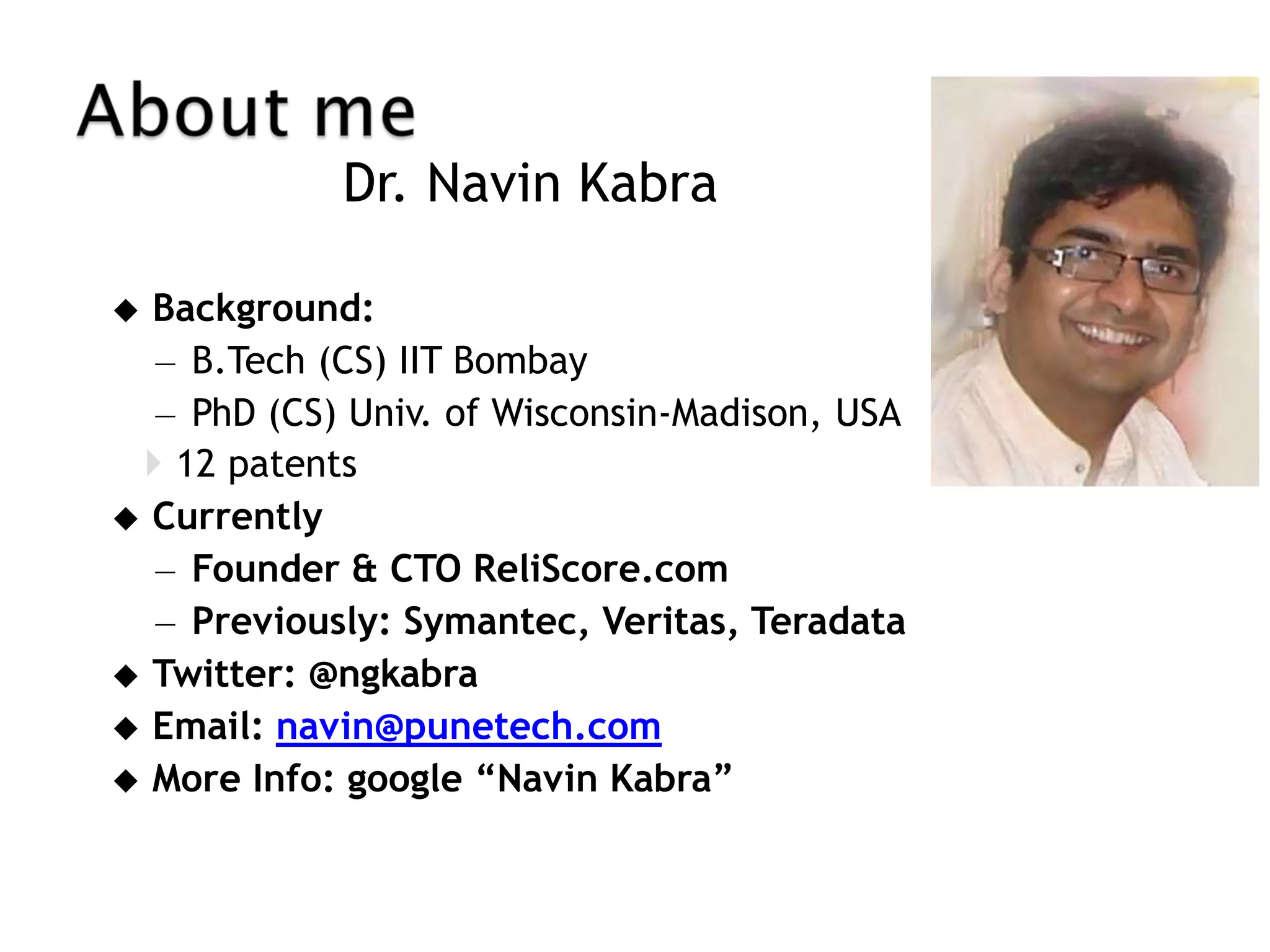
Dr. Navin Kabra
 Background:
– B.Tech (CS) IIT Bombay
– PhD (CS) Univ. of Wisconsin-Madison, USA
 12 patents
 Currently
– Founder & CTO ReliScore.com
– Previously: Symantec, Veritas, Teradata
 Twitter: @ngkabra
 Email: navin@punetech.com
 More Info: google “Navin Kabra”
Becoming
Employable
Real-world Skills
 College Exams ≠ Learning
 Create + Do ≫ Memorize + Copy
 Why ≫ How
Build a Portfolio
 College Project
 Do a Good Job
 Pick Something Fun
 But Showcases Existing Skill
 Learn New Skill
 Useful+Unique
 Do Other Projects
 Make Interview Irrelevant
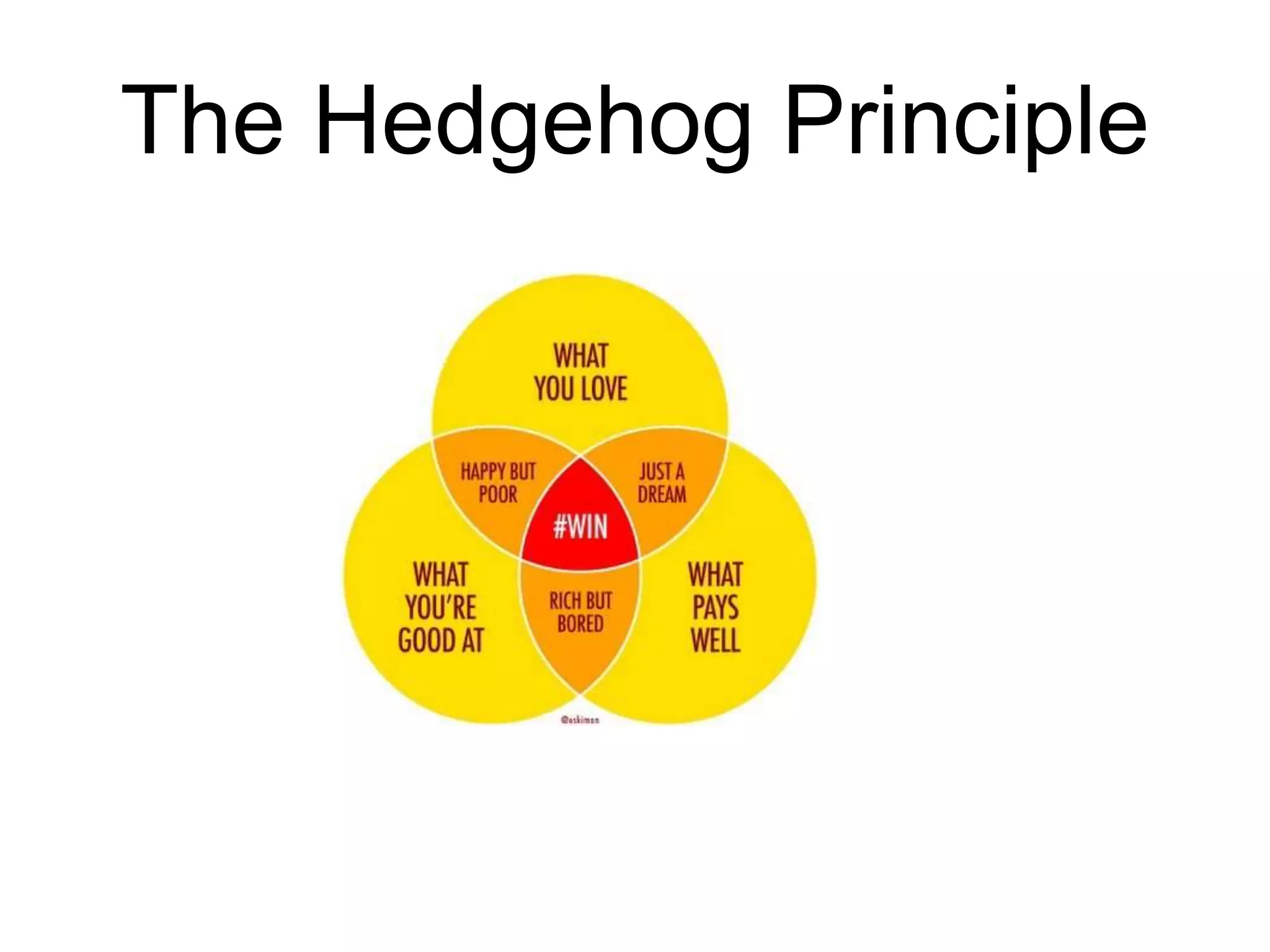
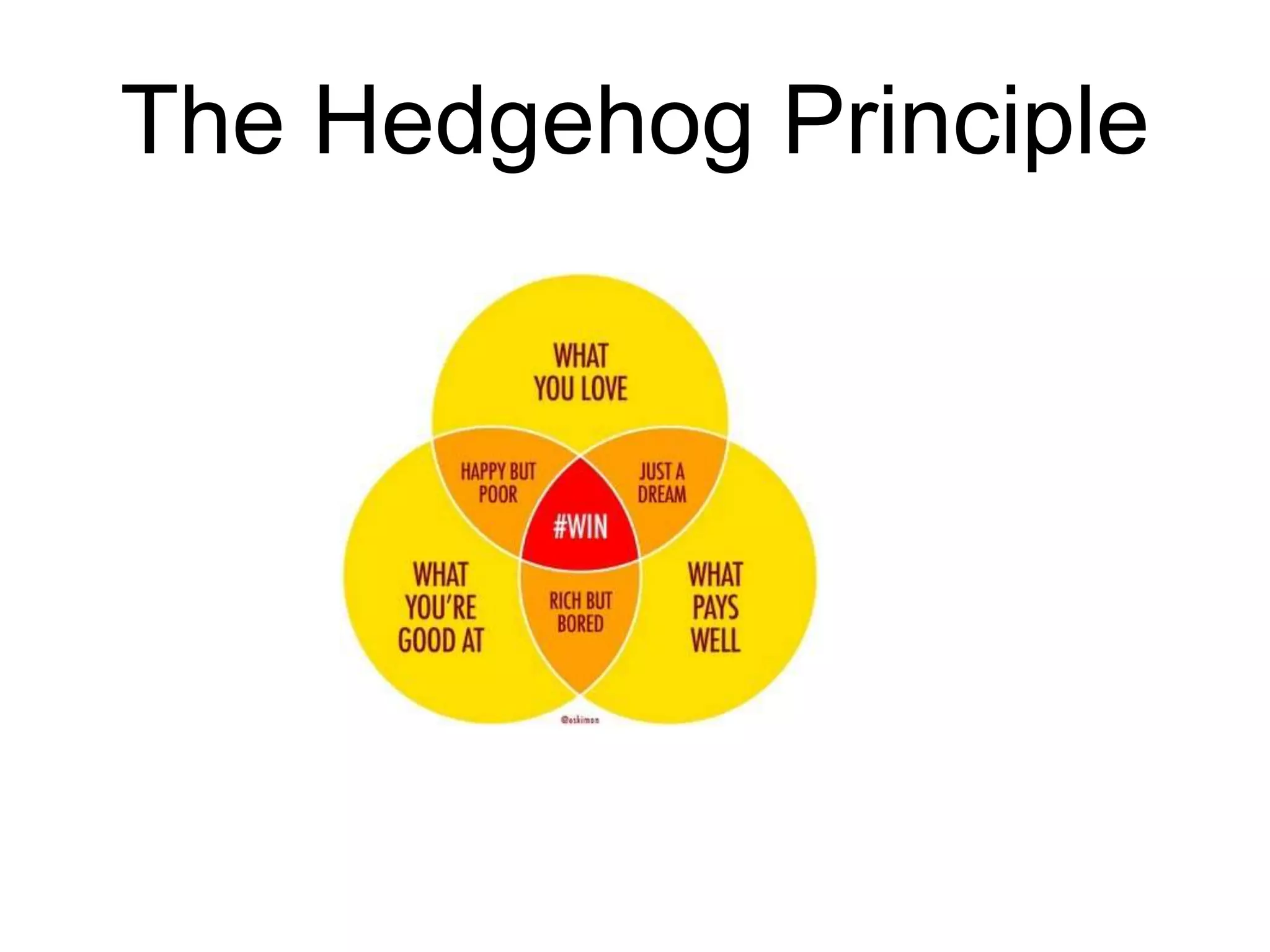
The Hedgehog Principle
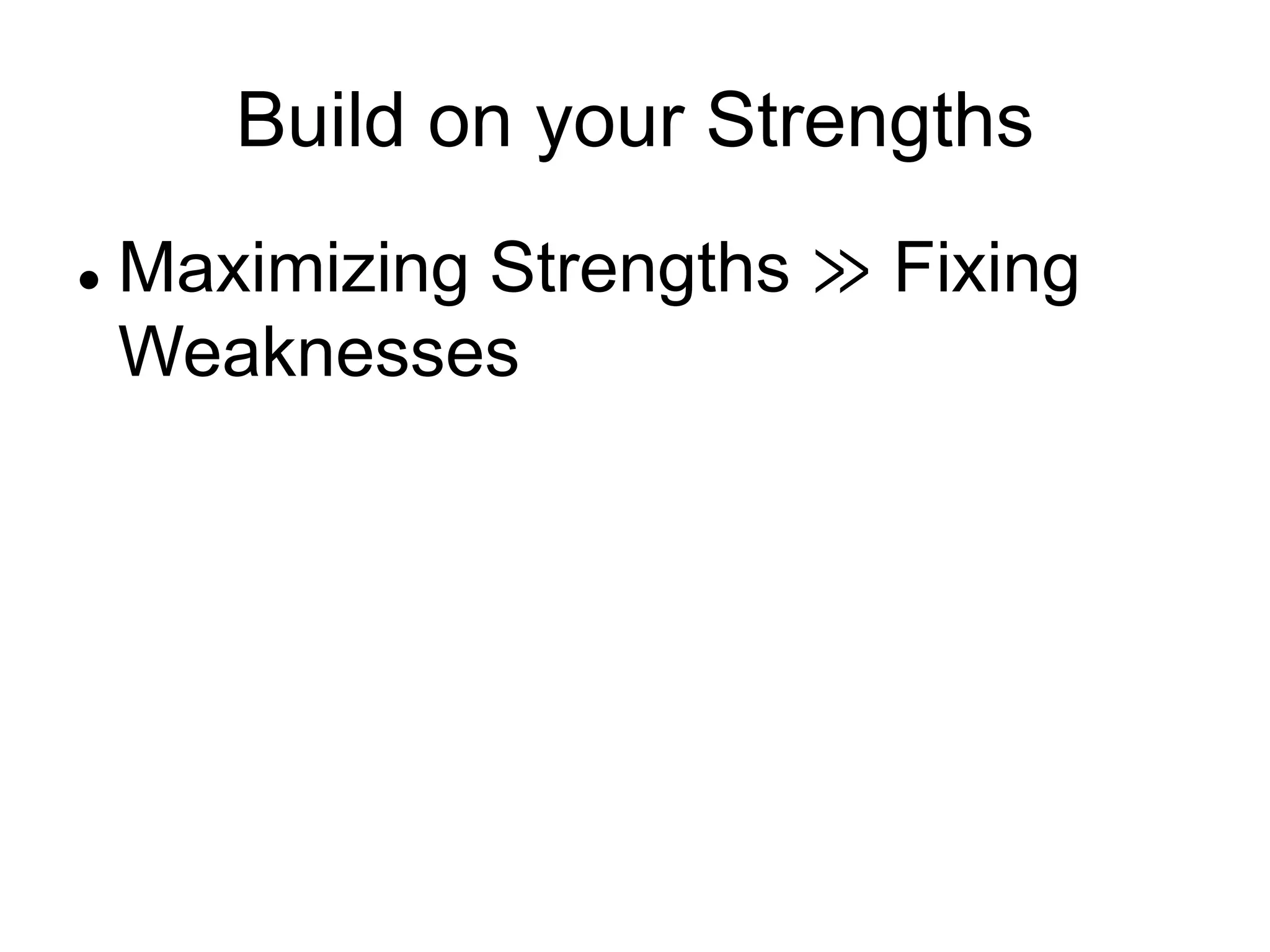
Build on your Strengths
 Maximizing Strengths ≫ Fixing
Weaknesses
Job Search
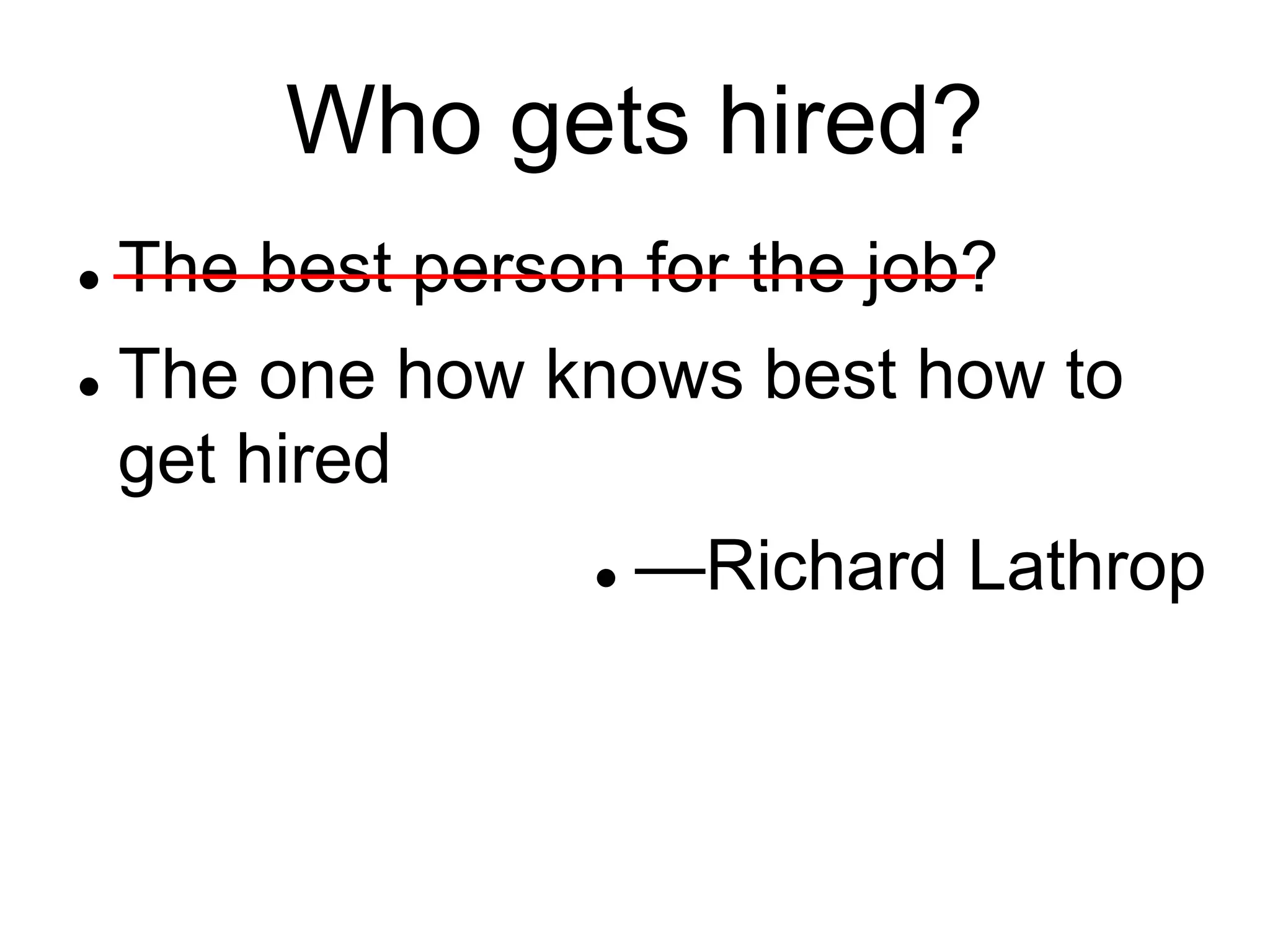
Who gets hired?
 The best person for the job?
 The one how knows best how to
get hired
 —Richard Lathrop
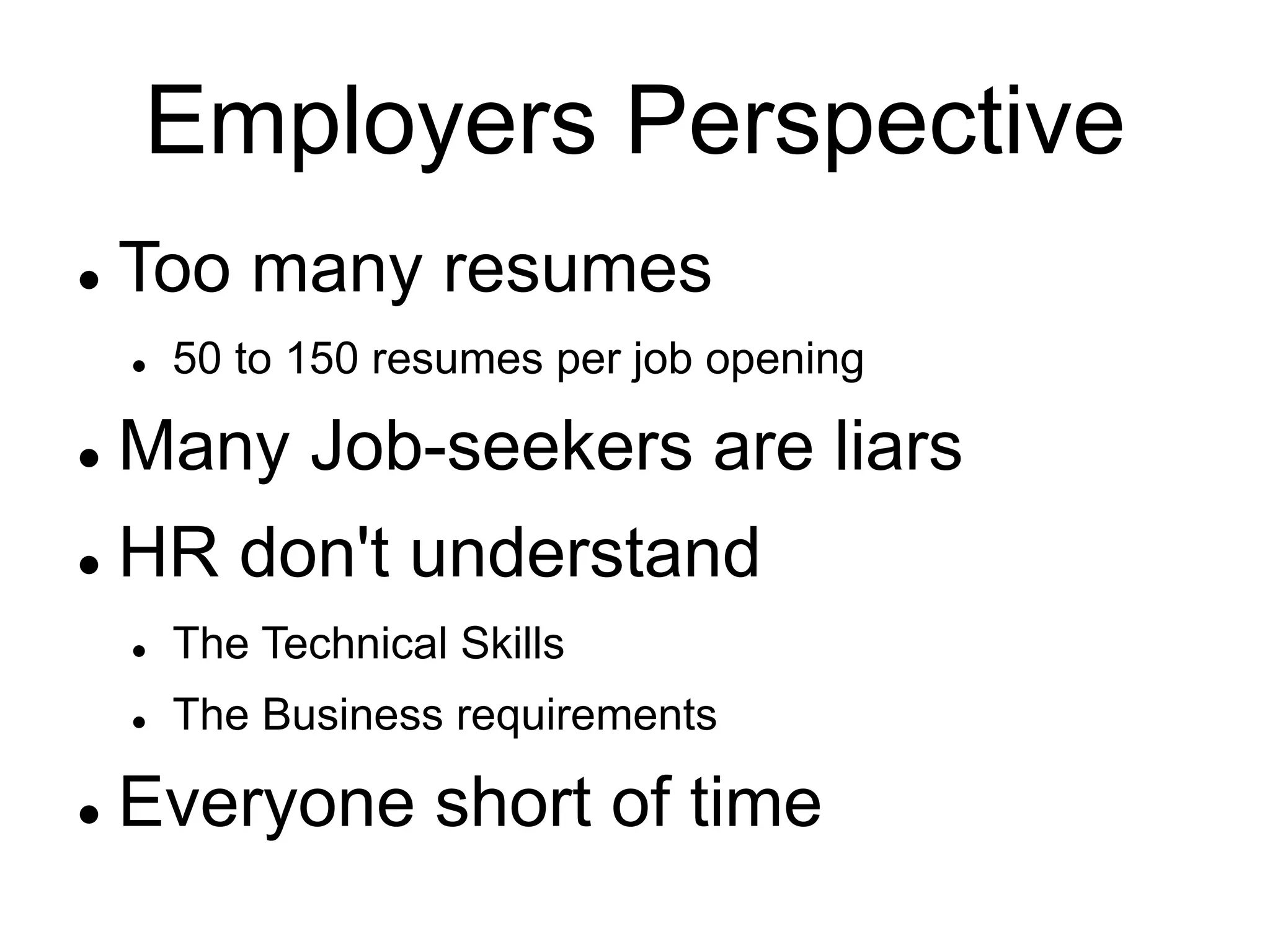
Employers Perspective
 Too many resumes
 50 to 150 resumes per job opening
 Many Job-seekers are liars
 HR don't understand
 The Technical Skills
 The Business requirements
 Everyone short of time
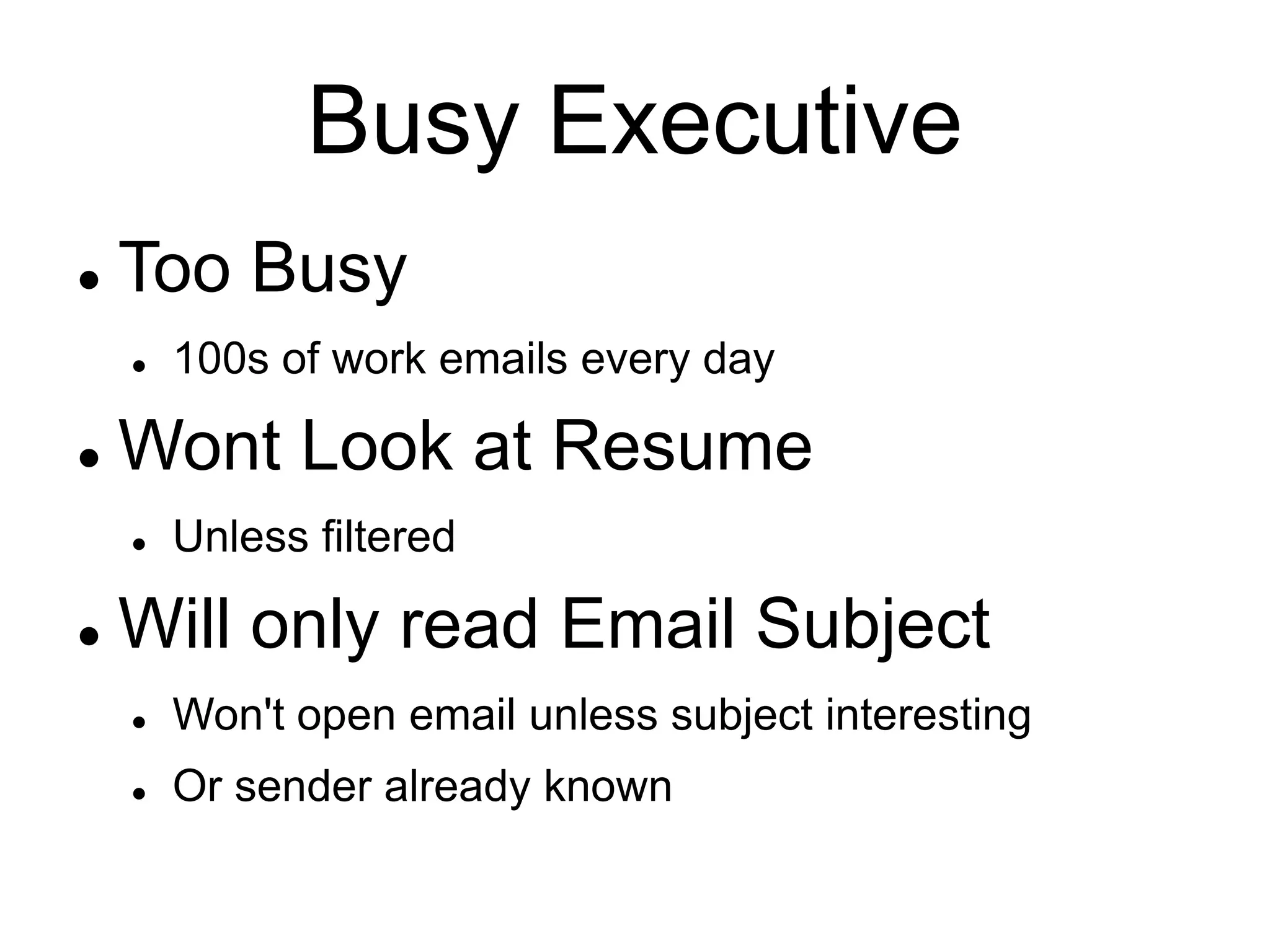
Busy Executive
 Too Busy
 100s of work emails every day
 Wont Look at Resume
 Unless filtered
 Will only read Email Subject
 Won't open email unless subject interesting
 Or sender already known
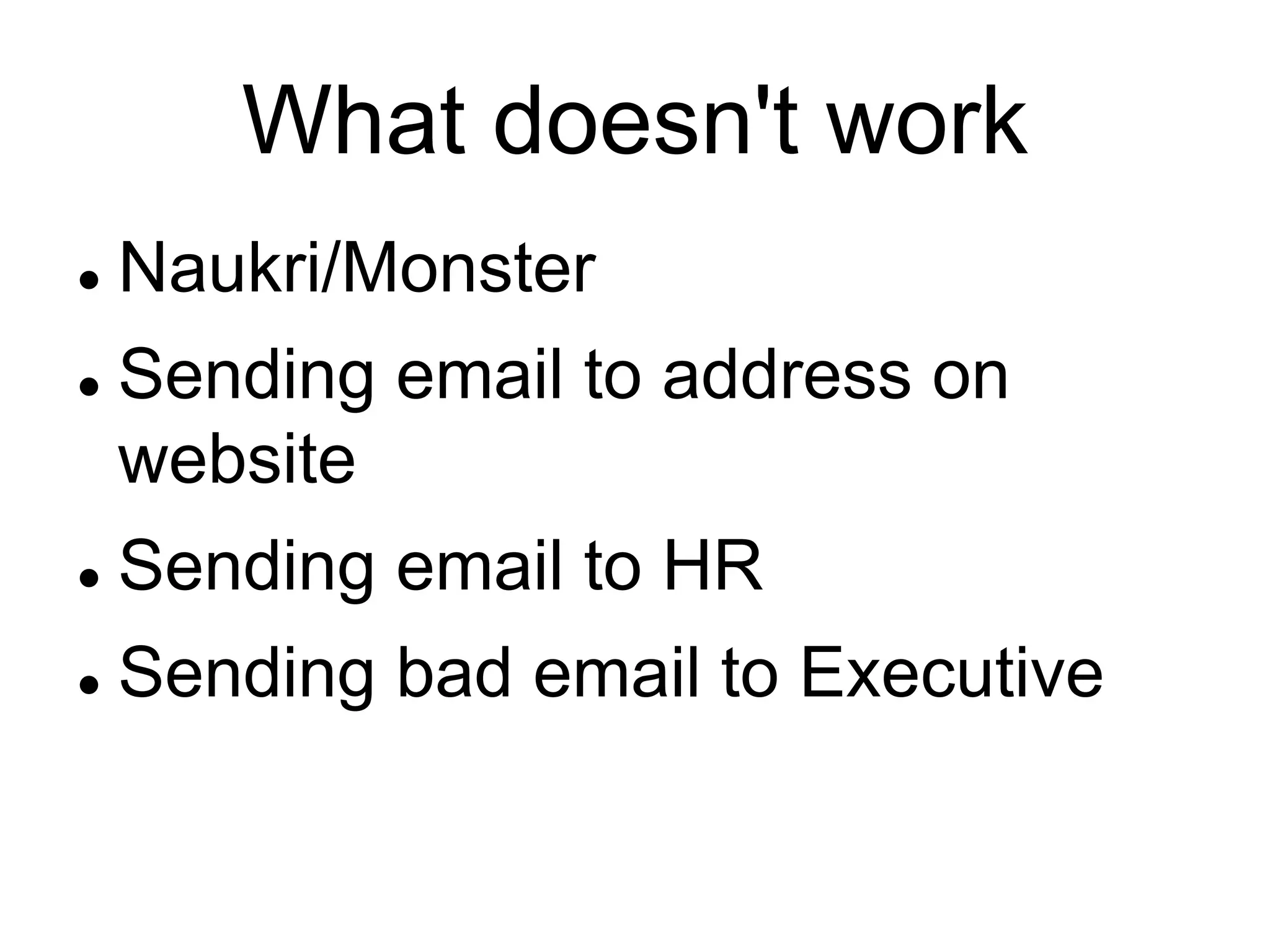
What doesn't work
 Naukri/Monster
 Sending email to address on
website
 Sending email to HR
 Sending bad email to Executive
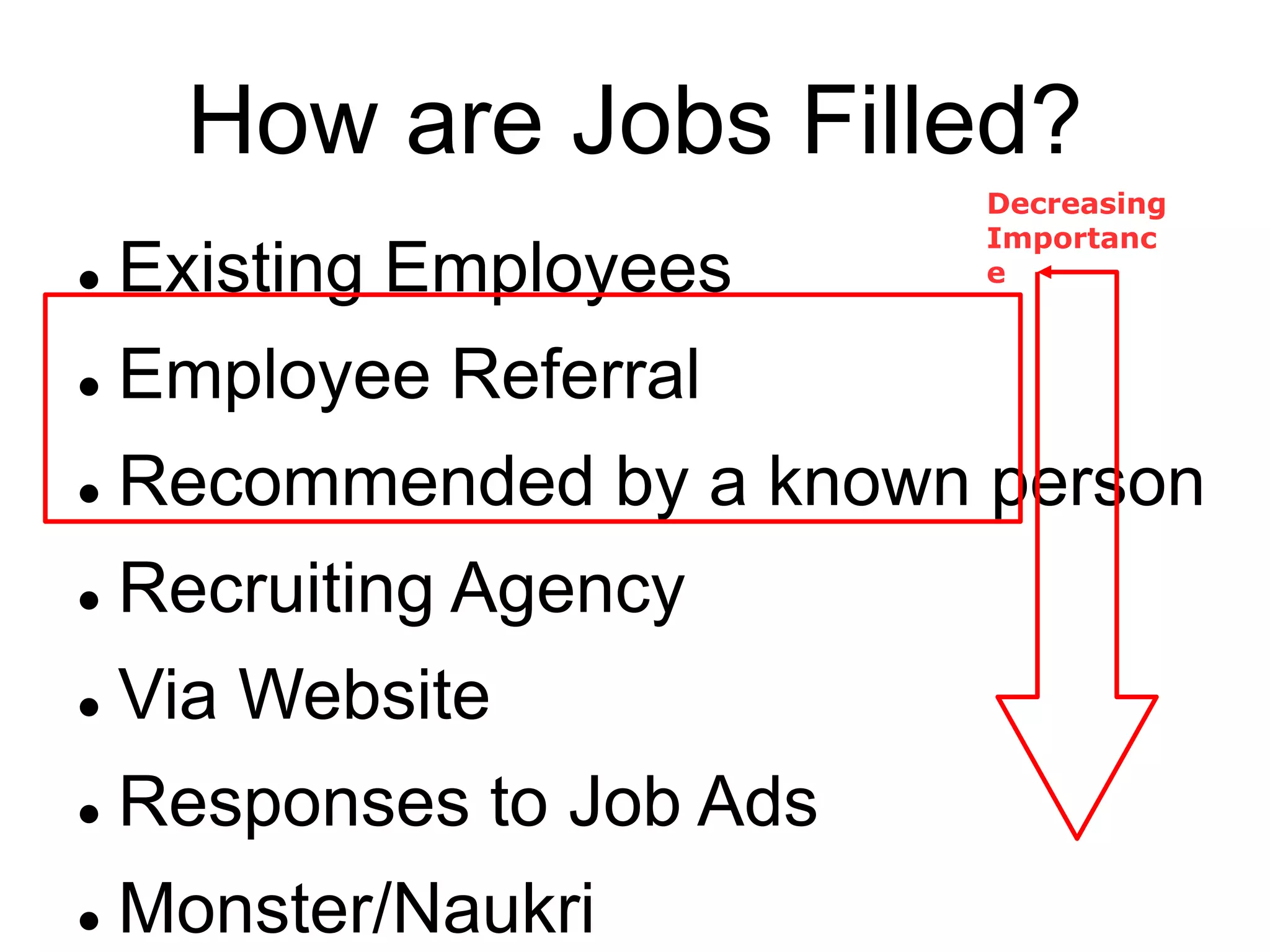
How are Jobs Filled?
 Existing Employees
 Employee Referral
 Recommended by a known person
 Recruiting Agency
 Via Website
 Responses to Job Ads
 Monster/Naukri
Decreasing
Importanc
e
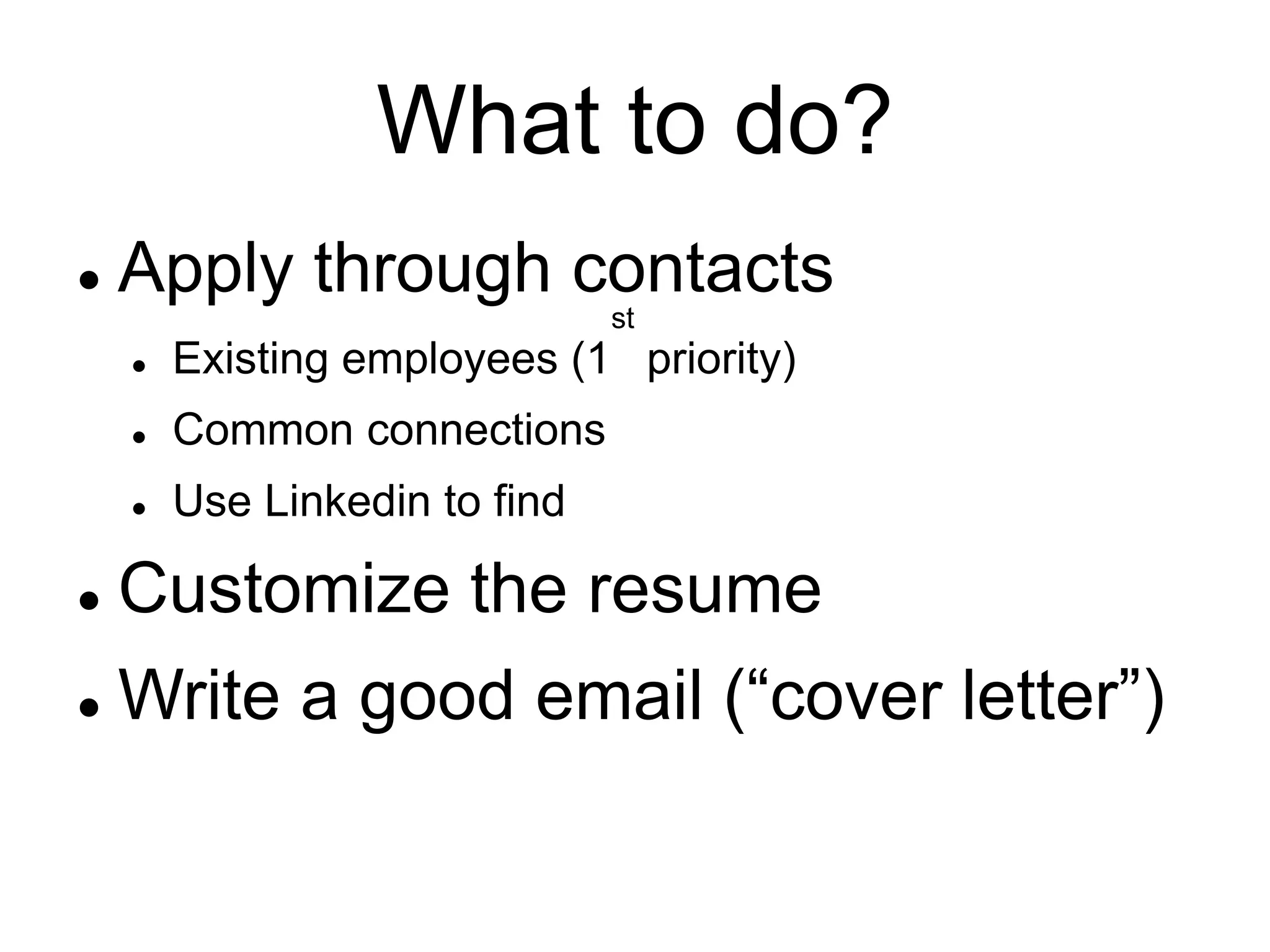
What to do?
 Apply through contacts
 Existing employees (1
st
priority)
 Common connections
 Use Linkedin to find
 Customize the resume
 Write a good email (“cover letter”)
Linkedin
 Extremely Important in a Job Hunt
 Update your profile
 Fully, with details
 Not just job titles, describe role/achievements
 Put a sensible photograph
 This is not Facebook
 Connect to everyone you know
 Even when not looking for a job
Writing a Good Email: Subject
 Bad
 No Subject
 “Resume”
 “Looking for a job”
 Good
 Looking for a job: Java/SpringMVC Dev. (5 years
exp)
Writing a Good Email: Content
 Short, and to-the-point
 Customized to this job
 Contents:
 Why You Are Writing (1 sentence)
 Your Overall Background (1-2 sentences)
 Why You Are Ideal For This Job (1-2 sentences)
No, No, No, No,
No, No, No, No,
No, No, No, Yes
Shy?
 Are you bad a Interviews?
 The “3-Types Of Interviews”
Technique
 Practice Interviews
 Information Interviews
 Real Interviews
Practice Interviews
 Not Related to Work
 About Topic You’re Passionate
About
 With Friends/Acqaintances
 “Conversation”
Informational Interviews
 You Interview Other People
 To Find Out about a Domain/Job
 Gives You Knowledge/Confidence
 Easy, Because You're Not Asking
For a Job
Job Search++
 Resume+Interview = Terrible
 Broken process, lots of errors
 Make Resume+Interview
Irrelevant
 Portfolio
 Networking
Managing Your
Career
Choosing An Industry?
 All are equally good
 Every industry has scope
 All are equally bad
 Any industry might collapse suddenly
 Use other principles to guide you
 Key skill: making the best of
whereever you land up
Choosing a Company
 Product vs Services
 Large vs Medium vs Small
Company
 Which City?
 How Much Salary?
 MNC vs Indian
Product vs Services
 Product
 Long-term focus
 Depth
 Better salaries (avg)
 More Relaxed
 Services
 Fast moving
 Breadth
 More Growth
 More Driven
Company Size
 Large
 Relaxed
 Narrower
focus
 Lots of smart
peole
 Much larger
scale
 Some things
only
possible
 Medium
 Compromise
between
large and
small
 Possibility of
starting
small, taking
on
responsibiliti
es and
growing with
 Small
 Lots of
responsibilit
y
 But also lots
of “other”
work
 Uncertainty
and Risk
 Terrible if
bad
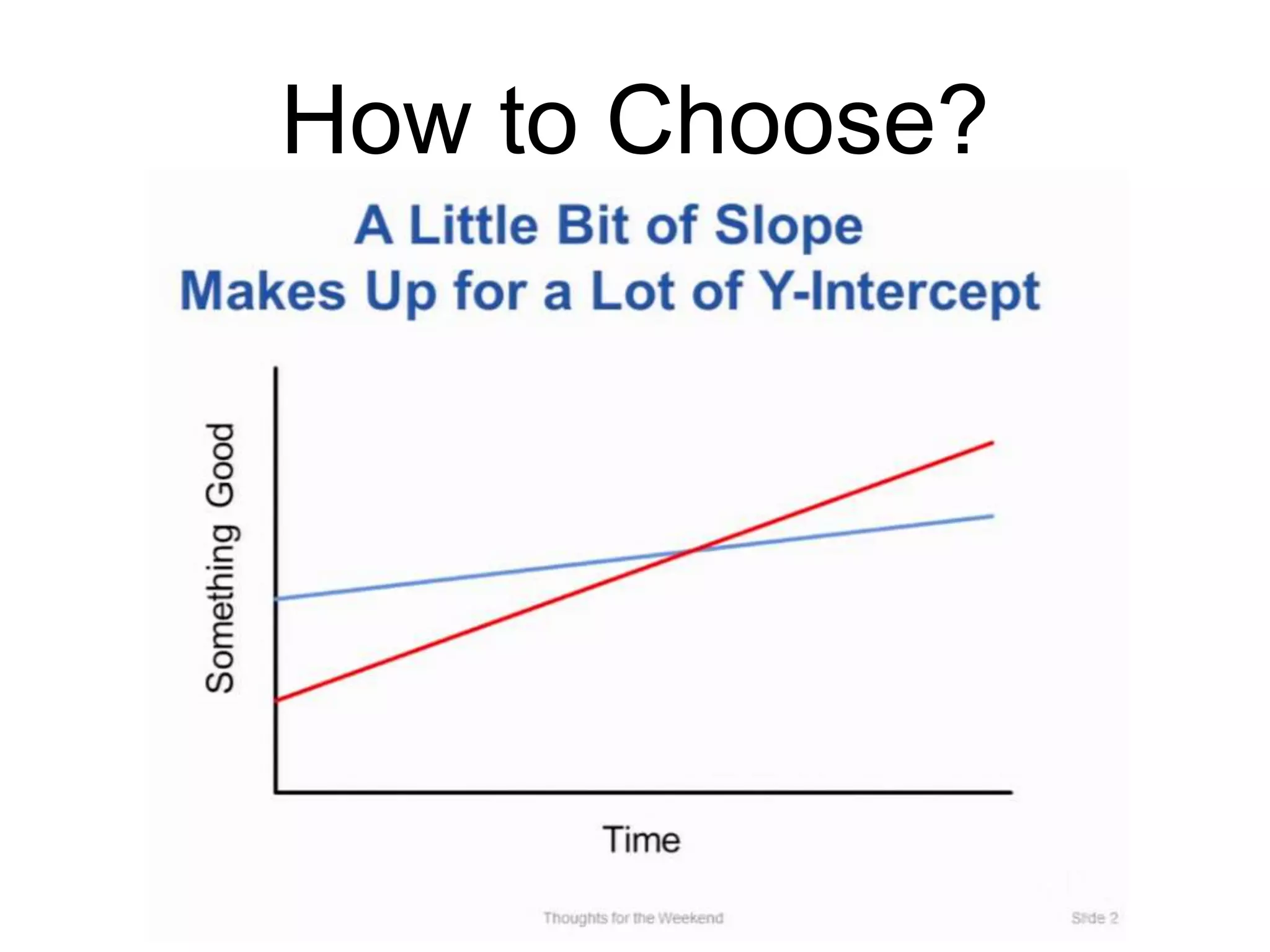
How to Choose?
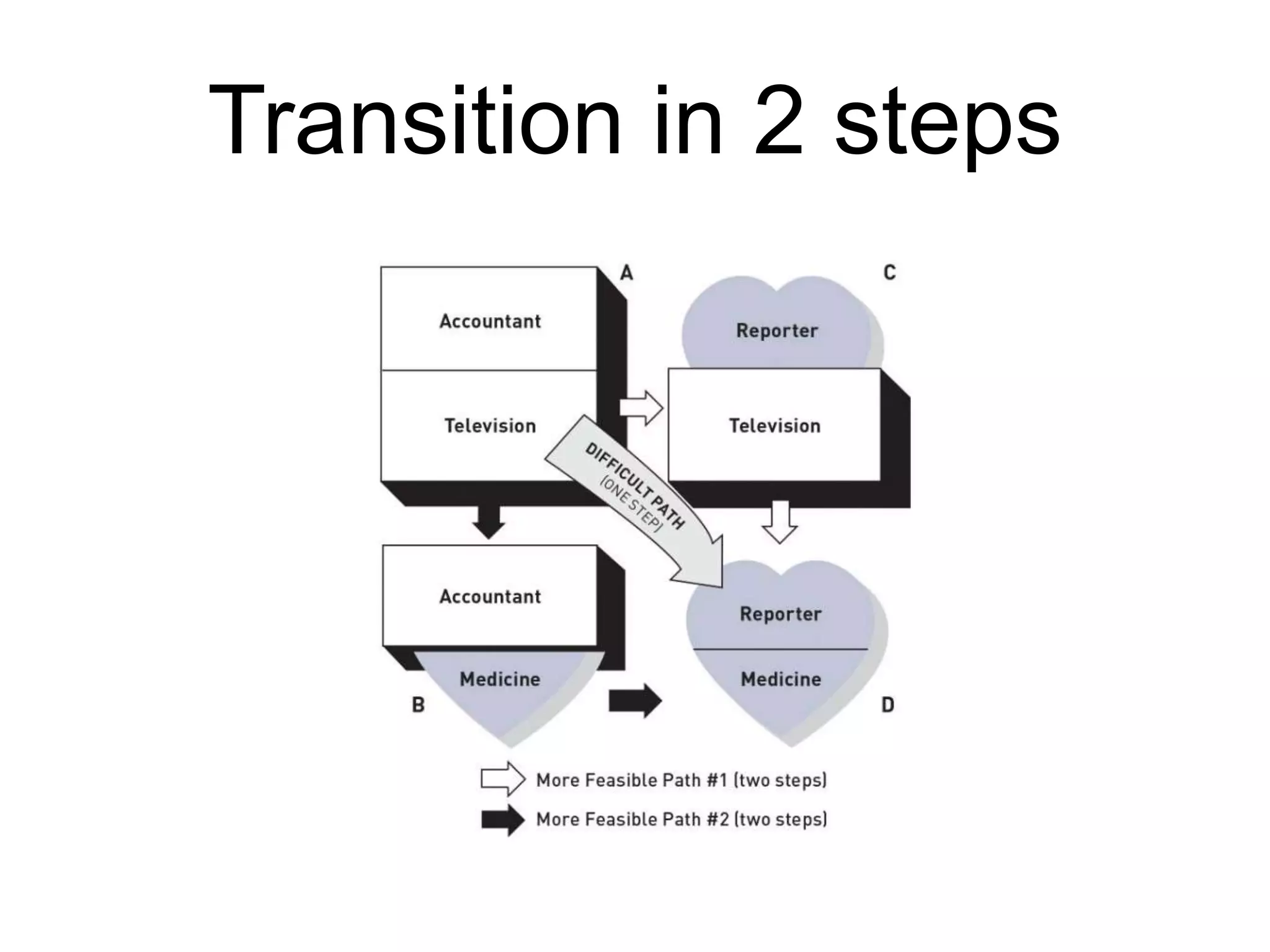
Career Changes
The Hedgehog Principle
Transition in 2 steps
Transitioning Risks
 Grass Greener on Other Side?
 Don't Change Too Much At Once
 What's “Hot” Changes
 Transition needs time
 And money
General
Principles
Optimize for the Long Term
 Your Career is 50 Year
 1 “lost year” doesn’t matter
 Starting salary doesn’t matter
 “You overestimate what you can achieve
in 2 years, and underestimate what you
can achieve in 10 years” -Bill Gates
कर्मण्येवाधिकारस्ते
 Focus on process/systems not
goals
 Success (goals) is luck-based
 Not in your control
 Creating/adjusting
processes/systems/habits
 In your control
 Lead to success in the long term
The Future is Uncertain
 Nobody can predict the future
 People confident of their predications are deluded,
or lairs
 Prepare for an Uncertain Future
 Have broad/transferable skills
 Be good at reacting fast to
changes
 Awareness + learning + smart career transitions
Seek Help / Give Help
 Those who take help from others
and provide help to others always
outperform those who don’t
 Seniors/mentors always willing to
help
 If you show initiative / passion / hard work
Asking for Help
 No Need to Feel Ashamed
 Have Mentors
 Law of Weak Links
Help Others
 Teaching others is the best way to
learn
 Even those you don't know very
well
 Remember Law of Weak Links
Networking
 Law of Weak Links
 Informational Interviews
 “Help Others”
Keep Learning
 World Keeps Changing
 Learning is Easier Than Ever
 The More you Learn, The Easier it
Becomes
 What to Learn:
 What's Hot or What you Enjoy?
Social-Media
 Friend not Enemy
 Use for Business/Career/Contacts
 Follow the Right People
 Unfollow the Wrong People
Software Is Eating The World
 Your job could go
 Your business could go
 Must understand software
 Apps / Websites / Packages
Small Steps
 We overestimate what we can
achieve in 2 years and
underestimate what we can
achieve in 10 years
Suggested Reading
 Designing Your Life
 Bill Burnett and Dave Evans
 What Colour Is My Parachute
 Richard Bolles
 Atomic Habits
 James Clear
 How to Fail at Almost Everything
and still Win Big
Contact:
@ngkabra on Twitter
navin@reliscore.com
or
Navin Kabra
on
Twitter
Google
don't send a LinkedIn request (yet)

How to choose the right company - By Navin Kabra

  • 1.
    Dr. Navin Kabra Background: – B.Tech (CS) IIT Bombay – PhD (CS) Univ. of Wisconsin-Madison, USA  12 patents  Currently – Founder & CTO ReliScore.com – Previously: Symantec, Veritas, Teradata  Twitter: @ngkabra  Email: navin@punetech.com  More Info: google “Navin Kabra”
  • 2.
  • 3.
    Real-world Skills  CollegeExams ≠ Learning  Create + Do ≫ Memorize + Copy  Why ≫ How
  • 4.
    Build a Portfolio College Project  Do a Good Job  Pick Something Fun  But Showcases Existing Skill  Learn New Skill  Useful+Unique  Do Other Projects  Make Interview Irrelevant
  • 5.
  • 6.
    Build on yourStrengths  Maximizing Strengths ≫ Fixing Weaknesses
  • 7.
  • 8.
    Who gets hired? The best person for the job?  The one how knows best how to get hired  —Richard Lathrop
  • 9.
    Employers Perspective  Toomany resumes  50 to 150 resumes per job opening  Many Job-seekers are liars  HR don't understand  The Technical Skills  The Business requirements  Everyone short of time
  • 10.
    Busy Executive  TooBusy  100s of work emails every day  Wont Look at Resume  Unless filtered  Will only read Email Subject  Won't open email unless subject interesting  Or sender already known
  • 11.
    What doesn't work Naukri/Monster  Sending email to address on website  Sending email to HR  Sending bad email to Executive
  • 12.
    How are JobsFilled?  Existing Employees  Employee Referral  Recommended by a known person  Recruiting Agency  Via Website  Responses to Job Ads  Monster/Naukri Decreasing Importanc e
  • 13.
    What to do? Apply through contacts  Existing employees (1 st priority)  Common connections  Use Linkedin to find  Customize the resume  Write a good email (“cover letter”)
  • 14.
    Linkedin  Extremely Importantin a Job Hunt  Update your profile  Fully, with details  Not just job titles, describe role/achievements  Put a sensible photograph  This is not Facebook  Connect to everyone you know  Even when not looking for a job
  • 15.
    Writing a GoodEmail: Subject  Bad  No Subject  “Resume”  “Looking for a job”  Good  Looking for a job: Java/SpringMVC Dev. (5 years exp)
  • 16.
    Writing a GoodEmail: Content  Short, and to-the-point  Customized to this job  Contents:  Why You Are Writing (1 sentence)  Your Overall Background (1-2 sentences)  Why You Are Ideal For This Job (1-2 sentences)
  • 17.
    No, No, No,No, No, No, No, No, No, No, No, Yes
  • 18.
    Shy?  Are youbad a Interviews?  The “3-Types Of Interviews” Technique  Practice Interviews  Information Interviews  Real Interviews
  • 19.
    Practice Interviews  NotRelated to Work  About Topic You’re Passionate About  With Friends/Acqaintances  “Conversation”
  • 20.
    Informational Interviews  YouInterview Other People  To Find Out about a Domain/Job  Gives You Knowledge/Confidence  Easy, Because You're Not Asking For a Job
  • 21.
    Job Search++  Resume+Interview= Terrible  Broken process, lots of errors  Make Resume+Interview Irrelevant  Portfolio  Networking
  • 22.
  • 23.
    Choosing An Industry? All are equally good  Every industry has scope  All are equally bad  Any industry might collapse suddenly  Use other principles to guide you  Key skill: making the best of whereever you land up
  • 24.
    Choosing a Company Product vs Services  Large vs Medium vs Small Company  Which City?  How Much Salary?  MNC vs Indian
  • 25.
    Product vs Services Product  Long-term focus  Depth  Better salaries (avg)  More Relaxed  Services  Fast moving  Breadth  More Growth  More Driven
  • 26.
    Company Size  Large Relaxed  Narrower focus  Lots of smart peole  Much larger scale  Some things only possible  Medium  Compromise between large and small  Possibility of starting small, taking on responsibiliti es and growing with  Small  Lots of responsibilit y  But also lots of “other” work  Uncertainty and Risk  Terrible if bad
  • 27.
  • 28.
  • 29.
  • 30.
  • 31.
    Transitioning Risks  GrassGreener on Other Side?  Don't Change Too Much At Once  What's “Hot” Changes  Transition needs time  And money
  • 32.
  • 33.
    Optimize for theLong Term  Your Career is 50 Year  1 “lost year” doesn’t matter  Starting salary doesn’t matter  “You overestimate what you can achieve in 2 years, and underestimate what you can achieve in 10 years” -Bill Gates
  • 34.
    कर्मण्येवाधिकारस्ते  Focus onprocess/systems not goals  Success (goals) is luck-based  Not in your control  Creating/adjusting processes/systems/habits  In your control  Lead to success in the long term
  • 35.
    The Future isUncertain  Nobody can predict the future  People confident of their predications are deluded, or lairs  Prepare for an Uncertain Future  Have broad/transferable skills  Be good at reacting fast to changes  Awareness + learning + smart career transitions
  • 36.
    Seek Help /Give Help  Those who take help from others and provide help to others always outperform those who don’t  Seniors/mentors always willing to help  If you show initiative / passion / hard work
  • 37.
    Asking for Help No Need to Feel Ashamed  Have Mentors  Law of Weak Links
  • 38.
    Help Others  Teachingothers is the best way to learn  Even those you don't know very well  Remember Law of Weak Links
  • 39.
    Networking  Law ofWeak Links  Informational Interviews  “Help Others”
  • 40.
    Keep Learning  WorldKeeps Changing  Learning is Easier Than Ever  The More you Learn, The Easier it Becomes  What to Learn:  What's Hot or What you Enjoy?
  • 41.
    Social-Media  Friend notEnemy  Use for Business/Career/Contacts  Follow the Right People  Unfollow the Wrong People
  • 42.
    Software Is EatingThe World  Your job could go  Your business could go  Must understand software  Apps / Websites / Packages
  • 43.
    Small Steps  Weoverestimate what we can achieve in 2 years and underestimate what we can achieve in 10 years
  • 44.
    Suggested Reading  DesigningYour Life  Bill Burnett and Dave Evans  What Colour Is My Parachute  Richard Bolles  Atomic Habits  James Clear  How to Fail at Almost Everything and still Win Big
  • 45.
    Contact: @ngkabra on Twitter navin@reliscore.com or NavinKabra on Twitter Google don't send a LinkedIn request (yet)