
#learnwithschoology
Welcome to our Webinar
How to Adopt a Standards-
Based Mindset
#learnwithschoology
Kellie Ady, Senior Director of
Instructional Technology, Schoology
Meet the Presenters
2
Joe Vassallo, Product Engagement
Specialist, Schoology
#learnwithschoology
Agenda
● Introductions
● What is a standards-based mindset?
● Where do you start?
● What grading practices need to be explored?
● How can technology support a standards-based mindset?
● What can I try to implement today or tomorrow?
3
#learnwithschoology
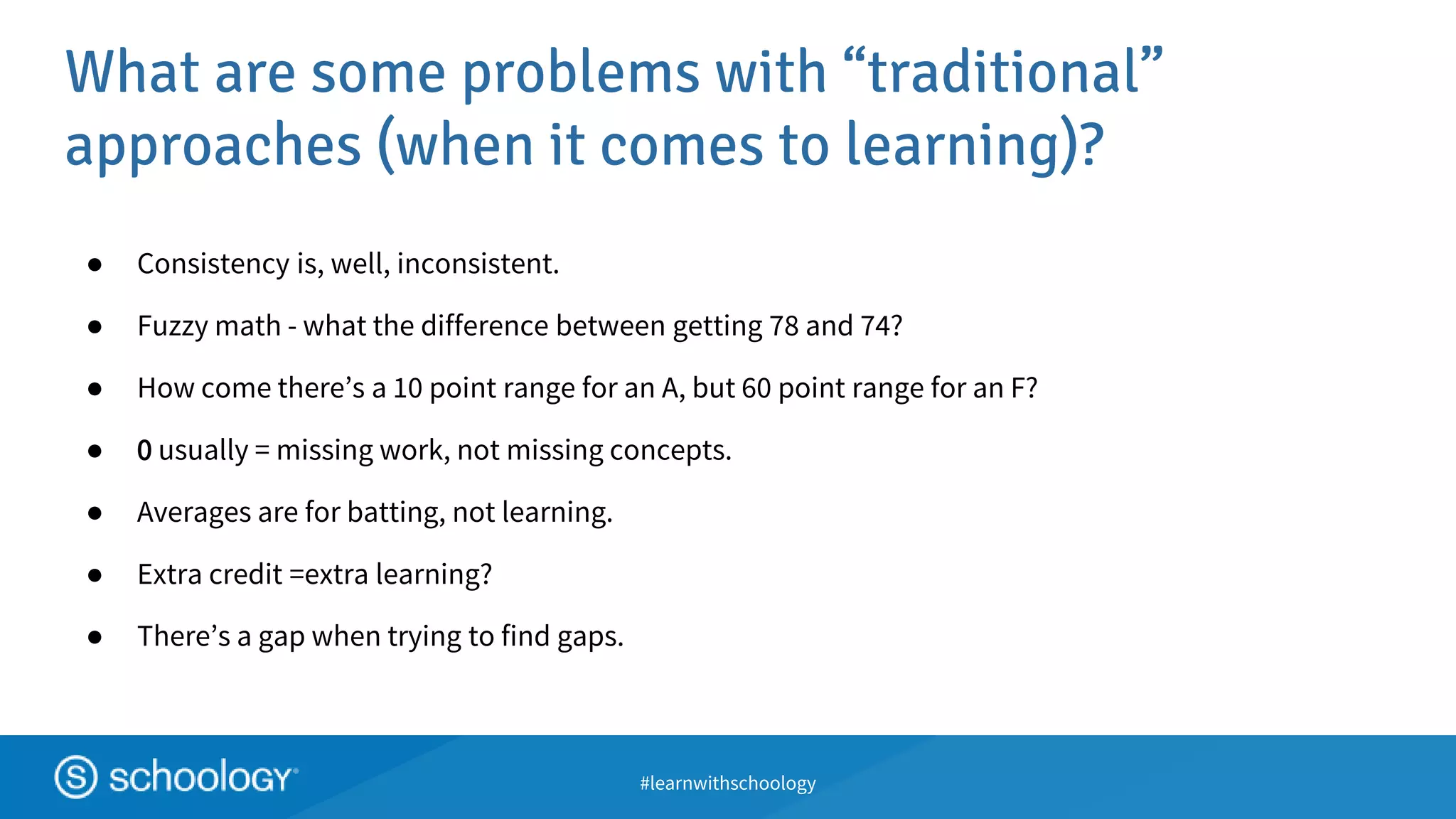
What are some problems with “traditional”
approaches (when it comes to learning)?
● Consistency is, well, inconsistent.
● Fuzzy math - what the difference between getting 78 and 74?
● How come there’s a 10 point range for an A, but 60 point range for an F?
● 0 usually = missing work, not missing concepts.
● Averages are for batting, not learning.
● Extra credit =extra learning?
● There’s a gap when trying to find gaps.
#learnwithschoology
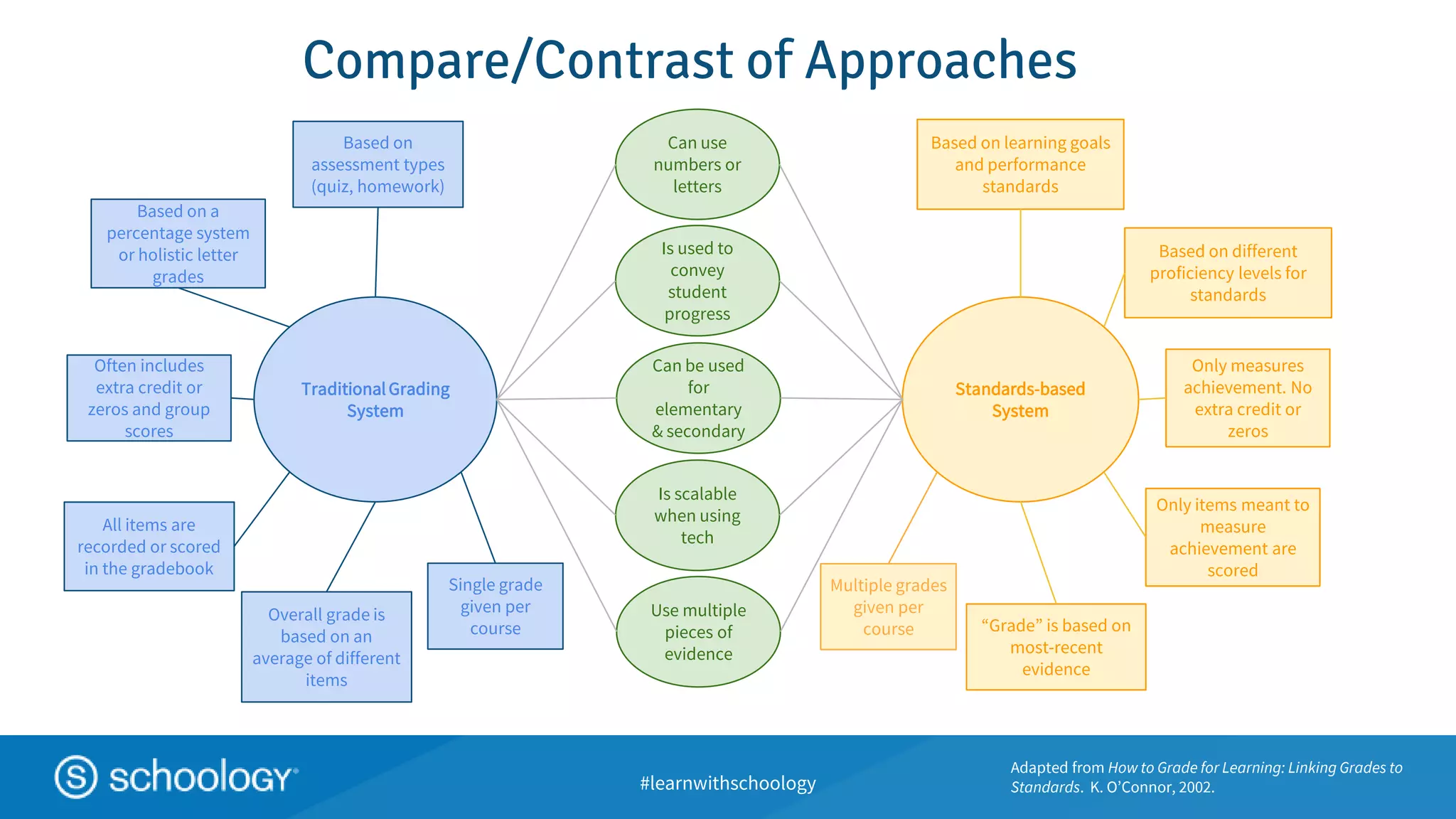
Compare/Contrast of Approaches
Can use
numbers or
letters
Standards-based
System
TraditionalGrading
System
Is used to
convey
student
progress
Is scalable
when using
tech
Use multiple
pieces of
evidence
Based on
assessment types
(quiz, homework)
Often includes
extra credit or
zeros and group
scores
Based on a
percentage system
or holistic letter
grades
Based on learning goals
and performance
standards
Only measures
achievement. No
extra credit or
zeros
Only items meant to
measure
achievement are
scored
Can be used
for
elementary
& secondary
Based on different
proficiency levels for
standards
All items are
recorded or scored
in the gradebook
“Grade” is based on
most-recent
evidence
Overall grade is
based on an
average of different
items
Single grade
given per
course
Multiple grades
given per
course
Adapted from How to Grade for Learning: Linking Grades to
Standards. K. O’Connor, 2002.
#learnwithschoology
Poll Question:
Are you currently using a standards-based approach?
#learnwithschoology
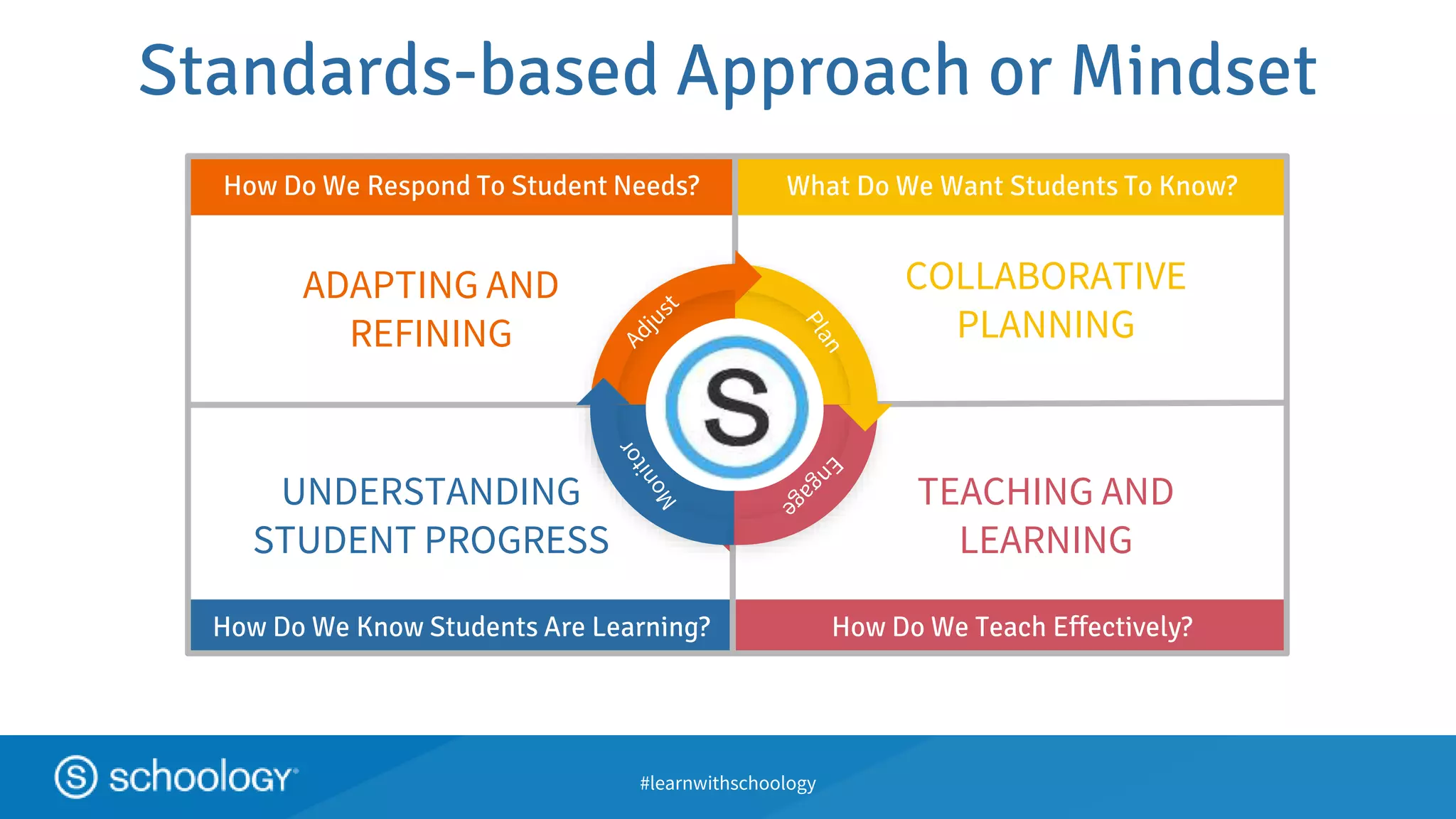
Standards-based Approach or Mindset
What Do We Want Students To Know?
How Do We Know Students Are Learning?
COLLABORATIVE
PLANNING
ADAPTING AND
REFINING
TEACHING AND
LEARNING
UNDERSTANDING
STUDENT PROGRESS
How Do We Teach Effectively?
How Do We Respond To Student Needs?
#learnwithschoology
What do we want students to know,
understand, & do?
#learnwithschoology
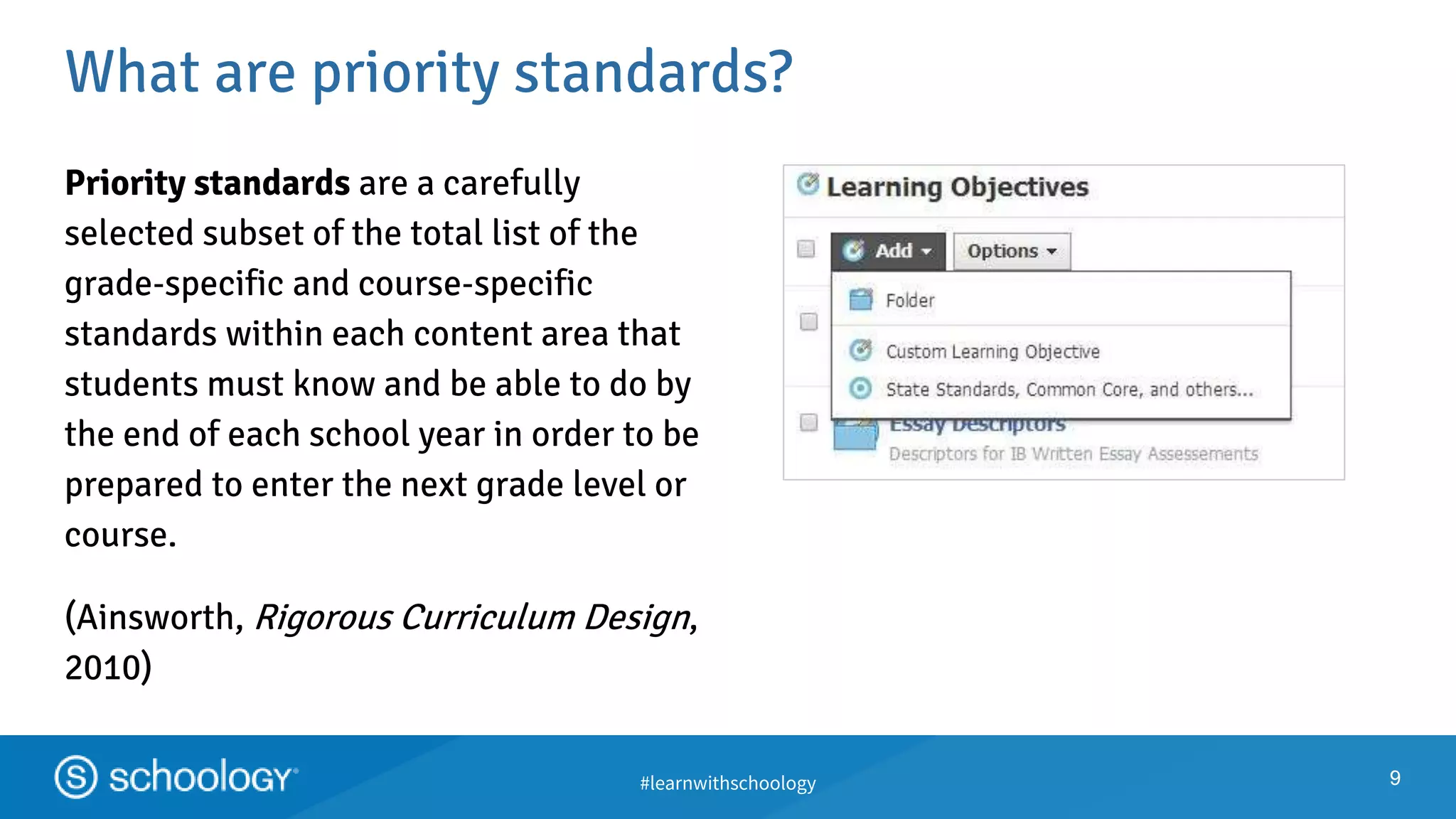
What are priority standards?
9
Priority standards are a carefully
selected subset of the total list of the
grade‐specific and course‐specific
standards within each content area that
students must know and be able to do by
the end of each school year in order to be
prepared to enter the next grade level or
course.
(Ainsworth, Rigorous Curriculum Design,
2010)
9
#learnwithschoology
What are proficiency scales?
10
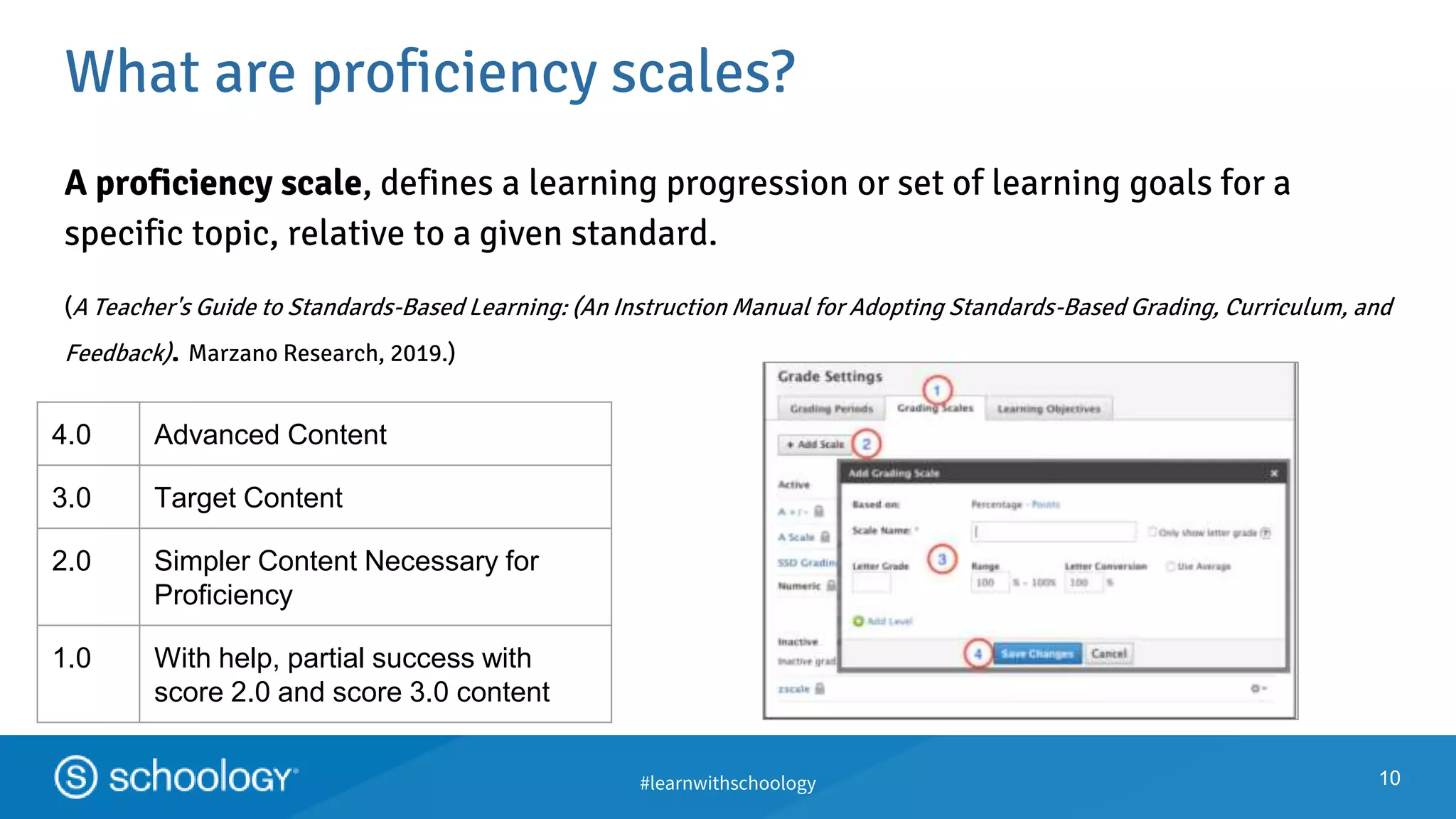
A proficiency scale, defines a learning progression or set of learning goals for a
specific topic, relative to a given standard.
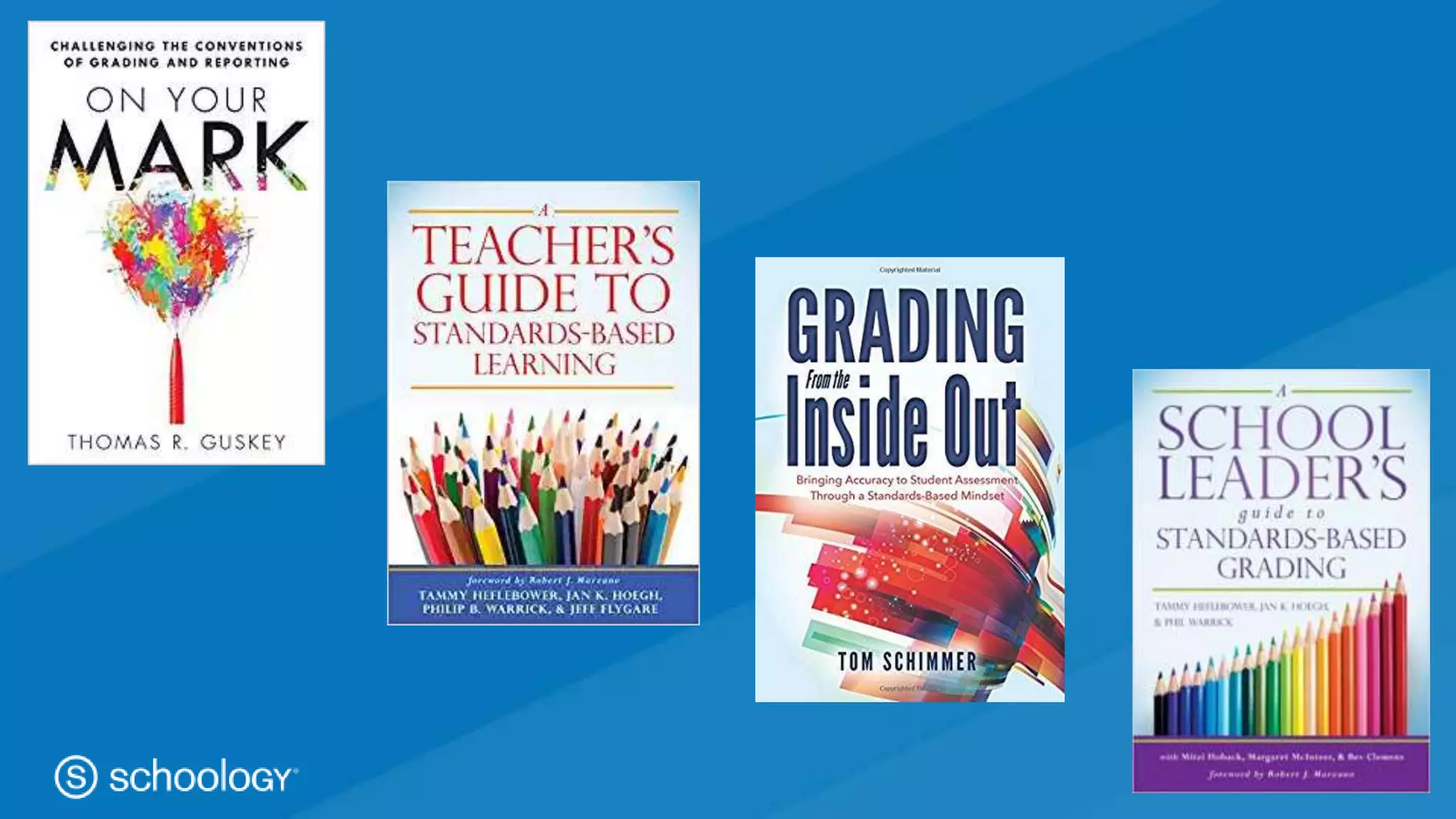
(A Teacher's Guide to Standards-Based Learning: (An Instruction Manual for Adopting Standards-Based Grading, Curriculum, and
Feedback). Marzano Research, 2019.)
10
4.0 Advanced Content
3.0 Target Content
2.0 Simpler Content Necessary for
Proficiency
1.0 With help, partial success with
score 2.0 and score 3.0 content
#learnwithschoology
How do we teach effectively?
#learnwithschoology
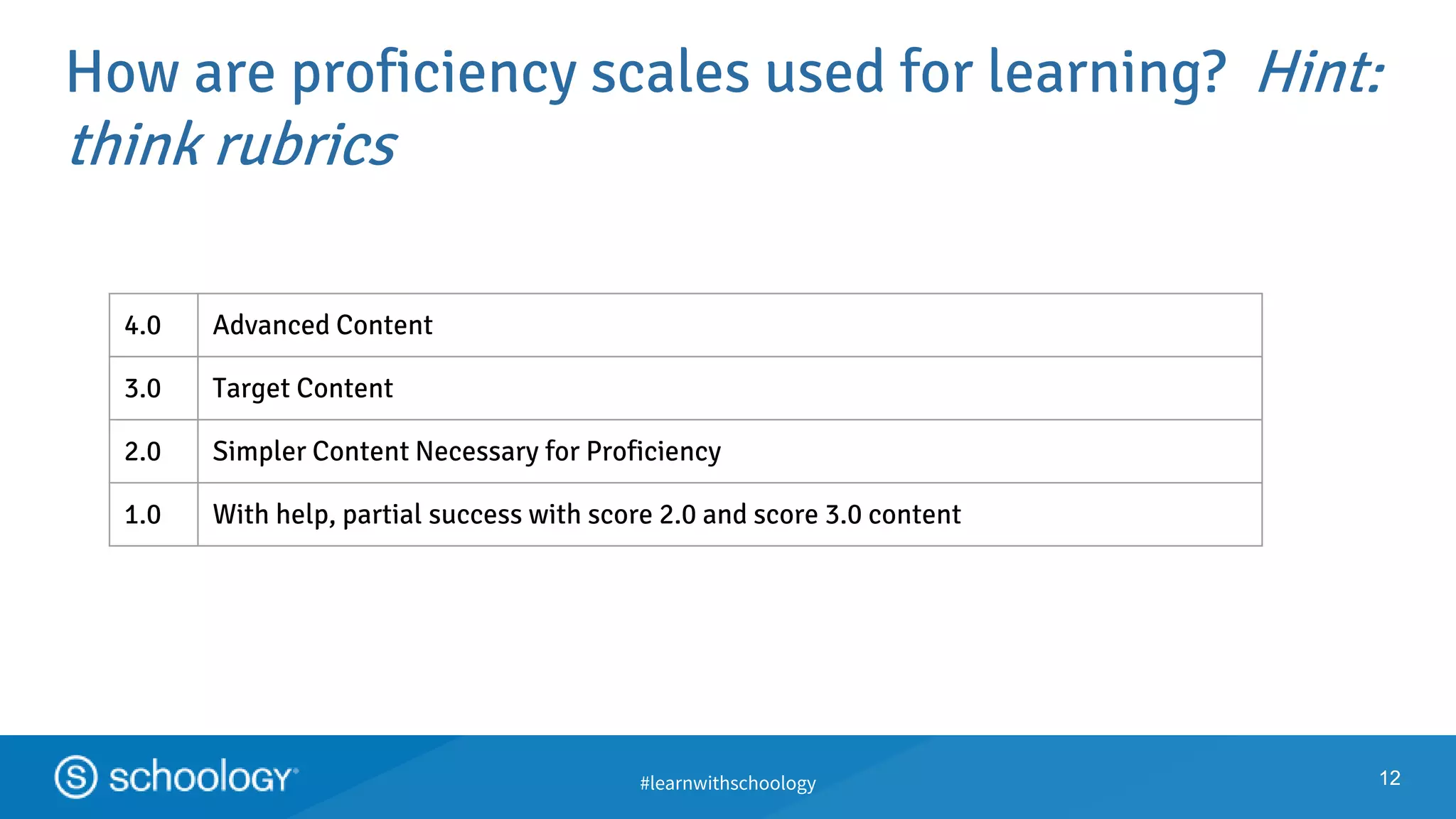
How are proficiency scales used for learning? Hint:
think rubrics
1212
4.0 Advanced Content
3.0 Target Content
2.0 Simpler Content Necessary for Proficiency
1.0 With help, partial success with score 2.0 and score 3.0 content
#learnwithschoology
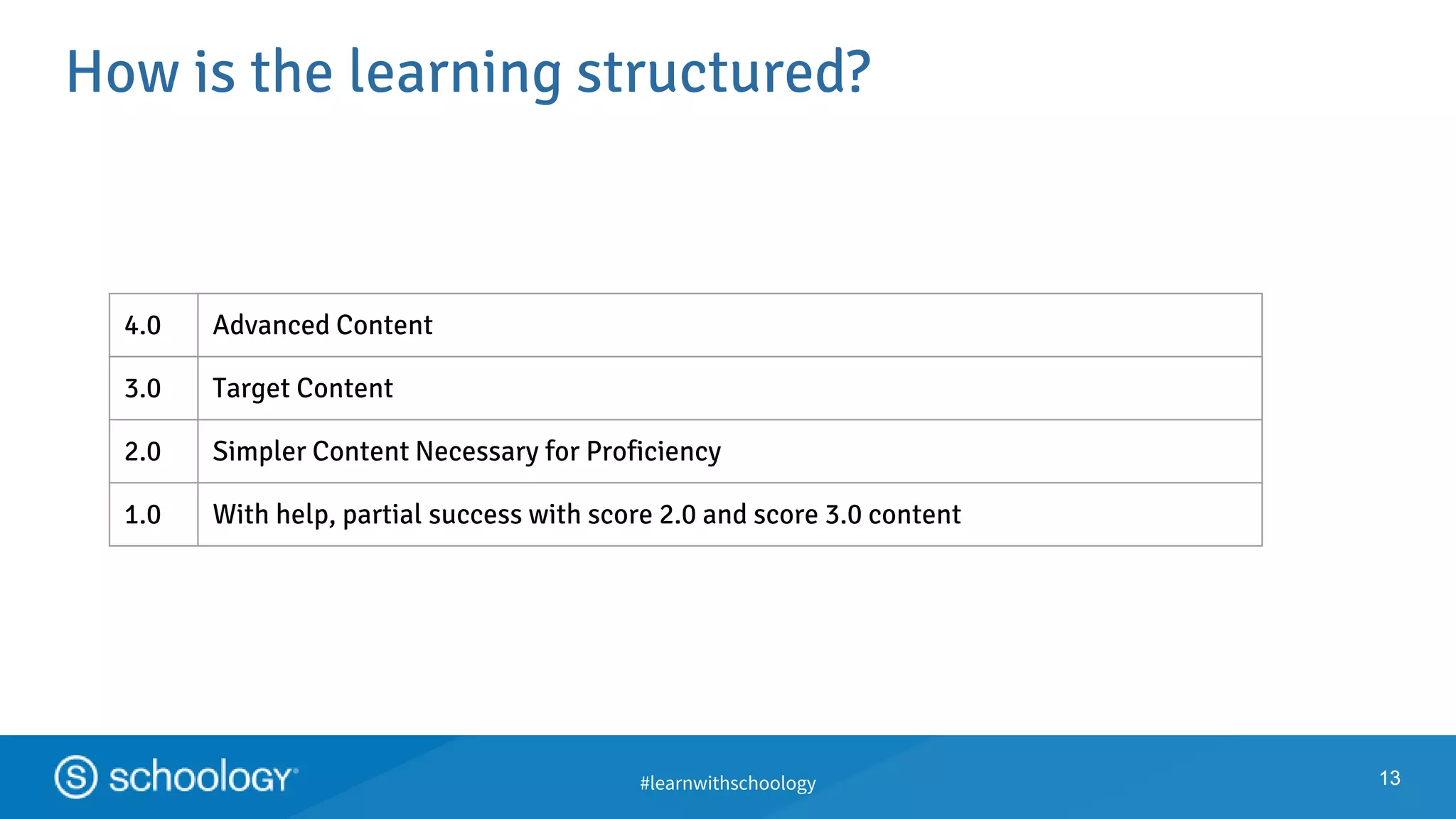
How is the learning structured?
1313
4.0 Advanced Content
3.0 Target Content
2.0 Simpler Content Necessary for Proficiency
1.0 With help, partial success with score 2.0 and score 3.0 content
#learnwithschoology
Poll Question:
Are you using rubrics currently to assess student work?
#learnwithschoology
How do we know students are learning?
#learnwithschoology
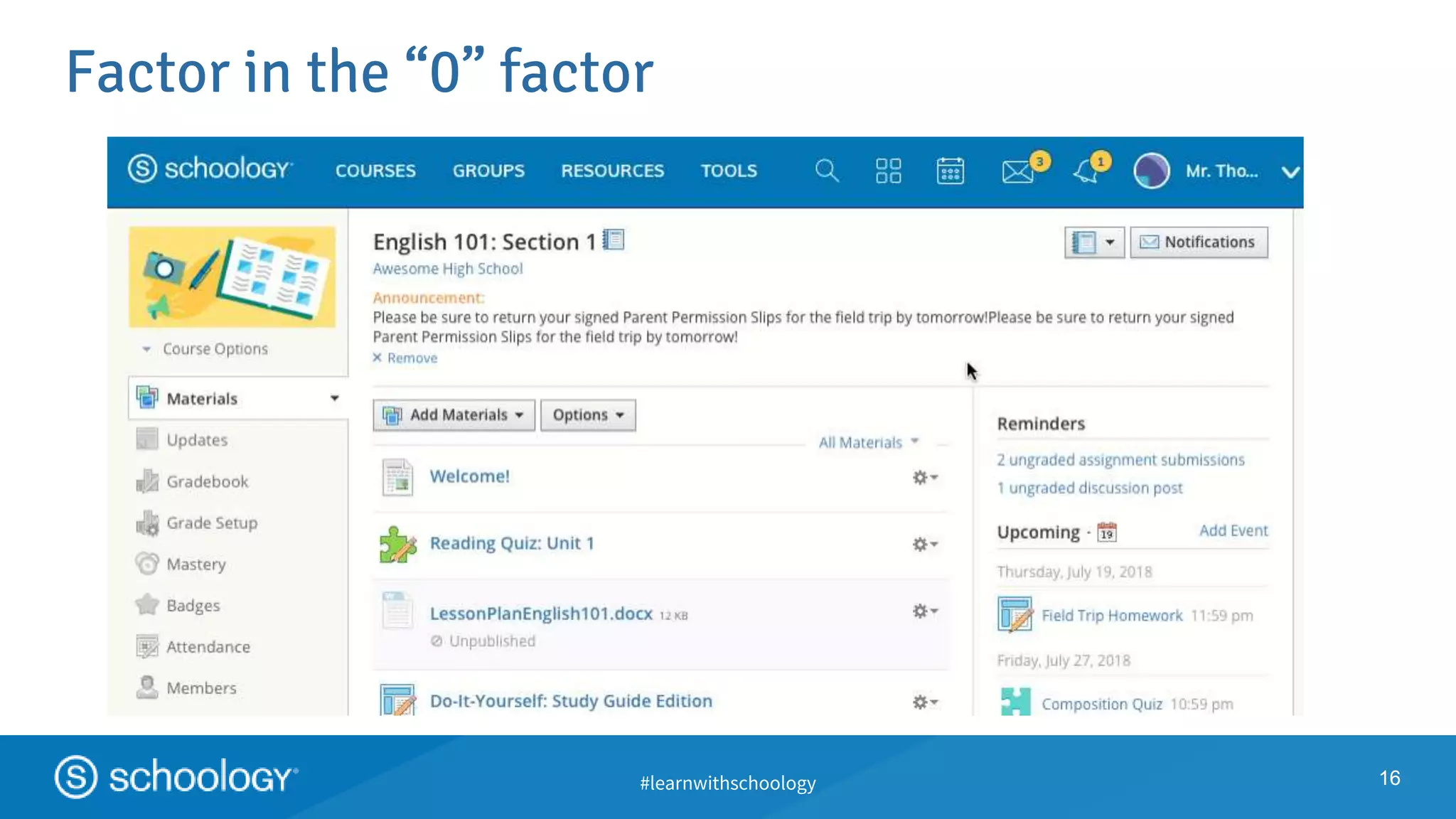
Factor in the “0” factor
1616
#learnwithschoology
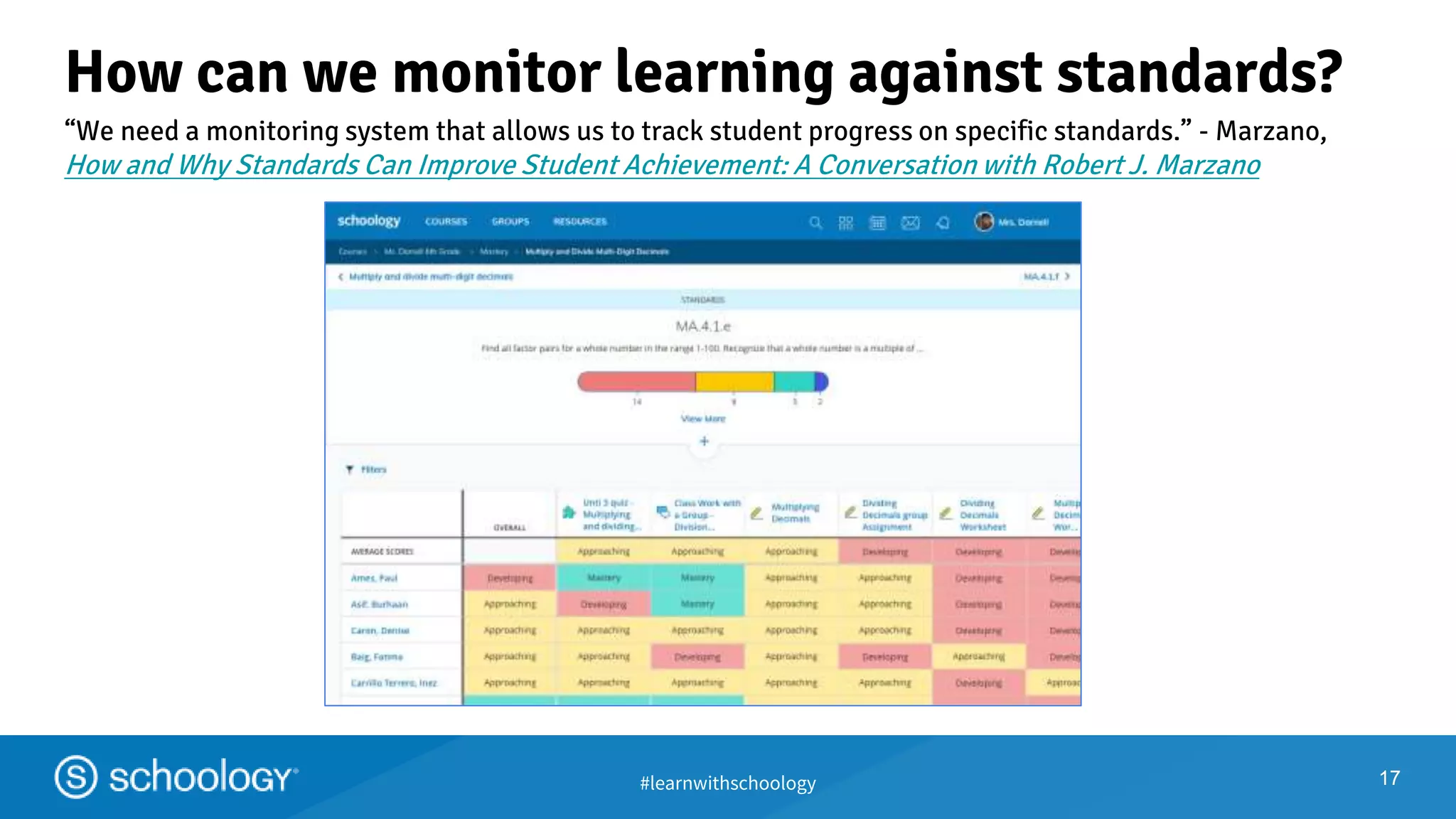
How can we monitor learning against standards?
1717
“We need a monitoring system that allows us to track student progress on specific standards.” - Marzano,
How and Why Standards Can Improve Student Achievement: A Conversation with Robert J. Marzano
#learnwithschoology
How do we meet student needs?
#learnwithschoology
Poll Question:
Are you currently using something to track student
mastery against standards?
#learnwithschoology
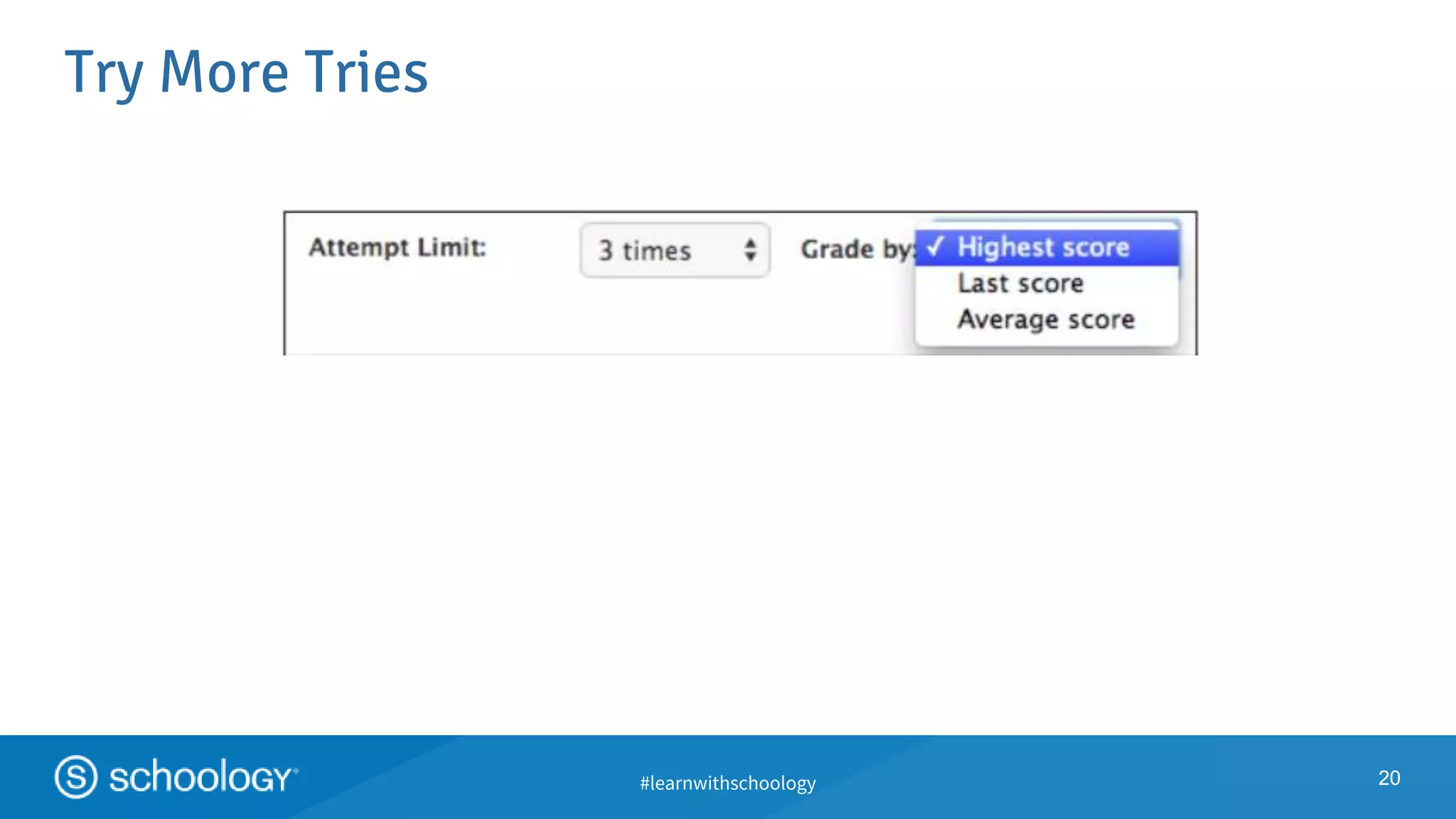
Try More Tries
2020
#learnwithschoology
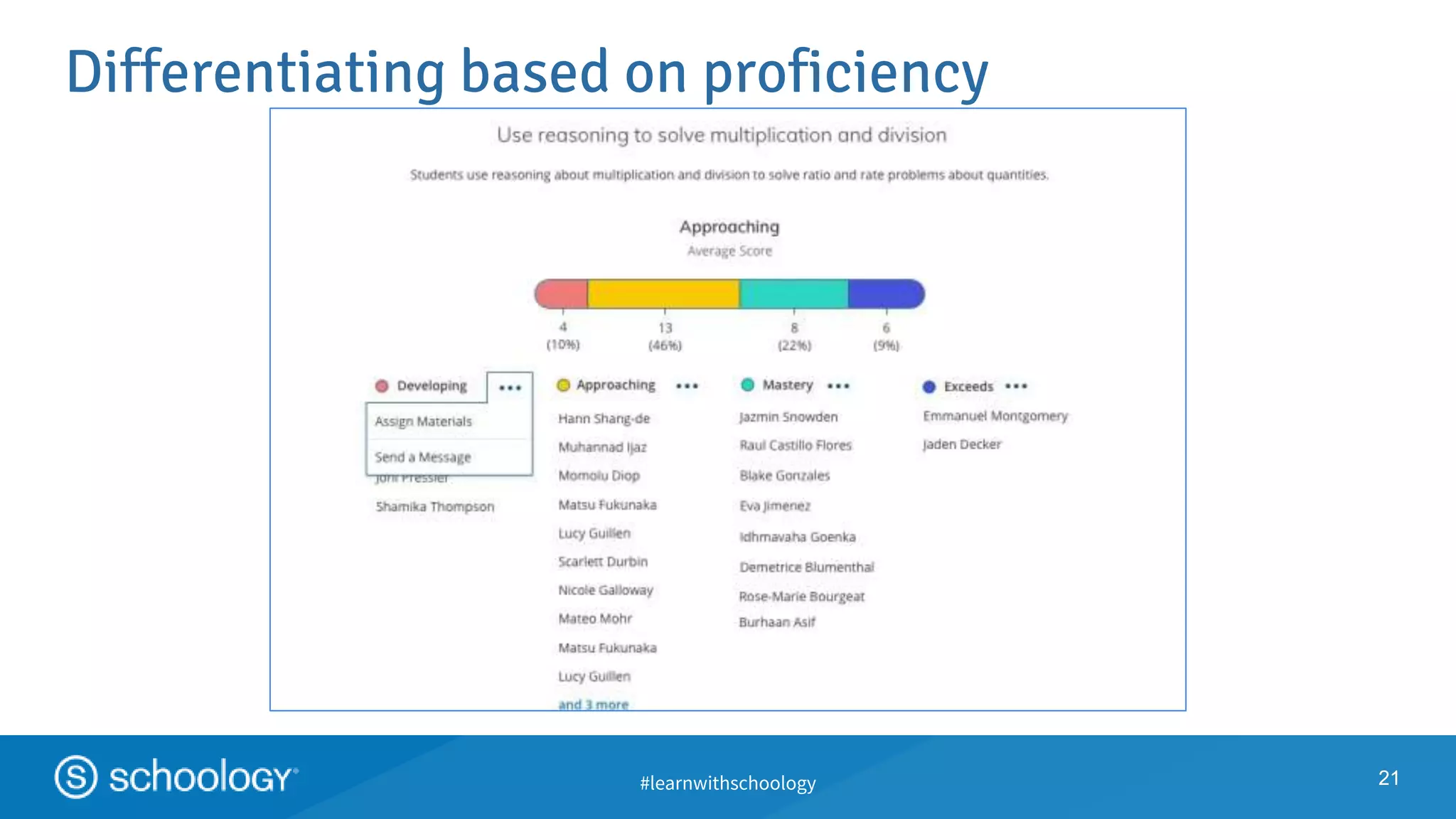
Differentiating based on proficiency
2121
CONFIDENTIAL
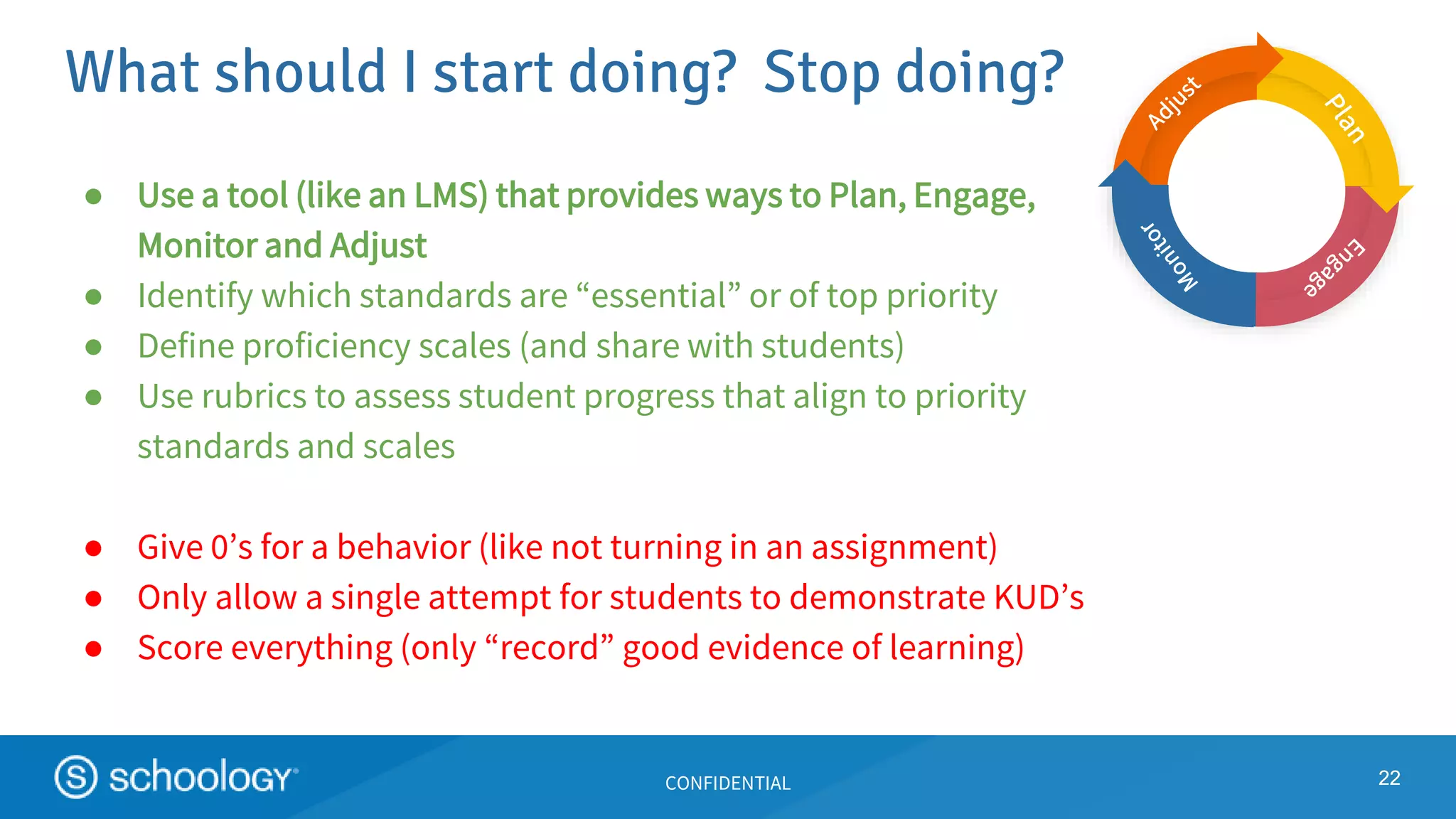
What should I start doing? Stop doing?
2222
● Use a tool (like an LMS) that provides ways to Plan, Engage,
Monitor and Adjust
● Identify which standards are “essential” or of top priority
● Define proficiency scales (and share with students)
● Use rubrics to assess student progress that align to priority
standards and scales
● Give 0’s for a behavior (like not turning in an assignment)
● Only allow a single attempt for students to demonstrate KUD’s
● Score everything (only “record” good evidence of learning)
CONFIDENTIAL

How to Adopt a Standards-based Gradebook

  • 1.
    #learnwithschoology Welcome to ourWebinar How to Adopt a Standards- Based Mindset
  • 2.
    #learnwithschoology Kellie Ady, SeniorDirector of Instructional Technology, Schoology Meet the Presenters 2 Joe Vassallo, Product Engagement Specialist, Schoology
  • 3.
    #learnwithschoology Agenda ● Introductions ● Whatis a standards-based mindset? ● Where do you start? ● What grading practices need to be explored? ● How can technology support a standards-based mindset? ● What can I try to implement today or tomorrow? 3
  • 4.
    #learnwithschoology What are someproblems with “traditional” approaches (when it comes to learning)? ● Consistency is, well, inconsistent. ● Fuzzy math - what the difference between getting 78 and 74? ● How come there’s a 10 point range for an A, but 60 point range for an F? ● 0 usually = missing work, not missing concepts. ● Averages are for batting, not learning. ● Extra credit =extra learning? ● There’s a gap when trying to find gaps.
  • 5.
    #learnwithschoology Compare/Contrast of Approaches Canuse numbers or letters Standards-based System TraditionalGrading System Is used to convey student progress Is scalable when using tech Use multiple pieces of evidence Based on assessment types (quiz, homework) Often includes extra credit or zeros and group scores Based on a percentage system or holistic letter grades Based on learning goals and performance standards Only measures achievement. No extra credit or zeros Only items meant to measure achievement are scored Can be used for elementary & secondary Based on different proficiency levels for standards All items are recorded or scored in the gradebook “Grade” is based on most-recent evidence Overall grade is based on an average of different items Single grade given per course Multiple grades given per course Adapted from How to Grade for Learning: Linking Grades to Standards. K. O’Connor, 2002.
  • 6.
    #learnwithschoology Poll Question: Are youcurrently using a standards-based approach?
  • 7.
    #learnwithschoology Standards-based Approach orMindset What Do We Want Students To Know? How Do We Know Students Are Learning? COLLABORATIVE PLANNING ADAPTING AND REFINING TEACHING AND LEARNING UNDERSTANDING STUDENT PROGRESS How Do We Teach Effectively? How Do We Respond To Student Needs?
  • 8.
    #learnwithschoology What do wewant students to know, understand, & do?
  • 9.
    #learnwithschoology What are prioritystandards? 9 Priority standards are a carefully selected subset of the total list of the grade‐specific and course‐specific standards within each content area that students must know and be able to do by the end of each school year in order to be prepared to enter the next grade level or course. (Ainsworth, Rigorous Curriculum Design, 2010) 9
  • 10.
    #learnwithschoology What are proficiencyscales? 10 A proficiency scale, defines a learning progression or set of learning goals for a specific topic, relative to a given standard. (A Teacher's Guide to Standards-Based Learning: (An Instruction Manual for Adopting Standards-Based Grading, Curriculum, and Feedback). Marzano Research, 2019.) 10 4.0 Advanced Content 3.0 Target Content 2.0 Simpler Content Necessary for Proficiency 1.0 With help, partial success with score 2.0 and score 3.0 content
  • 11.
  • 12.
    #learnwithschoology How are proficiencyscales used for learning? Hint: think rubrics 1212 4.0 Advanced Content 3.0 Target Content 2.0 Simpler Content Necessary for Proficiency 1.0 With help, partial success with score 2.0 and score 3.0 content
  • 13.
    #learnwithschoology How is thelearning structured? 1313 4.0 Advanced Content 3.0 Target Content 2.0 Simpler Content Necessary for Proficiency 1.0 With help, partial success with score 2.0 and score 3.0 content
  • 14.
    #learnwithschoology Poll Question: Are youusing rubrics currently to assess student work?
  • 15.
    #learnwithschoology How do weknow students are learning?
  • 16.
  • 17.
    #learnwithschoology How can wemonitor learning against standards? 1717 “We need a monitoring system that allows us to track student progress on specific standards.” - Marzano, How and Why Standards Can Improve Student Achievement: A Conversation with Robert J. Marzano
  • 18.
    #learnwithschoology How do wemeet student needs?
  • 19.
    #learnwithschoology Poll Question: Are youcurrently using something to track student mastery against standards?
  • 20.
  • 21.
  • 22.
    CONFIDENTIAL What should Istart doing? Stop doing? 2222 ● Use a tool (like an LMS) that provides ways to Plan, Engage, Monitor and Adjust ● Identify which standards are “essential” or of top priority ● Define proficiency scales (and share with students) ● Use rubrics to assess student progress that align to priority standards and scales ● Give 0’s for a behavior (like not turning in an assignment) ● Only allow a single attempt for students to demonstrate KUD’s ● Score everything (only “record” good evidence of learning)
  • 23.

Editor's Notes

  • #2 3 Things to Implement Today: Identify Priority Standards Identify Learning Progressions for those Priority Standards Align Stop Doing This: Giving Zeros Stop giving work that aren’t evidence of priority standards
  • #8 What is a standards-based approach? Standards-based is a way of teaching, assessing and reporting that describes student progress in relation to standards.
  • #10 priority standards are the ones on which teachers focus instruction, assessment, and feedback in standards-based learning.
  • #11 Link for the chat area: http://www.ascd.org/publications/educational-leadership/sept01/vol59/num01/How-and-Why-Standards-Can-Improve-Student-Achievement@-A-Conversation-with-Robert-J.-Marzano.aspx
  • #13 Link for the chat area: http://www.ascd.org/publications/educational-leadership/sept01/vol59/num01/How-and-Why-Standards-Can-Improve-Student-Achievement@-A-Conversation-with-Robert-J.-Marzano.aspx
  • #14 Link for the chat area: http://www.ascd.org/publications/educational-leadership/sept01/vol59/num01/How-and-Why-Standards-Can-Improve-Student-Achievement@-A-Conversation-with-Robert-J.-Marzano.aspx
  • #17 Link for the chat area: http://www.ascd.org/publications/educational-leadership/sept01/vol59/num01/How-and-Why-Standards-Can-Improve-Student-Achievement@-A-Conversation-with-Robert-J.-Marzano.aspx
  • #18 Link for the chat area: http://www.ascd.org/publications/educational-leadership/sept01/vol59/num01/How-and-Why-Standards-Can-Improve-Student-Achievement@-A-Conversation-with-Robert-J.-Marzano.aspx