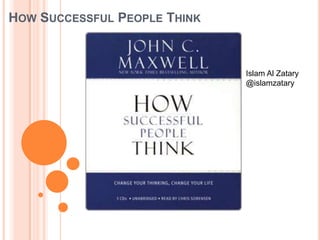
HOW SUCCESSFUL PEOPLE THINK


                              Islam Al Zatary
                              @islamzatary
WHAT‟S A SUCCESSFUL PERSON‟S GREATEST
RESOURCE IN DIFFICULT TIMES? GOOD THINKING!
 Good thinkers solve problems, they never lack
  ideas for building an organization, and they
  always have hope for a better future. Good
  thinkers rarely find themselves at the mercy of
  ruthless people who would take advantage of
  them or try to deceive them, people like Nazi
  dictator Adolf Hitler, who once boasted, “What
  luck for rulers that men do not think.”
 Those who develop the process of good thinking
  can rule themselves – even while under an
  oppressive ruler or in other difficult
  circumstances. In short, good thinkers are
  successful.
HOW TO BECOME A BETTER THINKER
1. EXPOSE YOURSELF TO GOOD INPUT
 Good thinkers always prime the pump of ideas.
  They always look for things to get the thinking
  process started, because what you put in always
  impacts what comes out.
 Read books, review trade magazines, listen to
  CDs, and spend time with good thinkers. And
  when something intrigues you-whether it‟s
  someone else‟s idea or the seed of an idea that
  you‟ve come up with yourself-keep it in front of
  you. Put it in writing and keep it somewhere in a
  favorite place to stimulate your thinking.
2. EXPOSE YOURSELF TO GOOD THINKERS
 All of the people in my life whom I consider to be
  close friends or colleagues are good thinkers.
  Now, I love all people. I try to be kind to everyone
  I meet, and I desire to add value to as many
  people as I can through
  conferences, books, audio lessons, etc. But the
  people I seek out and choose to spend time with
  all challenge me with their thinking and their
  actions. They are constantly trying to grow and
  learn.
 The writer of Proverbs observed that sharp
  people sharpen one another, just as iron
  sharpens iron. If you want to be a sharp
  thinker, be around sharp people.
3. CHOOSE TO THINK GOOD THOUGHTS
   To become a good thinker, you must become intentional about
    the thinking process. Regularly put yourself in the right place
    to think, shape, stretch, and land your thoughts. Make it a
    priority. Thinking is a discipline.
   Recently I had breakfast with Dan Cathy, the president of
    Chick-fil-A, a fast food restaurant chain headquartered in the
    Atlanta area. I told him that I was working on this book and I
    asked him if he made thinking time a high priority. Not only did
    he say yes, but he told me about what he calls his “thinking
    schedule.” It helps him to fight the hectic pace of life that
    discourages intentional thinking. Dan says he sets aside time
    just to think for half a day every two weeks, for one whole day
    every month, and for two or three full days every year. Dan
    explains, “This helps me „keep the main thing, the main thing,‟
    since I am so easily distracted.”
4. ACT ON YOUR GOOD THOUGHTS
   Ideas have a short shelf life. You must act on them
    before the expiration date. World War I flying ace
    Eddie Rickenbacker said it all when he remarked, “I
    can give you a six-word formula for success: Think
    things through-then follow through.”
5. ALLOW YOUR EMOTIONS TO CREATE
ANOTHER GOOD THOUGHT
   To start the thinking process, you cannot rely on your
    feelings. In Failing Forward, I wrote that you can act
    your way into feeling long before you can feel your way
    into action. If you wait until you feel like doing
    something, you will likely never accomplish it. The same
    is true for thinking. You cannot wait until you feel like
    thinking to do it. However, I‟ve found that once you
    engage in the process of good thinking, you can use
    your emotions to feed the process and create mental
    momentum.
   Try it for yourself. After you go through the disciplined
    process of thinking and enjoy some success, allow
    yourself to savor the moment and try riding the mental
    energy of that success. If you‟re like me, it‟s likely to
    spur additional thoughts and productive ideas.
6. REPEAT THE PROCESS
   One good thought does not make a good life. The
    people who have one good thought and try to ride it
    for an entire career often end up unhappy or
    destitute. They are the one-hit wonders, the one-
    book authors, the one-message speakers, the one-
    time inventors who spend their life struggling to
    protect or promote their single idea. Success
    comes to those who have an entire mountain of
    gold that they continually mine, not those who find
    one nugget and try to live on it for fifty years. To
    become someone who can mine a lot of gold, you
    need to keep repeating the process of good
    thinking.
11 KEYS TO SUCCESSFUL THINKING:
   1.    Cultivate Big-Picture Thinking
    2.    Engage in Focused Thinking
    3.    Harness Creative Thinking
    4.    Employ Realistic Thinking
    5.    Utilize Strategic Thinking
    6.    Explore Possibility Thinking
    7.    Learn from Reflective Thinking
    8.    Question Popular Thinking
    9.    Benefit from Shared Thinking
    10.   Practice Unselfish Thinking
    11.   Rely on Bottom-Line Thinking

How successful people think

  • 1.
    HOW SUCCESSFUL PEOPLETHINK Islam Al Zatary @islamzatary
  • 2.
    WHAT‟S A SUCCESSFULPERSON‟S GREATEST RESOURCE IN DIFFICULT TIMES? GOOD THINKING!  Good thinkers solve problems, they never lack ideas for building an organization, and they always have hope for a better future. Good thinkers rarely find themselves at the mercy of ruthless people who would take advantage of them or try to deceive them, people like Nazi dictator Adolf Hitler, who once boasted, “What luck for rulers that men do not think.”  Those who develop the process of good thinking can rule themselves – even while under an oppressive ruler or in other difficult circumstances. In short, good thinkers are successful.
  • 3.
    HOW TO BECOMEA BETTER THINKER
  • 4.
    1. EXPOSE YOURSELFTO GOOD INPUT  Good thinkers always prime the pump of ideas. They always look for things to get the thinking process started, because what you put in always impacts what comes out.  Read books, review trade magazines, listen to CDs, and spend time with good thinkers. And when something intrigues you-whether it‟s someone else‟s idea or the seed of an idea that you‟ve come up with yourself-keep it in front of you. Put it in writing and keep it somewhere in a favorite place to stimulate your thinking.
  • 5.
    2. EXPOSE YOURSELFTO GOOD THINKERS  All of the people in my life whom I consider to be close friends or colleagues are good thinkers. Now, I love all people. I try to be kind to everyone I meet, and I desire to add value to as many people as I can through conferences, books, audio lessons, etc. But the people I seek out and choose to spend time with all challenge me with their thinking and their actions. They are constantly trying to grow and learn.  The writer of Proverbs observed that sharp people sharpen one another, just as iron sharpens iron. If you want to be a sharp thinker, be around sharp people.
  • 6.
    3. CHOOSE TOTHINK GOOD THOUGHTS  To become a good thinker, you must become intentional about the thinking process. Regularly put yourself in the right place to think, shape, stretch, and land your thoughts. Make it a priority. Thinking is a discipline.  Recently I had breakfast with Dan Cathy, the president of Chick-fil-A, a fast food restaurant chain headquartered in the Atlanta area. I told him that I was working on this book and I asked him if he made thinking time a high priority. Not only did he say yes, but he told me about what he calls his “thinking schedule.” It helps him to fight the hectic pace of life that discourages intentional thinking. Dan says he sets aside time just to think for half a day every two weeks, for one whole day every month, and for two or three full days every year. Dan explains, “This helps me „keep the main thing, the main thing,‟ since I am so easily distracted.”
  • 7.
    4. ACT ONYOUR GOOD THOUGHTS  Ideas have a short shelf life. You must act on them before the expiration date. World War I flying ace Eddie Rickenbacker said it all when he remarked, “I can give you a six-word formula for success: Think things through-then follow through.”
  • 8.
    5. ALLOW YOUREMOTIONS TO CREATE ANOTHER GOOD THOUGHT  To start the thinking process, you cannot rely on your feelings. In Failing Forward, I wrote that you can act your way into feeling long before you can feel your way into action. If you wait until you feel like doing something, you will likely never accomplish it. The same is true for thinking. You cannot wait until you feel like thinking to do it. However, I‟ve found that once you engage in the process of good thinking, you can use your emotions to feed the process and create mental momentum.  Try it for yourself. After you go through the disciplined process of thinking and enjoy some success, allow yourself to savor the moment and try riding the mental energy of that success. If you‟re like me, it‟s likely to spur additional thoughts and productive ideas.
  • 9.
    6. REPEAT THEPROCESS  One good thought does not make a good life. The people who have one good thought and try to ride it for an entire career often end up unhappy or destitute. They are the one-hit wonders, the one- book authors, the one-message speakers, the one- time inventors who spend their life struggling to protect or promote their single idea. Success comes to those who have an entire mountain of gold that they continually mine, not those who find one nugget and try to live on it for fifty years. To become someone who can mine a lot of gold, you need to keep repeating the process of good thinking.
  • 10.
    11 KEYS TOSUCCESSFUL THINKING:  1. Cultivate Big-Picture Thinking 2. Engage in Focused Thinking 3. Harness Creative Thinking 4. Employ Realistic Thinking 5. Utilize Strategic Thinking 6. Explore Possibility Thinking 7. Learn from Reflective Thinking 8. Question Popular Thinking 9. Benefit from Shared Thinking 10. Practice Unselfish Thinking 11. Rely on Bottom-Line Thinking