How Purposive Are Purposives?
1
Mitsuya Sasaki
Yale Nahuatl Conference
at Yale University, May 13
Outline
1. Introduction
2. “Purposive” in Ixquihuacan Nahuatl
3. What do purposives mean?
4. Discussion: A unified account of purposives
5. Implications
2
1. Introduction:
Typical and non-typical purposives
3
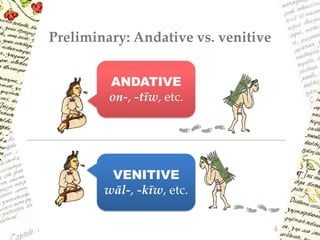
Preliminary: Andative vs. venitive
4
ANDATIVE
on-, -tīw, etc.
VENITIVE
wāl-, -kīw, etc.
Purposive forms
Traditionally described/translated as
“go/come in order to …”
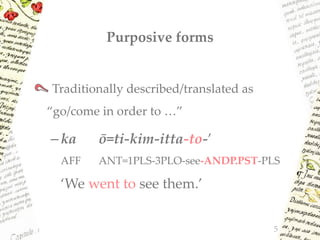
–ka ō=ti-kim-itta-to-’
AFF ANT=1PLS-3PLO-see-ANDP.PST-PLS
‘We went to see them.’
5
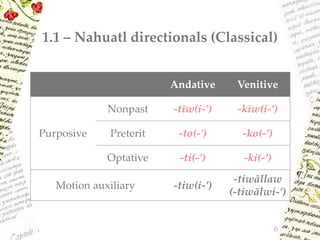
1.1 – Nahuatl directionals (Classical)
Andative Venitive
Purposive
Nonpast -tīw(i-’) -kīw(i-’)
Preterit -to(-') -ko(-’)
Optative -ti(-’) -ki(-’)
Motion auxiliary -tiw(i-’)
-tiwāllaw
(-tiwālwi-’)
6
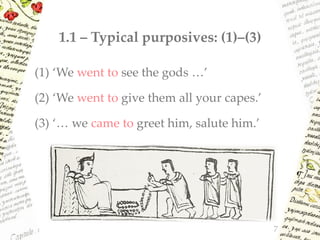
1.1 – Typical purposives: (1)–(3)
(1) ‘We went to see the gods …’
(2) ‘We went to give them all your capes.’
(3) ‘… we came to greet him, salute him.’
7
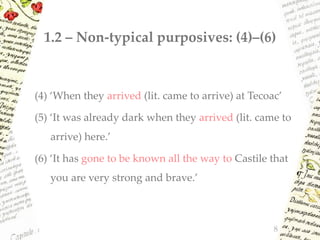
1.2 – Non-typical purposives: (4)–(6)
(4) ‘When they arrived (lit. came to arrive) at Tecoac’
(5) ‘It was already dark when they arrived (lit. came to
arrive) here.’
(6) ‘It has gone to be known all the way to Castile that
you are very strong and brave.’
8
1.3 – Research questions
Do they really denote purpose?
– Non-typical uses: just a figurative extension?
If not, what do they mean?
– How can the “purpose” reading be derived?
9
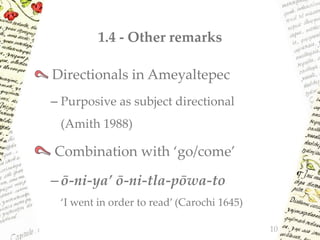
1.4 - Other remarks
Directionals in Ameyaltepec
– Purposive as subject directional
(Amith 1988)
Combination with ‘go/come’
–ō-ni-ya’ ō-ni-tla-pōwa-to
‘I went in order to read’ (Carochi 1645)
10
2. Purposive in Ixquihuacan
Nahuatl
11
PUEBLA
©INEGI
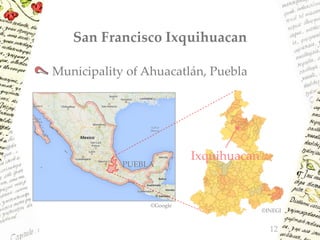
San Francisco Ixquihuacan
Municipality of Ahuacatlán, Puebla
12
©Google
Ixquihuacan
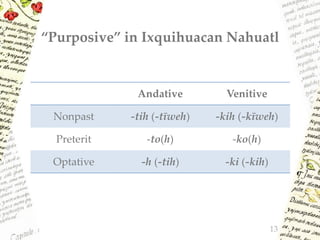
“Purposive” in Ixquihuacan Nahuatl
Andative Venitive
Nonpast -tih (-tīweh) -kih (-kīweh)
Preterit -to(h) -ko(h)
Optative -h (-tih) -ki (-kih)
13
2.1 - Typical purposives in Ixquihuacan
Nahuatl
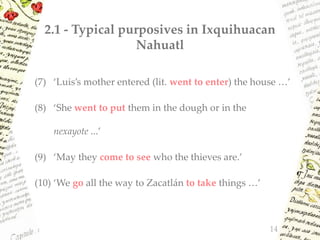
(7) ‘Luis’s mother entered (lit. went to enter) the house …’
(8) ‘She went to put them in the dough or in the
nexayote ...’
(9) ‘May they come to see who the thieves are.’
(10) ‘We go all the way to Zacatlán to take things …’
14
2.2 – “On-the-way” use of purposives in
Ixquihuacan Nahuatl
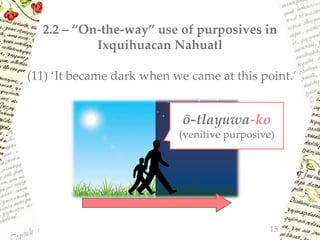
(11) ‘It became dark when we came at this point.’
15
ō-tlayuwa-ko
(venitive purposive)
2.3 – “On-the-way” use of purposives in
Ixquihuacan Nahuatl
(12) ‘if he passes away on the way [to the city]…’
16
poliwi-tih
(andative purposive)
2.2 – “On-the-way” use of purposives in
Ixquihuacan Nahuatl
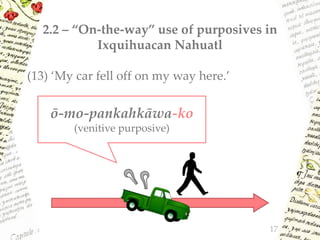
(13) ‘My car fell off on my way here.’
17
ō-mo-pankahkāwa-ko
(venitive purposive)
3. What do purposives mean?
18
3. – Typical and non-typical uses
“True purpose” use
– ‘She went to put them in the dough.’
“On-the-way” use
– ‘It became dark when we reached here.’
– ‘The patient died on the way to the city.’
– ‘The car fell off on my way here.’
19
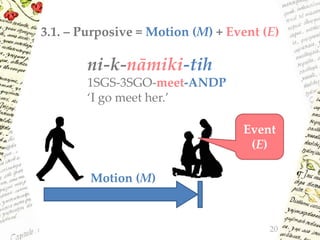
3.1. – Purposive = Motion (M) + Event (E)
20
Event
(E)
Motion (M)
ni-k-nāmiki-tih
1SGS-3SGO-meet-ANDP
‘I go meet her.’
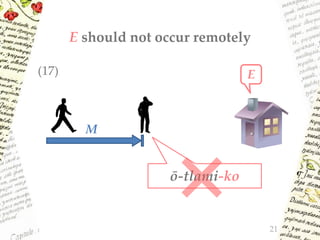
E should not occur remotely
21
E
M
ō-tlami-ko
(17)
Similarities between typical and non-
typical purposive
There is a movement M and the event E
M and E occur in succession
E occurs at the same place as the subject
of M
22
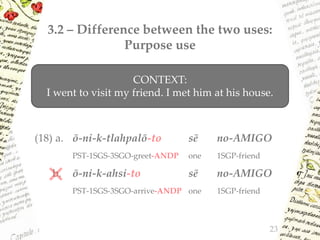
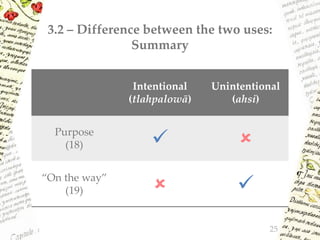
3.2 – Difference between the two uses:
Purpose use
(18) a. ō-ni-k-tlahpalō-to sē no-AMIGO
PST-1SGS-3SGO-greet-ANDP one 1SGP-friend
b. ō-ni-k-ahsi-to sē no-AMIGO
PST-1SGS-3SGO-arrive-ANDP one 1SGP-friend
23
CONTEXT:
I went to visit my friend. I met him at his house.
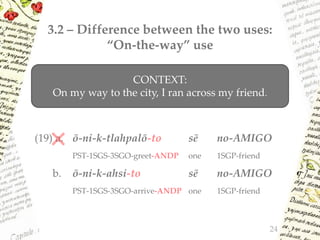
3.2 – Difference between the two uses:
“On-the-way” use
(19) a. ō-ni-k-tlahpalō-to sē no-AMIGO
PST-1SGS-3SGO-greet-ANDP one 1SGP-friend
b. ō-ni-k-ahsi-to sē no-AMIGO
PST-1SGS-3SGO-arrive-ANDP one 1SGP-friend
24
CONTEXT:
On my way to the city, I ran across my friend.
3.2 – Difference between the two uses:
Summary
Intentional
(tlahpalowā)
Unintentional
(ahsi)
Purpose
(18)  
“On the way”
(19)  
25
4. Discussion: A unified account
of purposives
26
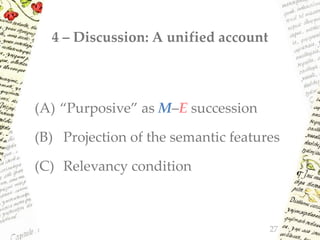
4 – Discussion: A unified account
(A) “Purposive” as M–E succession
(B) Projection of the semantic features
(C) Relevancy condition
27
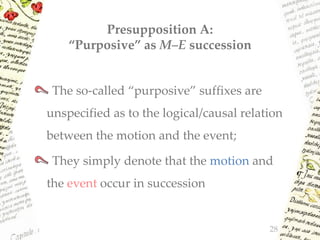
Presupposition A:
“Purposive” as M–E succession
The so-called “purposive” suffixes are
unspecified as to the logical/causal relation
between the motion and the event;
They simply denote that the motion and
the event occur in succession
28
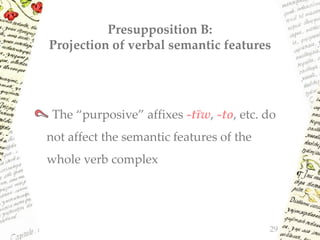
Presupposition B:
Projection of verbal semantic features
The “purposive” affixes -tīw, -to, etc. do
not affect the semantic features of the
whole verb complex
29
Presupposition C:
Relevancy principle
A verb form cannot combine two events
logically or cognitively irrelevant to each
other.
M and E are interpreted as relevant to
each other
30
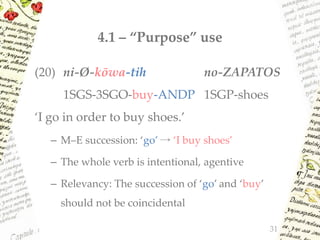
4.1 – “Purpose” use
(20) ni-Ø-kōwa-tih no-ZAPATOS
1SGS-3SGO-buy-ANDP 1SGP-shoes
‘I go in order to buy shoes.’
– M–E succession: ‘go’ → ‘I buy shoes’
– The whole verb is intentional, agentive
– Relevancy: The succession of ‘go’ and ‘buy’
should not be coincidental
31
4.2 – “On-the-way” use
(21) ō-tlayuwa-ko
PST-be.dark-VENP.PST
‘Night fell when [we] came to this point.’
– M–E succession: ‘come’ → ‘it gets dark’
– Agentivity: The whole verb is inintentional
– Relevancy: The motion should be logically
related to the event
32
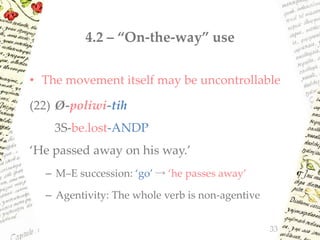
4.2 – “On-the-way” use
• The movement itself may be uncontrollable
(22) Ø-poliwi-tih
3S-be.lost-ANDP
‘He passed away on his way.’
– M–E succession: ‘go’ → ‘he passes away’
– Agentivity: The whole verb is non-agentive
33
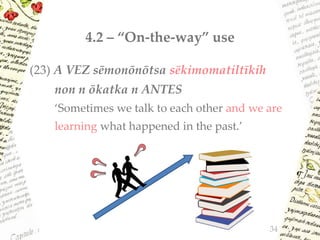
4.2 – “On-the-way” use
(23) A VEZ sēmonōnōtsa sēkimomatiltīkih
non n ōkatka n ANTES
‘Sometimes we talk to each other and we are
learning what happened in the past.’
34
5. Implications
35
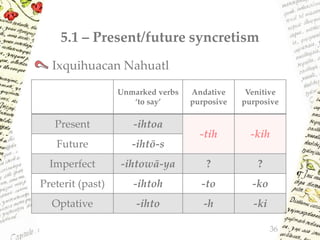
5.1 – Present/future syncretism
Ixquihuacan Nahuatl
36
Unmarked verbs
‘to say’
Andative
purposive
Venitive
purposive
Present -ihtoa
-tih -kih
Future -ihtō-s
Imperfect -ihtowā-ya ? ?
Preterit (past) -ihtoh -to -ko
Optative -ihto -h -ki
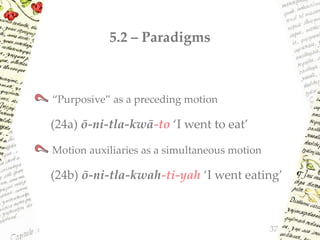
5.2 – Paradigms
“Purposive” as a preceding motion
(24a) ō-ni-tla-kwā-to ‘I went to eat’
Motion auxiliaries as a simultaneous motion
(24b) ō-ni-tla-kwah-ti-yah ‘I went eating’
37
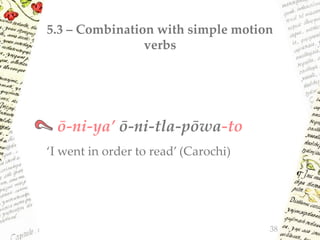
5.3 – Combination with simple motion
verbs
ō-ni-ya’ ō-ni-tla-pōwa-to
‘I went in order to read’ (Carochi)
38
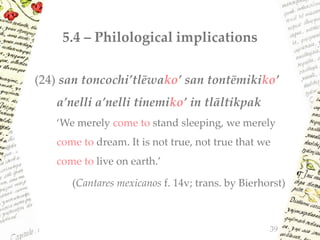
5.4 – Philological implications
39
(24) san toncochi’tlēwako’ san tontēmikiko’
a’nelli a’nelli tinemiko’ in tlāltikpak
‘We merely come to stand sleeping, we merely
come to dream. It is not true, not true that we
come to live on earth.’
(Cantares mexicanos f. 14v; trans. by Bierhorst)
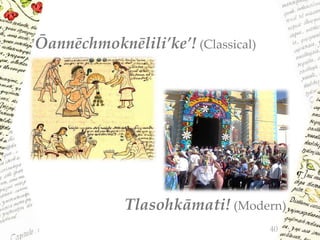
40
Ōannēchmoknēlili’ke’! (Classical)
Tlasohkāmati! (Modern)

How purposive are purposives?

  • 1.
    How Purposive ArePurposives? 1 Mitsuya Sasaki Yale Nahuatl Conference at Yale University, May 13
  • 2.
    Outline 1. Introduction 2. “Purposive”in Ixquihuacan Nahuatl 3. What do purposives mean? 4. Discussion: A unified account of purposives 5. Implications 2
  • 3.
    1. Introduction: Typical andnon-typical purposives 3
  • 4.
    Preliminary: Andative vs.venitive 4 ANDATIVE on-, -tīw, etc. VENITIVE wāl-, -kīw, etc.
  • 5.
    Purposive forms Traditionally described/translatedas “go/come in order to …” –ka ō=ti-kim-itta-to-’ AFF ANT=1PLS-3PLO-see-ANDP.PST-PLS ‘We went to see them.’ 5
  • 6.
    1.1 – Nahuatldirectionals (Classical) Andative Venitive Purposive Nonpast -tīw(i-’) -kīw(i-’) Preterit -to(-') -ko(-’) Optative -ti(-’) -ki(-’) Motion auxiliary -tiw(i-’) -tiwāllaw (-tiwālwi-’) 6
  • 7.
    1.1 – Typicalpurposives: (1)–(3) (1) ‘We went to see the gods …’ (2) ‘We went to give them all your capes.’ (3) ‘… we came to greet him, salute him.’ 7
  • 8.
    1.2 – Non-typicalpurposives: (4)–(6) (4) ‘When they arrived (lit. came to arrive) at Tecoac’ (5) ‘It was already dark when they arrived (lit. came to arrive) here.’ (6) ‘It has gone to be known all the way to Castile that you are very strong and brave.’ 8
  • 9.
    1.3 – Researchquestions Do they really denote purpose? – Non-typical uses: just a figurative extension? If not, what do they mean? – How can the “purpose” reading be derived? 9
  • 10.
    1.4 - Otherremarks Directionals in Ameyaltepec – Purposive as subject directional (Amith 1988) Combination with ‘go/come’ –ō-ni-ya’ ō-ni-tla-pōwa-to ‘I went in order to read’ (Carochi 1645) 10
  • 11.
    2. Purposive inIxquihuacan Nahuatl 11
  • 12.
    PUEBLA ©INEGI San Francisco Ixquihuacan Municipalityof Ahuacatlán, Puebla 12 ©Google Ixquihuacan
  • 13.
    “Purposive” in IxquihuacanNahuatl Andative Venitive Nonpast -tih (-tīweh) -kih (-kīweh) Preterit -to(h) -ko(h) Optative -h (-tih) -ki (-kih) 13
  • 14.
    2.1 - Typicalpurposives in Ixquihuacan Nahuatl (7) ‘Luis’s mother entered (lit. went to enter) the house …’ (8) ‘She went to put them in the dough or in the nexayote ...’ (9) ‘May they come to see who the thieves are.’ (10) ‘We go all the way to Zacatlán to take things …’ 14
  • 15.
    2.2 – “On-the-way”use of purposives in Ixquihuacan Nahuatl (11) ‘It became dark when we came at this point.’ 15 ō-tlayuwa-ko (venitive purposive)
  • 16.
    2.3 – “On-the-way”use of purposives in Ixquihuacan Nahuatl (12) ‘if he passes away on the way [to the city]…’ 16 poliwi-tih (andative purposive)
  • 17.
    2.2 – “On-the-way”use of purposives in Ixquihuacan Nahuatl (13) ‘My car fell off on my way here.’ 17 ō-mo-pankahkāwa-ko (venitive purposive)
  • 18.
    3. What dopurposives mean? 18
  • 19.
    3. – Typicaland non-typical uses “True purpose” use – ‘She went to put them in the dough.’ “On-the-way” use – ‘It became dark when we reached here.’ – ‘The patient died on the way to the city.’ – ‘The car fell off on my way here.’ 19
  • 20.
    3.1. – Purposive= Motion (M) + Event (E) 20 Event (E) Motion (M) ni-k-nāmiki-tih 1SGS-3SGO-meet-ANDP ‘I go meet her.’
  • 21.
    E should notoccur remotely 21 E M ō-tlami-ko (17)
  • 22.
    Similarities between typicaland non- typical purposive There is a movement M and the event E M and E occur in succession E occurs at the same place as the subject of M 22
  • 23.
    3.2 – Differencebetween the two uses: Purpose use (18) a. ō-ni-k-tlahpalō-to sē no-AMIGO PST-1SGS-3SGO-greet-ANDP one 1SGP-friend b. ō-ni-k-ahsi-to sē no-AMIGO PST-1SGS-3SGO-arrive-ANDP one 1SGP-friend 23 CONTEXT: I went to visit my friend. I met him at his house.
  • 24.
    3.2 – Differencebetween the two uses: “On-the-way” use (19) a. ō-ni-k-tlahpalō-to sē no-AMIGO PST-1SGS-3SGO-greet-ANDP one 1SGP-friend b. ō-ni-k-ahsi-to sē no-AMIGO PST-1SGS-3SGO-arrive-ANDP one 1SGP-friend 24 CONTEXT: On my way to the city, I ran across my friend.
  • 25.
    3.2 – Differencebetween the two uses: Summary Intentional (tlahpalowā) Unintentional (ahsi) Purpose (18)   “On the way” (19)   25
  • 26.
    4. Discussion: Aunified account of purposives 26
  • 27.
    4 – Discussion:A unified account (A) “Purposive” as M–E succession (B) Projection of the semantic features (C) Relevancy condition 27
  • 28.
    Presupposition A: “Purposive” asM–E succession The so-called “purposive” suffixes are unspecified as to the logical/causal relation between the motion and the event; They simply denote that the motion and the event occur in succession 28
  • 29.
    Presupposition B: Projection ofverbal semantic features The “purposive” affixes -tīw, -to, etc. do not affect the semantic features of the whole verb complex 29
  • 30.
    Presupposition C: Relevancy principle Averb form cannot combine two events logically or cognitively irrelevant to each other. M and E are interpreted as relevant to each other 30
  • 31.
    4.1 – “Purpose”use (20) ni-Ø-kōwa-tih no-ZAPATOS 1SGS-3SGO-buy-ANDP 1SGP-shoes ‘I go in order to buy shoes.’ – M–E succession: ‘go’ → ‘I buy shoes’ – The whole verb is intentional, agentive – Relevancy: The succession of ‘go’ and ‘buy’ should not be coincidental 31
  • 32.
    4.2 – “On-the-way”use (21) ō-tlayuwa-ko PST-be.dark-VENP.PST ‘Night fell when [we] came to this point.’ – M–E succession: ‘come’ → ‘it gets dark’ – Agentivity: The whole verb is inintentional – Relevancy: The motion should be logically related to the event 32
  • 33.
    4.2 – “On-the-way”use • The movement itself may be uncontrollable (22) Ø-poliwi-tih 3S-be.lost-ANDP ‘He passed away on his way.’ – M–E succession: ‘go’ → ‘he passes away’ – Agentivity: The whole verb is non-agentive 33
  • 34.
    4.2 – “On-the-way”use (23) A VEZ sēmonōnōtsa sēkimomatiltīkih non n ōkatka n ANTES ‘Sometimes we talk to each other and we are learning what happened in the past.’ 34
  • 35.
  • 36.
    5.1 – Present/futuresyncretism Ixquihuacan Nahuatl 36 Unmarked verbs ‘to say’ Andative purposive Venitive purposive Present -ihtoa -tih -kih Future -ihtō-s Imperfect -ihtowā-ya ? ? Preterit (past) -ihtoh -to -ko Optative -ihto -h -ki
  • 37.
    5.2 – Paradigms “Purposive”as a preceding motion (24a) ō-ni-tla-kwā-to ‘I went to eat’ Motion auxiliaries as a simultaneous motion (24b) ō-ni-tla-kwah-ti-yah ‘I went eating’ 37
  • 38.
    5.3 – Combinationwith simple motion verbs ō-ni-ya’ ō-ni-tla-pōwa-to ‘I went in order to read’ (Carochi) 38
  • 39.
    5.4 – Philologicalimplications 39 (24) san toncochi’tlēwako’ san tontēmikiko’ a’nelli a’nelli tinemiko’ in tlāltikpak ‘We merely come to stand sleeping, we merely come to dream. It is not true, not true that we come to live on earth.’ (Cantares mexicanos f. 14v; trans. by Bierhorst)
  • 40.