

How Plants Grow

   Mort Kothmann
Texas A&M University
Plant Development and Responses to
              Grazing
• Objective 1
  – Review the developmental morphology and
    growth form of grass plants.
• Objective 2.
  – Evaluate some major physiological and
    morphological plant responses to grazing.
• Objective 3.
  – Explore the mechanisms that convey grazing
    resistance to plants.
Functional Categories of Plants
• Annual (grass, forb)
• Perennial (grass, forb)
• Woody
  – Deciduous or evergreen
  – Sprouting or non-sprouting (basal)
• Cool season or warm season
• Anti-herbivory
     • Chemical
     • Physical
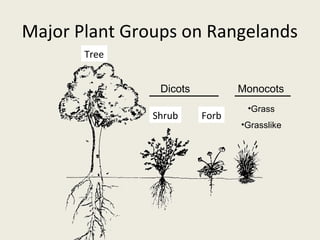
Major Plant Groups on Rangelands
       Tree


                Dicots          Monocots
                                 •Grass
               Shrub     Forb
                                •Grasslike
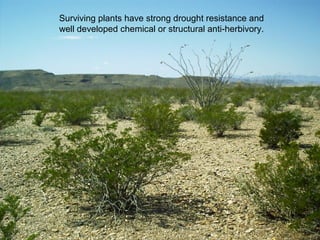
Surviving plants have strong drought resistance and
well developed chemical or structural anti-herbivory.
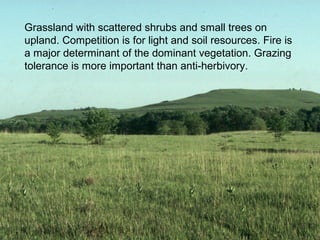
Grassland with scattered shrubs and small trees on
upland. Competition is for light and soil resources. Fire is
a major determinant of the dominant vegetation. Grazing
tolerance is more important than anti-herbivory.
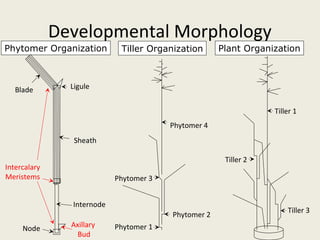
Developmental Morphology
Phytomer Organization        Tiller Organization      Plant Organization


   Blade        Ligule


                                                                  Tiller 1
                                         Phytomer 4
                 Sheath

                                                       Tiller 2
Intercalary
Meristems                   Phytomer 3


                Internode
                                                                      Tiller 3
                                         Phytomer 2
     Node       Axillary    Phytomer 1
                  Bud
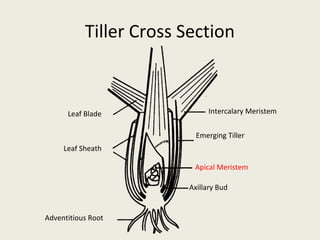
Tiller Cross Section


      Leaf Blade              Intercalary Meristem


                          Emerging Tiller
     Leaf Sheath

                         Apical Meristem

                        Axillary Bud


Adventitious Root
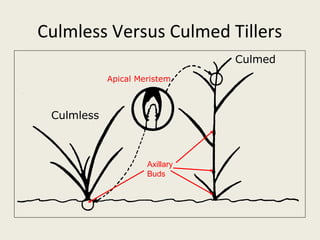
Culmless Versus Culmed Tillers
                                Culmed
            Apical Meristem


 Culmless


                     Axillary
                     Buds
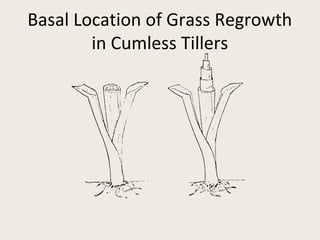
Basal Location of Grass Regrowth
        in Cumless Tillers
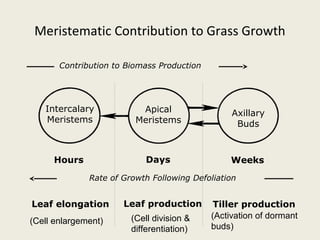
Meristematic Contribution to Grass Growth

       Contribution to Biomass Production


   Intercalary            Apical                 Axillary
   Meristems             Meristems                Buds


     Hours                  Days                 Weeks
              Rate of Growth Following Defoliation


Leaf elongation       Leaf production        Tiller production
                        (Cell division &    (Activation of dormant
(Cell enlargement)
                        differentiation)    buds)
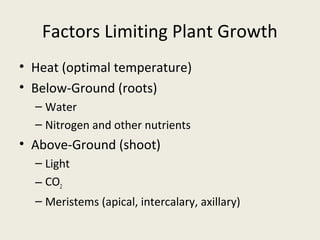
Factors Limiting Plant Growth
• Heat (optimal temperature)
• Below-Ground (roots)
  – Water
  – Nitrogen and other nutrients
• Above-Ground (shoot)
  – Light
  – CO2
  – Meristems (apical, intercalary, axillary)
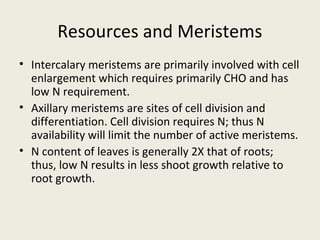
Resources and Meristems
• Intercalary meristems are primarily involved with cell
  enlargement which requires primarily CHO and has
  low N requirement.
• Axillary meristems are sites of cell division and
  differentiation. Cell division requires N; thus N
  availability will limit the number of active meristems.
• N content of leaves is generally 2X that of roots;
  thus, low N results in less shoot growth relative to
  root growth.
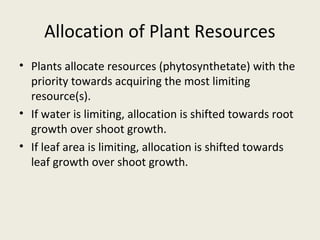
Allocation of Plant Resources
• Plants allocate resources (phytosynthetate) with the
  priority towards acquiring the most limiting
  resource(s).
• If water is limiting, allocation is shifted towards root
  growth over shoot growth.
• If leaf area is limiting, allocation is shifted towards
  leaf growth over shoot growth.
Key Concepts
• N uptake is with water; if water is limiting, N
  will be limiting
• Higher levels of available N increase water use
  efficiency
• Level of available NO3 in the soil affects the
  species composition of the vegetation
  – Weeds require higher levels of NO3 than do climax
    grasses
Physiological Responses to Grazing
Effects of Grazing on Plants
1. Removal of photosynthetic tissues reduces a plant’s
   ability to assimilate energy.
2. Removal of meristems (apical & intercalary) delays
   or stops growth.
3. Removal of reproductive structures reduces a
   plant’s ability to produce new individuals.
4. Grazing is a natural ecological process and
   overgrazing occurred prior to humans.
5. Properly managed grazing is a sustainable
   enterprise, but destructive grazing can occur.
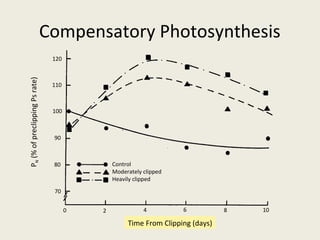
Compensatory Photosynthesis
                                120
PN (% of preclipping Ps rate)


                                110


                                100


                                90


                                80            Control
                                              Moderately clipped
                                              Heavily clipped
                                70


                                      0   2              4         6           8   10

                                                   Time From Clipping (days)
Resource Allocation
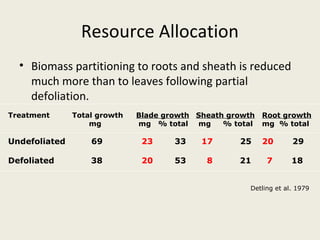
  • Biomass partitioning to roots and sheath is reduced
    much more than to leaves following partial
    defoliation.
Treatment      Total growth   Blade growth Sheath growth   Root growth
                   mg         mg % total mg      % total   mg % total

Undefoliated       69          23     33    17      25     20       29

Defoliated         38          20     53     8      21      7       18


                                                       Detling et al. 1979
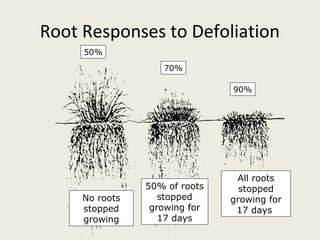
Root Responses to Defoliation
     50%

                   70%

                               90%


                                All roots
                50% of roots     stopped
     No roots      stopped     growing for
     stopped     growing for    17 days
     growing       17 days
Root Responses to Defoliation
• Root growth decreases proportionally as
  defoliation removes greater than 50% of the
  plant leaf area.
• Frequency of defoliation interacts with
  defoliation intensity to determine the total
  effect of defoliation on root growth.
  – The more intense the defoliation, the greater the
    effect of frequency of defoliation.
Consequences of Reduced Root
              Growth
• The net effect of severe grazing is to reduce:
  – Total absorptive area of roots.
  – Soil volume explored for soil resources e.g. water
    and nitrogen.
• How may this alter competitive interactions?
TNC Contribution to Shoot Regrowth
• Carbohydrate reserves exist and they provide a small
  amount of energy to contribute to initial leaf growth
  following severe grazing or leaf damage e.g., fire,
  late spring freeze.
• Current photosynthesis is the primary source for
  growth of new shoots.
Growth is Exponential
• The initial or residual amount of plant tissue is
  very important in determining the rate of
  plant growth at any point in time.
• The total amount of root and shoot biomass is
  more important than the concentration of
  reserve CHO.
Morphological characteristics
• Primary growth forms of grasses
  – Bunchgrasses
  – Turf or sod grasses
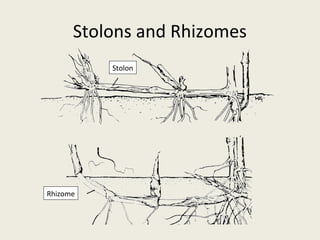
Stolons and Rhizomes
          Stolon


Rhizome
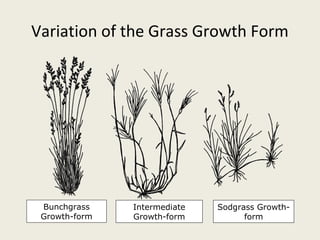
Variation of the Grass Growth Form


 Bunchgrass    Intermediate   Sodgrass Growth-
 Growth-form   Growth-form          form
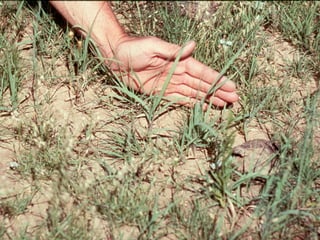
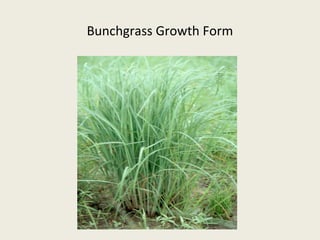
Bunchgrass Growth Form
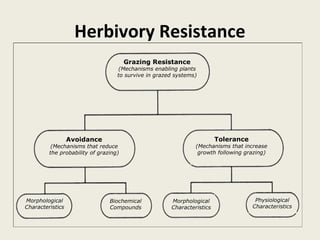
Herbivory Resistance
                                       Grazing Resistance
                                   (Mechanisms enabling plants
                                   to survive in grazed systems)


                  Avoidance                                             Tolerance
          (Mechanisms that reduce                              (Mechanisms that increase
         the probability of grazing)                            growth following grazing)


Morphological                   Biochemical           Morphological                  Physiological
Characteristics                 Compounds             Characteristics               Characteristics
Anti-quality Factors in Forages
Classes of Anti-quality
• Structural plant traits
  – Plant parts
     • Spines, Awns, Pubescence
  – Plant maturity
     • Leaf:Stem ratio
     • Live:Dead
     • Reproductive:Vegetative tillers
  – Tensile/shear strength
Structural Anti-quality
• Fiber components
  – Cell walls
  – Lignin
  – Silica
Anti-quality
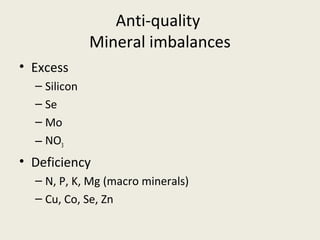
              Mineral imbalances
• Excess
  – Silicon
  – Se
  – Mo
  – NO3
• Deficiency
  – N, P, K, Mg (macro minerals)
  – Cu, Co, Se, Zn
Anti-quality
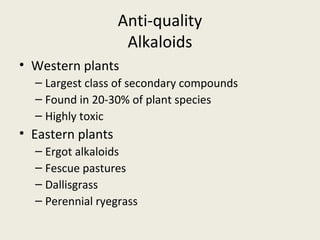
                    Alkaloids
• Western plants
  – Largest class of secondary compounds
  – Found in 20-30% of plant species
  – Highly toxic
• Eastern plants
  – Ergot alkaloids
  – Fescue pastures
  – Dallisgrass
  – Perennial ryegrass
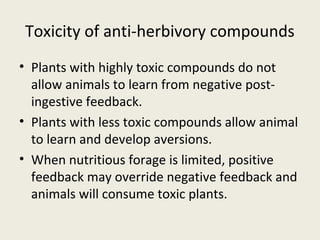
Toxicity of anti-herbivory compounds
• Plants with highly toxic compounds do not
  allow animals to learn from negative post-
  ingestive feedback.
• Plants with less toxic compounds allow animal
  to learn and develop aversions.
• When nutritious forage is limited, positive
  feedback may override negative feedback and
  animals will consume toxic plants.

how plants grow

  • 1.
    How Plants Grow Mort Kothmann Texas A&M University
  • 2.
    Plant Development andResponses to Grazing • Objective 1 – Review the developmental morphology and growth form of grass plants. • Objective 2. – Evaluate some major physiological and morphological plant responses to grazing. • Objective 3. – Explore the mechanisms that convey grazing resistance to plants.
  • 3.
    Functional Categories ofPlants • Annual (grass, forb) • Perennial (grass, forb) • Woody – Deciduous or evergreen – Sprouting or non-sprouting (basal) • Cool season or warm season • Anti-herbivory • Chemical • Physical
  • 4.
    Major Plant Groupson Rangelands Tree Dicots Monocots •Grass Shrub Forb •Grasslike
  • 5.
    Surviving plants havestrong drought resistance and well developed chemical or structural anti-herbivory.
  • 6.
    Grassland with scatteredshrubs and small trees on upland. Competition is for light and soil resources. Fire is a major determinant of the dominant vegetation. Grazing tolerance is more important than anti-herbivory.
  • 7.
    Developmental Morphology Phytomer Organization Tiller Organization Plant Organization Blade Ligule Tiller 1 Phytomer 4 Sheath Tiller 2 Intercalary Meristems Phytomer 3 Internode Tiller 3 Phytomer 2 Node Axillary Phytomer 1 Bud
  • 8.
    Tiller Cross Section Leaf Blade Intercalary Meristem Emerging Tiller Leaf Sheath Apical Meristem Axillary Bud Adventitious Root
  • 10.
    Culmless Versus CulmedTillers Culmed Apical Meristem Culmless Axillary Buds
  • 11.
    Basal Location ofGrass Regrowth in Cumless Tillers
  • 12.
    Meristematic Contribution toGrass Growth Contribution to Biomass Production Intercalary Apical Axillary Meristems Meristems Buds Hours Days Weeks Rate of Growth Following Defoliation Leaf elongation Leaf production Tiller production (Cell division & (Activation of dormant (Cell enlargement) differentiation) buds)
  • 13.
    Factors Limiting PlantGrowth • Heat (optimal temperature) • Below-Ground (roots) – Water – Nitrogen and other nutrients • Above-Ground (shoot) – Light – CO2 – Meristems (apical, intercalary, axillary)
  • 14.
    Resources and Meristems •Intercalary meristems are primarily involved with cell enlargement which requires primarily CHO and has low N requirement. • Axillary meristems are sites of cell division and differentiation. Cell division requires N; thus N availability will limit the number of active meristems. • N content of leaves is generally 2X that of roots; thus, low N results in less shoot growth relative to root growth.
  • 15.
    Allocation of PlantResources • Plants allocate resources (phytosynthetate) with the priority towards acquiring the most limiting resource(s). • If water is limiting, allocation is shifted towards root growth over shoot growth. • If leaf area is limiting, allocation is shifted towards leaf growth over shoot growth.
  • 16.
    Key Concepts • Nuptake is with water; if water is limiting, N will be limiting • Higher levels of available N increase water use efficiency • Level of available NO3 in the soil affects the species composition of the vegetation – Weeds require higher levels of NO3 than do climax grasses
  • 17.
  • 18.
    Effects of Grazingon Plants 1. Removal of photosynthetic tissues reduces a plant’s ability to assimilate energy. 2. Removal of meristems (apical & intercalary) delays or stops growth. 3. Removal of reproductive structures reduces a plant’s ability to produce new individuals. 4. Grazing is a natural ecological process and overgrazing occurred prior to humans. 5. Properly managed grazing is a sustainable enterprise, but destructive grazing can occur.
  • 19.
    Compensatory Photosynthesis 120 PN (% of preclipping Ps rate) 110 100 90 80 Control Moderately clipped Heavily clipped 70 0 2 4 6 8 10 Time From Clipping (days)
  • 20.
    Resource Allocation • Biomass partitioning to roots and sheath is reduced much more than to leaves following partial defoliation. Treatment Total growth Blade growth Sheath growth Root growth mg mg % total mg % total mg % total Undefoliated 69 23 33 17 25 20 29 Defoliated 38 20 53 8 21 7 18 Detling et al. 1979
  • 21.
    Root Responses toDefoliation 50% 70% 90% All roots 50% of roots stopped No roots stopped growing for stopped growing for 17 days growing 17 days
  • 22.
    Root Responses toDefoliation • Root growth decreases proportionally as defoliation removes greater than 50% of the plant leaf area. • Frequency of defoliation interacts with defoliation intensity to determine the total effect of defoliation on root growth. – The more intense the defoliation, the greater the effect of frequency of defoliation.
  • 23.
    Consequences of ReducedRoot Growth • The net effect of severe grazing is to reduce: – Total absorptive area of roots. – Soil volume explored for soil resources e.g. water and nitrogen. • How may this alter competitive interactions?
  • 24.
    TNC Contribution toShoot Regrowth • Carbohydrate reserves exist and they provide a small amount of energy to contribute to initial leaf growth following severe grazing or leaf damage e.g., fire, late spring freeze. • Current photosynthesis is the primary source for growth of new shoots.
  • 25.
    Growth is Exponential •The initial or residual amount of plant tissue is very important in determining the rate of plant growth at any point in time. • The total amount of root and shoot biomass is more important than the concentration of reserve CHO.
  • 26.
    Morphological characteristics • Primarygrowth forms of grasses – Bunchgrasses – Turf or sod grasses
  • 27.
    Stolons and Rhizomes Stolon Rhizome
  • 28.
    Variation of theGrass Growth Form Bunchgrass Intermediate Sodgrass Growth- Growth-form Growth-form form
  • 30.
  • 31.
    Herbivory Resistance Grazing Resistance (Mechanisms enabling plants to survive in grazed systems) Avoidance Tolerance (Mechanisms that reduce (Mechanisms that increase the probability of grazing) growth following grazing) Morphological Biochemical Morphological Physiological Characteristics Compounds Characteristics Characteristics
  • 32.
  • 33.
    Classes of Anti-quality •Structural plant traits – Plant parts • Spines, Awns, Pubescence – Plant maturity • Leaf:Stem ratio • Live:Dead • Reproductive:Vegetative tillers – Tensile/shear strength
  • 34.
    Structural Anti-quality • Fibercomponents – Cell walls – Lignin – Silica
  • 35.
    Anti-quality Mineral imbalances • Excess – Silicon – Se – Mo – NO3 • Deficiency – N, P, K, Mg (macro minerals) – Cu, Co, Se, Zn
  • 36.
    Anti-quality Alkaloids • Western plants – Largest class of secondary compounds – Found in 20-30% of plant species – Highly toxic • Eastern plants – Ergot alkaloids – Fescue pastures – Dallisgrass – Perennial ryegrass
  • 37.
    Toxicity of anti-herbivorycompounds • Plants with highly toxic compounds do not allow animals to learn from negative post- ingestive feedback. • Plants with less toxic compounds allow animal to learn and develop aversions. • When nutritious forage is limited, positive feedback may override negative feedback and animals will consume toxic plants.

Editor's Notes

  • #22 Classic investigation from mid1950s; lead to take half – leave half rule.