Frictional Force
Exploring its Role, Limiting Friction, and Types
BY: 24IR011 AND
WHAT IS FRICTIONAL
FORCE?
• Frictional force is the resistive force that
acts opposite to the direction of motion
when two surfaces come in contact. It
arises due to surface irregularities and
interlocking of surfaces.
• Friction is crucial in daily life. It
enables walking, driving, writing,
and more. Without friction, motion
would be uncontrollable
WHY IS FRICTION
IMPORTANT?
FORMULA:µN
Here f=force of friction
N=value of normal force
FACTORS
AFFECTING
FRICTION
1. Nature of surfaces in
contact.
2. Normal force acting
between the surfaces.
3. Surface area (to a
lesser extent).
ROLE OF FRICTION
IN MOTION
• Friction opposes motion but is also
necessary for initiating motion. It
provides grip and prevents slipping.
• What role does friction play in
motion?
• Friction can slow things down and
stop stationary things from moving.
In a frictionless world, more objects
would be sliding about, shoes would
be difficult to keep on and it would
be very difficult for people or cars to
get moving or change direction.
LAWS OF FRICTION:-
• Friction of the moving object is proportional and
perpendicular to the normal force applied on it.
• The friction experienced by the object depends on the
nature of the surface it is in contact with.
• Friction is independent of the area of contact as long as
there is an area of contact
• Kinetic friction is independent of velocity.
• The coefficient of static friction is greater than the
coefficient of kinetic friction
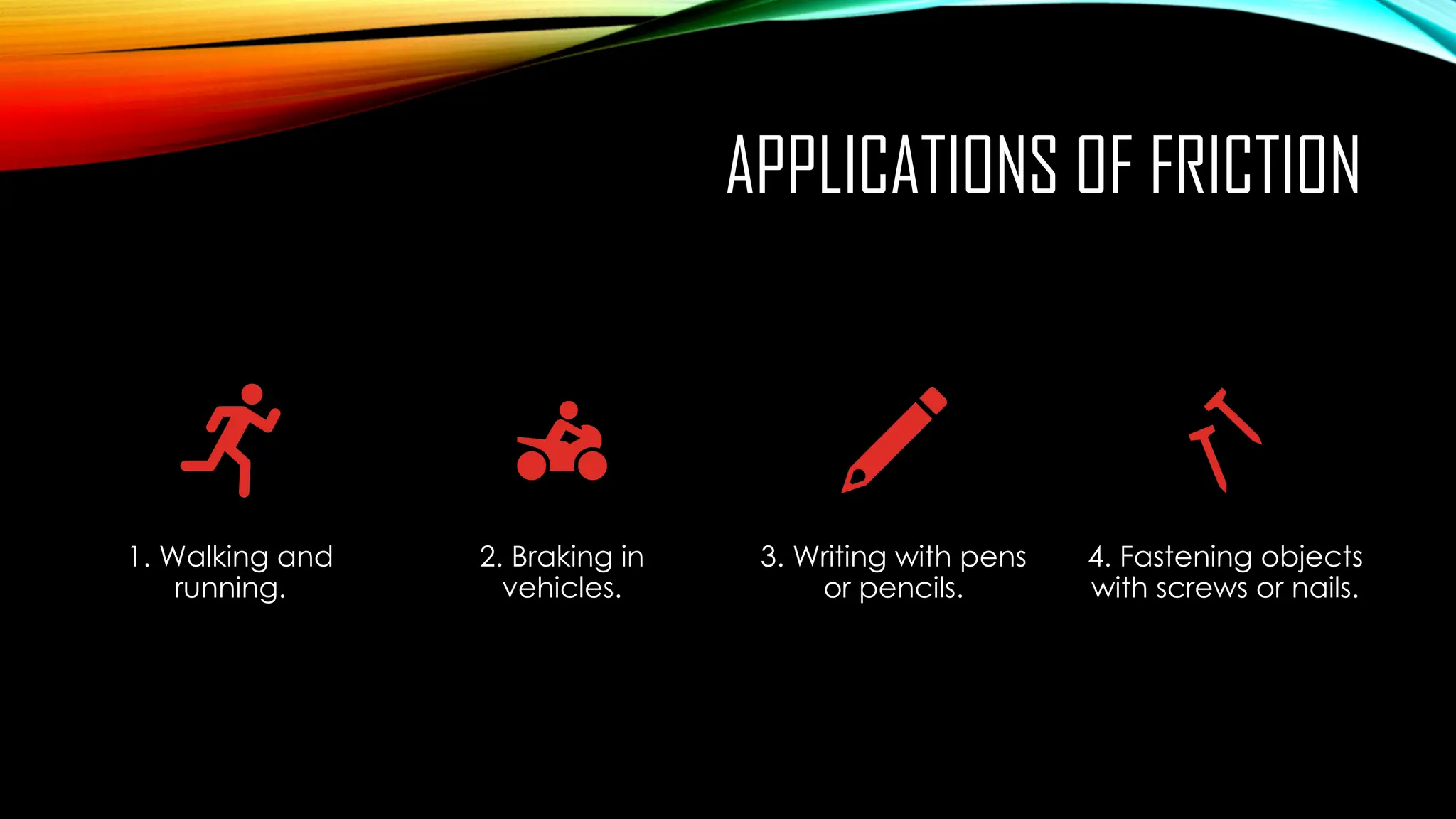
APPLICATIONS OF FRICTION
1. Walking and
running.
2. Braking in
vehicles.
3. Writing with pens
or pencils.
4. Fastening objects
with screws or nails.
FRICTION IN NATURE
1. Animal claws provide grip.
2. Gecko feet use microscopic hairs for friction.
3. Bird wings minimize fluid friction.
FRICTION IN TECHNOLOGY
1. Friction in brakes and clutches.
2. Bearings reduce friction in machinery.
3. Aerodynamics reduce fluid friction in vehicles.
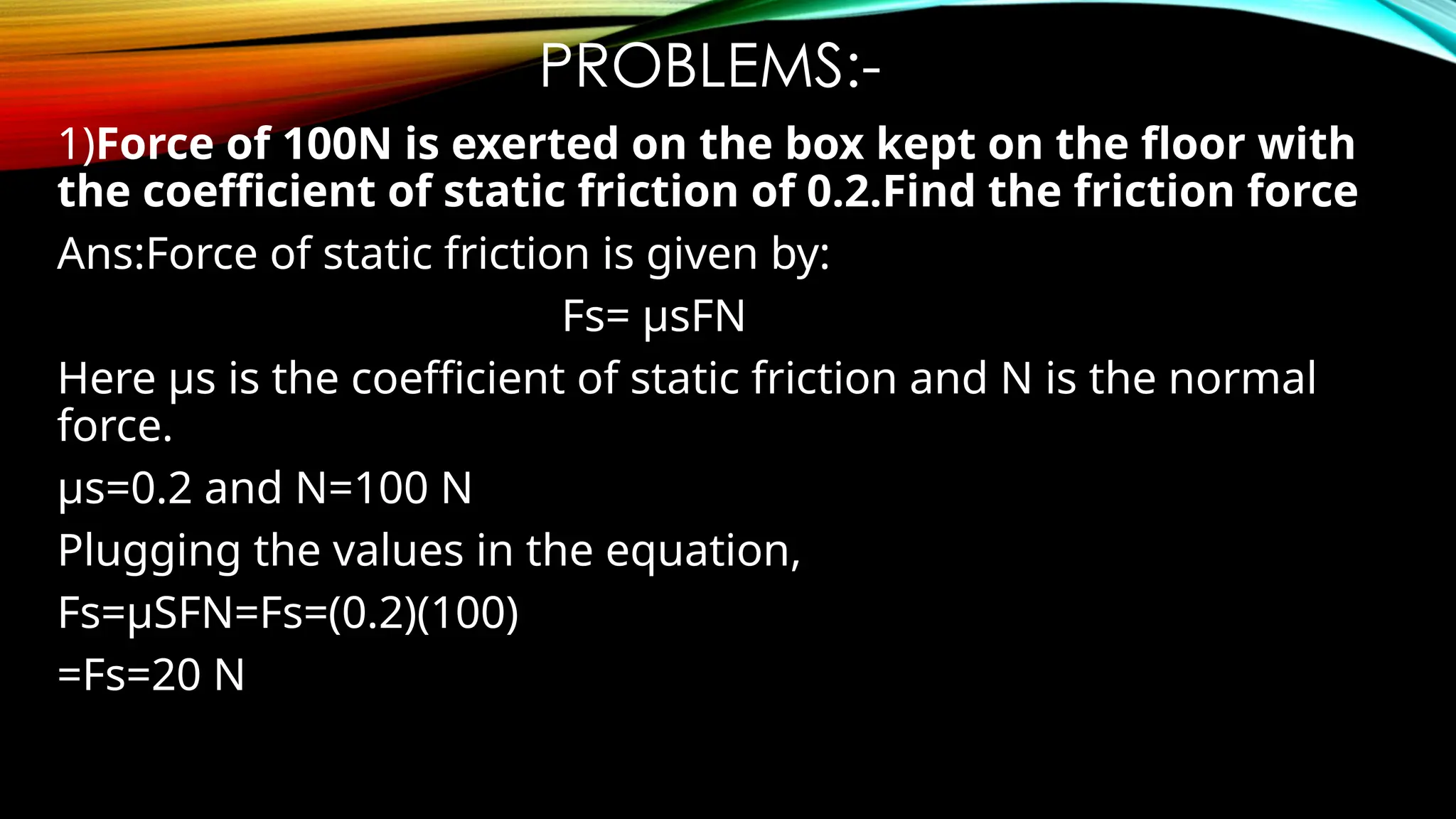
PROBLEMS:-
1)Force of 100N is exerted on the box kept on the floor with
the coefficient of static friction of 0.2.Find the friction force
Ans:Force of static friction is given by:
Fs= µsFN
Here µs is the coefficient of static friction and N is the normal
force.
µs=0.2 and N=100 N
Plugging the values in the equation,
Fs=µSFN=Fs=(0.2)(100)
=Fs=20 N
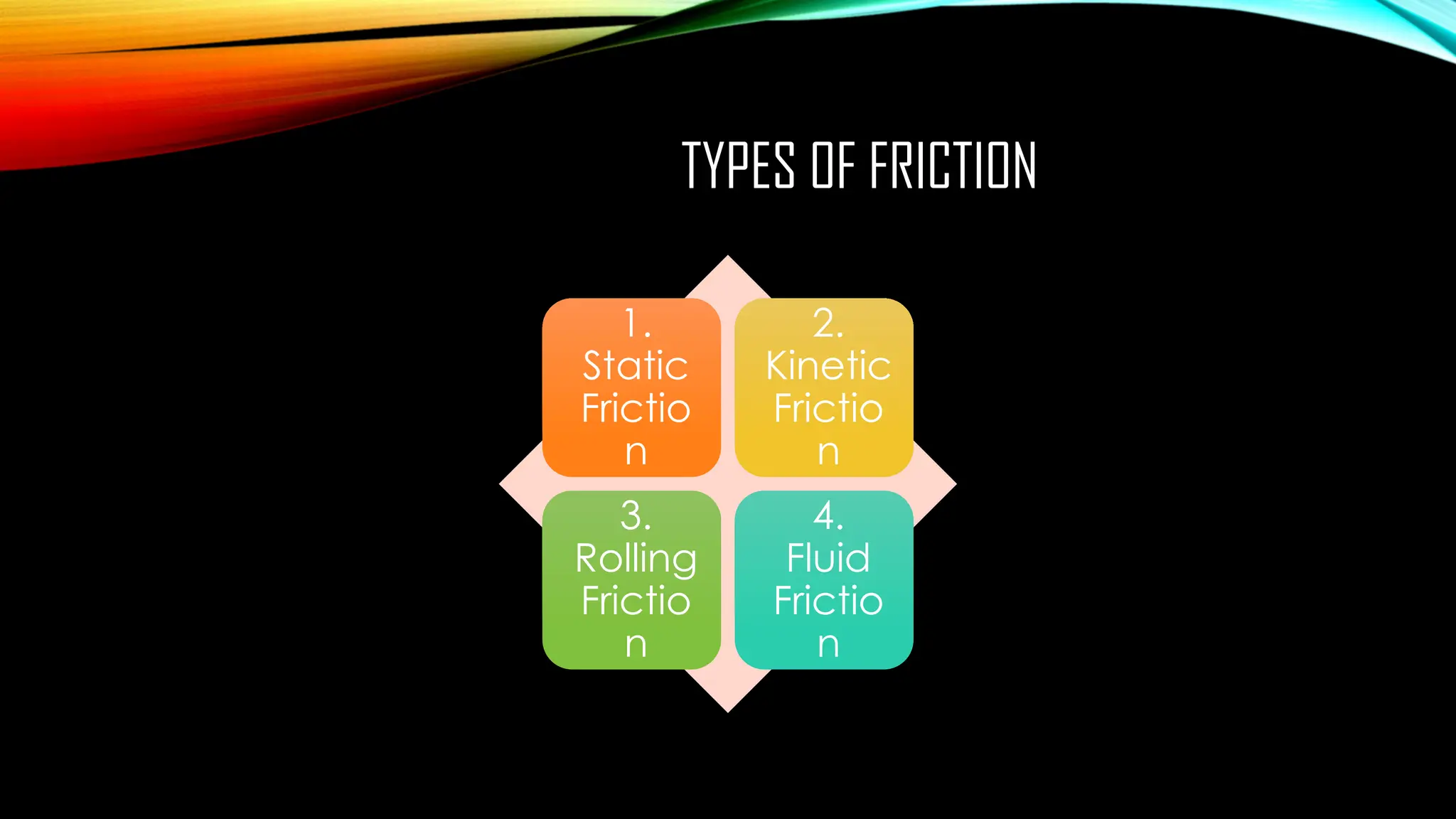
TYPES OF FRICTION
1.
Static
Frictio
n
2.
Kinetic
Frictio
n
3.
Rolling
Frictio
n
4.
Fluid
Frictio
n
STATIC FRICTION
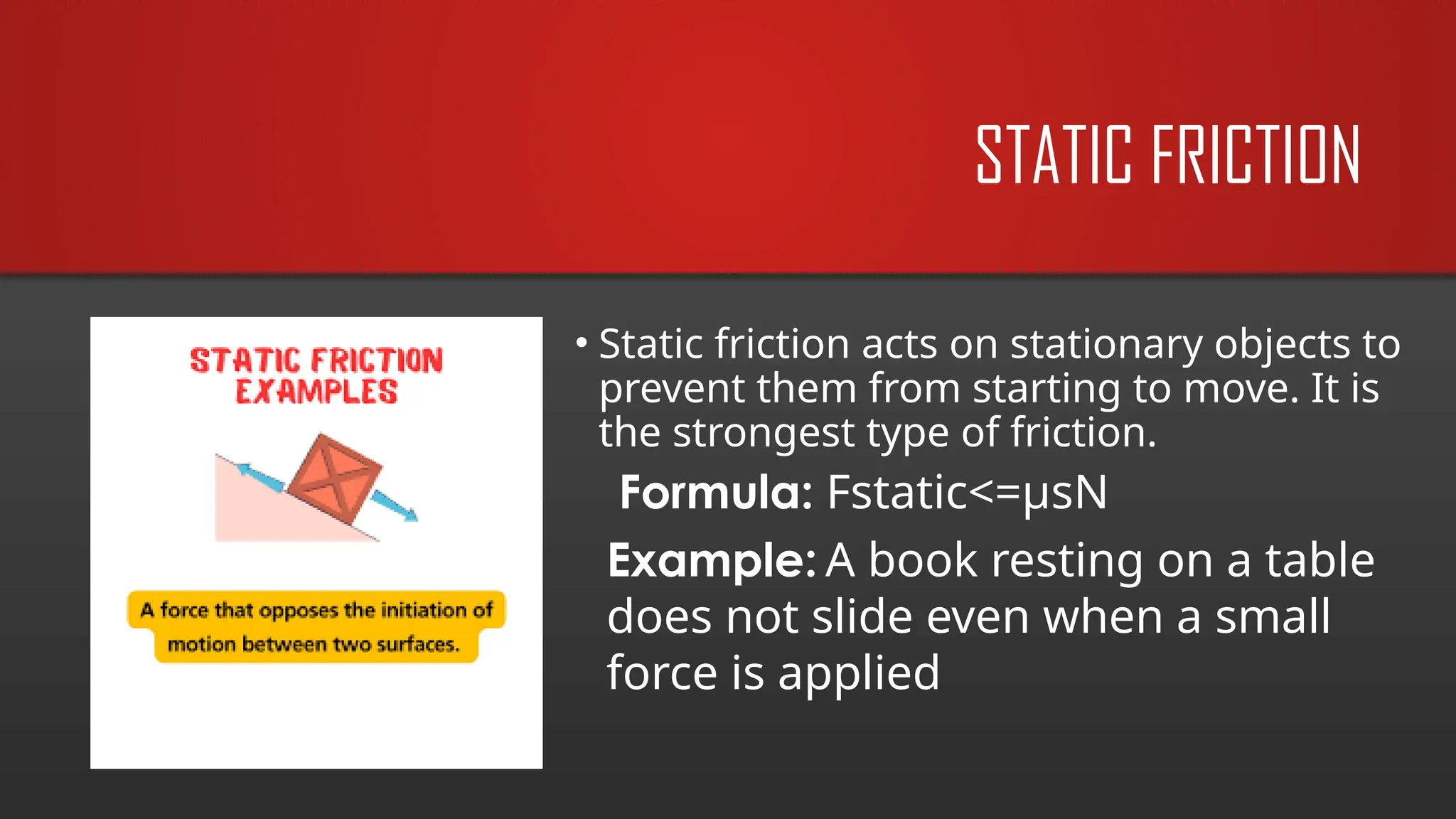
• Static friction acts on stationary objects to
prevent them from starting to move. It is
the strongest type of friction.
Example: A book resting on a table
does not slide even when a small
force is applied
Formula: Fstatic<=µsN
KINETIC FRICTION(SLIDING FRICTION)
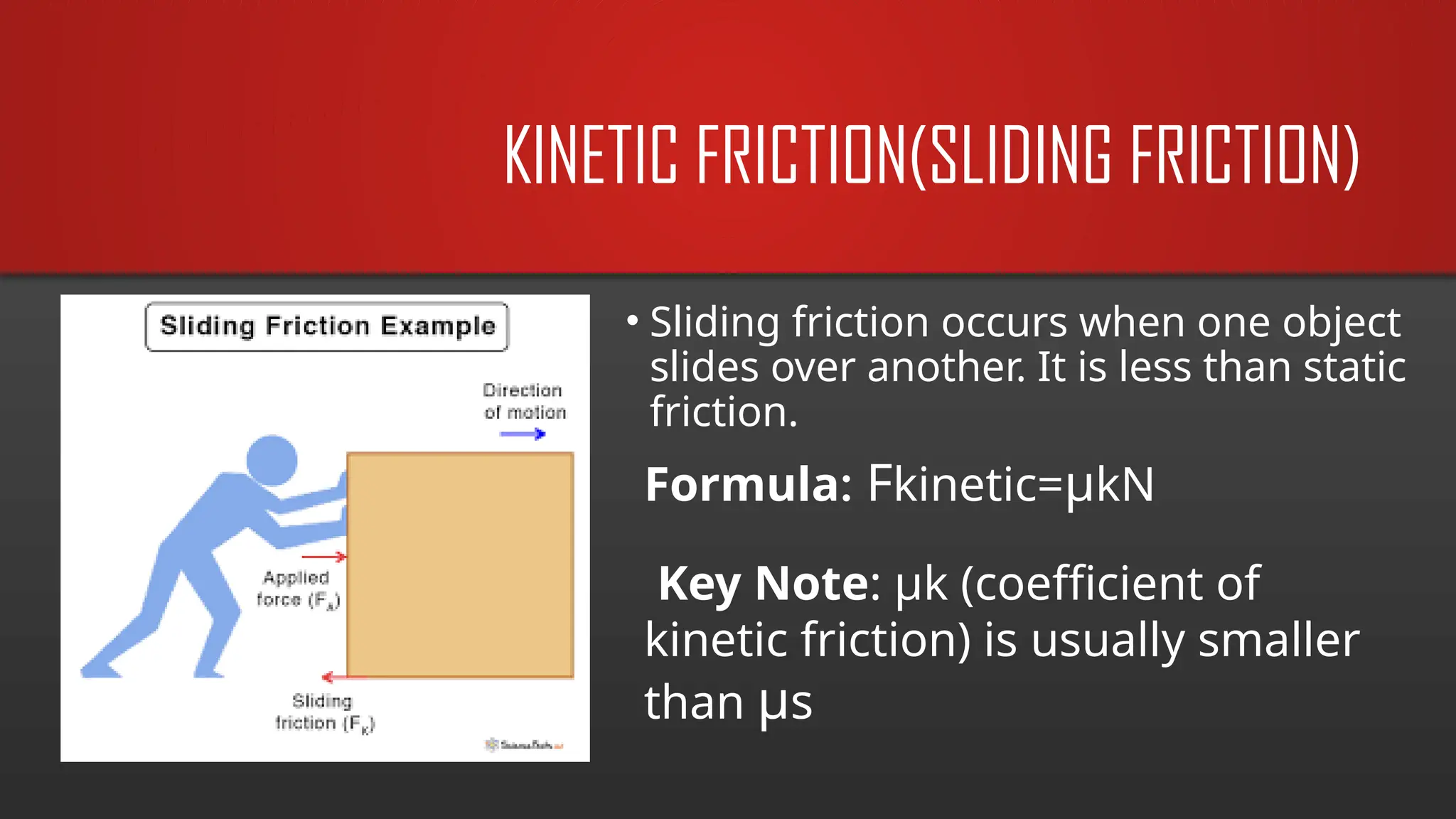
• Sliding friction occurs when one object
slides over another. It is less than static
friction.
Formula: Fkinetic=µkN
Key Note: µk (coefficient of
kinetic friction) is usually smaller
than µs
ROLLING FRICTION
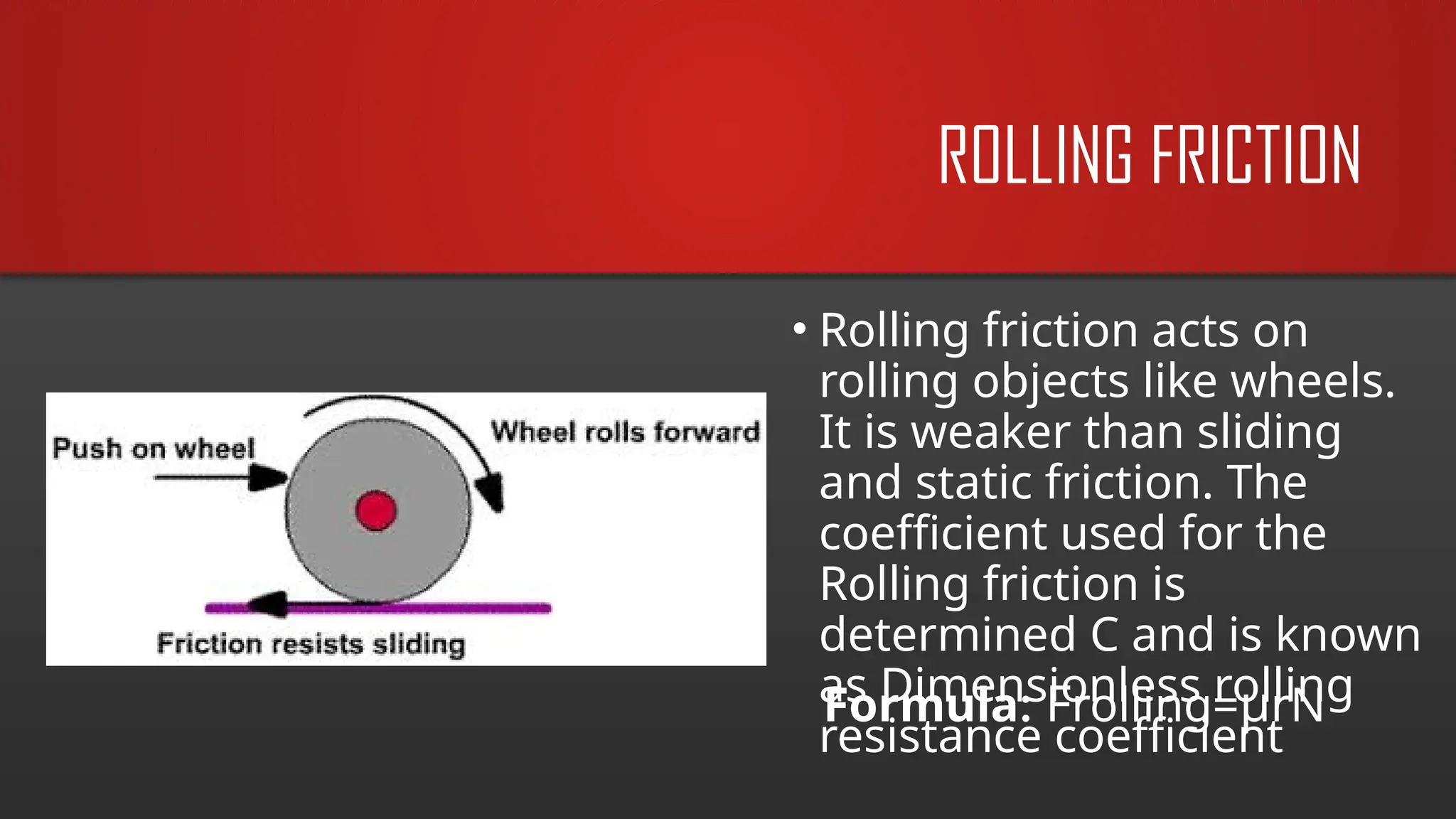
• Rolling friction acts on
rolling objects like wheels.
It is weaker than sliding
and static friction. The
coefficient used for the
Rolling friction is
determined C and is known
as Dimensionless rolling
resistance coefficient
Formula: Frolling=µrN
FLUID FRICTION
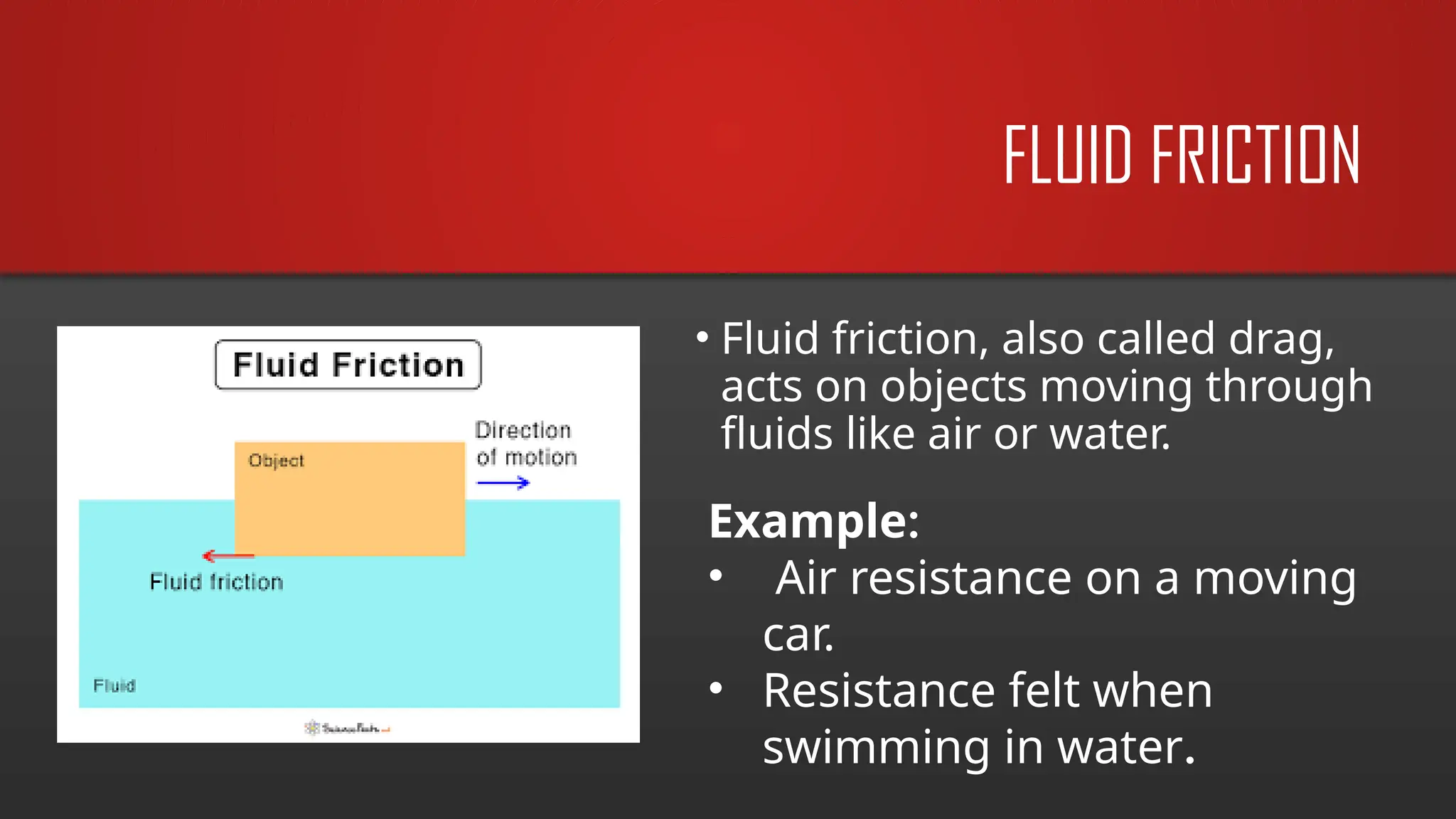
• Fluid friction, also called drag,
acts on objects moving through
fluids like air or water.
Example:
• Air resistance on a moving
car.
• Resistance felt when
swimming in water.
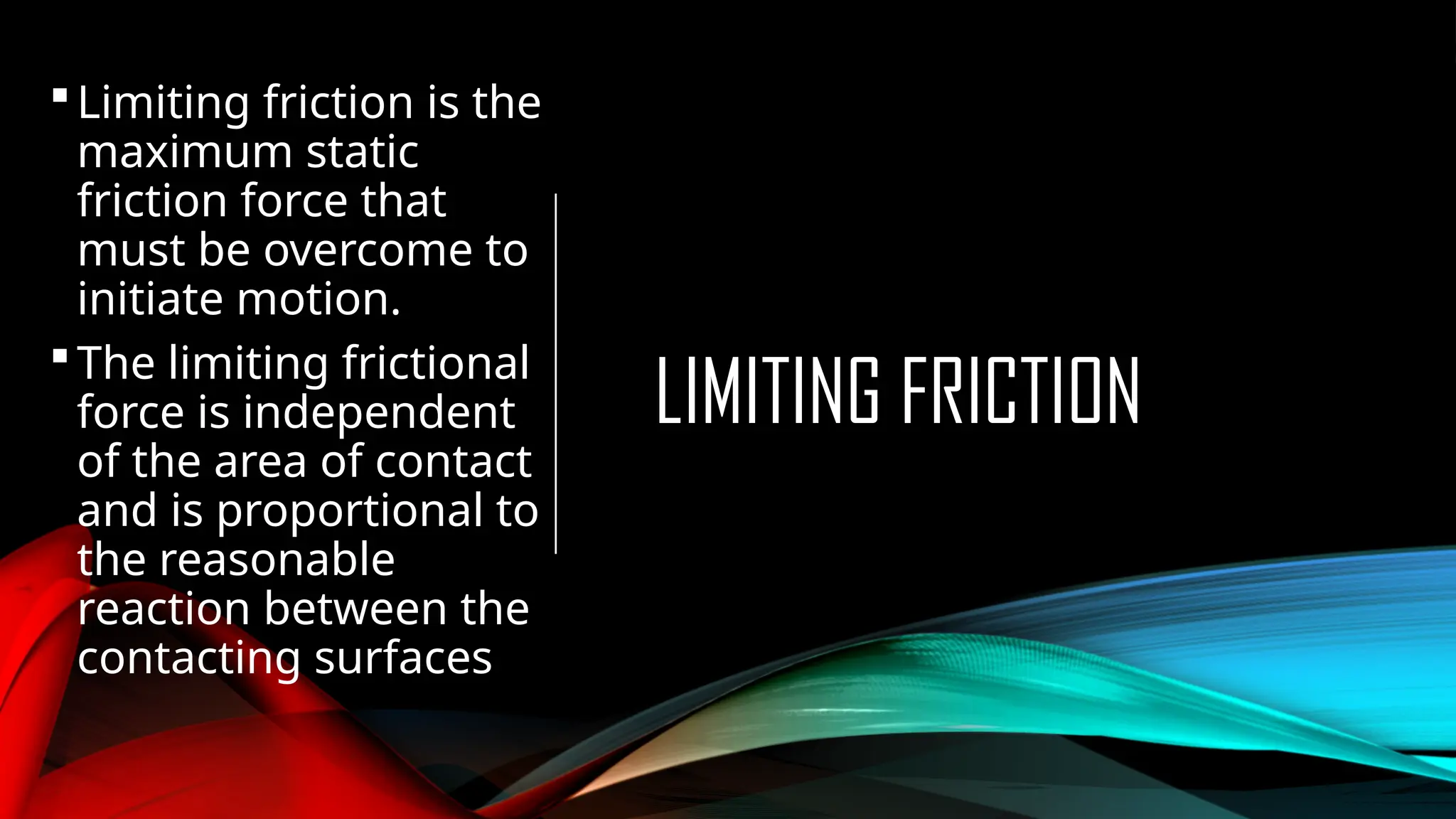
LIMITING FRICTION
Limiting friction is the
maximum static
friction force that
must be overcome to
initiate motion.
The limiting frictional
force is independent
of the area of contact
and is proportional to
the reasonable
reaction between the
contacting surfaces
FACTORS AFFECTING LIMITING FRICTION
1. NATURE OF MATERIALS
IN CONTACT.
2. SURFACE ROUGHNESS. 3. NORMAL FORCE.
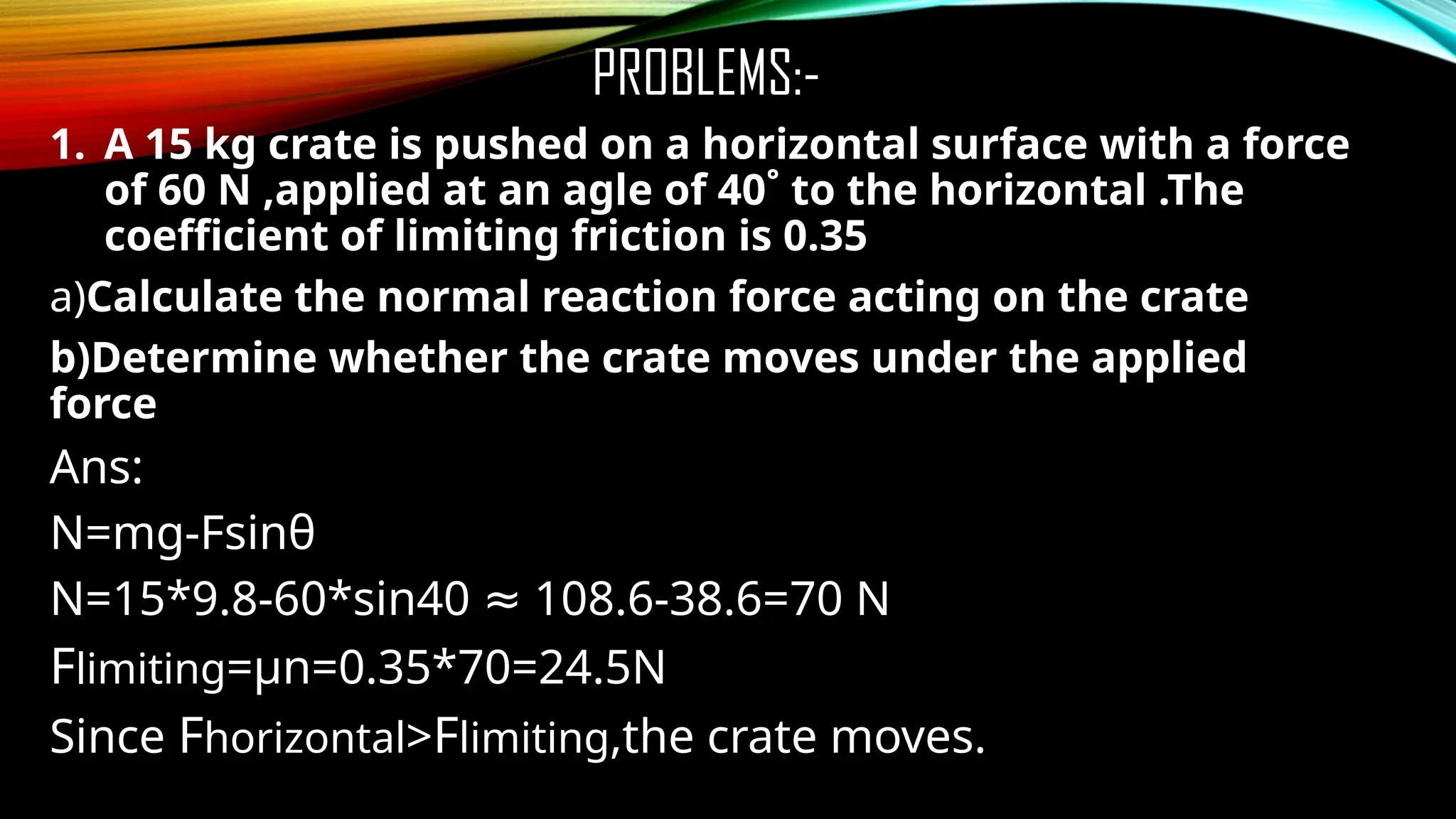
PROBLEMS:-
1. A 15 kg crate is pushed on a horizontal surface with a force
of 60 N ,applied at an agle of 40˚ to the horizontal .The
coefficient of limiting friction is 0.35
a)Calculate the normal reaction force acting on the crate
b)Determine whether the crate moves under the applied
force
Ans:
N=mg-Fsinθ
N=15*9.8-60*sin40 108.6-38.6=70 N
≈
Flimiting=µn=0.35*70=24.5N
Since Fhorizontal>Flimiting,the crate moves.
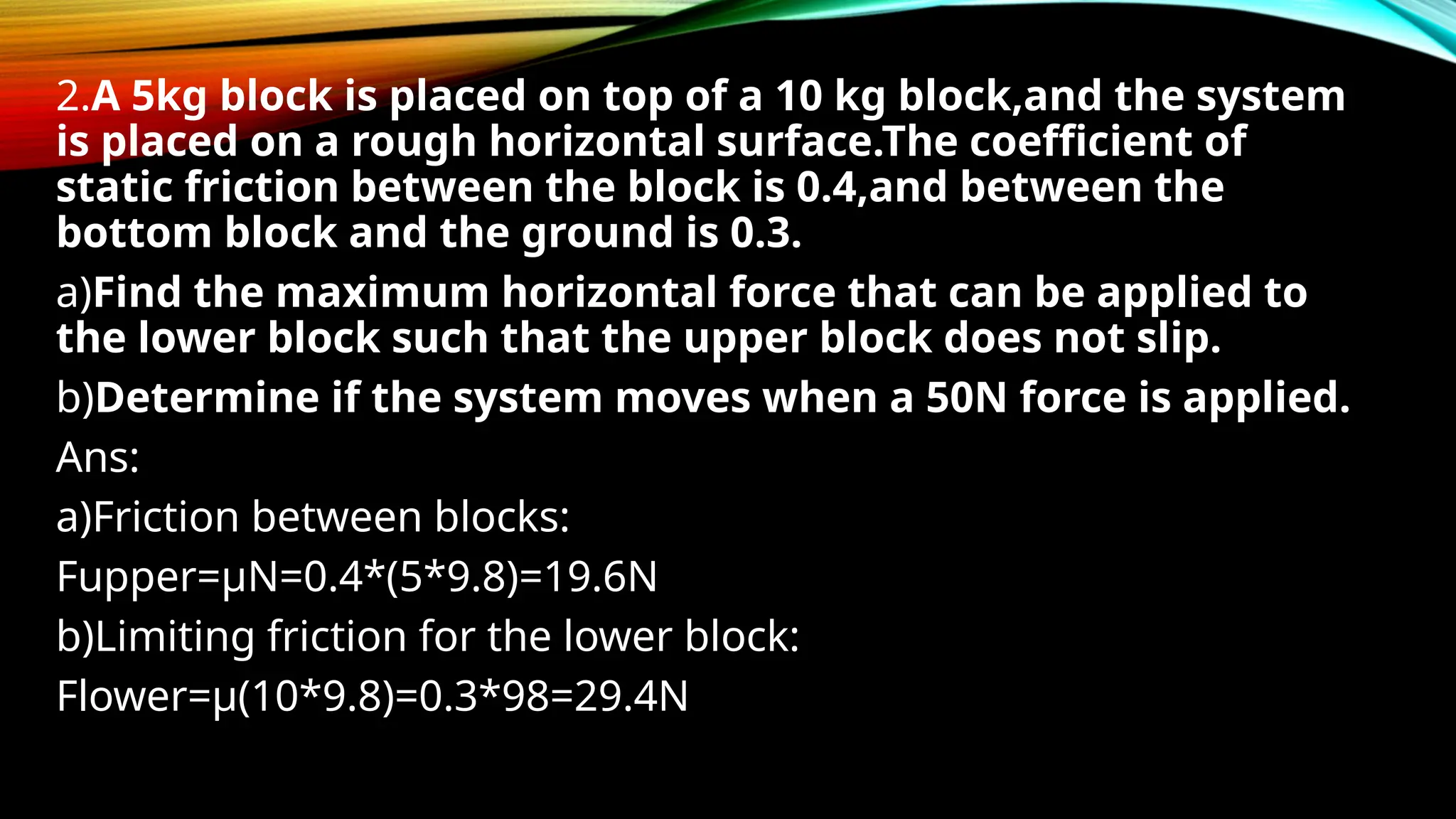
2.A 5kg block is placed on top of a 10 kg block,and the system
is placed on a rough horizontal surface.The coefficient of
static friction between the block is 0.4,and between the
bottom block and the ground is 0.3.
a)Find the maximum horizontal force that can be applied to
the lower block such that the upper block does not slip.
b)Determine if the system moves when a 50N force is applied.
Ans:
a)Friction between blocks:
Fupper=µN=0.4*(5*9.8)=19.6N
b)Limiting friction for the lower block:
Flower=µ(10*9.8)=0.3*98=29.4N
• Friction is a resistive force
essential for motion
control. and
management.We are able
to reduce friction by various
methods .
• It has various uses,types
and plays a greater role
than known in real life.
• Understanding its types
and roles helps in its
effective application
SUMMARY
Thank You
- By Shobanaa and Meghana

frictional force and types of friction.pptx

  • 1.
    Frictional Force Exploring itsRole, Limiting Friction, and Types BY: 24IR011 AND
  • 2.
    WHAT IS FRICTIONAL FORCE? •Frictional force is the resistive force that acts opposite to the direction of motion when two surfaces come in contact. It arises due to surface irregularities and interlocking of surfaces. • Friction is crucial in daily life. It enables walking, driving, writing, and more. Without friction, motion would be uncontrollable WHY IS FRICTION IMPORTANT? FORMULA:µN Here f=force of friction N=value of normal force
  • 3.
    FACTORS AFFECTING FRICTION 1. Nature ofsurfaces in contact. 2. Normal force acting between the surfaces. 3. Surface area (to a lesser extent).
  • 4.
    ROLE OF FRICTION INMOTION • Friction opposes motion but is also necessary for initiating motion. It provides grip and prevents slipping. • What role does friction play in motion? • Friction can slow things down and stop stationary things from moving. In a frictionless world, more objects would be sliding about, shoes would be difficult to keep on and it would be very difficult for people or cars to get moving or change direction.
  • 5.
    LAWS OF FRICTION:- •Friction of the moving object is proportional and perpendicular to the normal force applied on it. • The friction experienced by the object depends on the nature of the surface it is in contact with. • Friction is independent of the area of contact as long as there is an area of contact • Kinetic friction is independent of velocity. • The coefficient of static friction is greater than the coefficient of kinetic friction
  • 6.
    APPLICATIONS OF FRICTION 1.Walking and running. 2. Braking in vehicles. 3. Writing with pens or pencils. 4. Fastening objects with screws or nails.
  • 7.
    FRICTION IN NATURE 1.Animal claws provide grip. 2. Gecko feet use microscopic hairs for friction. 3. Bird wings minimize fluid friction. FRICTION IN TECHNOLOGY 1. Friction in brakes and clutches. 2. Bearings reduce friction in machinery. 3. Aerodynamics reduce fluid friction in vehicles.
  • 8.
    PROBLEMS:- 1)Force of 100Nis exerted on the box kept on the floor with the coefficient of static friction of 0.2.Find the friction force Ans:Force of static friction is given by: Fs= µsFN Here µs is the coefficient of static friction and N is the normal force. µs=0.2 and N=100 N Plugging the values in the equation, Fs=µSFN=Fs=(0.2)(100) =Fs=20 N
  • 9.
  • 10.
    STATIC FRICTION • Staticfriction acts on stationary objects to prevent them from starting to move. It is the strongest type of friction. Example: A book resting on a table does not slide even when a small force is applied Formula: Fstatic<=µsN
  • 11.
    KINETIC FRICTION(SLIDING FRICTION) •Sliding friction occurs when one object slides over another. It is less than static friction. Formula: Fkinetic=µkN Key Note: µk (coefficient of kinetic friction) is usually smaller than µs
  • 12.
    ROLLING FRICTION • Rollingfriction acts on rolling objects like wheels. It is weaker than sliding and static friction. The coefficient used for the Rolling friction is determined C and is known as Dimensionless rolling resistance coefficient Formula: Frolling=µrN
  • 13.
    FLUID FRICTION • Fluidfriction, also called drag, acts on objects moving through fluids like air or water. Example: • Air resistance on a moving car. • Resistance felt when swimming in water.
  • 14.
    LIMITING FRICTION Limiting frictionis the maximum static friction force that must be overcome to initiate motion. The limiting frictional force is independent of the area of contact and is proportional to the reasonable reaction between the contacting surfaces
  • 15.
    FACTORS AFFECTING LIMITINGFRICTION 1. NATURE OF MATERIALS IN CONTACT. 2. SURFACE ROUGHNESS. 3. NORMAL FORCE.
  • 16.
    PROBLEMS:- 1. A 15kg crate is pushed on a horizontal surface with a force of 60 N ,applied at an agle of 40˚ to the horizontal .The coefficient of limiting friction is 0.35 a)Calculate the normal reaction force acting on the crate b)Determine whether the crate moves under the applied force Ans: N=mg-Fsinθ N=15*9.8-60*sin40 108.6-38.6=70 N ≈ Flimiting=µn=0.35*70=24.5N Since Fhorizontal>Flimiting,the crate moves.
  • 17.
    2.A 5kg blockis placed on top of a 10 kg block,and the system is placed on a rough horizontal surface.The coefficient of static friction between the block is 0.4,and between the bottom block and the ground is 0.3. a)Find the maximum horizontal force that can be applied to the lower block such that the upper block does not slip. b)Determine if the system moves when a 50N force is applied. Ans: a)Friction between blocks: Fupper=µN=0.4*(5*9.8)=19.6N b)Limiting friction for the lower block: Flower=µ(10*9.8)=0.3*98=29.4N
  • 18.
    • Friction isa resistive force essential for motion control. and management.We are able to reduce friction by various methods . • It has various uses,types and plays a greater role than known in real life. • Understanding its types and roles helps in its effective application SUMMARY
  • 19.
    Thank You - ByShobanaa and Meghana