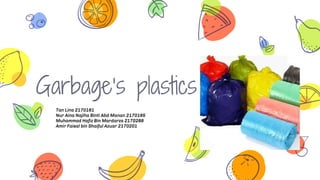
Garbage’s plastics
Tan Lina 2170161
Nur Aina Najiha Binti Abd Manan 2170165
Muhammad Hafiz Bin Mardarza 2170288
Amir Faisal bin Shaiful Azuar 2170201
Raw Materials
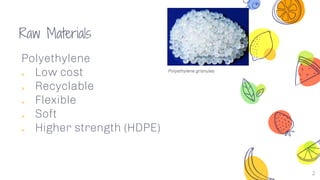
Polyethylene
༝ Low cost
༝ Recyclable
༝ Flexible
༝ Soft
༝ Higher strength (HDPE)
2
Polyethylene granules
Manufacturing process (Extrusion)
1. Putting polyethylene granules into large containers or
hoppers. (Color can be added to make the plastic attractive.)
2. Then polyethylene granules are heated to 150-200 degrees C.
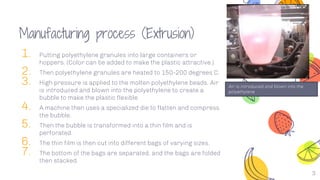
3. High pressure is applied to the molten polyethylene beads. Air
is introduced and blown into the polyethylene to create a
bubble to make the plastic flexible.
4. A machine then uses a specialized die to flatten and compress
the bubble.
5. Then the bubble is transformed into a thin film and is
perforated.
6. The thin film is then cut into different bags of varying sizes.
7. The bottom of the bags are separated, and the bags are folded
then stacked.
3
Air is introduced and blown into the
polyethylene
Performance of products
 Biodegradable (easy decomposed)
 Good tear resistance (easy to stretch and glossy)
 Aesthetics (colorful)
 fairly light weight
 High dimensional accuracy
 Strength depends on density of polyethylene
 Waterproof (good moisture barrier)
 Air tight
4
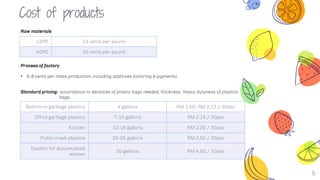
Cost of products
LDPE 13 cents per pound
HDPE 20 cents per pound
5
Raw materials
Process of factory
• 5-8 cents per mass production including additives (coloring & pigments)
Standard pricing: accordance to densities of plastic bags needed, thickness, heavy dutyness of plastics
bags.
Bathroom garbage plastics 4 gallons RM 1.50- RM 2.13 / 30psc
Office garbage plastics 7-10 gallons RM 2.15 / 30psc
Kitchen 12-16 gallons RM 2.25 / 30psc
Public trash plastics 20-25 gallons RM 2.50 / 30psc
Dustbin for accumulated
wastes
30 gallons RM 4.50 / 10psc

How It Is Made: Garbage plastics

  • 1.
    Garbage’s plastics Tan Lina2170161 Nur Aina Najiha Binti Abd Manan 2170165 Muhammad Hafiz Bin Mardarza 2170288 Amir Faisal bin Shaiful Azuar 2170201
  • 2.
    Raw Materials Polyethylene ༝ Lowcost ༝ Recyclable ༝ Flexible ༝ Soft ༝ Higher strength (HDPE) 2 Polyethylene granules
  • 3.
    Manufacturing process (Extrusion) 1.Putting polyethylene granules into large containers or hoppers. (Color can be added to make the plastic attractive.) 2. Then polyethylene granules are heated to 150-200 degrees C. 3. High pressure is applied to the molten polyethylene beads. Air is introduced and blown into the polyethylene to create a bubble to make the plastic flexible. 4. A machine then uses a specialized die to flatten and compress the bubble. 5. Then the bubble is transformed into a thin film and is perforated. 6. The thin film is then cut into different bags of varying sizes. 7. The bottom of the bags are separated, and the bags are folded then stacked. 3 Air is introduced and blown into the polyethylene
  • 4.
    Performance of products Biodegradable (easy decomposed)  Good tear resistance (easy to stretch and glossy)  Aesthetics (colorful)  fairly light weight  High dimensional accuracy  Strength depends on density of polyethylene  Waterproof (good moisture barrier)  Air tight 4
  • 5.
    Cost of products LDPE13 cents per pound HDPE 20 cents per pound 5 Raw materials Process of factory • 5-8 cents per mass production including additives (coloring & pigments) Standard pricing: accordance to densities of plastic bags needed, thickness, heavy dutyness of plastics bags. Bathroom garbage plastics 4 gallons RM 1.50- RM 2.13 / 30psc Office garbage plastics 7-10 gallons RM 2.15 / 30psc Kitchen 12-16 gallons RM 2.25 / 30psc Public trash plastics 20-25 gallons RM 2.50 / 30psc Dustbin for accumulated wastes 30 gallons RM 4.50 / 10psc