Kris Buytaert

@krisbuytaert
Infrastructure as Code Patterns
StackConf 2022, Berlin
• I used to be a developer
• Then I became an Ops person
• Chief Trolling/Travel/Technical Officer @ Inuits.eu
• Chief Yak Shaver @ o11y.eu
• Organiser of #devopsdays, #cfgmgmtcamp, #loadays, ...
• Everything is a Freaking DNS Problem
• Cofounder of all of the above
• DNS : devops needs sushi
• @krisbuytaert on twitter/github
Who am I ?
@krisbuytaert
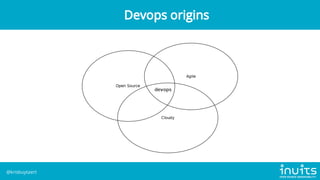
Devops origins
@krisbuytaert
A global movement to improve the quality of software delivery leveraging Open
Source experiences , started in Gent in 2009
Devops definition
@krisbuytaert
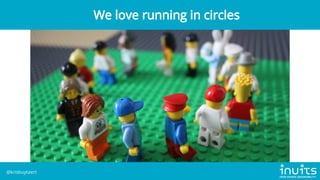
We love running in circles
@krisbuytaert
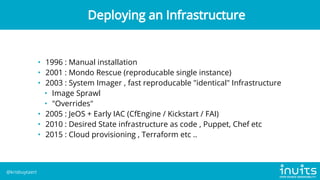
• 1996 : Manual installation
• 2001 : Mondo Rescue (reproducable single instance)
• 2003 : System Imager , fast reproducable "identical" Infrastructure
• Image Sprawl
• "Overrides"
• 2005 : JeOS + Early IAC (CfEngine / Kickstart / FAI)
• 2010 : Desired State infrastructure as code , Puppet, Chef etc
• 2015 : Cloud provisioning , Terraform etc ..
Deploying an Infrastructure
@krisbuytaert
• 1 (Snowflake) server
• Multiple (snowflake) servers (cluster nodes)
• Virtualization
• Cloud
• Containers
20+ years of changes
@krisbuytaert
• Manual error
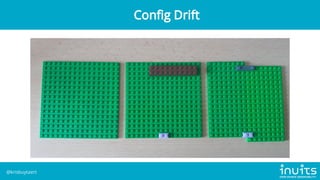
• Differences in nodes due to manual changes
• Not reproducable
• Humans
• Scale
Some of The problems
@krisbuytaert
Config Drift
@krisbuytaert
• Manually Crafted Snowflake
• Copied and modified
• Impossible to trace origin
• Impossible to reproduce
• Patching / Security nightmare
Image Sprawling & Golden Images vs JeOS
@krisbuytaert
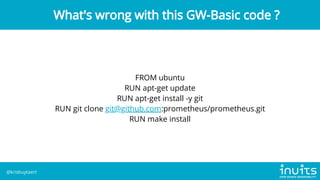
FROM ubuntu

RUN apt-get update

RUN apt-get install -y git
RUN git clone git@github.com:prometheus/prometheus.git
RUN make install
What's wrong with this GW-Basic code ?
@krisbuytaert
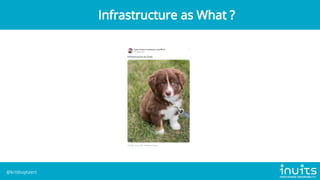
Infrastructure as What ?
@krisbuytaert
• Treat configuration automation as Code
• Model your infrastructure
• Development best practices
• Model your infrastructure
• Pipeline your Code
• Test your Code
Infrastructure as Code
@krisbuytaert
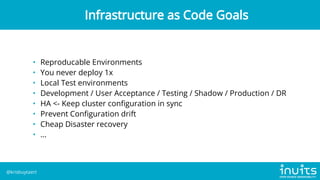
• Reproducable Environments
• You never deploy 1x
• Local Test environments
• Development / User Acceptance / Testing / Shadow / Production / DR
• HA <- Keep cluster configuration in sync
• Prevent Configuration drift
• Cheap Disaster recovery
• ...
Infrastructure as Code Goals
@krisbuytaert
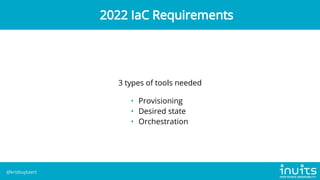
3 types of tools needed
• Provisioning
• Desired state
• Orchestration
2022 IaC Requirements
@krisbuytaert
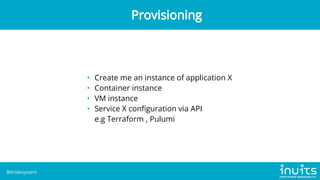
• Create me an instance of application X
• Container instance
• VM instance
• Service X configuration via API

e.g Terraform , Pulumi
Provisioning
@krisbuytaert
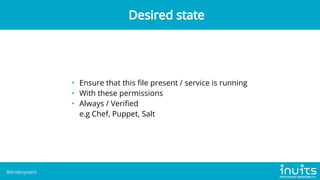
• Ensure that this file present / service is running
• With these permissions
• Always / Verified
e.g Chef, Puppet, Salt
Desired state
@krisbuytaert
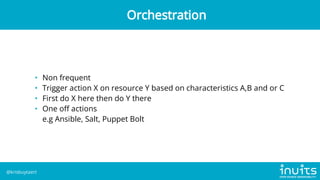
• Non frequent
• Trigger action X on resource Y based on characteristics A,B and or C
• First do X here then do Y there
• One off actions

e.g Ansible, Salt, Puppet Bolt
Orchestration
@krisbuytaert
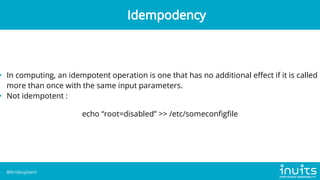
• In computing, an idempotent operation is one that has no additional effect if it is called
more than once with the same input parameters.
• Not idempotent :
echo “root=disabled” >> /etc/someconfigfile
Idempodency
@krisbuytaert
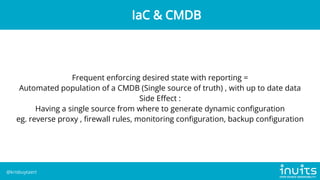
Frequent enforcing desired state with reporting =
Automated population of a CMDB (Single source of truth) , with up to date data

Side Effect :
Having a single source from where to generate dynamic configuration

eg. reverse proxy , firewall rules, monitoring configuration, backup configuration
IaC & CMDB
@krisbuytaert
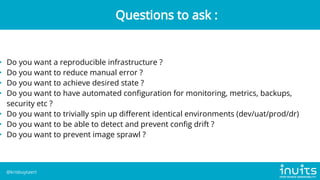
• Do you want a reproducible infrastructure ?
• Do you want to reduce manual error ?
• Do you want to achieve desired state ?
• Do you want to have automated configuration for monitoring, metrics, backups,
security etc ?
• Do you want to trivially spin up different identical environments (dev/uat/prod/dr)
• Do you want to be able to detect and prevent config drift ?
• Do you want to prevent image sprawl ?
Questions to ask :
@krisbuytaert
The Patterns
@krisbuytaert
• Code is not in source control
• Bolt / Ansible / Terraform is triggered from the admin's local machine
• Works for individual admin
• Doesn't Scale
• Prevents Collaboration
Pattern: It works from my homedir
@krisbuytaert
Improvement over $prev, but still doesn't Scale
Collaboration has been improved.
Pattern: It works from my workstation but its in git
@krisbuytaert
• Just the operating System
• Maybe some basic services
• Application is untouched
• Partial source of maybes
• Not suitable for derived configuration
• Kill your Silos
Pattern: We only automate the OS
@krisbuytaert
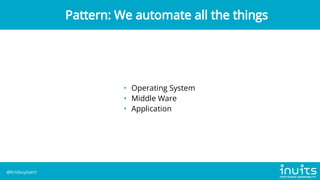
• Operating System
• Middle Ware
• Application
Pattern: We automate all the things
@krisbuytaert
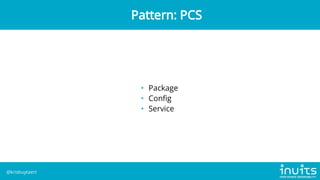
• Package
• Config
• Service
Pattern: PCS
@krisbuytaert
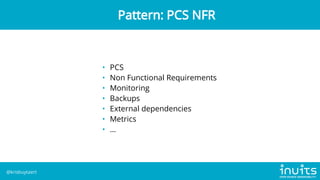
• PCS
• Non Functional Requirements
• Monitoring
• Backups
• External dependencies
• Metrics
• ...
Pattern: PCS NFR
@krisbuytaert
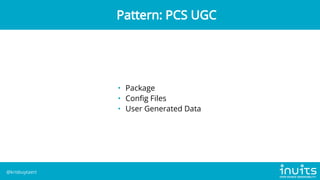
• Package
• Config Files
• User Generated Data
Pattern: PCS UGC
@krisbuytaert
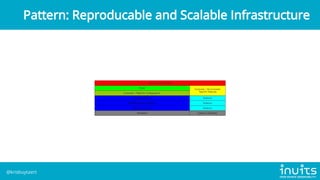
Pattern: Reproducable and Scalable Infrastructure
@krisbuytaert
• Ops use Chef but Devs use Java templating tool

or
• Terraform but Manual changes from UI.
Variants:
• Non centralized code base,

people run code from local forks undoing changes made by colleagues
• Templating tool is not idempotent (ruby sort ? / XML)
• Bonus points if the tool restarts a service on a change
Pattern: Multiple tools overwrite changes
@krisbuytaert
• Code is checked into a git repository
• The only way to apply is by central user
Pattern: Centralised apply , from source control
@krisbuytaert
• Tool is run once at deploy time then yolo
• manual changes afterwards are not identified or reversed
• State is not enforced, people are afraid to rerun playbooks
• Now we don't dare to update anymore
Orchestraition only mode, no desired state

AKA Yolo or Integrator mode
Pattern: We haven't run it for 6 months
@krisbuytaert
• Reporting says it's broken, we are not going to fix it
• Its been disabled for weeks, local modifications break it
• See Config Drift
Pattern: It's broken anyhow .
@krisbuytaert
• X < 120
• Periodically we run ensure the state of our Infrastructure
• We prevent config Drift
• We actively monitor broken runs
• We actively monitor change frequency
We have achieved desired state of our infra.
Pattern: We run it every X minutes
@krisbuytaert
• We setup everything, it worked for a while
• Then we broke service A ,
• Then something unrelated broke service B
• Automation got blamed
• We are not allowed to enable it again
• Team X doesn't trust automation,
• Often Team X = Security
• We manually make the changes now , but we have visibility on drift.
• We have semi desired state
Pattern: We run it in nooop now
@krisbuytaert
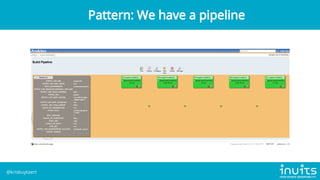
Pattern: We have a pipeline
@krisbuytaert
What is an Environment , a stack, a platform ?
A logically split of set of servers that together offer a service,
Typically existing in dev/uat/prod flavours
Environments
@krisbuytaert
• Limiting Blast radius
• Easy to spin up multiple variants
• Feature flagged code introduction
• And promotion of features
• Clear line of ownership (team bound)
• Same code , different config per environment
• Easier release management
Pattern : Using Environments
@krisbuytaert
• Huge blast radius
• Potential Scaling issues
• Difficult to "promote" changes
• Upgrade everthing or write host based if then case spaghetti
• Code duplication :

role_app_dev, role_app_uat, role_app_prod
Pattern : Not using environments
@krisbuytaert
• Typically with no environments
• Environment specific config is hardcoded
• See Config drift
Pattern: Config is hardcoded in the code
@krisbuytaert
• The same codebase is used
• Only the config data differs
• Multiple Environments possible
Pattern: Config Data defines config per environment
@krisbuytaert
• Code is run
• We will see the errors when they happen
• Code is not tested
Pattern: It we don't test
@krisbuytaert
• Every config run
• Collect information of the run,
• Store that information
• Be able to query a central source with live, correctly, machine generated data
• Reconfigure services based on changes in that data
• Full lifecycle
• Decomission instance => Automatically Clean out the data
Pattern: Single source of truth
@krisbuytaert
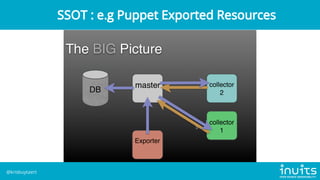
SSOT : e.g Puppet Exported Resources
@krisbuytaert
• Our Ansible playbook does a git commit to a config repo
• That repo gets checked out on the monitoring server
• Humans also modify this config
• Information is scattered over different tools
• you can't leverage the real power of automation , no dynamic reconfiguration of
resources
therefore configuration is often done manually , but through a tool
Pattern: No single source of truth
@krisbuytaert
We have one repo with all
• code
• passwords
• software binaries
Pattern: One repo for all the things
@krisbuytaert
"Blue printing"
Building a UI on top of a provisioning framework is typically an intermediate
step before people realize they either need to build in all AAA functionality and
buy a bloated tool.
Or realize git + Terraform solves these problems in a better way.
Pattern: Provisioning from a UI
@krisbuytaert
• We have written all code in house ?
• What do you mean there are modules on github to manage apache ?
• We spent about 3 months building our own
Pattern: we ignore the existing codebase group
@krisbuytaert
• Aka We do NOT understand Continuous Integration
• We have mapped our environments to git branches
• Obviously they are long running
• We are cherry picking changes from uat to prod
• We don't test those combinations
• We are in merge hell now
Puppet r10k is an antipattern.
So is running your gitops from multiple branches.
Pattern: We love Branching
@krisbuytaert
Puppet & Chef
Terraform & Pulumi
Pattern: We want a full language
@krisbuytaert
• All of these people say they are doing infrastructure as Code
• Some with 0 real benefit
• Find the patterns you like / dislike
• Implement or remove the ones you please
• My preferences might not fit your use case
Lessons Learned
@krisbuytaert
Kris Buytaert
@krisbuytaert
kris@inuits.eu
Essensteenweg 31
2930 Brasschaat
Belgium
Contact:
info@inuits.eu
+32-3-8082105

Infrastructure as Code Patterns

  • 1.
    Kris Buytaert @krisbuytaert Infrastructure asCode Patterns StackConf 2022, Berlin
  • 2.
    • I usedto be a developer • Then I became an Ops person • Chief Trolling/Travel/Technical Officer @ Inuits.eu • Chief Yak Shaver @ o11y.eu • Organiser of #devopsdays, #cfgmgmtcamp, #loadays, ... • Everything is a Freaking DNS Problem • Cofounder of all of the above • DNS : devops needs sushi • @krisbuytaert on twitter/github Who am I ? @krisbuytaert
  • 3.
  • 4.
    A global movementto improve the quality of software delivery leveraging Open Source experiences , started in Gent in 2009 Devops definition @krisbuytaert
  • 5.
    We love runningin circles @krisbuytaert
  • 6.
    • 1996 :Manual installation • 2001 : Mondo Rescue (reproducable single instance) • 2003 : System Imager , fast reproducable "identical" Infrastructure • Image Sprawl • "Overrides" • 2005 : JeOS + Early IAC (CfEngine / Kickstart / FAI) • 2010 : Desired State infrastructure as code , Puppet, Chef etc • 2015 : Cloud provisioning , Terraform etc .. Deploying an Infrastructure @krisbuytaert
  • 7.
    • 1 (Snowflake)server • Multiple (snowflake) servers (cluster nodes) • Virtualization • Cloud • Containers 20+ years of changes @krisbuytaert
  • 8.
    • Manual error •Differences in nodes due to manual changes • Not reproducable • Humans • Scale Some of The problems @krisbuytaert
  • 9.
  • 10.
    • Manually CraftedSnowflake • Copied and modified • Copied and modified • Impossible to trace origin • Impossible to reproduce • Patching / Security nightmare Image Sprawling & Golden Images vs JeOS @krisbuytaert
  • 11.
    FROM ubuntu RUN apt-getupdate RUN apt-get install -y git RUN git clone git@github.com:prometheus/prometheus.git RUN make install What's wrong with this GW-Basic code ? @krisbuytaert
  • 12.
    Infrastructure as What? @krisbuytaert
  • 13.
    • Treat configurationautomation as Code • Model your infrastructure • Development best practices • Model your infrastructure • Pipeline your Code • Test your Code Infrastructure as Code @krisbuytaert
  • 14.
    • Reproducable Environments •You never deploy 1x • Local Test environments • Development / User Acceptance / Testing / Shadow / Production / DR • HA <- Keep cluster configuration in sync • Prevent Configuration drift • Cheap Disaster recovery • ... Infrastructure as Code Goals @krisbuytaert
  • 15.
    3 types oftools needed • Provisioning • Desired state • Orchestration 2022 IaC Requirements @krisbuytaert
  • 16.
    • Create mean instance of application X • Container instance • VM instance • Service X configuration via API e.g Terraform , Pulumi Provisioning @krisbuytaert
  • 17.
    • Ensure thatthis file present / service is running • With these permissions • Always / Verified e.g Chef, Puppet, Salt Desired state @krisbuytaert
  • 18.
    • Non frequent •Trigger action X on resource Y based on characteristics A,B and or C • First do X here then do Y there • One off actions e.g Ansible, Salt, Puppet Bolt Orchestration @krisbuytaert
  • 19.
    • In computing,an idempotent operation is one that has no additional effect if it is called more than once with the same input parameters. • Not idempotent : echo “root=disabled” >> /etc/someconfigfile Idempodency @krisbuytaert
  • 20.
    Frequent enforcing desiredstate with reporting = Automated population of a CMDB (Single source of truth) , with up to date data Side Effect : Having a single source from where to generate dynamic configuration eg. reverse proxy , firewall rules, monitoring configuration, backup configuration IaC & CMDB @krisbuytaert
  • 21.
    • Do youwant a reproducible infrastructure ? • Do you want to reduce manual error ? • Do you want to achieve desired state ? • Do you want to have automated configuration for monitoring, metrics, backups, security etc ? • Do you want to trivially spin up different identical environments (dev/uat/prod/dr) • Do you want to be able to detect and prevent config drift ? • Do you want to prevent image sprawl ? Questions to ask : @krisbuytaert
  • 22.
  • 23.
    • Code isnot in source control • Bolt / Ansible / Terraform is triggered from the admin's local machine • Works for individual admin • Doesn't Scale • Prevents Collaboration Pattern: It works from my homedir @krisbuytaert
  • 24.
    Improvement over $prev,but still doesn't Scale Collaboration has been improved. Pattern: It works from my workstation but its in git @krisbuytaert
  • 25.
    • Just theoperating System • Maybe some basic services • Application is untouched • Partial source of maybes • Not suitable for derived configuration • Kill your Silos Pattern: We only automate the OS @krisbuytaert
  • 26.
    • Operating System •Middle Ware • Application Pattern: We automate all the things @krisbuytaert
  • 27.
    • Package • Config •Service Pattern: PCS @krisbuytaert
  • 28.
    • PCS • NonFunctional Requirements • Monitoring • Backups • External dependencies • Metrics • ... Pattern: PCS NFR @krisbuytaert
  • 29.
    • Package • ConfigFiles • User Generated Data Pattern: PCS UGC @krisbuytaert
  • 30.
    Pattern: Reproducable andScalable Infrastructure @krisbuytaert
  • 31.
    • Ops useChef but Devs use Java templating tool or • Terraform but Manual changes from UI. Variants: • Non centralized code base, people run code from local forks undoing changes made by colleagues • Templating tool is not idempotent (ruby sort ? / XML) • Bonus points if the tool restarts a service on a change Pattern: Multiple tools overwrite changes @krisbuytaert
  • 32.
    • Code ischecked into a git repository • The only way to apply is by central user Pattern: Centralised apply , from source control @krisbuytaert
  • 33.
    • Tool isrun once at deploy time then yolo • manual changes afterwards are not identified or reversed • State is not enforced, people are afraid to rerun playbooks • Now we don't dare to update anymore Orchestraition only mode, no desired state AKA Yolo or Integrator mode Pattern: We haven't run it for 6 months @krisbuytaert
  • 34.
    • Reporting saysit's broken, we are not going to fix it • Its been disabled for weeks, local modifications break it • See Config Drift Pattern: It's broken anyhow . @krisbuytaert
  • 35.
    • X <120 • Periodically we run ensure the state of our Infrastructure • We prevent config Drift • We actively monitor broken runs • We actively monitor change frequency We have achieved desired state of our infra. Pattern: We run it every X minutes @krisbuytaert
  • 36.
    • We setupeverything, it worked for a while • Then we broke service A , • Then something unrelated broke service B • Automation got blamed • We are not allowed to enable it again • Team X doesn't trust automation, • Often Team X = Security • We manually make the changes now , but we have visibility on drift. • We have semi desired state Pattern: We run it in nooop now @krisbuytaert
  • 37.
    Pattern: We havea pipeline @krisbuytaert
  • 38.
    What is anEnvironment , a stack, a platform ? A logically split of set of servers that together offer a service, Typically existing in dev/uat/prod flavours Environments @krisbuytaert
  • 39.
    • Limiting Blastradius • Easy to spin up multiple variants • Feature flagged code introduction • And promotion of features • Clear line of ownership (team bound) • Same code , different config per environment • Easier release management Pattern : Using Environments @krisbuytaert
  • 40.
    • Huge blastradius • Potential Scaling issues • Difficult to "promote" changes • Upgrade everthing or write host based if then case spaghetti • Code duplication : role_app_dev, role_app_uat, role_app_prod Pattern : Not using environments @krisbuytaert
  • 41.
    • Typically withno environments • Environment specific config is hardcoded • See Config drift Pattern: Config is hardcoded in the code @krisbuytaert
  • 42.
    • The samecodebase is used • Only the config data differs • Multiple Environments possible Pattern: Config Data defines config per environment @krisbuytaert
  • 43.
    • Code isrun • We will see the errors when they happen • Code is not tested Pattern: It we don't test @krisbuytaert
  • 44.
    • Every configrun • Collect information of the run, • Store that information • Be able to query a central source with live, correctly, machine generated data • Reconfigure services based on changes in that data • Full lifecycle • Decomission instance => Automatically Clean out the data Pattern: Single source of truth @krisbuytaert
  • 45.
    SSOT : e.gPuppet Exported Resources @krisbuytaert
  • 46.
    • Our Ansibleplaybook does a git commit to a config repo • That repo gets checked out on the monitoring server • Humans also modify this config • Information is scattered over different tools • you can't leverage the real power of automation , no dynamic reconfiguration of resources therefore configuration is often done manually , but through a tool Pattern: No single source of truth @krisbuytaert
  • 47.
    We have onerepo with all • code • passwords • software binaries Pattern: One repo for all the things @krisbuytaert
  • 48.
    "Blue printing" Building aUI on top of a provisioning framework is typically an intermediate step before people realize they either need to build in all AAA functionality and buy a bloated tool. Or realize git + Terraform solves these problems in a better way. Pattern: Provisioning from a UI @krisbuytaert
  • 49.
    • We havewritten all code in house ? • What do you mean there are modules on github to manage apache ? • We spent about 3 months building our own Pattern: we ignore the existing codebase group @krisbuytaert
  • 50.
    • Aka Wedo NOT understand Continuous Integration • We have mapped our environments to git branches • Obviously they are long running • We are cherry picking changes from uat to prod • We don't test those combinations • We are in merge hell now Puppet r10k is an antipattern. So is running your gitops from multiple branches. Pattern: We love Branching @krisbuytaert
  • 51.
    Puppet & Chef Terraform& Pulumi Pattern: We want a full language @krisbuytaert
  • 52.
    • All ofthese people say they are doing infrastructure as Code • Some with 0 real benefit • Find the patterns you like / dislike • Implement or remove the ones you please • My preferences might not fit your use case Lessons Learned @krisbuytaert
  • 53.
    Kris Buytaert @krisbuytaert kris@inuits.eu Essensteenweg 31 2930Brasschaat Belgium Contact: info@inuits.eu +32-3-8082105