Crooked teeth can really ruin your smile and cramp your style.
Misaligned bites can be painful, uncomfortable, and cause
digestive problems. A dentist or orthodontist can suggest
devices and offer treatment methods if you are suffering from
crooked or misaligned teeth. After conducting exams, taking
photos, and examining x-rays, one of the available options for
corrective treatment may be teeth braces. Braces
recommended by your orthodontist may consist of wires,
bands, and a variety of other removable or fixed corrective
dental appliances. Different parts of the braces perform
different functions to ensure your beautiful smile is restored.
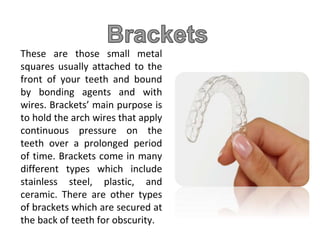
These are those small metal
squares usually attached to the
front of your teeth and bound
by bonding agents and with
wires. Brackets’ main purpose is
to hold the arch wires that apply
continuous pressure on the
teeth over a prolonged period
of time. Brackets come in many
different types which include
stainless steel, plastic, and
ceramic. There are other types
of brackets which are secured at
the back of teeth for obscurity.
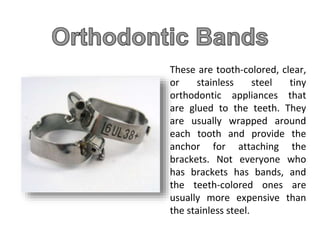
These are tooth-colored, clear,
or stainless steel tiny
orthodontic appliances that
are glued to the teeth. They
are usually wrapped around
each tooth and provide the
anchor for attaching the
brackets. Not everyone who
has brackets has bands, and
the teeth-colored ones are
usually more expensive than
the stainless steel.
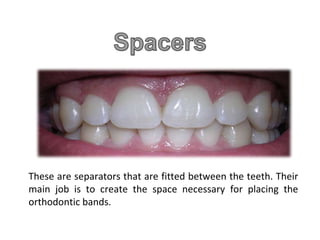
These are separators that are fitted between the teeth. Their
main job is to create the space necessary for placing the
orthodontic bands.
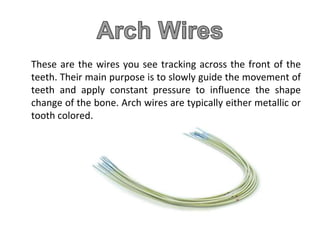
These are the wires you see tracking across the front of the
teeth. Their main purpose is to slowly guide the movement of
teeth and apply constant pressure to influence the shape
change of the bone. Arch wires are typically either metallic or
tooth colored.
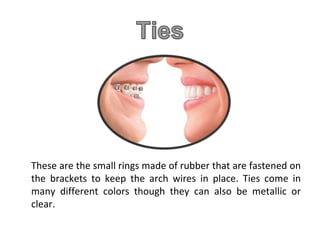
These are the small rings made of rubber that are fastened on
the brackets to keep the arch wires in place. Ties come in
many different colors though they can also be metallic or
clear.
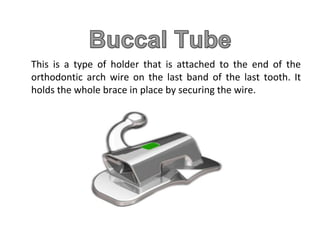
This is a type of holder that is attached to the end of the
orthodontic arch wire on the last band of the last tooth. It
holds the whole brace in place by securing the wire.
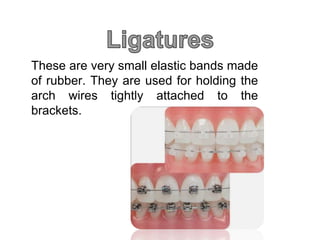
These are very small elastic bands made
of rubber. They are used for holding the
arch wires tightly attached to the
brackets.
These are spring-like dental appliances for
Houston braces that are placed in between
brackets. Their function is to either push or
pull brackets together to open or close the
space between adjacent teeth.
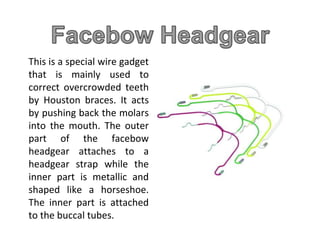
This is a special wire gadget
that is mainly used to
correct overcrowded teeth
by Houston braces. It acts
by pushing back the molars
into the mouth. The outer
part of the facebow
headgear attaches to a
headgear strap while the
inner part is metallic and
shaped like a horseshoe.
The inner part is attached
to the buccal tubes.
These individual components make up
the brace which in its entirety applies
pressure over a prolonged period to the
teeth and bone. This pressure slowly
moves the teeth in the desired direction
and changes the bone into a specific
shape.
How a Tooth Brace Works

How a Tooth Brace Works

  • 2.
    Crooked teeth canreally ruin your smile and cramp your style. Misaligned bites can be painful, uncomfortable, and cause digestive problems. A dentist or orthodontist can suggest devices and offer treatment methods if you are suffering from crooked or misaligned teeth. After conducting exams, taking photos, and examining x-rays, one of the available options for corrective treatment may be teeth braces. Braces recommended by your orthodontist may consist of wires, bands, and a variety of other removable or fixed corrective dental appliances. Different parts of the braces perform different functions to ensure your beautiful smile is restored.
  • 3.
    These are thosesmall metal squares usually attached to the front of your teeth and bound by bonding agents and with wires. Brackets’ main purpose is to hold the arch wires that apply continuous pressure on the teeth over a prolonged period of time. Brackets come in many different types which include stainless steel, plastic, and ceramic. There are other types of brackets which are secured at the back of teeth for obscurity.
  • 4.
    These are tooth-colored,clear, or stainless steel tiny orthodontic appliances that are glued to the teeth. They are usually wrapped around each tooth and provide the anchor for attaching the brackets. Not everyone who has brackets has bands, and the teeth-colored ones are usually more expensive than the stainless steel.
  • 5.
    These are separatorsthat are fitted between the teeth. Their main job is to create the space necessary for placing the orthodontic bands.
  • 6.
    These are thewires you see tracking across the front of the teeth. Their main purpose is to slowly guide the movement of teeth and apply constant pressure to influence the shape change of the bone. Arch wires are typically either metallic or tooth colored.
  • 7.
    These are thesmall rings made of rubber that are fastened on the brackets to keep the arch wires in place. Ties come in many different colors though they can also be metallic or clear.
  • 8.
    This is atype of holder that is attached to the end of the orthodontic arch wire on the last band of the last tooth. It holds the whole brace in place by securing the wire.
  • 9.
    These are verysmall elastic bands made of rubber. They are used for holding the arch wires tightly attached to the brackets.
  • 10.
    These are spring-likedental appliances for Houston braces that are placed in between brackets. Their function is to either push or pull brackets together to open or close the space between adjacent teeth.
  • 11.
    This is aspecial wire gadget that is mainly used to correct overcrowded teeth by Houston braces. It acts by pushing back the molars into the mouth. The outer part of the facebow headgear attaches to a headgear strap while the inner part is metallic and shaped like a horseshoe. The inner part is attached to the buccal tubes.
  • 12.
    These individual componentsmake up the brace which in its entirety applies pressure over a prolonged period to the teeth and bone. This pressure slowly moves the teeth in the desired direction and changes the bone into a specific shape.