BASAVKALYAN ENGINEERING COLLEGE
BASAVKALYAN
DEPARTMENT OF MECHANICAL ENGINEERING
A
SEMINAR
ON
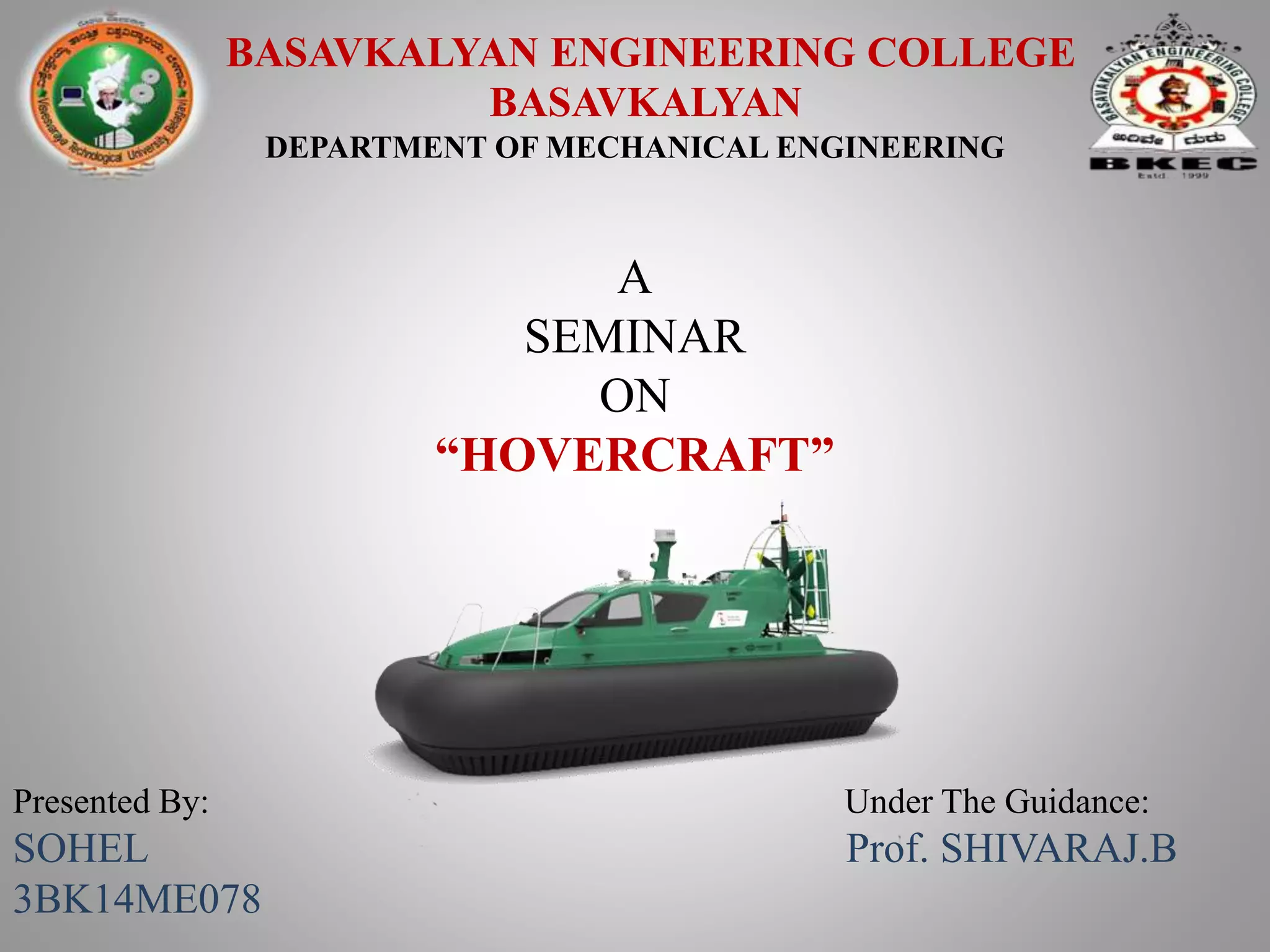
“HOVERCRAFT”
Presented By: Under The Guidance:
SOHEL Prof. SHIVARAJ.B
3BK14ME078
CONTENT
 INTRODUCTION
 HISTORY
 BASIC COMPONENT OF HOVERCRAFT
 WORKING PRINCIPLE OF HOVERCRAFT
 ADVANTAGES
 DISADVANTAGES
 APPLICATIONS
 CONCLUSION
 REFERENCES
INTODUCTION
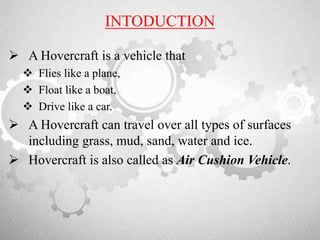
 A Hovercraft is a vehicle that
 Flies like a plane,
 Float like a boat,
 Drive like a car.
 A Hovercraft can travel over all types of surfaces
including grass, mud, sand, water and ice.
 Hovercraft is also called as Air Cushion Vehicle.
HISTORY
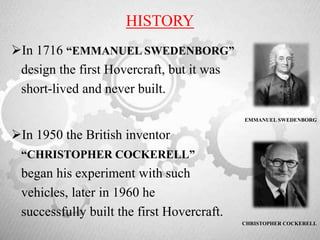
In 1716 “EMMANUEL SWEDENBORG”
design the first Hovercraft, but it was
short-lived and never built.
EMMANUEL SWEDENBORG
In 1950 the British inventor
“CHRISTOPHER COCKERELL”
began his experiment with such
vehicles, later in 1960 he
successfully built the first Hovercraft.
CHRISTOPHER COCKERELL
BASIC COMPONENTS OF
HOVERCRAFT
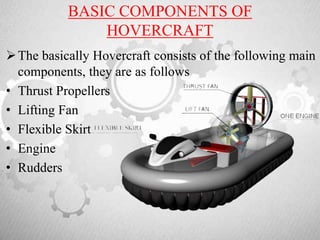
The basically Hovercraft consists of the following main
components, they are as follows
• Thrust Propellers
• Lifting Fan
• Flexible Skirt
• Engine
• Rudders
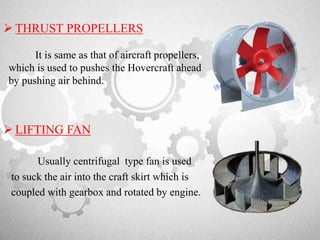
 LIFTING FAN
Usually centrifugal type fan is used
to suck the air into the craft skirt which is
coupled with gearbox and rotated by engine.
 THRUST PROPELLERS
It is same as that of aircraft propellers,
which is used to pushes the Hovercraft ahead
by pushing air behind.
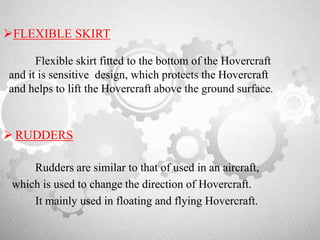
 RUDDERS
Rudders are similar to that of used in an aircraft,
which is used to change the direction of Hovercraft.
It mainly used in floating and flying Hovercraft.
FLEXIBLE SKIRT
Flexible skirt fitted to the bottom of the Hovercraft
and it is sensitive design, which protects the Hovercraft
and helps to lift the Hovercraft above the ground surface.
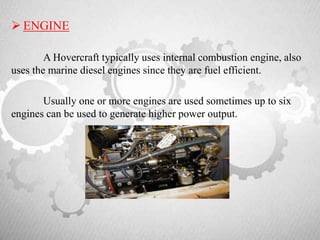
 ENGINE
A Hovercraft typically uses internal combustion engine, also
uses the marine diesel engines since they are fuel efficient.
Usually one or more engines are used sometimes up to six
engines can be used to generate higher power output.
WORKING PRINCIPLE
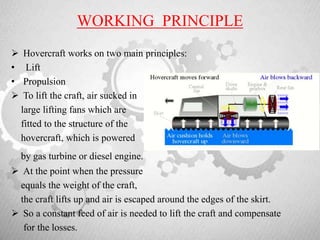
 Hovercraft works on two main principles:
• Lift
• Propulsion
 To lift the craft, air sucked in
large lifting fans which are
fitted to the structure of the
hovercraft, which is powered
by gas turbine or diesel engine.
 At the point when the pressure
equals the weight of the craft,
the craft lifts up and air is escaped around the edges of the skirt.
 So a constant feed of air is needed to lift the craft and compensate
for the losses.
 ADVATAGES
• Travel over any type of surface.
• Shortcutting the routes.
• It can travel with a great speed.
• It does not leads to accidents.
• Hovercraft are very fuel efficient.
• It can be built up any size, small to large.
 DISADVATAGES
• They produces Noise pollution.
• They are expensive.
• Potential of skirt damage.
• Not able to move easily at corner.
• It’s high speed make it difficult to control while on
land.
 APPLICATIONS
• It can be used as personal vehicle.
• As Passenger Transport and tourism related journey.
• As rescue life boat.
• In military operations.
• In racing.
• In mass transportation.
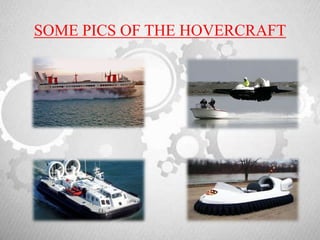
SOME PICS OF THE HOVERCRAFT
CONCLUSION
Hovercrafts are generally simple mechanisms in theory.
Yet the process from theory to manifestation is not as easy as it
may seem. A plethora of problems exist and must be faced in
order to attain a well-functioning hovercraft. The plans and
designs must be flawless. One must take under consideration the
weight and the shape of each component in order to avoid
problems such as instability and dysfunction. This is a marvelous
machine which greatly cuts down the friction which in turn helps
it to attain greater speed and more stability.
REFERENCES
• Fantoni, R. Lozano, F. Mazenc, and K. Y. Pettersen,
“Stabilization of a nonlinear under actuated hovercraft,” in
Proc. 38th IEEE Conf. Decision Control, vol. 3. Dec. 1999,
pp. 2533–2538.
• W. B. Dunbar, R. O. Saber, and R. M. Murray, “Nonlinear and
cooperative control of multiple hovercraft with input
constraints,” in Proc. IEEE Eur. Control Conf., Sep. 2003, pp.
1917–1922.
• R. Munoz-Mansilla, D. Chaos, J. Aranda, and J. M. Diaz,
“Application of quantitative feedback theory techniques for
the control of a nonholonomic under actuated hovercraft,” IET
Control Theory Appl., vol. 6, no. 14, pp. 2188–2197, Sep.
2012.
• Y. H. Hossamel-din Mechatronics Eng. Department Future
University in Egypt (FUE) Cairo, Egypt
yehia.hendawy@hti.edu.eg
THANK YOU

HOVERCRAFT PRESENTETION

  • 1.
    BASAVKALYAN ENGINEERING COLLEGE BASAVKALYAN DEPARTMENTOF MECHANICAL ENGINEERING A SEMINAR ON “HOVERCRAFT” Presented By: Under The Guidance: SOHEL Prof. SHIVARAJ.B 3BK14ME078
  • 2.
    CONTENT  INTRODUCTION  HISTORY BASIC COMPONENT OF HOVERCRAFT  WORKING PRINCIPLE OF HOVERCRAFT  ADVANTAGES  DISADVANTAGES  APPLICATIONS  CONCLUSION  REFERENCES
  • 3.
    INTODUCTION  A Hovercraftis a vehicle that  Flies like a plane,  Float like a boat,  Drive like a car.  A Hovercraft can travel over all types of surfaces including grass, mud, sand, water and ice.  Hovercraft is also called as Air Cushion Vehicle.
  • 4.
    HISTORY In 1716 “EMMANUELSWEDENBORG” design the first Hovercraft, but it was short-lived and never built. EMMANUEL SWEDENBORG In 1950 the British inventor “CHRISTOPHER COCKERELL” began his experiment with such vehicles, later in 1960 he successfully built the first Hovercraft. CHRISTOPHER COCKERELL
  • 5.
    BASIC COMPONENTS OF HOVERCRAFT Thebasically Hovercraft consists of the following main components, they are as follows • Thrust Propellers • Lifting Fan • Flexible Skirt • Engine • Rudders
  • 6.
     LIFTING FAN Usuallycentrifugal type fan is used to suck the air into the craft skirt which is coupled with gearbox and rotated by engine.  THRUST PROPELLERS It is same as that of aircraft propellers, which is used to pushes the Hovercraft ahead by pushing air behind.
  • 7.
     RUDDERS Rudders aresimilar to that of used in an aircraft, which is used to change the direction of Hovercraft. It mainly used in floating and flying Hovercraft. FLEXIBLE SKIRT Flexible skirt fitted to the bottom of the Hovercraft and it is sensitive design, which protects the Hovercraft and helps to lift the Hovercraft above the ground surface.
  • 8.
     ENGINE A Hovercrafttypically uses internal combustion engine, also uses the marine diesel engines since they are fuel efficient. Usually one or more engines are used sometimes up to six engines can be used to generate higher power output.
  • 9.
    WORKING PRINCIPLE  Hovercraftworks on two main principles: • Lift • Propulsion  To lift the craft, air sucked in large lifting fans which are fitted to the structure of the hovercraft, which is powered by gas turbine or diesel engine.  At the point when the pressure equals the weight of the craft, the craft lifts up and air is escaped around the edges of the skirt.  So a constant feed of air is needed to lift the craft and compensate for the losses.
  • 10.
     ADVATAGES • Travelover any type of surface. • Shortcutting the routes. • It can travel with a great speed. • It does not leads to accidents. • Hovercraft are very fuel efficient. • It can be built up any size, small to large.
  • 11.
     DISADVATAGES • Theyproduces Noise pollution. • They are expensive. • Potential of skirt damage. • Not able to move easily at corner. • It’s high speed make it difficult to control while on land.
  • 12.
     APPLICATIONS • Itcan be used as personal vehicle. • As Passenger Transport and tourism related journey. • As rescue life boat. • In military operations. • In racing. • In mass transportation.
  • 13.
    SOME PICS OFTHE HOVERCRAFT
  • 14.
    CONCLUSION Hovercrafts are generallysimple mechanisms in theory. Yet the process from theory to manifestation is not as easy as it may seem. A plethora of problems exist and must be faced in order to attain a well-functioning hovercraft. The plans and designs must be flawless. One must take under consideration the weight and the shape of each component in order to avoid problems such as instability and dysfunction. This is a marvelous machine which greatly cuts down the friction which in turn helps it to attain greater speed and more stability.
  • 15.
    REFERENCES • Fantoni, R.Lozano, F. Mazenc, and K. Y. Pettersen, “Stabilization of a nonlinear under actuated hovercraft,” in Proc. 38th IEEE Conf. Decision Control, vol. 3. Dec. 1999, pp. 2533–2538. • W. B. Dunbar, R. O. Saber, and R. M. Murray, “Nonlinear and cooperative control of multiple hovercraft with input constraints,” in Proc. IEEE Eur. Control Conf., Sep. 2003, pp. 1917–1922. • R. Munoz-Mansilla, D. Chaos, J. Aranda, and J. M. Diaz, “Application of quantitative feedback theory techniques for the control of a nonholonomic under actuated hovercraft,” IET Control Theory Appl., vol. 6, no. 14, pp. 2188–2197, Sep. 2012. • Y. H. Hossamel-din Mechatronics Eng. Department Future University in Egypt (FUE) Cairo, Egypt yehia.hendawy@hti.edu.eg
  • 16.