Content
Introduction
History
The First Hovercraft
Basic Structure Of Hovercraft
Principle Of Working
Advantages of Hovercraft
Future of Hovercraft
Conclusion
References
3.
Introduction
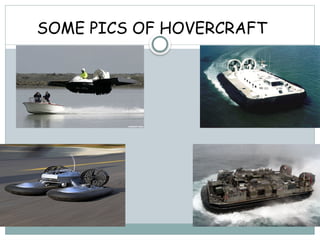
A Hovercraft isa vehicle that
Flies like a plane but
Float like a boat
Drive like a car
It can hover over or move across land or water surfaces while
being held off from the surfaces by a cushion of air.
4.
A Hovercraftcan travel over all types of
surfaces including grass, mud, muskeg, sand,
quicksand, water and ice .Hovercraft prefer
gentle terrain although they are capable of
climbing slopes up to 20%, depending upon
surface characteristics.
5.
History
The firstdesign by Swedish designer Emmanuel
Swedenborg in 1716.
The project was short-lived because it was never
built, for soon Swedenborg soon realized that to
operate such a machine required a source of
energy far greater than that could be supplied
by single human equipment.
Until the early 20th century Hovercraft was not
practically possible, because only the internal
combustion engine had the very high power to
weight ratio suitable for Hover flight.
The First Hovercraft
Christopher Cockerel thought of using a
load of stuff you might find about the
house to make a hovercraft.
Cockerel took a set of scales and a long
rod and arranged them so the rod was
vertical.
He then affixed a vacuum cleaner to the
rod so it pointed down.
Next he made a hole in a can and affixed a
can that was smaller than the first in such
a way it allowed air in-between the two
cans. Cockerel made the vacuum cleaner
blow instead of suck, blowing air through
the gap in the two cans, and it worked.
The scale went down as far as it could!.
8.
Basic Structure OfHovercraft
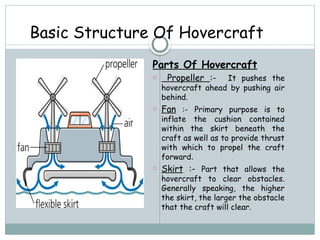
Parts Of Hovercraft
o Propeller :- It pushes the
hovercraft ahead by pushing air
behind.
o Fan :- Primary purpose is to
inflate the cushion contained
within the skirt beneath the
craft as well as to provide thrust
with which to propel the craft
forward.
o Skirt :- Part that allows the
hovercraft to clear obstacles.
Generally speaking, the higher
the skirt, the larger the obstacle
that the craft will clear.
9.
Principle Of Working
TOLIFT THE CRAFT BY A CUSHION OF AIR TO
PROPEL IT
USING PROPELLERS.
The air sucked in through a port by large
lifting
fans which are fitted to the primary
structure
of the craft.
They are powered by gas turbine or diesel
engine.
10.
Fan is usedto inflate the skirt and rest is
ducted down under the craft to fill area
enclosed by the skirt.
At the point when the pressure equals the
weight of the craft, the craft lifts up and
air is
escaped around the edges of the skirt.
So a constant feed of air is needed to lift
the
craft and compensate for the losses.
11.
ADVANTAGES OF HOVERCRAFT
Travel over any surface.
Shortcutting routes.
Travel rivers up as fast as down, irrespective
of the current.
Travel in dry water-beds.
No collision with debris, logs etc.
Access to 75% of coastal area instead of
only 5% with conventional vessels.
12.
Hovercraft arevery fuel efficient (CO²
friendly)
as Hovercraft do not have to plough through the
water but "fly" above the surface. At maximum
speed fuel consumption of a Hovercraft is
approx.
70% less than of a fast patrol boat with similar
payload capacity.
No turbulence or impact in water as no propeller
churns up the water so sea life remains
untouched
13.
FUTURE OF HOVERCRAFT
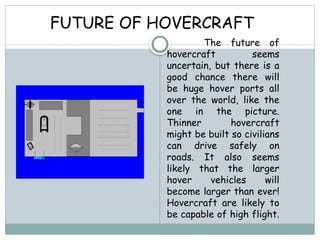
Thefuture of
hovercraft seems
uncertain, but there is a
good chance there will
be huge hover ports all
over the world, like the
one in the picture.
Thinner hovercraft
might be built so civilians
can drive safely on
roads. It also seems
likely that the larger
hover vehicles will
become larger than ever!
Hovercraft are likely to
be capable of high flight.
14.
CONCLUSION
Hovercrafts are generallysimple mechanisms in
theory. Yet the process from theory to manifestation is
not as easy as it may seem.
A plethora of problems exist and must be faced in order to
attain a well functioning hovercraft.
The plans and designs must be flawless. One must take
under consideration the weight and the shape of each
component in order to avoid problems such as instability
and dysfunction.
One thing is certain; when building a hovercraft, be well
aware of the demands of construction. Be prepared and
willing to embrace failure for it is the only way to success.
Only after failed attempts will you be able to finally design
an effective hovercraft.