November 2016
Conversation
Staffordshire and
Stoke-on-Trent
Working together to improve local
health and social care
1
The purpose of this event
• Understand the challenges facing our local health and social care
services
• Look at some of the potential options available to us
• Begin to think about some of the more difficult decisions we may have to
make
• Listen to your views, feedback and ideas
• Work together going forward to help bring about long-lasting, positive
improvements for everyone
2
Our local NHS and social care services
• Everyone deserves good quality, safe health and social care, regardless
of background
• We must make the best possible use of taxpayers money
• Standards of care should be consistently high
• Most services should be as close to where you live as possible
• You should be able to go home as soon as treatment is completed and it
is safe to discharge you
3
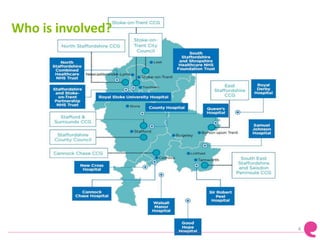
Who is involved?
4
…and you
5
• We all need to think and act differently if we are to improve our health
and well being
• We need your help and ideas
Please note:
• This is not a consultation event
• No decisions about major changes to local services will be made without
extensive public consultation and feedback
Challenges facing the local health and care system
6
1. We’re spending too much money but not seeing
enough improvements as a result
2. Our major hospitals are struggling to meet quality
standards and demand
3. We’re not always providing the right care at the right
time in the right way
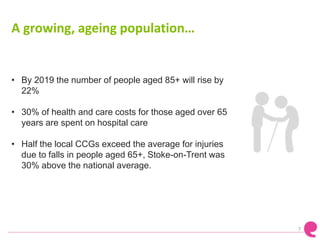
A growing, ageing population…
• By 2019 the number of people aged 85+ will rise by
22%
• 30% of health and care costs for those aged over 65
years are spent on hospital care
• Half the local CCGs exceed the average for injuries
due to falls in people aged 65+, Stoke-on-Trent was
30% above the national average.
7
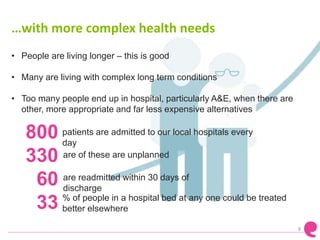
…with more complex health needs
• People are living longer – this is good
• Many are living with complex long term conditions
• Too many people end up in hospital, particularly A&E, when there are
other, more appropriate and far less expensive alternatives
8
patients are admitted to our local hospitals every
day
800
330
60
33
are of these are unplanned
are readmitted within 30 days of
discharge
% of people in a hospital bed at any one could be treated
better elsewhere
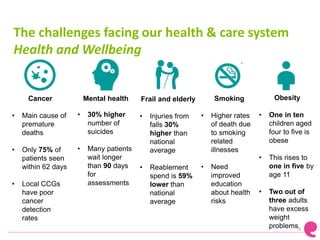
The challenges facing our health & care system
Health and Wellbeing
9
Cancer
• Main cause of
premature
deaths
• Only 75% of
patients seen
within 62 days
• Local CCGs
have poor
cancer
detection
rates
Mental health
• 30% higher
number of
suicides
• Many patients
wait longer
than 90 days
for
assessments
Frail and elderly
• Injuries from
falls 30%
higher than
national
average
• Reablement
spend is 59%
lower than
national
average
Smoking
• Higher rates
of death due
to smoking
related
illnesses
• Need
improved
education
about health
risks
Obesity
• One in ten
children aged
four to five is
obese
• This rises to
one in five by
age 11
• Two out of
three adults
have excess
weight
problems
10
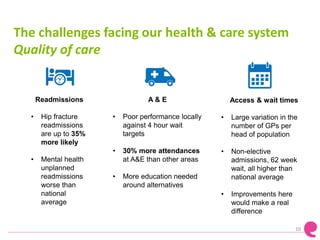
Readmissions
• Hip fracture
readmissions
are up to 35%
more likely
• Mental health
unplanned
readmissions
worse than
national
average
A & E
• Poor performance locally
against 4 hour wait
targets
• 30% more attendances
at A&E than other areas
• More education needed
around alternatives
Access & wait times
• Large variation in the
number of GPs per
head of population
• Non-elective
admissions, 62 week
wait, all higher than
national average
• Improvements here
would make a real
difference
The challenges facing our health & care system
Quality of care
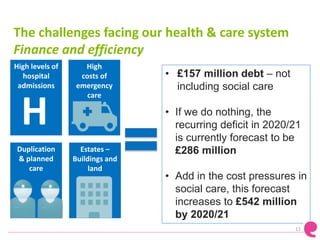
• £157 million debt – not
including social care
• If we do nothing, the
recurring deficit in 2020/21
is currently forecast to be
£286 million
• Add in the cost pressures in
social care, this forecast
increases to £542 million
by 2020/21
High levels of
hospital
admissions
High
costs of
emergency
care
Duplication
& planned
care
Estates –
Buildings and
land
11
H
The challenges facing our health & care system
Finance and efficiency
Having an honest and difficult conversation
• Can we really continue to try and run a system that was put in place
almost 70 years ago?
• Where could our money be better spent?
• What can we do without, do less of or do in a more effective and efficient
way?
• We need to be brave enough to rethink the idea that a hospital is always
the best place to go when you are unwell
• We need to recognise that we could all do more to look after our own
health to help ease the burden on local services
• There are lots of opportunities to improve the way health and social care
is delivered, including the use of technology – bringing services to people
rather than the other way around 12
Emerging hypotheses
• We all need to work together to reduce demand
• Right care, right place, right time
• More education needed around alternatives to A&E
• Take more responsibility for our care, where possible
• Help people stay at home and independent for longer
• Improve quality
• Help people to stay fit and healthy for as long as possible
13
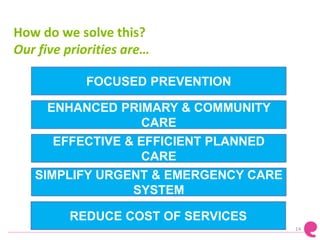
How do we solve this?
Our five priorities are…
14
FOCUSED PREVENTION
ENHANCED PRIMARY & COMMUNITY
CARE
EFFECTIVE & EFFICIENT PLANNED
CARE
SIMPLIFY URGENT & EMERGENCY CARE
SYSTEM
REDUCE COST OF SERVICES
New models of care
15
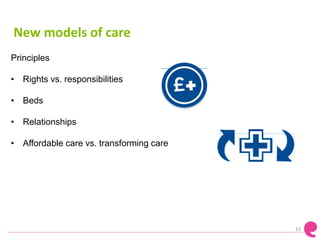
Principles
• Rights vs. responsibilities
• Beds
• Relationships
• Affordable care vs. transforming care
16
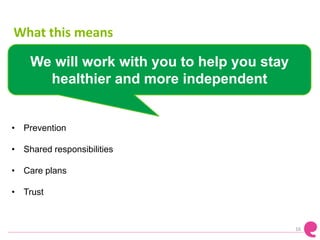
We will work with you to help you stay
healthier and more independent
• Prevention
• Shared responsibilities
• Care plans
• Trust
What this means
17
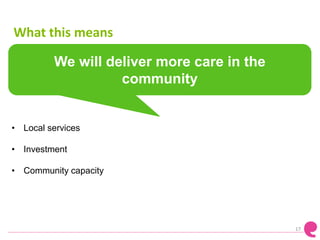
We will deliver more care in the
community
• Local services
• Investment
• Community capacity
What this means
18
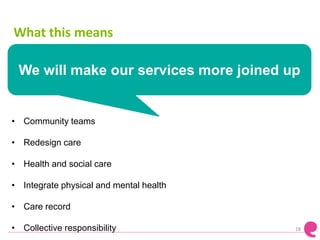
We will make our services more joined up
• Community teams
• Redesign care
• Health and social care
• Integrate physical and mental health
• Care record
• Collective responsibility
What this means
19
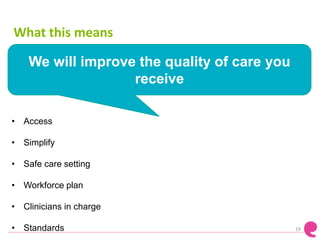
We will improve the quality of care you
receive
• Access
• Simplify
• Safe care setting
• Workforce plan
• Clinicians in charge
• Standards
What this means
20
And if you go to hospital…
We will treat you more efficiently and
discharge you as soon as you are ready
• Admit?
• Take your mental health as seriously as your physical health
• Recover at home
• More day cases
• Separate planned and emergency care
• Centres of excellence
Things to consider…
• This is not a consultation – but our discussions may help to inform
future consultations
• We want you to give us your views, feedback and ideas
• What have you seen that could be done better? Where do you think
money could be better spent? What services mean the most to you
and how can we improve them?
• If most of the care you need is closer to home, how far is acceptable to
travel for specialist care?
21
Would you like to know more?
22

STP - Conversation Events - Stoke-on-Trent

  • 1.
    November 2016 Conversation Staffordshire and Stoke-on-Trent Workingtogether to improve local health and social care 1
  • 2.
    The purpose ofthis event • Understand the challenges facing our local health and social care services • Look at some of the potential options available to us • Begin to think about some of the more difficult decisions we may have to make • Listen to your views, feedback and ideas • Work together going forward to help bring about long-lasting, positive improvements for everyone 2
  • 3.
    Our local NHSand social care services • Everyone deserves good quality, safe health and social care, regardless of background • We must make the best possible use of taxpayers money • Standards of care should be consistently high • Most services should be as close to where you live as possible • You should be able to go home as soon as treatment is completed and it is safe to discharge you 3
  • 4.
  • 5.
    …and you 5 • Weall need to think and act differently if we are to improve our health and well being • We need your help and ideas Please note: • This is not a consultation event • No decisions about major changes to local services will be made without extensive public consultation and feedback
  • 6.
    Challenges facing thelocal health and care system 6 1. We’re spending too much money but not seeing enough improvements as a result 2. Our major hospitals are struggling to meet quality standards and demand 3. We’re not always providing the right care at the right time in the right way
  • 7.
    A growing, ageingpopulation… • By 2019 the number of people aged 85+ will rise by 22% • 30% of health and care costs for those aged over 65 years are spent on hospital care • Half the local CCGs exceed the average for injuries due to falls in people aged 65+, Stoke-on-Trent was 30% above the national average. 7
  • 8.
    …with more complexhealth needs • People are living longer – this is good • Many are living with complex long term conditions • Too many people end up in hospital, particularly A&E, when there are other, more appropriate and far less expensive alternatives 8 patients are admitted to our local hospitals every day 800 330 60 33 are of these are unplanned are readmitted within 30 days of discharge % of people in a hospital bed at any one could be treated better elsewhere
  • 9.
    The challenges facingour health & care system Health and Wellbeing 9 Cancer • Main cause of premature deaths • Only 75% of patients seen within 62 days • Local CCGs have poor cancer detection rates Mental health • 30% higher number of suicides • Many patients wait longer than 90 days for assessments Frail and elderly • Injuries from falls 30% higher than national average • Reablement spend is 59% lower than national average Smoking • Higher rates of death due to smoking related illnesses • Need improved education about health risks Obesity • One in ten children aged four to five is obese • This rises to one in five by age 11 • Two out of three adults have excess weight problems
  • 10.
    10 Readmissions • Hip fracture readmissions areup to 35% more likely • Mental health unplanned readmissions worse than national average A & E • Poor performance locally against 4 hour wait targets • 30% more attendances at A&E than other areas • More education needed around alternatives Access & wait times • Large variation in the number of GPs per head of population • Non-elective admissions, 62 week wait, all higher than national average • Improvements here would make a real difference The challenges facing our health & care system Quality of care
  • 11.
    • £157 milliondebt – not including social care • If we do nothing, the recurring deficit in 2020/21 is currently forecast to be £286 million • Add in the cost pressures in social care, this forecast increases to £542 million by 2020/21 High levels of hospital admissions High costs of emergency care Duplication & planned care Estates – Buildings and land 11 H The challenges facing our health & care system Finance and efficiency
  • 12.
    Having an honestand difficult conversation • Can we really continue to try and run a system that was put in place almost 70 years ago? • Where could our money be better spent? • What can we do without, do less of or do in a more effective and efficient way? • We need to be brave enough to rethink the idea that a hospital is always the best place to go when you are unwell • We need to recognise that we could all do more to look after our own health to help ease the burden on local services • There are lots of opportunities to improve the way health and social care is delivered, including the use of technology – bringing services to people rather than the other way around 12
  • 13.
    Emerging hypotheses • Weall need to work together to reduce demand • Right care, right place, right time • More education needed around alternatives to A&E • Take more responsibility for our care, where possible • Help people stay at home and independent for longer • Improve quality • Help people to stay fit and healthy for as long as possible 13
  • 14.
    How do wesolve this? Our five priorities are… 14 FOCUSED PREVENTION ENHANCED PRIMARY & COMMUNITY CARE EFFECTIVE & EFFICIENT PLANNED CARE SIMPLIFY URGENT & EMERGENCY CARE SYSTEM REDUCE COST OF SERVICES
  • 15.
    New models ofcare 15 Principles • Rights vs. responsibilities • Beds • Relationships • Affordable care vs. transforming care
  • 16.
    16 We will workwith you to help you stay healthier and more independent • Prevention • Shared responsibilities • Care plans • Trust What this means
  • 17.
    17 We will delivermore care in the community • Local services • Investment • Community capacity What this means
  • 18.
    18 We will makeour services more joined up • Community teams • Redesign care • Health and social care • Integrate physical and mental health • Care record • Collective responsibility What this means
  • 19.
    19 We will improvethe quality of care you receive • Access • Simplify • Safe care setting • Workforce plan • Clinicians in charge • Standards What this means
  • 20.
    20 And if yougo to hospital… We will treat you more efficiently and discharge you as soon as you are ready • Admit? • Take your mental health as seriously as your physical health • Recover at home • More day cases • Separate planned and emergency care • Centres of excellence
  • 21.
    Things to consider… •This is not a consultation – but our discussions may help to inform future consultations • We want you to give us your views, feedback and ideas • What have you seen that could be done better? Where do you think money could be better spent? What services mean the most to you and how can we improve them? • If most of the care you need is closer to home, how far is acceptable to travel for specialist care? 21
  • 22.
    Would you liketo know more? 22

Editor's Notes

  • #5 Working together to develop a five-year plan to join up the system to give everyone the high quality, safe health and social care services they deserve.
  • #6 We all need to think and act differently if we are to improve our health and well being We want to make sure as many people as possible are given the opportunity to join the discussion and give their views, feedback and ideas on how they see the future of local health and care services Please note: This is not a consultation event, but the discussions we have today may inform future consultations No decisions about major changes to local services will be made without extensive public consultation and feedback
  • #7  We’re spending too much money but not seeing enough improvement as a result The local NHS and social care organisations have been spending far more than we can afford for a number of years now hoping it will fix things. This has resulted in rising and unacceptable levels of debt. Unfortunately, this has not resulted in significant improvements in the health and well -being of local people. This is not a good use of your tax money and needs to improve.   Our major hospitals are struggling to meet quality standards and demand Our major hospitals have highly publicised and on-going difficulties in meeting the quality standards set by the NHS at a national level, including unacceptably high waiting times to access A&E departments or to receive non-urgent operations. They are also struggling to meet increasing demand on their services, particularly from patients who would be better treated elsewhere, such as more specialised, more accessible treatment centres.   We’re not always providing the right care at the right time in the right way We are struggling to provide the right packages of social and community care to allow frail and older people to return home from hospital quickly and in some cases this means that people lose the ability to remain independent and in control. Put simply you - our staff, our patients and your families deserve better than this and we want to work with you to develop the solutions to address these problems.
  • #8 Our population is aging… Between 2014 and 2019 the number of people aged 85+ will rise by 22% 30% of health and care costs for those aged over 65 years are spent on hospital care Half the CCGs exceed the average for injuries due to falls in people aged 65+, Stoke-on-Trent was 30% above the national average.
  • #10 Cancer Main cause of premature deaths – twice as high as heart disease and stroke Poor waiting times and diagnoses – only 75% of patients seen within 62 days Local CCGs have poor cancer detection rates Mental health 30% higher number of suicides as well as more detentions than other local areas Four out of six local CCGs had patients waiting longer than 90 days for assessments Frail and elderly Injuries from falls for Stoke-on-Trent 30% higher than national average Reablement upon discharge from hospital is 59% lower than national average Improve treatment and help maintain independence Smoking Higher rates of death due to smoking related illnesses in Stoke-on-Trent, Newcastle and Cannock Stopping can help, but never starting is better Need improved education about health risks Obesity One in ten children aged four to five is obese This rises to one in five by age 11 Two out of three adults have excess weight problems
  • #14 More collaboration between all service providers and all types of care is needed quickly to help reduce demand and ensure you receive the right treatment from the most appropriate place of care Solving demand issues by changing behaviours and improving education around alternatives to A&E will move us from an expensive ‘urgent’ healthcare system to a much more planned and preventative one, with patients having more control We will all need to be more involved in and take responsibility for our own health where appropriate to help ease unnecessary burden on services We need to reduce the reliance on bed based care to allow people to stay at home rather than in hospitals or residential homes Implementing consistent quality standards across the system will give a better service to patients and reduce unnecessary costs due to issues like duplication of treatments Providing people with the advice and support to help them to stay fit and healthy for as long as possible is not only the right thing to do but will help reduce costs
  • #15 Focused prevention – Focus investment and prevention activities on tackling the top 3 issues e.g. obesity, smoking and diabetes along with addressing health inequalities Enhance primary & community care – enhance and integrate primary and community care to enable frail elderly and those with LTCs to live independent lives and avoid unnecessary, costly and upsetting emergency episodes Simplify urgent & emergency care system – Simplify emergency and urgent care services across the system to reduce avoidable a&e attendances and non-elective admissions Reduce cost of services – Accelerate the delivery of productivity and efficiency plans. Reduce total bed capacity and rationalise estates. Increase provider collaboration to reduce management costs.
  • #16 Focused prevention – Focus investment and prevention activities on tackling the top 3 issues e.g. obesity, smoking and diabetes along with addressing health inequalities Enhance primary & community care – enhance and integrate primary and community care to enable frail elderly and those with LTCs to live independent lives and avoid unnecessary, costly and upsetting emergency episodes Simplify urgent & emergency care system – Simplify emergency and urgent care services across the system to reduce avoidable a&e attendances and non-elective admissions Reduce cost of services – Accelerate the delivery of productivity and efficiency plans. Reduce total bed capacity and rationalise estates. Increase provider collaboration to reduce management costs.
  • #17 Examples of how we will do it Focus on specific causes of illness Improve the speed at which we diagnose Share responsibility for staying well and get you more involved in your own healthcare What this means to you Cancer diagnoses and treatment will be better, quicker and easier We will help you take more responsibility for managing your own health where it is safe and appropriate to do so
  • #18 Examples of how we will do it Invest in general practices and community care Move resources to where they’re needed most, including centres of excellence Plan services around the needs of local communities instead of having hospitals at the centre What this means to you You will see the right person for your need Basic care needs will be easier to access closer to home Avoid the stress and pressure of unnecessary hospital visits You may have to travel further for specialist treatment
  • #19 Examples of how we will do it Create a safe and secure electronic patient record sharing service Reduce the amount of forms you need to fill in Invest in local community teams with people from a variety of professions and with a wide range of skills What this means to you Information about your care will be shared safely, securely and appropriately with those caring for you so you don’t need to keep repeating your information You will see more joined-up working between those caring for you, even across organisations
  • #20 Examples of how we will do it Improve access to your GP Simplify the emergency & urgent care system so it’s easier to know where is best to get help Expand access to 24/7 services, particularly mental health What this means to you It will be easier for you to get appointments with your GP and the number of GPs, nurses and clinicians will go up The quality of care you receive will be excellent regardless of where you go i.e. GP, walk in centre, pharmacy
  • #21 Examples of how we will do it Assess you more quickly and ensure you are only admitted to hospital when it is necessary and right for you Ensure your mental health is taken as seriously as your physical health Discharge you from hospital as soon as it is safe and you are medically fit and then help you to recover in your own home, where appropriate What this means to you Less time ‘stuck’ in hospital You won’t have to travel as far for routine tests i.e. blood tests If you are sent to another place of care as part of your treatment, ensure the relevant parts of your care information follows you