Host Cell Protein Analysis
Measuring the Forest,
Or Counting the Trees?
Ted Kocot
IBC Life Sciences Conference
15 May 2010
2
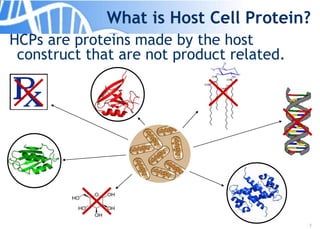
What is Host Cell Protein?
HCPs are proteins made by the host
construct that are not product related.
3
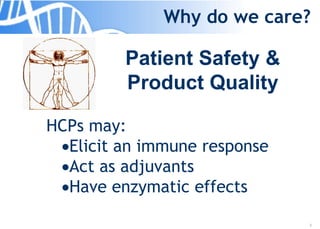
Why do we care?
Patient Safety &
Product Quality
HCPs may:
Elicit an immune response
Act as adjuvants
Have enzymatic effects
4
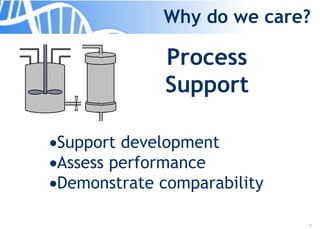
Why do we care?
Process
Support
Support development
Assess performance
Demonstrate comparability
5
Why do we care?
Regulatory
Expectation
Release Testing
Process Validation
6
Frequently Asked Questions
“How much HCP is in
my sample?”
“Is that low enough?”
7
The Challenges
HCPs are:
Proteinaceous
Identical to our products to many method
Diverse
E. coli have ≈4000 protein encoding genes
Heterogenous
A wide range of properties
Rare
Parts per million sensitivity is required
8
The Challenges
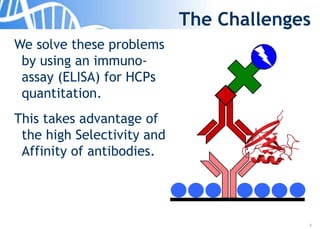
We solve these problems
by using an immuno-
assay (ELISA) for HCPs
quantitation.
This takes advantage of
the high Selectivity and
Affinity of antibodies.
9
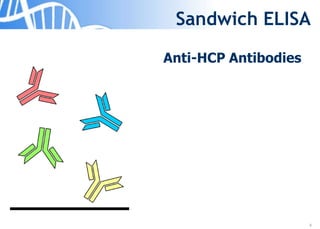
Sandwich ELISA
Anti-HCP Antibodies
10
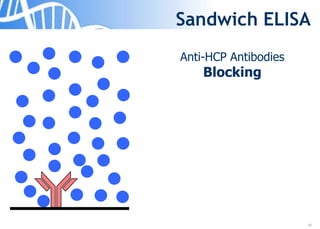
Sandwich ELISA
Anti-HCP Antibodies
Blocking
11
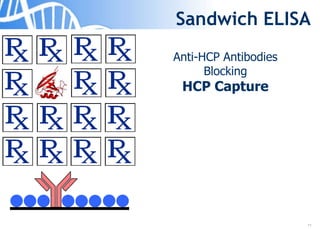
Sandwich ELISA
Anti-HCP Antibodies
Blocking
HCP Capture
12
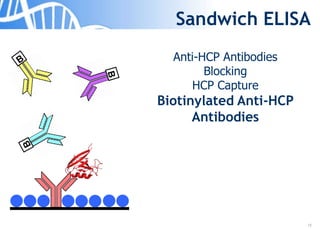
Sandwich ELISA
Anti-HCP Antibodies
Blocking
HCP Capture
Biotinylated Anti-HCP
Antibodies
13
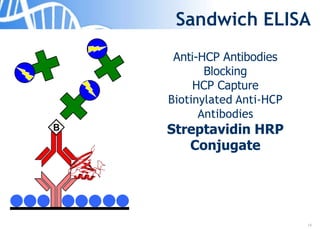
Sandwich ELISA
Anti-HCP Antibodies
Blocking
HCP Capture
Biotinylated Anti-HCP
Antibodies
Streptavidin HRP
Conjugate
B
14
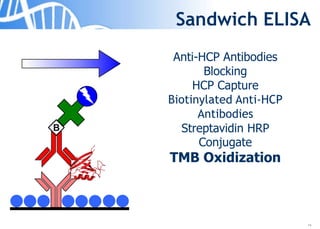
Sandwich ELISA
Anti-HCP Antibodies
Blocking
HCP Capture
Biotinylated Anti-HCP
Antibodies
Streptavidin HRP
Conjugate
TMB Oxidization
B
15
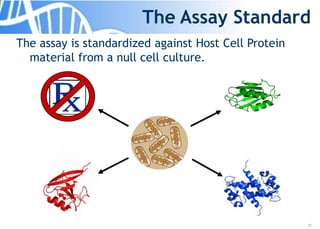
The Assay Standard
The assay is standardized against Host Cell Protein
material from a null cell culture.
16
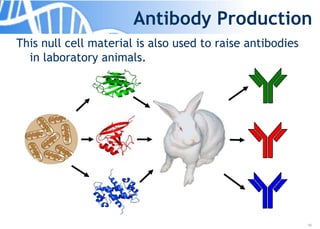
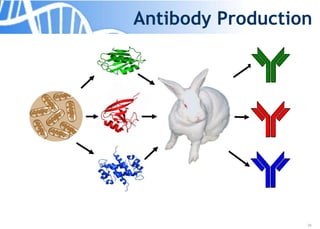
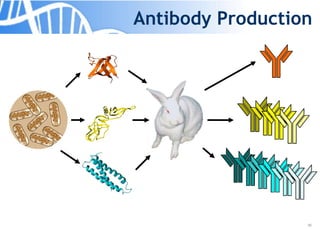
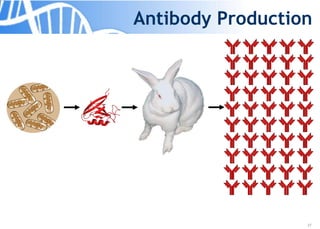
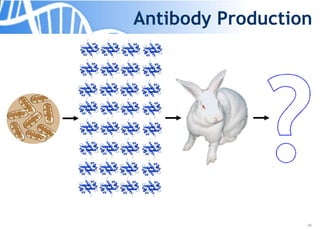
Antibody Production
This null cell material is also used to raise antibodies
in laboratory animals.
17
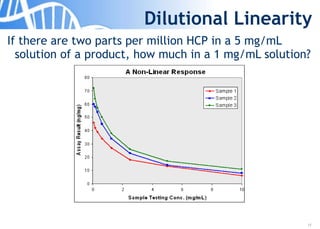
Dilutional Linearity
If there are two parts per million HCP in a 5 mg/mL
solution of a product, how much in a 1 mg/mL solution?
18
Dilutional Linearity
OK, a lot of discussion:
19
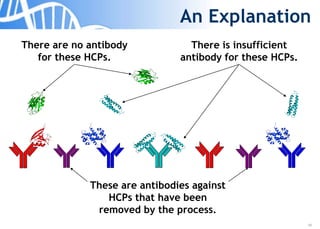
An Explanation
There are no antibody
for these HCPs.
These are antibodies against
HCPs that have been
removed by the process.
There is insufficient
antibody for these HCPs.
20
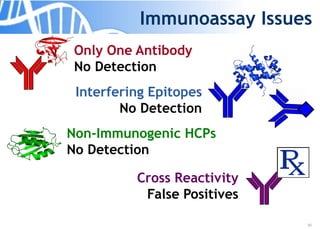
Immunoassay Issues
Only One Antibody
No Detection
Non-Immunogenic HCPs
No Detection
Interfering Epitopes
No Detection
Cross Reactivity
False Positives
21
HCP ELISAs: Linearity
In a DoE exercise designed to improve
HCP assay linearity it was found:
Changes in the assay
conditions had different
effects on different sample
types.
Which is not too surprising, except...
22
HCP ELISAs: Linearity
In a DoE exercise designed to improve HCP assay
linearity it was found:
Changes in the assay conditions had
different effects on different sample types.
And for one sample type:
“Lower Coating Antibody
concentration is better…”
This is completely contrary to the conventional
wisdom!
23
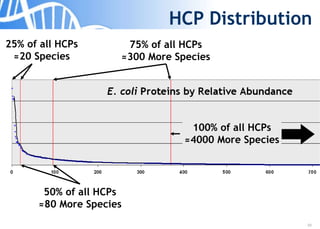
HCP Distribution
25% of all HCPs
≈20 Species
50% of all HCPs
≈80 More Species
75% of all HCPs
≈300 More Species
100% of all HCPs
≈4000 More Species
24
Antibody Production
25
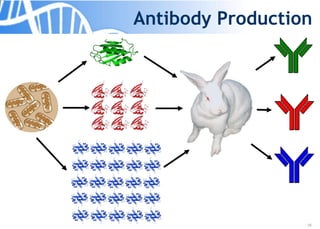
Antibody Production
26
Antibody Production
27
Antibody Production
28
Antibody Production
29
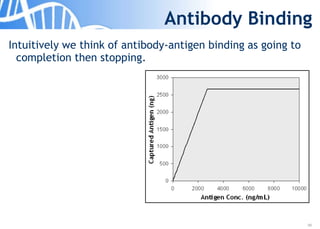
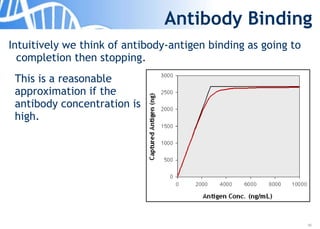
Antibody Binding
Intuitively we think of antibody-antigen binding as going to
completion then stopping.
30
Antibody Binding
Intuitively we think of antibody-antigen binding as going to
completion then stopping.
This is a reasonable
approximation if the
antibody concentration is
high.
31
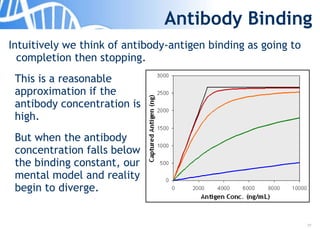
Antibody Binding
Intuitively we think of antibody-antigen binding as going to
completion then stopping.
This is a reasonable
approximation if the
antibody concentration is
high.
But when the antibody
concentration falls below
the binding constant, our
mental model and reality
begin to diverge.
32
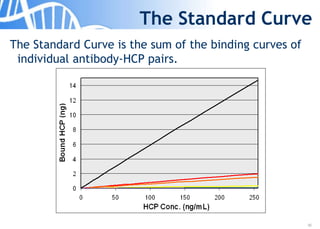
The Standard Curve
The Standard Curve is the sum of the binding curves of
individual antibody-HCP pairs.
33
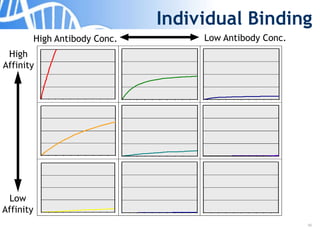
Individual Binding
High Antibody Conc.
Low
Affinity
High
Affinity
Low Antibody Conc.
34
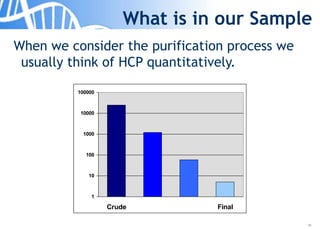
What is in our Sample
When we consider the purification process we
usually think of HCP quantitatively.
1
10
100
1000
10000
100000
Crude Final
35
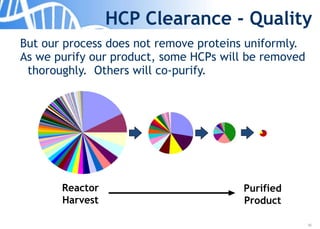
HCP Clearance - Quality
But our process does not remove proteins uniformly.
As we purify our product, some HCPs will be removed
thoroughly. Others will co-purify.
Reactor
Harvest
Purified
Product
36
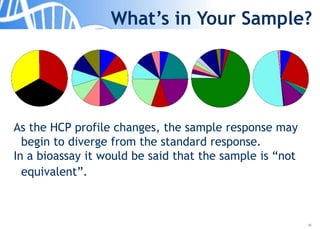
What’s in Your Sample?
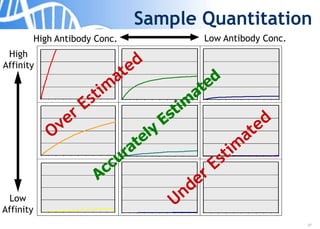
As the HCP profile changes, the sample response may
begin to diverge from the standard response.
In a bioassay it would be said that the sample is “not
equivalent”.
37
Sample Quantitation
High Antibody Conc.
Low
Affinity
High
Affinity
Low Antibody Conc.
38
Going Forward
So, given all this, what practices
suggest themselves?
 Test at a uniform product concentration (or
concentrations).
or
 Test at multiple concentrations (but always
the same concentrations) and report an
average.
39
Going Forward
So, given all this, what practices
suggest themselves?
Run the assay as a limit test standardizing
against material from an engineering run.
NOTE: There are a lot of complications, both
technically and logistically, inherent in this
approach, so I cannot seriously recommend it. But,
if dilutional linearity was our only issue, this would
be the solution.
40
Going Forward
Watch out for the things our ELISA
assay might not be telling us!
 Western Blots – reveals a few HCPs in
large abundance.
 Silver Stained Gels and Mass
Spectrometry – reveals HCPs present in
abundance but not seen by our
antibody pool.
41
Finally
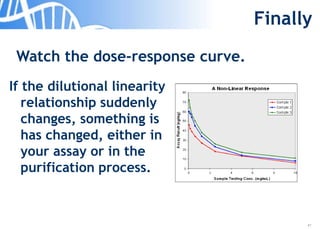
Watch the dose-response curve.
If the dilutional linearity
relationship suddenly
changes, something is
has changed, either in
your assay or in the
purification process.
42
Acknowledgements
Mark Abrams
Sean Concannon
Aparna Deora
Ned Mozier
Asenath Rasmussen
Tom Schomogy
Xing Wang
Kristine Wells

Host Cell Protein Analysis - Measuring the Forest, or Counting theTrees