Prepared by: TIMSNA D., THAPA T. Page i
Healthcare Waste Management Plan
Guiding Document on Effective Healthcare Waste
Management at District (Trishuli) Hospital Nuwakot.
January 2017
ii
Introduction:
Hospital produces many type of waste material. Broadly hospital waste is
categorized into risk healthcare waste and non-risk healthcare waste. Major hospital
wastes are generated as a result of clinical and housekeeping activity. Hospital
waste is a potential reservoir of pathogenic microorganism and requires appropriate,
safe and reliable handling. Proper management of hospital waste can minimize the
risks both within and outside healthcare facility. It is essential that hospital waste
should be collected, stored and disposed in a proper process with standard
technique. Proper hospital waste management is a prerequisite to minimize hospital
acquired infection. However, one of the major problems District Trishuli Hospital is
facing is management of Healthcare Waste (HCW) which increases the risk of
infection, injury and environmental pollution. HCW might affect the waste generators
as well as waste handlers, patients and general public.
For effective healthcare waste management in a hospital, it is important to have a
guiding document. District Trishuli Hospital has necessity of HCWM plan as a
reference document to improve healthcare waste management measures of hospital.
Hospital Situation: Based on HCWM assessment report
A waste generation survey (7 days) was conducted at the DTH from August 03-09,
2016 with the objective of identifying current situation of hospital on healthcare waste
management. With the average patient occupancy of 63%, it is revealed that the
daily waste generation from DTH, Nuwakot is 35.13 Kg out of which 23.61 Kg
(67.20%) is general healthcare waste (Non-hazardous) while remaining 11.52 Kg
(32.8%) is healthcare risk waste. As per WHO standard, Waste in HCF should be
around 20% hazardous and 80% non-hazardous.
Major findings of the survey depicted-
1. Healthcare risk waste and non-risk healthcare waste were not segregated
properly.
2. The waste collection bins were found in inappropriate place, inadequate in
number and without information labeling.
3. The waste management items such as Needle cutter, Medication trolley,
Transportation trolley, Autoclave machine, shredder etc. were in insufficient
quantity.
4. Solid waste generated inside the hospital was transported manually (without
use of any trolley or cart) by the support staffs to dump in pit.
5. Infectious and general wastes were mixed and burnt openly which increased
the risk of exposure to toxic emissions.
6. Waste was disposed without treatment which further increases volume of
infectious health care waste.
7. DTH has placenta pit to dispose pathological waste such as placenta.
8. The healthcare waste management committee in hospital was not functional
state.
iii
9. There was no provision for regular supervision and monitoring in healthcare
waste management practices.
10.Hospital has not annual plan to improve safety and prevent future problem in
HCWM.
Rationale for healthcare waste management plan:
 One of the expected outcomes of Nepal Health Sector Strategy (2015-2020)
is improved infection prevention and healthcare waste management practices
in health institution.
 The Health Care Waste management Guideline, 2014 clearly elaborates,
"Each HCF shall be responsible for the development of waste management
plan for their HCF, outlining the accountabilities and responsibilities of
managers, employees and staffs. The HCF shall comply with guidelines, to
ensure proper HCWM i.e. proper classification, segregation, collection,
transportation, treatment and disposal."
 The assessment report indicated that there is need of a technical assistance
from supporting agency to prepare HCWM plan for the hospital.
 As hospital receives different grants such as MD grant, NSI grant for Hospital
Management Strengthening Program (HMSP), support from S2HSP for
healthcare waste management. Some percentage of these grants is allocated
for HCW management of hospital.
 There are potential private sectors interested to buy treated and reusable
health care waste in Nuwakot.
Objective:
The overall objective of this Healthcare Waste Management Plan is to provide a
complete framework on effective healthcare waste management measures for
District Trishuli Hospital.
Indicators:
Following indicators with mentioned target will be applied to measure the
effectiveness of healthcare of waste management intervention I DTH.
 Reduce healthcare risk waste from 32.8% to 20%
 Increase compliance of waste management practices from X% to Y%.
Healthcare waste management plan:
A comprehensive waste management plan is made based on an assessment of the
current situation of hospital on healthcare waste management practices. This plan
minimizes the amount of waste generated and guides for safe and efficient waste
management. While developing the waste management plan, the team considered
the following points:
iv
• Existing policies, laws, regulations and guidelines related to HCWM.
• Recent assessment report of healthcare waste management for DTH.
• Feedback from hospital management committee, GIZ staffs and consultant on
assessment report
• Existing and future need of the hospital.
• Suggestions from Management Division for healthcare waste management in
hospital.
Basic steps in health care waste management
In the context of District (Trishuli) Hospital, following basic steps are considered
essential for the proper waste management:
1. Re-activation of health care waste management committee
In order to conduct the health care waste management activities within the
hospital, every hospital should have functioning HCWMC committee having
following members
 Chief/Director of Hospital
 Department Head
 Matron
 Waste management officer
 Reprehensive from support staff
S2HSP,Nuwakot will support hospital for activation of HCWMC and assign roles
and responsibility to exercise on waste management practices.
2. Appoint responsible person for health care waste management
HCWM committee will have a focal person to implement the waste management
plan of hospital. She/he will play liaison role between HCWMC and hospital
administration to address identified issues and way forward.
3. Raise awareness at the management level on the importance of HCWM plan
The management of hospital needs to recognize the importance of good
healthcare waste management so that they should assign designated responsible
staff for overseeing the situation. For this continuous discussion will be made
between S2HSP, Nuwakot members and HCWMC members which will further
sensitize hospital management on healthcare waste management.
4. Determine the most appropriate measures on:
a) Waste minimization measures.
Currently DTH has not initiated any waste minimization actions which is an
initial steps of waste management. Waste minimization at source level can be
the one of the best intervention to reduce operational cost of hospital. Based
v
on Healthcare waste assessment report, following methods will be appropriate
for Trishuli hospital to minimize waste.
 Waste reduction at source:
This includes product substitution, product change, and procedural change.
Some examples are-
Product substitution:
- substituting disposal cups with reusable cups in hospital canteen
Procedural change:
- Adopting simple changes to patient care products- e.g. when preparing for
dressing, cleaning and sterile procedures, practitioners will critically assess
material required, supply and use only the needed amount. Only the needed
materials shall be sterilized and used so that repeated sterilization of excess
materials is avoided.
- Promoting the prevention of wastages of products, e.g. in nursing and
cleaning activities.
- Digitalization of hospital procedures- e.g. introduction of electronic medical
recording (EMR) in the hospital, substituting paper memos with email etc.
 Preference to recyclable and reusable items
Certain healthcare waste can be re-used to minimize waste. The reusable
items should be carefully washed and sterilized before its next use.
Reusable items in Trishuli Hospital include:
- Glass: It can be reuse vials for sample collection in lab after disinfecting them.
- Gloves: It can be reuse after disinfecting and sterilizing them.
Recyclable items in Trishuli Hospital include:
- Vials and Ampule
- Gloves, IV set, NS bottle, Syringe
- Aluminum/steel cans and trays
- Paper and card board etc.
b) Waste segregation of health care waste
The assessment report on the healthcare waste showed that around 67% of total
waste generated is general waste and 33% is healthcare risk waste. This
revealed that still more efforts are essential to reduce volume of infectious waste.
For this, following activities on waste segregation and collection will be very
appropriate;
 Requirement of Color Coded Bins with information label for General and
Healthcare risk waste Segregation
 Location of waste segregation points at department/ward level
 Identify level of waste segregation at different departments and provide
waste management items accordingly.
 Routine for laundry collection( since laundry procedure often can be applied
to healthcare waste collection)
vi
 Orientation of hospital staffs on waste segregation
 Develop mechanism for the regular orientation of admitted patient and visitor
on waste segregation
 PPE should be worn while during waste segregation.
c) Appropriate waste transportation procedures
It is an efficient movement of healthcare waste from point of generation to
treatment. Collection frequency on room to room basis is once every shift. Bag
should be labeled with their point of production and also replace immediately.
The waste disposal plan of hospital should include procedure for onsite and off-
site transport of waste.
Onsite transport:
 Onsite transport of waste from the point of generation to an assembly
storage or treatment area should be carried by wheeled trolleys.
 Hazardous/infectious HCW and non-risk HCW should be transported on
separate trolleys.
 The transportation must follow specific routes through the hospital to
reduce the passage of loaded carts through wards and other clean areas.
 The on-site collection vehicle must be cleaned and disinfected daily using
chlorine solution, phenolic compounds.
 Persons transporting the waste should be equipped with appropriate
protective equipment.
Off-site transport:
 The hospital is responsible for safe packaging and appropriate labeling to
the waste to be transported off-site and for authorization of its destination
i.e. at the landfill site
 All the waste should be treated well before its transportation to landfill.
 Vehicles used for transporting must be stop and park at appropriate site to
reduce spread of contamination.
d) Treatment and Disposal
 On site practices for healthcare waste treatment such as sterilization and
chemical disinfection can be used for infectious waste
 Practices for on-site disposal e.g. septic vault for sharp waste, encapsulation
for pharmaceutical waste, municipal landfill for treated infectious waste,
placenta pit for pathological waste can be applied.
5. Develop and implement annual HCWM operational plan.
Hospital should have or develop HCWM operational plans including daily routines
for collection, handling, segregation and packaging of different categories of
waste.
vii
6. Capacity building of health care workers through comprehensive training
and orientation
All healthcare staff should be aware of the technical aspect of hospital’s basic
healthcare waste management and their role in the plan. For this hospital will
arrange training on waste management and on its implementation plan. Training
should include
 Basic information about HCWM
 Health hazards of poor management of HCW
 Basic information on hospital healthcare waste management plan
 Technical instruction on application of the practices described in the waste
management plan.
 Individual employee’s responsibility and role in healthcare waste
management
7. Ensure adequate resources to increase efficiency of HCWM
Every year hospital is getting budget through Management Division grant for the
improvement of healthcare waste management. Similarly, hospital can coordinate
with local bodies such as CDO, Municipality to get resources and for the further
management of HCW.
8. Monitoring and supervision
Monitoring is the process of regularly reviewing achievements towards the goal. It
helps to identify loop holes, bottle necks and expose the issues which have come
in managing the HCWs. Baseline monitoring will be done by using IRAT tools for
healthcare waste management.
viii
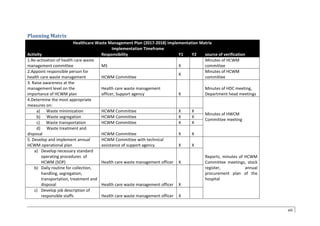
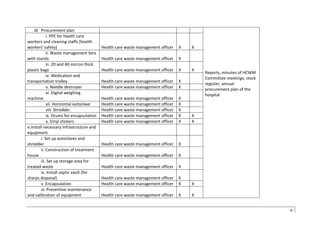
Planning Matrix
Healthcare Waste Management Plan (2017-2018) Implementation Matrix
Implementation Timeframe
Activity Responsibility Y1 Y2 source of verification
1.Re-activation of health care waste
management committee MS X
Minutes of HCWM
committee
2.Appoint responsible person for
health care waste management HCWM Committee
X
Minutes of HCWM
committee
3. Raise awareness at the
management level on the
importance of HCWM plan
Health care waste management
officer, Support agency X
Minutes of HDC meeting,
Department head meetings
4.Determine the most appropriate
measures on:
Minutes of HWCM
Committee meeting
a) Waste minimization HCWM Committee X X
b) Waste segregation HCWM Committee X X
c) Waste transportation HCWM Committee X X
d) Waste treatment and
disposal HCWM Committee X X
5. Develop and implement annual
HCWM operational plan
HCWM Committee with technical
assistance of support agency X X
Reports, minutes of HCWM
Committee meetings, stock
register, annual
procurement plan of the
hospital
a) Develop necessary standard
operating procedures of
HCWM (SOP) Health care waste management officer X
b) Daily routine for collection,
handling, segregation,
transportation, treatment and
disposal Health care waste management officer X
c) Develop job description of
responsible staffs Health care waste management officer X
ix
d) Procurement plan
Reports, minutes of HCWM
Committee meetings, stock
register, annual
procurement plan of the
hospital
i. PPE for health care
workers and cleaning staffs (health
workers' safety) Health care waste management officer X X
ii. Waste management bins
with stands Health care waste management officer X
iii. 20 and 40 micron thick
plastic bags Health care waste management officer X X
iv. Medication and
transportation trolley Health care waste management officer X
v. Needle destroyer Health care waste management officer X
vi. Digital weighing
machine Health care waste management officer X
vii. Horizontal autoclave Health care waste management officer X
viii. Shredder Health care waste management officer X
ix. Drums for encapsulation Health care waste management officer X X
x. Vinyl stickers Health care waste management officer X X
e.Install necessary infrastructure and
equipment
i. Set up autoclaves and
shredder Health care waste management officer X
ii. Construction of treatment
house Health care waste management officer X
iii. Set up storage area for
treated waste Health care waste management officer X
iv. Install septic vault (for
sharps disposal) Health care waste management officer X
v. Encapsulation Health care waste management officer X X
vi. Preventive maintenance
and calibration of equipment Health care waste management officer X X
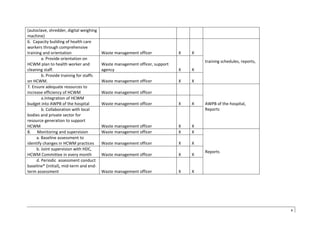
x
(autoclave, shredder, digital weighing
machine)
6. Capacity building of health care
workers through comprehensive
training and orientation Waste management officer X X
training schedules, reports,
a. Provide orientation on
HCWM plan to health worker and
cleaning staff.
Waste management officer, support
agency X X
b. Provide training for staffs
on HCWM. Waste management officer X X
7. Ensure adequate resources to
increase efficiency of HCWM Waste management officer
AWPB of the hospital,
Reports
a.Integration of HCWM
budget into AWPB of the hospital Waste management officer X X
b. Collaboration with local
bodies and private sector for
resource generation to support
HCWM Waste management officer X X
8. Monitoring and supervision Waste management officer X X
Reports
a. Baseline assessment to
identify changes in HCWM practices Waste management officer X X
b. Joint supervision with HDC,
HCWM Committee in every month Waste management officer X X
d. Periodic assessment conduct
baseline* (initial), mid-term and end-
term assessment Waste management officer X X

Hospital waste management plan 2016

  • 1.
    Prepared by: TIMSNAD., THAPA T. Page i Healthcare Waste Management Plan Guiding Document on Effective Healthcare Waste Management at District (Trishuli) Hospital Nuwakot. January 2017
  • 2.
    ii Introduction: Hospital produces manytype of waste material. Broadly hospital waste is categorized into risk healthcare waste and non-risk healthcare waste. Major hospital wastes are generated as a result of clinical and housekeeping activity. Hospital waste is a potential reservoir of pathogenic microorganism and requires appropriate, safe and reliable handling. Proper management of hospital waste can minimize the risks both within and outside healthcare facility. It is essential that hospital waste should be collected, stored and disposed in a proper process with standard technique. Proper hospital waste management is a prerequisite to minimize hospital acquired infection. However, one of the major problems District Trishuli Hospital is facing is management of Healthcare Waste (HCW) which increases the risk of infection, injury and environmental pollution. HCW might affect the waste generators as well as waste handlers, patients and general public. For effective healthcare waste management in a hospital, it is important to have a guiding document. District Trishuli Hospital has necessity of HCWM plan as a reference document to improve healthcare waste management measures of hospital. Hospital Situation: Based on HCWM assessment report A waste generation survey (7 days) was conducted at the DTH from August 03-09, 2016 with the objective of identifying current situation of hospital on healthcare waste management. With the average patient occupancy of 63%, it is revealed that the daily waste generation from DTH, Nuwakot is 35.13 Kg out of which 23.61 Kg (67.20%) is general healthcare waste (Non-hazardous) while remaining 11.52 Kg (32.8%) is healthcare risk waste. As per WHO standard, Waste in HCF should be around 20% hazardous and 80% non-hazardous. Major findings of the survey depicted- 1. Healthcare risk waste and non-risk healthcare waste were not segregated properly. 2. The waste collection bins were found in inappropriate place, inadequate in number and without information labeling. 3. The waste management items such as Needle cutter, Medication trolley, Transportation trolley, Autoclave machine, shredder etc. were in insufficient quantity. 4. Solid waste generated inside the hospital was transported manually (without use of any trolley or cart) by the support staffs to dump in pit. 5. Infectious and general wastes were mixed and burnt openly which increased the risk of exposure to toxic emissions. 6. Waste was disposed without treatment which further increases volume of infectious health care waste. 7. DTH has placenta pit to dispose pathological waste such as placenta. 8. The healthcare waste management committee in hospital was not functional state.
  • 3.
    iii 9. There wasno provision for regular supervision and monitoring in healthcare waste management practices. 10.Hospital has not annual plan to improve safety and prevent future problem in HCWM. Rationale for healthcare waste management plan:  One of the expected outcomes of Nepal Health Sector Strategy (2015-2020) is improved infection prevention and healthcare waste management practices in health institution.  The Health Care Waste management Guideline, 2014 clearly elaborates, "Each HCF shall be responsible for the development of waste management plan for their HCF, outlining the accountabilities and responsibilities of managers, employees and staffs. The HCF shall comply with guidelines, to ensure proper HCWM i.e. proper classification, segregation, collection, transportation, treatment and disposal."  The assessment report indicated that there is need of a technical assistance from supporting agency to prepare HCWM plan for the hospital.  As hospital receives different grants such as MD grant, NSI grant for Hospital Management Strengthening Program (HMSP), support from S2HSP for healthcare waste management. Some percentage of these grants is allocated for HCW management of hospital.  There are potential private sectors interested to buy treated and reusable health care waste in Nuwakot. Objective: The overall objective of this Healthcare Waste Management Plan is to provide a complete framework on effective healthcare waste management measures for District Trishuli Hospital. Indicators: Following indicators with mentioned target will be applied to measure the effectiveness of healthcare of waste management intervention I DTH.  Reduce healthcare risk waste from 32.8% to 20%  Increase compliance of waste management practices from X% to Y%. Healthcare waste management plan: A comprehensive waste management plan is made based on an assessment of the current situation of hospital on healthcare waste management practices. This plan minimizes the amount of waste generated and guides for safe and efficient waste management. While developing the waste management plan, the team considered the following points:
  • 4.
    iv • Existing policies,laws, regulations and guidelines related to HCWM. • Recent assessment report of healthcare waste management for DTH. • Feedback from hospital management committee, GIZ staffs and consultant on assessment report • Existing and future need of the hospital. • Suggestions from Management Division for healthcare waste management in hospital. Basic steps in health care waste management In the context of District (Trishuli) Hospital, following basic steps are considered essential for the proper waste management: 1. Re-activation of health care waste management committee In order to conduct the health care waste management activities within the hospital, every hospital should have functioning HCWMC committee having following members  Chief/Director of Hospital  Department Head  Matron  Waste management officer  Reprehensive from support staff S2HSP,Nuwakot will support hospital for activation of HCWMC and assign roles and responsibility to exercise on waste management practices. 2. Appoint responsible person for health care waste management HCWM committee will have a focal person to implement the waste management plan of hospital. She/he will play liaison role between HCWMC and hospital administration to address identified issues and way forward. 3. Raise awareness at the management level on the importance of HCWM plan The management of hospital needs to recognize the importance of good healthcare waste management so that they should assign designated responsible staff for overseeing the situation. For this continuous discussion will be made between S2HSP, Nuwakot members and HCWMC members which will further sensitize hospital management on healthcare waste management. 4. Determine the most appropriate measures on: a) Waste minimization measures. Currently DTH has not initiated any waste minimization actions which is an initial steps of waste management. Waste minimization at source level can be the one of the best intervention to reduce operational cost of hospital. Based
  • 5.
    v on Healthcare wasteassessment report, following methods will be appropriate for Trishuli hospital to minimize waste.  Waste reduction at source: This includes product substitution, product change, and procedural change. Some examples are- Product substitution: - substituting disposal cups with reusable cups in hospital canteen Procedural change: - Adopting simple changes to patient care products- e.g. when preparing for dressing, cleaning and sterile procedures, practitioners will critically assess material required, supply and use only the needed amount. Only the needed materials shall be sterilized and used so that repeated sterilization of excess materials is avoided. - Promoting the prevention of wastages of products, e.g. in nursing and cleaning activities. - Digitalization of hospital procedures- e.g. introduction of electronic medical recording (EMR) in the hospital, substituting paper memos with email etc.  Preference to recyclable and reusable items Certain healthcare waste can be re-used to minimize waste. The reusable items should be carefully washed and sterilized before its next use. Reusable items in Trishuli Hospital include: - Glass: It can be reuse vials for sample collection in lab after disinfecting them. - Gloves: It can be reuse after disinfecting and sterilizing them. Recyclable items in Trishuli Hospital include: - Vials and Ampule - Gloves, IV set, NS bottle, Syringe - Aluminum/steel cans and trays - Paper and card board etc. b) Waste segregation of health care waste The assessment report on the healthcare waste showed that around 67% of total waste generated is general waste and 33% is healthcare risk waste. This revealed that still more efforts are essential to reduce volume of infectious waste. For this, following activities on waste segregation and collection will be very appropriate;  Requirement of Color Coded Bins with information label for General and Healthcare risk waste Segregation  Location of waste segregation points at department/ward level  Identify level of waste segregation at different departments and provide waste management items accordingly.  Routine for laundry collection( since laundry procedure often can be applied to healthcare waste collection)
  • 6.
    vi  Orientation ofhospital staffs on waste segregation  Develop mechanism for the regular orientation of admitted patient and visitor on waste segregation  PPE should be worn while during waste segregation. c) Appropriate waste transportation procedures It is an efficient movement of healthcare waste from point of generation to treatment. Collection frequency on room to room basis is once every shift. Bag should be labeled with their point of production and also replace immediately. The waste disposal plan of hospital should include procedure for onsite and off- site transport of waste. Onsite transport:  Onsite transport of waste from the point of generation to an assembly storage or treatment area should be carried by wheeled trolleys.  Hazardous/infectious HCW and non-risk HCW should be transported on separate trolleys.  The transportation must follow specific routes through the hospital to reduce the passage of loaded carts through wards and other clean areas.  The on-site collection vehicle must be cleaned and disinfected daily using chlorine solution, phenolic compounds.  Persons transporting the waste should be equipped with appropriate protective equipment. Off-site transport:  The hospital is responsible for safe packaging and appropriate labeling to the waste to be transported off-site and for authorization of its destination i.e. at the landfill site  All the waste should be treated well before its transportation to landfill.  Vehicles used for transporting must be stop and park at appropriate site to reduce spread of contamination. d) Treatment and Disposal  On site practices for healthcare waste treatment such as sterilization and chemical disinfection can be used for infectious waste  Practices for on-site disposal e.g. septic vault for sharp waste, encapsulation for pharmaceutical waste, municipal landfill for treated infectious waste, placenta pit for pathological waste can be applied. 5. Develop and implement annual HCWM operational plan. Hospital should have or develop HCWM operational plans including daily routines for collection, handling, segregation and packaging of different categories of waste.
  • 7.
    vii 6. Capacity buildingof health care workers through comprehensive training and orientation All healthcare staff should be aware of the technical aspect of hospital’s basic healthcare waste management and their role in the plan. For this hospital will arrange training on waste management and on its implementation plan. Training should include  Basic information about HCWM  Health hazards of poor management of HCW  Basic information on hospital healthcare waste management plan  Technical instruction on application of the practices described in the waste management plan.  Individual employee’s responsibility and role in healthcare waste management 7. Ensure adequate resources to increase efficiency of HCWM Every year hospital is getting budget through Management Division grant for the improvement of healthcare waste management. Similarly, hospital can coordinate with local bodies such as CDO, Municipality to get resources and for the further management of HCW. 8. Monitoring and supervision Monitoring is the process of regularly reviewing achievements towards the goal. It helps to identify loop holes, bottle necks and expose the issues which have come in managing the HCWs. Baseline monitoring will be done by using IRAT tools for healthcare waste management.
  • 8.
    viii Planning Matrix Healthcare WasteManagement Plan (2017-2018) Implementation Matrix Implementation Timeframe Activity Responsibility Y1 Y2 source of verification 1.Re-activation of health care waste management committee MS X Minutes of HCWM committee 2.Appoint responsible person for health care waste management HCWM Committee X Minutes of HCWM committee 3. Raise awareness at the management level on the importance of HCWM plan Health care waste management officer, Support agency X Minutes of HDC meeting, Department head meetings 4.Determine the most appropriate measures on: Minutes of HWCM Committee meeting a) Waste minimization HCWM Committee X X b) Waste segregation HCWM Committee X X c) Waste transportation HCWM Committee X X d) Waste treatment and disposal HCWM Committee X X 5. Develop and implement annual HCWM operational plan HCWM Committee with technical assistance of support agency X X Reports, minutes of HCWM Committee meetings, stock register, annual procurement plan of the hospital a) Develop necessary standard operating procedures of HCWM (SOP) Health care waste management officer X b) Daily routine for collection, handling, segregation, transportation, treatment and disposal Health care waste management officer X c) Develop job description of responsible staffs Health care waste management officer X
  • 9.
    ix d) Procurement plan Reports,minutes of HCWM Committee meetings, stock register, annual procurement plan of the hospital i. PPE for health care workers and cleaning staffs (health workers' safety) Health care waste management officer X X ii. Waste management bins with stands Health care waste management officer X iii. 20 and 40 micron thick plastic bags Health care waste management officer X X iv. Medication and transportation trolley Health care waste management officer X v. Needle destroyer Health care waste management officer X vi. Digital weighing machine Health care waste management officer X vii. Horizontal autoclave Health care waste management officer X viii. Shredder Health care waste management officer X ix. Drums for encapsulation Health care waste management officer X X x. Vinyl stickers Health care waste management officer X X e.Install necessary infrastructure and equipment i. Set up autoclaves and shredder Health care waste management officer X ii. Construction of treatment house Health care waste management officer X iii. Set up storage area for treated waste Health care waste management officer X iv. Install septic vault (for sharps disposal) Health care waste management officer X v. Encapsulation Health care waste management officer X X vi. Preventive maintenance and calibration of equipment Health care waste management officer X X
  • 10.
    x (autoclave, shredder, digitalweighing machine) 6. Capacity building of health care workers through comprehensive training and orientation Waste management officer X X training schedules, reports, a. Provide orientation on HCWM plan to health worker and cleaning staff. Waste management officer, support agency X X b. Provide training for staffs on HCWM. Waste management officer X X 7. Ensure adequate resources to increase efficiency of HCWM Waste management officer AWPB of the hospital, Reports a.Integration of HCWM budget into AWPB of the hospital Waste management officer X X b. Collaboration with local bodies and private sector for resource generation to support HCWM Waste management officer X X 8. Monitoring and supervision Waste management officer X X Reports a. Baseline assessment to identify changes in HCWM practices Waste management officer X X b. Joint supervision with HDC, HCWM Committee in every month Waste management officer X X d. Periodic assessment conduct baseline* (initial), mid-term and end- term assessment Waste management officer X X