HOSPITAL DISCHARGE INSTRUCTIONS USING MIND MAPPING
Image courtesy of cooldesign at FreeDigitalPhotos.net
(c) Infoseg, S.A. 2016 http://bit.ly/1Eimh3k 1
Vulnerability of Patients after Hospital Discharge
Image courtesy of Stuart Miles at FreeDigitalPhotos.net
(c) Infoseg, S.A. 2016 http://bit.ly/1Eimh3k 2
Vulnerability of Patients after Hospital Discharge [1]
• About half of the adult patients, experience at least
one medical error after a hospital discharge. [2]
• Between a 19 and a 23% suffer an adverse effect
after discharge, most of the times related to
medication. [3-5]
• When there are adverse effects, 66% are related to
medication, 17% to procedures. [4]
(c) Infoseg, S.A. 2016 http://bit.ly/1Eimh3k 3
Adherence of Patients to Discharge Instructions
Image courtesy of dan at FreeDigitalPhotos.net
(c) Infoseg, S.A. 2016 http://bit.ly/1Eimh3k 4
Factors that influence conformity and satisfaction of
the patient with the post-discharge plan [6,7]
• Amount of information
• Quality of the information
• Capacity of the patient to understand the
information
(c) Infoseg, S.A. 2016 http://bit.ly/1Eimh3k 5
Study investigating patient perceptions of the quality
of discharge instruction 1997-2001 [8]
• Patient satisfaction decreased significantly every year.
• Patients gave lower ratings to the quality of discharge
instruction than to the overall quality of their hospital stay.
• Patient assessments of discharge instruction quality varied
systematically among conditions
(c) Infoseg, S.A. 2016 http://bit.ly/1Eimh3k 6
Main areas of non-compliance with discharge instructions
• Medication
• Cures
• Medical appointments
• Diet
• Exercise
• Habitual behaviors
(c) Infoseg, S.A. 2016 http://bit.ly/1Eimh3k 7
Quantification of Patient’s Adherence to Medical Recommendations [9]
• Average: 75%
• Minimum: less than 50%
(c) Infoseg, S.A. 2016 http://bit.ly/1Eimh3k 8
Consequences of non-adherence to medical recommendations
• Unnecessary phone calls
• Unnecessary visits
• Delay in rehabilitation
• Unnecessary readmissions
• Unnecessary relapses
• Superfluous medical costs Image courtesy of ddpavumba at FreeDigitalPhotos.net
(c) Infoseg, S.A. 2016 http://bit.ly/1Eimh3k 9
Problems when discharge
instructions are too simple
or incomplete
Image courtesy of Mister GC at FreeDigitalPhotos.net
(c) Infoseg, S.A. 2016 http://bit.ly/1Eimh3k 10
If discharge instructions are too simple or incomplete, patients
look for complementary information through
• Relatives
• Friends
• Newspapers and
magazines
• Internet
Image courtesy of franky242 at FreeDigitalPhotos.net
(c) Infoseg, S.A. 2016 http://bit.ly/1Eimh3k 11
The Toronto Consensus [10]
• “Effective communication between doctor and
patient is a central clinical function that cannot be
delegated.”
If the patient has to look for the information she needs
through relatives, friends, internet or any other non
reliable source, effective commnication is interrupted.
(c) Infoseg, S.A. 2016 http://bit.ly/1Eimh3k 12
Shortcomings of Health Information on the Internet [11]
• Uneven quality of medical information available.
• Difficulties in finding, understanding and using this
information.
• Lack of access for the unconnected population.
• The potential for harm and risks of overconsumption.
(c) Infoseg, S.A. 2016 http://bit.ly/1Eimh3k 13
Image courtesy of Stuart Miles at FreeDigitalPhotos.net
Problems when discharge instructions are complex
(c) Infoseg, S.A. 2016 http://bit.ly/1Eimh3k 14
Main problems when discharge instructions are complex [12]
• Inadequate health literacy of patients and relatives.
• Unrecognized cognitive impairment of patients.
• Linear text is very difficult to understand when it is
extensive, even for people not affected by any of the
two previous problems.
• Difficulty in memorizing the combination of verbal and
written instructions. [13]
(c) Infoseg, S.A. 2016 http://bit.ly/1Eimh3k 15
IMPROVEMENT OF THE DISCHARGE
INSTRUCTIONS
Image courtesy of renjith krishnan at FreeDigitalPhotos.net
(c) Infoseg, S.A. 2016 http://bit.ly/1Eimh3k 16
Use of images. Study 1. [14]
• The patients given cartoon instructions were more likely to
have read the instructions (98% versus 79%)
• More likely to answer all wound care questions correctly (46%
versus 6%)
• More compliant with daily wound care (77% versus 54%)
(c) Infoseg, S.A. 2016 http://bit.ly/1Eimh3k 17
Use of images. Study 2 [15]
50% improvement in the comprehension of
instructions.
(c) Infoseg, S.A. 2016 http://bit.ly/1Eimh3k 18
Standardized Electronic Discharge Instructions [16]
• Implementation of standardized electronic discharge
instructions was not associated with reduction in post-
discharge hospital utilization.
• More studies are needed but simply using electronic
discharge instructions does not solve the fundamental
problems.
(c) Infoseg, S.A. 2016 http://bit.ly/1Eimh3k 19
The main problem
• If the discharge instructions are short and simple,
they cannot include all needed information.
• If the discharge instructions are complex and
extensive, patients cannot assimilate all the
information due to the limitations of linear text.
• The consequence is that patients cannot be
empowered.
(c) Infoseg, S.A. 2016 http://bit.ly/1Eimh3k 20
The biopsychosocial model and the discharge instructions [17]
• Discharge instructions have to be adapted to the new
biopsychosocial model.
• This is needed in order to empower the patient.
(c) Infoseg, S.A. 2016 http://bit.ly/1Eimh3k 21
Mind mapping in the
biopsychosocial model as a tool
to empower the patient
Image courtesy of Salvatore Vuono at FreeDigitalPhotos.net
(c) Infoseg, S.A. 2016 http://bit.ly/1Eimh3k 22
The Mind Mapping technique [18]
It is a graphical technique for the
vualization of hierarchical connections
beween several elements of information.
Each element of information is linked
with other elements through lines,
creating a network of relations. They are
always organized around a single central
idea or information.
A mind map is a diagram created using
this technique.
(c) Infoseg, S.A. 2016 http://bit.ly/1Eimh3k 23
Most important characteristics of mind maps
Fast processing of images in the brain
+ Hierarchical organization
+ Chunking of information
+ Whole picture and detail views at the same time
+ Visible relationship between the parts
+ Collapse / Expansion of the branches
+ Use of color (facilitating grouping)
+ Multimedia (text, images, documents, videos, sound)
+ 1 single compressed file, easy to send by email or FTP
+ Collaboration (online and presential)
+ Autoformatting
+ No need to change from one screen to another (no context loss)
+ Less mental fatigue
+ Easy to create, visualize and edit
+ The most important information is at the center (better vision)
(c) Infoseg, S.A. 2016 http://bit.ly/1Eimh3k 24
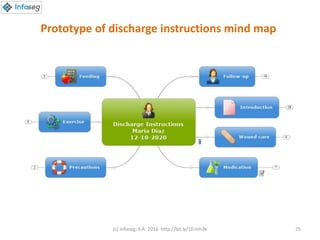
(c) Infoseg, S.A. 2016 http://bit.ly/1Eimh3k 25
Prototype of discharge instructions mind map
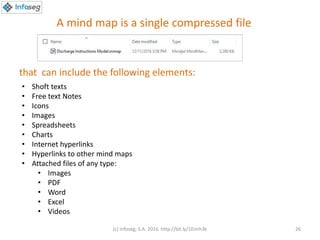
(c) Infoseg, S.A. 2016 http://bit.ly/1Eimh3k 26
A mind map is a single compressed file
that can include the following elements:
• Shoft texts
• Free text Notes
• Icons
• Images
• Spreadsheets
• Charts
• Internet hyperlinks
• Hyperlinks to other mind maps
• Attached files of any type:
• Images
• PDF
• Word
• Excel
• Videos
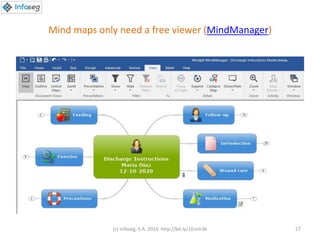
Mind maps only need a free viewer (MindManager)
(c) Infoseg, S.A. 2016 http://bit.ly/1Eimh3k 27
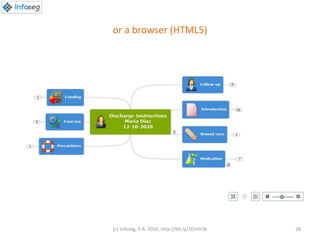
or a browser (HTML5)
(c) Infoseg, S.A. 2016 http://bit.ly/1Eimh3k 28
(c) Infoseg, S.A. 2016 http://bit.ly/1Eimh3k 29
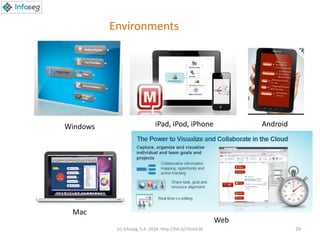
Environments
Mac
Windows iPad, iPod, iPhone Android
Web
(c) Infoseg, S.A. 2016 http://bit.ly/1Eimh3k 30
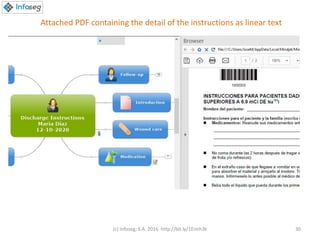
Attached PDF containing the detail of the instructions as linear text
(c) Infoseg, S.A. 2016 http://bit.ly/1Eimh3k 31
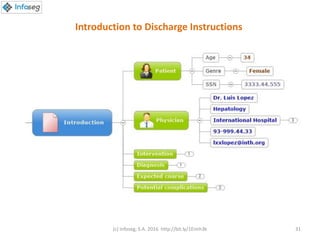
Introduction to Discharge Instructions
(c) Infoseg, S.A. 2016 http://bit.ly/1Eimh3k 32
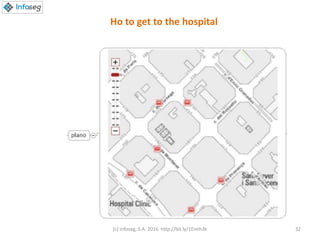
Ho to get to the hospital
(c) Infoseg, S.A. 2016 http://bit.ly/1Eimh3k 33
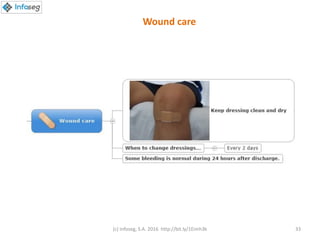
Wound care
(c) Infoseg, S.A. 2016 http://bit.ly/1Eimh3k 34
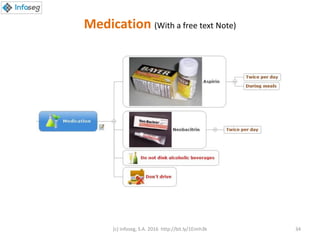
Medication (With a free text Note)
(c) Infoseg, S.A. 2016 http://bit.ly/1Eimh3k 35
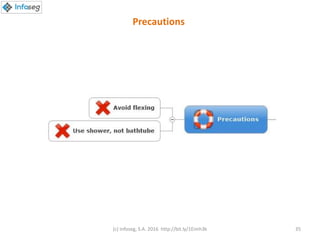
Precautions
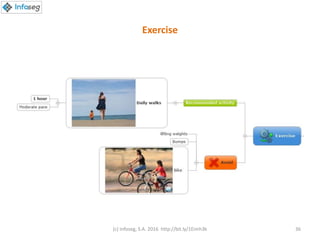
Exercise
(c) Infoseg, S.A. 2016 http://bit.ly/1Eimh3k 36
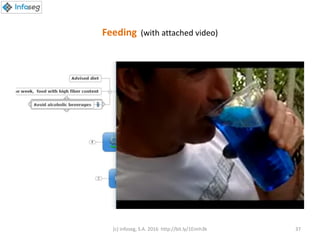
Feeding (with attached video)
(c) Infoseg, S.A. 2016 http://bit.ly/1Eimh3k 37
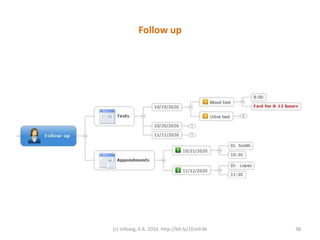
Follow up
(c) Infoseg, S.A. 2016 http://bit.ly/1Eimh3k 38
Advantages of mind maps as discharge instructions
• Visual.
• Easy to use by the patient.
• No limit to the amount of information.
• All information on a single screen. No screen changes.
• All types of multimedia elements.
• Reduce / eliminate communication errors.
• Reduce / eliminate the problems of linear text o web
pages.
• Easy to send and visualize.
• Small size.
• Free viewer.
(c) Infoseg, S.A. 2016 http://bit.ly/1Eimh3k 39
How are mind maps created?
• By automation from information contained in data bases.
• Can be personalized for each patient from her Personal Health
Record.
• Software developed in C#.NET for Windows.
• After being created, the mind map can be sent as an attached
file by email or FTP’s to a web page to be downloaded by the
patient.
(c) Infoseg, S.A. 2016 http://bit.ly/1Eimh3k 40
References
[1] Kripalani S, Jackson AT, Schnipper JL, Coleman EA. Promoting effective transitions of care at hospital
discharge: a review of key issues for hospitalists. J Hosp Med. 2007;2:314–323.
[2] Moore C, et al., Medical errors related to discontinuity of care from an inpatient to an outpatient setting. J
Gen Intern Med. 2003;18:646-651.
[3] Forster AJ, Clark HD, Menard A, et al. Adverse events among medical patients after discharge from hospital.
CMAJ. 2004;170:345-349.
[4] Forster AJ et al., The incidence and severity of adverse events affecting patients after discharge from the hospital.
Ann Intern Med. 2003;138:161-167.
[5] Forster AJ, et al., Adverse drug events occurring following hospital discharge. J Gen Intern Med. 2005;20:317-323
[6] Vukmir RB. Kremen R. Ellis GL, et al. Compliance with emergency department referral: the effect of
computerized discharge instructions. Ann Emerg Med. 1993; 22:819-23.
[7] Jolly BT, Scott JL, Feied CF, et al. Functional illiteracy among emergency department patients: a preliminary
study. Ann Emerg Med. 1993; 22:573-8
[8] Clark PA et al., Patient perceptions of quality in discharge instruction, Patient Education and Counseling 59 (2005) 56–68
[9] DiMatteo MR. Variations in patients’ adherence to medical recommendations: a quantitative review
of 50 years of research. Med Care 2004;42:200–209.
[10] Simpson M et al., Doctor-patient communication: the Toronto consensus statement, BMJ7 1991;303:1385-7
[11] Benigeri M, Pluye P., Shortcomings of health information on the Internet, Health Promotion International
Vol. 18. No. 4, 2003
[12] Chugh A et al., Better Transitions: Improving Comprehension of Discharge Instructions, Frontiers of Health
Services Management, 2009 Spring;25(3):11-32.
[13] Krohn DA, Discharge Instructions in the Outpatient Setting: Nursing Considerations, J Radiol Nurs 2008;27:29-33.
[14] Delp C, Jones J, Communicating Information to Patients: The Use of Cartoon Illustrations to Improve
Comprehension of Instructions, Academic Emergency Medicine Mar 1996 Vol 3/No 3
[15] Austin PE, Discharge Instructions: Do Illustrations Help Our Patients Understand Them?, Annals of Emergency Medicine , March 1995,
25:3.
[16] Showalter JW, Effect of Standardized Electronic Discharge Instructions on Post-Discharge Hospital Utilization.
J Gen Intern Med 26(7):718–23 (2011)
[17] Engel GJ, The Biopsychosocial Model and the Education of Health Professionals, Ann N Y Acad Sci. 1978 Jun 21;310:169-87.
[18] Guerrero JM, Ramos P, Introduction to the Applications of Mind Mapping in Medicine, International Medical Publishing, 2015.
(c) Infoseg, S.A. 2016 http://bit.ly/1Eimh3k 41
Introduction to the Applications of Mind Mapping in Medicine
(c) Infoseg, S.A. 2016 http://bit.ly/1Eimh3k 42
(c) Infoseg, S.A. 2016 http://bit.ly/1Eimh3k 43
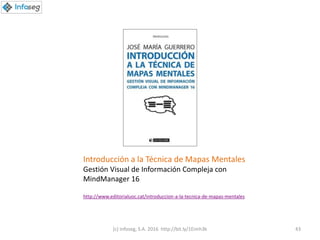
Introducción a la Técnica de Mapas Mentales
Gestión Visual de Información Compleja con
MindManager 16
http://www.editorialuoc.cat/introduccion-a-la-tecnica-de-mapas-mentales
José M. Guerrero
jm@infoseg.com
http://www.infoseg.com/imi.shtml
https://es.linkedin.com/in/josemguerrero2012
http://www.slideshare.net/jmgf2009/presentations
https://twitter.com/InfosegS
http://paper.li/InfosegS/1356259200
(c) Infoseg, S.A. 2016 http://bit.ly/1Eimh3k 44

Hospital Discharge Instructions using Mind Mapping

  • 1.
    HOSPITAL DISCHARGE INSTRUCTIONSUSING MIND MAPPING Image courtesy of cooldesign at FreeDigitalPhotos.net (c) Infoseg, S.A. 2016 http://bit.ly/1Eimh3k 1
  • 2.
    Vulnerability of Patientsafter Hospital Discharge Image courtesy of Stuart Miles at FreeDigitalPhotos.net (c) Infoseg, S.A. 2016 http://bit.ly/1Eimh3k 2
  • 3.
    Vulnerability of Patientsafter Hospital Discharge [1] • About half of the adult patients, experience at least one medical error after a hospital discharge. [2] • Between a 19 and a 23% suffer an adverse effect after discharge, most of the times related to medication. [3-5] • When there are adverse effects, 66% are related to medication, 17% to procedures. [4] (c) Infoseg, S.A. 2016 http://bit.ly/1Eimh3k 3
  • 4.
    Adherence of Patientsto Discharge Instructions Image courtesy of dan at FreeDigitalPhotos.net (c) Infoseg, S.A. 2016 http://bit.ly/1Eimh3k 4
  • 5.
    Factors that influenceconformity and satisfaction of the patient with the post-discharge plan [6,7] • Amount of information • Quality of the information • Capacity of the patient to understand the information (c) Infoseg, S.A. 2016 http://bit.ly/1Eimh3k 5
  • 6.
    Study investigating patientperceptions of the quality of discharge instruction 1997-2001 [8] • Patient satisfaction decreased significantly every year. • Patients gave lower ratings to the quality of discharge instruction than to the overall quality of their hospital stay. • Patient assessments of discharge instruction quality varied systematically among conditions (c) Infoseg, S.A. 2016 http://bit.ly/1Eimh3k 6
  • 7.
    Main areas ofnon-compliance with discharge instructions • Medication • Cures • Medical appointments • Diet • Exercise • Habitual behaviors (c) Infoseg, S.A. 2016 http://bit.ly/1Eimh3k 7
  • 8.
    Quantification of Patient’sAdherence to Medical Recommendations [9] • Average: 75% • Minimum: less than 50% (c) Infoseg, S.A. 2016 http://bit.ly/1Eimh3k 8
  • 9.
    Consequences of non-adherenceto medical recommendations • Unnecessary phone calls • Unnecessary visits • Delay in rehabilitation • Unnecessary readmissions • Unnecessary relapses • Superfluous medical costs Image courtesy of ddpavumba at FreeDigitalPhotos.net (c) Infoseg, S.A. 2016 http://bit.ly/1Eimh3k 9
  • 10.
    Problems when discharge instructionsare too simple or incomplete Image courtesy of Mister GC at FreeDigitalPhotos.net (c) Infoseg, S.A. 2016 http://bit.ly/1Eimh3k 10
  • 11.
    If discharge instructionsare too simple or incomplete, patients look for complementary information through • Relatives • Friends • Newspapers and magazines • Internet Image courtesy of franky242 at FreeDigitalPhotos.net (c) Infoseg, S.A. 2016 http://bit.ly/1Eimh3k 11
  • 12.
    The Toronto Consensus[10] • “Effective communication between doctor and patient is a central clinical function that cannot be delegated.” If the patient has to look for the information she needs through relatives, friends, internet or any other non reliable source, effective commnication is interrupted. (c) Infoseg, S.A. 2016 http://bit.ly/1Eimh3k 12
  • 13.
    Shortcomings of HealthInformation on the Internet [11] • Uneven quality of medical information available. • Difficulties in finding, understanding and using this information. • Lack of access for the unconnected population. • The potential for harm and risks of overconsumption. (c) Infoseg, S.A. 2016 http://bit.ly/1Eimh3k 13
  • 14.
    Image courtesy ofStuart Miles at FreeDigitalPhotos.net Problems when discharge instructions are complex (c) Infoseg, S.A. 2016 http://bit.ly/1Eimh3k 14
  • 15.
    Main problems whendischarge instructions are complex [12] • Inadequate health literacy of patients and relatives. • Unrecognized cognitive impairment of patients. • Linear text is very difficult to understand when it is extensive, even for people not affected by any of the two previous problems. • Difficulty in memorizing the combination of verbal and written instructions. [13] (c) Infoseg, S.A. 2016 http://bit.ly/1Eimh3k 15
  • 16.
    IMPROVEMENT OF THEDISCHARGE INSTRUCTIONS Image courtesy of renjith krishnan at FreeDigitalPhotos.net (c) Infoseg, S.A. 2016 http://bit.ly/1Eimh3k 16
  • 17.
    Use of images.Study 1. [14] • The patients given cartoon instructions were more likely to have read the instructions (98% versus 79%) • More likely to answer all wound care questions correctly (46% versus 6%) • More compliant with daily wound care (77% versus 54%) (c) Infoseg, S.A. 2016 http://bit.ly/1Eimh3k 17
  • 18.
    Use of images.Study 2 [15] 50% improvement in the comprehension of instructions. (c) Infoseg, S.A. 2016 http://bit.ly/1Eimh3k 18
  • 19.
    Standardized Electronic DischargeInstructions [16] • Implementation of standardized electronic discharge instructions was not associated with reduction in post- discharge hospital utilization. • More studies are needed but simply using electronic discharge instructions does not solve the fundamental problems. (c) Infoseg, S.A. 2016 http://bit.ly/1Eimh3k 19
  • 20.
    The main problem •If the discharge instructions are short and simple, they cannot include all needed information. • If the discharge instructions are complex and extensive, patients cannot assimilate all the information due to the limitations of linear text. • The consequence is that patients cannot be empowered. (c) Infoseg, S.A. 2016 http://bit.ly/1Eimh3k 20
  • 21.
    The biopsychosocial modeland the discharge instructions [17] • Discharge instructions have to be adapted to the new biopsychosocial model. • This is needed in order to empower the patient. (c) Infoseg, S.A. 2016 http://bit.ly/1Eimh3k 21
  • 22.
    Mind mapping inthe biopsychosocial model as a tool to empower the patient Image courtesy of Salvatore Vuono at FreeDigitalPhotos.net (c) Infoseg, S.A. 2016 http://bit.ly/1Eimh3k 22
  • 23.
    The Mind Mappingtechnique [18] It is a graphical technique for the vualization of hierarchical connections beween several elements of information. Each element of information is linked with other elements through lines, creating a network of relations. They are always organized around a single central idea or information. A mind map is a diagram created using this technique. (c) Infoseg, S.A. 2016 http://bit.ly/1Eimh3k 23
  • 24.
    Most important characteristicsof mind maps Fast processing of images in the brain + Hierarchical organization + Chunking of information + Whole picture and detail views at the same time + Visible relationship between the parts + Collapse / Expansion of the branches + Use of color (facilitating grouping) + Multimedia (text, images, documents, videos, sound) + 1 single compressed file, easy to send by email or FTP + Collaboration (online and presential) + Autoformatting + No need to change from one screen to another (no context loss) + Less mental fatigue + Easy to create, visualize and edit + The most important information is at the center (better vision) (c) Infoseg, S.A. 2016 http://bit.ly/1Eimh3k 24
  • 25.
    (c) Infoseg, S.A.2016 http://bit.ly/1Eimh3k 25 Prototype of discharge instructions mind map
  • 26.
    (c) Infoseg, S.A.2016 http://bit.ly/1Eimh3k 26 A mind map is a single compressed file that can include the following elements: • Shoft texts • Free text Notes • Icons • Images • Spreadsheets • Charts • Internet hyperlinks • Hyperlinks to other mind maps • Attached files of any type: • Images • PDF • Word • Excel • Videos
  • 27.
    Mind maps onlyneed a free viewer (MindManager) (c) Infoseg, S.A. 2016 http://bit.ly/1Eimh3k 27
  • 28.
    or a browser(HTML5) (c) Infoseg, S.A. 2016 http://bit.ly/1Eimh3k 28
  • 29.
    (c) Infoseg, S.A.2016 http://bit.ly/1Eimh3k 29 Environments Mac Windows iPad, iPod, iPhone Android Web
  • 30.
    (c) Infoseg, S.A.2016 http://bit.ly/1Eimh3k 30 Attached PDF containing the detail of the instructions as linear text
  • 31.
    (c) Infoseg, S.A.2016 http://bit.ly/1Eimh3k 31 Introduction to Discharge Instructions
  • 32.
    (c) Infoseg, S.A.2016 http://bit.ly/1Eimh3k 32 Ho to get to the hospital
  • 33.
    (c) Infoseg, S.A.2016 http://bit.ly/1Eimh3k 33 Wound care
  • 34.
    (c) Infoseg, S.A.2016 http://bit.ly/1Eimh3k 34 Medication (With a free text Note)
  • 35.
    (c) Infoseg, S.A.2016 http://bit.ly/1Eimh3k 35 Precautions
  • 36.
    Exercise (c) Infoseg, S.A.2016 http://bit.ly/1Eimh3k 36
  • 37.
    Feeding (with attachedvideo) (c) Infoseg, S.A. 2016 http://bit.ly/1Eimh3k 37
  • 38.
    Follow up (c) Infoseg,S.A. 2016 http://bit.ly/1Eimh3k 38
  • 39.
    Advantages of mindmaps as discharge instructions • Visual. • Easy to use by the patient. • No limit to the amount of information. • All information on a single screen. No screen changes. • All types of multimedia elements. • Reduce / eliminate communication errors. • Reduce / eliminate the problems of linear text o web pages. • Easy to send and visualize. • Small size. • Free viewer. (c) Infoseg, S.A. 2016 http://bit.ly/1Eimh3k 39
  • 40.
    How are mindmaps created? • By automation from information contained in data bases. • Can be personalized for each patient from her Personal Health Record. • Software developed in C#.NET for Windows. • After being created, the mind map can be sent as an attached file by email or FTP’s to a web page to be downloaded by the patient. (c) Infoseg, S.A. 2016 http://bit.ly/1Eimh3k 40
  • 41.
    References [1] Kripalani S,Jackson AT, Schnipper JL, Coleman EA. Promoting effective transitions of care at hospital discharge: a review of key issues for hospitalists. J Hosp Med. 2007;2:314–323. [2] Moore C, et al., Medical errors related to discontinuity of care from an inpatient to an outpatient setting. J Gen Intern Med. 2003;18:646-651. [3] Forster AJ, Clark HD, Menard A, et al. Adverse events among medical patients after discharge from hospital. CMAJ. 2004;170:345-349. [4] Forster AJ et al., The incidence and severity of adverse events affecting patients after discharge from the hospital. Ann Intern Med. 2003;138:161-167. [5] Forster AJ, et al., Adverse drug events occurring following hospital discharge. J Gen Intern Med. 2005;20:317-323 [6] Vukmir RB. Kremen R. Ellis GL, et al. Compliance with emergency department referral: the effect of computerized discharge instructions. Ann Emerg Med. 1993; 22:819-23. [7] Jolly BT, Scott JL, Feied CF, et al. Functional illiteracy among emergency department patients: a preliminary study. Ann Emerg Med. 1993; 22:573-8 [8] Clark PA et al., Patient perceptions of quality in discharge instruction, Patient Education and Counseling 59 (2005) 56–68 [9] DiMatteo MR. Variations in patients’ adherence to medical recommendations: a quantitative review of 50 years of research. Med Care 2004;42:200–209. [10] Simpson M et al., Doctor-patient communication: the Toronto consensus statement, BMJ7 1991;303:1385-7 [11] Benigeri M, Pluye P., Shortcomings of health information on the Internet, Health Promotion International Vol. 18. No. 4, 2003 [12] Chugh A et al., Better Transitions: Improving Comprehension of Discharge Instructions, Frontiers of Health Services Management, 2009 Spring;25(3):11-32. [13] Krohn DA, Discharge Instructions in the Outpatient Setting: Nursing Considerations, J Radiol Nurs 2008;27:29-33. [14] Delp C, Jones J, Communicating Information to Patients: The Use of Cartoon Illustrations to Improve Comprehension of Instructions, Academic Emergency Medicine Mar 1996 Vol 3/No 3 [15] Austin PE, Discharge Instructions: Do Illustrations Help Our Patients Understand Them?, Annals of Emergency Medicine , March 1995, 25:3. [16] Showalter JW, Effect of Standardized Electronic Discharge Instructions on Post-Discharge Hospital Utilization. J Gen Intern Med 26(7):718–23 (2011) [17] Engel GJ, The Biopsychosocial Model and the Education of Health Professionals, Ann N Y Acad Sci. 1978 Jun 21;310:169-87. [18] Guerrero JM, Ramos P, Introduction to the Applications of Mind Mapping in Medicine, International Medical Publishing, 2015. (c) Infoseg, S.A. 2016 http://bit.ly/1Eimh3k 41
  • 42.
    Introduction to theApplications of Mind Mapping in Medicine (c) Infoseg, S.A. 2016 http://bit.ly/1Eimh3k 42
  • 43.
    (c) Infoseg, S.A.2016 http://bit.ly/1Eimh3k 43 Introducción a la Técnica de Mapas Mentales Gestión Visual de Información Compleja con MindManager 16 http://www.editorialuoc.cat/introduccion-a-la-tecnica-de-mapas-mentales
  • 44.