MSS Technologies 1
IMPLEMENTING ELECTRONIC HEALTH RECORDS SYSTEM IN THE BEHAVIORAL HEALTH INDUSTRY:
KEY CONSIDERATIONS
Behavioral health organizations face many challenges in today’s quickly changing healthcare landscape. The
movement from paper medical records to Electronic Health Records (EHR) is one of the biggest challenges, but
also, an opportunity to reduce overall cost of care and improve patient outcomes. This blog post highlights key
areas of consideration for behavioral health organizations as they implement new EHR systems including the
impact of regulatory compliance, meaningful use, environment, systems implementation, organizational change
management and clinical and business workflows.
Regulatory Compliance
Patient confidentiality remains a top priority in behavioral health. Due to the ultra-sensitive nature of behavioral
health information, the HIPAA Privacy and Security Rules offer more protection for both patients and providers.
Most notably, Rule 45 Part 164 allows providers to deny patient access to psychotherapy notes and restricts
organizations from releasing patient notes to a third party payer for reimbursement considerations.
As the industry shifts to new technology for increased efficiency and better patient care, provider and payer
organizations must create, implement and govern a set of guiding principles to adhere to HIPAA rules, and restrict
unauthorized access to patient records. Although new technology provides a means for strengthened security
through use of audit trails, encryption and access controls, it’s up to each organization to maintain compliance,
educate users on HIPAA awareness and to safeguard technology such as networks, servers, mobile devices and
the EHR itself. Maintaining compliance, particularly in multi-entity organizations, can be a challenge so it’s
important to form a security task force to assess vulnerabilities and threats, establish security metrics around all
technology, and develop enterprise wide HIPAA guidelines to eliminate potential unrestricted access and protect
patient records.
 HIPAA Education and Awareness Training
o Educate users on HIPAA Privacy and Security Rules. Create user agreements, documentation and
training courses geared towards HIPAA awareness and compliance.
o Develop an internal non-compliance process and enforce the rules.
 Establish Guidelines to Protect Patient Information
o Mobile Devices
 Create a User Agreement that clearly defines device rules and guidelines, especially for
employee owned devices.
 Define the rights of users and organizations for mobile devices, including remote wipe
capabilities.
o Technology Safeguards
 Implement features that allow control of technology
 Password Protection
 Auto Lock
 Role/User Based Access Controls
o Security Metrics
 Define metrics and create a baseline to measure key performance indicators for security
 Antivirus, Antispyware, Firewall, Scans
 Risks Analysis and Audits
Meaningful Use
The introduction of the Medicare and Medicaid EHR Incentive Programs to provide financial incentives for the
“meaningful use” of certified EHR technology, has led behavioral health providers to move from paper based
medical records towards EHRs. Initially, during the program’s inception, behavioral health organizations found
themselves left out; however, through increased legislation, the program has been extended to include behavioral
health professionals.
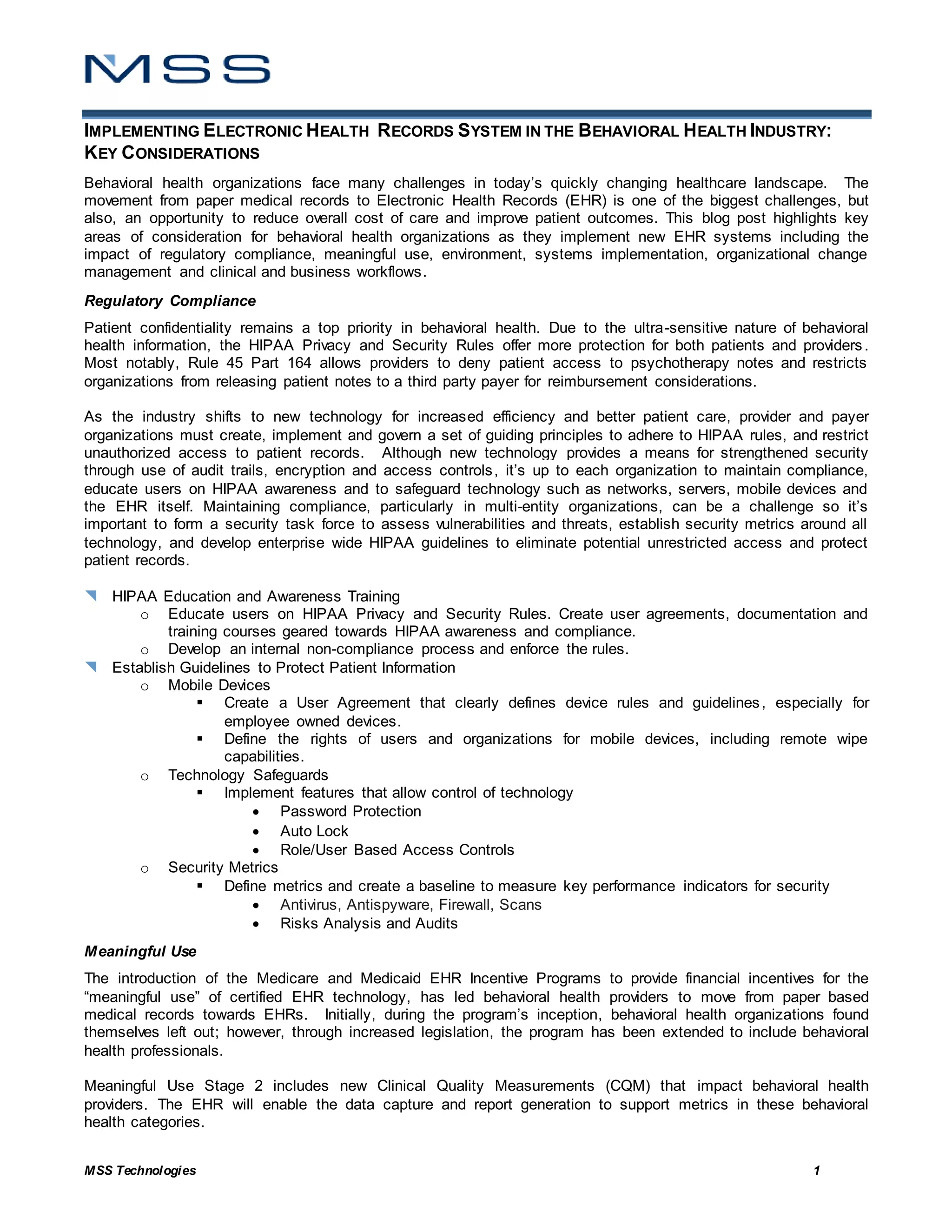
Meaningful Use Stage 2 includes new Clinical Quality Measurements (CQM) that impact behavioral health
providers. The EHR will enable the data capture and report generation to support metrics in these behavioral
health categories.
MSS Technologies, Inc. Proprietary & Confidential Page 2
1. Alcohol Use 4. Drug Use
2. Autism 5. Suicide
3. Depression 6. Trauma
Environment
Changes in behavioral healthcare are happening not only on a national level, but also at a state and local level.
Organizations must stay abreast of these changes and understand the impact on how data must flow in and out of
an EHR to meet reporting requirements.
 The Behavioral Health Information Exchange (BHIE) is live and will enable healthcare providers in Arizona to
access physical health and behavioral information at point of care based on a patient’s permission.
o Patients have the choice to Opt In or Opt Out giving them the right to choose what, if any data can be
shared with their physical and behavioral health providers.
 The State of Arizona has progressed towards an integrated care model to better serve and provide
coordinated care for physical and mental health to individuals with Severe Mental Illnesses (SMI). Sharing
patient health information through the BHIE is key to enabling improved care and outcomes.
 Through the Greater Arizona initiative, Arizona Department of Health Services is planning to consolidate the
Regional Behavioral Health Authorities (RHBA) into three Geographical Service Areas; Northern, Southern
and Maricopa County.
o The restructuring of the Geographic Service Areas is aimed at creating a cohesive network of physical
and behavioral health providers within a region to increase patient access and care coordination. One
major challenge that stands in the way of achieving total integration is getting providers to adopt EHR
solutions.
 The Affordable Care Act requires that all insurance policies sold on the Federal Healthcare Exchange as well
as Medicaid patients include mental and behavioral health treatment as one of the ten essential benefits. The
EHR must accurately capture each patient’s payer information so there are no delays in billing and
reimbursement.
 There is an increase in mergers and acquisitions within the behavioral health industry, including Southern
Arizona Mental Health Corporation and Compass Behavioral Health Care that jointly formed the Pasadera
Behavioral Health Network.
 As healthcare moves towards integration, organizations are looking for new ways to reduce cost, expand
service offerings and provide better patient care. Mergers bring many changes to an organization particularly
around technology such as:
o Conversion to a single EHR
o Interoperability
o Data Migration
o System Uses
Systems Implementation
Developing the right approach to implement an EHR solution requires careful planning and consideration with
respect to organizational structure, staff availability and support capacity. A common strategy for multi-entity
organizations is a phased approach, where the new technology is implemented by functional area or pilot site.
This approach allows multi-entity organizations to stabilize the new technology and develop the right support
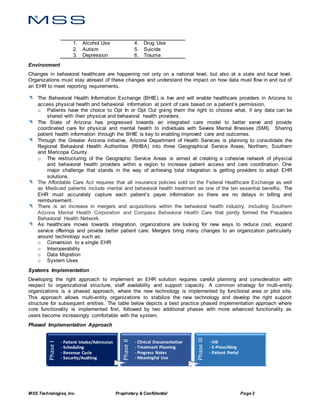
structure for subsequent entities. The table below depicts a best practice phased implementation approach where
core functionality is implemented first, followed by two additional phases with more advanced functionality as
users become increasingly comfortable with the system.
Phased Implementation Approach
PhaseI
- Patient Intake/Admission
- Scheduling
- Revenue Cycle
- Security/Auditing
PhaseII
- Clinical Documentation
- Treatment Planning
- Progress Notes
- Meaningful Use
PhaseIII
- HIE
- E-Prescribing
- Patient Portal
MSS Technologies, Inc. Proprietary & Confidential Page 3
Another more risky approach is known as “Big Bang.” This approach is typically selected by organizations that do
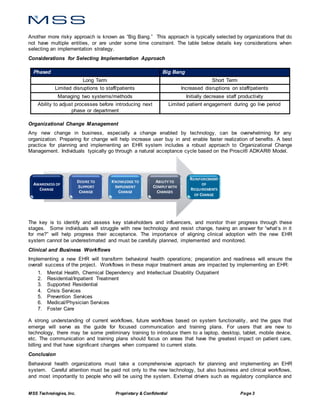
not have multiple entities, or are under some time constraint. The table below details key considerations when
selecting an implementation strategy.
Considerations for Selecting Implementation Approach
Organizational Change Management
Any new change in business, especially a change enabled by technology, can be overwhelming for any
organization. Preparing for change will help increase user buy in and enable faster realization of benefits. A best
practice for planning and implementing an EHR system includes a robust approach to Organizational Change
Management. Individuals typically go through a natural acceptance cycle based on the Prosci® ADKAR® Model.
The key is to identify and assess key stakeholders and influencers, and monitor their progress through these
stages. Some individuals will struggle with new technology and resist change, having an answer for “what’s in it
for me?” will help progress their acceptance. The importance of aligning clinical adoption with the new EHR
system cannot be underestimated and must be carefully planned, implemented and monitored.
Clinical and Business Workflows
Implementing a new EHR will transform behavioral health operations; preparation and readiness will ensure the
overall success of the project. Workflows in these major treatment areas are impacted by implementing an EHR:
1. Mental Health, Chemical Dependency and Intellectual Disability Outpatient
2. Residential/Inpatient Treatment
3. Supported Residential
4. Crisis Services
5. Prevention Services
6. Medical/Physician Services
7. Foster Care
A strong understanding of current workflows, future workflows based on system functionality, and the gaps that
emerge will serve as the guide for focused communication and training plans. For users that are new to
technology, there may be some preliminary training to introduce them to a laptop, desktop, tablet, mobile device,
etc. The communication and training plans should focus on areas that have the greatest impact on patient care,
billing and that have significant changes when compared to current state.
Conclusion
Behavioral health organizations must take a comprehensive approach for planning and implementing an EHR
system. Careful attention must be paid not only to the new technology, but also business and clinical workflows,
and most importantly to people who will be using the system. External drivers such as regulatory compliance and
AWARENESS OF
CHANGE
DESIRE TO
SUPPORT
CHANGE
KNOWLEDGE TO
IMPLEMENT
CHANGE
ABILITY TO
COMPLY WITH
CHANGES
REINFORCEMENT
OF
REQUIREMENTS
OF CHANGE
Phased Big Bang
Long Term Short Term
Limited disruptions to staff/patients Increased disruptions on staff/patients
Managing two systems/methods Initially decrease staff productivity
Ability to adjust processes before introducing next
phase or department
Limited patient engagement during go live period
MSS Technologies, Inc. Proprietary & Confidential Page 4
environment are also key areas of consideration when configuring the system and designing reports and queries.
Finally, making sure the right approach is taken for the implementation, whether phased or big bang, will ensure
project success.

Implementing EHR in Behavioral Health Blog Post

  • 1.
    MSS Technologies 1 IMPLEMENTINGELECTRONIC HEALTH RECORDS SYSTEM IN THE BEHAVIORAL HEALTH INDUSTRY: KEY CONSIDERATIONS Behavioral health organizations face many challenges in today’s quickly changing healthcare landscape. The movement from paper medical records to Electronic Health Records (EHR) is one of the biggest challenges, but also, an opportunity to reduce overall cost of care and improve patient outcomes. This blog post highlights key areas of consideration for behavioral health organizations as they implement new EHR systems including the impact of regulatory compliance, meaningful use, environment, systems implementation, organizational change management and clinical and business workflows. Regulatory Compliance Patient confidentiality remains a top priority in behavioral health. Due to the ultra-sensitive nature of behavioral health information, the HIPAA Privacy and Security Rules offer more protection for both patients and providers. Most notably, Rule 45 Part 164 allows providers to deny patient access to psychotherapy notes and restricts organizations from releasing patient notes to a third party payer for reimbursement considerations. As the industry shifts to new technology for increased efficiency and better patient care, provider and payer organizations must create, implement and govern a set of guiding principles to adhere to HIPAA rules, and restrict unauthorized access to patient records. Although new technology provides a means for strengthened security through use of audit trails, encryption and access controls, it’s up to each organization to maintain compliance, educate users on HIPAA awareness and to safeguard technology such as networks, servers, mobile devices and the EHR itself. Maintaining compliance, particularly in multi-entity organizations, can be a challenge so it’s important to form a security task force to assess vulnerabilities and threats, establish security metrics around all technology, and develop enterprise wide HIPAA guidelines to eliminate potential unrestricted access and protect patient records.  HIPAA Education and Awareness Training o Educate users on HIPAA Privacy and Security Rules. Create user agreements, documentation and training courses geared towards HIPAA awareness and compliance. o Develop an internal non-compliance process and enforce the rules.  Establish Guidelines to Protect Patient Information o Mobile Devices  Create a User Agreement that clearly defines device rules and guidelines, especially for employee owned devices.  Define the rights of users and organizations for mobile devices, including remote wipe capabilities. o Technology Safeguards  Implement features that allow control of technology  Password Protection  Auto Lock  Role/User Based Access Controls o Security Metrics  Define metrics and create a baseline to measure key performance indicators for security  Antivirus, Antispyware, Firewall, Scans  Risks Analysis and Audits Meaningful Use The introduction of the Medicare and Medicaid EHR Incentive Programs to provide financial incentives for the “meaningful use” of certified EHR technology, has led behavioral health providers to move from paper based medical records towards EHRs. Initially, during the program’s inception, behavioral health organizations found themselves left out; however, through increased legislation, the program has been extended to include behavioral health professionals. Meaningful Use Stage 2 includes new Clinical Quality Measurements (CQM) that impact behavioral health providers. The EHR will enable the data capture and report generation to support metrics in these behavioral health categories.
  • 2.
    MSS Technologies, Inc.Proprietary & Confidential Page 2 1. Alcohol Use 4. Drug Use 2. Autism 5. Suicide 3. Depression 6. Trauma Environment Changes in behavioral healthcare are happening not only on a national level, but also at a state and local level. Organizations must stay abreast of these changes and understand the impact on how data must flow in and out of an EHR to meet reporting requirements.  The Behavioral Health Information Exchange (BHIE) is live and will enable healthcare providers in Arizona to access physical health and behavioral information at point of care based on a patient’s permission. o Patients have the choice to Opt In or Opt Out giving them the right to choose what, if any data can be shared with their physical and behavioral health providers.  The State of Arizona has progressed towards an integrated care model to better serve and provide coordinated care for physical and mental health to individuals with Severe Mental Illnesses (SMI). Sharing patient health information through the BHIE is key to enabling improved care and outcomes.  Through the Greater Arizona initiative, Arizona Department of Health Services is planning to consolidate the Regional Behavioral Health Authorities (RHBA) into three Geographical Service Areas; Northern, Southern and Maricopa County. o The restructuring of the Geographic Service Areas is aimed at creating a cohesive network of physical and behavioral health providers within a region to increase patient access and care coordination. One major challenge that stands in the way of achieving total integration is getting providers to adopt EHR solutions.  The Affordable Care Act requires that all insurance policies sold on the Federal Healthcare Exchange as well as Medicaid patients include mental and behavioral health treatment as one of the ten essential benefits. The EHR must accurately capture each patient’s payer information so there are no delays in billing and reimbursement.  There is an increase in mergers and acquisitions within the behavioral health industry, including Southern Arizona Mental Health Corporation and Compass Behavioral Health Care that jointly formed the Pasadera Behavioral Health Network.  As healthcare moves towards integration, organizations are looking for new ways to reduce cost, expand service offerings and provide better patient care. Mergers bring many changes to an organization particularly around technology such as: o Conversion to a single EHR o Interoperability o Data Migration o System Uses Systems Implementation Developing the right approach to implement an EHR solution requires careful planning and consideration with respect to organizational structure, staff availability and support capacity. A common strategy for multi-entity organizations is a phased approach, where the new technology is implemented by functional area or pilot site. This approach allows multi-entity organizations to stabilize the new technology and develop the right support structure for subsequent entities. The table below depicts a best practice phased implementation approach where core functionality is implemented first, followed by two additional phases with more advanced functionality as users become increasingly comfortable with the system. Phased Implementation Approach PhaseI - Patient Intake/Admission - Scheduling - Revenue Cycle - Security/Auditing PhaseII - Clinical Documentation - Treatment Planning - Progress Notes - Meaningful Use PhaseIII - HIE - E-Prescribing - Patient Portal
  • 3.
    MSS Technologies, Inc.Proprietary & Confidential Page 3 Another more risky approach is known as “Big Bang.” This approach is typically selected by organizations that do not have multiple entities, or are under some time constraint. The table below details key considerations when selecting an implementation strategy. Considerations for Selecting Implementation Approach Organizational Change Management Any new change in business, especially a change enabled by technology, can be overwhelming for any organization. Preparing for change will help increase user buy in and enable faster realization of benefits. A best practice for planning and implementing an EHR system includes a robust approach to Organizational Change Management. Individuals typically go through a natural acceptance cycle based on the Prosci® ADKAR® Model. The key is to identify and assess key stakeholders and influencers, and monitor their progress through these stages. Some individuals will struggle with new technology and resist change, having an answer for “what’s in it for me?” will help progress their acceptance. The importance of aligning clinical adoption with the new EHR system cannot be underestimated and must be carefully planned, implemented and monitored. Clinical and Business Workflows Implementing a new EHR will transform behavioral health operations; preparation and readiness will ensure the overall success of the project. Workflows in these major treatment areas are impacted by implementing an EHR: 1. Mental Health, Chemical Dependency and Intellectual Disability Outpatient 2. Residential/Inpatient Treatment 3. Supported Residential 4. Crisis Services 5. Prevention Services 6. Medical/Physician Services 7. Foster Care A strong understanding of current workflows, future workflows based on system functionality, and the gaps that emerge will serve as the guide for focused communication and training plans. For users that are new to technology, there may be some preliminary training to introduce them to a laptop, desktop, tablet, mobile device, etc. The communication and training plans should focus on areas that have the greatest impact on patient care, billing and that have significant changes when compared to current state. Conclusion Behavioral health organizations must take a comprehensive approach for planning and implementing an EHR system. Careful attention must be paid not only to the new technology, but also business and clinical workflows, and most importantly to people who will be using the system. External drivers such as regulatory compliance and AWARENESS OF CHANGE DESIRE TO SUPPORT CHANGE KNOWLEDGE TO IMPLEMENT CHANGE ABILITY TO COMPLY WITH CHANGES REINFORCEMENT OF REQUIREMENTS OF CHANGE Phased Big Bang Long Term Short Term Limited disruptions to staff/patients Increased disruptions on staff/patients Managing two systems/methods Initially decrease staff productivity Ability to adjust processes before introducing next phase or department Limited patient engagement during go live period
  • 4.
    MSS Technologies, Inc.Proprietary & Confidential Page 4 environment are also key areas of consideration when configuring the system and designing reports and queries. Finally, making sure the right approach is taken for the implementation, whether phased or big bang, will ensure project success.