Horror conventions 
By Bushra Ijaiya
Reference: http://horror.about.com/od/horrorthemelists/ss/horrortimeline 
Horror film genre history 
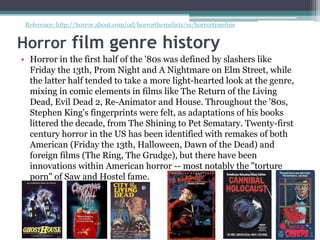
• Horror in the first half of the '80s was defined by slashers like 
Friday the 13th, Prom Night and A Nightmare on Elm Street, while 
the latter half tended to take a more light-hearted look at the genre, 
mixing in comic elements in films like The Return of the Living 
Dead, Evil Dead 2, Re-Animator and House. Throughout the '80s, 
Stephen King's fingerprints were felt, as adaptations of his books 
littered the decade, from The Shining to Pet Sematary. Twenty-first 
century horror in the US has been identified with remakes of both 
American (Friday the 13th, Halloween, Dawn of the Dead) and 
foreign films (The Ring, The Grudge), but there have been 
innovations within American horror -- most notably the "torture 
porn" of Saw and Hostel fame.
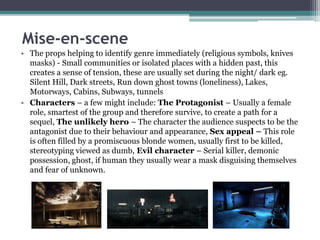
Mise-en-scene 
• The props helping to identify genre immediately (religious symbols, knives 
masks) - Small communities or isolated places with a hidden past, this 
creates a sense of tension, these are usually set during the night/ dark eg. 
Silent Hill, Dark streets, Run down ghost towns (loneliness), Lakes, 
Motorways, Cabins, Subways, tunnels 
• Characters – a few might include: The Protagonist – Usually a female 
role, smartest of the group and therefore survive, to create a path for a 
sequel, The unlikely hero – The character the audience suspects to be the 
antagonist due to their behaviour and appearance, Sex appeal – This role 
is often filled by a promiscuous blonde women, usually first to be killed, 
stereotyping viewed as dumb, Evil character – Serial killer, demonic 
possession, ghost, if human they usually wear a mask disguising themselves 
and fear of unknown.
GENRE 
• GOOD VS EVIL - The good vs evil is shown in the ‘Omen’ when a boys family is 
Christian family vs the individual who is possessed by the devil this shows the battle 
between good vs evil for example when the family drive past the church the possessed 
individual by the devil begins to act violent and abusive. This shows the horror of good 
vs evil as a sub genre, and how it can be portrayed through movies. 
• RELIGION – Religion was revealed in the film ‘Unborn’ as the main character 
was being followed by an evil demon/spirt that killed people around her. In order for 
this demon to be diminished, religious rituals had to be said by a priest. This indicates 
that religion is needed for the horrific problems to be taken out of your life. This also 
links to CHILDHOOD ISSUES because it only occurred as she was a twin, and 
followed her since she was young. 
• SCIENCE GONE BAD – ‘Frankenstein’ originally a 1930s film Henry Frankenstein 
is a doctor who is trying to discover a way to make the dead walk. He succeeds and 
creates a monster that has to deal with living again. 
• CLASSIC GOTHIC – ‘Dracula’ – 1931, was set in England, nineteenth century Castle, 
large private houses, a foreign country – Transylvania. The plot was the killing of the 
monster Dracula. The iconography such as the night time and the moon, were clear 
compatible matches to being associated with Dracula. Crucifixes, holy water, candles, 
bats and cobwebs are props are key for the characters of Hero’s and Monsters.
FEATURES 
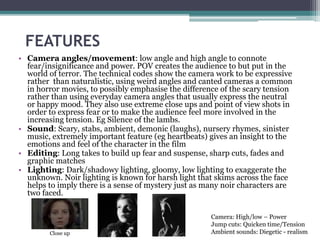
• Camera angles/movement: low angle and high angle to connote 
fear/insignificance and power. POV creates the audience to but put in the 
world of terror. The technical codes show the camera work to be expressive 
rather than naturalistic, using weird angles and canted cameras a common 
in horror movies, to possibly emphasise the difference of the scary tension 
rather than using everyday camera angles that usually express the neutral 
or happy mood. They also use extreme close ups and point of view shots in 
order to express fear or to make the audience feel more involved in the 
increasing tension. Eg Silence of the lambs. 
• Sound: Scary, stabs, ambient, demonic (laughs), nursery rhymes, sinister 
music, extremely important feature (eg heartbeats) gives an insight to the 
emotions and feel of the character in the film 
• Editing: Long takes to build up fear and suspense, sharp cuts, fades and 
graphic matches 
• Lighting: Dark/shadowy lighting, gloomy, low lighting to exaggerate the 
unknown. Noir lighting is known for harsh light that skims across the face 
helps to imply there is a sense of mystery just as many noir characters are 
two faced. 
Close up 
Camera: High/low – Power 
Jump cuts: Quicken time/Tension 
Ambient sounds: Diegetic - realism
Additional features 
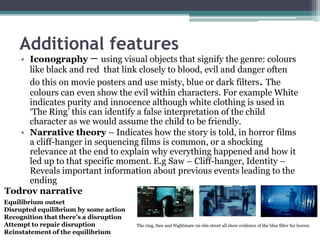
• Iconography – using visual objects that signify the genre: colours 
like black and red that link closely to blood, evil and danger often 
do this on movie posters and use misty, blue or dark filters. The 
colours can even show the evil within characters. For example White 
indicates purity and innocence although white clothing is used in 
‘The Ring’ this can identify a false interpretation of the child 
character as we would assume the child to be friendly. 
• Narrative theory – Indicates how the story is told, in horror films 
a cliff-hanger in sequencing films is common, or a shocking 
relevance at the end to explain why everything happened and how it 
led up to that specific moment. E.g Saw – Cliff-hanger, Identity – 
Reveals important information about previous events leading to the 
ending 
The ring, Saw and Nightmare on elm street all show evidence of the blue filter for horror. 
Todrov narrative 
Equilibrium outset 
Disrupted equilibrium by some action 
Recognition that there’s a disruption 
Attempt to repair disruption 
Reinstatement of the equilibrium
Copy cat theory 
• The copy cat theory relates to something which is publicized in he 
media that creates a lot of attention resulting in other people imitating 
or ‘copying’ this in order to gain the same level of attention. Audiences 
react differently to various situations as they have different 
interpretations. 
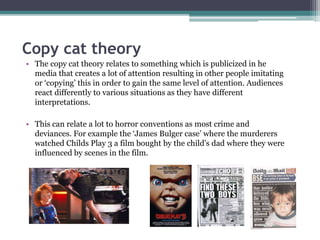
• This can relate a lot to horror conventions as most crime and 
deviances. For example the ‘James Bulger case’ where the murderers 
watched Childs Play 3 a film bought by the child's dad where they were 
influenced by scenes in the film.

Horror conventions

  • 1.
    Horror conventions ByBushra Ijaiya
  • 3.
    Reference: http://horror.about.com/od/horrorthemelists/ss/horrortimeline Horrorfilm genre history • Horror in the first half of the '80s was defined by slashers like Friday the 13th, Prom Night and A Nightmare on Elm Street, while the latter half tended to take a more light-hearted look at the genre, mixing in comic elements in films like The Return of the Living Dead, Evil Dead 2, Re-Animator and House. Throughout the '80s, Stephen King's fingerprints were felt, as adaptations of his books littered the decade, from The Shining to Pet Sematary. Twenty-first century horror in the US has been identified with remakes of both American (Friday the 13th, Halloween, Dawn of the Dead) and foreign films (The Ring, The Grudge), but there have been innovations within American horror -- most notably the "torture porn" of Saw and Hostel fame.
  • 4.
    Mise-en-scene • Theprops helping to identify genre immediately (religious symbols, knives masks) - Small communities or isolated places with a hidden past, this creates a sense of tension, these are usually set during the night/ dark eg. Silent Hill, Dark streets, Run down ghost towns (loneliness), Lakes, Motorways, Cabins, Subways, tunnels • Characters – a few might include: The Protagonist – Usually a female role, smartest of the group and therefore survive, to create a path for a sequel, The unlikely hero – The character the audience suspects to be the antagonist due to their behaviour and appearance, Sex appeal – This role is often filled by a promiscuous blonde women, usually first to be killed, stereotyping viewed as dumb, Evil character – Serial killer, demonic possession, ghost, if human they usually wear a mask disguising themselves and fear of unknown.
  • 5.
    GENRE • GOODVS EVIL - The good vs evil is shown in the ‘Omen’ when a boys family is Christian family vs the individual who is possessed by the devil this shows the battle between good vs evil for example when the family drive past the church the possessed individual by the devil begins to act violent and abusive. This shows the horror of good vs evil as a sub genre, and how it can be portrayed through movies. • RELIGION – Religion was revealed in the film ‘Unborn’ as the main character was being followed by an evil demon/spirt that killed people around her. In order for this demon to be diminished, religious rituals had to be said by a priest. This indicates that religion is needed for the horrific problems to be taken out of your life. This also links to CHILDHOOD ISSUES because it only occurred as she was a twin, and followed her since she was young. • SCIENCE GONE BAD – ‘Frankenstein’ originally a 1930s film Henry Frankenstein is a doctor who is trying to discover a way to make the dead walk. He succeeds and creates a monster that has to deal with living again. • CLASSIC GOTHIC – ‘Dracula’ – 1931, was set in England, nineteenth century Castle, large private houses, a foreign country – Transylvania. The plot was the killing of the monster Dracula. The iconography such as the night time and the moon, were clear compatible matches to being associated with Dracula. Crucifixes, holy water, candles, bats and cobwebs are props are key for the characters of Hero’s and Monsters.
  • 6.
    FEATURES • Cameraangles/movement: low angle and high angle to connote fear/insignificance and power. POV creates the audience to but put in the world of terror. The technical codes show the camera work to be expressive rather than naturalistic, using weird angles and canted cameras a common in horror movies, to possibly emphasise the difference of the scary tension rather than using everyday camera angles that usually express the neutral or happy mood. They also use extreme close ups and point of view shots in order to express fear or to make the audience feel more involved in the increasing tension. Eg Silence of the lambs. • Sound: Scary, stabs, ambient, demonic (laughs), nursery rhymes, sinister music, extremely important feature (eg heartbeats) gives an insight to the emotions and feel of the character in the film • Editing: Long takes to build up fear and suspense, sharp cuts, fades and graphic matches • Lighting: Dark/shadowy lighting, gloomy, low lighting to exaggerate the unknown. Noir lighting is known for harsh light that skims across the face helps to imply there is a sense of mystery just as many noir characters are two faced. Close up Camera: High/low – Power Jump cuts: Quicken time/Tension Ambient sounds: Diegetic - realism
  • 7.
    Additional features •Iconography – using visual objects that signify the genre: colours like black and red that link closely to blood, evil and danger often do this on movie posters and use misty, blue or dark filters. The colours can even show the evil within characters. For example White indicates purity and innocence although white clothing is used in ‘The Ring’ this can identify a false interpretation of the child character as we would assume the child to be friendly. • Narrative theory – Indicates how the story is told, in horror films a cliff-hanger in sequencing films is common, or a shocking relevance at the end to explain why everything happened and how it led up to that specific moment. E.g Saw – Cliff-hanger, Identity – Reveals important information about previous events leading to the ending The ring, Saw and Nightmare on elm street all show evidence of the blue filter for horror. Todrov narrative Equilibrium outset Disrupted equilibrium by some action Recognition that there’s a disruption Attempt to repair disruption Reinstatement of the equilibrium
  • 8.
    Copy cat theory • The copy cat theory relates to something which is publicized in he media that creates a lot of attention resulting in other people imitating or ‘copying’ this in order to gain the same level of attention. Audiences react differently to various situations as they have different interpretations. • This can relate a lot to horror conventions as most crime and deviances. For example the ‘James Bulger case’ where the murderers watched Childs Play 3 a film bought by the child's dad where they were influenced by scenes in the film.