HOMEOSTASIS
The maintenance of a steady state in
the body despite changes in the
external environment
The steady state is the optimum level
for the body functions
© 2016 Paul Billiet ODWS
A system in homeostasis
needs
 Sensors to detect changes in the internal
environment
 A comparator to fix the set point of the system
 Effectors which bring the system back to the
set point
 Feedback control. Negative feedback stops
the system over compensating (going too far)
 A communication system to link the different
parts together. © 2016 Paul Billiet ODWS
A system in homeostasis
needs
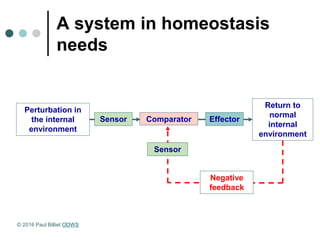
Sensor
Perturbation in
the internal
environment
Return to
normal
internal
environment
Effector
Comparator
Sensor
Negative
feedback
© 2016 Paul Billiet ODWS
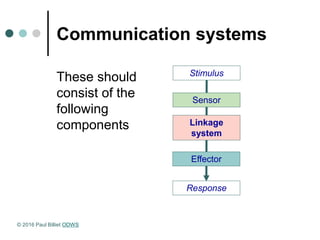
Communication systems
These should
consist of the
following
components Linkage
system
Effector
Response
Sensor
Stimulus
© 2016 Paul Billiet ODWS
In animals there are two
communication systems
 The endocrine system based upon
hormones
 The nervous system based upon
nerve impulses.
© 2016 Paul Billiet ODWS
Hormones
 Organic substances
 Produced in small quantities
 Produced in one part of an organism (an
endocrine gland)
 Transported by the blood system
 All over the body
 Target organs or tissues respond to the
hormone.
© 2016 Paul Billiet ODWS
The endocrine system
 Chemical signals
 Specific messages
 Effects may be very slow (e.g. growth
hormone over years)
 Some are very fast (e.g. adrenaline which
acts in seconds).
© 2016 Paul Billiet ODWS
Nerve impulses
 All nerve impulses look the same
 Signals travel along nerves…
 …to specific parts of the body
 The nerve impulses travel very quickly
Affect their target tissues in milliseconds.
© 2016 Paul Billiet ODWS
The nervous system
 The nervous system is composed of
excitable cells called neurons
 Neurons have long thin extensions which
carry electrical nerve impulses
 The electrical signal of the nerve impulse
needs to be converted into a chemical signal
(a neurotransmitter) so that it can pass from
nerve cell to nerve cell
 The neurotransmitter is destroyed after the
signal has passed on. © 2016 Paul Billiet ODWS
The nervous system
organisation
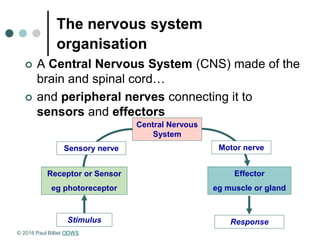
 A Central Nervous System (CNS) made of the
brain and spinal cord…
 and peripheral nerves connecting it to
sensors and effectors
Stimulus
Effector
eg muscle or gland
Central Nervous
System
Receptor or Sensor
eg photoreceptor
Sensory nerve
Response
Motor nerve
© 2016 Paul Billiet ODWS
Hormone pathway
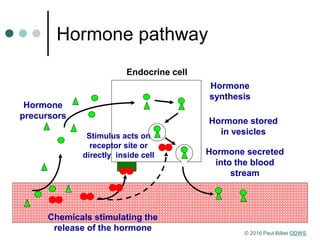
Hormone secreted
into the blood
stream
Endocrine cell
Hormone stored
in vesicles
Hormone
precursors
Hormone
synthesis
Stimulus acts on
receptor site or
directly inside cell
Chemicals stimulating the
release of the hormone © 2016 Paul Billiet ODWS
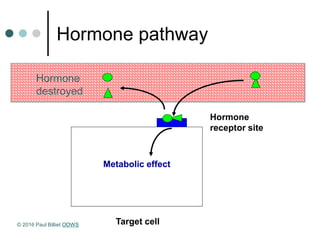
Hormone pathway
Hormone
receptor site
Target cell
Metabolic effect
Hormone
destroyed
© 2016 Paul Billiet ODWS

homeostasis

  • 1.
    HOMEOSTASIS The maintenance ofa steady state in the body despite changes in the external environment The steady state is the optimum level for the body functions © 2016 Paul Billiet ODWS
  • 2.
    A system inhomeostasis needs  Sensors to detect changes in the internal environment  A comparator to fix the set point of the system  Effectors which bring the system back to the set point  Feedback control. Negative feedback stops the system over compensating (going too far)  A communication system to link the different parts together. © 2016 Paul Billiet ODWS
  • 3.
    A system inhomeostasis needs Sensor Perturbation in the internal environment Return to normal internal environment Effector Comparator Sensor Negative feedback © 2016 Paul Billiet ODWS
  • 4.
    Communication systems These should consistof the following components Linkage system Effector Response Sensor Stimulus © 2016 Paul Billiet ODWS
  • 5.
    In animals thereare two communication systems  The endocrine system based upon hormones  The nervous system based upon nerve impulses. © 2016 Paul Billiet ODWS
  • 6.
    Hormones  Organic substances Produced in small quantities  Produced in one part of an organism (an endocrine gland)  Transported by the blood system  All over the body  Target organs or tissues respond to the hormone. © 2016 Paul Billiet ODWS
  • 7.
    The endocrine system Chemical signals  Specific messages  Effects may be very slow (e.g. growth hormone over years)  Some are very fast (e.g. adrenaline which acts in seconds). © 2016 Paul Billiet ODWS
  • 8.
    Nerve impulses  Allnerve impulses look the same  Signals travel along nerves…  …to specific parts of the body  The nerve impulses travel very quickly Affect their target tissues in milliseconds. © 2016 Paul Billiet ODWS
  • 9.
    The nervous system The nervous system is composed of excitable cells called neurons  Neurons have long thin extensions which carry electrical nerve impulses  The electrical signal of the nerve impulse needs to be converted into a chemical signal (a neurotransmitter) so that it can pass from nerve cell to nerve cell  The neurotransmitter is destroyed after the signal has passed on. © 2016 Paul Billiet ODWS
  • 10.
    The nervous system organisation A Central Nervous System (CNS) made of the brain and spinal cord…  and peripheral nerves connecting it to sensors and effectors Stimulus Effector eg muscle or gland Central Nervous System Receptor or Sensor eg photoreceptor Sensory nerve Response Motor nerve © 2016 Paul Billiet ODWS
  • 11.
    Hormone pathway Hormone secreted intothe blood stream Endocrine cell Hormone stored in vesicles Hormone precursors Hormone synthesis Stimulus acts on receptor site or directly inside cell Chemicals stimulating the release of the hormone © 2016 Paul Billiet ODWS
  • 12.
    Hormone pathway Hormone receptor site Targetcell Metabolic effect Hormone destroyed © 2016 Paul Billiet ODWS