Holistic District Heating Grid Design with
SimulationX / Green City
Torsten Schwan
René Unger
EA Systems Dresden GmbH
ESI SimulationX User Forum
Dresden, November 24th, 2016
2
Copyright © ESI Group, 2017. All rights reserved.
www.esi-group.com
Note:
This presentation was published together with a technical paper.
The full paper can be downloaded here.
Paper Abstract
Buildings are central elements of future smart grids. Heating and cooling demand are predictable within reason,
building mass as well as heating and hot water systems provide inherent storage capacity. Additionally, the
fluctuation between peak and average power of a building is much more friendly to the grid than of other
network nodes like wind power or electric mobility.
A local heating grid partially supplied by renewable solar heat is currently being built in a town in Bavaria. Heat
pump systems provide additional storage capacity for electric grid surplus while they serve as wind energy dump
for the local utility company. Cogeneration plants and peak-power boilers provide heat and power in times of low
energy coverage. The low temperature heating grid supplies decentral heat pumps, which provide required heat
at a much higher temperature level to each building.
The paper describes basic modeling aspects for district heating grids with SimulationX & Green City. An
interesting solar-aided grid example helps to identify benefits of a new modeling approach.
2optimizing your energy applications
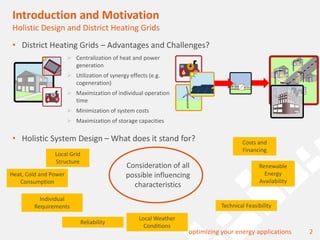
Introduction and Motivation
Holistic Design and District Heating Grids
• District Heating Grids – Advantages and Challenges?
• Holistic System Design – What does it stand for?
 Centralization of heat and power
generation
 Utilization of synergy effects (e.g.
cogeneration)
 Maximization of individual operation
time
 Minimization of system costs
 Maximization of storage capacities
Consideration of all
possible influencing
characteristics
Costs and
Financing
Renewable
Energy
Availability
Local Grid
Structure
Heat, Cold and Power
Consumption
Individual
Requirements
Local Weather
Conditions
Technical Feasibility
Reliability
3optimizing your energy applications
Introduction and Motivation
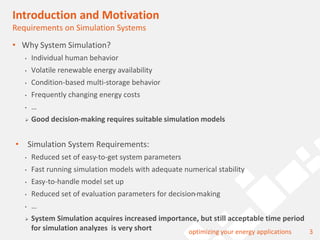
Requirements on Simulation Systems
• Why System Simulation?
• Individual human behavior
• Volatile renewable energy availability
• Condition-based multi-storage behavior
• Frequently changing energy costs
• …
 Good decision-making requires suitable simulation models
• Simulation System Requirements:
• Reduced set of easy-to-get system parameters
• Fast running simulation models with adequate numerical stability
• Easy-to-handle model set up
• Reduced set of evaluation parameters for decision-making
• …
 System Simulation acquires increased importance, but still acceptable time period
for simulation analyzes is very short
4optimizing your energy applications
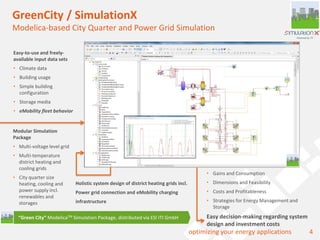
GreenCity / SimulationX
Modelica-based City Quarter and Power Grid Simulation
Easy-to-use and freely-
available input data sets
• Climate data
• Building usage
• Simple building
configuration
• Storage media
• eMobility fleet behavior
Holistic system design of district heating grids incl.
Power grid connection and eMobility charging
infrastructure
Modular Simulation
Package
• Multi-voltage level grid
• Multi-temperature
district heating and
cooling grids
• City quarter size
heating, cooling and
power supply incl.
renewables and
storages
“Green City“ ModelicaTM Simulation Package, distributed via ESI ITI GmbH
• Gains and Consumption
• Dimensions and Feasibility
• Costs and Profitableness
• Strategies for Energy Management and
Storage
Easy decision-making regarding system
design and investment costs
5optimizing your energy applications
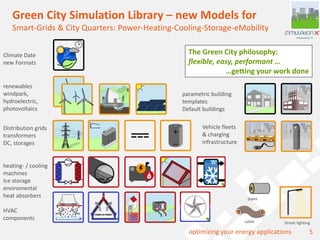
Green City Simulation Library – new Models for
Smart-Grids & City Quarters: Power-Heating-Cooling-Storage-eMobility
Climate Date
new Formats
pipes
cable Street lighting
renewables
windpark,
hydroelectric,
photovoltaics
Distribution grids
transformers
DC, storages
heating- / cooling
machines
Ice storage
enviromental
heat absorbers
HVAC
components
parametric building
templates
Default buildings
Vehicle fleets
& charging
infrastructure
The Green City philosophy:
flexible, easy, performant …
…getting your work done
6optimizing your energy applications
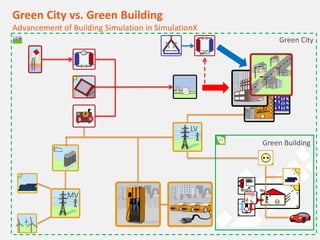
Green City vs. Green Building
Advancement of Building Simulation in SimulationX
Green Building
LV
MV
Green City
7optimizing your energy applications
New Residential Area – Osterfeld, City of Haßfurt
Small Town Detached Housing and Appartement Buildings
[google maps]
[Stadt Haßfurt]
8optimizing your energy applications
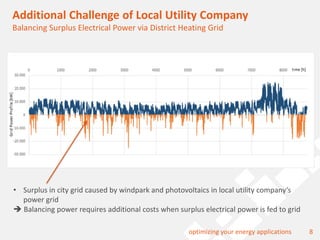
Additional Challenge of Local Utility Company
Balancing Surplus Electrical Power via District Heating Grid
• Surplus in city grid caused by windpark and photovoltaics in local utility company‘s
power grid
 Balancing power requires additional costs when surplus electrical power is fed to grid
9optimizing your energy applications
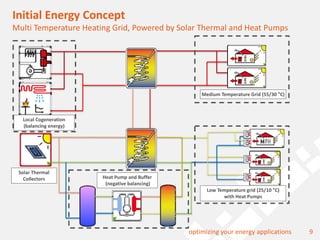
Initial Energy Concept
Multi Temperature Heating Grid, Powered by Solar Thermal and Heat Pumps
Local Cogeneration
(balancing energy)
Solar Thermal
Collectors Heat Pump and Buffer
(negative balancing)
Medium Temperature Grid (55/30 °C)
Low Temperature grid (25/10 °C)
with Heat Pumps
10optimizing your energy applications
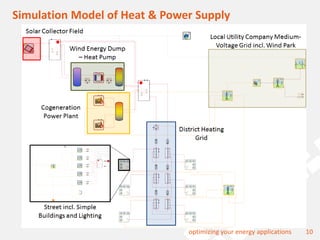
Simulation Model of Heat & Power Supply
11optimizing your energy applications
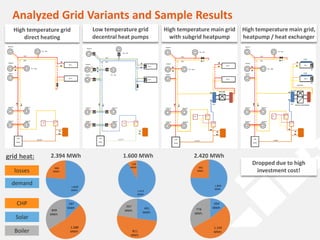
Analyzed Grid Variants and Sample Results
High temperature grid
direct heating
Low temperature grid
decentral heat pumps
High temperature main grid
with subgrid heatpump
High temperature main grid,
heatpump / heat exchanger
Dropped due to high
investment cost!losses
demand
CHP
Solar
grid heat:
Boiler
2.394 MWh 1.600 MWh 2.420 MWh
12optimizing your energy applications
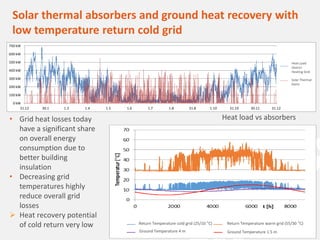
Solar thermal absorbers and ground heat recovery with
low temperature return cold grid
0 kW
100 kW
200 kW
300 kW
400 kW
500 kW
600 kW
700 kW
31.12 30.1 1.3 1.4 1.5 1.6 1.7 1.8 31.8 1.10 31.10 30.11 31.12
Wärmelast
Neubaugebiet
Solarabsorber
therm. Ertrag
Heat load vs absorbers• Grid heat losses today
have a significant share
on overall energy
consumption due to
better building
insulation
• Decreasing grid
temperatures highly
reduce overall grid
losses
 Heat recovery potential
of cold return very low
Heat Load
District
Heating Grid
Solar Thermal
Gains
Return Temperature cold grid (25/10 °C) Return Temperature warm grid (55/30 °C)
Ground Temperature 4 m Ground Temperature 1.5 m
13optimizing your energy applications
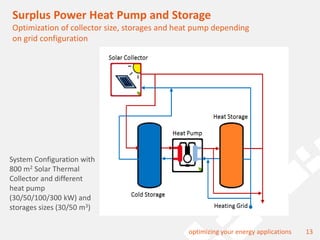
Surplus Power Heat Pump and Storage
Optimization of collector size, storages and heat pump depending
on grid configuration
System Configuration with
800 m2 Solar Thermal
Collector and different
heat pump
(30/50/100/300 kW) and
storages sizes (30/50 m3)
14optimizing your energy applications
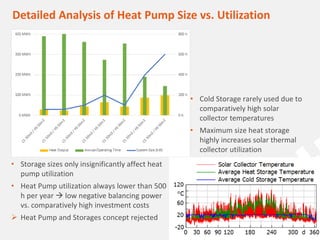
Detailed Analysis of Heat Pump Size vs. Utilization
• Storage sizes only insignificantly affect heat
pump utilization
• Heat Pump utilization always lower than 500
h per year  low negative balancing power
vs. comparatively high investment costs
 Heat Pump and Storages concept rejected
• Cold Storage rarely used due to
comparatively high solar
collector temperatures
• Maximum size heat storage
highly increases solar thermal
collector utilization
15optimizing your energy applications
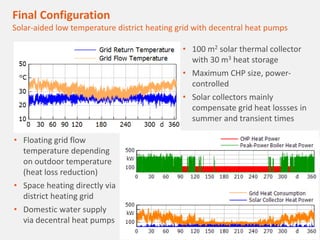
Final Configuration
Solar-aided low temperature district heating grid with decentral heat pumps
• Floating grid flow
temperature depending
on outdoor temperature
(heat loss reduction)
• Space heating directly via
district heating grid
• Domestic water supply
via decentral heat pumps
• 100 m2 solar thermal collector
with 30 m3 heat storage
• Maximum CHP size, power-
controlled
• Solar collectors mainly
compensate grid heat lossses in
summer and transient times
16optimizing your energy applications
Conclusions
• New Green City library in ESI ITI‘s SimulationX helps to identify optimal
configurations of district heating grids as well as heat, cold and power supply
for whole city quarters
• Upcoming challenges of future energy supply require complex solutions (heat-
cold-power cogeneration incl. renewables in city quarter size)
• Complex energy concepts require intensive simulation analyzes
• Presented simulation approach firstly used for a district heating grid in Hassfurt
(northern bavaria)
• Final solution has been built from the beginning of 2015, will be extended from
the beginning of 2017
3
Copyright © ESI Group, 2017. All rights reserved.
www.esi-group.com
Download the Paper
This presentation was published together with a technical paper.
The full paper can be downloaded here.
Paper Abstract
Buildings are central elements of future smart grids. Heating and cooling demand are predictable within reason,
building mass as well as heating and hot water systems provide inherent storage capacity. Additionally, the
fluctuation between peak and average power of a building is much more friendly to the grid than of other
network nodes like wind power or electric mobility.
A local heating grid partially supplied by renewable solar heat is currently being built in a town in Bavaria. Heat
pump systems provide additional storage capacity for electric grid surplus while they serve as wind energy dump
for the local utility company. Cogeneration plants and peak-power boilers provide heat and power in times of low
energy coverage. The low temperature heating grid supplies decentral heat pumps, which provide required heat
at a much higher temperature level to each building.
The paper describes basic modeling aspects for district heating grids with SimulationX & Green City. An
interesting solar-aided grid example helps to identify benefits of a new modeling approach.
Thank you for your
attention
[Esters2012]
Contact:
EA Systems Dresden GmbH
Würzburger Str. 14
01187 Dresden
+49-351-467-136-52
torsten.schwan@ea-energie.de

Holistic District Heating Grid Design with SimulationX & Green City

  • 1.
    Holistic District HeatingGrid Design with SimulationX / Green City Torsten Schwan René Unger EA Systems Dresden GmbH ESI SimulationX User Forum Dresden, November 24th, 2016
  • 2.
    2 Copyright © ESIGroup, 2017. All rights reserved. www.esi-group.com Note: This presentation was published together with a technical paper. The full paper can be downloaded here. Paper Abstract Buildings are central elements of future smart grids. Heating and cooling demand are predictable within reason, building mass as well as heating and hot water systems provide inherent storage capacity. Additionally, the fluctuation between peak and average power of a building is much more friendly to the grid than of other network nodes like wind power or electric mobility. A local heating grid partially supplied by renewable solar heat is currently being built in a town in Bavaria. Heat pump systems provide additional storage capacity for electric grid surplus while they serve as wind energy dump for the local utility company. Cogeneration plants and peak-power boilers provide heat and power in times of low energy coverage. The low temperature heating grid supplies decentral heat pumps, which provide required heat at a much higher temperature level to each building. The paper describes basic modeling aspects for district heating grids with SimulationX & Green City. An interesting solar-aided grid example helps to identify benefits of a new modeling approach.
  • 3.
    2optimizing your energyapplications Introduction and Motivation Holistic Design and District Heating Grids • District Heating Grids – Advantages and Challenges? • Holistic System Design – What does it stand for?  Centralization of heat and power generation  Utilization of synergy effects (e.g. cogeneration)  Maximization of individual operation time  Minimization of system costs  Maximization of storage capacities Consideration of all possible influencing characteristics Costs and Financing Renewable Energy Availability Local Grid Structure Heat, Cold and Power Consumption Individual Requirements Local Weather Conditions Technical Feasibility Reliability
  • 4.
    3optimizing your energyapplications Introduction and Motivation Requirements on Simulation Systems • Why System Simulation? • Individual human behavior • Volatile renewable energy availability • Condition-based multi-storage behavior • Frequently changing energy costs • …  Good decision-making requires suitable simulation models • Simulation System Requirements: • Reduced set of easy-to-get system parameters • Fast running simulation models with adequate numerical stability • Easy-to-handle model set up • Reduced set of evaluation parameters for decision-making • …  System Simulation acquires increased importance, but still acceptable time period for simulation analyzes is very short
  • 5.
    4optimizing your energyapplications GreenCity / SimulationX Modelica-based City Quarter and Power Grid Simulation Easy-to-use and freely- available input data sets • Climate data • Building usage • Simple building configuration • Storage media • eMobility fleet behavior Holistic system design of district heating grids incl. Power grid connection and eMobility charging infrastructure Modular Simulation Package • Multi-voltage level grid • Multi-temperature district heating and cooling grids • City quarter size heating, cooling and power supply incl. renewables and storages “Green City“ ModelicaTM Simulation Package, distributed via ESI ITI GmbH • Gains and Consumption • Dimensions and Feasibility • Costs and Profitableness • Strategies for Energy Management and Storage Easy decision-making regarding system design and investment costs
  • 6.
    5optimizing your energyapplications Green City Simulation Library – new Models for Smart-Grids & City Quarters: Power-Heating-Cooling-Storage-eMobility Climate Date new Formats pipes cable Street lighting renewables windpark, hydroelectric, photovoltaics Distribution grids transformers DC, storages heating- / cooling machines Ice storage enviromental heat absorbers HVAC components parametric building templates Default buildings Vehicle fleets & charging infrastructure The Green City philosophy: flexible, easy, performant … …getting your work done
  • 7.
    6optimizing your energyapplications Green City vs. Green Building Advancement of Building Simulation in SimulationX Green Building LV MV Green City
  • 8.
    7optimizing your energyapplications New Residential Area – Osterfeld, City of Haßfurt Small Town Detached Housing and Appartement Buildings [google maps] [Stadt Haßfurt]
  • 9.
    8optimizing your energyapplications Additional Challenge of Local Utility Company Balancing Surplus Electrical Power via District Heating Grid • Surplus in city grid caused by windpark and photovoltaics in local utility company‘s power grid  Balancing power requires additional costs when surplus electrical power is fed to grid
  • 10.
    9optimizing your energyapplications Initial Energy Concept Multi Temperature Heating Grid, Powered by Solar Thermal and Heat Pumps Local Cogeneration (balancing energy) Solar Thermal Collectors Heat Pump and Buffer (negative balancing) Medium Temperature Grid (55/30 °C) Low Temperature grid (25/10 °C) with Heat Pumps
  • 11.
    10optimizing your energyapplications Simulation Model of Heat & Power Supply
  • 12.
    11optimizing your energyapplications Analyzed Grid Variants and Sample Results High temperature grid direct heating Low temperature grid decentral heat pumps High temperature main grid with subgrid heatpump High temperature main grid, heatpump / heat exchanger Dropped due to high investment cost!losses demand CHP Solar grid heat: Boiler 2.394 MWh 1.600 MWh 2.420 MWh
  • 13.
    12optimizing your energyapplications Solar thermal absorbers and ground heat recovery with low temperature return cold grid 0 kW 100 kW 200 kW 300 kW 400 kW 500 kW 600 kW 700 kW 31.12 30.1 1.3 1.4 1.5 1.6 1.7 1.8 31.8 1.10 31.10 30.11 31.12 Wärmelast Neubaugebiet Solarabsorber therm. Ertrag Heat load vs absorbers• Grid heat losses today have a significant share on overall energy consumption due to better building insulation • Decreasing grid temperatures highly reduce overall grid losses  Heat recovery potential of cold return very low Heat Load District Heating Grid Solar Thermal Gains Return Temperature cold grid (25/10 °C) Return Temperature warm grid (55/30 °C) Ground Temperature 4 m Ground Temperature 1.5 m
  • 14.
    13optimizing your energyapplications Surplus Power Heat Pump and Storage Optimization of collector size, storages and heat pump depending on grid configuration System Configuration with 800 m2 Solar Thermal Collector and different heat pump (30/50/100/300 kW) and storages sizes (30/50 m3)
  • 15.
    14optimizing your energyapplications Detailed Analysis of Heat Pump Size vs. Utilization • Storage sizes only insignificantly affect heat pump utilization • Heat Pump utilization always lower than 500 h per year  low negative balancing power vs. comparatively high investment costs  Heat Pump and Storages concept rejected • Cold Storage rarely used due to comparatively high solar collector temperatures • Maximum size heat storage highly increases solar thermal collector utilization
  • 16.
    15optimizing your energyapplications Final Configuration Solar-aided low temperature district heating grid with decentral heat pumps • Floating grid flow temperature depending on outdoor temperature (heat loss reduction) • Space heating directly via district heating grid • Domestic water supply via decentral heat pumps • 100 m2 solar thermal collector with 30 m3 heat storage • Maximum CHP size, power- controlled • Solar collectors mainly compensate grid heat lossses in summer and transient times
  • 17.
    16optimizing your energyapplications Conclusions • New Green City library in ESI ITI‘s SimulationX helps to identify optimal configurations of district heating grids as well as heat, cold and power supply for whole city quarters • Upcoming challenges of future energy supply require complex solutions (heat- cold-power cogeneration incl. renewables in city quarter size) • Complex energy concepts require intensive simulation analyzes • Presented simulation approach firstly used for a district heating grid in Hassfurt (northern bavaria) • Final solution has been built from the beginning of 2015, will be extended from the beginning of 2017
  • 18.
    3 Copyright © ESIGroup, 2017. All rights reserved. www.esi-group.com Download the Paper This presentation was published together with a technical paper. The full paper can be downloaded here. Paper Abstract Buildings are central elements of future smart grids. Heating and cooling demand are predictable within reason, building mass as well as heating and hot water systems provide inherent storage capacity. Additionally, the fluctuation between peak and average power of a building is much more friendly to the grid than of other network nodes like wind power or electric mobility. A local heating grid partially supplied by renewable solar heat is currently being built in a town in Bavaria. Heat pump systems provide additional storage capacity for electric grid surplus while they serve as wind energy dump for the local utility company. Cogeneration plants and peak-power boilers provide heat and power in times of low energy coverage. The low temperature heating grid supplies decentral heat pumps, which provide required heat at a much higher temperature level to each building. The paper describes basic modeling aspects for district heating grids with SimulationX & Green City. An interesting solar-aided grid example helps to identify benefits of a new modeling approach.
  • 19.
    Thank you foryour attention [Esters2012] Contact: EA Systems Dresden GmbH Würzburger Str. 14 01187 Dresden +49-351-467-136-52 torsten.schwan@ea-energie.de