Differences in Biomarker Expression
           in Head and Neck Cancer
                    Presented by: Rebecca Feldman
                                     May 30, 2012
Overview
• Part I
   – Head and Neck Cancer
                    • Background
                    • Standard of Care
        – Molecular Subtypes
        – Target Now Study
                    • Results
                    • Clinical Implications
• Part II
   – Head and Neck Cancer – Opportunities for R&D
                    • Current Diagnostic Approaches
                    • Current Research in area of exosomes
                    • Companies actively researching diagnostic platforms
©2012 Caris Life Sciences, Ltd. and Affiliates                              2
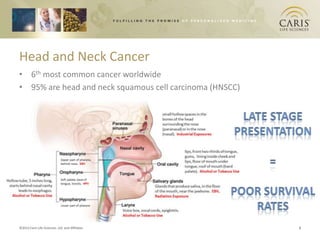
Head and Neck Cancer
• 6th most common cancer worldwide
• 95% are head and neck squamous cell carcinoma (HNSCC)


©2012 Caris Life Sciences, Ltd. and Affiliates            3
Standard of Care
  • Treatment Modalities
             – Surgery
             – Radiotherapy
             – Chemotherapy
  • Treatment Goals
             – Organ preservation
             – Quality of Life
  • Recent Improvements
             – Targeted therapy


©2012 Caris Life Sciences, Ltd. and Affiliates   4
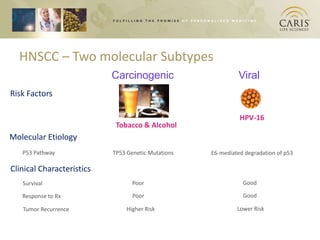
HNSCC – Two molecular Subtypes
                           Carcinogenic                       Viral
Risk Factors

                                                              HPV-16
                            Tobacco & Alcohol
Molecular Etiology
   P53 Pathway             TP53 Genetic Mutations   E6-mediated degradation of p53

Clinical Characteristics
   Survival                       Poor                         Good

   Response to Rx                 Poor                         Good

   Tumor Recurrence            Higher Risk                   Lower Risk
Genesis of Project Idea
•       Biological basis of the difference in prognosis remains unknown

•       Target Now profiles ~150 HNSCC patients/year
           –      analyses on a wide range of clinically relevant biomarkers
           –      Specimens are often left unused after profiling, stored


•       Only hurdle is to delineate our cohort into the two subtypes

•       HPV positive patients are usually P53 wildtype and HPV negative patients are P53 mutated

•       Teamed up with Caris’ Pharmaceutical Services who had resources to perform p53
        mutation analysis on cases we have leftover tissue sample

•       Compare biomarker expression profiles between p53 wildtype (HPV +) and p53 mutated
        (HPV -) cases with the goal of identifying molecular differences between the two
        subgroups which may explain differences in prognosis
©2012 Caris Life Sciences, Ltd. and Affiliates                                               6
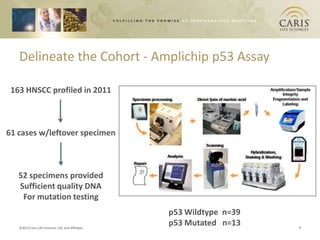
Delineate the Cohort - Amplichip p53 Assay

 163 HNSCC profiled in 2011


61 cases w/leftover specimen


   52 specimens provided
   Sufficient quality DNA
    For mutation testing
                                                    p53 Wildtype n=39
   ©2012 Caris Life Sciences, Ltd. and Affiliates
                                                    p53 Mutated n=13    7
IHC Results
                                                  ***


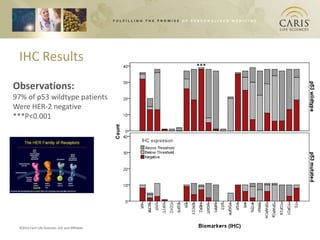
Observations:
97% of p53 wildtype patients
Were HER-2 negative
***P<0.001


 ©2012 Caris Life Sciences, Ltd. and Affiliates         8
FISH Results
                                                  *

                                                  ***
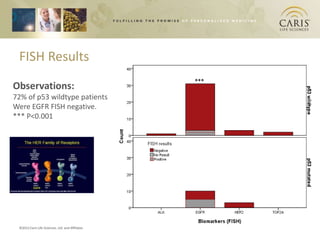
Observations:
72% of p53 wildtype patients
Were EGFR FISH negative.
*** P<0.001


 ©2012 Caris Life Sciences, Ltd. and Affiliates         9
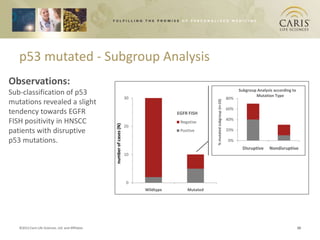
p53 mutated - Subgroup Analysis
Observations:
                                                                                                                                           Subgroup Analysis according to
Sub-classification of p53                                                                                                                          Mutation Type
                                                                          30                                                         80%
mutations revealed a slight


                                                                                                         % mutated subgroup (n=10)
                                                                                                                                     60%
tendency towards EGFR                                                                     EGFR FISH
FISH positivity in HNSCC                            number of cases (N)
                                                                                           Negative
                                                                                                                                     40%
                                                                          20
patients with disruptive                                                                   Positive                                  20%

p53 mutations.                                                                                                                       0%
                                                                                                                                             Disruptive    Nondisruptive
                                                                          10


                                                                           0
                                                                               Wildtype        Mutated


   ©2012 Caris Life Sciences, Ltd. and Affiliates                                                                                                                           10
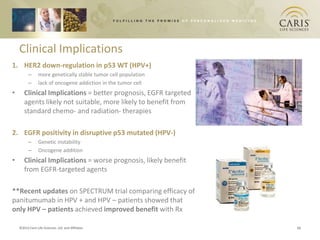
Clinical Implications
1. HER2 down-regulation in p53 WT (HPV+)
          –      more genetically stable tumor cell population
          –      lack of oncogene addiction in the tumor cell
•      Clinical Implications = better prognosis, EGFR targeted
       agents likely not suitable, more likely to benefit from
       standard chemo- and radiation- therapies

2. EGFR positivity in disruptive p53 mutated (HPV-)
          –      Genetic instability
          –      Oncogene addition
•      Clinical Implications = worse prognosis, likely benefit
       from EGFR-targeted agents

**Recent updates on SPECTRUM trial comparing efficacy of
panitumumab in HPV + and HPV – patients showed that
only HPV – patients achieved improved benefit with Rx

    ©2012 Caris Life Sciences, Ltd. and Affiliates               11
Part II
• Important Take Home Messages
           – Early Detection is Key to Improving Survival
                       • overall 5-year survival rate is 50% and has not improved in past decade
                       • 2/3 are diagnosed at advanced stage
           – Molecular subtyping impacts Treatment Approaches
                       • HPV + / p53 WT - overall better prognosis, Rx can be scaled down
                       • HPV - / p53 mutated - worse prognosis, aggressive treatment
                         approach, targeted therapy
• Head and Neck Cancer – Opportunities for R&D?
                       • Current Diagnostic Approaches
                       • Research in area of Exosomes
                       • Companies actively researching diagnostic platforms

©2012 Caris Life Sciences, Ltd. and Affiliates                                                     12
Current Diagnostic Approaches
     Visualization and/or Palpation

     Imaging Techniques
        • Endoscopy, CT or PET scans, MRI, X-rays

     Biopsy w/ Pathology Report
        • H&E

     Laboratory-based techniques
        • Loss of Heterozygosity (LOH)
        • P53 mutation testing or IHC expression
        • HPV testing (CISH, RT-PCR)


©2012 Caris Life Sciences, Ltd. and Affiliates      13
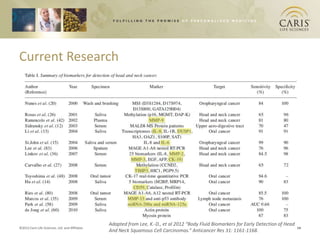
Current Research


                                                 Adapted from Lee, K.-D., et al 2012 “Body Fluid Biomarkers for Early Detection of Head
©2012 Caris Life Sciences, Ltd. and Affiliates                                                                                            14
                                                 And Neck Squamous Cell Carcinomas.” Anticancer Res 31: 1161-1168.
Exosome-related Research
Whiteside Lab – University of Pittsburgh Cancer Institute in collaboration with Ludwig-
Maximilians-University, Munich, Germany (Exosome Dx collaborator) “Tumor derived
microvesicles in sera of patients with headand neck cancer and their role in tumor
progression”
         •       Microvesicles isolated from sera of 60 HNSCC patients and 25 controls. MV from patients
                 with active disease expressed higher FasL levels than MV from patients with no evident
                 disease or normal controls.

Taylor Lab - University of Louisville “Exosomal-miRNA profiles as diagnostic and
prognostic biomarkers in head and neck squamous cell carcinoma” ASCO 2011
         •       Thirty HNSCC patients (19M, 11F), stage II (n=3), III (n=7), IVa (n=20) entered in the study.
                 Fifteen were considered for analysis since at least one follow-up sample was collected post
                 treatment. Of the 84 miRNAs analyzed and 12 detected, miR148b and miR222 appeared to
                 be uniquely expressed in HNSCC. miR16 was present in exosomes on patients with SCC. In
                 patients responding to initial therapy, the levels of most exosomal-miRNAs were
                 suppressed; in patients failing to respond, no decrease in the exosomal miRNAs were
                 observed.
 ©2012 Caris Life Sciences, Ltd. and Affiliates                                                           15
Potential Market
•        Vigilant Biosciences - University of Miami spinoff
          – Salivary CD44 oral rinses; 80% sensitivity; 88% specificity

•        mAbDx Immunodiagnostics
          – identified a “new biomarker” of HNSCC and are evaluating utility of prototype
            immunoassays using non-invasive sampling of oral and throat tissues

•        NIH (Dental and Craniofacial Research) – office of technology transfer
          – Detection of mutations in TGFbetaR1 and PTEN genes associates with devt of
             HNSCC.

•        Trovagene –
          – Diagnostic test for presence of HPV from urine specimens (78% sensitivity;
             86% specificity)


©2012 Caris Life Sciences, Ltd. and Affiliates                                           16

HNSCC Biomarker Expression According To p53

  • 1.
    Differences in BiomarkerExpression in Head and Neck Cancer Presented by: Rebecca Feldman May 30, 2012
  • 2.
    Overview • Part I – Head and Neck Cancer • Background • Standard of Care – Molecular Subtypes – Target Now Study • Results • Clinical Implications • Part II – Head and Neck Cancer – Opportunities for R&D • Current Diagnostic Approaches • Current Research in area of exosomes • Companies actively researching diagnostic platforms ©2012 Caris Life Sciences, Ltd. and Affiliates 2
  • 3.
    Head and NeckCancer • 6th most common cancer worldwide • 95% are head and neck squamous cell carcinoma (HNSCC) ©2012 Caris Life Sciences, Ltd. and Affiliates 3
  • 4.
    Standard of Care • Treatment Modalities – Surgery – Radiotherapy – Chemotherapy • Treatment Goals – Organ preservation – Quality of Life • Recent Improvements – Targeted therapy ©2012 Caris Life Sciences, Ltd. and Affiliates 4
  • 5.
    HNSCC – Twomolecular Subtypes Carcinogenic Viral Risk Factors HPV-16 Tobacco & Alcohol Molecular Etiology P53 Pathway TP53 Genetic Mutations E6-mediated degradation of p53 Clinical Characteristics Survival Poor Good Response to Rx Poor Good Tumor Recurrence Higher Risk Lower Risk
  • 6.
    Genesis of ProjectIdea • Biological basis of the difference in prognosis remains unknown • Target Now profiles ~150 HNSCC patients/year – analyses on a wide range of clinically relevant biomarkers – Specimens are often left unused after profiling, stored • Only hurdle is to delineate our cohort into the two subtypes • HPV positive patients are usually P53 wildtype and HPV negative patients are P53 mutated • Teamed up with Caris’ Pharmaceutical Services who had resources to perform p53 mutation analysis on cases we have leftover tissue sample • Compare biomarker expression profiles between p53 wildtype (HPV +) and p53 mutated (HPV -) cases with the goal of identifying molecular differences between the two subgroups which may explain differences in prognosis ©2012 Caris Life Sciences, Ltd. and Affiliates 6
  • 7.
    Delineate the Cohort- Amplichip p53 Assay 163 HNSCC profiled in 2011 61 cases w/leftover specimen 52 specimens provided Sufficient quality DNA For mutation testing p53 Wildtype n=39 ©2012 Caris Life Sciences, Ltd. and Affiliates p53 Mutated n=13 7
  • 8.
    IHC Results *** Observations: 97% of p53 wildtype patients Were HER-2 negative ***P<0.001 ©2012 Caris Life Sciences, Ltd. and Affiliates 8
  • 9.
    FISH Results * *** Observations: 72% of p53 wildtype patients Were EGFR FISH negative. *** P<0.001 ©2012 Caris Life Sciences, Ltd. and Affiliates 9
  • 10.
    p53 mutated -Subgroup Analysis Observations: Subgroup Analysis according to Sub-classification of p53 Mutation Type 30 80% mutations revealed a slight % mutated subgroup (n=10) 60% tendency towards EGFR EGFR FISH FISH positivity in HNSCC number of cases (N) Negative 40% 20 patients with disruptive Positive 20% p53 mutations. 0% Disruptive Nondisruptive 10 0 Wildtype Mutated ©2012 Caris Life Sciences, Ltd. and Affiliates 10
  • 11.
    Clinical Implications 1. HER2down-regulation in p53 WT (HPV+) – more genetically stable tumor cell population – lack of oncogene addiction in the tumor cell • Clinical Implications = better prognosis, EGFR targeted agents likely not suitable, more likely to benefit from standard chemo- and radiation- therapies 2. EGFR positivity in disruptive p53 mutated (HPV-) – Genetic instability – Oncogene addition • Clinical Implications = worse prognosis, likely benefit from EGFR-targeted agents **Recent updates on SPECTRUM trial comparing efficacy of panitumumab in HPV + and HPV – patients showed that only HPV – patients achieved improved benefit with Rx ©2012 Caris Life Sciences, Ltd. and Affiliates 11
  • 12.
    Part II • ImportantTake Home Messages – Early Detection is Key to Improving Survival • overall 5-year survival rate is 50% and has not improved in past decade • 2/3 are diagnosed at advanced stage – Molecular subtyping impacts Treatment Approaches • HPV + / p53 WT - overall better prognosis, Rx can be scaled down • HPV - / p53 mutated - worse prognosis, aggressive treatment approach, targeted therapy • Head and Neck Cancer – Opportunities for R&D? • Current Diagnostic Approaches • Research in area of Exosomes • Companies actively researching diagnostic platforms ©2012 Caris Life Sciences, Ltd. and Affiliates 12
  • 13.
    Current Diagnostic Approaches  Visualization and/or Palpation  Imaging Techniques • Endoscopy, CT or PET scans, MRI, X-rays  Biopsy w/ Pathology Report • H&E  Laboratory-based techniques • Loss of Heterozygosity (LOH) • P53 mutation testing or IHC expression • HPV testing (CISH, RT-PCR) ©2012 Caris Life Sciences, Ltd. and Affiliates 13
  • 14.
    Current Research Adapted from Lee, K.-D., et al 2012 “Body Fluid Biomarkers for Early Detection of Head ©2012 Caris Life Sciences, Ltd. and Affiliates 14 And Neck Squamous Cell Carcinomas.” Anticancer Res 31: 1161-1168.
  • 15.
    Exosome-related Research Whiteside Lab– University of Pittsburgh Cancer Institute in collaboration with Ludwig- Maximilians-University, Munich, Germany (Exosome Dx collaborator) “Tumor derived microvesicles in sera of patients with headand neck cancer and their role in tumor progression” • Microvesicles isolated from sera of 60 HNSCC patients and 25 controls. MV from patients with active disease expressed higher FasL levels than MV from patients with no evident disease or normal controls. Taylor Lab - University of Louisville “Exosomal-miRNA profiles as diagnostic and prognostic biomarkers in head and neck squamous cell carcinoma” ASCO 2011 • Thirty HNSCC patients (19M, 11F), stage II (n=3), III (n=7), IVa (n=20) entered in the study. Fifteen were considered for analysis since at least one follow-up sample was collected post treatment. Of the 84 miRNAs analyzed and 12 detected, miR148b and miR222 appeared to be uniquely expressed in HNSCC. miR16 was present in exosomes on patients with SCC. In patients responding to initial therapy, the levels of most exosomal-miRNAs were suppressed; in patients failing to respond, no decrease in the exosomal miRNAs were observed. ©2012 Caris Life Sciences, Ltd. and Affiliates 15
  • 16.
    Potential Market • Vigilant Biosciences - University of Miami spinoff – Salivary CD44 oral rinses; 80% sensitivity; 88% specificity • mAbDx Immunodiagnostics – identified a “new biomarker” of HNSCC and are evaluating utility of prototype immunoassays using non-invasive sampling of oral and throat tissues • NIH (Dental and Craniofacial Research) – office of technology transfer – Detection of mutations in TGFbetaR1 and PTEN genes associates with devt of HNSCC. • Trovagene – – Diagnostic test for presence of HPV from urine specimens (78% sensitivity; 86% specificity) ©2012 Caris Life Sciences, Ltd. and Affiliates 16