Chapter1:Introductionto
EmergingTechnologies
Chapter Overview
•Topics Covered:
• Evolution of Technology
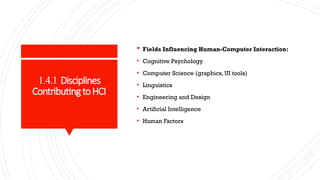
• Role of Data in Emerging Technologies
• Programmable Devices and Enabling Networks
• Human to Machine Interaction (HCI)
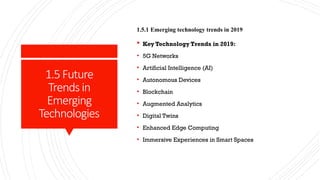
• Future Technology Trends
• Objectives:
• Understand the industrial revolutions
• Analyze impacts of tech evolution
• Learn about emerging tech and HCI
3.
Learning
Outcomes
By theend of this chapter, students will:
• Understand technological and industrial evolution
• Identify key technological advances
• Analyze societal and industrial impacts
• Understand programmable devices
• Explore Human-Computer Interaction (HCI)
• Gain knowledge of future trends in tech
Definitions
• Emerging Technology:New or developing tech with
major impact expected in 5–10 years.
• Technology: From Greek tekhnologia, meaning craft or
art method.
• Evolution: From Latin evolutio, meaning unrolling or
developing gradually.
6.
Activity1.2 –
ListTop
Emerging
Technologies
Examples ofcurrently available emerging technologies:
• Artificial Intelligence (AI)
• Blockchain
• AR/VR
• Cloud Computing
• Internet of Things (IoT)
• Robotic Process Automation (RPA)
• Intelligent Apps
• Big Data
The American
Industrial
Revolution
• Referredto as the Second IR
• Timeframe: 1820–1870
• Affected textiles, mining, glass, and agriculture
• Used steam and later electricity for mass production
9.
FourPhases of
Industrial
Revolutions
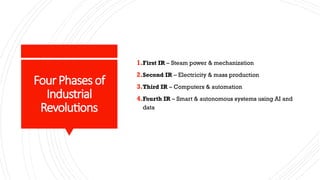
1.First IR– Steam power & mechanization
2.Second IR – Electricity & mass production
3.Third IR – Computers & automation
4.Fourth IR – Smart & autonomous systems using AI and
data
10.
Activity1.3 –
Inventions ofIR
What are the most important inventions of
industrial revolutions?
• Steam Engine
• Spinning Jenny
• Telegraph
• Electric Power
• Assembly Line
• Computers
• Internet
• AI & Robotics:
11.
1.1.2TheMost
ImportantInventions
oftheIndustrial
Revolution
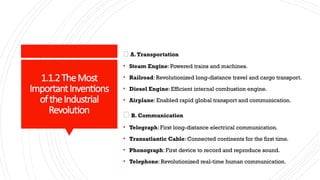
🚗 A.Transportation
• SteamEngine: Powered trains and machines.
• Railroad: Revolutionized long-distance travel and cargo transport.
• Diesel Engine: Efficient internal combustion engine.
• Airplane: Enabled rapid global transport and communication.
📡 B. Communication
• Telegraph: First long-distance electrical communication.
• Transatlantic Cable: Connected continents for the first time.
• Phonograph: First device to record and reproduce sound.
• Telephone: Revolutionized real-time human communication.
12.
Cont.
🏭C. Industry
• CottonGin: Increased speed of cotton processing.
• Sewing Machine:Transformed garment
manufacturing.
• Electric Lights: Replaced oil lamps; extended working
hours and urbanization.
13.
1.1.3Historical
Background(IR
1.0,IR2.0,IR
3.0)
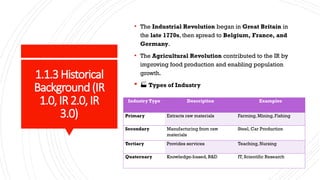
• The IndustrialRevolution began in Great Britain in
the late 1770s, then spread to Belgium, France, and
Germany.
• The Agricultural Revolution contributed to the IR by
improving food production and enabling population
growth.
🏭 Types of Industry
Industry Type Description Examples
Primary Extracts raw materials Farming, Mining, Fishing
Secondary Manufacturing from raw
materials
Steel, Car Production
Tertiary Provides services Teaching, Nursing
Quaternary Knowledge-based, R&D IT, Scientific Research
14.
1.1.3.1Industrial
Revolution(IR
1.0)
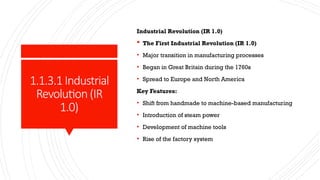
Industrial Revolution (IR1.0)
The First Industrial Revolution (IR 1.0)
• Major transition in manufacturing processes
• Began in Great Britain during the 1760s
• Spread to Europe and North America
Key Features:
• Shift from handmade to machine-based manufacturing
• Introduction of steam power
• Development of machine tools
• Rise of the factory system
15.
IR1.0 –Steam
Engine
SteamEngine:
• Powered factories and locomotives
• Drastically changed transportation and industry
Figure 1.1 – Steam Engine]
16.
Industrial
Revolution(IR
2.0)
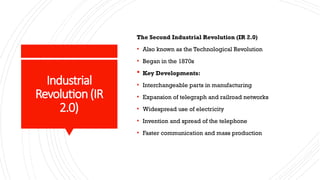
The Second IndustrialRevolution (IR 2.0)
• Also known as the Technological Revolution
• Began in the 1870s
Key Developments:
• Interchangeable parts in manufacturing
• Expansion of telegraph and railroad networks
• Widespread use of electricity
• Invention and spread of the telephone
• Faster communication and mass production
1.1.3.3 Industrial
Revolution(IR3.0)
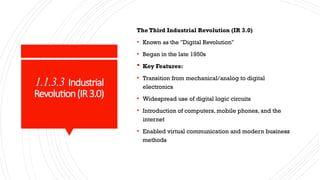
The ThirdIndustrial Revolution (IR 3.0)
• Known as the "Digital Revolution"
• Began in the late 1950s
Key Features:
• Transition from mechanical/analog to digital
electronics
• Widespread use of digital logic circuits
• Introduction of computers, mobile phones, and the
internet
• Enabled virtual communication and modern business
methods
19.
IR3.0 –High
TechElectronics
Digital TechnologyImpact:
• Revolutionized communication, business, and data
storage
• Enabled global digital interconnectivity
Figure 1.3 – High Tech Electronics]
20.
1.1.3.4 Fourth
IndustrialRevolution
(IR4.0)
The FourthIndustrial Revolution (IR 4.0)
• Term coined by Klaus Schwab (2016)
• Integrates cyber-physical systems with advanced technologies
Key Technologies:
• Robotics
• Internet of Things (IoT)
• Additive manufacturing (3D printing)
• Autonomous vehicles
• Artificial Intelligence (AI)
Cyber-Physical Systems:
• Computer-based systems integrated with the internet and real-
world applications
• Example: CNC Machines, AI-driven smartphones, autonomous
robots
1.2Roleof Data
forEmerging
Technologies
Data asa Strategic Asset:
• Data is the "new oil" in today’s world
• Drives science, technology, economy, and innovation
• Presents challenges but unlocks great opportunities
Big Data & Analytics:
• Shapes scientific discovery, economic growth, and
social development
• Enabling data-driven decision-making in:
• Computing, statistics, and informatics
• Business, health, and social sciences
23.
1.3EnablingDevices
andNetwork
(Programmable
Devices)
Core Digital ElectronicDevices:
• Memory Devices – store data (e.g., databases)
• Microprocessors – run software programs
• Logic Devices – handle interfacing, signal processing, contl
operations
• Networks – connect devices and enable data sharing (e.g., the
Internet)
Programmable Devices:
• Include FPGAs, CPLDs, and PLDs
• May also include analog versions like Field Programmable
Analog Arrays
Figure 1.5 – Programmable Device]
24.
1.3.1 Listofsome
Programmabledevices
Common ProgrammableDevices:
• Achronix Speedster SPD60
• Actel’s Devices
• Altera Stratix IV GT, Arria II GX
• Atmel AT91CAP7L
• Cypress PSoC family
• Lattice ECP3
• Lime Microsystems LMS6002
• Silicon Blue Technologies
• Xilinx Virtex 6, Spartan 6
• Xmos L Series
25.
Activity 1.7
DiscussionPrompt:
• From the programmable devices listed, select 2–3 and describe their unique
features
Service Enabling Devices (SEDs):
• Channel Service Unit (CSU) / Data Service Unit (DSU)
• Modems
• Routers
• Switches
• Conferencing Equipment
• Network Appliances (NIDs/SIDs)
• Hosting Equipment and Servers
Figure 1.5 – Programmable Device]
26.
1.4 Human to
MachineInteraction
Human to Machine Interaction
Human-Machine Interaction (HMI):
• Communication between a human and a machine via a user
interface
• Natural user interfaces (e.g., gestures) allow intuitive control
What is Interaction in HCI?
• Study of how people interact with computers
• Includes user, computer, and how they work together
How Users Interact with Computers:
• Through input/output devices and software interfaces (e.g., GUI)
Importance of HCI:
• Improves usability and user satisfaction
• Reduces cost, complexity, and design time
Activity 1.8
DiscussionPrompt:
• Which emerging technologies will have more effect on
our day-to-day life & how?
30.
TechnologiesThatWill
ShapeYourLifeand
Business
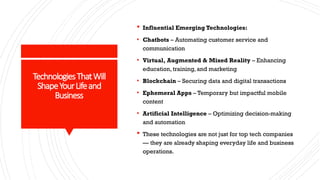
Influential EmergingTechnologies:
• Chatbots – Automating customer service and
communication
• Virtual, Augmented & Mixed Reality – Enhancing
education, training, and marketing
• Blockchain – Securing data and digital transactions
• Ephemeral Apps – Temporary but impactful mobile
content
• Artificial Intelligence – Optimizing decision-making
and automation
These technologies are not just for top tech companies
— they are already shaping everyday life and business
operations.
31.
Activity 1.9
BarflyDiscussion Prompt:
• Discuss how each of the following technologies could
shape your future and business:
• Chatbots
• Virtual, Augmented & Mixed Reality
• Blockchain
• Ephemeral Apps
• Artificial Intelligence
32.
Activity 1.10 –
GroupDebate
Debate Setup:
• Form small groups of 3–5 students
• Each group presents one invention from the Industrial Revolution
• Each student speaks for 1–2 minutes
Topics to Cover:
• What the invention is
• Why it was the most important advancement
• Its impact on society (positive/negative)
Inventions to Choose From:
• Steam Engine
• Railroad
• Interchangeable Parts
• Steamboat
• Spinning Jenny
• High-Quality Iron
Vote on the Most Important Invention!

![IR1.0 –Steam
Engine
Steam Engine:
• Powered factories and locomotives
• Drastically changed transportation and industry
Figure 1.1 – Steam Engine]](https://image.slidesharecdn.com/chapter-1introductiontoemergingtechnologiesautosaved-250721132907-a397d4ad/85/chapter-1-Introduction-to-Emerging-Technologies-Autosaved-pptx-15-320.jpg)
![IR2.0 –
Electricity&
Communication
Electricity:
• Replaced steam and gas
• Became the new power source for industries and homes
[ Figure 1.2 – Electricity Transmission Line]](https://image.slidesharecdn.com/chapter-1introductiontoemergingtechnologiesautosaved-250721132907-a397d4ad/85/chapter-1-Introduction-to-Emerging-Technologies-Autosaved-pptx-17-320.jpg)
![IR3.0 –High
TechElectronics
Digital Technology Impact:
• Revolutionized communication, business, and data
storage
• Enabled global digital interconnectivity
Figure 1.3 – High Tech Electronics]](https://image.slidesharecdn.com/chapter-1introductiontoemergingtechnologiesautosaved-250721132907-a397d4ad/85/chapter-1-Introduction-to-Emerging-Technologies-Autosaved-pptx-19-320.jpg)
![IR4.0 –IoTand
SmartDevices
ConnectedWorld:
• Anyone Connected Device (ABCD)
• Smart industries, smart homes, smart agriculture
Figure 1.4 – Anybody Connected Device]](https://image.slidesharecdn.com/chapter-1introductiontoemergingtechnologiesautosaved-250721132907-a397d4ad/85/chapter-1-Introduction-to-Emerging-Technologies-Autosaved-pptx-21-320.jpg)
![1.3EnablingDevices
andNetwork
(Programmable
Devices)
Core Digital Electronic Devices:
• Memory Devices – store data (e.g., databases)
• Microprocessors – run software programs
• Logic Devices – handle interfacing, signal processing, contl
operations
• Networks – connect devices and enable data sharing (e.g., the
Internet)
Programmable Devices:
• Include FPGAs, CPLDs, and PLDs
• May also include analog versions like Field Programmable
Analog Arrays
Figure 1.5 – Programmable Device]](https://image.slidesharecdn.com/chapter-1introductiontoemergingtechnologiesautosaved-250721132907-a397d4ad/85/chapter-1-Introduction-to-Emerging-Technologies-Autosaved-pptx-23-320.jpg)
![Activity 1.7
Discussion Prompt:
• From the programmable devices listed, select 2–3 and describe their unique
features
Service Enabling Devices (SEDs):
• Channel Service Unit (CSU) / Data Service Unit (DSU)
• Modems
• Routers
• Switches
• Conferencing Equipment
• Network Appliances (NIDs/SIDs)
• Hosting Equipment and Servers
Figure 1.5 – Programmable Device]](https://image.slidesharecdn.com/chapter-1introductiontoemergingtechnologiesautosaved-250721132907-a397d4ad/85/chapter-1-Introduction-to-Emerging-Technologies-Autosaved-pptx-25-320.jpg)





![Chapter 1 - Intro. to Emerging Technologies [Autosaved].pptx](https://cdn.slidesharecdn.com/ss_thumbnails/chapter1-intro-251129110229-405d20f9-thumbnail.jpg?width=640&height=640&fit=bounds)


![chapter-1 Introduction to Emerging Technologies [Autosaved].pptx](https://cdn.slidesharecdn.com/ss_thumbnails/chapter-1introductiontoemergingtechnologiesautosaved-250706055921-dccba335-thumbnail.jpg?width=640&height=640&fit=bounds)


