Developmental Education
Redesign:
Radically Increasing Acceleration,
Retention, and Completion Rates
Presenters:
Dr. Dennis C. Rittle, Provost and Executive Vice President of Learning
Holly Ayers, Division Chair for Math, Science, and Education
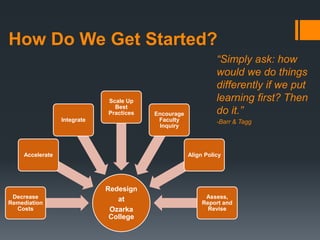
How Do We Get Started?
“Simply ask: how
would we do things
differently if we put
learning first? Then
do it.”
-Barr & Tagg
Redesign
at
Ozarka
College
Decrease
Remediation
Costs
Accelerate
Integrate
Scale Up
Best
Practices Encourage
Faculty
Inquiry
Align Policy
Assess,
Report and
Revise
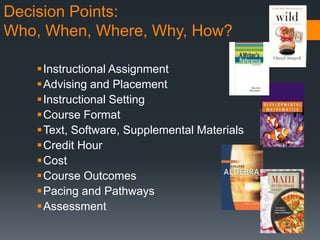
Decision Points:
Who, When, Where, Why, How?
Instructional Assignment
Advising and Placement
Instructional Setting
Course Format
Text, Software, Supplemental Materials
Credit Hour
Cost
Course Outcomes
Pacing and Pathways
Assessment
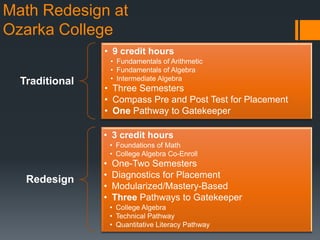
Math Redesign at
Ozarka College
Traditional
• 9 credit hours
• Fundamentals of Arithmetic
• Fundamentals of Algebra
• Intermediate Algebra
• Three Semesters
• Compass Pre and Post Test for Placement
• One Pathway to Gatekeeper
Redesign
• 3 credit hours
• Foundations of Math
• College Algebra Co-Enroll
• One-Two Semesters
• Diagnostics for Placement
• Modularized/Mastery-Based
• Three Pathways to Gatekeeper
• College Algebra
• Technical Pathway
• Quantitative Literacy Pathway
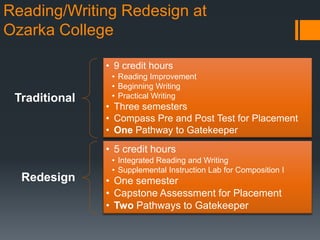
Reading/Writing Redesign at
Ozarka College
Traditional
• 9 credit hours
• Reading Improvement
• Beginning Writing
• Practical Writing
• Three semesters
• Compass Pre and Post Test for Placement
• One Pathway to Gatekeeper
Redesign
• 5 credit hours
• Integrated Reading and Writing
• Supplemental Instruction Lab for Composition I
• One semester
• Capstone Assessment for Placement
• Two Pathways to Gatekeeper
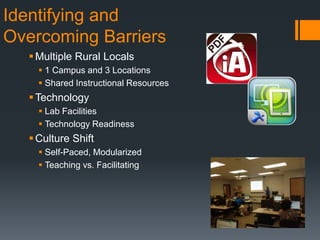
Identifying and
Overcoming Barriers
Multiple Rural Locals
 1 Campus and 3 Locations
 Shared Instructional Resources
Technology
 Lab Facilities
 Technology Readiness
Culture Shift
 Self-Paced, Modularized
 Teaching vs. Facilitating
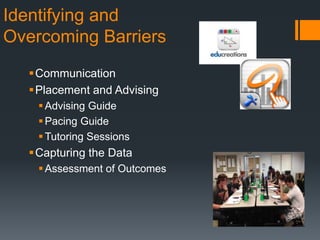
Identifying and
Overcoming Barriers
Communication
Placement and Advising
Advising Guide
Pacing Guide
Tutoring Sessions
Capturing the Data
Assessment of Outcomes
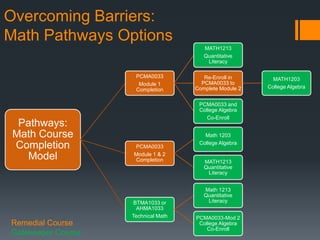
Pathways:
Math Course
Completion
Model
PCMA0033
Module 1
Completion
MATH1213
Quantitative
Literacy
Re-Enroll in
PCMA0033 to
Complete Module 2
MATH1203
College Algebra
PCMA0033 and
College Algebra
Co-Enroll
PCMA0033
Module 1 & 2
Completion
Math 1203
College Algebra
MATH1213
Quantitative
Literacy
BTMA1033 or
AHMA1033
Technical Math
Math 1213
Quantitative
Literacy
PCMA0033-Mod 2
College Algebra
Co-Enroll
Overcoming Barriers:
Math Pathways Options
Remedial Course
Gatekeeper Course
Overcoming Barriers:
Reading/Writing Options
Pathways:
Literacy Course
Completion
Model
PCEN0034
Foundations of Literacy
[grade C-F: re-enroll]
FOL grade: A
ENGL 1013
English Composition I
FOL grade: B
PCEN0001
Supplemental Instruction
for Comp I and Co-Enroll
Comp I
PCEN0001
Supplemental
Instruction for Comp I
and Co-Enroll Comp I
ENGL 1013
English Composition I
Remedial Course
Gatekeeper Course
Overcoming Barriers:
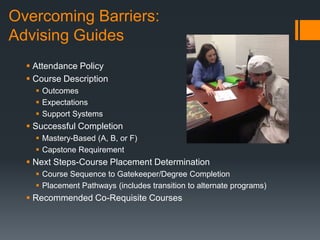
Advising Guides
 Attendance Policy
 Course Description
 Outcomes
 Expectations
 Support Systems
 Successful Completion
 Mastery-Based (A, B, or F)
 Capstone Requirement
 Next Steps-Course Placement Determination
 Course Sequence to Gatekeeper/Degree Completion
 Placement Pathways (includes transition to alternate programs)
 Recommended Co-Requisite Courses
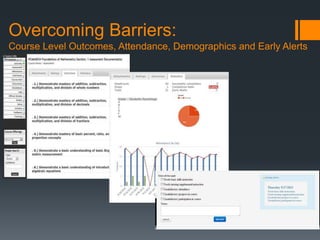
Overcoming Barriers:
Course Level Outcomes, Attendance, Demographics and Early Alerts
Using the Data:
What do we consider successful?
What do we consider unsuccessful?
What have we learned about student learning?
What roles can students play in the decisions?
Getting Results:
Developmental Math Redesign
Cohort Comparison: Fall 2011-Spring 2013
Student Retention: 96% Increase
Student Persistence to Gateway Course:
139% Increase
Student Degree Completion: 31% Increase
Getting Results:
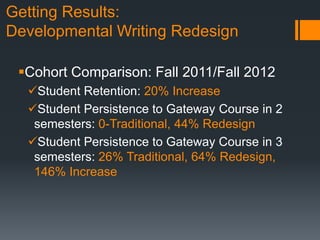
Developmental Writing Redesign
Cohort Comparison: Fall 2011/Fall 2012
Student Retention: 20% Increase
Student Persistence to Gateway Course in 2
semesters: 0-Traditional, 44% Redesign
Student Persistence to Gateway Course in 3
semesters: 26% Traditional, 64% Redesign,
146% Increase
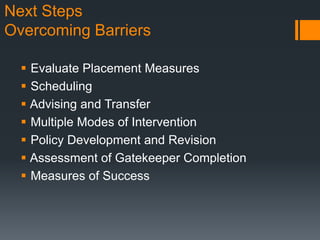
Next Steps
Overcoming Barriers
 Evaluate Placement Measures
 Scheduling
 Advising and Transfer
 Multiple Modes of Intervention
 Policy Development and Revision
 Assessment of Gatekeeper Completion
 Measures of Success
Questions?
Dr. Dennis C. Rittle
Provost and Executive Vice President of Learning
 dcrittle@ozarka.edu
 870-368-2004
Holly Ayers
Division Chair for Math, Science, and Education
 hayers@ozarka.edu
 870-368-2040
www.ozarka.edu

Hlc presentation final (2014)2

  • 1.
    Developmental Education Redesign: Radically IncreasingAcceleration, Retention, and Completion Rates Presenters: Dr. Dennis C. Rittle, Provost and Executive Vice President of Learning Holly Ayers, Division Chair for Math, Science, and Education
  • 2.
    How Do WeGet Started? “Simply ask: how would we do things differently if we put learning first? Then do it.” -Barr & Tagg Redesign at Ozarka College Decrease Remediation Costs Accelerate Integrate Scale Up Best Practices Encourage Faculty Inquiry Align Policy Assess, Report and Revise
  • 3.
    Decision Points: Who, When,Where, Why, How? Instructional Assignment Advising and Placement Instructional Setting Course Format Text, Software, Supplemental Materials Credit Hour Cost Course Outcomes Pacing and Pathways Assessment
  • 4.
    Math Redesign at OzarkaCollege Traditional • 9 credit hours • Fundamentals of Arithmetic • Fundamentals of Algebra • Intermediate Algebra • Three Semesters • Compass Pre and Post Test for Placement • One Pathway to Gatekeeper Redesign • 3 credit hours • Foundations of Math • College Algebra Co-Enroll • One-Two Semesters • Diagnostics for Placement • Modularized/Mastery-Based • Three Pathways to Gatekeeper • College Algebra • Technical Pathway • Quantitative Literacy Pathway
  • 5.
    Reading/Writing Redesign at OzarkaCollege Traditional • 9 credit hours • Reading Improvement • Beginning Writing • Practical Writing • Three semesters • Compass Pre and Post Test for Placement • One Pathway to Gatekeeper Redesign • 5 credit hours • Integrated Reading and Writing • Supplemental Instruction Lab for Composition I • One semester • Capstone Assessment for Placement • Two Pathways to Gatekeeper
  • 6.
    Identifying and Overcoming Barriers MultipleRural Locals  1 Campus and 3 Locations  Shared Instructional Resources Technology  Lab Facilities  Technology Readiness Culture Shift  Self-Paced, Modularized  Teaching vs. Facilitating
  • 7.
    Identifying and Overcoming Barriers Communication Placementand Advising Advising Guide Pacing Guide Tutoring Sessions Capturing the Data Assessment of Outcomes
  • 8.
    Pathways: Math Course Completion Model PCMA0033 Module 1 Completion MATH1213 Quantitative Literacy Re-Enrollin PCMA0033 to Complete Module 2 MATH1203 College Algebra PCMA0033 and College Algebra Co-Enroll PCMA0033 Module 1 & 2 Completion Math 1203 College Algebra MATH1213 Quantitative Literacy BTMA1033 or AHMA1033 Technical Math Math 1213 Quantitative Literacy PCMA0033-Mod 2 College Algebra Co-Enroll Overcoming Barriers: Math Pathways Options Remedial Course Gatekeeper Course
  • 9.
    Overcoming Barriers: Reading/Writing Options Pathways: LiteracyCourse Completion Model PCEN0034 Foundations of Literacy [grade C-F: re-enroll] FOL grade: A ENGL 1013 English Composition I FOL grade: B PCEN0001 Supplemental Instruction for Comp I and Co-Enroll Comp I PCEN0001 Supplemental Instruction for Comp I and Co-Enroll Comp I ENGL 1013 English Composition I Remedial Course Gatekeeper Course
  • 10.
    Overcoming Barriers: Advising Guides Attendance Policy  Course Description  Outcomes  Expectations  Support Systems  Successful Completion  Mastery-Based (A, B, or F)  Capstone Requirement  Next Steps-Course Placement Determination  Course Sequence to Gatekeeper/Degree Completion  Placement Pathways (includes transition to alternate programs)  Recommended Co-Requisite Courses
  • 11.
    Overcoming Barriers: Course LevelOutcomes, Attendance, Demographics and Early Alerts
  • 12.
    Using the Data: Whatdo we consider successful? What do we consider unsuccessful? What have we learned about student learning? What roles can students play in the decisions?
  • 13.
    Getting Results: Developmental MathRedesign Cohort Comparison: Fall 2011-Spring 2013 Student Retention: 96% Increase Student Persistence to Gateway Course: 139% Increase Student Degree Completion: 31% Increase
  • 14.
    Getting Results: Developmental WritingRedesign Cohort Comparison: Fall 2011/Fall 2012 Student Retention: 20% Increase Student Persistence to Gateway Course in 2 semesters: 0-Traditional, 44% Redesign Student Persistence to Gateway Course in 3 semesters: 26% Traditional, 64% Redesign, 146% Increase
  • 15.
    Next Steps Overcoming Barriers Evaluate Placement Measures  Scheduling  Advising and Transfer  Multiple Modes of Intervention  Policy Development and Revision  Assessment of Gatekeeper Completion  Measures of Success
  • 16.
    Questions? Dr. Dennis C.Rittle Provost and Executive Vice President of Learning  dcrittle@ozarka.edu  870-368-2004 Holly Ayers Division Chair for Math, Science, and Education  hayers@ozarka.edu  870-368-2040 www.ozarka.edu