Docker & Its Ecosystem
H-Layer 18.04 - www.hlayer.io
Docker, Kube, RunC, Moby & The Ecosystem
Aymen El Amri -
@eon01
Founder eralabs.io
Founder @DevOpsLinks
Author @PainlessDocker
The Ecosystem
Containers
History of Containers
● Chroot Jail
● FreeBSD Jails
● Linux-VServer
● Solaris Containers
● OpenVZ
● Process Containers
● LXC
● Warden
● LMCTFY
● Docker
● RKT
Chroot Jail
- The Chroot Jail, is one the first
containerization technologies (1979).
- It allows to isolate a process and its
children from the rest of the OS by
changing their root directory
- Security: A root process can easily exit the
chroot. Chroot was never intended as a
security mechanism
FreeBSD Jail
- A FreeBSD-specific implementation
- More secure than the Chroot Jail.
- A virtualization solution more advanced
than the simple chroot
- It lets you run multiple Linux
distributions on a single distribution
- Linux VServer / VPS
Linux-VServer
Oracle Solaris Containers
- An implementation of Linux-Vserver for
X86 and SPARC processors
- SPARC is a RISC (reduced instruction set
computing) architecture developed by
Sun Microsystems.
OpenVZ
- Similar to Solaris Containers
- Enables a physical baremetal server to
run multiple isolated operating systems →
containers.
- It is used by hosting companies to isolate
VPS.
CGroups - Process Containers
- It is a process isolator developed by
Google (CGroups)
- Docker is based on CGroups
LXC - Linux Containers
- Uses CGroups
- No need for Kernel patch
- Used to be used by Docker
LMCTFY
- Google developed the CGroups, which
was used by LXC
- Run applications in isolated environments
on the same Kernel and without patching
it
- Google: A leader in the container industry
- Everything, absolutely everything, runs
on containers at Google
- There are more than 2 billion containers
running on Google infrastructure every
week
Docker
- Most popular
- Developer friendly
RKT
- Developed by CoreOS
- Standards / Security
- Bought by Redhat
Containers : 1979 -> 2013
Containers vs VMs
Architecture
Docker Tools
2013 - Docker & LXC
- Docker se base sur LXC.
- Sponosrisé par Canonical
- A partir de la version 0.9 en 2014, Docker a cessé d’utiliser LXC et a
développé Libcontainer
2014 - Libcontainer
- L’interface de Docker pour accéder aux
Linux Facilities
2014 - Libcontainer
- Cgroups, Namespaces, Capabilities ..etc
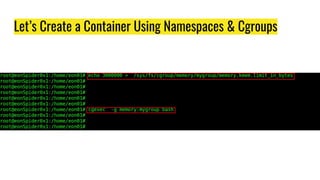
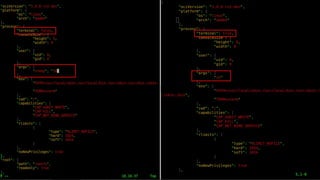
Let’s Create a Container Using Namespaces & Cgroups
The Container
Let’s Create a Container Using Namespaces & Cgroups
The Host Machine
2015 - RunC
- Leverage Libcontainer without without
going through the Docker Engine
- Standardization of the world of
containers.
- Other vendors can implement their own
version of containers
- The abstraction of the communication
between Docker and the runtime
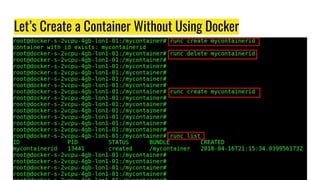
Let’s Create a Container Without Using Docker
The Host Machine
Let’s Create a Container Without Using Docker
The Host Machine
Let’s Create a Container Without Using Docker
The Host Machine
Let’s Create a Container Without Using Docker
The Host Machine
Let’s Create a Container Without Using Docker
The Host Machine
2016 - Containerd
- Uses RunC to manage and supervise
containers (lifecycle)
- Exposes containers functionalities over
gRPC (vs Docker who exposes images,
volumes, networks, builds, etc.)
- Refactory → Containerd is a community
Open Source project
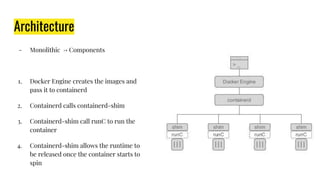
Architecture
- Monolithic → Components
1. Docker Engine creates the images and
pass it to containerd
2. Containerd calls containerd-shim
3. Containerd-shim call runC to run the
container
4. Containerd-shim allows the runtime to
be released once the container starts to
spin
2017 - Containers Go Mainstream
- Docker est devenu mainstream
- Plusieurs vendors: Mac, Linux, Windows,
AWS, GCP ..etc
- La création de l’OCI (Open Container
Initiative)
- Des nouveaux modèles de développement
et de production
The Moby Project
- A project to organize and modularize the
development of Docker
- It is an ecosystem of development and
production
- No change for the regular users
The Moby Project
Containerd
- Industry-standard core container
runtime
- Manage the container’s lifecycle
LinuxKit
- A tool for creating lightweight and secure
operating systems for containers
InfraKit
- Distributed / self-healing infrastructures
- Procedural vs Declarative
- Desired State
SwarmKit
- A toolbox for orchestrating distributed
systems at any scale.
- It includes primitives for node discovery,
RAFT-based consensus, and task
scheduling.
Orchestration
Orchestration
Orchestration
Orchestration is a Must
Kubernetes
- Developed by Google
- Google has been running production
workloads in containers for over 15 years
- Using K8S: Github, Ebay, Wikimedia ..
Kubernetes in the Cloud
- Amazon Elastic Container Service for
Kubernetes (EKS)
- Redhat Openshift
- Google Container Engine (GKE)
- Azure Container Service (AKS)
Kubernetes Community
- Organisation en SIG (Special Interest
Groups)
- Google, Redhat, CoreOs, Alibaba,
Microsoft, Samsung, Huawei, Canonical,
IBM, Fujitsu ..etc
Redhat & Kuberentes
Aymen El Amri
www.bit.ly/hldocker
Twitter: @eon01
Email: aymen@eralabs.io
Join eralabs.:
www.eralabs.io
Connect Deeper
Images via: sysadmincasts.com, docker.com, jimmysong.io

HLayer / Docker and its ecosystem

  • 1.
    Docker & ItsEcosystem H-Layer 18.04 - www.hlayer.io Docker, Kube, RunC, Moby & The Ecosystem
  • 2.
    Aymen El Amri- @eon01 Founder eralabs.io Founder @DevOpsLinks Author @PainlessDocker
  • 3.
  • 4.
  • 5.
    History of Containers ●Chroot Jail ● FreeBSD Jails ● Linux-VServer ● Solaris Containers ● OpenVZ ● Process Containers ● LXC ● Warden ● LMCTFY ● Docker ● RKT
  • 6.
    Chroot Jail - TheChroot Jail, is one the first containerization technologies (1979). - It allows to isolate a process and its children from the rest of the OS by changing their root directory - Security: A root process can easily exit the chroot. Chroot was never intended as a security mechanism
  • 7.
    FreeBSD Jail - AFreeBSD-specific implementation - More secure than the Chroot Jail.
  • 8.
    - A virtualizationsolution more advanced than the simple chroot - It lets you run multiple Linux distributions on a single distribution - Linux VServer / VPS Linux-VServer
  • 9.
    Oracle Solaris Containers -An implementation of Linux-Vserver for X86 and SPARC processors - SPARC is a RISC (reduced instruction set computing) architecture developed by Sun Microsystems.
  • 10.
    OpenVZ - Similar toSolaris Containers - Enables a physical baremetal server to run multiple isolated operating systems → containers. - It is used by hosting companies to isolate VPS.
  • 11.
    CGroups - ProcessContainers - It is a process isolator developed by Google (CGroups) - Docker is based on CGroups
  • 12.
    LXC - LinuxContainers - Uses CGroups - No need for Kernel patch - Used to be used by Docker
  • 13.
    LMCTFY - Google developedthe CGroups, which was used by LXC - Run applications in isolated environments on the same Kernel and without patching it - Google: A leader in the container industry - Everything, absolutely everything, runs on containers at Google - There are more than 2 billion containers running on Google infrastructure every week
  • 14.
    Docker - Most popular -Developer friendly
  • 15.
    RKT - Developed byCoreOS - Standards / Security - Bought by Redhat
  • 16.
  • 17.
  • 18.
  • 19.
  • 20.
    2013 - Docker& LXC - Docker se base sur LXC. - Sponosrisé par Canonical - A partir de la version 0.9 en 2014, Docker a cessé d’utiliser LXC et a développé Libcontainer
  • 21.
    2014 - Libcontainer -L’interface de Docker pour accéder aux Linux Facilities
  • 22.
    2014 - Libcontainer -Cgroups, Namespaces, Capabilities ..etc
  • 23.
    Let’s Create aContainer Using Namespaces & Cgroups
  • 24.
    Let’s Create aContainer Using Namespaces & Cgroups
  • 25.
    Let’s Create aContainer Using Namespaces & Cgroups
  • 26.
    Let’s Create aContainer Using Namespaces & Cgroups The Container
  • 27.
    Let’s Create aContainer Using Namespaces & Cgroups The Host Machine
  • 28.
    2015 - RunC -Leverage Libcontainer without without going through the Docker Engine - Standardization of the world of containers. - Other vendors can implement their own version of containers - The abstraction of the communication between Docker and the runtime
  • 29.
    Let’s Create aContainer Without Using Docker The Host Machine
  • 30.
    Let’s Create aContainer Without Using Docker The Host Machine
  • 31.
    Let’s Create aContainer Without Using Docker The Host Machine
  • 32.
    Let’s Create aContainer Without Using Docker The Host Machine
  • 33.
    Let’s Create aContainer Without Using Docker The Host Machine
  • 34.
    2016 - Containerd -Uses RunC to manage and supervise containers (lifecycle) - Exposes containers functionalities over gRPC (vs Docker who exposes images, volumes, networks, builds, etc.) - Refactory → Containerd is a community Open Source project
  • 35.
    Architecture - Monolithic →Components 1. Docker Engine creates the images and pass it to containerd 2. Containerd calls containerd-shim 3. Containerd-shim call runC to run the container 4. Containerd-shim allows the runtime to be released once the container starts to spin
  • 36.
    2017 - ContainersGo Mainstream - Docker est devenu mainstream - Plusieurs vendors: Mac, Linux, Windows, AWS, GCP ..etc - La création de l’OCI (Open Container Initiative) - Des nouveaux modèles de développement et de production
  • 37.
    The Moby Project -A project to organize and modularize the development of Docker - It is an ecosystem of development and production - No change for the regular users
  • 42.
  • 43.
    Containerd - Industry-standard corecontainer runtime - Manage the container’s lifecycle
  • 44.
    LinuxKit - A toolfor creating lightweight and secure operating systems for containers
  • 45.
    InfraKit - Distributed /self-healing infrastructures - Procedural vs Declarative - Desired State
  • 46.
    SwarmKit - A toolboxfor orchestrating distributed systems at any scale. - It includes primitives for node discovery, RAFT-based consensus, and task scheduling.
  • 47.
  • 48.
  • 49.
  • 50.
  • 51.
    Kubernetes - Developed byGoogle - Google has been running production workloads in containers for over 15 years - Using K8S: Github, Ebay, Wikimedia ..
  • 52.
    Kubernetes in theCloud - Amazon Elastic Container Service for Kubernetes (EKS) - Redhat Openshift - Google Container Engine (GKE) - Azure Container Service (AKS)
  • 53.
    Kubernetes Community - Organisationen SIG (Special Interest Groups) - Google, Redhat, CoreOs, Alibaba, Microsoft, Samsung, Huawei, Canonical, IBM, Fujitsu ..etc
  • 54.
  • 55.
    Aymen El Amri www.bit.ly/hldocker Twitter:@eon01 Email: aymen@eralabs.io Join eralabs.: www.eralabs.io Connect Deeper Images via: sysadmincasts.com, docker.com, jimmysong.io