CDAR2 PHMRPTS, R1R2


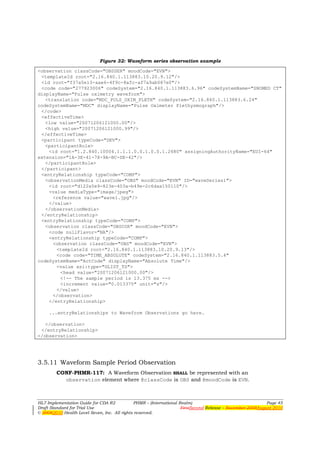
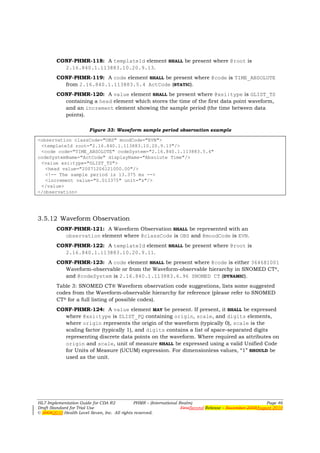
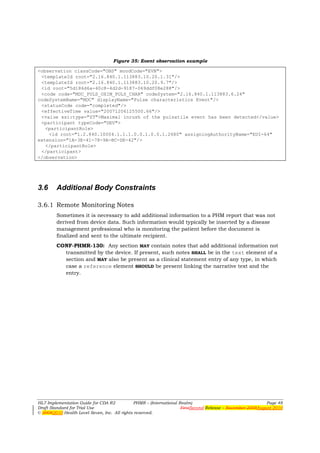
       Implementation Guide for CDA Release 2.0
     Personal Healthcare Monitoring Report (PHMR)
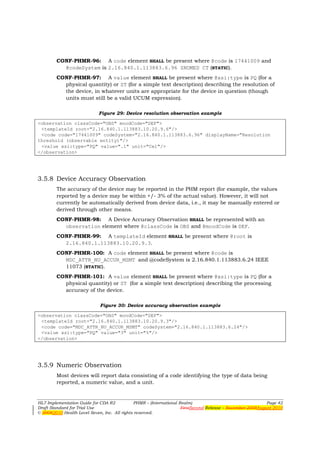
                                 (International Realm)
                          Draft Standard for Trial Use
                                             Release 12

                                               First Release
                                              November 2008
                                               August 2010

Publication of this draft standard for trial use and comment has been approved by Health Level
Seven, Inc. (HL7). Distribution of this draft standard for comment shall not continue beyond 24
months from the date of publication. It is expected that following this 24 month period, this draft
standard, revised as necessary, will be submitted to a normative ballot in preparation for approval
by ANSI as an American National Standard. This draft standard is not an accredited American
National Standard. Suggestions for revision should be submitted at
http://www.hl7.org/dstucomments/index.cfm.


© 20082010 Health Level Seven, Inc.
Ann Arbor, MI
All rights reserved.


HL7 Implementation Guide for CDA R2           PHMR – (International Realm)                                   Page 1
Draft Standard for Trial Use                                         FirstSecond Release – November 2008August 2010
© 20082010 Health Level Seven, Inc. All rights reserved.
Co-Chair/Co-Editor:                  Liora Alschuler
                                      Alschuler Associates, LLC.
                                      liora@alschulerassociates.com


 Co-Chair/Co-Editor:                  Calvin Beebe
                                      Mayo Clinic
                                      cbeebe@mayo.edu


 Co-Chair/Co-Editor:                  Keith W. Boone
                                      GE Healthcare
                                      keith.boone@ge.com


 Co-Chair/Co-Editor:                  Robert H. Dolin, M.D.
                                      Semantically Yours, LLC
                                      BobDolin@gmail.com


 Co-Editor:                           Rick Geimer
                                      Alschuler Associates, LLC
                                      rick@alschulerassociates.com


 Co-Editor:                           Igor Gejdos
                                      Roche
                                      igor.gejdos@roche.com


 Co-Editor:                           Nandu Kushalnagar
                                      Intel
                                      nandakishore.kushalnagar@intel.com


 Co-Editor:                           Rick Cnossen
                                      Intel
                                      rick.a.cnossen@intel.com


 Co-Editor:                           Douglas Bogia
                                      Intel
                                      douglas.p.bogia@intel.com
 Working Group Includes:              Randy Carroll
                                      IBM
                                      rwcarroll@us.ibm.com
                                      Jeffry J. Egan
                                      CHRISTUS Health
                                      jeff.egan@christushealth.org


HL7 Implementation Guide for CDA R2           PHMR – (International Realm)                                   Page 2
Draft Standard for Trial Use                                         FirstSecond Release – November 2008August 2010
© 20082010 Health Level Seven, Inc. All rights reserved.
Acknowledgments
        This Guide was produced and developed in conjunction with the Continua Alliance. Its
        development and ultimate deployment is a result of the dedication of the Continua xHR
        subteam and others, who turned requirements into an HL7 Clinical Document
        Architecture (CDA)-compliant specification. A special thanks to Randy Carroll, Keith
        Naylor, Jeff Egan, Rick Cnossen, Igor Gejdos, Dr. Ed Conley, Darek Nabialczyk, Chris
        Gough, Mitra Rocca, Jeffrey Brown, Nandu Kushalnagar, Rick Geimer, Doug Bogia,
        Tony Butt, Paul Schluter, Keith Boone, Jayant Parthasarathy, Kurt Kermes, Robert
        Hoy, Alex Neefus, and Julie Fleischer.
        This specification is a set of constraints on existing work, and the extent to which it can
        accommodate the expressive requirements of personal healthcare monitoring reporting
        is a function of the richness of the model on which it is built, the HL7 Reference
        Information Model (RIM) and the RIM document standard, and the Clinical Document
        Architecture Release 2 (CDA R2).
        Many thanks to all those who have worked for over a decade to produce these
        fundamental specifications and special thanks to structured documents co-chairs Liora
        Alschuler, Bob Dolin, Keith Boone, and Calvin Beebe for their support of this project.
        A special thanks also to Gunter Schadow, Grahame Grieve, and George Marcini and the
        HL7 Healthcare Devices WG co-chairs Todd Cooper, Jack Harrington, and Melvin
        Reynolds.


HL7 Implementation Guide for CDA R2           PHMR – (International Realm)                                   Page 3
Draft Standard for Trial Use                                         FirstSecond Release – November 2008August 2010
© 20082010 Health Level Seven, Inc. All rights reserved.
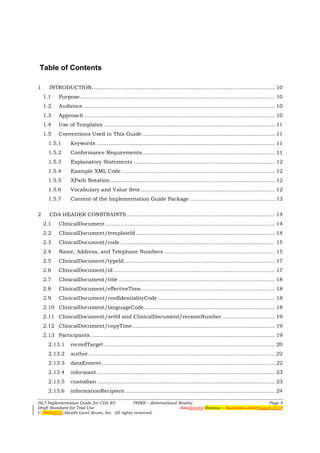
Table of Contents

1      INTRODUCTION............................................................................................................ 10
    1.1     Purpose ................................................................................................................... 10
    1.2     Audience ................................................................................................................. 10
    1.3     Approach ................................................................................................................ 10
    1.4     Use of Templates ..................................................................................................... 11
    1.5     Conventions Used in This Guide .............................................................................. 11
      1.5.1        Keywords ......................................................................................................... 11
      1.5.2        Conformance Requirements .............................................................................. 11
      1.5.3        Explanatory Statements ................................................................................... 12
      1.5.4        Example XML Code .......................................................................................... 12
      1.5.5        XPath Notation ................................................................................................. 12
      1.5.6        Vocabulary and Value Sets ............................................................................... 12
      1.5.7        Content of the Implementation Guide Package .................................................. 13

2      CDA HEADER CONSTRAINTS ....................................................................................... 14
    2.1     ClinicalDocument .................................................................................................... 14
    2.2     ClinicalDocument/templateId .................................................................................. 14
    2.3     ClinicalDocument/code ........................................................................................... 15
    2.4     Name, Address, and Telephone Numbers ................................................................. 15
    2.5     ClinicalDocument/typeId ......................................................................................... 17
    2.6     ClinicalDocument/id ............................................................................................... 17
    2.7     ClinicalDocument/title ............................................................................................ 18
    2.8     ClinicalDocument/effectiveTime............................................................................... 18
    2.9     ClinicalDocument/confidentialityCode ..................................................................... 18
    2.10 ClinicalDocument/languageCode ............................................................................. 18
    2.11 ClinicalDocument/setId and ClinicalDocument/versionNumber ............................... 19
    2.12 ClinicalDocument/copyTime .................................................................................... 19
    2.13 Participants ............................................................................................................. 19
      2.13.1       recordTarget ..................................................................................................... 20
      2.13.2       author .............................................................................................................. 22
      2.13.3       dataEnterer ...................................................................................................... 22
      2.13.4       informant ......................................................................................................... 23
      2.13.5       custodian ......................................................................................................... 23
      2.13.6       informationRecipient ........................................................................................ 24

HL7 Implementation Guide for CDA R2           PHMR – (International Realm)                                   Page 4
Draft Standard for Trial Use                                         FirstSecond Release – November 2008August 2010
© 20082010 Health Level Seven, Inc. All rights reserved.
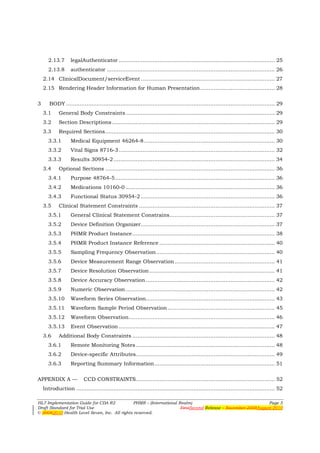
2.13.7       legalAuthenticator ............................................................................................ 25
      2.13.8       authenticator ................................................................................................... 26
    2.14 ClinicalDocument/serviceEvent ............................................................................... 27
    2.15 Rendering Header Information for Human Presentation ............................................ 28

3      BODY ........................................................................................................................... 29
    3.1     General Body Constraints ........................................................................................ 29
    3.2     Section Descriptions ................................................................................................ 29
    3.3     Required Sections .................................................................................................... 30
      3.3.1        Medical Equipment 46264-8 ............................................................................. 30
      3.3.2        Vital Signs 8716-3 ............................................................................................ 32
      3.3.3        Results 30954-2 ............................................................................................... 34
    3.4     Optional Sections .................................................................................................... 36
      3.4.1        Purpose 48764-5 .............................................................................................. 36
      3.4.2        Medications 10160-0 ........................................................................................ 36
      3.4.3        Functional Status 30954-2 ............................................................................... 36
    3.5     Clinical Statement Constraints ................................................................................ 37
      3.5.1        General Clinical Statement Constrains .............................................................. 37
      3.5.2        Device Definition Organizer............................................................................... 37
      3.5.3        PHMR Product Instance .................................................................................... 38
      3.5.4        PHMR Product Instance Reference .................................................................... 40
      3.5.5        Sampling Frequency Observation ...................................................................... 40
      3.5.6        Device Measurement Range Observation ........................................................... 41
      3.5.7        Device Resolution Observation .......................................................................... 41
      3.5.8        Device Accuracy Observation ............................................................................ 42
      3.5.9        Numeric Observation ........................................................................................ 42
      3.5.10       Waveform Series Observation............................................................................ 43
      3.5.11       Waveform Sample Period Observation ............................................................... 45
      3.5.12       Waveform Observation ...................................................................................... 46
      3.5.13       Event Observation ............................................................................................ 47
    3.6     Additional Body Constraints .................................................................................... 48
      3.6.1        Remote Monitoring Notes .................................................................................. 48
      3.6.2        Device-specific Attributes.................................................................................. 49
      3.6.3        Reporting Summary Information ....................................................................... 51

APPENDIX A —              CCD CONSTRAINTS.................................................................................. 52
    Introduction ..................................................................................................................... 52

HL7 Implementation Guide for CDA R2           PHMR – (International Realm)                                   Page 5
Draft Standard for Trial Use                                         FirstSecond Release – November 2008August 2010
© 20082010 Health Level Seven, Inc. All rights reserved.
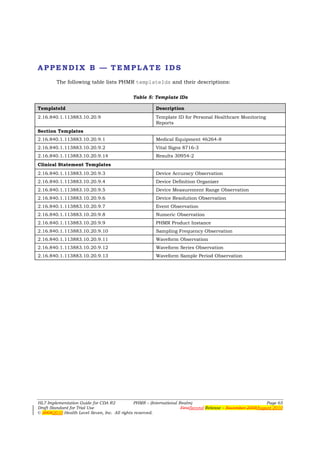
APPENDIX B —           TEMPLATE IDS......................................................................................... 65

APPENDIX C —           PHMR DATA MODEL ................................................................................ 66
  PHMR Device Data Model .................................................................................................. 66
  PHMR Data Model to CDA Mapping ................................................................................... 67

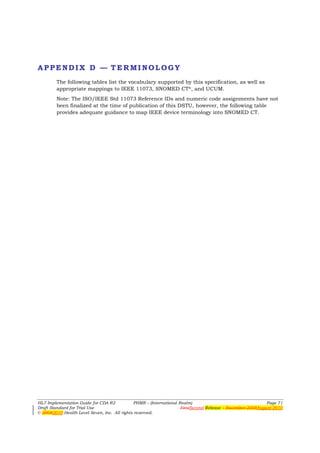
APPENDIX D —            TERMINOLOGY ........................................................................................ 71
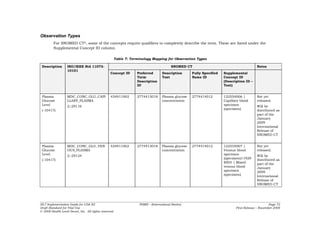
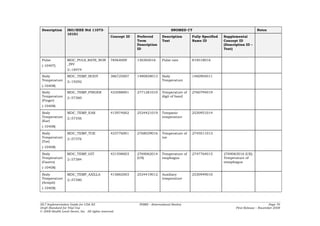
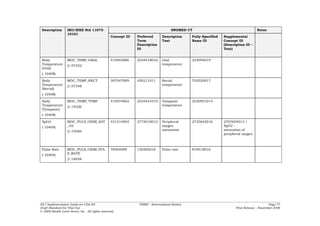
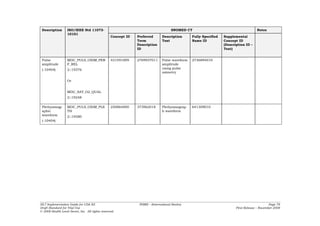
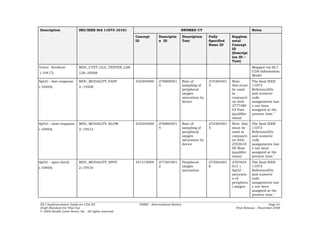
  Observation Types ............................................................................................................ 72
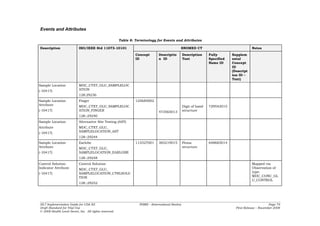
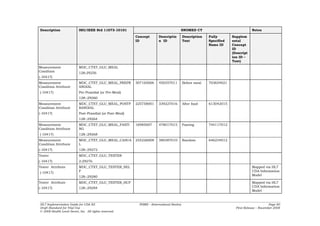
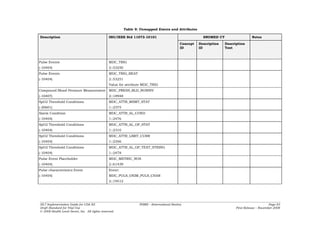
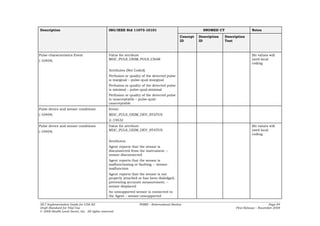
  Events and Attributes ....................................................................................................... 79
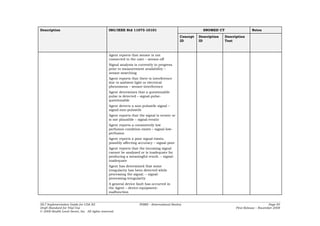
  Unmapped Events and Attributes...................................................................................... 82
  UCUM Unit Mapping ......................................................................................................... 90
  Common Object Identifiers (OIDs) ..................................................................................... 90


HL7 Implementation Guide for CDA R2           PHMR – (International Realm)                                   Page 6
Draft Standard for Trial Use                                         FirstSecond Release – November 2008August 2010
© 20082010 Health Level Seven, Inc. All rights reserved.
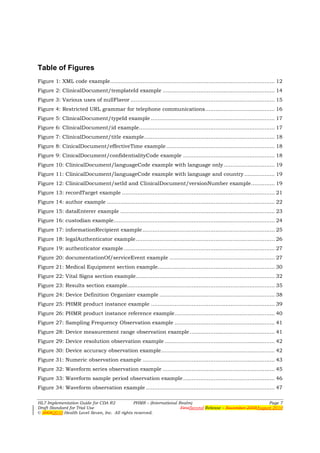
Table of Figures
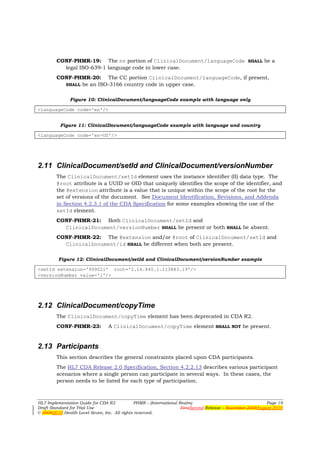
Figure 1: XML code example ................................................................................................. 12
Figure 2: ClinicalDocument/templateId example .................................................................. 14
Figure 3: Various uses of nullFlavor ..................................................................................... 15
Figure 4: Restricted URL grammar for telephone communications ......................................... 16
Figure 5: ClinicalDocument/typeId example ......................................................................... 17
Figure 6: ClinicalDocument/id example ................................................................................ 17
Figure 7: ClinicalDocument/title example ............................................................................. 18
Figure 8: CinicalDocument/effectiveTime example ................................................................ 18
Figure 9: CinicalDocument/confidentialityCode example ...................................................... 18
Figure 10: ClinicalDocument/languageCode example with language only .............................. 19
Figure 11: ClinicalDocument/languageCode example with language and country .................. 19
Figure 12: ClinicalDocument/setId and ClinicalDocument/versionNumber example.............. 19
Figure 13: recordTarget example .......................................................................................... 21
Figure 14: author example ................................................................................................... 22
Figure 15: dataEnterer example ........................................................................................... 23
Figure 16: custodian example............................................................................................... 24
Figure 17: informationRecipient example .............................................................................. 25
Figure 18: legalAuthenticator example .................................................................................. 26
Figure 19: authenticator example ......................................................................................... 27
Figure 20: documentationOf/serviceEvent example .............................................................. 27
Figure 21: Medical Equipment section example..................................................................... 30
Figure 22: Vital Signs section example.................................................................................. 32
Figure 23: Results section example....................................................................................... 35
Figure 24: Device Definition Organizer example .................................................................... 38
Figure 25: PHMR product instance example ......................................................................... 39
Figure 26: PHMR product instance reference example ........................................................... 40
Figure 27: Sampling Frequency Observation example ........................................................... 41
Figure 28: Device measurement range observation example .................................................. 41
Figure 29: Device resolution observation example ................................................................. 42
Figure 30: Device accuracy observation example ................................................................... 42
Figure 31: Numeric observation example .............................................................................. 43
Figure 32: Waveform series observation example .................................................................. 45
Figure 33: Waveform sample period observation example ...................................................... 46
Figure 34: Waveform observation example ............................................................................ 47

HL7 Implementation Guide for CDA R2           PHMR – (International Realm)                                   Page 7
Draft Standard for Trial Use                                         FirstSecond Release – November 2008August 2010
© 20082010 Health Level Seven, Inc. All rights reserved.
Figure 35: Event observation example .................................................................................. 48
Figure 36: Coded remote monitoring note example................................................................ 49
Figure 37: Uncoded remote monitoring note example ............................................................ 49
Figure 38: Blood glucose meter custom attribute mapping example....................................... 50
Figure 39: Expressing min/max values over a period of time example ................................... 51
Figure 40: Expressing mean and standard deviation example ............................................... 51
Figure 41: PHMR device data model ..................................................................................... 66


HL7 Implementation Guide for CDA R2           PHMR – (International Realm)                                   Page 8
Draft Standard for Trial Use                                         FirstSecond Release – November 2008August 2010
© 20082010 Health Level Seven, Inc. All rights reserved.
Table of Tables
Table 1: Contents of the Implementation Guide Package ....................................................... 13
Table 2: Section Cardinality ................................................................................................. 29
Table 3: SNOMED CT® Waveform observation code suggestions............................................ 44
Table 4: Examples of Some Device-specific Attributes Mapped to CDA Elements.................... 49
Table 5: Template IDs .......................................................................................................... 65
Table 6: PHMR Data Model to CDA Mapping ......................................................................... 67
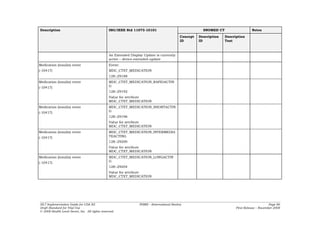
Table 7: Terminology Mapping for Observation Types ............................................................ 72
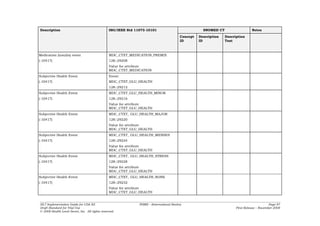
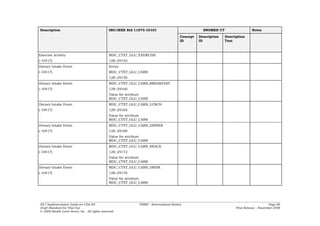
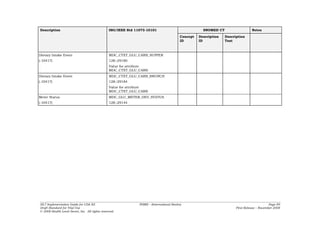
Table 8: Terminology for Events and Attributes ..................................................................... 79
Table 9: Unmapped Events and Attributes ............................................................................ 83
Table 10: UCUM Unit Mapping ............................................................................................. 90
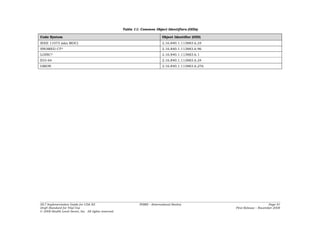
Table 11: Common Object Identifiers (OIDs).......................................................................... 91


HL7 Implementation Guide for CDA R2           PHMR – (International Realm)                                   Page 9
Draft Standard for Trial Use                                         FirstSecond Release – November 2008August 2010
© 20082010 Health Level Seven, Inc. All rights reserved.
1 INTRODUCTION

1.1     Purpose
        The purpose of this document is to describe constraints on the CDA Header and Body
        elements for Personal Healthcare Monitoring Report (PHMR) documents.
        The PHMR is a document that carries personal healthcare monitoring information. The
        information is transmitted as notes and as raw data. Notes may be supplied by a
        disease management service provider. The information may have multiple
        characteristics, including:
             •   Representation of measurements captured by devices.
             •   Representation of notes, summaries, and other kinds of narrative information
                 that may be added by caregivers or by the users themselves.
             •   Representation of graphs that may be added by intermediary devices that
                 represent trends of users’ health.
        A CDA-based format has been chosen to accommodate the wide variety of information
        available.
        Wherever possible, the PHMR reuses templates already set forth by the HL7 Continuity
        of Care Document (CCD).


1.2     Audience
        The audience for this document is software developers and other implementers of
        Personal Healthcare Monitoring (PHM) systems interfacing with Electronic Health
        Record (EHR) systems, Electronic Medical Record (EMR) systems, Personal Health
        Record (PHR) systems, and national health information exchange networks who wish to
        create and/or process PHMR documents created according to this specification.


1.3     Approach
        Overall, the approach is consistent with balloted Implementation Guides (IGs) for CDA.
        These publications view the ultimate implementation specification as a series of layered
        constraints. CDA itself is a set of constraints on the RIM defined in the CDA R2 Refined
        Message Information Model (RMIM). Implementation Guides such as this and the CCD
        add constraints to CDA through conformance statements that further define and
        restrict the sequence and cardinality of CDA objects and the vocabulary sets for coded
        elements.
        This Draft Standard for Trial Use (DSTU) is an extension of HL7's Continuity of Care
        Document (CCD) specification. The structured body of a PHMR is intended to be
        compatible with CCD, although there are some differences in the CDA Header, most
        notably the document type code (ClinicalDocument/code) and document template
        (ClinicalDocument/templateId). Tools that recognize CCD templates in the body of a
        document should be able to process CCD content from a PHMR document as they

HL7 Implementation Guide for CDA R2           PHMR – (International Realm)                                  Page 10
Draft Standard for Trial Use                                         FirstSecond Release – November 2008August 2010
© 20082010 Health Level Seven, Inc. All rights reserved.
would process content from a full CCD document. However, such tools would not be
        expected to process additional templates defined in this specification and not found in
        CCD without further enhancement.
        The PHMR adds constraints to CCD through conformance statements that further
        define and restrict the CCD objects and the vocabulary sets for coded elements.


1.4     Use of Templates
        Templates are collections of constraints that specify and validate agreed-to
        requirements for exchange. Collecting individual constraints and assigning a unique
        template identifier (templateId) to the collection establishes a shorthand mechanism
        for the instance creator to assert conformance to those constraints. The templateId
        itself carries no semantics. Validation errors against a template must not be construed
        as anything other than failure to meet the exact requirements of the template, and
        absence of a templateId need not be construed as failure to meet the constraints
        required by the template.


1.5     Conventions Used in This Guide
        This Implementation Guide is a conformance profile, as described in the Refinement
        and Localization section of the HL7 Version 3 standards. The base standard for this
        Implementation Guide is the HL7 Clinical Document Architecture, Release 2.0. As
        defined in that document, this Implementation Guide is both an annotation profile and
        a localization profile. Every aspect of the CDA R2 may not be described in this guide.


1.5.1 Keywords
        The keywords SHALL, SHALL NOT, SHOULD, SHOULD NOT, MAY, and NEED NOT in this
        document are to be interpreted as described in the HL7 Version 3 Publishing
        Facilitator's Guide.


1.5.2 Conformance Requirements
        Conformance requirements for this DSTU are of two types: those that are collected
        within a published template of CDA/V3 conformance statements and those that are not
        associated with a published template.
        Where not associated with a published template, conformance requirements are
        numbered sequentially and listed within the body of the DSTU as follows:
        CONF-PHMR-1: This is an example conformance requirement original to this DSTU.
        Where conformance requirements from another DSTU or IG are associated with a
        template, they are included through assertion of that templateId and listed in two
        ways:
             •   In the body of the DSTU, they are listed as follows (example of a foreign external
                 constraint from the CDA4CDT History and Physical DSTU):
                 CONF-HP-66: All constraints from this section are from the CCD Medications
                 section. See Appendix A — CCD Constraints for CCD conformance
HL7 Implementation Guide for CDA R2           PHMR – (International Realm)                                  Page 11
Draft Standard for Trial Use                                         FirstSecond Release – November 2008August 2010
© 20082010 Health Level Seven, Inc. All rights reserved.
requirements. This section SHALL include the CCD templateId for the
                 medications section (2.16.840.1.113883.10.20.1.8).
             •   In Appendix B — Template IDs, they are listed using the original numbering
                 sequence from the source guide:
                 Medications (templateId: 2.16.840.1.113883.10.20.1.8)
                 CCD-CONF-299: CCD SHOULD contain exactly one and SHALL NOT contain ...


1.5.3 Explanatory Statements
        Text that clarifies and summarizes the conformance statement appears throughout the
        document.


1.5.4 Example XML Code
        XML examples appear in various figures in this document in a fixed-width font.
        Portions of the XML content may be omitted from the content for brevity marked by an
        ellipsis (…) as shown in the example below.

                                         Figure 1: XML code example

<ClinicalDocument xmlns='urn:h17-org:v3'>
 ...
</ClinicalDocument>

        Within the narrative, XML element and attribute names will appear in this fixed
        character font.


1.5.5 XPath Notation
        Instead of the traditional dotted notation used by HL7 to represent RIM classes, this
        document uses XPath notation in conformance statements and elsewhere to identify the
        XML elements and attributes within the CDA document instance to which various
        constraints are applied. The implicit context of these expressions is the root of the
        document. The purpose of using this notation is to provide a mechanism that will be
        familiar to developers for identifying parts of an XML document.


1.5.6 Vocabulary and Value Sets
        Appendix D — Terminology, lists the terminology supported in this specification and,
        where applicable, its mappings to IEEE 11073, SNOMED, and LOINC®.


HL7 Implementation Guide for CDA R2           PHMR – (International Realm)                                  Page 12
Draft Standard for Trial Use                                         FirstSecond Release – November 2008August 2010
© 20082010 Health Level Seven, Inc. All rights reserved.
1.5.7 Content of the Implementation Guide Package
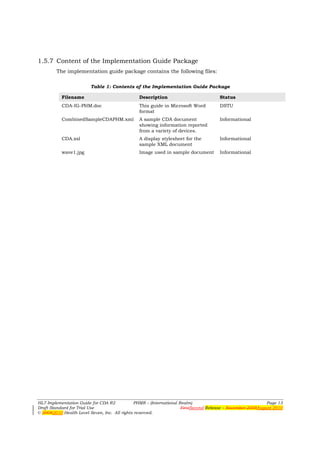
        The implementation guide package contains the following files:

                        Table 1: Contents of the Implementation Guide Package

           Filename                            Description                           Status
           CDA-IG-PHM.doc                      This guide in Microsoft Word          DSTU
                                               format
           CombinedSampleCDAPHM.xml            A sample CDA document                 Informational
                                               showing information reported
                                               from a variety of devices.
           CDA.xsl                             A display stylesheet for the          Informational
                                               sample XML document
           wave1.jpg                           Image used in sample document         Informational


HL7 Implementation Guide for CDA R2           PHMR – (International Realm)                                  Page 13
Draft Standard for Trial Use                                         FirstSecond Release – November 2008August 2010
© 20082010 Health Level Seven, Inc. All rights reserved.
2 C D A H E A D E R C O N S T R AI N T S
        While the body of a Personal Healthcare Monitoring Report contains constrained CCD
        templates, the header does not follow those constraints.
        The header constraints are adopted from the CDA4CDT specification, History and
        Physical Note (CDAR2_HPRPT_R1_D2_2007SEP). The H&P specification is US realm so
        applying the templateId from the H&P, 2.16.840.1.113883.10.20.3, is only acceptable
        if the document is being used in the US realm.
        All of the H&P constraints, minus the realm restriction, are included in this DSTU along
        with additional PHM specific constraints.


2.1     ClinicalDocument
        The namespace for CDA R2 is urn:hl7-org:v3. The appropriate namespace must be
        used in the XML instance of the Clinical Document. In the examples in this
        specification, all elements are shown unprefixed, assuming that the default namespace
        is declared to be urn:hl7-org:v3. This DSTU does not require use of any specific
        namespace prefix. Instances should not include the xsi:schemaLocation1 element.
        CONF-PHMR-1:     The root of a PHM report SHALL be a ClinicalDocument element
          from the urn:hl7-org:v3 namespace.


2.2     ClinicalDocument/templateId
        The ClinicalDocument/templateId element identifies the template that defines
        constraints on the content.
        CONF-PHMR-2:      A ClinicalDocument/templateId element SHALL be present where
          @root is 2.16.840.1.113883.10.20.9. This indicates conformance to this DSTU.
          U.S. realm implementations MAY also include an additional templateId where
          @root is 2.16.840.1.113883.10.20.3, indicating conformance to the general
          header constraints defined in the History and Physical Implementation Guide

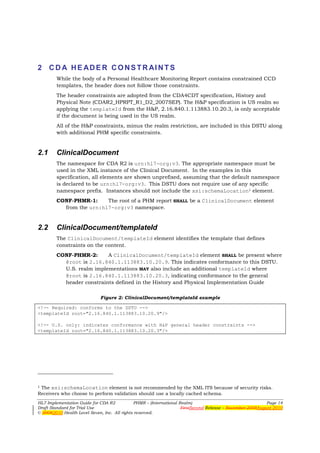
                             Figure 2: ClinicalDocument/templateId example

<!-- Required: conforms to the DSTU -->
<templateId root="2.16.840.1.113883.10.20.9"/>

<!-- U.S. only: indicates conformance with H&P general header constraints -->
<templateId root="2.16.840.1.113883.10.20.3"/>


1The xsi:schemaLocation element is not recommended by the XML ITS because of security risks.
Receivers who choose to perform validation should use a locally cached schema.
HL7 Implementation Guide for CDA R2           PHMR – (International Realm)                                  Page 14
Draft Standard for Trial Use                                         FirstSecond Release – November 2008August 2010
© 20082010 Health Level Seven, Inc. All rights reserved.
2.3     ClinicalDocument/code
        CONF-PHMR-3:     The ClinicalDocument/code element SHALL be present. The value
          for "ClinicalDocument/code" SHALL be "53576-5" "Personal Health Monitoring
          Report" 2.16.840.1.113883.6.1 LOINC® STATIC.


2.4     Name, Address, and Telephone Numbers
        To support communication between the receiver of the document and the patient or any
        other person or organization mentioned within it, the elements representing them will
        be named.
        CONF-PHMR-4:   All patient, guardianPerson, assignedPerson,
          maintainingPerson, relatedPerson,
          intendedRecipient/informationRecipient, associatedPerson, and
          relatedSubject/subject elements SHALL have a name.
        CONF-PHMR-5:     All patientRole, assignedAuthor, and associatedEntity
          elements SHOULD have addr and telecom elements.
        CONF-PHMR-6:     All guardian, dataEnterer/assignedEntity, relatedEntity,
          intendedRecipient, relatedSubject, and participantRole elements SHOULD
          have addr and telecom elements.
        CONF-PHMR-7:     All guardianOrganization, providerOrganization,
          wholeOrganization, representedOrganization,
          representedCustodianOrganization, receivedOrganization,
          scopingOrganization, and serviceProviderOrganization elements SHALL have
          name, addr, and telecom elements.
        When name, address, or telecom information is unknown and where these elements are
        required to be present, as with CDA conformance if the information is unknown, these
        elements will be represented using an appropriate value for the nullFlavor attribute
        on the element. Legal values according to this specification come from the HL7
        NullFlavor vocabulary.

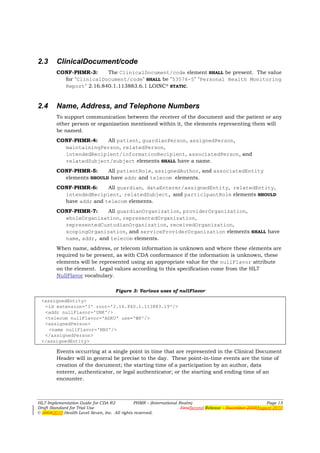
                                    Figure 3: Various uses of nullFlavor

 <assignedEntity>
  <id extension='3' root='2.16.840.1.113883.19'/>
  <addr nullFlavor='UNK'/>
  <telecom nullFlavor='ASKU' use='WP'/>
  <assignedPerson>
    <name nullFlavor='NAV'/>
  </assignedPerson>
 </assignedEntity>

        Events occurring at a single point in time that are represented in the Clinical Document
        Header will in general be precise to the day. These point-in-time events are the time of
        creation of the document; the starting time of a participation by an author, data
        enterer, authenticator, or legal authenticator; or the starting and ending time of an
        encounter.


HL7 Implementation Guide for CDA R2           PHMR – (International Realm)                                  Page 15
Draft Standard for Trial Use                                         FirstSecond Release – November 2008August 2010
© 20082010 Health Level Seven, Inc. All rights reserved.
CONF-PHMR-8:      Times or time intervals found in the
          ClinicalDocument/effectiveTime, author/time, dataEnterer/time,
          legalAuthenticator/time, authenticator/time and
          encompassingEncounter/effectiveTime elements SHALL be precise to the day,
          SHALL include a time zone if more precise than to the day2, and SHOULD be precise to
          the second.
        CONF-PHMR-9:      Times or time intervals found in the
          asOrganizationPartOf/effectiveTime, asMaintainedEntity/effectiveTime,
          relatedEntity/effectiveTime, serviceEvent/effectiveTime,
          ClinicalDocument/participant/time, serviceEvent/performer/time, and
          encounterParticipant/time elements SHALL be precise at least to the year,
          SHOULD be precise to the day, and MAY omit time zone.

        In CDA-conformant documents, all telephone numbers are to be encoded using a
        restricted form of the tel: URL scheme (as described below).
        The telecom element is used to provide a contact telephone number for the various
        participants that require it. The value attribute of this element is a URL that specifies
        the telephone number, as indicated by the TEL data type.
        Within the specification, all telephone numbers are to be encoded using the grammar of
        Figure 4 below, which is a restriction on the TEL data type and RFC 28063. It
        simplifies interchange between applications as it removes optional URL components
        found in RFC 2806 that applications typically do not know how to process, such as
        ISDN subaddress, phone context, or other dialing parameters.
        A telephone number used for voice calls begins with the URL scheme tel:. If the
        number is a global phone number, it starts with a plus (+) sign. The remaining number
        is made up of the dialing digits and an optional extension and may also contain visual
        separators.

                   Figure 4: Restricted URL grammar for telephone communications

telephone-url = telephone-scheme ':' telephone-subscriber
telephone-scheme= 'tel'
telephone-subscriber = global-phone-number [ extension ]
global-phone-number = '+' phone-number
phone-number= digits
digits = phonedigit | digits phonedigit
phonedigit = DIGIT | visual-separator
extension = ';ext=' digits
visual-separator= '-' | '.' | '(' | ')'

        CONF-PHMR-10: Telephone numbers SHALL match the regular expression pattern:
          tel:+?[-0-9().]+


2 The XML ITS precludes the use of time zone unless the precision of the timestamp is more than to the

day.
3 Note that RFC 3966 obsoletes RFC 2806, but is backwards-compatible. The restricted grammar is

compatible with both RFC 3966 and RFC 2806 by virtue of Section 2.5.11 of RFC 2806, which provides
for additional parameters; e.g., ‘;ext=’, to be added as future extensions.
HL7 Implementation Guide for CDA R2           PHMR – (International Realm)                                  Page 16
Draft Standard for Trial Use                                         FirstSecond Release – November 2008August 2010
© 20082010 Health Level Seven, Inc. All rights reserved.
CONF-PHMR-11: At least one dialing digit SHALL be present in the phone number
          after visual separators are removed.


2.5     ClinicalDocument/typeId
        The clinicalDocument/typeId identifies the constraints imposed by CDA R2 on the
        content, essentially acting as a version identifier. The @root and @extension values of
        this element are specified as shown in the figure below.

                                Figure 5: ClinicalDocument/typeId example

<typeId extension='POCD_HD000040' root='2.16.840.1.113883.1.3'/>


2.6     ClinicalDocument/id
        The ClinicalDocument/id element is an instance identifier data type. The @root
        attribute is a UUID or OID. The root uniquely identifies the scope of the extension. The
        @root and @extension attributes uniquely identify the document.
        OIDs are limited by this specification to no more than 64 characters in length for
        compatibility with other standards and Implementation Guides.
        CONF-PHMR-12:   The ClinicalDocument/id element SHALL be present. The
          ClinicalDocument/id/@root attribute SHALL be a syntactically correct UUID or
          OID.
        CONF-PHMR-13: UUIDs SHALL be represented in the form XXXXXXXX-XXXX-XXXX-
          XXXX-XXXXXXXXXXXX, where each X is a character from the set [A-Fa-f0-9].
        CONF-PHMR-14: OIDs SHALL be represented in dotted decimal notation, where each
          decimal number is either 0, or starts with a nonzero digit. More formally, an OID
          SHALL be in the form ([0-2])(.([1-9][0-9]*|0))+


                                  Figure 6: ClinicalDocument/id example

<id extension='999021'         root='2.16.840.1.113883.19'/>

        Organizations that wish to use OIDs should properly register their OID root and ensure
        uniqueness of the OID roots used in identifiers. A large number of mechanisms exist
        for obtaining OID roots for free or for a reasonable fee. HL7 maintains an OID registry
        page from which organizations may request an OID root under the HL7 OID root. This
        page can be accessed at: http://www.hl7.org/oid.
        Another useful resource lists the many ways to obtain a registered OID root for free or a
        small fee anywhere in the world and is located at:
        http://www.dclunie.com/medical-image-faq/html/part8.html#UIDRegistration.
        The manner in which the OID root is obtained is not constrained by this DSTU.


HL7 Implementation Guide for CDA R2           PHMR – (International Realm)                                  Page 17
Draft Standard for Trial Use                                         FirstSecond Release – November 2008August 2010
© 20082010 Health Level Seven, Inc. All rights reserved.
2.7     ClinicalDocument/title
        The title element must be present and specifies the local name used for the
        document.
        CONF-PHMR-15:            ClinicalDocument/title SHALL be present.

                                 Figure 7: ClinicalDocument/title example

<title>Good Health Personal Healthcare Monitoring Report</title>

        Note that the title does not need to be the same as the display name provided with the
        document type code. For example, the display name provided by LOINC® as an aid in
        debugging may be “Personal Health Monitoring Note.” The title can be localized, as
        appropriate (see Figure 7 above).


2.8     ClinicalDocument/effectiveTime
        The ClinicalDocument/effectiveTime element must be present and specifies the
        creation time of the document. All PHMR documents authored by direct input to a
        computer system should record an effectiveTime that is precise to the second.
        CONF-PHMR-16: ClinicalDocument/effectiveTime SHALL be present and SHOULD
          be precise to the second.

                            Figure 8: CinicalDocument/effectiveTime example

<effectiveTime value='20050303171504+0500'/>


2.9     ClinicalDocument/confidentialityCode
        CDA R2 requires that the ClinicalDocument/confidentialityCode be present. It
        specifies the confidentiality assigned to the document. This DSTU provides no further
        guidance on documents with respect to the vocabulary used for confidentialityCode,
        nor treatment or implementation of confidentiality. A CDA R2-conforming example is
        shown below:

                        Figure 9: CinicalDocument/confidentialityCode example

<confidentialityCode code='N' codeSystem='2.16.840.1.113883.5.25'/>


2.10 ClinicalDocument/languageCode
        The ClinicalDocument/languageCode specifies the language of the PHMR. PHMRs
        must be readable by medical practitioners, caregivers, and patients.
        CONF-PHMR-17:            ClinicalDocument/languageCode SHALL be present.
        CONF-PHMR-18:            ClinicalDocument/languageCode SHALL be in the form nn, or nn-
          CC.


HL7 Implementation Guide for CDA R2           PHMR – (International Realm)                                  Page 18
Draft Standard for Trial Use                                         FirstSecond Release – November 2008August 2010
© 20082010 Health Level Seven, Inc. All rights reserved.
CONF-PHMR-19: The nn portion of ClinicalDocument/languageCode SHALL be a
          legal ISO-639-1 language code in lower case.
        CONF-PHMR-20: The CC portion ClinicalDocument/languageCode, if present,
          SHALL be an ISO-3166 country code in upper case.


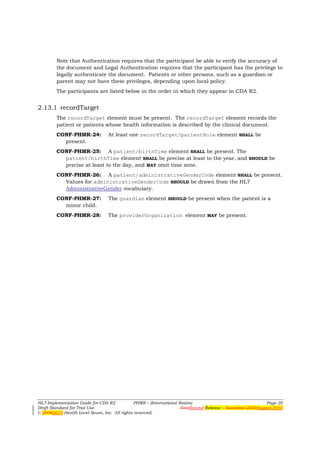
               Figure 10: ClinicalDocument/languageCode example with language only

<languageCode code='en'/>


          Figure 11: ClinicalDocument/languageCode example with language and country

<languageCode code='en-US'/>


2.11 ClinicalDocument/setId and ClinicalDocument/versionNumber
        The ClinicalDocument/setId element uses the instance identifier (II) data type. The
        @root attribute is a UUID or OID that uniquely identifies the scope of the identifier, and
        the @extension attribute is a value that is unique within the scope of the root for the
        set of versions of the document. See Document Identification, Revisions, and Addenda
        in Section 4.2.3.1 of the CDA Specification for some examples showing the use of the
        setId element.
        CONF-PHMR-21: Both ClinicalDocument/setId and
          ClinicalDocument/versionNumber SHALL be present or both SHALL be absent.
        CONF-PHMR-22: The @extension and/or @root of ClinicalDocument/setId and
          ClinicalDocument/id SHALL be different when both are present.

         Figure 12: ClinicalDocument/setId and ClinicalDocument/versionNumber example

<setId extension='999021' root='2.16.840.1.113883.19'/>
<versionNumber value='1'/>


2.12 ClinicalDocument/copyTime
        The ClinicalDocument/copyTime element has been deprecated in CDA R2.
        CONF-PHMR-23:            A ClinicalDocument/copyTime element SHALL NOT be present.


2.13 Participants
        This section describes the general constraints placed upon CDA participants.
        The HL7 CDA Release 2.0 Specification, Section 4.2.2.13 describes various participant
        scenarios where a single person can participate in several ways. In these cases, the
        person needs to be listed for each type of participation.


HL7 Implementation Guide for CDA R2           PHMR – (International Realm)                                  Page 19
Draft Standard for Trial Use                                         FirstSecond Release – November 2008August 2010
© 20082010 Health Level Seven, Inc. All rights reserved.
Note that Authentication requires that the participant be able to verify the accuracy of
        the document and Legal Authentication requires that the participant has the privilege to
        legally authenticate the document. Patients or other persons, such as a guardian or
        parent may not have these privileges, depending upon local policy.
        The participants are listed below in the order in which they appear in CDA R2.


2.13.1 recordTarget
        The recordTarget element must be present. The recordTarget element records the
        patient or patients whose health information is described by the clinical document.
        CONF-PHMR-24:            At least one recordTarget/patientRole element SHALL be
          present.
        CONF-PHMR-25: A patient/birthTime element SHALL be present. The
          patient/birthTime element SHALL be precise at least to the year, and SHOULD be
          precise at least to the day, and MAY omit time zone.
        CONF-PHMR-26: A patient/administrativeGenderCode element SHALL be present.
          Values for administrativeGenderCode SHOULD be drawn from the HL7
          AdministrativeGender vocabulary.
        CONF-PHMR-27:            The guardian element SHOULD be present when the patient is a
          minor child.
        CONF-PHMR-28:            The providerOrganization element MAY be present.


HL7 Implementation Guide for CDA R2           PHMR – (International Realm)                                  Page 20
Draft Standard for Trial Use                                         FirstSecond Release – November 2008August 2010
© 20082010 Health Level Seven, Inc. All rights reserved.
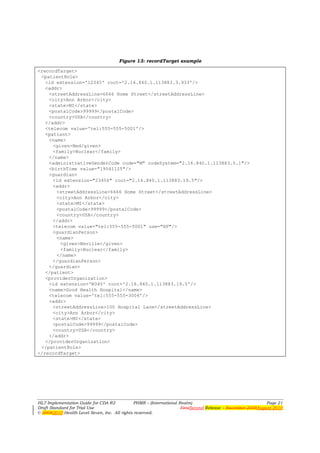
Figure 13: recordTarget example

<recordTarget>
 <patientRole>
   <id extension='12345' root='2.16.840.1.113883.3.933'/>
   <addr>
    <streetAddressLine>6666 Home Street</streetAddressLine>
    <city>Ann Arbor</city>
    <state>MI</state>
    <postalCode>99999</postalCode>
    <country>USA</country>
   </addr>
   <telecom value='tel:555-555-5001'/>
   <patient>
    <name>
      <given>Ned/given>
      <family>Nuclear</family>
    </name>
    <administrativeGenderCode code="M" codeSystem="2.16.840.1.113883.5.1"/>
    <birthTime value="19541125"/>
    <guardian>
      <id extension="23456" root="2.16.840.1.113883.19.5"/>
      <addr>
       <streetAddressLine>6666 Home Street</streetAddressLine>
       <city>Ann Arbor</city>
       <state>MI</state>
       <postalCode>99999</postalCode>
       <country>USA</country>
      </addr>
      <telecom value="tel:555-555-5001" use="HP"/>
      <guardianPerson>
       <name>
         <given>Neville</given>
         <family>Nuclear</family>
       </name>
      </guardianPerson>
    </guardian>
   </patient>
   <providerOrganization>
    <id extension='M345' root='2.16.840.1.113883.19.5'/>
    <name>Good Health Hospital</name>
    <telecom value='tel:555-555-3004'/>
    <addr>
      <streetAddressLine>100 Hospital Lane</streetAddressLine>
      <city>Ann Arbor</city>
      <state>MI</state>
      <postalCode>99999</postalCode>
      <country>USA</country>
    </addr>
   </providerOrganization>
 </patientRole>
</recordTarget>


HL7 Implementation Guide for CDA R2           PHMR – (International Realm)                                  Page 21
Draft Standard for Trial Use                                         FirstSecond Release – November 2008August 2010
© 20082010 Health Level Seven, Inc. All rights reserved.
2.13.2 author
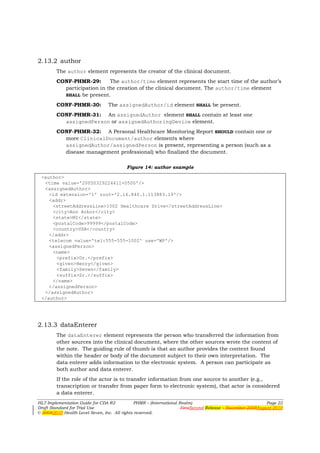
        The author element represents the creator of the clinical document.
        CONF-PHMR-29:       The author/time element represents the start time of the author’s
          participation in the creation of the clinical document. The author/time element
          SHALL be present.

        CONF-PHMR-30:            The assignedAuthor/id element SHALL be present.
        CONF-PHMR-31: An assignedAuthor element SHALL contain at least one
          assignedPerson or assignedAuthoringDevice element.
        CONF-PHMR-32: A Personal Healthcare Monitoring Report SHOULD contain one or
          more ClinicalDocument/author elements where
          assignedAuthor/assignedPerson is present, representing a person (such as a
          disease management professional) who finalized the document.

                                         Figure 14: author example

 <author>
  <time value='20050329224411+0500'/>
  <assignedAuthor>
    <id extension='1' root='2.16.840.1.113883.19'/>
    <addr>
     <streetAddressLine>1002 Healthcare Drive</streetAddressLine>
     <city>Ann Arbor</city>
     <state>MI</state>
     <postalCode>99999</postalCode>
     <country>USA</country>
    </addr>
    <telecom value='tel:555-555-1002' use='WP'/>
    <assignedPerson>
     <name>
       <prefix>Dr.</prefix>
       <given>Henry</given>
       <family>Seven</family>
       <suffix>Sr.</suffix>
     </name>
    </assignedPerson>
  </assignedAuthor>
 </author>


2.13.3 dataEnterer
        The dataEnterer element represents the person who transferred the information from
        other sources into the clinical document, where the other sources wrote the content of
        the note. The guiding rule of thumb is that an author provides the content found
        within the header or body of the document subject to their own interpretation. The
        data enterer adds information to the electronic system. A person can participate as
        both author and data enterer.
        If the role of the actor is to transfer information from one source to another (e.g.,
        transcription or transfer from paper form to electronic system), that actor is considered
        a data enterer.
HL7 Implementation Guide for CDA R2           PHMR – (International Realm)                                  Page 22
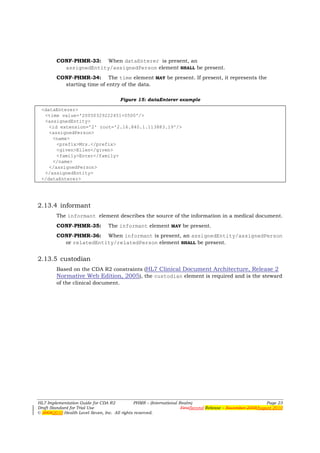
Draft Standard for Trial Use                                         FirstSecond Release – November 2008August 2010
© 20082010 Health Level Seven, Inc. All rights reserved.
CONF-PHMR-33: When dataEnterer is present, an
          assignedEntity/assignedPerson element SHALL be present.
        CONF-PHMR-34: The time element MAY be present. If present, it represents the
          starting time of entry of the data.

                                      Figure 15: dataEnterer example

 <dataEnterer>
  <time value='20050329222451+0500'/>
  <assignedEntity>
    <id extension='2' root='2.16.840.1.113883.19'/>
    <assignedPerson>
     <name>
       <prefix>Mrs.</prefix>
       <given>Ellen</given>
       <family>Enter</family>
     </name>
    </assignedPerson>
  </assignedEntity>
 </dataEnterer>


2.13.4 informant
        The informant element describes the source of the information in a medical document.
        CONF-PHMR-35:            The informant element MAY be present.
        CONF-PHMR-36: When informant is present, an assignedEntity/assignedPerson
          or relatedEntity/relatedPerson element SHALL be present.


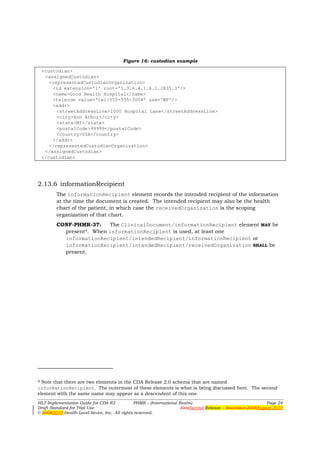
2.13.5 custodian
        Based on the CDA R2 constraints (HL7 Clinical Document Architecture, Release 2
        Normative Web Edition, 2005), the custodian element is required and is the steward
        of the clinical document.


HL7 Implementation Guide for CDA R2           PHMR – (International Realm)                                  Page 23
Draft Standard for Trial Use                                         FirstSecond Release – November 2008August 2010
© 20082010 Health Level Seven, Inc. All rights reserved.
Figure 16: custodian example

 <custodian>
  <assignedCustodian>
    <representedCustodianOrganization>
     <id extension='1' root='1.3.6.4.1.4.1.2835.3'/>
     <name>Good Health Hospital</name>
     <telecom value='tel:555-555-3004' use='WP'/>
     <addr>
       <streetAddressLine>1000 Hospital Lane</streetAddressLine>
       <city>Ann Arbor</city>
       <state>MI</state>
       <postalCode>99999</postalCode>
       <country>USA</country>
     </addr>
    </representedCustodianOrganization>
  </assignedCustodian>
 </custodian>


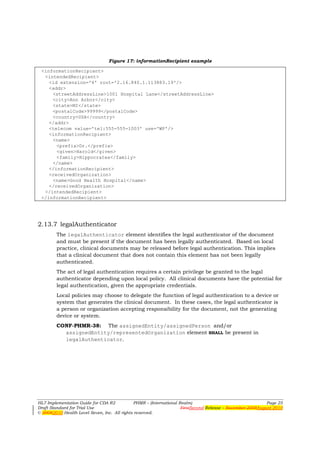
2.13.6 informationRecipient
        The informationRecipient element records the intended recipient of the information
        at the time the document is created. The intended recipient may also be the health
        chart of the patient, in which case the receivedOrganization is the scoping
        organization of that chart.
        CONF-PHMR-37:    The ClinicalDocument/informationRecipient element MAY be
          present4. When informationRecipient is used, at least one
          informationRecipient/intendedRecipient/informationRecipient or
          informationRecipient/intendedRecipient/receivedOrganization SHALL be
          present.


4 Note that there are two elements in the CDA Release 2.0 schema that are named

informationRecipient. The outermost of these elements is what is being discussed here. The second
element with the same name may appear as a descendent of this one.
HL7 Implementation Guide for CDA R2           PHMR – (International Realm)                                  Page 24
Draft Standard for Trial Use                                         FirstSecond Release – November 2008August 2010
© 20082010 Health Level Seven, Inc. All rights reserved.
Figure 17: informationRecipient example

 <informationRecipient>
  <intendedRecipient>
    <id extension='4' root='2.16.840.1.113883.19'/>
    <addr>
     <streetAddressLine>1001 Hospital Lane</streetAddressLine>
     <city>Ann Arbor</city>
     <state>MI</state>
     <postalCode>99999</postalCode>
     <country>USA</country>
    </addr>
    <telecom value='tel:555-555-1003' use='WP'/>
    <informationRecipient>
     <name>
       <prefix>Dr.</prefix>
       <given>Harold</given>
       <family>Hippocrates</family>
     </name>
    </informationRecipient>
    <receivedOrganization>
     <name>Good Health Hospital</name>
    </receivedOrganization>
  </intendedRecipient>
 </informationRecipient>


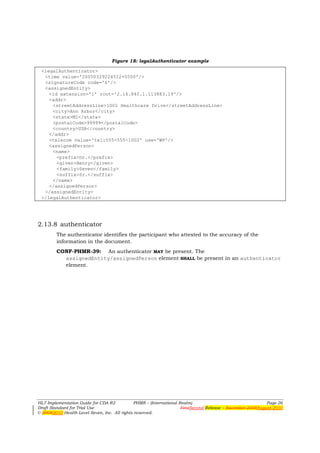
2.13.7 legalAuthenticator
        The legalAuthenticator element identifies the legal authenticator of the document
        and must be present if the document has been legally authenticated. Based on local
        practice, clinical documents may be released before legal authentication. This implies
        that a clinical document that does not contain this element has not been legally
        authenticated.
        The act of legal authentication requires a certain privilege be granted to the legal
        authenticator depending upon local policy. All clinical documents have the potential for
        legal authentication, given the appropriate credentials.
        Local policies may choose to delegate the function of legal authentication to a device or
        system that generates the clinical document. In these cases, the legal authenticator is
        a person or organization accepting responsibility for the document, not the generating
        device or system.
        CONF-PHMR-38: The assignedEntity/assignedPerson and/or
          assignedEntity/representedOrganization element SHALL be present in
          legalAuthenticator.


HL7 Implementation Guide for CDA R2           PHMR – (International Realm)                                  Page 25
Draft Standard for Trial Use                                         FirstSecond Release – November 2008August 2010
© 20082010 Health Level Seven, Inc. All rights reserved.
Figure 18: legalAuthenticator example

 <legalAuthenticator>
  <time value='20050329224512+0500'/>
  <signatureCode code='S'/>
  <assignedEntity>
    <id extension='1' root='2.16.840.1.113883.19'/>
    <addr>
     <streetAddressLine>1002 Healthcare Drive</streetAddressLine>
     <city>Ann Arbor</city>
     <state>MI</state>
     <postalCode>99999</postalCode>
     <country>USA</country>
    </addr>
    <telecom value='tel:555-555-1002' use='WP'/>
    <assignedPerson>
     <name>
       <prefix>Dr.</prefix>
       <given>Henry</given>
       <family>Seven</family>
       <suffix>Sr.</suffix>
     </name>
    </assignedPerson>
  </assignedEntity>
 </legalAuthenticator>


2.13.8 authenticator
        The authenticator identifies the participant who attested to the accuracy of the
        information in the document.
        CONF-PHMR-39: An authenticator MAY be present. The
          assignedEntity/assignedPerson element SHALL be present in an authenticator
          element.


HL7 Implementation Guide for CDA R2           PHMR – (International Realm)                                  Page 26
Draft Standard for Trial Use                                         FirstSecond Release – November 2008August 2010
© 20082010 Health Level Seven, Inc. All rights reserved.
Figure 19: authenticator example

 <authenticator>
  <time value='20050329224512+0500'/>
  <signatureCode code='S'/>
  <assignedEntity>
    <id extension='3' root='2.16.840.1.113883.19'/>
    <addr>
     <streetAddressLine>1002 Healthcare Drive </streetAddressLine>
     <city>Ann Arbor</city>
     <state>MI</state>
     <postalCode>99999</postalCode>
     <country>USA</country>
    </addr>
    <telecom value='tel:555-555-1002' use='WP'/>
    <assignedPerson>
     <name>
       <prefix>Dr.</prefix>
       <given>Henry</given>
       <family>Seven</family>
       <suffix>Sr.</suffix>
     </name>
    </assignedPerson>
  </assignedEntity>
 </authenticator>


2.14 ClinicalDocument/serviceEvent
        The main activity being described by a PHMR is the monitoring of a patient over a
        period of time. This is shown by setting the value of
        ClinicalDocument/documentationOf/serviceEvent/@classCode to MPROT
        (Monitoring Program) and indicating the duration over which the person's health was
        monitored in ClinicalDocument/documentationOf/serviceEvent/effectiveTime.
        CONF-PHMR-40:            The documentationOf/serviceEvent element SHALL be present.
        CONF-PHMR-41: The value for
          ClinicalDocument/documentationOf/serviceEvent/@classCode SHALL be
          MPROT (Monitoring Program) 2.16.840.1.113883.5.6 ActClass STATIC.
        CONF-PHMR-42: A serviceEvent/effectiveTime element SHALL be present, and
          SHALL reflect the period of time for which the patient's health was monitored.


                            Figure 20: documentationOf/serviceEvent example

<documentationOf>
 <serviceEvent classCode="MPROT">
   <effectiveTime>
    <low value="20080501"/>
    <high value="20080531"/>
   </effectiveTime>
 </serviceEvent>
</documentationOf>


HL7 Implementation Guide for CDA R2           PHMR – (International Realm)                                  Page 27
Draft Standard for Trial Use                                         FirstSecond Release – November 2008August 2010
© 20082010 Health Level Seven, Inc. All rights reserved.
2.15 Rendering Header Information for Human Presentation
        Metadata carried in the header may already be available for rendering from EHRs or
        other sources external to the document; therefore, there is no strict requirement to
        render directly from the document. An example of this would be a doctor using an EHR
        that already contains the patient’s name, date of birth, current address, and phone
        number. When a CDA document is rendered within that EHR, those pieces of
        information may not need to be displayed since they are already known and displayed
        within the EHR’s user interface.
        Best practice would recommend that the following also be present whenever a
        document is viewed:
             •   Document title and document date
             •   Service and encounter types and date ranges as appropriate
             •   All persons named along with their roles, participations, participation date
                 ranges, identifiers, address, and telecommunications information
             •   Selected organizations named along with their roles, participations, participation
                 date ranges, identifiers, address, and telecommunications information
             •   Date of birth for recordTarget(s)


HL7 Implementation Guide for CDA R2           PHMR – (International Realm)                                  Page 28
Draft Standard for Trial Use                                         FirstSecond Release – November 2008August 2010
© 20082010 Health Level Seven, Inc. All rights reserved.
3 BODY

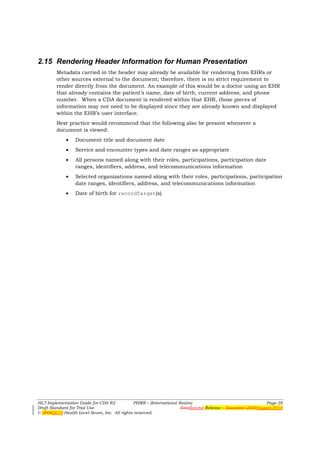
3.1     General Body Constraints
        CONF-PHMR-43: A Personal Healthcare Monitoring Report SHALL have a
          structuredBody element. The content of this element makes up the human-
          readable text of the document. This information SHALL be organized into sections
          and MAY have subsections.
        CONF-PHMR-44: Except where specifically noted in this DSTU, the structured body
          of a Personal Healthcare Monitoring Report SHALL conform to the constraints of
          HL7's Continuity of Care Document (CCD) specification (published April 1, 2007),
          and all references to CCD templateIds apply to that initial release of CCD.


3.2     Section Descriptions
        This Implementation Guide defines required and optional sections. In CCD, all sections
        are optional. This document constrains CCD by adding some section requirements and
        providing guidance on which sections are recommended for use with personal
        healthcare monitoring reports and how they should be used.
        The following table summarizes required and recommended sections within this DSTU:

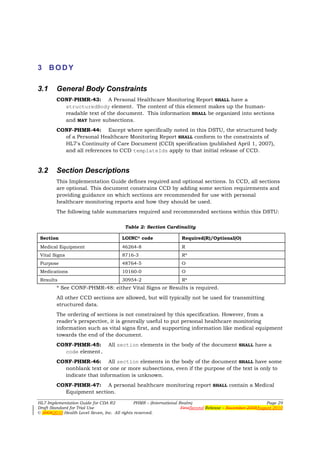
                                        Table 2: Section Cardinality

 Section                               LOINC® code                 Required(R)/Optional(O)
 Medical Equipment                     46264-8                     R
 Vital Signs                           8716-3                      R*
 Purpose                               48764-5                     O
 Medications                           10160-0                     O
 Results                               30954-2                     R*
        * See CONF-PHMR-48: either Vital Signs or Results is required.
        All other CCD sections are allowed, but will typically not be used for transmitting
        structured data.
        The ordering of sections is not constrained by this specification. However, from a
        reader’s perspective, it is generally useful to put personal healthcare monitoring
        information such as vital signs first, and supporting information like medical equipment
        towards the end of the document.
        CONF-PHMR-45: All section elements in the body of the document SHALL have a
          code element.
        CONF-PHMR-46: All section elements in the body of the document SHALL have some
          nonblank text or one or more subsections, even if the purpose of the text is only to
          indicate that information is unknown.
        CONF-PHMR-47: A personal healthcare monitoring report SHALL contain a Medical
          Equipment section.

HL7 Implementation Guide for CDA R2           PHMR – (International Realm)                                  Page 29
Draft Standard for Trial Use                                         FirstSecond Release – November 2008August 2010
© 20082010 Health Level Seven, Inc. All rights reserved.
CONF-PHMR-48: A personal healthcare monitoring report SHALL contain either a
          Vital Signs section or Results section, and MAY contain both.


3.3     Required Sections

3.3.1 Medical Equipment 46264-8
        CONF-PHMR-49: A Medical Equipment section SHALL contain two templateIds. CCD
          templateId 2.16.840.1.113883.10.20.1.7 SHALL be present and the section
          SHALL conform to all the constraints specified in CCD for that template. An
          additional templateId SHALL be present where the value of @root is
          2.16.840.1.113883.10.20.9.1, indicating conformance to the constraints
          specified in this DSTU.
        CONF-PHMR-50: One or more Device Definition Organizers (templateId
          2.16.840.1.113883.10.20.9.4) (see section 3.5.2) SHOULD be present.
        CONF-PHMR-51: If no medical devices are defined, this section SHALL contain a text
          element noting this fact.

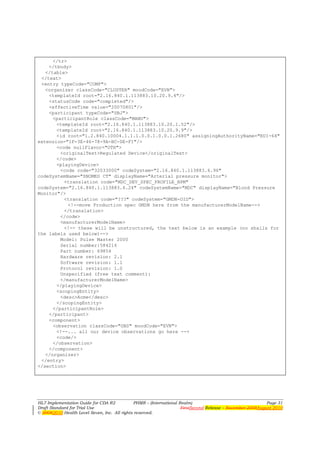
                              Figure 21: Medical Equipment section example


<section>
 <templateId root="2.16.840.1.113883.10.20.1.7"/>
 <templateId root="2.16.840.1.113883.10.20.9.1"/>
 <code code="46264-8" codeSystem="2.16.840.1.113883.6.1"/>
 <title>Medical Equipment</title>
 <text>
   <!-- Device information -->
   <table border="1" width="100%">
    <tbody>
      <tr>
       <th>System Type</th>
       <th>System Model</th>
       <th>System Manufacturer</th>
       <th>System ID</th>
       <th>Production Spec</th>
       <th>Regulated</th>
      </tr>
      <tr>
       <td>Blood Pressure Monitor</td>
       <td>Pulse Master 2000</td>
       <td>Acme</td>
       <td>1F-3E-46-78-9A-BC-DE-F1</td>
       <td>
            Unspecified:
         Serial Number: 584216<br/>
         Part Number: 69854<br/>
         Hardware Revision: 2.1<br/>
         Software Revision: 1.1<br/>
         Protocol Revision: 1.0<br/>
         Prod Spec GMDN:
       </td>
       <td>Regulated</td>

HL7 Implementation Guide for CDA R2           PHMR – (International Realm)                                  Page 30
Draft Standard for Trial Use                                         FirstSecond Release – November 2008August 2010
© 20082010 Health Level Seven, Inc. All rights reserved.
</tr>
    </tbody>
   </table>
 </text>
 <entry typeCode="COMP">
   <organizer classCode="CLUSTER" moodCode="EVN">
    <templateId root="2.16.840.1.113883.10.20.9.4"/>
    <statusCode code="completed"/>
    <effectiveTime value="20070801"/>
    <participant typeCode="SBJ">
      <participantRole classCode="MANU">
       <templateId root="2.16.840.1.113883.10.20.1.52"/>
       <templateId root="2.16.840.1.113883.10.20.9.9"/>
       <id root="1.2.840.10004.1.1.1.0.0.1.0.0.1.2680" assigningAuthorityName="EUI-64"
extension="1F-3E-46-78-9A-BC-DE-F1"/>
       <code nullFlavor="OTH">
         <originalText>Regulated Device</originalText>
       </code>
       <playingDevice>
         <code code="32033000" codeSystem="2.16.840.1.113883.6.96"
codeSystemName="SNOMED CT" displayName="Arterial pressure monitor">
          <translation code="MDC_DEV_SPEC_PROFILE_BPM"
codeSystem="2.16.840.1.113883.6.24" codeSystemName="MDC" displayName="Blood Pressure
Monitor"/>
          <translation code="???" codeSystem="GMDN-OID">
            <!--move Production spec GMDN here from the manufacturerModelName-->
          </translation>
         </code>
         <manufacturerModelName>
          <!-- these will be unstructured, the text below is an example (no shalls for
the labels used below)-->
         Model: Pulse Master 2000
         Serial number:584216
         Part number: 69854
         Hardware revision: 2.1
         Software revision: 1.1
         Protocol revision: 1.0
         Unspecified (free text comment):
         </manufacturerModelName>
       </playingDevice>
       <scopingEntity>
         <desc>Acme</desc>
       </scopingEntity>
      </participantRole>
    </participant>
    <component>
      <observation classCode="OBS" moodCode="EVN">
       <!--... all our device observations go here -->
       <code/>
      </observation>
    </component>
   </organizer>
 </entry>
</section>


HL7 Implementation Guide for CDA R2           PHMR – (International Realm)                                  Page 31
Draft Standard for Trial Use                                         FirstSecond Release – November 2008August 2010
© 20082010 Health Level Seven, Inc. All rights reserved.
3.3.2 Vital Signs 8716-3
        The Vital Signs section is only required if there is no Results section.
        CONF-PHMR-52: A Vital Signs section SHALL contain two templateIds. CCD
          templateId 2.16.840.1.113883.10.20.1.16 SHALL be present and the section
          SHALL conform to all the constraints specified in CCD for that template. An
          additional templateId SHALL be present where the value of @root is
          2.16.840.1.113883.10.20.9.2, indicating conformance to the constraints
          specified in this DSTU.
        CONF-PHMR-53: If the following values are present in the PHMR, they SHOULD be
          recorded in the Vital Signs section: blood pressure, temperature, O2 saturation,
          respiratory rate, pulse. All other values SHOULD be recorded in the Results section.
        CONF-PHMR-54: One or more Numeric Observations (templateId
          2.16.840.1.113883.10.20.9.8) SHOULD be present inside entry elements.
        CONF-PHMR-55: One or more Waveform Series Observations (templateId
          2.16.840.1.113883.10.20.9.12) MAY be present inside entry elements.
        CONF-PHMR-56: If no vital signs are recorded, this section SHALL contain a text
          element noting this fact.

                                  Figure 22: Vital Signs section example

<section>
 <templateId root="2.16.840.1.113883.10.20.1.16"/>
 <templateId root="2.16.840.1.113883.10.20.9.2"/>
 <code code="8716-3" codeSystem="2.16.840.1.113883.6.1"/>
 <title>Vital Signs</title>
 <text>
   <paragraph>Thermometer Results</paragraph>
   <table border="1" width="100%">
    <tBody>
      <tr>
       <th>Date/Time</th>
       <th>Body Temp</th>
       <th>Finger Temp</th>
       <th>Oral Temp</th>
      </tr>
      <tr>
       <td>20080501104033</td>
       <td>99.9 deg F</td>
       <td>88.8 deg F</td>
       <td>37.5 deg C</td>
      </tr>
    </tBody>
   </table>
 </text>
 <entry typeCode="DRIV">
   <organizer classCode="CLUSTER" moodCode="EVN">
    <!-- Vital sign data/ Test Groups -->
    <!-- A VITAL SIGNS ORGANIZER IS USED TO GROUP RELATED -->
    <templateId root="2.16.840.1.113883.10.20.1.35"/>
    <id root="b606a959-baab-4836-84a8-97c4e9857533"/>
    <code code="46680005" codeSystem="2.16.840.1.113883.6.96" displayName="Vital
signs"/>

HL7 Implementation Guide for CDA R2           PHMR – (International Realm)                                  Page 32
Draft Standard for Trial Use                                         FirstSecond Release – November 2008August 2010
© 20082010 Health Level Seven, Inc. All rights reserved.
<statusCode code="completed"/>
    <component>
     <observation classCode="OBS" moodCode="EVN">
       <templateId root="2.16.840.1.113883.10.20.1.31"/>
       <id root="975c2f3b-2bd4-4e45-aed1-84af9ff51b10"/>
        <code code="386725007" codeSystem="2.16.840.1.113883.6.96"
codeSystemName="SNOMED CT" displayName="Body Temperature">
          <translation code="MDC_TEMP_BODY" codeSystem="2.16.840.1.113883.6.24"
codeSystemName="MDC" displayName="Body Temperature"/>
        </code>
       <statusCode code="completed"/>
       <effectiveTime value="20080501104033"/>
       <value xsi:type="PQ" value="99.9" unit="[degF]"/>
       <participant typeCode="DEV">
        <participantRole>
       <id root="1.2.840.10004.1.1.1.0.0.1.0.0.1.2680" assigningAuthorityName="EUI-64"
extension="1A-34-46-78-9A-BC-DE-F3"/>
        </participantRole>
       </participant>
     </observation>
    </component>
    <component>
     <observation classCode="OBS" moodCode="EVN">
       <templateId root="2.16.840.1.113883.10.20.1.31"/>
       <id root="975c2f3b-2bd4-4e45-aed1-84af9ff51b10"/>
       <code code="MDC_TEMP_FINGER" codeSystem="2.16.840.1.113883.6.24"
codeSystemName="MDC" displayName="Finger Temperature"/>
       <statusCode code="completed"/>
       <effectiveTime value="20080501104033"/>
       <value xsi:type="PQ" value="88.8" unit="[degF]"/>
       <participant typeCode="DEV">
        <participantRole>
       <id root="1.2.840.10004.1.1.1.0.0.1.0.0.1.2680" assigningAuthorityName="EUI-64"
extension="1A-34-46-78-9A-BC-DE-F3"/>
        </participantRole>
       </participant>
     </observation>
    </component>
    <component>
     <observation classCode="OBS" moodCode="EVN">
       <templateId root="2.16.840.1.113883.10.20.1.31"/>
       <id root="975c2f3b-2bd4-4e45-aed1-84af9ff51b10"/>
        <code code="415945006" codeSystem="2.16.840.1.113883.6.96"
codeSystemName="SNOMED CT" displayName="Oral Temperature">
          <translation code="MDC_TEMP_ORAL" codeSystem="2.16.840.1.113883.6.24"
codeSystemName="MDC" displayName="Oral Temperature"/>
        </code>
       <statusCode code="completed"/>
       <effectiveTime value="20080501104033"/>
       <value xsi:type="PQ" value="37.5" unit="Cel"/>
       <participant typeCode="DEV">
        <participantRole>
       <id root="1.2.840.10004.1.1.1.0.0.1.0.0.1.2680" assigningAuthorityName="EUI-64"
extension="1A-34-46-78-9A-BC-DE-F3"/>
        </participantRole>
       </participant>
     </observation>
    </component>

HL7 Implementation Guide for CDA R2           PHMR – (International Realm)                                  Page 33
Draft Standard for Trial Use                                         FirstSecond Release – November 2008August 2010
© 20082010 Health Level Seven, Inc. All rights reserved.
</organizer>
 </entry>
</section>


3.3.3 Results 30954-2
        The results section is only required if there is no Vital Signs section.
        CONF-PHMR-57: A Results section SHALL contain two templateIds. CCD
          templateId 2.16.840.1.113883.10.20.1.14 SHALL be present and the section
          SHALL conform to all the constraints specified in CCD for that template. An
          additional templateId SHALL be present where the value of @root is
          2.16.840.1.113883.10.20.9.14, indicating conformance to the constraints
          specified in this DSTU.
        CONF-PHMR-58: One or more Numeric Observations (templateId
          2.16.840.1.113883.10.20.9.8) SHOULD be present inside entry elements.
        CONF-PHMR-59: One or more Waveform Series Observations (templateId
          2.16.840.1.113883.10.20.9.12) MAY be present inside entry elements.
        CONF-PHMR-60: If no results are recorded, this section SHALL contain a text
          element noting this fact.


HL7 Implementation Guide for CDA R2           PHMR – (International Realm)                                  Page 34
Draft Standard for Trial Use                                         FirstSecond Release – November 2008August 2010
© 20082010 Health Level Seven, Inc. All rights reserved.
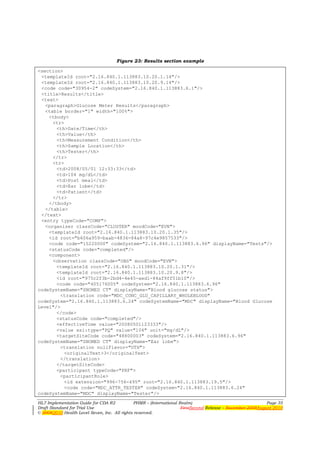
Figure 23: Results section example

<section>
 <templateId root="2.16.840.1.113883.10.20.1.14"/>
 <templateId root="2.16.840.1.113883.10.20.9.14"/>
 <code code="30954-2" codeSystem="2.16.840.1.113883.6.1"/>
 <title>Results</title>
 <text>
   <paragraph>Glucose Meter Results</paragraph>
   <table border="1" width="100%">
    <tbody>
      <tr>
       <th>Date/Time</th>
       <th>Value</th>
       <th>Measurement Condition</th>
       <th>Sample Location</th>
       <th>Tester</th>
      </tr>
      <tr>
       <td>2008/05/01 12:33:33</td>
       <td>104 mg/dL</td>
       <td>Post meal</td>
       <td>Ear lobe</td>
       <td>Patient</td>
      </tr>
    </tbody>
   </table>
 </text>
 <entry typeCode="COMP">
   <organizer classCode="CLUSTER" moodCode="EVN">
    <templateId root="2.16.840.1.113883.10.20.1.35"/>
    <id root="b606a959-baab-4836-84a8-97c4e9857533"/>
    <code code="15220000" codeSystem="2.16.840.1.113883.6.96" displayName="Tests"/>
    <statusCode code="completed"/>
    <component>
      <observation classCode="OBS" moodCode="EVN">
       <templateId root="2.16.840.1.113883.10.20.1.31"/>
       <templateId root="2.16.840.1.113883.10.20.9.8"/>
       <id root="975c2f3b-2bd4-4e45-aed1-84af9ff51b10"/>
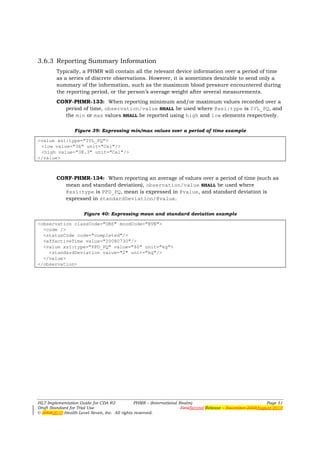
       <code code="405176005" codeSystem="2.16.840.1.113883.6.96"
codeSystemName="SNOMED CT" displayName="Blood glucose status">
         <translation code="MDC_CONC_GLU_CAPILLARY_WHOLEBLOOD"
codeSystem="2.16.840.1.113883.6.24" codeSystemName="MDC" displayName="Blood Glucose
Level"/>
       </code>
       <statusCode code="completed"/>
       <effectiveTime value="20080501123333"/>
       <value xsi:type="PQ" value="104" unit="mg/dL"/>
       <targetSiteCode code="48800003" codeSystem="2.16.840.1.113883.6.96"
codeSystemName="SNOMED CT" displayName="Ear lobe">
         <translation nullFlavor="OTH">
           <originalText>3</originalText>
         </translation>
       </targetSiteCode>
       <participant typeCode="PRF">
         <participantRole>
           <id extension="996-756-495" root="2.16.840.1.113883.19.5"/>
           <code code="MDC_ATTR_TESTER" codeSystem="2.16.840.1.113883.6.24"
codeSystemName="MDC" displayName="Tester"/>
HL7 Implementation Guide for CDA R2           PHMR – (International Realm)                                  Page 35
Draft Standard for Trial Use                                         FirstSecond Release – November 2008August 2010
© 20082010 Health Level Seven, Inc. All rights reserved.
</participantRole>
       </participant>
       <participant typeCode="DEV">
         <participantRole>
          <id root="1.2.840.10004.1.1.1.0.0.1.0.0.1.2680" assigningAuthorityName="EUI-
64" extension="12-34-56-78-9A-BC-DE-F1"/>
         </participantRole>
       </participant>
       <entryRelationship typeCode="COMP">
         <observation classCode="OBS" moodCode="EVN">
          <code code="MDC_ATTR_MEASUREMENT_CONDITION"
codeSystem="2.16.840.1.113883.6.24" codeSystemName="MDC" displayName="Measurement
condition"/>
          <value xsi:type="CD" code="24863003" codeSystem="2.16.840.1.113883.6.96"
codeSystemName="SNOMED CT" displayName="After meal">
            <translation nullFlavor="OTH">
             <originalText>1</originalText>
            </translation>
          </value>
         </observation>
       </entryRelationship>
      </observation>
    </component>
   </organizer>
 </entry>
</section>


3.4     Optional Sections
        The following sections may optionally be present in a PHMR for activity, exercise, and
        medication monitoring. Currently, they are expressed as unconstrained CCD templates,
        although future releases of this specification may apply additional constraints.


3.4.1 Purpose 48764-5
        CONF-PHMR-61: A Purpose section (CCD templateId
          2.16.840.1.113883.10.20.1.13) MAY be present, and if present SHALL conform to
          all the constraints specified in CCD.


3.4.2 Medications 10160-0
        CONF-PHMR-62: A Medications section (CCD templateId
          2.16.840.1.113883.10.20.1.8) MAY be present, and if present SHALL conform to
          all the constraints specified in CCD.


3.4.3 Functional Status 30954-2
        CONF-PHMR-63: A Functional Status section (CCD templateId
          2.16.840.1.113883.10.20.1.5) MAY be present, and if present SHALL conform to
          all the constraints specified in CCD.


HL7 Implementation Guide for CDA R2           PHMR – (International Realm)                                  Page 36
Draft Standard for Trial Use                                         FirstSecond Release – November 2008August 2010
© 20082010 Health Level Seven, Inc. All rights reserved.
3.5     Clinical Statement Constraints

3.5.1 General Clinical Statement Constrains
        CONF-PHMR-64: Wherever clinical statement terminology conformance is left
          unspecified by CCD, SNOMED CT® or LOINC® (in the case of lab data) SHOULD be
          used, unless no SNOMED or LOINC term exists for a particular concept, in which
          case IEEE 11073-10101 MDC SHOULD be used (code system
          2.16.840.1.113883.6.24).
        CONF-PHMR-65: If the data being reported came from a PHM-compliant device, and
          IEEE 11073-10101 is not used as the primary code, then a translation element
          SHOULD be present containing the equivalent IEEE 11073-10101 code. This
          constraint applies to the following elements: act/code, encounter/code,
          observation/code, procedure/code, substanceAdministration/code,
          supply/code, and observation/value if value/@xsi:type is CD or CE.
        CONF-PHMR-66: If the data in an observation was obtained directly from a PHM
          device, the observation SHALL include an entryRelationship element containing a
          Device Reference Act identifying the device providing the data for the observation. If
          the data in an observation was entered manually, the observation SHALL NOT include
          a Device Reference Act.
        Devices sometimes report alerts. These are typically recorded using the
        interpretationCode element on an observation. Since many of the alerts are device
        specific and not defined in any code system, only in the device specs themselves, the
        human-readable equivalent of the alert is often the best information to communicate in
        the PHM report.
        CONF-PHMR-67: When an observation is intended to convey that an alert threshold
          has been exceeded, the observation SHOULD include an interpretationCode
          element with an appropriate code (such as “A” for abnormal) from
          2.16.840.1.113883.5.83 ObservationInterpretation (DYNAMIC) as well as an
          originalText element describing the alert reported by the device. When an alert
          results in missing data, null flavors SHOULD be used on observation/code or
          observation/value where appropriate.
        Data may be collected from devices that, due to manufacturing cost issues, do not
        implement time-zone information. The measurement is therefore stamped by a so-called
        "wall clock" set by the user. It will be the responsibility of the hosting system to append
        time-zone information where necessary before generating the CDA document.
        CONF-PHMR-68: Observation time SHOULD incorporate the local time zone of the
          device into any effectiveTime elements with accuracy greater than the day in the
          resulting clinical statements.


3.5.2 Device Definition Organizer
        CONF-PHMR-69: A Device Definition Organizer SHALL be represented with an
          organizer element where @classCode is CLUSTER and @moodCode is EVN.
        CONF-PHMR-70: A templateId element SHALL be present where @root is
          2.16.840.1.113883.10.20.9.4.

HL7 Implementation Guide for CDA R2           PHMR – (International Realm)                                  Page 37
Draft Standard for Trial Use                                         FirstSecond Release – November 2008August 2010
© 20082010 Health Level Seven, Inc. All rights reserved.
CONF-PHMR-71: A participant element where @typeCode is SBJ SHALL be present.
          It SHALL contain a single PHMR Product Instance template (templateId
          2.16.840.1.113883.10.20.9.9).
        CONF-PHMR-72: A single Sampling Frequency Observation (templateId
          2.16.840.1.113883.10.20.9.10) MAY be present inside a component element.
        CONF-PHMR-73: A single Device Measurement Range Observation (templateId
          2.16.840.1.113883.10.20.9.5) MAY be present inside a component element.
        CONF-PHMR-74: A single Device Resolution Observation (templateId
          2.16.840.1.113883.10.20.9.6) MAY be present inside a component element.
        CONF-PHMR-75: A single Device Accuracy Observation (templateId
          2.16.840.1.113883.10.20.9.3) MAY be present inside a component element.

                             Figure 24: Device Definition Organizer example


<organizer classCode="CLUSTER" moodCode="EVN">
 <templateId root="2.16.840.1.113883.10.20.9.4"/>
 <statusCode code="completed"/>
 <effectiveTime value="20070801"/>
 <participant typeCode="SBJ">
   <participantRole classCode="MANU">
    <templateId root="2.16.840.1.113883.10.20.1.52"/>
    <templateId root="2.16.840.1.113883.10.20.9.9"/>

     ...

  </participantRole>
 </participant>
 <component>

     ...

 </component>
</organizer>


3.5.3 PHMR Product Instance
        CONF-PHMR-76: A PHMR Product Instance SHALL conform to the constraints of the
          CCD Product Instance template (CCD templateId
          2.16.840.1.113883.10.20.1.52).
        CONF-PHMR-77: A templateId SHALL be present where @root is
          2.16.840.1.113883.10.20.9.9.
        CONF-PHMR-78: An id element SHALL be present where @root is OID of device
          numbering space and @extension is a valid device ID within that space. (e.g. @root
          is 1.2.840.10004.1.1.1.0.0.1.0.0.1.2680 and @extension is a valid EUI-64
          device ID. ).


HL7 Implementation Guide for CDA R2           PHMR – (International Realm)                                  Page 38
Draft Standard for Trial Use                                         FirstSecond Release – November 2008August 2010
© 20082010 Health Level Seven, Inc. All rights reserved.
CONF-PHMR-79: A code element MAY be present where @nullFlavor is OTH (other)
          containing an originalText element describing the regulatory status of the device
          in plain text (e.g., " Regulated Device " or " Unregulated Device").
        CONF-PHMR-80: A playingDevice/code element SHALL be present indicating the
          type of device, where @code SHALL be drawn from code system
          2.16.840.1.113883.6.24 MDC DYNAMIC. An equivalent SNOMED CT® code MAY be
          used as a translation. Also, the value for ProdSpecGMDN from the Continua data
          model MAY be present as a translation. (See Appendix C — PHMR Data Model).
        CONF-PHMR-81: A playingDevice/manufacturerModelName element SHALL be
          present. It SHALL contain the following data items from the Continua data model
          (See Appendix C — PHMR Data Model): Model, Unspecified, SerialNumber,
          PartNumber, HardwareRevision, SoftwareRevision, and ProtocolRevision. The
          manufacturerModelName may also contain device certification information. No
          constraints are placed on the ordering or formatting of those items.
        CONF-PHMR-82: A scopingEntity/desc element SHOULD be present containing the
          manufacturer's name.

                                Figure 25: PHMR product instance example

<participantRole classCode="MANU">
 <templateId root="2.16.840.1.113883.10.20.1.52"/>
 <templateId root="2.16.840.1.113883.10.20.9.9"/>
 <id root="1.2.840.10004.1.1.1.0.0.1.0.0.1.2680" assigningAuthorityName="EUI-64"
extension="1F-3E-46-78-9A-BC-DE-F1"/>
 <code nullFlavor="OTH">
   <originalText>Regulated Device</originalText>
 </code>
 <playingDevice>
     <code code="MDC_DEV_SPEC_PROFILE_BP" codeSystem="2.16.840.1.113883.6.24"
codeSystemName="MDC" displayName="BloodPressure Monitor">
    <translation code="32033000" codeSystem="2.16.840.1.113883.6.96"
codeSystemName="SNOMED CT" displayName="Arterial pressure monitor">"/>
    <translation code="MDC_DEV_SPEC_PROFILE_BPM" codeSystem="2.16.840.1.113883.6.24"
codeSystemName="MDC" displayName="Blood Pressure Monitor"/>
     </code>
   <manufacturerModelName>
   Model: Pulse Master 2000
   Serial number:584216
   Part number: 69854
   Hardware revision: 2.1
   Software revision: 1.1
   Protocol revision: 1.0
   Unspecified (free text comment):
   Certified for blood pressure monitoring by Acme Inc. (ACME_OID)
   </manufacturerModelName>
 </playingDevice>
 <scopingEntity>
   <desc>Acme</desc>
 </scopingEntity>
</participantRole>


HL7 Implementation Guide for CDA R2           PHMR – (International Realm)                                  Page 39
Draft Standard for Trial Use                                         FirstSecond Release – November 2008August 2010
© 20082010 Health Level Seven, Inc. All rights reserved.
3.5.4 PHMR Product Instance Reference
        A PHMR Product Instance Reference is used to refer to a PHMR Product Instance
        defined in the Device Definition Organizer for the device.
        Note: Per SDWG recommendations, there is no templateId for a device reference act.
        The guidance for any act reference is to include only the ID of the source act, and the
        minimal number of elements and attributes required as defined by the CDA schema.
        CONF-PHMR-83: A PHMR Product Instance Reference SHALL be represented with the
          participant element where @typeCode is SBJ.
        CONF-PHMR-84: A participantRole element containing only a single id element
          SHALL be present. The id element SHALL contain the same values for @root and
          @extension as the PHMR Product Instance that it references.
        CONF-PHMR-85:            All other elements SHALL NOT be present.
        Note: Some information regarding the device (device accuracy, et cetera) is found in the
        Device Definition Organizer, not the PHMR Product Instance. Therefore, someone
        following a PHMR Product Instance Reference may need to traverse to the Device
        Definition Organizer parent element to retrieve all related device information.

                          Figure 26: PHMR product instance reference example

<participant typeCode="SBJ">
 <participantRole>
   <id .../>
 </participantRole>
</participant>


3.5.5 Sampling Frequency Observation
        The sampling period (frequency) of the device may be communicated in the PHMR.
        However, it will not be automatically derived from device data, i.e., it may be manually
        entered.
        CONF-PHMR-86: A Sampling Frequency Observation SHALL be represented with an
          observation element where @classCode is OBS and @moodCode is DEF.
        CONF-PHMR-87: A templateId element SHALL be present where @root is
          2.16.840.1.113883.10.20.9.10.
        CONF-PHMR-88: A code element SHALL be present where @code is
          MDC_ATTR_TIME_PD_SAMP and @codeSystem is 2.16.840.1.113883.6.24 IEEE
          11073 (STATIC)
        CONF-PHMR-89: A value element SHALL be present where @xsi:type is PQ
          containing the sampling period in milliseconds (@unit= “ms”).


HL7 Implementation Guide for CDA R2           PHMR – (International Realm)                                  Page 40
Draft Standard for Trial Use                                         FirstSecond Release – November 2008August 2010
© 20082010 Health Level Seven, Inc. All rights reserved.
Figure 27: Sampling Frequency Observation example

<observation classCode="OBS" moodCode="DEF">
 <templateId root="2.16.840.1.113883.10.20.9.10"/>
 <code code="MDC_ATTR_TIME_PD_SAMP" codeSystem="2.16.840.1.113883.6.24"/>
 <value xsi:type="PQ" value="10" unit="ms"/>
</observation>


3.5.6 Device Measurement Range Observation
        The measurement range of the device may be communicated in the PHMR (for example,
        a thermometer may report values between 0 and 100 degrees Celsius). However, it will
        not currently be automatically derived from device data, i.e., it may be manually entered
        or derived through other means.
        CONF-PHMR-90: A Device Measurement Range Observation SHALL be represented
          with an observation element where @classCode is OBS and @moodCode is DEF.
        CONF-PHMR-91: A templateId element SHALL be present where @root is
          2.16.840.1.113883.10.20.9.5.
        CONF-PHMR-92: A code element SHALL be present where @code is
          MDC_ATTR_NU_RANGE_MSMT and @codeSystem is 2.16.840.1.113883.6.24 IEEE
          11073 (STATIC)
        CONF-PHMR-93: A value element SHALL be present where @xsi:type is IVL_PQ (for
          a range of physical quantities) or ST (for a simple text description) describing the
          resolution of the device.

                      Figure 28: Device measurement range observation example

<observation classCode="OBS" moodCode="DEF">
 <templateId root=" 2.16.840.1.113883.10.20.9.5"/>
 <code code="x-MEASUREMENT-MDC_ATTR_NU_RANGE_MSMT" displayName="Device Measurement
Range" codeSystemName="LOINC" codeSystem="2.16.840.1.113883.6.1"/>
 <value xsi:type="IVL_PQ">
  <low value="0" unit="Cel"/>
  <high value="100" unit="Cel"/>
 </value>
</observation>


3.5.7 Device Resolution Observation
        The reporting resolution of the device may be communicated in the PHMR (for example,
        a thermometer may have a resolution of 0.1 degrees Celsius). However, it will not
        currently be automatically derived from device data, i.e., it may be manually entered or
        derived through other means.
        CONF-PHMR-94: A Device Resolution Observation SHALL be represented with an
          observation element where @classCode is OBS and @moodCode is DEF.
        CONF-PHMR-95: A templateId element SHALL be present where @root is
          2.16.840.1.113883.10.20.9.6.


HL7 Implementation Guide for CDA R2           PHMR – (International Realm)                                  Page 41
Draft Standard for Trial Use                                         FirstSecond Release – November 2008August 2010
© 20082010 Health Level Seven, Inc. All rights reserved.
CONF-PHMR-96: A code element SHALL be present where @code is 17441009 and
          @codeSystem is 2.16.840.1.113883.6.96 SNOMED CT (STATIC).
        CONF-PHMR-97: A value element SHALL be present where @xsi:type is PQ (for a
          physical quantity) or ST (for a simple text description) describing the resolution of
          the device, in whatever units are appropriate for the device in question (though
          units must still be a valid UCUM expression).

                            Figure 29: Device resolution observation example

<observation classCode="OBS" moodCode="DEF">
 <templateId root="2.16.840.1.113883.10.20.9.6"/>
 <code code="17441009" codeSystem="2.16.840.1.113883.6.96" displayName="Resolution
threshold (observable entity)"/>
 <value xsi:type="PQ" value=".1" unit="Cel"/>
</observation>


3.5.8 Device Accuracy Observation
        The accuracy of the device may be reported in the PHM report (for example, the values
        reported by a device may be within +/- 3% of the actual value). However, it will not
        currently be automatically derived from device data, i.e., it may be manually entered or
        derived through other means.
        CONF-PHMR-98: A Device Accuracy Observation SHALL be represented with an
          observation element where @classCode is OBS and @moodCode is DEF.
        CONF-PHMR-99: A templateId element SHALL be present where @root is
          2.16.840.1.113883.10.20.9.3.
        CONF-PHMR-100: A code element SHALL be present where @code is
          MDC_ATTR_NU_ACCUR_MSMT and @codeSystem is 2.16.840.1.113883.6.24 IEEE
          11073 (STATIC).
        CONF-PHMR-101: A value element SHALL be present where @xsi:type is PQ (for a
          physical quantity) or ST (for a simple text description) describing the processing
          accuracy of the device.

                             Figure 30: Device accuracy observation example

<observation classCode="OBS" moodCode="DEF">
 <templateId root="2.16.840.1.113883.10.20.9.3"/>
 <code code="MDC_ATTR_NU_ACCUR_MSMT" codeSystem="2.16.840.1.113883.6.24"/>
 <value xsi:type="PQ" value="3" unit="%"/>
</observation>


3.5.9 Numeric Observation
        Most devices will report data consisting of a code identifying the type of data being
        reported, a numeric value, and a unit.


HL7 Implementation Guide for CDA R2           PHMR – (International Realm)                                  Page 42
Draft Standard for Trial Use                                         FirstSecond Release – November 2008August 2010
© 20082010 Health Level Seven, Inc. All rights reserved.
CONF-PHMR-102: A Numeric Observation SHALL be represented with an observation
          element where @classCode is OBS and @moodCode is EVN.
        CONF-PHMR-103: A templateId element SHALL be present where @root is
          2.16.840.1.113883.10.20.9.8.
        CONF-PHMR-104: A Numeric Observation MAY also conform to another CCD
          observation template (such as a Result Observation). If so, it SHOULD also include
          the CCD templateId for that observation type.
        CONF-PHMR-105: A code element SHALL be present where @codeSystem is
          2.16.840.1.113883.6.96 SNOMED CT (DYNAMIC) or 2.16.840.1.113883.6.24
          MDC (DYNAMIC).
        CONF-PHMR-106: A value element SHALL be present where @xsi:type is PQ (physical
          quantity) and the unit of measure is expressed using a valid Unified Code for Units
          of Measure (UCUM) expression.
        CONF-PHMR-107: A participant element SHOULD be present conforming to the
          constraints of a PHMR Product Instance Reference.

                                 Figure 31: Numeric observation example

<observation classCode="OBS" moodCode="EVN">
 <templateId root="2.16.840.1.113883.10.20.1.31"/>
 <templateId root="2.16.840.1.113883.10.20.9.8"/>
 <id root="975c2f3b-2bd4-4e45-aed1-84af9ff51b10"/>
   <code code="386725007" codeSystem="2.16.840.1.113883.6.96" codeSystemName="SNOMED
CT" displayName="Body Temperature">
    <translation code="MDC_TEMP_BODY" codeSystem="2.16.840.1.113883.6.24"
codeSystemName="MDC" displayName="Body Temperature"/>
   </code>
 <statusCode code="completed"/>
 <effectiveTime value="20080501104033"/>
 <value xsi:type="PQ" value="99.9" unit="[degF]"/>
 <participant typeCode="DEV">
   <participantRole>
 <id root="1.2.840.10004.1.1.1.0.0.1.0.0.1.2680" assigningAuthorityName="EUI-64"
extension="1A-34-46-78-9A-BC-DE-F3"/>
   </participantRole>
 </participant>
</observation>


3.5.10 Waveform Series Observation
        Some devices, such as the pulse oximeter, report a series of equidistant time-spaced
        observations that can be represented as a waveform.
        CONF-PHMR-108: A Waveform Observation SHALL be represented with an
          observation element where @classCode is OBSSER and @moodCode is EVN.
        CONF-PHMR-109: A templateId element SHALL be present where @root is
          2.16.840.1.113883.10.20.9.12.


HL7 Implementation Guide for CDA R2           PHMR – (International Realm)                                  Page 43
Draft Standard for Trial Use                                         FirstSecond Release – November 2008August 2010
© 20082010 Health Level Seven, Inc. All rights reserved.
CONF-PHMR-110: A code element SHALL be present where @code is either 364681001
          Waveform-observable or from the Waveform-observable hierarchy in SNOMED CT®,
          and @codeSystem is 2.16.840.1.113883.6.96 SNOMED CT (DYNAMIC).
        Table 3 below lists some suggested codes from the Waveform-observable hierarchy for
        reference (please refer to SNOMED CT® for a full listing of possible codes).

                    Table 3: SNOMED CT® Waveform observation code suggestions

        Concept ID                                         Description
        364681001                                          Waveform-observable
        250864000                                          Plethysmograph waveform
        277923006                                          Pulse oximetry waveform


        CONF-PHMR-111: An effectiveTime element SHALL be present containing low and
          high elements, where low represents the time of the first data point on the
          waveform, and high represents the time of the last data point.
        CONF-PHMR-112: A participant element SHOULD be present conforming to the
          constraints of a PHMR Product Instance Reference.
        CONF-PHMR-113: An entryRelationship element SHOULD be present containing an
          observableMedia element. If present, the observableMedia element SHALL include
          a reference to a displayable graphic containing a graphic representation of the data
          in the waveform.
        CONF-PHMR-114: An entryRelationship element where @typeCode is COMP SHOULD
          be present containing an observation element where @classCode is OBSCOR,
          @moodeCode is EVN, representing a container for series of correlated observations.
        CONF-PHMR-115: The correlated observation container SHALL contain an
          entryRelationship where @typeCode is COMP containing a Waveform Sample
          Period Observation (templateId 2.16.840.1.113883.10.20.9.13). Only one
          Waveform Sample Period Observation SHALL be present within the correlated
          observation container.
        CONF-PHMR-116: The correlated observation container SHALL contain one or more
          entryRelationship elements where @typeCode is COMP each containing a
          Waveform Observation (templateId 2.16.840.1.113883.10.20.9.11).


HL7 Implementation Guide for CDA R2           PHMR – (International Realm)                                  Page 44
Draft Standard for Trial Use                                         FirstSecond Release – November 2008August 2010
© 20082010 Health Level Seven, Inc. All rights reserved.
Figure 32: Waveform series observation example

<observation classCode="OBSSER" moodCode="EVN">
 <templateId root="2.16.840.1.113883.10.20.9.12"/>
 <id root="f37a5e13-aae6-4f9c-8afc-af7a9ab087e0"/>
 <code code="277923006" codeSystem="2.16.840.1.113883.6.96" codeSystemName="SNOMED CT"
displayName="Pulse oximetry waveform">
   <translation code="MDC_PULS_OXIM_PLETH" codeSystem="2.16.840.1.113883.6.24"
codeSystemName="MDC" displayName="Pulse Oximeter Plethysmograph"/>
 </code>
 <effectiveTime>
   <low value="20071206121000.00"/>
   <high value="20071206121000.99"/>
 </effectiveTime>
 <participant typeCode="DEV">
   <participantRole>
    <id root="1.2.840.10004.1.1.1.0.0.1.0.0.1.2680" assigningAuthorityName="EUI-64"
extension="1A-3E-41-78-9A-BC-DE-42"/>
   </participantRole>
 </participant>
 <entryRelationship typeCode="COMP">
   <observationMedia classCode="OBS" moodCode="EVN" ID="waveSeries1">
    <id root="d122a5e9-823e-403a-b49e-2c6daa150110"/>
    <value mediaType="image/jpeg">
      <reference value="wave1.jpg"/>
    </value>
   </observationMedia>
 </entryRelationship>
 <entryRelationship typeCode="COMP">
   <observation classCode="OBSCOR" moodCode="EVN">
    <code nullFlavor="NA"/>
    <entryRelationship typeCode="COMP">
      <observation classCode="OBS" moodCode="EVN">
       <templateId root="2.16.840.1.113883.10.20.9.13"/>
       <code code="TIME_ABSOLUTE" codeSystem="2.16.840.1.113883.5.4"
codeSystemName="ActCode" displayName="Absolute Time"/>
       <value xsi:type="GLIST_TS">
         <head value="20071206121000.00"/>
         <!-- The sample period is 13.375 ms -->
         <increment value="0.013375" unit="s"/>
       </value>
      </observation>
    </entryRelationship>

     ...entryRelationships to Waveform Observations go here.

   </observation>
 </entryRelationship>
</observation>


3.5.11 Waveform Sample Period Observation
        CONF-PHMR-117: A Waveform Observation SHALL be represented with an
          observation element where @classCode is OBS and @moodCode is EVN.


HL7 Implementation Guide for CDA R2           PHMR – (International Realm)                                  Page 45
Draft Standard for Trial Use                                         FirstSecond Release – November 2008August 2010
© 20082010 Health Level Seven, Inc. All rights reserved.
CONF-PHMR-118: A templateId element SHALL be present where @root is
          2.16.840.1.113883.10.20.9.13.
        CONF-PHMR-119: A code element SHALL be present where @code is TIME_ABSOLUTE
          from 2.16.840.1.113883.5.4 ActCode (STATIC).
        CONF-PHMR-120: A value element SHALL be present where @xsi:type is GLIST_TS
          containing a head element which stores the time of the first data point waveform,
          and an increment element showing the sample period (the time between data
          points).

                        Figure 33: Waveform sample period observation example

<observation classCode="OBS" moodCode="EVN">
 <templateId root="2.16.840.1.113883.10.20.9.13"/>
 <code code="TIME_ABSOLUTE" codeSystem="2.16.840.1.113883.5.4"
codeSystemName="ActCode" displayName="Absolute Time"/>
 <value xsi:type="GLIST_TS">
   <head value="20071206121000.00"/>
   <!-- The sample period is 13.375 ms -->
   <increment value="0.013375" unit="s"/>
 </value>
</observation>


3.5.12 Waveform Observation
        CONF-PHMR-121: A Waveform Observation SHALL be represented with an
          observation element where @classCode is OBS and @moodCode is EVN.
        CONF-PHMR-122: A templateId element SHALL be present where @root is
          2.16.840.1.113883.10.20.9.11.
        CONF-PHMR-123: A code element SHALL be present where @code is either 364681001
          Waveform-observable or from the Waveform-observable hierarchy in SNOMED CT®,
          and @codeSystem is 2.16.840.1.113883.6.96 SNOMED CT (DYNAMIC).
        Table 3: SNOMED CT® Waveform observation code suggestions, lists some suggested
        codes from the Waveform-observable hierarchy for reference (please refer to SNOMED
        CT® for a full listing of possible codes).
        CONF-PHMR-124: A value element MAY be present. If present, it SHALL be expressed
          where @xsi:type is SLIST_PQ containing origin, scale, and digits elements,
          where origin represents the origin of the waveform (typically 0), scale is the
          scaling factor (typically 1), and digits contains a list of space-separated digits
          representing discrete data points on the waveform. Where required as attributes on
          origin and scale, unit of measure SHALL be expressed using a valid Unified Code
          for Units of Measure (UCUM) expression. For dimensionless values, “1” SHOULD be
          used as the unit.


HL7 Implementation Guide for CDA R2           PHMR – (International Realm)                                  Page 46
Draft Standard for Trial Use                                         FirstSecond Release – November 2008August 2010
© 20082010 Health Level Seven, Inc. All rights reserved.
Figure 34: Waveform observation example

<observation classCode="OBS" moodCode="EVN">
 <templateId root="2.16.840.1.113883.10.20.9.11"/>
 <code code="277923006" codeSystem="2.16.840.1.113883.6.96" codeSystemName="SNOMED CT"
displayName="Pulse oximetry waveform">
   <translation code="MDC_PULS_OXIM_PLETH" codeSystem="2.16.840.1.113883.6.24"
codeSystemName="MDC" displayName="Pulse Oximeter Plethysmograph"/>
 </code>
 <statusCode code="completed"/>
 <value xsi:type="SLIST_PQ">
   <origin value="0" unit="1"/>
   <scale value="1" unit="1"/>
   <digits>94 92 92 91 90 90 89 88 86 85 84 82 81 80 79 78 77 77 77 76 77 77 77 78
78</digits>
 </value>
</observation>


3.5.13 Event Observation
        Sometimes devices report events that are not related to the health of the patient, but
        are necessary to properly perform remote monitoring. Events can be present directly
        inside a section/entry, organizer/component, or related to any other clinical statement
        via an entryRelationship element.
        CONF-PHMR-125: An Event Observation SHALL be represented with an observation
          element where @classCode is OBS and @moodCode is EVN.
        CONF-PHMR-126: A templateId element SHALL be present where @root is
          2.16.840.1.113883.10.20.9.7.
        CONF-PHMR-127: A code element SHALL be present containing an appropriate event
          code from 2.16.840.1.113883.6.24 MDC DYNAMIC.
        CONF-PHMR-128: A value element SHALL be present where @xsi:type is CS or ST
          describing the event. Note that the codes reported by the devices are typically
          arbitrary values defined in device specific specifications, and are currently not part
          of any code system; thus it is often most useful to translate such a code into a
          human readable string (thus the ST datatype).
        CONF-PHMR-129: A participant element where @typeCode is SBJ SHOULD be present
          conforming to the constraints of a PHMR Product Instance Reference.


HL7 Implementation Guide for CDA R2           PHMR – (International Realm)                                  Page 47
Draft Standard for Trial Use                                         FirstSecond Release – November 2008August 2010
© 20082010 Health Level Seven, Inc. All rights reserved.
Figure 35: Event observation example

<observation classCode="OBS" moodCode="EVN">
 <templateId root="2.16.840.1.113883.10.20.1.31"/>
 <templateId root="2.16.840.1.113883.10.20.9.7"/>
 <id root="5d186d6a-40c8-4d2d-9187-069ddf08e288"/>
 <code code="MDC_PULS_OXIM_PULS_CHAR" codeSystem="2.16.840.1.113883.6.24"
codeSystemName="MDC" displayName="Pulse characteristics Event"/>
 <statusCode code="completed"/>
 <effectiveTime value="20071206125500.66"/>
 <value xsi:type="ST">Maximal inrush of the pulsatile event has been detected</value>
 <participant typeCode="DEV">
   <participantRole>
    <id root="1.2.840.10004.1.1.1.0.0.1.0.0.1.2680" assigningAuthorityName="EUI-64"
extension="1A-3E-41-78-9A-BC-DE-42"/>
   </participantRole>
 </participant>
</observation>


3.6     Additional Body Constraints

3.6.1 Remote Monitoring Notes
        Sometimes it is necessary to add additional information to a PHM report that was not
        derived from device data. Such information would typically be inserted by a disease
        management professional who is monitoring the patient before the document is
        finalized and sent to the ultimate recipient.
        CONF-PHMR-130: Any section MAY contain notes that add additional information not
          transmitted by the device. If present, such notes SHALL be in the text element of a
          section and MAY also be present as a clinical statement entry of any type, in which
          case a reference element SHOULD be present linking the narrative text and the
          entry.


HL7 Implementation Guide for CDA R2           PHMR – (International Realm)                                  Page 48
Draft Standard for Trial Use                                         FirstSecond Release – November 2008August 2010
© 20082010 Health Level Seven, Inc. All rights reserved.
Figure 36: Coded remote monitoring note example

<section>
 ...
 <text>
   <paragraph>
    <content ID="note1">Patient was found dead in bed</content>
   </paragraph>
 </text>
 <entry>
   <observation classCode="OBS" moodCode="EVN">
    <code code="ASSERTION" codeSystem="2.16.840.1.113883.5.4" />
    <text><reference value="#note1"/></text>
    <value xsi:type="CD" code="300990005" codeSystem="2.16.840.1.113883.6.96"
displayName="Found dead in bed"/>
   </observation>
 </entry>
</section>


                          Figure 37: Uncoded remote monitoring note example

<section>
 ...
 <text>
   <paragraph>Patient was found dead in bed</paragraph>
 </text>
</section>


3.6.2 Device-specific Attributes
        Some devices may have attributes that can modify an observation in some way. At the
        time this IG was being written, not all device-specific attributes were known, so it was
        not possible to create individual mappings for each attribute.
        CONF-PHMR-131: If a device-specific attribute has a CDA equivalent element as a
          direct child of an observation, the specific CDA element SHALL be used. Some
          examples are shown below:

           Table 4: Examples of Some Device-specific Attributes Mapped to CDA Elements

                                                          CDA Equivalent
        Device      Attribute                             (XPath from observation)
        Blood       MDC_ATTR_TESTER                       participant
        Glucose
                    MDC_ATTR_SAMPLE_LOCATION              entryRelationship/procedure[specimen]/targetSiteCode
        Meter


        CONF-PHMR-132: If a device-specific attribute has no CDA equivalent, an
          entryRelationship SHALL be used containing an observation where
          observation/code contains the attribute type and observation/value contains
          the attribute value. An example of this would be the


HL7 Implementation Guide for CDA R2           PHMR – (International Realm)                                  Page 49
Draft Standard for Trial Use                                         FirstSecond Release – November 2008August 2010
© 20082010 Health Level Seven, Inc. All rights reserved.
MDC_ATTR_MEASUREMENT_CONDITION attribute from the blood glucose meter
             specification.

                  Figure 38: Blood glucose meter custom attribute mapping example

<observation classCode="OBS" moodCode="EVN">
 <templateId root="2.16.840.1.113883.10.20.1.31"/>
 <templateId root="2.16.840.1.113883.10.20.9.8"/>
 <id root="975c2f3b-2bd4-4e45-aed1-84af9ff51b10"/>
 <code code="405176005" codeSystem="2.16.840.1.113883.6.96" codeSystemName="SNOMED CT"
displayName="Blood glucose status">
   <translation code="MDC_CONC_GLU_CAPILLARY_WHOLEBLOOD"
codeSystem="2.16.840.1.113883.6.24" codeSystemName="MDC" displayName="Blood Glucose
Level"/>
 </code>
 <statusCode code="completed"/>
 <effectiveTime value="20080501123333"/>
 <value xsi:type="PQ" value="104" unit="mg/dL"/>
 <specimen typeCode="SPC">
   <specimenRole classCode="SPEC">
    <id root="ab3bde0e-46f3-4508-9b2c-a5bf7c6a6cbd"/>
    <specimenPlayingEntity>
      <code code="87612001" codeSystem="2.16.840.1.113883.6.96" codeSystemName="SNOMED
CT" displayName="Blood"/>
    </specimenPlayingEntity>
   </specimenRole>
 </specimen>
 ...
 <entryRelationship typeCode="COMP">
   <procedure classCode="PROC" moodCode="EVN">
    <templateId root="1.3.6.1.4.1.19376.1.3.1.8"/>
    <effectiveTime value="20080404000000.0000-0400"/>
    <targetSiteCode code="48800003" codeSystem="2.16.840.1.113883.6.96"
codeSystemName="SNOMED CT" displayName="Ear lobe">
      <translation nullFlavor="OTH">
       <!-- The original value sent from the device (no IEEE code, it is device
dependent) -->
       <originalText>3</originalText>
      </translation>
    </targetSiteCode>
    <specimen typeCode="SPC">
      <specimenRole classCode="SPEC">
       <id root="ab3bde0e-46f3-4508-9b2c-a5bf7c6a6cbd"/>
      </specimenRole>
    </specimen>
   </procedure>
 </entryRelationship>
 ...
</observation>


HL7 Implementation Guide for CDA R2           PHMR – (International Realm)                                  Page 50
Draft Standard for Trial Use                                         FirstSecond Release – November 2008August 2010
© 20082010 Health Level Seven, Inc. All rights reserved.
3.6.3 Reporting Summary Information
        Typically, a PHMR will contain all the relevant device information over a period of time
        as a series of discrete observations. However, it is sometimes desirable to send only a
        summary of the information, such as the maximum blood pressure encountered during
        the reporting period, or the person’s average weight after several measurements.
        CONF-PHMR-133: When reporting minimum and/or maximum values recorded over a
          period of time, observation/value SHALL be used where @xsi:type is IVL_PQ, and
          the min or max values SHALL be reported using high and low elements respectively.

                 Figure 39: Expressing min/max values over a period of time example

<value xsi:type="IVL_PQ">
 <low value="36" unit="Cel"/>
 <high value="38.3" unit="Cel"/>
</value>


        CONF-PHMR-134: When reporting an average of values over a period of time (such as
          mean and standard deviation), observation/value SHALL be used where
          @xsi:type is PPD_PQ, mean is expressed in @value, and standard deviation is
          expressed in standardDeviation/@value.

                     Figure 40: Expressing mean and standard deviation example

<observation classCode="OBS" moodCode="EVN">
  <code />
  <statusCode code="completed"/>
  <effectiveTime value="20080730"/>
  <value xsi:type="PPD_PQ" value="80" unit="kg">
    <standardDeviation value="2" unit="kg"/>
  </value>
</observation>


HL7 Implementation Guide for CDA R2           PHMR – (International Realm)                                  Page 51
Draft Standard for Trial Use                                         FirstSecond Release – November 2008August 2010
© 20082010 Health Level Seven, Inc. All rights reserved.
APPENDIX A — CCD CONSTRAINTS


Introduction
        This appendix lists all of the CCD conformance statements from templates referenced
        from the body of this document. These constraints are provided for reference only. For a
        complete description of these constraints of CCD, please refer to the original
        specification.

Medical Equipment (CCD templateId 2.16.840.1.113883.10.20.1.7)
        CONF-371: CCD SHOULD contain exactly one and SHALL NOT contain more than one
        Medical Equipment section (templateId 2.16.840.1.113883.10.20.1.7). The Medical
        Equipment section SHALL contain a narrative block, and SHOULD contain clinical
        statements. Clinical statements SHOULD include one or more supply activities
        (templateId 2.16.840.1.113883.10.20.1.34) and MAY include one or more medication
        activities (templateId 2.16.840.1.113883.10.20.1.24).
        CONF-372: The medical equipment section SHALL contain Section / code.
        CONF-373: The value for “Section / code” SHALL be “46264-8” “History of medical
        device use” 2.16.840.1.113883.6.1 LOINC STATIC.
        CONF-374: The medical equipment section SHALL contain Section / title.
        CONF-375: Section / title SHOULD be valued with a case-insensitive language-
        insensitive text string containing “equipment”.

Medication activity (CCD templateId 2.16.840.1.113883.10.20.1.24)
        CONF-304: A medication activity (templateId 2.16.840.1.113883.10.20.1.24) SHALL be
        represented with SubstanceAdministration.
        CONF-305: The value for “SubstanceAdministration / @moodCode” in a medication
        activity SHALL be “EVN” or “INT” 2.16.840.1.113883.5.1001 ActMood STATIC.
        CONF-306: A medication activity SHALL contain at least one SubstanceAdministration
        / id.
        CONF-307: A medication activity SHOULD contain exactly one
        SubstanceAdministration / statusCode.
        CONF-308: A medication activity SHOULD contain one or more
        SubstanceAdministration / effectiveTime elements, used to indicate the actual or
        intended start and stop date of a medication, and the frequency of administration. (See
        section 5.4.1 Dates and Times for additional details about time representation).
        CONF-309: A medication activity SHOULD contain exactly one
        SubstanceAdministration / routeCode.
        CONF-310: The value for “SubstanceAdministration / routeCode” in a medication
        activity SHOULD be selected from the HL7 RouteOfAdministration


HL7 Implementation Guide for CDA R2           PHMR – (International Realm)                                  Page 52
Draft Standard for Trial Use                                         FirstSecond Release – November 2008August 2010
© 20082010 Health Level Seven, Inc. All rights reserved.
CONF-311: A medication activity SHOULD contain exactly one
        SubstanceAdministration / doseQuantity or SubstanceAdministration / rateQuantity.
        CONF-312: A medication activity MAY contain exactly one SubstanceAdministration /
        maxDoseQuantity, which represents a maximum dose limit.
        CONF-313: A medication activity MAY contain one or more SubstanceAdministration /
        performer, to indicate the person administering a substance.
        CONF-314: A medication activity MAY have one or more associated consents,
        represented in the CCD Header as ClinicalDocument / authorization / consent.
        CONF-315: A medication activity SHALL contain one or more sources of information, as
        defined in section 5.2 Source.

Supply activity (CCD templateId 2.16.840.1.113883.10.20.1.34)
        CONF-316: A supply activity (templateId 2.16.840.1.113883.10.20.1.34) SHALL be
        represented with Supply.
        CONF-317: The value for “Supply / @moodCode” in a supply activity SHALL be “EVN” or
        “INT” 2.16.840.1.113883.5.1001 ActMood STATIC.
        CONF-318: A supply activity SHALL contain at least one Supply / id.
        CONF-319: A supply activity SHOULD contain exactly one Supply / statusCode.
        CONF-320: A supply activity SHOULD contain exactly one Supply / effectiveTime, to
        indicate the actual or intended time of dispensing.
        CONF-321: A supply activity MAY contain exactly one Supply / repeatNumber, to
        indicate the number of fills. (Note that Supply / repeatNumber corresponds to the
        number of “fills”, as opposed to the number of “refills”).
        CONF-322: A supply activity MAY contain exactly one Supply / quantity, to indicate the
        actual or intended supply quantity.
        CONF-323: A supply activity MAY contain one or more Supply / author, to indicate the
        prescriber.
        CONF-324: A supply activity MAY contain one or more Supply / performer, to indicate
        the person dispensing the product.
        CONF-325: A supply activity MAY contain exactly one Supply / participant / @typeCode
        = “LOC”, to indicate the supply location.
        CONF-326: A supply activity SHALL contain one or more sources of information, as
        defined in section 5.2 Source.

Indications
        CONF-327: A medication activity MAY contain one or more SubstanceAdministration /
        precondition / Criterion, to indicate that the medication is administered only when the
        associated (coded or free text) criteria are met.
        CONF-328: A medication activity MAY contain one or more SubstanceAdministration /
        entryRelationship, whose value for “entryRelationship / @typeCode” SHALL be “RSON”


HL7 Implementation Guide for CDA R2           PHMR – (International Realm)                                  Page 53
Draft Standard for Trial Use                                         FirstSecond Release – November 2008August 2010
© 20082010 Health Level Seven, Inc. All rights reserved.
“Has reason” 2.16.840.1.113883.5.1002 ActRelationshipType STATIC, where the target
        of the relationship represents the indication for the activity.
        CONF-329: SubstanceAdministration / entryRelationship / @typeCode=“RSON” in a
        medication activity SHALL have a target of problem act (templateId
        2.16.840.1.113883.10.20.1.27), problem observation (templateId
        2.16.840.1.113883.10.20.1.28), or some other clinical statement.

Patient instructions (CCD templateId 2.16.840.1.113883.10.20.1.49)
        CONF-330: A medication activity MAY contain one or more patient instructions.
        CONF-331: A patient instruction (templateId 2.16.840.1.113883.10.20.1.49) SHALL be
        represented with Act.
        CONF-332: The value for “Act / @moodCode” in a patient instruction SHALL be “INT”
        “Intent” 2.16.840.1.113883.5.1001 ActMood STATIC.
        CONF-333: The value for “entryRelationship / @typeCode” in a relationship to a patient
        instruction SHALL be “SUBJ” “Subject” 2.16.840.1.113883.5.1002 ActRelationshipType
        STATIC.

Fulfillment instructions (CCD templateId 2.16.840.1.113883.10.20.1.43)
        CONF-334: A supply activity MAY contain one or more fulfillment instructions.
        CONF-335: A fulfillment instruction (templateId 2.16.840.1.113883.10.20.1.43) SHALL
        be represented with Act.
        CONF-336: The value for “Act / @moodCode” in a fulfillment instruction SHALL be “INT”
        “Intent” 2.16.840.1.113883.5.1001 ActMood STATIC.
        CONF-337: The value for “entryRelationship / @typeCode” in a relationship between a
        supply activity and fulfillment instruction SHALL be “SUBJ” “Subject”
        2.16.840.1.113883.5.1002 ActRelationshipType STATIC.

Medication series number observation (CCD templateId 2.16.840.1.113883.10.20.1.46)
        CONF-338: A medication activity MAY contain exactly one medication series number
        observations.
        CONF-339: The value for “entryRelationship / @typeCode” in a relationship between a
        medication activity and medication series number observation SHALL be “SUBJ”
        “Subject” 2.16.840.1.113883.5.1002 ActRelationshipType STATIC.
        CONF-340: A medication series number observation (templateId
        2.16.840.1.113883.10.20.1.46) SHALL be represented with Observation.
        CONF-341: The value for “Observation / @classCode” in a medication series number
        observation SHALL be “OBS” 2.16.840.1.113883.5.6 ActClass STATIC.
        CONF-342: The value for “Observation / @moodCode” in a medication series number
        observation SHALL be “EVN” 2.16.840.1.113883.5.1001 ActMood STATIC.
        CONF-343: A medication series number observation SHALL include exactly one
        Observation / statusCode.


HL7 Implementation Guide for CDA R2           PHMR – (International Realm)                                  Page 54
Draft Standard for Trial Use                                         FirstSecond Release – November 2008August 2010
© 20082010 Health Level Seven, Inc. All rights reserved.
CONF-344: A medication series number observation SHALL contain exactly one
        Observation / code.
        CONF-345: The value for “Observation / code” in a medication series number
        observation SHALL be “30973-2” “Dose number” 2.16.840.1.113883.6.1 LOINC STATIC.
        CONF-346: A medication series number observation SHALL contain exactly one
        Observation / value.
        CONF-347: The data type for “Observation / value” in a medication series number
        observation SHALL be INT (integer).

Reaction observations and interventions
        CONF-348: A medication activity MAY contain one or more reaction observations
        (templateId 2.16.840.1.113883.10.20.1.54), each of which MAY contain exactly one
        severity observation (templateId 2.16.840.1.113883.10.20.1.55) AND/OR one or more
        reaction interventions.
        CONF-349: The value for “entryRelationship / @typeCode” in a relationship between a
        medication activity and reaction observation SHALL be “CAUS” “Is etiology for”
        2.16.840.1.113883.5.1002 ActRelationshipType STATIC.

Representation of “status” values (CCD templateId 2.16.840.1.113883.10.20.1.47)
        CONF-350: A medication activity MAY contain exactly one medication status
        observation.
        CONF-351: A supply activity MAY contain exactly one medication status observation.
        CONF-352: A medication status observation (templateId 2.16.840.1.113883.10.20.1.47)
        SHALL be a conformant status observation (templateId 2.16.840.1.113883.10.20.1.57)
        (as defined in section 5.1 “Type” and “Status” values).
        CONF-353: The value for “Observation / value” in a medication status observation
        SHALL be selected from ValueSet 2.16.840.1.113883.1.11.20.7 MedicationStatusCode
        STATIC 20061017.

Representation of a product (CCD templateId 2.16.840.1.113883.10.20.1.53)
        CONF-354: A medication activity SHALL contain exactly one SubstanceAdministration /
        consumable, the target of which is a product template.
        CONF-355: A supply activity MAY contain exactly one Supply / product, the target of
        which is a product template.
        CONF-356: A product (templateId 2.16.840.1.113883.10.20.1.53) SHALL be represented
        with the ManufacturedProduct class.
        CONF-357: A ManufacturedProduct in a product template SHALL contain exactly one
        manufacturedProduct / manufacturedMaterial.
        CONF-358: A manufacturedMaterial in a product template SHALL contain exactly one
        manufacturedMaterial / code.
        CONF-359: The value for “manufacturedMaterial / code” in a product template
        SHOULD be selected from the RxNorm (2.16.840.1.113883.6.88) code system for
HL7 Implementation Guide for CDA R2           PHMR – (International Realm)                                  Page 55
Draft Standard for Trial Use                                         FirstSecond Release – November 2008August 2010
© 20082010 Health Level Seven, Inc. All rights reserved.
medications, and from the CDC Vaccine Code (2.16.840.1.113883.6.59) code system for
        immunizations , or MAY be selected from ValueSet 2.16.840.1.113883.1.11.20.8
        MedicationTypeCode STATIC 20061017.
        CONF-360: The value for “manufacturedMaterial / code” in a product template MAY
        contain a precoordinated product strength, product form, or product concentration (e.g.
        “metoprolol 25mg tablet”, “amoxicillin 400mg/5mL suspension”).
        CONF-361: If manufacturedMaterial / code contains a precoordinated unit dose (e.g.
        “metoprolol 25mg tablet”), then SubstanceAdministration / doseQuantity SHALL be a
        unitless number that indicates the number of products given per administration.
        CONF-362: If manufacturedMaterial / code does not contain a precoordinated unit dose
        (e.g. “metoprolol product”), then SubstanceAdministration / doseQuantity SHALL be a
        physical quantity that indicates the amount of product given per administration.
        CONF-363: A manufacturedMaterial in a product template SHALL contain exactly one
        Material / code / originalText, which represents the generic name of the product.
        CONF-364: A manufacturedMaterial in a product template MAY contain exactly one
        Material / name, which represents the brand name of the product.
        CONF-365: A ManufacturedProduct in a product template MAY contain exactly one
        manufacturedProduct / manufacturerOrganization, which represents the manufacturer
        of the Material.
        CONF-366: A ManufacturedProduct in a product template MAY contain one or more
        manufacturedProduct / id, which uniquely represent a particular kind of product.
        CONF-367: If ManufacturedProduct in a product template contains
        manufacturedProduct / id, then ManufacturedProduct SHOULD also contain
        manufacturedProduct / manufacturerOrganization.
        CONF-368: A medication activity MAY contain one or more product instance templates
        (templateId 2.16.840.1.113883.10.20.1.52) (see section 3.14.2.2 Procedure related
        products), to identify a particular product instance.
        CONF-369: A supply activity MAY contain one or more product instance templates
        (templateId 2.16.840.1.113883.10.20.1.52) (see section 3.14.2.2 Procedure related
        products), to identify a particular product instance.
        CONF-370: Supply / participant / participantRole / id SHOULD be set to equal a [Act |
        Observation | Procedure] / participant / participantRole / id (see section 3.14.2.2
        Procedure related products) to indicate that the Supply and the Procedure are referring
        to the same product instance.

Vital Signs (CCD templateId 2.16.840.1.113883.10.20.1.16)
        CONF-381: CCD SHOULD contain exactly one and SHALL NOT contain more than one
        Vital signs section (templateId 2.16.840.1.113883.10.20.1.16). The Vital signs section
        SHALL contain a narrative block, and SHOULD contain clinical statements. Clinical
        statements SHOULD include one or more vital signs organizers (templateId
        2.16.840.1.113883.10.20.1.35), each of which SHALL contain one or more result
        observations (templateId 2.16.840.1.113883.10.20.1.31).
        CONF-382: The vital signs section SHALL contain Section / code.

HL7 Implementation Guide for CDA R2           PHMR – (International Realm)                                  Page 56
Draft Standard for Trial Use                                         FirstSecond Release – November 2008August 2010
© 20082010 Health Level Seven, Inc. All rights reserved.
CONF-383: The value for “Section / code” SHALL be “8716-3” “Vital signs”
        2.16.840.1.113883.6.1 LOINC STATIC.
        CONF-384: The vital signs section SHALL contain Section / title.
        CONF-385: Section / title SHOULD be valued with a case-insensitive language-
        insensitive text string containing “vital signs”.

Vital signs organizer (CCD templateId 2.16.840.1.113883.10.20.1.35)
        CONF-386: A vital signs organizer (templateId 2.16.840.1.113883.10.20.1.35) SHALL be
        a conformant results organizer (templateId 2.16.840.1.113883.10.20.1.32).
        CONF-387: A vital signs organizer SHALL contain one or more sources of information,
        as defined in section 5.2 Source.

Result organizer (CCD templateId 2.16.840.1.113883.10.20.1.32)
        CONF-393: A result organizer (templateId 2.16.840.1.113883.10.20.1.32) SHALL be
        represented with Organizer.
        CONF-394: The value for “Organizer / @moodCode” in a result organizer SHALL be
        “EVN” 2.16.840.1.113883.5.1001 ActMood STATIC.
        CONF-395: A result organizer SHALL contain at least one Organizer / id.
        CONF-396: A result organizer SHALL contain exactly one Organizer / statusCode.
        CONF-397: A result organizer SHALL contain exactly one Organizer / code.
        CONF-398: The value for “Organizer / code” in a result organizer SHOULD be selected
        from LOINC (codeSystem 2.16.840.1.113883.6.1) or SNOMED CT (codeSystem
        2.16.840.1.113883.6.96), and MAY be selected from CPT-4 (codeSystem
        2.16.840.1.113883.6.12) or ValueSet 2.16.840.1.113883.1.11.20.16 ResultTypeCode
        STATIC.
        CONF-399: A result organizer SHOULD include one or more Organizer / specimen if the
        specimen isn't inherent in Organizer / code.
        CONF-400: Organizer / specimen SHALL NOT conflict with the specimen inherent in
        Organizer / code.
        CONF-401: Organizer / specimen / specimenRole / id SHOULD be set to equal a
        Procedure / specimen / specimenRole / id (see section 3.14 Procedures) to indicate that
        the Results and the Procedure are referring to the same specimen.
        CONF-402: A result organizer SHALL contain one or more Organizer / component.
        CONF-403: The target of one or more result organizer Organizer / component
        relationships MAY be a procedure, to indicate the means or technique by which a result
        is obtained, particularly if the means or technique isn’t inherent in Organizer / code or
        if there is a need to further specialize the Organizer / code value.
        CONF-404: A result organizer Organizer / component / procedure MAY be a reference
        to a procedure described in the Procedure section. (See section 5.3 InternalCCRLink for
        more on referencing within CCD).


HL7 Implementation Guide for CDA R2           PHMR – (International Realm)                                  Page 57
Draft Standard for Trial Use                                         FirstSecond Release – November 2008August 2010
© 20082010 Health Level Seven, Inc. All rights reserved.
CONF-405: The target of one or more result organizer Organizer / component
        relationships SHALL be a result observation.
        CONF-406: A result organizer SHALL contain one or more sources of information, as
        defined in section 5.2 Source.

Result observation (CCD templateId 2.16.840.1.113883.10.20.1.31)
        CONF-407: A result observation (templateId 2.16.840.1.113883.10.20.1.31) SHALL be
        represented with Observation.
        CONF-408: The value for “Observation / @moodCode” in a result observation SHALL be
        “EVN” 2.16.840.1.113883.5.1001 ActMood STATIC.
        CONF-409: A result observation SHALL contain at least one Observation / id.
        CONF-410: A result observation SHALL contain exactly one Observation / statusCode.
        CONF-411: A result observation SHOULD contain exactly one Observation /
        effectiveTime, which represents the biologically relevant time (e.g. time the specimen
        was obtained from the patient).
        CONF-412: A result observation SHALL contain exactly one Observation / code.
        CONF-413: The value for “Observation / code” in a result observation SHOULD be
        selected from LOINC (codeSystem 2.16.840.1.113883.6.1) or SNOMED CT (codeSystem
        2.16.840.1.113883.6.96), and MAY be selected from CPT-4 (codeSystem
        2.16.840.1.113883.6.12).
        CONF-414: A result observation MAY contain exactly one Observation / methodCode if
        the method isn't inherent in Observation / code or if there is a need to further specialize
        the method in Observation / code.
        CONF-415: Observation / methodCode SHALL NOT conflict with the method inherent in
        Observation / code.
        CONF-416: A result observation SHALL contain exactly one Observation / value.
        CONF-417: Where Observation / value is a physical quantity, the unit of measure
        SHALL be expressed using a valid Unified Code for Units of Measure (UCUM)
        expression.
        CONF-418: A result observation SHOULD contain exactly one Observation /
        interpretationCode, which can be used to provide a rough qualitative interpretation of
        the observation, such as “N” (normal), “L” (low), “S” (susceptible), etc. Interpretation is
        generally provided for numeric results where an interpretation range has been defined,
        or for antimicrobial susceptibility test interpretation.
        CONF-419: A result observation SHOULD contain one or more Observation /
        referenceRange to show the normal range of values for the observation result.
        CONF-420: A result observation SHALL NOT contain Observation / referenceRange /
        observationRange / code, as this attribute is not used by the HL7 Clinical Statement or
        Lab Committee models.
        CONF-421: A result observation SHALL contain one or more sources of information, as
        defined in section 5.2 Source.


HL7 Implementation Guide for CDA R2           PHMR – (International Realm)                                  Page 58
Draft Standard for Trial Use                                         FirstSecond Release – November 2008August 2010
© 20082010 Health Level Seven, Inc. All rights reserved.
Purpose (CCD templateId 2.16.840.1.113883.10.20.1.13)
        CONF-15: CCD MAY contain exactly one and SHALL NOT contain more than one
        Purpose section (templateId 2.16.840.1.113883.10.20.1.13). The Purpose section
        SHALL contain a narrative block, and SHOULD contain clinical statements. Clinical
        statements SHOULD include one or more purpose activities (templateId
        2.16.840.1.113883.10.20.1.30).
        CONF-16: The purpose section SHALL contain Section / code.
        CONF-17: The value for “Section / code” SHALL be “48764-5” “Summary purpose”
        2.16.840.1.113883.6.1 LOINC STATIC.
        CONF-18: The purpose section SHALL contain Section / title.
        CONF-19: Section / title SHOULD be valued with a case-insensitive language-
        insensitive text string containing “purpose”.

Purpose activity (CCD templateId 2.16.840.1.113883.10.20.1.30)
        CONF-20: A purpose activity (templateId 2.16.840.1.113883.10.20.1.30) SHALL be
        represented with Act.
        CONF-21: The value for “Act / @classCode” in a purpose activity SHALL be “ACT”
        2.16.840.1.113883.5.6 ActClass STATIC.
        CONF-22: The value for “Act / @moodCode” in a purpose activity SHALL be “EVN”
        2.16.840.1.113883.5.1001 ActMood STATIC.
        CONF-23: A purpose activity SHALL contain exactly one Act / statusCode.
        CONF-24: The value for “Act / statusCode” in a purpose activity SHALL be “completed”
        2.16.840.1.113883.5.14 ActStatus STATIC.
        CONF-25: A purpose activity SHALL contain exactly one Act / code, with a value of
        “23745001” “Documentation procedure” 2.16.840.1.113883.6.96 SNOMED CT STATIC.
        CONF-26: A purpose activity SHALL contain exactly one Act / entryRelationship /
        @typeCode, with a value of “RSON” “Has reason” 2.16.840.1.113883.5.1002
        ActRelationshipType STATIC, to indicate the reason or purpose for creating the CCD.
        CONF-27: The target of Act / entryRelationship / @typeCode in a purpose activity
        SHALL be an Act, Encounter, Observation, Procedure, SubstanceAdministration, or
        Supply.

Functional Status (CCD templateId 2.16.840.1.113883.10.20.1.5)
        CONF-123: CCD SHOULD contain exactly one and SHALL NOT contain more than one
        Functional status section (templateId 2.16.840.1.113883.10.20.1.5). The Functional
        status section SHALL contain a narrative block, and SHOULD contain clinical
        statements. Clinical statements SHOULD include one or more problem acts (templateId
        2.16.840.1.113883.10.20.1.27) and/or result organizers (templateId
        2.16.840.1.113883.10.20.1.32).
        CONF-124: The functional status section SHALL contain Section / code.
        CONF-125: The value for “Section / code” SHALL be “47420-5” “Functional status
        assessment” 2.16.840.1.113883.6.1 LOINC STATIC.
HL7 Implementation Guide for CDA R2           PHMR – (International Realm)                                  Page 59
Draft Standard for Trial Use                                         FirstSecond Release – November 2008August 2010
© 20082010 Health Level Seven, Inc. All rights reserved.
CONF-126: The functional status section SHALL contain Section / title.
        CONF-127: Section / title SHOULD be valued with a case-insensitive language-
        insensitive text string containing “functional status”.

Problem act (CCD templateId 2.16.840.1.113883.10.20.1.27)
        CONF-145: A problem act (templateId 2.16.840.1.113883.10.20.1.27) SHALL be
        represented with Act.
        CONF-146: The value for “Act / @classCode” in a problem act SHALL be “ACT”
        2.16.840.1.113883.5.6 ActClass STATIC.
        CONF-147: The value for “Act / @moodCode” in a problem act SHALL be “EVN”
        2.16.840.1.113883.5.1001 ActMood STATIC.
        CONF-148: A problem act SHALL contain at least one Act / id.
        CONF-149: The value for “Act / code / @NullFlavor” in a problem act SHALL be “NA”
        “Not applicable” 2.16.840.1.113883.5.1008 NullFlavor STATIC.
        CONF-150: A problem act MAY contain exactly one Act / effectiveTime, to indicate the
        timing of the concern (e.g. the interval of time for which the problem is a concern).
        CONF-151: A problem act SHALL contain one or more Act / entryRelationship.
        CONF-152: A problem act MAY reference a problem observation, alert observation (see
        section 3.8 Alerts) or other clinical statement that is the subject of concern, by setting
        the value for “Act / entryRelationship / @typeCode” to be “SUBJ”
        2.16.840.1.113883.5.1002 ActRelationshipType STATIC.
        CONF-153: The target of a problem act with Act / entryRelationship /
        @typeCode=“SUBJ” SHOULD be a problem observation (in the Problem section) or alert
        observation (in the Alert section, see section 3.8 Alerts), but MAY be some other clinical
        statement.

Problem observation (CCD templateId 2.16.840.1.113883.10.20.1.28)
        CONF-154: A problem observation (templateId 2.16.840.1.113883.10.20.1.28) SHALL
        be represented with Observation.
        CONF-155: The value for “Observation / @moodCode” in a problem observation SHALL
        be “EVN” 2.16.840.1.113883.5.1001 ActMood STATIC.
        CONF-156: A problem observation SHALL include exactly one Observation /
        statusCode.
        CONF-157: The value for “Observation / statusCode” in a problem observation SHALL
        be “completed” 2.16.840.1.113883.5.14 ActStatus STATIC.
        CONF-158: A problem observation SHOULD contain exactly one Observation /
        effectiveTime, to indicate the biological timing of condition (e.g. the time the condition
        started, the onset of the illness or symptom, the duration of a condition).
        CONF-159: The value for “Observation / code” in a problem observation MAY be
        selected from ValueSet 2.16.840.1.113883.1.11.20.14 ProblemTypeCode STATIC
        20061017.


HL7 Implementation Guide for CDA R2           PHMR – (International Realm)                                  Page 60
Draft Standard for Trial Use                                         FirstSecond Release – November 2008August 2010
© 20082010 Health Level Seven, Inc. All rights reserved.
CONF-160: The value for “Observation / entryRelationship / @typeCode” in a problem
        observation MAY be “SUBJ” “Subject” 2.16.840.1.113883.5.1002 ActRelationshipType
        STATIC to reference an age observation (templateId 2.16.840.1.113883.10.20.1.38).
        CONF-161: A problem observation SHALL contain one or more sources of information,
        as defined in section 5.2 Source.

Problem status observation (CCD templateId 2.16.840.1.113883.10.20.1.50)
        CONF-162: A problem observation MAY contain exactly one problem status observation.
        CONF-163: A problem status observation (templateId 2.16.840.1.113883.10.20.1.50)
        SHALL be a conformant status observation (templateId 2.16.840.1.113883.10.20.1.57)
        (as defined in section 5.1 “Type” and “Status” values).
        CONF-164: The value for “Observation / value” in a problem status observation SHALL
        be selected from ValueSet 2.16.840.1.113883.1.11.20.13 ProblemStatusCode STATIC
        20061017.
        CONF-165: A problem observation MAY contain exactly one problem healthstatus
        observation.

Problem healthstatus observation (CCD templateId 2.16.840.1.113883.10.20.1.51)
        CONF-166: A problem healthstatus observation (templateId
        2.16.840.1.113883.10.20.1.51) SHALL be a conformant status observation (templateId
        2.16.840.1.113883.10.20.1.57) (as defined in section 5.1 “Type” and “Status” values),
        except that the value for “Observation / code” in a problem healthstatus observation
        SHALL be “11323-3” “Health status” 2.16.840.1.113883.6.1 LOINC STATIC.
        CONF-167: The value for “Observation / value” in a problem healthstatus observation
        SHALL be selected from ValueSet 2.16.840.1.113883.1.11.20.12
        ProblemHealthStatusCode STATIC 20061017.

Results organizer (CCD templateId 2.16.840.1.113883.10.20.1.32)
        CONF-393: A result organizer (templateId 2.16.840.1.113883.10.20.1.32) SHALL be
        represented with Organizer.
        CONF-394: The value for “Organizer / @moodCode” in a result organizer SHALL be
        “EVN” 2.16.840.1.113883.5.1001 ActMood STATIC.
        CONF-395: A result organizer SHALL contain at least one Organizer / id.
        CONF-396: A result organizer SHALL contain exactly one Organizer / statusCode.
        CONF-397: A result organizer SHALL contain exactly one Organizer / code.
        CONF-398: The value for “Organizer / code” in a result organizer SHOULD be selected
        from LOINC (codeSystem 2.16.840.1.113883.6.1) or SNOMED CT (codeSystem
        2.16.840.1.113883.6.96), and MAY be selected from CPT-4 (codeSystem
        2.16.840.1.113883.6.12) or ValueSet 2.16.840.1.113883.1.11.20.16 ResultTypeCode
        STATIC.
        CONF-399: A result organizer SHOULD include one or more Organizer / specimen if the
        specimen isn't inherent in Organizer / code.

HL7 Implementation Guide for CDA R2           PHMR – (International Realm)                                  Page 61
Draft Standard for Trial Use                                         FirstSecond Release – November 2008August 2010
© 20082010 Health Level Seven, Inc. All rights reserved.
CONF-400: Organizer / specimen SHALL NOT conflict with the specimen inherent in
        Organizer / code.
        CONF-401: Organizer / specimen / specimenRole / id SHOULD be set to equal a
        Procedure / specimen / specimenRole / id (see section 3.14 Procedures) to indicate that
        the Results and the Procedure are referring to the same specimen.
        CONF-402: A result organizer SHALL contain one or more Organizer / component.
        CONF-403: The target of one or more result organizer Organizer / component
        relationships MAY be a procedure, to indicate the means or technique by which a result
        is obtained, particularly if the means or technique isn’t inherent in Organizer / code or
        if there is a need to further specialize the Organizer / code value.
        CONF-404: A result organizer Organizer / component / procedure MAY be a reference
        to a procedure described in the Procedure section. (See section 5.3 InternalCCRLink for
        more on referencing within CCD).
        CONF-405: The target of one or more result organizer Organizer / component
        relationships SHALL be a result observation.
        CONF-406: A result organizer SHALL contain one or more sources of information, as
        defined in section 5.2 Source.

Result observation, Result organizer, Problem act and Problem observation (CCD templateId
2.16.840.1.113883.10.20.1.31, 2.16.840.1.113883.10.20.1.32, 2.16.840.1.113883.10.20.1.27 and
2.16.840.1.113883.10.20.1.28))
        CONF-407: A result observation (templateId, 2.16.840.1.113883.10.20.1.31) SHALL be
        represented with Observation.
        CONF-408: The value for “Observation / @moodCode” in a result observation SHALL be
        “EVN”32, 2.16.840.1.113883.5.1001 ActMood STATIC.
        CONF-409: A result observation SHALL contain at least one Observation / id.
        CONF-410: A result observation SHALL contain exactly one Observation / statusCode.
        CONF-411: A result observation SHOULD contain exactly one Observation /
        effectiveTime, which represents the biologically relevant time (e.g. time the specimen
        was obtained from the patient).
        CONF-412: A result observation SHALL contain exactly one Observation / code.
        CONF-413: The value for “Observation / code” in a result observation SHOULD be
        selected from LOINC (codeSystem 2.16.840.1.113883.6.1) or SNOMED CT (codeSystem
        2.16.840.1.113883.6.96), and MAY be selected from CPT-4 (codeSystem
        2.16.840.1.113883.6.12).
        CONF-414: A result observation MAY contain exactly one Observation / methodCode if
        the method isn't inherent in Observation / code or if there is a need to further specialize
        the method in Observation / code.
        CONF-415: Observation / methodCode SHALL NOT conflict with the method inherent in
        Observation / code.
        CONF-416: A result observation SHALL contain exactly one Observation / value.


HL7 Implementation Guide for CDA R2           PHMR – (International Realm)                                  Page 62
Draft Standard for Trial Use                                         FirstSecond Release – November 2008August 2010
© 20082010 Health Level Seven, Inc. All rights reserved.
CONF-417: Where Observation / value is a physical quantity, the unit of measure
        SHALL be expressed using a valid Unified Code for Units of Measure (UCUM)
        expression.
        CONF-418: A result observation SHOULD contain exactly one Observation /
        interpretationCode, which can be used to provide a rough qualitative interpretation of
        the observation, such as “N” (normal), “L” (low), “S” (susceptible), etc. Interpretation is
        generally provided for numeric results where an interpretation range has been defined,
        or for antimicrobial susceptibility test interpretation.
        CONF-419: A result observation SHOULD contain one or more Observation /
        referenceRange to show the normal range of values for the observation result.
        CONF-420: A result observation SHALL NOT contain Observation / referenceRange /
        observationRange / code, as this attribute is not used by the HL7 Clinical Statement or
        Lab Committee models.
        CONF-421: A result observation SHALL contain one or more sources of information, as
        defined in section 5.2 Source.
        CONF-128: A problem observation or result observation in the functional status section
        SHALL contain exactly one observation / code.
        CONF-129: The value for “Observation / code” in a problem observation or result
        observation in the functional status section MAY be selected from ValueSet
        2.16.840.1.113883.1.11.20.6 FunctionalStatusTypeCode STATIC 20061017.
        CONF-130: If the functional status was collected using a standardized assessment
        instrument, then the instrument itself SHOULD be represented in the “Organizer /
        code” of a result organizer, with a value selected from LOINC (codeSystem
        2.16.840.1.113883.6.1) or SNOMED CT (codeSystem 2.16.840.1.113883.6.96) .
        CONF-131: If the functional status was collected using a standardized assessment
        instrument, then the question within that instrument SHOULD be represented in the
        “Observation / code” of a result observation, with a value selected from LOINC
        (codeSystem 2.16.840.1.113883.6.1) or SNOMED CT (codeSystem
        2.16.840.1.113883.6.96).
        CONF-132: If the functional status was collected using a standardized assessment
        instrument containing questions with enumerated values as answers, then the answer
        SHOULD be represented in the “Observation / value” of a result observation.
        CONF-133: If Observation / value in a result observation in the functional status
        section is of data type CE or CD, then it SHOULD use the same code system used to
        code the question in Observation / code.
        CONF-134: Observation / value in a result observation in the functional status section
        MAY be of datatype CE or CD and MAY contain one or more Observation / value /
        translation, to represent equivalent values from other code systems.
        CONF-135: A problem observation or result observation in the functional status section
        MAY use codes from the International Classification of Functioning, Disability, and
        Health (ICF, http://www.who.int/classifications/icf/en/) (codeSystem
        2.16.840.1.113883.6.254).


HL7 Implementation Guide for CDA R2           PHMR – (International Realm)                                  Page 63
Draft Standard for Trial Use                                         FirstSecond Release – November 2008August 2010
© 20082010 Health Level Seven, Inc. All rights reserved.
CONF-136: A problem observation in the functional status section SHALL contain
        exactly one status of functional status observation.
        CONF-137: A result observation in the functional status section SHALL contain exactly
        one status of functional status observation.
        CONF-138: A status of functional status observation (templateId
        2.16.840.1.113883.10.20.1.44) SHALL be a conformant status observation (templateId
        2.16.840.1.113883.10.20.1.57) (as defined in section 5.1 “Type” and “Status” values).
        CONF-139: The value for “Observation / value” in a status of functional status
        observation SHALL be selected from ValueSet 2.16.840.1.113883.1.11.20.5
        StatusOfFunctionalStatusCode STATIC 20061017.


HL7 Implementation Guide for CDA R2           PHMR – (International Realm)                                  Page 64
Draft Standard for Trial Use                                         FirstSecond Release – November 2008August 2010
© 20082010 Health Level Seven, Inc. All rights reserved.
APPENDIX B — TEMPLATE IDS
        The following table lists PHMR templateIds and their descriptions:

                                            Table 5: Template IDs

TemplateId                                             Description
2.16.840.1.113883.10.20.9                              Template ID for Personal Healthcare Monitoring
                                                       Reports
Section Templates
2.16.840.1.113883.10.20.9.1                            Medical Equipment 46264-8
2.16.840.1.113883.10.20.9.2                            Vital Signs 8716-3
2.16.840.1.113883.10.20.9.14                           Results 30954-2
Clinical Statement Templates
2.16.840.1.113883.10.20.9.3                            Device Accuracy Observation
2.16.840.1.113883.10.20.9.4                            Device Definition Organizer
2.16.840.1.113883.10.20.9.5                            Device Measurement Range Observation
2.16.840.1.113883.10.20.9.6                            Device Resolution Observation
2.16.840.1.113883.10.20.9.7                            Event Observation
2.16.840.1.113883.10.20.9.8                            Numeric Observation
2.16.840.1.113883.10.20.9.9                            PHMR Product Instance
2.16.840.1.113883.10.20.9.10                           Sampling Frequency Observation
2.16.840.1.113883.10.20.9.11                           Waveform Observation
2.16.840.1.113883.10.20.9.12                           Waveform Series Observation
2.16.840.1.113883.10.20.9.13                           Waveform Sample Period Observation


HL7 Implementation Guide for CDA R2           PHMR – (International Realm)                                  Page 65
Draft Standard for Trial Use                                         FirstSecond Release – November 2008August 2010
© 20082010 Health Level Seven, Inc. All rights reserved.
APPENDIX C — PHMR DATA MODEL


PHMR Device Data Model
          The following diagram5 shows the PHMR device data model:

                                                              Figure 41: PHMR device data model


                                                                                Actors and identification                                  Subj ect
                             PHMReport
                                                                                                              +Patient
                                                                            +    Authorized Source                        + Name
                   +    Creation DateTime
                                                                            +    Authorized Destination                 1 + Patient ID
                   +    Document Identifier
                   +    Document Code                                     1 +    Document Author                          + Demographics
                                                                            +    Cust odian
                   +    L anguage
                   +    Version
                                                                                        Purpos e

                                                                            +    Narrative Description
                                                                          1 +    Cod e
                                                                            +    Title


                                                                                Remote Monitoring Notes
                                                                    0..1 +       Narrative Text
                                                                                                                                         ProductionSpe c

                                                                                    Functional Status                           +    Unspecified [0..1]
                                                                    0..1 +                                                      +    SerialNumber [0..1]
                                                                                 Narrative Text                                 +    PartNumber [0..1]
                                                                                                                                +    HardwareRevision [0..1]
                                                                                                                                +    SoftwareRevision [0..1]
                                                                                                                                +    ProtocolRevision [0..1]
                                                                                         Dev ice                                +    ProdSpecGMDN [0..1]
                                                                                                                        0..1
                                                                            +    Device ID: EUI-64
                                                                            +    SystemType                                           RegulatoryInformation
                                                                            +    Manufacturer
                                   1.. *                                    +    Model                                  0..1 +       RegulatoryStat us

                                                                     0..*
                    PHM Section
                                                                                                                                       Technical Attributes
             +   Data Filter                                                                                             0..*
             +   Narrative Text                                                                                                  +   Sampling Frequency [0..1]
                                                                                                   0..*                          +   Measurement Range [0..1]
                                                                   +Measurement Device
                                                                                                                                 +   Resolution [0..1]
                                                                                                                                 +   Accuracy [0..1]
                                                                                         Observ ation
                                                                            1.. *
                                                                                    + DateTime
                                                                                    + ObservationType                                         Attribute

                    Vital Signs                                                                                          0..* +      Type
                                                                                                                              +      Value
                                           {OR}
                       Results
                                                                                                                                                Value                                 AlertFlag

                                                                                                                           1 +       Unit s                                  0..* + FlagCode
                 Extended Sections


                   Medications

                                                                                                            {XOR}


                    Ex ercise                                                                       1
                                                                   0..*                                                                                         Wav eform
                                                                                                   Ev ent                       Numeri c

                                                         Attachment                     + Event Code                +    NumericValue                     +   SamplePeriod
                                                                                                                                                          +   ValueSet
                       Activ ity                  +   Type
                                                  +   Cont ent s


5   Continua Design Guidelines, Version 1.0, Copyright (c) 2008 Continua Health Alliance, October 2008.
HL7 Implementation Guide for CDA R2           PHMR – (International Realm)                                  Page 66
Draft Standard for Trial Use                                         FirstSecond Release – November 2008August 2010
© 20082010 Health Level Seven, Inc. All rights reserved.
PHMR Data Model to CDA Mapping
         The following table shows how items in the PHMR data model are mapped to constructs
         in this PHMR CDA specification. Please refer to the relevant sections in this document,
         the CCD specification, or the CDA specification for further details and constraints. This
         table is meant to serve as a quick reference, not a complete set of constraints.
         Note: All XPath statements reference elements in the CDA namespace; for readability
         no namespace prefixes are shown.

                                Table 6: PHMR Data Model to CDA Mapping

 Class            Attribute         CDA XPath                                 Comments
 PHMReport        Creation          /ClinicalDocument/effectiveTime
                  Data/Time
                  Document          /ClinicalDocument/id
                  Identifier
                  Document          /ClinicalDocument/code[@code="53
                  Code              576-
                                    5"][@codeSystem="2.16.840.1.11388
                                    3.6.1"]
                  Language          /ClinicalDocument/languageCode
                  Version           /ClinicalDocument/versionNumber           If versionNumber is specified then
                                                                              setId should also be specified.
 Actors and       Authorized        /ClinicalDocument/author
 Identification   Source
                  Authorized        /ClinicalDocument/
                  Destination       informationRecipient
                  Document          /ClinicalDocument/author
                  Author
                  Custodian         /ClinicalDocument/custodian
 Subject          Name              /ClinicalDocument/recordTarget/
                                    patientRole/name
                  Patient id        /ClinicalDocument/recordTarget/
                                    patientRole/id
                  Demographics      /ClinicalDocument/recordTarget/           Various elements in the
                                    patientRole/…                             recordTarget can store
                                                                              demographic information. Refer to
                                                                              the CDA specification for
                                                                              guidance.
 Purpose          Narrative         //section[templateId/@root="2.16.         Maps to the CCD purpose section.
                  Description       840.1.113883.10.20.1.13"]/text
                  Code              //section[templateId/@root="2.16.
                                    840.1.113883.10.20.1.13"]/code
                  Title             //section[templateId/@root="2.16.
                                    840.1.113883.10.20.1.13"]/title
 Remote                             //section/text                            Can be present in any section in
 Monitoring                                                                   the document.
 Notes

HL7 Implementation Guide for CDA R2           PHMR – (International Realm)                                  Page 67
Draft Standard for Trial Use                                         FirstSecond Release – November 2008August 2010
© 20082010 Health Level Seven, Inc. All rights reserved.
Class            Attribute         CDA XPath                                 Comments
 Functional                         //section[templateId/@root="2.16.         Maps to the CCD functional
 Status                             840.1.113883.10.20.1.5"]                  status section.
 PHM Section                        //component/section                       Maps to generic CDA section. Not
                                                                              expected to be used directly,
                                                                              rather use a subclass such as
                                                                              Vital Signs, etc.
 Vital Signs                        //section[templateId/@root="2.16.         Maps to the CCD Vital Signs
                                    840.1.113883.10.20.1.16"]                 section.
 Results                            //section[templateId/@root="2.16.8        Maps to the CCD Results section.
                                    40.1.113883.10.20.1.14"]
 Medications                        //section[templateId/@root="2.16.         Maps to the CCD Medications
                                    840.1.113883.10.20.1.8"]                  section.
 Exercise                           //section[templateId/@root="2.16.         Maps to the Functional Status
                                    840.1.113883.10.20.1.5"]                  section.
 Activity                           //section[templateId/@root="2.16.         Maps to the Functional Status
                                    840.1.113883.10.20.1.5"]                  section.
 Device           Device Id         //participant[templateId/@root="2.        The root attribute of the id will be
                                    16.840.1.113883.10.20.9.9"]/id            "1.2.840.10004.1.1.1.0.0.1.0.0.1.
                                                                              2680" and the extension will be
                                                                              the actual EUI-64 id.
                  System Type       //participant[templateId/@root="2.
                                    16.840.1.113883.10.20.9.9"]/
                                    participantRole[templateId/@root="
                                    2.16.840.1.113883.10.20.9.9"]/playi
                                    ngDevice/code
                  Manufacturer      //participantRole[templateId/@roo
                                    t="2.16.840.1.113883.10.20.9.9"]/s
                                    copingEntity/desc
                  Model             //participantRole[templateId/@roo         Note 1
                                    t="2.16.840.1.113883.10.20.9.9"]/p
                                    layingDevice/manufacturerModelNa
                                    me
 Production       Unspecified       //participantRole[templateId/@roo         Note 1
 Spec                               t="2.16.840.1.113883.10.20.9.9"]/p
                                    layingDevice/manufacturerModelNa
                                    me
                  Serial            //participantRole[templateId/@roo         Note 1
                  Number            t="2.16.840.1.113883.10.20.9.9"]/p
                                    layingDevice/manufacturerModelNa
                                    me
                  Part Number       //participantRole[templateId/@roo         Note 1
                                    t="2.16.840.1.113883.10.20.9.9"]/p
                                    layingDevice/manufacturerModelNa
                                    me
                  Hardware          //participantRole[templateId/@roo         Note 1
                  Revision          t="2.16.840.1.113883.10.20.9.9"]/p
                                    layingDevice/manufacturerModelNa
                                    me
                  Software          //participantRole[templateId/@roo         Note 1
                  Revision          t="2.16.840.1.113883.10.20.9.9"]/p

HL7 Implementation Guide for CDA R2           PHMR – (International Realm)                                  Page 68
Draft Standard for Trial Use                                         FirstSecond Release – November 2008August 2010
© 20082010 Health Level Seven, Inc. All rights reserved.
Class            Attribute         CDA XPath                                 Comments
                                    layingDevice/manufacturerModelNa
                                    me
                  Protocol          //participantRole[templateId/@roo         Note 1
                  Revision          t="2.16.840.1.113883.10.20.9.9"]/p
                                    layingDevice/manufacturerModelNa
                                    me
                  Prod Spec         //participantRole[templateId/@roo         Note 1
                  MDN               t="2.16.840.1.113883.10.20.9.9"]/p
                                    layingDevice/manufacturerModelNa
                                    me
 Regulatory       Regulatory        //participantRole[templateId/@roo         The originalText element will
 Information      Status            t="2.16.840.1.113883.10.20.9.9"]/c        contain a simple free text
                                    ode[@nullFlavor="OTH"]/originalTex        description of the regulatory
                                    t                                         status, such as "Regulated
                                                                              Device" or "Unregulated Device".
 Technical        Sampling          //observation[templateId/@root="          Note 2
 Attributes       Frequency         2.16.840.1.113883.10.20.9.10
                                    "]/interpretationCode
                  Measurement       //observation[templateId/@root="2         Note 2
                  Range             .16.840.1.113883.10.20.9.5"]/interp
                                    retationCode
                  Resolution        //observation[templateId/@root="2         Note 2
                                    .16.840.1.113883.10.20.9.6
                                    "]/interpretationCode
                  Accuracy          //observation[templateId/@root="2         Note 2
                                    .16.840.1.113883.10.20.9.3
                                    "]/interpretationCode
 Observation      Observation       //observation/code
                  Type
                  Date Time         //observation/effectiveTime
                  Stamp
                  Units             //observation/value[xsi:type="PQ"]/       Only applicable for value
                                    @unit                                     elements containing physical
                                                                              quanities.
 Attribute        type              See 0:
                                    Device-specific Attributes.
                  value             See 0:
                                    Device-specific Attributes.
 Value                              //observation                             Will either be a numeric
                                                                              observation or a waveform
                                                                              observation.
                  Units             //observation/value[xsi:type="PQ"]/
                                    @unit
                  Accuracy          //observation[templateId/@root="2         Reference from an observation
                                    .16.840.1.113883.10.20.9.3"]              using an entryRelationship.
 AlertFlag                          //observation/interpretationCode
 Numeric          NumericValue      //observation[templateId/@root="2
                                    .16.840.1.113883.10.20.9.8


HL7 Implementation Guide for CDA R2           PHMR – (International Realm)                                  Page 69
Draft Standard for Trial Use                                         FirstSecond Release – November 2008August 2010
© 20082010 Health Level Seven, Inc. All rights reserved.
Class            Attribute         CDA XPath                                 Comments
                                    "]/value[xsi:type="PQ"]/@value
 Waveform         Sample Period     //observation[templateId/@root="2
                                    .16.840.1.113883.10.20.9.13"]
                  ValueSet          //observation[templateId/@root="2
                                    .16.840.1.113883.10.20.9.11
                                    "]/value
 Event            Event Code        //observation[templateId/@root="2         Referenced from any observation
                                    .16.840.1.113883.10.20.9.7"]/value        type
Notes:
         1.   The manufacturer ModelName field will contain the model name as well as the
              production spec and regulatory information in structured text.
         2.   Reference from a Device Definition Organizer using an entryRelationship.


HL7 Implementation Guide for CDA R2           PHMR – (International Realm)                                  Page 70
Draft Standard for Trial Use                                         FirstSecond Release – November 2008August 2010
© 20082010 Health Level Seven, Inc. All rights reserved.
APPENDIX D — TERMINOLOGY
        The following tables list the vocabulary supported by this specification, as well as
        appropriate mappings to IEEE 11073, SNOMED CT®, and UCUM.
        Note: The ISO/IEEE Std 11073 Reference IDs and numeric code assignments have not
        been finalized at the time of publication of this DSTU, however, the following table
        provides adequate guidance to map IEEE device terminology into SNOMED CT.


HL7 Implementation Guide for CDA R2           PHMR – (International Realm)                                  Page 71
Draft Standard for Trial Use                                         FirstSecond Release – November 2008August 2010
© 20082010 Health Level Seven, Inc. All rights reserved.
Observation Types
         For SNOMED CT®, some of the concepts require qualifiers to completely describe the term. These are listed under the
         Supplemental Concept ID column.

                                                   Table 7: Terminology Mapping for Observation Types

 Description       ISO/IEEE Std 11073-                                               SNOMED CT                                        Notes
                   10101
                                                 Concept ID    Preferred       Description      Fully Specified   Supplemental
                                                               Term            Text             Name ID           Concept ID
                                                               Description                                        (Description ID –
                                                               ID                                                 Text)


 Plasma            MDC_CONC_GLU_CAPI             434911002     2774413018      Plasma glucose   2774414012        122554006 |         Not yet
 Glucose           LLARY_PLASMA                                                concentration                      Capillary blood     released.
 Level             2::29116                                                                                       specimen            Will be
 (-10417)                                                                                                         (specimen)          distributed as
                                                                                                                                      part of the
                                                                                                                                      January
                                                                                                                                      2009
                                                                                                                                      International
                                                                                                                                      Release of
                                                                                                                                      SNOMED CT


 Plasma            MDC_CONC_GLU_VEN              434911002     2774413018      Plasma glucose   2774414012        122555007 |         Not yet
 Glucose           OUS_PLASMA                                                  concentration                      Venous blood        released.
 Level             2::29124                                                                                       specimen            Will be
 (-10417)                                                                                                         (specimen)11929     distributed as
                                                                                                                  8005 | Mixed        part of the
                                                                                                                  venous blood        January
                                                                                                                  specimen            2009
                                                                                                                  (specimen)          International
                                                                                                                                      Release of
                                                                                                                                      SNOMED CT


HL7 Implementation Guide for CDA R2                             PHMR – (International Realm)                                                   Page 72
Draft Standard for Trial Use                                                                                             First Release – November 2008
© 2008 Health Level Seven, Inc. All rights reserved.
Description       ISO/IEEE Std 11073-                                              SNOMED CT                                        Notes
                   10101
                                                 Concept ID   Preferred       Description      Fully Specified   Supplemental
                                                              Term            Text             Name ID           Concept ID
                                                              Description                                        (Description ID –
                                                              ID                                                 Text)


 Plasma            MDC_CONC_GLU_ART              434911002    2774413018      Plasma glucose   2774414012        122552005 |         Not yet
 Glucose           ERIAL_PLASMA                                               concentration                      Arterial blood      released.
 Level             2::29132                                                                                      specimen            Will be
 (-10417)                                                                                                        (specimen)          distributed as
                                                                                                                                     part of the
                                                                                                                                     January
                                                                                                                                     2009
                                                                                                                                     International
                                                                                                                                     Release of
                                                                                                                                     SNOMED CT
 Blood             MDC_CONC_GLU_CAPI             434912009    2774415013      Blood glucose    2774416014        122554006 |         Not yet
 Glucose           LLARY_WHOLEBLOOD                                           concentration                      Capillary blood     released.
 Level             2::29112                                                                                      specimen            Will be
 (-10417)                                                                                                        (specimen)          distributed as
                                                                                                                 119298005 |         part of the
                                                                                                                 Mixed venous        January
                                                                                                                 blood specimen      2009
                                                                                                                 (specimen)          International
                                                                                                                                     Release of
                                                                                                                                     SNOMED CT


 Blood             MDC_CONC_GLU_VEN              434912009    2774415013      Blood glucose    2774416014        122555007 |         Not yet
 Glucose           OUS_WHOLEBLOOD                                             concentration                      Venous blood        released.
 Level             2::29120                                                                                      specimen            Will be
 (-10417)                                                                                                        (specimen)          distributed as
                                                                                                                 119298005 |         part of the
                                                                                                                 Mixed venous        January
                                                                                                                 blood specimen      2009
                                                                                                                 (specimen)          International
                                                                                                                                     Release of
                                                                                                                                     SNOMED CT


HL7 Implementation Guide for CDA R2                            PHMR – (International Realm)                                                   Page 73
Draft Standard for Trial Use                                                                                            First Release – November 2008
© 2008 Health Level Seven, Inc. All rights reserved.
Description       ISO/IEEE Std 11073-                                              SNOMED CT                                            Notes
                   10101
                                                 Concept ID   Preferred       Description          Fully Specified   Supplemental
                                                              Term            Text                 Name ID           Concept ID
                                                              Description                                            (Description ID –
                                                              ID                                                     Text)


 Blood             MDC_CONC_GLU_ART              434912009    2774415013      Blood glucose        2774416014        122552005 |         Not yet
 Glucose           ERIAL_WHOLEBLOOD                                           concentration                          Arterial blood      released.
 Level             2::29128                                                                                          specimen            Will be
 (-10417)                                                                                                            (specimen)          distributed as
                                                                                                                     119298005 |         part of the
                                                                                                                     Mixed venous        January
                                                                                                                     blood specimen      2009
                                                                                                                     (specimen)          International
                                                                                                                                         Release of
                                                                                                                                         SNOMED CT
 Glucose           MDC_CONC_GLU_CON              434913004    2774417017      Glucose              2774418010                            Not yet
 Control           TROL                                                       concentration                                              released.
 Measuremen        2::29136                                                   in quality                                                 Will be
 t                                                                            control reagent                                            distributed as
 (-10417)                                                                                                                                part of the
                                                                                                                                         January
                                                                                                                                         2009
                                                                                                                                         International
                                                                                                                                         Release of
                                                                                                                                         SNOMED CT
 Interstitial      MDC_CONC_GLU_ISF              434910001    2774412011      Interstitial fluid   2774411016                            Not yet
 Fluid             2::29140                                                   glucose                                                    released.
 Glucose level                                                                concentration                                              Will be
 (-10417)                                                                                                                                distributed as
                                                                                                                                         part of the
                                                                                                                                         January
                                                                                                                                         2009
                                                                                                                                         International
                                                                                                                                         Release of
                                                                                                                                         SNOMED CT


HL7 Implementation Guide for CDA R2                            PHMR – (International Realm)                                                       Page 74
Draft Standard for Trial Use                                                                                                First Release – November 2008
© 2008 Health Level Seven, Inc. All rights reserved.
Description       ISO/IEEE Std 11073-                                              SNOMED CT                                         Notes
                   10101
                                                 Concept ID   Preferred       Description       Fully Specified   Supplemental
                                                              Term            Text              Name ID           Concept ID
                                                              Description                                         (Description ID –
                                                              ID                                                  Text)


 Hemoglobin        MDC_CONC_HBA1C                365845005    489331011       Hemoglobin        772274010
 A1C finding       2::29148                                                   A1C - diabetic
 (-10417)                                                                     control finding

 Body mass         MDC_MASS_BODY_AC              27113001     45352010        Body weight       757644016
 (weight)          TUAL
 (-20601)          2::57664

 Body height       MDC_LEN_BODY_ACT              50373000     495662010       Body height       788154012
 (-10415)          UAL                                                        measure
                   2::57668
 Body mass         MDC_RATIO_MASS_BO             60621009     100716012       Body mass         799594012
 index             DY_LEN_SQ                                                  index
 (-10415)          2::57680

 Systolic          MDC_PRESS_BLD_NON             271649006    106507015       Systolic blood    664067013
 Pressure          INV_SYS                                                    pressure
 (-10407)          2::18949


 Diastolic         MDC_PRESS_BLD_NON             271650006    406508013       Diastolic blood   664068015
 Pressure          INV_DIA                                                    pressure
 (-10407)          2::18950

 Mean              MDC_PRESS_BLD_NON             6797001      500884018       Mean blood        807753012         Note: Must be
 Arterial          INV_MEAN                                                   pressure                            rendered as mean
 Pressure          2::18951                                                                                       blood press not
 (-10407)                                                                                                         mean arterial
                                                                                                                  pressure


HL7 Implementation Guide for CDA R2                            PHMR – (International Realm)                                                    Page 75
Draft Standard for Trial Use                                                                                             First Release – November 2008
© 2008 Health Level Seven, Inc. All rights reserved.
Description       ISO/IEEE Std 11073-                                              SNOMED CT                                        Notes
                   10101
                                                 Concept ID   Preferred       Description      Fully Specified   Supplemental
                                                              Term            Text             Name ID           Concept ID
                                                              Description                                        (Description ID –
                                                              ID                                                 Text)


 Pulse             MDC_PULS_RATE_NON             78564009     130365016       Pulse rate       819518016
 (-10407)          _INV
                   2::18474
 Body              MDC_TEMP_BODY                 386725007    1480858013      Body             1460904011
 Temperature       2::19292                                                   Temperature
 (-10408)
 Body              MDC_TEMP_FINGER               433588001    2771281010      Temperature of   2760794019
 Temperature       2::57360                                                   digit of hand
 (Finger)
 (-10408)

 Body              MDC_TEMP_EAR                  415974002    2534421019      Tympanic         2530951014
 Temperature       2::57356                                                   temperature
 (Ear)
 (-10408)

 Body              MDC_TEMP_TOE                  433776001    2768039016      Temperature of   2745011013
 Temperature       2::57376                                                   toe
 (Toe)
 (-10408)

 Body              MDC_TEMP_GIT                  431598003    2769062014      Temperature of   2747764015        2769063016 (UK)
 Temperature       2::57384                                   (US)            esophagus                          Temperature of
 (Gastro)                                                                                                        oesophagus
 (-10408)

 Body              MDC_TEMP_AXILLA               415882003    2534419012      Auxiliary        2530949010
 Temperature       2::57380                                                   temperature
 (Armpit)
 (-10408)


HL7 Implementation Guide for CDA R2                            PHMR – (International Realm)                                                   Page 76
Draft Standard for Trial Use                                                                                            First Release – November 2008
© 2008 Health Level Seven, Inc. All rights reserved.
Description       ISO/IEEE Std 11073-                                              SNOMED CT                                       Notes
                   10101
                                                 Concept ID   Preferred       Description     Fully Specified   Supplemental
                                                              Term            Text            Name ID           Concept ID
                                                              Description                                       (Description ID –
                                                              ID                                                Text)


 Body              MDC_TEMP_ORAL                 415945006    2534418016      Oral            253094019
 Temperature       2::57352                                                   temperature
 (Oral)
 (-10408)

 Body              MDC_TEMP_RECT                 307047009    450211011       Rectal          703520017
 Temperature       2::57348                                                   temperature
 (Rectal)
 (-10408)

 Body              MDC_TEMP_TYMP                 415974002    2534421019      Tympanic        2530951014
 Temperature       2::19320                                                   temperature
 (Tympanic)
 (-10408)

 SpO2              MDC_PULS_OXIM_SAT             431314004    2772010012      Peripheral      2735642016        2767654013 |
 (-10404)          _O2                                                        oxygen                            SpO2 -
                   2::19384                                                   saturation                        saturation of
                                                                                                                peripheral oxygen


 Pulse Rate        MDC_PULS_OXIM_PUL             78564009     130365016       Pulse rate      819518016
 (-10404)          S_RATE
                   2::18458


HL7 Implementation Guide for CDA R2                            PHMR – (International Realm)                                                  Page 77
Draft Standard for Trial Use                                                                                           First Release – November 2008
© 2008 Health Level Seven, Inc. All rights reserved.
Description       ISO/IEEE Std 11073-                                              SNOMED CT                                        Notes
                   10101
                                                 Concept ID   Preferred       Description      Fully Specified   Supplemental
                                                              Term            Text             Name ID           Concept ID
                                                              Description                                        (Description ID –
                                                              ID                                                 Text)


 Pulse             MDC_PULS_OXIM_PER             431591009    2769937011      Pulse waveform   2736894010
 amplitude         F_REL                                                      amplitude
 (-10404)          2::19376                                                   using pulse
                                                                              oximetry

                   Or


                   MDC_SAT_O2_QUAL
                   2::19248

 Plethysmogr       MDC_PULS_OXIM_PLE             250864000    373962018       Plethysmograp    641309010
 aphic             TH                                                         h waveform
 waveform          2::19380
 (-10404)


HL7 Implementation Guide for CDA R2                            PHMR – (International Realm)                                                   Page 78
Draft Standard for Trial Use                                                                                            First Release – November 2008
© 2008 Health Level Seven, Inc. All rights reserved.
Events and Attributes

                                                       Table 8: Terminology for Events and Attributes

Description                ISO/IEEE Std 11073-10101                                              SNOMED CT                               Notes
                                                                Concept        Descriptio        Description     Fully       Supplem
                                                                ID             n ID              Text            Specified   ental
                                                                                                                 Name ID     Concept
                                                                                                                             ID
                                                                                                                             (Descript
                                                                                                                             ion ID –
                                                                                                                             Text)
Sample Location            MDC_CTXT_GLU_SAMPLELOC
(-10417)                   ATION
                           128:29236
Sample Location            Finger                               125685002
Attribute                  MDC_CTXT_GLU_SAMPLELOC                                                Digit of hand   729542015
(-10417)                   ATION_FINGER                                        473565013         structure
                           128::29240
Sample Location            Alternative Site Testing (AST)
Attribute                  MDC_CTXT_GLU_
(-10417)                   SAMPLELOCATION_AST
                           128::29244
Sample Location            Earlobe                              113327001      383219015         Pinna           648683014
Attribute                  MDC_CTXT_GLU_                                                         structure
(-10417)                   SAMPLELOCATION_EARLOBE
                           128::29248
Control Solution           Control Solution                                                                                              Mapped via
Indicator Attribute        MDC_CTXT_GLU_                                                                                                 Observation of
(-10417)                   SAMPLELOCATION_CTRLSOLU                                                                                       type:
                           TION                                                                                                          MDC_CONC_GL
                                                                                                                                         U_CONTROL
                           128::29252


HL7 Implementation Guide for CDA R2                               PHMR – (International Realm)                                                       Page 79
Draft Standard for Trial Use                                                                                                   First Release – November 2008
© 2008 Health Level Seven, Inc. All rights reserved.
Description                ISO/IEEE Std 11073-10101                                       SNOMED CT                             Notes
                                                          Concept       Descriptio        Description   Fully       Supplem
                                                          ID            n ID              Text          Specified   ental
                                                                                                        Name ID     Concept
                                                                                                                    ID
                                                                                                                    (Descript
                                                                                                                    ion ID –
                                                                                                                    Text)
Measurement                MDC_CTXT_GLU_MEAL
Condition                  128:29256
(-10417)
Measurement                MDC_CTXT_GLU_MEAL_PREPR        307165006     450357011         Before meal   703654021
Condition Attribute        ANDIAL
(-10417)                   Pre-Prandial (or Pre-Meal)
                           128::29260
Measurement                MDC_CTXT_GLU_MEAL_POSTP        225758001     339227016         After food    613042015
Condition Attribute        RANDIAL
(-10417)                   Post-Prandial (or Post-Meal)
                           128::29264
Measurement                MDC_CTXT_GLU_MEAL_FASTI        16985007      478017015         Fasting       744117012
Condition Attribute        NG
(-10417)                   128::29268
Measurement                MDC_CTXT_GLU_MEAL_CASUA        255226008     380387010         Random        646234012
Condition Attribute        L
(-10417)                   128::29272
Tester                     MDC_CTXT_GLU_TESTER
(-10417)                   2:29276
Tester Attribute           MDC_CTXT_GLU_TESTER_SEL                                                                              Mapped via HL7
(-10417)                   F                                                                                                    CDA Information
                           128::29280                                                                                           Model

Tester Attribute           MDC_CTXT_GLU_TESTER_HCP                                                                              Mapped via HL7
(-10417)                   128::29284                                                                                           CDA Information
                                                                                                                                Model


HL7 Implementation Guide for CDA R2                        PHMR – (International Realm)                                                     Page 80
Draft Standard for Trial Use                                                                                          First Release – November 2008
© 2008 Health Level Seven, Inc. All rights reserved.
Description                ISO/IEEE Std 11073-10101                                    SNOMED CT                                Notes
                                                       Concept       Descriptio        Description     Fully       Supplem
                                                       ID            n ID              Text            Specified   ental
                                                                                                       Name ID     Concept
                                                                                                                   ID
                                                                                                                   (Descript
                                                                                                                   ion ID –
                                                                                                                   Text)
Tester Attribute           MDC_CTXT_GLU_TESTER_LAB                                                                              Mapped via HL7
(-10417)                   128::29288                                                                                           CDA Information
                                                                                                                                Model
SpO2 – fast-response       MDC_MODALITY_FAST           433204000     276869501         Rate of         274364501   Note:        The final IEEE
(-10404)                   2::19508                                  4                 sampling of     5           this must    11073
                                                                                       peripheral                  be used      ReferenceIDs
                                                                                       oxygen                      in           and numeric
                                                                                       saturation by               conjuncti    code
                                                                                       device                      on with      assignments hav
                                                                                                                   2777480      e not been
                                                                                                                   03 Fast      assigned at the
                                                                                                                   (qualifier   present time."
                                                                                                                   value)
SpO2 – slow-response       MDC_MODALITY_SLOW           433204000     276869501         Rate of         274364501   Note: this   The final IEEE
(-10404)                   2::19512                                  4                 sampling of     5           must be      11073
                                                                                       peripheral                  used in      ReferenceIDs
                                                                                       oxygen                      conjuncti    and numeric
                                                                                       saturation by               on with      code
                                                                                       device                      2553610      assignments hav
                                                                                                                   00 Slow      e not been
                                                                                                                   (qualifier   assigned at the
                                                                                                                   value)       present time."
SpO2 – spot-check          MDC_MODALITY_SPOT           431314004     277201001         Peripheral      273564201   2767654      The final IEEE
(-10404)                   2::19516                                  2                 oxygen          6           013 |        11073
                                                                                       saturation                  SpO2 -       ReferenceIDs
                                                                                                                   saturatio    and numeric
                                                                                                                   n of         code
                                                                                                                   periphera    assignments hav
                                                                                                                   l oxygen     e not been
                                                                                                                                assigned at the
                                                                                                                                present time."

HL7 Implementation Guide for CDA R2                     PHMR – (International Realm)                                                       Page 81
Draft Standard for Trial Use                                                                                         First Release – November 2008
© 2008 Health Level Seven, Inc. All rights reserved.
Description                ISO/IEEE Std 11073-10101                                    SNOMED CT                             Notes
                                                       Concept       Descriptio        Description   Fully       Supplem
                                                       ID            n ID              Text          Specified   ental
                                                                                                     Name ID     Concept
                                                                                                                 ID
                                                                                                                 (Descript
                                                                                                                 ion ID –
                                                                                                                 Text)
SpO2 – precise pulse       MDC_TRIG_BEAT_MAX_INRUS                                                                           The final IEEE
(-10404)                   H                                                                                                 11073
                           2::53259                                                                                          ReferenceIDs
                                                                                                                             and numeric
                                                                                                                             code
                                                                                                                             assignments hav
                                                                                                                             e not been
                                                                                                                             assigned at the
                                                                                                                             present time."


Unmapped Events and Attributes
           Currently there is no SNOMED CT mapping of IEEE-11073 for these values.


HL7 Implementation Guide for CDA R2                     PHMR – (International Realm)                                                     Page 82
Draft Standard for Trial Use                                                                                       First Release – November 2008
© 2008 Health Level Seven, Inc. All rights reserved.
Table 9: Unmapped Events and Attributes

Description                                     ISO/IEEE Std 11073-10101                                  SNOMED CT                   Notes
                                                                                              Concept   Description   Description
                                                                                              ID        ID            Text


Pulse Events                                    MDC_TRIG
(-10404)                                        2::53250
Pulse Events                                    MDC_TRIG_BEAT
(-10404)                                        2::53251
                                                Value for attribute MDC_TRIG
Compound Blood Pressure Measurement MDC_PRESS_BLD_NONINV
(-10407)                                        2::18948
SpO2 Threshold Conditions                       MDC_ATTR_MSMT_STAT
(-20601)                                        1::2375
Alarm Condition                                 MDC_ATTR_AL_COND
(-10404)                                        1::2476
SpO2 Threshold Conditions                       MDC_ATTR_AL_OP_STAT
(-10404)                                        1::2310
SpO2 Threshold Conditions                       MDC_ATTR_LIMIT_CURR
(-10404)                                        1::2356
SpO2 Threshold Conditions                       MDC_ATTR_AL_OP_TEXT_STRING
(-10404)                                        1::2478
Pulse Event Placeholder                         MDC_METRIC_NOS
(-10404)                                        2::61439
Pulse characteristics Event                     Event:
(-10404)                                        MDC_PULS_OXIM_PULS_CHAR
                                                2::19512


HL7 Implementation Guide for CDA R2                                PHMR – (International Realm)                                                   Page 83
Draft Standard for Trial Use                                                                                                First Release – November 2008
© 2008 Health Level Seven, Inc. All rights reserved.
Description                                     ISO/IEEE Std 11073-10101                                  SNOMED CT                   Notes
                                                                                              Concept   Description   Description
                                                                                              ID        ID            Text


Pulse characteristics Event                     Value for attribute                                                                   Bit values will
(-10404)                                        MDC_PULS_OXIM_PULS_CHAR                                                               need local
                                                                                                                                      coding

                                                Attributes (Not Coded)
                                                Perfusion or quality of the detected pulse
                                                is marginal – pulse-qual-marginal
                                                Perfusion or quality of the detected pulse
                                                is minimal – pulse-qual-minimal
                                                Perfusion or quality of the detected pulse
                                                is unacceptable – pulse-qual-
                                                unacceptable
Pulse device and sensor conditions              Event:
(-10404)                                        MDC_PULS_OXIM_DEV_STATUS
                                                2::19532
Pulse device and sensor conditions              Value for attribute                                                                   Bit values will
(-10404)                                        MDC_PULS_OXIM_DEV_STATUS                                                              need local
                                                                                                                                      coding

                                                Attributes:
                                                Agent reports that the sensor is
                                                disconnected from the instrument. –
                                                sensor-disconnected
                                                Agent reports that the sensor is
                                                malfunctioning or faulting. – sensor-
                                                malfunction
                                                Agent reports that the sensor is not
                                                properly attached or has been dislodged,
                                                preventing accurate measurement. –
                                                sensor-displaced
                                                An unsupported sensor is connected to
                                                the Agent – sensor-unsupported

HL7 Implementation Guide for CDA R2                                PHMR – (International Realm)                                                   Page 84
Draft Standard for Trial Use                                                                                                First Release – November 2008
© 2008 Health Level Seven, Inc. All rights reserved.
Description                                     ISO/IEEE Std 11073-10101                                  SNOMED CT                   Notes
                                                                                              Concept   Description   Description
                                                                                              ID        ID            Text


                                                Agent reports that sensor is not
                                                connected to the user – sensor-off
                                                Signal analysis is currently in progress
                                                prior to measurement availability –
                                                sensor-searching
                                                Agent reports that there is interference
                                                due to ambient light or electrical
                                                phenomena – sensor-interference
                                                Agent determines that a questionable
                                                pulse is detected – signal-pulse-
                                                questionable
                                                Agent detects a non-pulsatile signal –
                                                signal-non-pulsatile
                                                Agent reports that the signal is erratic or
                                                is not plausible – signal-erratic
                                                Agent reports a consistently low
                                                perfusion condition exists – signal-low-
                                                perfusion
                                                Agent reports a poor signal exists,
                                                possibly affecting accuracy – signal-poor
                                                Agent reports that the incoming signal
                                                cannot be analyzed or is inadequate for
                                                producing a meaningful result. – signal-
                                                inadequate
                                                Agent has determined that some
                                                irregularity has been detected while
                                                processing the signal. – signal-
                                                processing-irregularity
                                                A general device fault has occurred in
                                                the Agent – device-equipment-
                                                malfunction


HL7 Implementation Guide for CDA R2                                PHMR – (International Realm)                                                   Page 85
Draft Standard for Trial Use                                                                                                First Release – November 2008
© 2008 Health Level Seven, Inc. All rights reserved.
Description                                     ISO/IEEE Std 11073-10101                                SNOMED CT                   Notes
                                                                                            Concept   Description   Description
                                                                                            ID        ID            Text


                                                An Extended Display Update is currently
                                                active – device-extended-update
Medication (insulin) event                      Event:
(-10417)                                        MDC_CTXT_MEDICATION
                                                128::29188
Medication (insulin) event                      MDC_CTXT_MEDICATION_RAPIDACTIN
(-10417)                                        G
                                                128::29192
                                                Value for attribute
                                                MDC_CTXT_MEDICATION
Medication (insulin) event                      MDC_CTXT_MEDICATION_SHORTACTIN
(-10417)                                        G
                                                128::29196
                                                Value for attribute
                                                MDC_CTXT_MEDICATION
Medication (insulin) event                      MDC_CTXT_MEDICATION_INTERMEDIA
(-10417)                                        TEACTING
                                                128::29200
                                                Value for attribute
                                                MDC_CTXT_MEDICATION
Medication (insulin) event                      MDC_CTXT_MEDICATION_LONGACTIN
(-10417)                                        G
                                                128::29204
                                                Value for attribute
                                                MDC_CTXT_MEDICATION


HL7 Implementation Guide for CDA R2                              PHMR – (International Realm)                                                   Page 86
Draft Standard for Trial Use                                                                                              First Release – November 2008
© 2008 Health Level Seven, Inc. All rights reserved.
Description                                     ISO/IEEE Std 11073-10101                              SNOMED CT                   Notes
                                                                                          Concept   Description   Description
                                                                                          ID        ID            Text


Medication (insulin) event                      MDC_CTXT_MEDICATION_PREMIX
(-10417)                                        128::29208
                                                Value for attribute
                                                MDC_CTXT_MEDICATION
Subjective Health Event                         Event:
(-10417)                                        MDC_CTXT_GLU_HEALTH
                                                128::29212
Subjective Health Event                         MDC_CTXT_GLU_HEALTH_MINOR
(-10417)                                        128::29216
                                                Value for attribute
                                                MDC_CTXT_GLU_HEALTH
Subjective Health Event                         MDC_CTXT_ GLU_HEALTH_MAJOR
(-10417)                                        128::29220
                                                Value for attribute
                                                MDC_CTXT_GLU_HEALTH
Subjective Health Event                         MDC_CTXT_ GLU_HEALTH_MENSES
(-10417)                                        128::29224
                                                Value for attribute
                                                MDC_CTXT_GLU_HEALTH
Subjective Health Event                         MDC_CTXT_ GLU_HEALTH_STRESS
(-10417)                                        128::29228
                                                Value for attribute
                                                MDC_CTXT_GLU_HEALTH
Subjective Health Event                         MDC_CTXT_ GLU_HEALTH_NONE
(-10417)                                        128::29232
                                                Value for attribute
                                                MDC_CTXT_GLU_HEALTH


HL7 Implementation Guide for CDA R2                            PHMR – (International Realm)                                                   Page 87
Draft Standard for Trial Use                                                                                            First Release – November 2008
© 2008 Health Level Seven, Inc. All rights reserved.
Description                                     ISO/IEEE Std 11073-10101                              SNOMED CT                   Notes
                                                                                          Concept   Description   Description
                                                                                          ID        ID            Text


Exercise Activity                               MDC_CTXT_GLU_EXERCISE
(-10417)                                        128::29152
Dietary Intake Event                            Event:
(-10417)                                        MDC_CTXT_GLU_CARB
                                                128::29156
Dietary Intake Event                            MDC_CTXT_GLU_CARB_BREAKFAST
(-10417)                                        128::29160
                                                Value for attribute
                                                MDC_CTXT_GLU_CARB
Dietary Intake Event                            MDC_CTXT_GLU_CARB_LUNCH
(-10417)                                        128::29164
                                                Value for attribute
                                                MDC_CTXT_GLU_CARB
Dietary Intake Event                            MDC_CTXT_GLU_CARB_DINNER
(-10417)                                        128::29168
                                                Value for attribute
                                                MDC_CTXT_GLU_CARB
Dietary Intake Event                            MDC_CTXT_GLU_CARB_SNACK
(-10417)                                        128::29172
                                                Value for attribute
                                                MDC_CTXT_GLU_CARB
Dietary Intake Event                            MDC_CTXT_GLU_CARB_DRINK
(-10417)                                        128::29176
                                                Value for attribute
                                                MDC_CTXT_GLU_CARB


HL7 Implementation Guide for CDA R2                            PHMR – (International Realm)                                                   Page 88
Draft Standard for Trial Use                                                                                            First Release – November 2008
© 2008 Health Level Seven, Inc. All rights reserved.
Description                                     ISO/IEEE Std 11073-10101                              SNOMED CT                   Notes
                                                                                          Concept   Description   Description
                                                                                          ID        ID            Text


Dietary Intake Event                            MDC_CTXT_GLU_CARB_SUPPER
(-10417)                                        128::29180
                                                Value for attribute
                                                MDC_CTXT_GLU_CARB
Dietary Intake Event                            MDC_CTXT_GLU_CARB_BRUNCH
(-10417)                                        128::29184
                                                Value for attribute
                                                MDC_CTXT_GLU_CARB
Meter Status                                    MDC_GLU_METER_DEV_STATUS
(-10417)                                        128::29144


HL7 Implementation Guide for CDA R2                            PHMR – (International Realm)                                                   Page 89
Draft Standard for Trial Use                                                                                            First Release – November 2008
© 2008 Health Level Seven, Inc. All rights reserved.
UCUM Unit Mapping

                                                        Table 10: UCUM Unit Mapping

11073 Reference ID                                     Symbol (informative)                 UCUM Unit Code (case sensitive)
MDC_DIM_PERCENT                                        %                                    %
MDC_DIM_BEAT_PER_MIN                                   bpm                                  {beat }/min
MDC_DIM_MMHG                                           mmHg                                 mm[Hg]
MDC_DIM_KILO_PASCAL                                    kPa                                  kPa
MDC_DIM_BEAT_PER_MIN                                   bpm                                  {beat}/min
MDC_DIM_DEGC                                           ˚C                                   Cel
MDC_DIM_FAHR                                           ˚F                                   [degF]
MDC_DIM_KILO_G                                         kg                                   kg
MDC_DIM_LB                                             lb                                   [lb_av]
MDC_DIM_CENTI_M                                        cm                                   cm
MDC_DIM_INCH                                           in                                   [in_i]
MDC_DIM_KG_PER_M_SQ                                    kg/m2                                kg/m2
MDC_DIM_MILLI_MOLE_PER_L                               mmol/L                               mmol/L
MDC_DIM_KCAL                                           Cal                                  [Cal]
MDC_DIM_MILLI_G_PER_DL                                 mg/dL                                mg/dL
MDC_DIM_DIMLESS                                                                             1


Common Object Identifiers (OIDs)
         The following table lists the code systems and identifier namespaces referenced in this IG along with their object identifiers
         (OIDs):


HL7 Implementation Guide for CDA R2                          PHMR – (International Realm)                                                      Page 90
Draft Standard for Trial Use                                                                                             First Release – November 2008
© 2008 Health Level Seven, Inc. All rights reserved.
Table 11: Common Object Identifiers (OIDs)

Code System                                                                    Object Identifier (OID)
IEEE 11073 (aka MDC)                                                           2.16.840.1.113883.6.24
SNOMED CT®                                                                     2.16.840.1.113883.6.96
LOINC®                                                                         2.16.840.1.113883.6.1
EUI-64                                                                         2.16.840.1.113883.6.24
GMDN                                                                           2.16.840.1.113883.6.276


HL7 Implementation Guide for CDA R2                             PHMR – (International Realm)                                   Page 91
Draft Standard for Trial Use                                                                             First Release – November 2008
© 2008 Health Level Seven, Inc. All rights reserved.

Cda ig-phm-diff v2

  • 1.
    CDAR2 PHMRPTS, R1R2 Implementation Guide for CDA Release 2.0 Personal Healthcare Monitoring Report (PHMR) (International Realm) Draft Standard for Trial Use Release 12 First Release November 2008 August 2010 Publication of this draft standard for trial use and comment has been approved by Health Level Seven, Inc. (HL7). Distribution of this draft standard for comment shall not continue beyond 24 months from the date of publication. It is expected that following this 24 month period, this draft standard, revised as necessary, will be submitted to a normative ballot in preparation for approval by ANSI as an American National Standard. This draft standard is not an accredited American National Standard. Suggestions for revision should be submitted at http://www.hl7.org/dstucomments/index.cfm. © 20082010 Health Level Seven, Inc. Ann Arbor, MI All rights reserved. HL7 Implementation Guide for CDA R2 PHMR – (International Realm) Page 1 Draft Standard for Trial Use FirstSecond Release – November 2008August 2010 © 20082010 Health Level Seven, Inc. All rights reserved.
  • 2.
    Co-Chair/Co-Editor: Liora Alschuler Alschuler Associates, LLC. liora@alschulerassociates.com Co-Chair/Co-Editor: Calvin Beebe Mayo Clinic cbeebe@mayo.edu Co-Chair/Co-Editor: Keith W. Boone GE Healthcare keith.boone@ge.com Co-Chair/Co-Editor: Robert H. Dolin, M.D. Semantically Yours, LLC BobDolin@gmail.com Co-Editor: Rick Geimer Alschuler Associates, LLC rick@alschulerassociates.com Co-Editor: Igor Gejdos Roche igor.gejdos@roche.com Co-Editor: Nandu Kushalnagar Intel nandakishore.kushalnagar@intel.com Co-Editor: Rick Cnossen Intel rick.a.cnossen@intel.com Co-Editor: Douglas Bogia Intel douglas.p.bogia@intel.com Working Group Includes: Randy Carroll IBM rwcarroll@us.ibm.com Jeffry J. Egan CHRISTUS Health jeff.egan@christushealth.org HL7 Implementation Guide for CDA R2 PHMR – (International Realm) Page 2 Draft Standard for Trial Use FirstSecond Release – November 2008August 2010 © 20082010 Health Level Seven, Inc. All rights reserved.
  • 3.
    Acknowledgments This Guide was produced and developed in conjunction with the Continua Alliance. Its development and ultimate deployment is a result of the dedication of the Continua xHR subteam and others, who turned requirements into an HL7 Clinical Document Architecture (CDA)-compliant specification. A special thanks to Randy Carroll, Keith Naylor, Jeff Egan, Rick Cnossen, Igor Gejdos, Dr. Ed Conley, Darek Nabialczyk, Chris Gough, Mitra Rocca, Jeffrey Brown, Nandu Kushalnagar, Rick Geimer, Doug Bogia, Tony Butt, Paul Schluter, Keith Boone, Jayant Parthasarathy, Kurt Kermes, Robert Hoy, Alex Neefus, and Julie Fleischer. This specification is a set of constraints on existing work, and the extent to which it can accommodate the expressive requirements of personal healthcare monitoring reporting is a function of the richness of the model on which it is built, the HL7 Reference Information Model (RIM) and the RIM document standard, and the Clinical Document Architecture Release 2 (CDA R2). Many thanks to all those who have worked for over a decade to produce these fundamental specifications and special thanks to structured documents co-chairs Liora Alschuler, Bob Dolin, Keith Boone, and Calvin Beebe for their support of this project. A special thanks also to Gunter Schadow, Grahame Grieve, and George Marcini and the HL7 Healthcare Devices WG co-chairs Todd Cooper, Jack Harrington, and Melvin Reynolds. HL7 Implementation Guide for CDA R2 PHMR – (International Realm) Page 3 Draft Standard for Trial Use FirstSecond Release – November 2008August 2010 © 20082010 Health Level Seven, Inc. All rights reserved.
  • 4.
    Table of Contents 1 INTRODUCTION............................................................................................................ 10 1.1 Purpose ................................................................................................................... 10 1.2 Audience ................................................................................................................. 10 1.3 Approach ................................................................................................................ 10 1.4 Use of Templates ..................................................................................................... 11 1.5 Conventions Used in This Guide .............................................................................. 11 1.5.1 Keywords ......................................................................................................... 11 1.5.2 Conformance Requirements .............................................................................. 11 1.5.3 Explanatory Statements ................................................................................... 12 1.5.4 Example XML Code .......................................................................................... 12 1.5.5 XPath Notation ................................................................................................. 12 1.5.6 Vocabulary and Value Sets ............................................................................... 12 1.5.7 Content of the Implementation Guide Package .................................................. 13 2 CDA HEADER CONSTRAINTS ....................................................................................... 14 2.1 ClinicalDocument .................................................................................................... 14 2.2 ClinicalDocument/templateId .................................................................................. 14 2.3 ClinicalDocument/code ........................................................................................... 15 2.4 Name, Address, and Telephone Numbers ................................................................. 15 2.5 ClinicalDocument/typeId ......................................................................................... 17 2.6 ClinicalDocument/id ............................................................................................... 17 2.7 ClinicalDocument/title ............................................................................................ 18 2.8 ClinicalDocument/effectiveTime............................................................................... 18 2.9 ClinicalDocument/confidentialityCode ..................................................................... 18 2.10 ClinicalDocument/languageCode ............................................................................. 18 2.11 ClinicalDocument/setId and ClinicalDocument/versionNumber ............................... 19 2.12 ClinicalDocument/copyTime .................................................................................... 19 2.13 Participants ............................................................................................................. 19 2.13.1 recordTarget ..................................................................................................... 20 2.13.2 author .............................................................................................................. 22 2.13.3 dataEnterer ...................................................................................................... 22 2.13.4 informant ......................................................................................................... 23 2.13.5 custodian ......................................................................................................... 23 2.13.6 informationRecipient ........................................................................................ 24 HL7 Implementation Guide for CDA R2 PHMR – (International Realm) Page 4 Draft Standard for Trial Use FirstSecond Release – November 2008August 2010 © 20082010 Health Level Seven, Inc. All rights reserved.
  • 5.
    2.13.7 legalAuthenticator ............................................................................................ 25 2.13.8 authenticator ................................................................................................... 26 2.14 ClinicalDocument/serviceEvent ............................................................................... 27 2.15 Rendering Header Information for Human Presentation ............................................ 28 3 BODY ........................................................................................................................... 29 3.1 General Body Constraints ........................................................................................ 29 3.2 Section Descriptions ................................................................................................ 29 3.3 Required Sections .................................................................................................... 30 3.3.1 Medical Equipment 46264-8 ............................................................................. 30 3.3.2 Vital Signs 8716-3 ............................................................................................ 32 3.3.3 Results 30954-2 ............................................................................................... 34 3.4 Optional Sections .................................................................................................... 36 3.4.1 Purpose 48764-5 .............................................................................................. 36 3.4.2 Medications 10160-0 ........................................................................................ 36 3.4.3 Functional Status 30954-2 ............................................................................... 36 3.5 Clinical Statement Constraints ................................................................................ 37 3.5.1 General Clinical Statement Constrains .............................................................. 37 3.5.2 Device Definition Organizer............................................................................... 37 3.5.3 PHMR Product Instance .................................................................................... 38 3.5.4 PHMR Product Instance Reference .................................................................... 40 3.5.5 Sampling Frequency Observation ...................................................................... 40 3.5.6 Device Measurement Range Observation ........................................................... 41 3.5.7 Device Resolution Observation .......................................................................... 41 3.5.8 Device Accuracy Observation ............................................................................ 42 3.5.9 Numeric Observation ........................................................................................ 42 3.5.10 Waveform Series Observation............................................................................ 43 3.5.11 Waveform Sample Period Observation ............................................................... 45 3.5.12 Waveform Observation ...................................................................................... 46 3.5.13 Event Observation ............................................................................................ 47 3.6 Additional Body Constraints .................................................................................... 48 3.6.1 Remote Monitoring Notes .................................................................................. 48 3.6.2 Device-specific Attributes.................................................................................. 49 3.6.3 Reporting Summary Information ....................................................................... 51 APPENDIX A — CCD CONSTRAINTS.................................................................................. 52 Introduction ..................................................................................................................... 52 HL7 Implementation Guide for CDA R2 PHMR – (International Realm) Page 5 Draft Standard for Trial Use FirstSecond Release – November 2008August 2010 © 20082010 Health Level Seven, Inc. All rights reserved.
  • 6.
    APPENDIX B — TEMPLATE IDS......................................................................................... 65 APPENDIX C — PHMR DATA MODEL ................................................................................ 66 PHMR Device Data Model .................................................................................................. 66 PHMR Data Model to CDA Mapping ................................................................................... 67 APPENDIX D — TERMINOLOGY ........................................................................................ 71 Observation Types ............................................................................................................ 72 Events and Attributes ....................................................................................................... 79 Unmapped Events and Attributes...................................................................................... 82 UCUM Unit Mapping ......................................................................................................... 90 Common Object Identifiers (OIDs) ..................................................................................... 90 HL7 Implementation Guide for CDA R2 PHMR – (International Realm) Page 6 Draft Standard for Trial Use FirstSecond Release – November 2008August 2010 © 20082010 Health Level Seven, Inc. All rights reserved.
  • 7.
    Table of Figures Figure1: XML code example ................................................................................................. 12 Figure 2: ClinicalDocument/templateId example .................................................................. 14 Figure 3: Various uses of nullFlavor ..................................................................................... 15 Figure 4: Restricted URL grammar for telephone communications ......................................... 16 Figure 5: ClinicalDocument/typeId example ......................................................................... 17 Figure 6: ClinicalDocument/id example ................................................................................ 17 Figure 7: ClinicalDocument/title example ............................................................................. 18 Figure 8: CinicalDocument/effectiveTime example ................................................................ 18 Figure 9: CinicalDocument/confidentialityCode example ...................................................... 18 Figure 10: ClinicalDocument/languageCode example with language only .............................. 19 Figure 11: ClinicalDocument/languageCode example with language and country .................. 19 Figure 12: ClinicalDocument/setId and ClinicalDocument/versionNumber example.............. 19 Figure 13: recordTarget example .......................................................................................... 21 Figure 14: author example ................................................................................................... 22 Figure 15: dataEnterer example ........................................................................................... 23 Figure 16: custodian example............................................................................................... 24 Figure 17: informationRecipient example .............................................................................. 25 Figure 18: legalAuthenticator example .................................................................................. 26 Figure 19: authenticator example ......................................................................................... 27 Figure 20: documentationOf/serviceEvent example .............................................................. 27 Figure 21: Medical Equipment section example..................................................................... 30 Figure 22: Vital Signs section example.................................................................................. 32 Figure 23: Results section example....................................................................................... 35 Figure 24: Device Definition Organizer example .................................................................... 38 Figure 25: PHMR product instance example ......................................................................... 39 Figure 26: PHMR product instance reference example ........................................................... 40 Figure 27: Sampling Frequency Observation example ........................................................... 41 Figure 28: Device measurement range observation example .................................................. 41 Figure 29: Device resolution observation example ................................................................. 42 Figure 30: Device accuracy observation example ................................................................... 42 Figure 31: Numeric observation example .............................................................................. 43 Figure 32: Waveform series observation example .................................................................. 45 Figure 33: Waveform sample period observation example ...................................................... 46 Figure 34: Waveform observation example ............................................................................ 47 HL7 Implementation Guide for CDA R2 PHMR – (International Realm) Page 7 Draft Standard for Trial Use FirstSecond Release – November 2008August 2010 © 20082010 Health Level Seven, Inc. All rights reserved.
  • 8.
    Figure 35: Eventobservation example .................................................................................. 48 Figure 36: Coded remote monitoring note example................................................................ 49 Figure 37: Uncoded remote monitoring note example ............................................................ 49 Figure 38: Blood glucose meter custom attribute mapping example....................................... 50 Figure 39: Expressing min/max values over a period of time example ................................... 51 Figure 40: Expressing mean and standard deviation example ............................................... 51 Figure 41: PHMR device data model ..................................................................................... 66 HL7 Implementation Guide for CDA R2 PHMR – (International Realm) Page 8 Draft Standard for Trial Use FirstSecond Release – November 2008August 2010 © 20082010 Health Level Seven, Inc. All rights reserved.
  • 9.
    Table of Tables Table1: Contents of the Implementation Guide Package ....................................................... 13 Table 2: Section Cardinality ................................................................................................. 29 Table 3: SNOMED CT® Waveform observation code suggestions............................................ 44 Table 4: Examples of Some Device-specific Attributes Mapped to CDA Elements.................... 49 Table 5: Template IDs .......................................................................................................... 65 Table 6: PHMR Data Model to CDA Mapping ......................................................................... 67 Table 7: Terminology Mapping for Observation Types ............................................................ 72 Table 8: Terminology for Events and Attributes ..................................................................... 79 Table 9: Unmapped Events and Attributes ............................................................................ 83 Table 10: UCUM Unit Mapping ............................................................................................. 90 Table 11: Common Object Identifiers (OIDs).......................................................................... 91 HL7 Implementation Guide for CDA R2 PHMR – (International Realm) Page 9 Draft Standard for Trial Use FirstSecond Release – November 2008August 2010 © 20082010 Health Level Seven, Inc. All rights reserved.
  • 10.
    1 INTRODUCTION 1.1 Purpose The purpose of this document is to describe constraints on the CDA Header and Body elements for Personal Healthcare Monitoring Report (PHMR) documents. The PHMR is a document that carries personal healthcare monitoring information. The information is transmitted as notes and as raw data. Notes may be supplied by a disease management service provider. The information may have multiple characteristics, including: • Representation of measurements captured by devices. • Representation of notes, summaries, and other kinds of narrative information that may be added by caregivers or by the users themselves. • Representation of graphs that may be added by intermediary devices that represent trends of users’ health. A CDA-based format has been chosen to accommodate the wide variety of information available. Wherever possible, the PHMR reuses templates already set forth by the HL7 Continuity of Care Document (CCD). 1.2 Audience The audience for this document is software developers and other implementers of Personal Healthcare Monitoring (PHM) systems interfacing with Electronic Health Record (EHR) systems, Electronic Medical Record (EMR) systems, Personal Health Record (PHR) systems, and national health information exchange networks who wish to create and/or process PHMR documents created according to this specification. 1.3 Approach Overall, the approach is consistent with balloted Implementation Guides (IGs) for CDA. These publications view the ultimate implementation specification as a series of layered constraints. CDA itself is a set of constraints on the RIM defined in the CDA R2 Refined Message Information Model (RMIM). Implementation Guides such as this and the CCD add constraints to CDA through conformance statements that further define and restrict the sequence and cardinality of CDA objects and the vocabulary sets for coded elements. This Draft Standard for Trial Use (DSTU) is an extension of HL7's Continuity of Care Document (CCD) specification. The structured body of a PHMR is intended to be compatible with CCD, although there are some differences in the CDA Header, most notably the document type code (ClinicalDocument/code) and document template (ClinicalDocument/templateId). Tools that recognize CCD templates in the body of a document should be able to process CCD content from a PHMR document as they HL7 Implementation Guide for CDA R2 PHMR – (International Realm) Page 10 Draft Standard for Trial Use FirstSecond Release – November 2008August 2010 © 20082010 Health Level Seven, Inc. All rights reserved.
  • 11.
    would process contentfrom a full CCD document. However, such tools would not be expected to process additional templates defined in this specification and not found in CCD without further enhancement. The PHMR adds constraints to CCD through conformance statements that further define and restrict the CCD objects and the vocabulary sets for coded elements. 1.4 Use of Templates Templates are collections of constraints that specify and validate agreed-to requirements for exchange. Collecting individual constraints and assigning a unique template identifier (templateId) to the collection establishes a shorthand mechanism for the instance creator to assert conformance to those constraints. The templateId itself carries no semantics. Validation errors against a template must not be construed as anything other than failure to meet the exact requirements of the template, and absence of a templateId need not be construed as failure to meet the constraints required by the template. 1.5 Conventions Used in This Guide This Implementation Guide is a conformance profile, as described in the Refinement and Localization section of the HL7 Version 3 standards. The base standard for this Implementation Guide is the HL7 Clinical Document Architecture, Release 2.0. As defined in that document, this Implementation Guide is both an annotation profile and a localization profile. Every aspect of the CDA R2 may not be described in this guide. 1.5.1 Keywords The keywords SHALL, SHALL NOT, SHOULD, SHOULD NOT, MAY, and NEED NOT in this document are to be interpreted as described in the HL7 Version 3 Publishing Facilitator's Guide. 1.5.2 Conformance Requirements Conformance requirements for this DSTU are of two types: those that are collected within a published template of CDA/V3 conformance statements and those that are not associated with a published template. Where not associated with a published template, conformance requirements are numbered sequentially and listed within the body of the DSTU as follows: CONF-PHMR-1: This is an example conformance requirement original to this DSTU. Where conformance requirements from another DSTU or IG are associated with a template, they are included through assertion of that templateId and listed in two ways: • In the body of the DSTU, they are listed as follows (example of a foreign external constraint from the CDA4CDT History and Physical DSTU): CONF-HP-66: All constraints from this section are from the CCD Medications section. See Appendix A — CCD Constraints for CCD conformance HL7 Implementation Guide for CDA R2 PHMR – (International Realm) Page 11 Draft Standard for Trial Use FirstSecond Release – November 2008August 2010 © 20082010 Health Level Seven, Inc. All rights reserved.
  • 12.
    requirements. This sectionSHALL include the CCD templateId for the medications section (2.16.840.1.113883.10.20.1.8). • In Appendix B — Template IDs, they are listed using the original numbering sequence from the source guide: Medications (templateId: 2.16.840.1.113883.10.20.1.8) CCD-CONF-299: CCD SHOULD contain exactly one and SHALL NOT contain ... 1.5.3 Explanatory Statements Text that clarifies and summarizes the conformance statement appears throughout the document. 1.5.4 Example XML Code XML examples appear in various figures in this document in a fixed-width font. Portions of the XML content may be omitted from the content for brevity marked by an ellipsis (…) as shown in the example below. Figure 1: XML code example <ClinicalDocument xmlns='urn:h17-org:v3'> ... </ClinicalDocument> Within the narrative, XML element and attribute names will appear in this fixed character font. 1.5.5 XPath Notation Instead of the traditional dotted notation used by HL7 to represent RIM classes, this document uses XPath notation in conformance statements and elsewhere to identify the XML elements and attributes within the CDA document instance to which various constraints are applied. The implicit context of these expressions is the root of the document. The purpose of using this notation is to provide a mechanism that will be familiar to developers for identifying parts of an XML document. 1.5.6 Vocabulary and Value Sets Appendix D — Terminology, lists the terminology supported in this specification and, where applicable, its mappings to IEEE 11073, SNOMED, and LOINC®. HL7 Implementation Guide for CDA R2 PHMR – (International Realm) Page 12 Draft Standard for Trial Use FirstSecond Release – November 2008August 2010 © 20082010 Health Level Seven, Inc. All rights reserved.
  • 13.
    1.5.7 Content ofthe Implementation Guide Package The implementation guide package contains the following files: Table 1: Contents of the Implementation Guide Package Filename Description Status CDA-IG-PHM.doc This guide in Microsoft Word DSTU format CombinedSampleCDAPHM.xml A sample CDA document Informational showing information reported from a variety of devices. CDA.xsl A display stylesheet for the Informational sample XML document wave1.jpg Image used in sample document Informational HL7 Implementation Guide for CDA R2 PHMR – (International Realm) Page 13 Draft Standard for Trial Use FirstSecond Release – November 2008August 2010 © 20082010 Health Level Seven, Inc. All rights reserved.
  • 14.
    2 C DA H E A D E R C O N S T R AI N T S While the body of a Personal Healthcare Monitoring Report contains constrained CCD templates, the header does not follow those constraints. The header constraints are adopted from the CDA4CDT specification, History and Physical Note (CDAR2_HPRPT_R1_D2_2007SEP). The H&P specification is US realm so applying the templateId from the H&P, 2.16.840.1.113883.10.20.3, is only acceptable if the document is being used in the US realm. All of the H&P constraints, minus the realm restriction, are included in this DSTU along with additional PHM specific constraints. 2.1 ClinicalDocument The namespace for CDA R2 is urn:hl7-org:v3. The appropriate namespace must be used in the XML instance of the Clinical Document. In the examples in this specification, all elements are shown unprefixed, assuming that the default namespace is declared to be urn:hl7-org:v3. This DSTU does not require use of any specific namespace prefix. Instances should not include the xsi:schemaLocation1 element. CONF-PHMR-1: The root of a PHM report SHALL be a ClinicalDocument element from the urn:hl7-org:v3 namespace. 2.2 ClinicalDocument/templateId The ClinicalDocument/templateId element identifies the template that defines constraints on the content. CONF-PHMR-2: A ClinicalDocument/templateId element SHALL be present where @root is 2.16.840.1.113883.10.20.9. This indicates conformance to this DSTU. U.S. realm implementations MAY also include an additional templateId where @root is 2.16.840.1.113883.10.20.3, indicating conformance to the general header constraints defined in the History and Physical Implementation Guide Figure 2: ClinicalDocument/templateId example <!-- Required: conforms to the DSTU --> <templateId root="2.16.840.1.113883.10.20.9"/> <!-- U.S. only: indicates conformance with H&P general header constraints --> <templateId root="2.16.840.1.113883.10.20.3"/> 1The xsi:schemaLocation element is not recommended by the XML ITS because of security risks. Receivers who choose to perform validation should use a locally cached schema. HL7 Implementation Guide for CDA R2 PHMR – (International Realm) Page 14 Draft Standard for Trial Use FirstSecond Release – November 2008August 2010 © 20082010 Health Level Seven, Inc. All rights reserved.
  • 15.
    2.3 ClinicalDocument/code CONF-PHMR-3: The ClinicalDocument/code element SHALL be present. The value for "ClinicalDocument/code" SHALL be "53576-5" "Personal Health Monitoring Report" 2.16.840.1.113883.6.1 LOINC® STATIC. 2.4 Name, Address, and Telephone Numbers To support communication between the receiver of the document and the patient or any other person or organization mentioned within it, the elements representing them will be named. CONF-PHMR-4: All patient, guardianPerson, assignedPerson, maintainingPerson, relatedPerson, intendedRecipient/informationRecipient, associatedPerson, and relatedSubject/subject elements SHALL have a name. CONF-PHMR-5: All patientRole, assignedAuthor, and associatedEntity elements SHOULD have addr and telecom elements. CONF-PHMR-6: All guardian, dataEnterer/assignedEntity, relatedEntity, intendedRecipient, relatedSubject, and participantRole elements SHOULD have addr and telecom elements. CONF-PHMR-7: All guardianOrganization, providerOrganization, wholeOrganization, representedOrganization, representedCustodianOrganization, receivedOrganization, scopingOrganization, and serviceProviderOrganization elements SHALL have name, addr, and telecom elements. When name, address, or telecom information is unknown and where these elements are required to be present, as with CDA conformance if the information is unknown, these elements will be represented using an appropriate value for the nullFlavor attribute on the element. Legal values according to this specification come from the HL7 NullFlavor vocabulary. Figure 3: Various uses of nullFlavor <assignedEntity> <id extension='3' root='2.16.840.1.113883.19'/> <addr nullFlavor='UNK'/> <telecom nullFlavor='ASKU' use='WP'/> <assignedPerson> <name nullFlavor='NAV'/> </assignedPerson> </assignedEntity> Events occurring at a single point in time that are represented in the Clinical Document Header will in general be precise to the day. These point-in-time events are the time of creation of the document; the starting time of a participation by an author, data enterer, authenticator, or legal authenticator; or the starting and ending time of an encounter. HL7 Implementation Guide for CDA R2 PHMR – (International Realm) Page 15 Draft Standard for Trial Use FirstSecond Release – November 2008August 2010 © 20082010 Health Level Seven, Inc. All rights reserved.
  • 16.
    CONF-PHMR-8: Times or time intervals found in the ClinicalDocument/effectiveTime, author/time, dataEnterer/time, legalAuthenticator/time, authenticator/time and encompassingEncounter/effectiveTime elements SHALL be precise to the day, SHALL include a time zone if more precise than to the day2, and SHOULD be precise to the second. CONF-PHMR-9: Times or time intervals found in the asOrganizationPartOf/effectiveTime, asMaintainedEntity/effectiveTime, relatedEntity/effectiveTime, serviceEvent/effectiveTime, ClinicalDocument/participant/time, serviceEvent/performer/time, and encounterParticipant/time elements SHALL be precise at least to the year, SHOULD be precise to the day, and MAY omit time zone. In CDA-conformant documents, all telephone numbers are to be encoded using a restricted form of the tel: URL scheme (as described below). The telecom element is used to provide a contact telephone number for the various participants that require it. The value attribute of this element is a URL that specifies the telephone number, as indicated by the TEL data type. Within the specification, all telephone numbers are to be encoded using the grammar of Figure 4 below, which is a restriction on the TEL data type and RFC 28063. It simplifies interchange between applications as it removes optional URL components found in RFC 2806 that applications typically do not know how to process, such as ISDN subaddress, phone context, or other dialing parameters. A telephone number used for voice calls begins with the URL scheme tel:. If the number is a global phone number, it starts with a plus (+) sign. The remaining number is made up of the dialing digits and an optional extension and may also contain visual separators. Figure 4: Restricted URL grammar for telephone communications telephone-url = telephone-scheme ':' telephone-subscriber telephone-scheme= 'tel' telephone-subscriber = global-phone-number [ extension ] global-phone-number = '+' phone-number phone-number= digits digits = phonedigit | digits phonedigit phonedigit = DIGIT | visual-separator extension = ';ext=' digits visual-separator= '-' | '.' | '(' | ')' CONF-PHMR-10: Telephone numbers SHALL match the regular expression pattern: tel:+?[-0-9().]+ 2 The XML ITS precludes the use of time zone unless the precision of the timestamp is more than to the day. 3 Note that RFC 3966 obsoletes RFC 2806, but is backwards-compatible. The restricted grammar is compatible with both RFC 3966 and RFC 2806 by virtue of Section 2.5.11 of RFC 2806, which provides for additional parameters; e.g., ‘;ext=’, to be added as future extensions. HL7 Implementation Guide for CDA R2 PHMR – (International Realm) Page 16 Draft Standard for Trial Use FirstSecond Release – November 2008August 2010 © 20082010 Health Level Seven, Inc. All rights reserved.
  • 17.
    CONF-PHMR-11: At leastone dialing digit SHALL be present in the phone number after visual separators are removed. 2.5 ClinicalDocument/typeId The clinicalDocument/typeId identifies the constraints imposed by CDA R2 on the content, essentially acting as a version identifier. The @root and @extension values of this element are specified as shown in the figure below. Figure 5: ClinicalDocument/typeId example <typeId extension='POCD_HD000040' root='2.16.840.1.113883.1.3'/> 2.6 ClinicalDocument/id The ClinicalDocument/id element is an instance identifier data type. The @root attribute is a UUID or OID. The root uniquely identifies the scope of the extension. The @root and @extension attributes uniquely identify the document. OIDs are limited by this specification to no more than 64 characters in length for compatibility with other standards and Implementation Guides. CONF-PHMR-12: The ClinicalDocument/id element SHALL be present. The ClinicalDocument/id/@root attribute SHALL be a syntactically correct UUID or OID. CONF-PHMR-13: UUIDs SHALL be represented in the form XXXXXXXX-XXXX-XXXX- XXXX-XXXXXXXXXXXX, where each X is a character from the set [A-Fa-f0-9]. CONF-PHMR-14: OIDs SHALL be represented in dotted decimal notation, where each decimal number is either 0, or starts with a nonzero digit. More formally, an OID SHALL be in the form ([0-2])(.([1-9][0-9]*|0))+ Figure 6: ClinicalDocument/id example <id extension='999021' root='2.16.840.1.113883.19'/> Organizations that wish to use OIDs should properly register their OID root and ensure uniqueness of the OID roots used in identifiers. A large number of mechanisms exist for obtaining OID roots for free or for a reasonable fee. HL7 maintains an OID registry page from which organizations may request an OID root under the HL7 OID root. This page can be accessed at: http://www.hl7.org/oid. Another useful resource lists the many ways to obtain a registered OID root for free or a small fee anywhere in the world and is located at: http://www.dclunie.com/medical-image-faq/html/part8.html#UIDRegistration. The manner in which the OID root is obtained is not constrained by this DSTU. HL7 Implementation Guide for CDA R2 PHMR – (International Realm) Page 17 Draft Standard for Trial Use FirstSecond Release – November 2008August 2010 © 20082010 Health Level Seven, Inc. All rights reserved.
  • 18.
    2.7 ClinicalDocument/title The title element must be present and specifies the local name used for the document. CONF-PHMR-15: ClinicalDocument/title SHALL be present. Figure 7: ClinicalDocument/title example <title>Good Health Personal Healthcare Monitoring Report</title> Note that the title does not need to be the same as the display name provided with the document type code. For example, the display name provided by LOINC® as an aid in debugging may be “Personal Health Monitoring Note.” The title can be localized, as appropriate (see Figure 7 above). 2.8 ClinicalDocument/effectiveTime The ClinicalDocument/effectiveTime element must be present and specifies the creation time of the document. All PHMR documents authored by direct input to a computer system should record an effectiveTime that is precise to the second. CONF-PHMR-16: ClinicalDocument/effectiveTime SHALL be present and SHOULD be precise to the second. Figure 8: CinicalDocument/effectiveTime example <effectiveTime value='20050303171504+0500'/> 2.9 ClinicalDocument/confidentialityCode CDA R2 requires that the ClinicalDocument/confidentialityCode be present. It specifies the confidentiality assigned to the document. This DSTU provides no further guidance on documents with respect to the vocabulary used for confidentialityCode, nor treatment or implementation of confidentiality. A CDA R2-conforming example is shown below: Figure 9: CinicalDocument/confidentialityCode example <confidentialityCode code='N' codeSystem='2.16.840.1.113883.5.25'/> 2.10 ClinicalDocument/languageCode The ClinicalDocument/languageCode specifies the language of the PHMR. PHMRs must be readable by medical practitioners, caregivers, and patients. CONF-PHMR-17: ClinicalDocument/languageCode SHALL be present. CONF-PHMR-18: ClinicalDocument/languageCode SHALL be in the form nn, or nn- CC. HL7 Implementation Guide for CDA R2 PHMR – (International Realm) Page 18 Draft Standard for Trial Use FirstSecond Release – November 2008August 2010 © 20082010 Health Level Seven, Inc. All rights reserved.
  • 19.
    CONF-PHMR-19: The nnportion of ClinicalDocument/languageCode SHALL be a legal ISO-639-1 language code in lower case. CONF-PHMR-20: The CC portion ClinicalDocument/languageCode, if present, SHALL be an ISO-3166 country code in upper case. Figure 10: ClinicalDocument/languageCode example with language only <languageCode code='en'/> Figure 11: ClinicalDocument/languageCode example with language and country <languageCode code='en-US'/> 2.11 ClinicalDocument/setId and ClinicalDocument/versionNumber The ClinicalDocument/setId element uses the instance identifier (II) data type. The @root attribute is a UUID or OID that uniquely identifies the scope of the identifier, and the @extension attribute is a value that is unique within the scope of the root for the set of versions of the document. See Document Identification, Revisions, and Addenda in Section 4.2.3.1 of the CDA Specification for some examples showing the use of the setId element. CONF-PHMR-21: Both ClinicalDocument/setId and ClinicalDocument/versionNumber SHALL be present or both SHALL be absent. CONF-PHMR-22: The @extension and/or @root of ClinicalDocument/setId and ClinicalDocument/id SHALL be different when both are present. Figure 12: ClinicalDocument/setId and ClinicalDocument/versionNumber example <setId extension='999021' root='2.16.840.1.113883.19'/> <versionNumber value='1'/> 2.12 ClinicalDocument/copyTime The ClinicalDocument/copyTime element has been deprecated in CDA R2. CONF-PHMR-23: A ClinicalDocument/copyTime element SHALL NOT be present. 2.13 Participants This section describes the general constraints placed upon CDA participants. The HL7 CDA Release 2.0 Specification, Section 4.2.2.13 describes various participant scenarios where a single person can participate in several ways. In these cases, the person needs to be listed for each type of participation. HL7 Implementation Guide for CDA R2 PHMR – (International Realm) Page 19 Draft Standard for Trial Use FirstSecond Release – November 2008August 2010 © 20082010 Health Level Seven, Inc. All rights reserved.
  • 20.
    Note that Authenticationrequires that the participant be able to verify the accuracy of the document and Legal Authentication requires that the participant has the privilege to legally authenticate the document. Patients or other persons, such as a guardian or parent may not have these privileges, depending upon local policy. The participants are listed below in the order in which they appear in CDA R2. 2.13.1 recordTarget The recordTarget element must be present. The recordTarget element records the patient or patients whose health information is described by the clinical document. CONF-PHMR-24: At least one recordTarget/patientRole element SHALL be present. CONF-PHMR-25: A patient/birthTime element SHALL be present. The patient/birthTime element SHALL be precise at least to the year, and SHOULD be precise at least to the day, and MAY omit time zone. CONF-PHMR-26: A patient/administrativeGenderCode element SHALL be present. Values for administrativeGenderCode SHOULD be drawn from the HL7 AdministrativeGender vocabulary. CONF-PHMR-27: The guardian element SHOULD be present when the patient is a minor child. CONF-PHMR-28: The providerOrganization element MAY be present. HL7 Implementation Guide for CDA R2 PHMR – (International Realm) Page 20 Draft Standard for Trial Use FirstSecond Release – November 2008August 2010 © 20082010 Health Level Seven, Inc. All rights reserved.
  • 21.
    Figure 13: recordTargetexample <recordTarget> <patientRole> <id extension='12345' root='2.16.840.1.113883.3.933'/> <addr> <streetAddressLine>6666 Home Street</streetAddressLine> <city>Ann Arbor</city> <state>MI</state> <postalCode>99999</postalCode> <country>USA</country> </addr> <telecom value='tel:555-555-5001'/> <patient> <name> <given>Ned/given> <family>Nuclear</family> </name> <administrativeGenderCode code="M" codeSystem="2.16.840.1.113883.5.1"/> <birthTime value="19541125"/> <guardian> <id extension="23456" root="2.16.840.1.113883.19.5"/> <addr> <streetAddressLine>6666 Home Street</streetAddressLine> <city>Ann Arbor</city> <state>MI</state> <postalCode>99999</postalCode> <country>USA</country> </addr> <telecom value="tel:555-555-5001" use="HP"/> <guardianPerson> <name> <given>Neville</given> <family>Nuclear</family> </name> </guardianPerson> </guardian> </patient> <providerOrganization> <id extension='M345' root='2.16.840.1.113883.19.5'/> <name>Good Health Hospital</name> <telecom value='tel:555-555-3004'/> <addr> <streetAddressLine>100 Hospital Lane</streetAddressLine> <city>Ann Arbor</city> <state>MI</state> <postalCode>99999</postalCode> <country>USA</country> </addr> </providerOrganization> </patientRole> </recordTarget> HL7 Implementation Guide for CDA R2 PHMR – (International Realm) Page 21 Draft Standard for Trial Use FirstSecond Release – November 2008August 2010 © 20082010 Health Level Seven, Inc. All rights reserved.
  • 22.
    2.13.2 author The author element represents the creator of the clinical document. CONF-PHMR-29: The author/time element represents the start time of the author’s participation in the creation of the clinical document. The author/time element SHALL be present. CONF-PHMR-30: The assignedAuthor/id element SHALL be present. CONF-PHMR-31: An assignedAuthor element SHALL contain at least one assignedPerson or assignedAuthoringDevice element. CONF-PHMR-32: A Personal Healthcare Monitoring Report SHOULD contain one or more ClinicalDocument/author elements where assignedAuthor/assignedPerson is present, representing a person (such as a disease management professional) who finalized the document. Figure 14: author example <author> <time value='20050329224411+0500'/> <assignedAuthor> <id extension='1' root='2.16.840.1.113883.19'/> <addr> <streetAddressLine>1002 Healthcare Drive</streetAddressLine> <city>Ann Arbor</city> <state>MI</state> <postalCode>99999</postalCode> <country>USA</country> </addr> <telecom value='tel:555-555-1002' use='WP'/> <assignedPerson> <name> <prefix>Dr.</prefix> <given>Henry</given> <family>Seven</family> <suffix>Sr.</suffix> </name> </assignedPerson> </assignedAuthor> </author> 2.13.3 dataEnterer The dataEnterer element represents the person who transferred the information from other sources into the clinical document, where the other sources wrote the content of the note. The guiding rule of thumb is that an author provides the content found within the header or body of the document subject to their own interpretation. The data enterer adds information to the electronic system. A person can participate as both author and data enterer. If the role of the actor is to transfer information from one source to another (e.g., transcription or transfer from paper form to electronic system), that actor is considered a data enterer. HL7 Implementation Guide for CDA R2 PHMR – (International Realm) Page 22 Draft Standard for Trial Use FirstSecond Release – November 2008August 2010 © 20082010 Health Level Seven, Inc. All rights reserved.
  • 23.
    CONF-PHMR-33: When dataEntereris present, an assignedEntity/assignedPerson element SHALL be present. CONF-PHMR-34: The time element MAY be present. If present, it represents the starting time of entry of the data. Figure 15: dataEnterer example <dataEnterer> <time value='20050329222451+0500'/> <assignedEntity> <id extension='2' root='2.16.840.1.113883.19'/> <assignedPerson> <name> <prefix>Mrs.</prefix> <given>Ellen</given> <family>Enter</family> </name> </assignedPerson> </assignedEntity> </dataEnterer> 2.13.4 informant The informant element describes the source of the information in a medical document. CONF-PHMR-35: The informant element MAY be present. CONF-PHMR-36: When informant is present, an assignedEntity/assignedPerson or relatedEntity/relatedPerson element SHALL be present. 2.13.5 custodian Based on the CDA R2 constraints (HL7 Clinical Document Architecture, Release 2 Normative Web Edition, 2005), the custodian element is required and is the steward of the clinical document. HL7 Implementation Guide for CDA R2 PHMR – (International Realm) Page 23 Draft Standard for Trial Use FirstSecond Release – November 2008August 2010 © 20082010 Health Level Seven, Inc. All rights reserved.
  • 24.
    Figure 16: custodianexample <custodian> <assignedCustodian> <representedCustodianOrganization> <id extension='1' root='1.3.6.4.1.4.1.2835.3'/> <name>Good Health Hospital</name> <telecom value='tel:555-555-3004' use='WP'/> <addr> <streetAddressLine>1000 Hospital Lane</streetAddressLine> <city>Ann Arbor</city> <state>MI</state> <postalCode>99999</postalCode> <country>USA</country> </addr> </representedCustodianOrganization> </assignedCustodian> </custodian> 2.13.6 informationRecipient The informationRecipient element records the intended recipient of the information at the time the document is created. The intended recipient may also be the health chart of the patient, in which case the receivedOrganization is the scoping organization of that chart. CONF-PHMR-37: The ClinicalDocument/informationRecipient element MAY be present4. When informationRecipient is used, at least one informationRecipient/intendedRecipient/informationRecipient or informationRecipient/intendedRecipient/receivedOrganization SHALL be present. 4 Note that there are two elements in the CDA Release 2.0 schema that are named informationRecipient. The outermost of these elements is what is being discussed here. The second element with the same name may appear as a descendent of this one. HL7 Implementation Guide for CDA R2 PHMR – (International Realm) Page 24 Draft Standard for Trial Use FirstSecond Release – November 2008August 2010 © 20082010 Health Level Seven, Inc. All rights reserved.
  • 25.
    Figure 17: informationRecipientexample <informationRecipient> <intendedRecipient> <id extension='4' root='2.16.840.1.113883.19'/> <addr> <streetAddressLine>1001 Hospital Lane</streetAddressLine> <city>Ann Arbor</city> <state>MI</state> <postalCode>99999</postalCode> <country>USA</country> </addr> <telecom value='tel:555-555-1003' use='WP'/> <informationRecipient> <name> <prefix>Dr.</prefix> <given>Harold</given> <family>Hippocrates</family> </name> </informationRecipient> <receivedOrganization> <name>Good Health Hospital</name> </receivedOrganization> </intendedRecipient> </informationRecipient> 2.13.7 legalAuthenticator The legalAuthenticator element identifies the legal authenticator of the document and must be present if the document has been legally authenticated. Based on local practice, clinical documents may be released before legal authentication. This implies that a clinical document that does not contain this element has not been legally authenticated. The act of legal authentication requires a certain privilege be granted to the legal authenticator depending upon local policy. All clinical documents have the potential for legal authentication, given the appropriate credentials. Local policies may choose to delegate the function of legal authentication to a device or system that generates the clinical document. In these cases, the legal authenticator is a person or organization accepting responsibility for the document, not the generating device or system. CONF-PHMR-38: The assignedEntity/assignedPerson and/or assignedEntity/representedOrganization element SHALL be present in legalAuthenticator. HL7 Implementation Guide for CDA R2 PHMR – (International Realm) Page 25 Draft Standard for Trial Use FirstSecond Release – November 2008August 2010 © 20082010 Health Level Seven, Inc. All rights reserved.
  • 26.
    Figure 18: legalAuthenticatorexample <legalAuthenticator> <time value='20050329224512+0500'/> <signatureCode code='S'/> <assignedEntity> <id extension='1' root='2.16.840.1.113883.19'/> <addr> <streetAddressLine>1002 Healthcare Drive</streetAddressLine> <city>Ann Arbor</city> <state>MI</state> <postalCode>99999</postalCode> <country>USA</country> </addr> <telecom value='tel:555-555-1002' use='WP'/> <assignedPerson> <name> <prefix>Dr.</prefix> <given>Henry</given> <family>Seven</family> <suffix>Sr.</suffix> </name> </assignedPerson> </assignedEntity> </legalAuthenticator> 2.13.8 authenticator The authenticator identifies the participant who attested to the accuracy of the information in the document. CONF-PHMR-39: An authenticator MAY be present. The assignedEntity/assignedPerson element SHALL be present in an authenticator element. HL7 Implementation Guide for CDA R2 PHMR – (International Realm) Page 26 Draft Standard for Trial Use FirstSecond Release – November 2008August 2010 © 20082010 Health Level Seven, Inc. All rights reserved.
  • 27.
    Figure 19: authenticatorexample <authenticator> <time value='20050329224512+0500'/> <signatureCode code='S'/> <assignedEntity> <id extension='3' root='2.16.840.1.113883.19'/> <addr> <streetAddressLine>1002 Healthcare Drive </streetAddressLine> <city>Ann Arbor</city> <state>MI</state> <postalCode>99999</postalCode> <country>USA</country> </addr> <telecom value='tel:555-555-1002' use='WP'/> <assignedPerson> <name> <prefix>Dr.</prefix> <given>Henry</given> <family>Seven</family> <suffix>Sr.</suffix> </name> </assignedPerson> </assignedEntity> </authenticator> 2.14 ClinicalDocument/serviceEvent The main activity being described by a PHMR is the monitoring of a patient over a period of time. This is shown by setting the value of ClinicalDocument/documentationOf/serviceEvent/@classCode to MPROT (Monitoring Program) and indicating the duration over which the person's health was monitored in ClinicalDocument/documentationOf/serviceEvent/effectiveTime. CONF-PHMR-40: The documentationOf/serviceEvent element SHALL be present. CONF-PHMR-41: The value for ClinicalDocument/documentationOf/serviceEvent/@classCode SHALL be MPROT (Monitoring Program) 2.16.840.1.113883.5.6 ActClass STATIC. CONF-PHMR-42: A serviceEvent/effectiveTime element SHALL be present, and SHALL reflect the period of time for which the patient's health was monitored. Figure 20: documentationOf/serviceEvent example <documentationOf> <serviceEvent classCode="MPROT"> <effectiveTime> <low value="20080501"/> <high value="20080531"/> </effectiveTime> </serviceEvent> </documentationOf> HL7 Implementation Guide for CDA R2 PHMR – (International Realm) Page 27 Draft Standard for Trial Use FirstSecond Release – November 2008August 2010 © 20082010 Health Level Seven, Inc. All rights reserved.
  • 28.
    2.15 Rendering HeaderInformation for Human Presentation Metadata carried in the header may already be available for rendering from EHRs or other sources external to the document; therefore, there is no strict requirement to render directly from the document. An example of this would be a doctor using an EHR that already contains the patient’s name, date of birth, current address, and phone number. When a CDA document is rendered within that EHR, those pieces of information may not need to be displayed since they are already known and displayed within the EHR’s user interface. Best practice would recommend that the following also be present whenever a document is viewed: • Document title and document date • Service and encounter types and date ranges as appropriate • All persons named along with their roles, participations, participation date ranges, identifiers, address, and telecommunications information • Selected organizations named along with their roles, participations, participation date ranges, identifiers, address, and telecommunications information • Date of birth for recordTarget(s) HL7 Implementation Guide for CDA R2 PHMR – (International Realm) Page 28 Draft Standard for Trial Use FirstSecond Release – November 2008August 2010 © 20082010 Health Level Seven, Inc. All rights reserved.
  • 29.
    3 BODY 3.1 General Body Constraints CONF-PHMR-43: A Personal Healthcare Monitoring Report SHALL have a structuredBody element. The content of this element makes up the human- readable text of the document. This information SHALL be organized into sections and MAY have subsections. CONF-PHMR-44: Except where specifically noted in this DSTU, the structured body of a Personal Healthcare Monitoring Report SHALL conform to the constraints of HL7's Continuity of Care Document (CCD) specification (published April 1, 2007), and all references to CCD templateIds apply to that initial release of CCD. 3.2 Section Descriptions This Implementation Guide defines required and optional sections. In CCD, all sections are optional. This document constrains CCD by adding some section requirements and providing guidance on which sections are recommended for use with personal healthcare monitoring reports and how they should be used. The following table summarizes required and recommended sections within this DSTU: Table 2: Section Cardinality Section LOINC® code Required(R)/Optional(O) Medical Equipment 46264-8 R Vital Signs 8716-3 R* Purpose 48764-5 O Medications 10160-0 O Results 30954-2 R* * See CONF-PHMR-48: either Vital Signs or Results is required. All other CCD sections are allowed, but will typically not be used for transmitting structured data. The ordering of sections is not constrained by this specification. However, from a reader’s perspective, it is generally useful to put personal healthcare monitoring information such as vital signs first, and supporting information like medical equipment towards the end of the document. CONF-PHMR-45: All section elements in the body of the document SHALL have a code element. CONF-PHMR-46: All section elements in the body of the document SHALL have some nonblank text or one or more subsections, even if the purpose of the text is only to indicate that information is unknown. CONF-PHMR-47: A personal healthcare monitoring report SHALL contain a Medical Equipment section. HL7 Implementation Guide for CDA R2 PHMR – (International Realm) Page 29 Draft Standard for Trial Use FirstSecond Release – November 2008August 2010 © 20082010 Health Level Seven, Inc. All rights reserved.
  • 30.
    CONF-PHMR-48: A personalhealthcare monitoring report SHALL contain either a Vital Signs section or Results section, and MAY contain both. 3.3 Required Sections 3.3.1 Medical Equipment 46264-8 CONF-PHMR-49: A Medical Equipment section SHALL contain two templateIds. CCD templateId 2.16.840.1.113883.10.20.1.7 SHALL be present and the section SHALL conform to all the constraints specified in CCD for that template. An additional templateId SHALL be present where the value of @root is 2.16.840.1.113883.10.20.9.1, indicating conformance to the constraints specified in this DSTU. CONF-PHMR-50: One or more Device Definition Organizers (templateId 2.16.840.1.113883.10.20.9.4) (see section 3.5.2) SHOULD be present. CONF-PHMR-51: If no medical devices are defined, this section SHALL contain a text element noting this fact. Figure 21: Medical Equipment section example <section> <templateId root="2.16.840.1.113883.10.20.1.7"/> <templateId root="2.16.840.1.113883.10.20.9.1"/> <code code="46264-8" codeSystem="2.16.840.1.113883.6.1"/> <title>Medical Equipment</title> <text> <!-- Device information --> <table border="1" width="100%"> <tbody> <tr> <th>System Type</th> <th>System Model</th> <th>System Manufacturer</th> <th>System ID</th> <th>Production Spec</th> <th>Regulated</th> </tr> <tr> <td>Blood Pressure Monitor</td> <td>Pulse Master 2000</td> <td>Acme</td> <td>1F-3E-46-78-9A-BC-DE-F1</td> <td> Unspecified: Serial Number: 584216<br/> Part Number: 69854<br/> Hardware Revision: 2.1<br/> Software Revision: 1.1<br/> Protocol Revision: 1.0<br/> Prod Spec GMDN: </td> <td>Regulated</td> HL7 Implementation Guide for CDA R2 PHMR – (International Realm) Page 30 Draft Standard for Trial Use FirstSecond Release – November 2008August 2010 © 20082010 Health Level Seven, Inc. All rights reserved.
  • 31.
    </tr> </tbody> </table> </text> <entry typeCode="COMP"> <organizer classCode="CLUSTER" moodCode="EVN"> <templateId root="2.16.840.1.113883.10.20.9.4"/> <statusCode code="completed"/> <effectiveTime value="20070801"/> <participant typeCode="SBJ"> <participantRole classCode="MANU"> <templateId root="2.16.840.1.113883.10.20.1.52"/> <templateId root="2.16.840.1.113883.10.20.9.9"/> <id root="1.2.840.10004.1.1.1.0.0.1.0.0.1.2680" assigningAuthorityName="EUI-64" extension="1F-3E-46-78-9A-BC-DE-F1"/> <code nullFlavor="OTH"> <originalText>Regulated Device</originalText> </code> <playingDevice> <code code="32033000" codeSystem="2.16.840.1.113883.6.96" codeSystemName="SNOMED CT" displayName="Arterial pressure monitor"> <translation code="MDC_DEV_SPEC_PROFILE_BPM" codeSystem="2.16.840.1.113883.6.24" codeSystemName="MDC" displayName="Blood Pressure Monitor"/> <translation code="???" codeSystem="GMDN-OID"> <!--move Production spec GMDN here from the manufacturerModelName--> </translation> </code> <manufacturerModelName> <!-- these will be unstructured, the text below is an example (no shalls for the labels used below)--> Model: Pulse Master 2000 Serial number:584216 Part number: 69854 Hardware revision: 2.1 Software revision: 1.1 Protocol revision: 1.0 Unspecified (free text comment): </manufacturerModelName> </playingDevice> <scopingEntity> <desc>Acme</desc> </scopingEntity> </participantRole> </participant> <component> <observation classCode="OBS" moodCode="EVN"> <!--... all our device observations go here --> <code/> </observation> </component> </organizer> </entry> </section> HL7 Implementation Guide for CDA R2 PHMR – (International Realm) Page 31 Draft Standard for Trial Use FirstSecond Release – November 2008August 2010 © 20082010 Health Level Seven, Inc. All rights reserved.
  • 32.
    3.3.2 Vital Signs8716-3 The Vital Signs section is only required if there is no Results section. CONF-PHMR-52: A Vital Signs section SHALL contain two templateIds. CCD templateId 2.16.840.1.113883.10.20.1.16 SHALL be present and the section SHALL conform to all the constraints specified in CCD for that template. An additional templateId SHALL be present where the value of @root is 2.16.840.1.113883.10.20.9.2, indicating conformance to the constraints specified in this DSTU. CONF-PHMR-53: If the following values are present in the PHMR, they SHOULD be recorded in the Vital Signs section: blood pressure, temperature, O2 saturation, respiratory rate, pulse. All other values SHOULD be recorded in the Results section. CONF-PHMR-54: One or more Numeric Observations (templateId 2.16.840.1.113883.10.20.9.8) SHOULD be present inside entry elements. CONF-PHMR-55: One or more Waveform Series Observations (templateId 2.16.840.1.113883.10.20.9.12) MAY be present inside entry elements. CONF-PHMR-56: If no vital signs are recorded, this section SHALL contain a text element noting this fact. Figure 22: Vital Signs section example <section> <templateId root="2.16.840.1.113883.10.20.1.16"/> <templateId root="2.16.840.1.113883.10.20.9.2"/> <code code="8716-3" codeSystem="2.16.840.1.113883.6.1"/> <title>Vital Signs</title> <text> <paragraph>Thermometer Results</paragraph> <table border="1" width="100%"> <tBody> <tr> <th>Date/Time</th> <th>Body Temp</th> <th>Finger Temp</th> <th>Oral Temp</th> </tr> <tr> <td>20080501104033</td> <td>99.9 deg F</td> <td>88.8 deg F</td> <td>37.5 deg C</td> </tr> </tBody> </table> </text> <entry typeCode="DRIV"> <organizer classCode="CLUSTER" moodCode="EVN"> <!-- Vital sign data/ Test Groups --> <!-- A VITAL SIGNS ORGANIZER IS USED TO GROUP RELATED --> <templateId root="2.16.840.1.113883.10.20.1.35"/> <id root="b606a959-baab-4836-84a8-97c4e9857533"/> <code code="46680005" codeSystem="2.16.840.1.113883.6.96" displayName="Vital signs"/> HL7 Implementation Guide for CDA R2 PHMR – (International Realm) Page 32 Draft Standard for Trial Use FirstSecond Release – November 2008August 2010 © 20082010 Health Level Seven, Inc. All rights reserved.
  • 33.
    <statusCode code="completed"/> <component> <observation classCode="OBS" moodCode="EVN"> <templateId root="2.16.840.1.113883.10.20.1.31"/> <id root="975c2f3b-2bd4-4e45-aed1-84af9ff51b10"/> <code code="386725007" codeSystem="2.16.840.1.113883.6.96" codeSystemName="SNOMED CT" displayName="Body Temperature"> <translation code="MDC_TEMP_BODY" codeSystem="2.16.840.1.113883.6.24" codeSystemName="MDC" displayName="Body Temperature"/> </code> <statusCode code="completed"/> <effectiveTime value="20080501104033"/> <value xsi:type="PQ" value="99.9" unit="[degF]"/> <participant typeCode="DEV"> <participantRole> <id root="1.2.840.10004.1.1.1.0.0.1.0.0.1.2680" assigningAuthorityName="EUI-64" extension="1A-34-46-78-9A-BC-DE-F3"/> </participantRole> </participant> </observation> </component> <component> <observation classCode="OBS" moodCode="EVN"> <templateId root="2.16.840.1.113883.10.20.1.31"/> <id root="975c2f3b-2bd4-4e45-aed1-84af9ff51b10"/> <code code="MDC_TEMP_FINGER" codeSystem="2.16.840.1.113883.6.24" codeSystemName="MDC" displayName="Finger Temperature"/> <statusCode code="completed"/> <effectiveTime value="20080501104033"/> <value xsi:type="PQ" value="88.8" unit="[degF]"/> <participant typeCode="DEV"> <participantRole> <id root="1.2.840.10004.1.1.1.0.0.1.0.0.1.2680" assigningAuthorityName="EUI-64" extension="1A-34-46-78-9A-BC-DE-F3"/> </participantRole> </participant> </observation> </component> <component> <observation classCode="OBS" moodCode="EVN"> <templateId root="2.16.840.1.113883.10.20.1.31"/> <id root="975c2f3b-2bd4-4e45-aed1-84af9ff51b10"/> <code code="415945006" codeSystem="2.16.840.1.113883.6.96" codeSystemName="SNOMED CT" displayName="Oral Temperature"> <translation code="MDC_TEMP_ORAL" codeSystem="2.16.840.1.113883.6.24" codeSystemName="MDC" displayName="Oral Temperature"/> </code> <statusCode code="completed"/> <effectiveTime value="20080501104033"/> <value xsi:type="PQ" value="37.5" unit="Cel"/> <participant typeCode="DEV"> <participantRole> <id root="1.2.840.10004.1.1.1.0.0.1.0.0.1.2680" assigningAuthorityName="EUI-64" extension="1A-34-46-78-9A-BC-DE-F3"/> </participantRole> </participant> </observation> </component> HL7 Implementation Guide for CDA R2 PHMR – (International Realm) Page 33 Draft Standard for Trial Use FirstSecond Release – November 2008August 2010 © 20082010 Health Level Seven, Inc. All rights reserved.
  • 34.
    </organizer> </entry> </section> 3.3.3 Results30954-2 The results section is only required if there is no Vital Signs section. CONF-PHMR-57: A Results section SHALL contain two templateIds. CCD templateId 2.16.840.1.113883.10.20.1.14 SHALL be present and the section SHALL conform to all the constraints specified in CCD for that template. An additional templateId SHALL be present where the value of @root is 2.16.840.1.113883.10.20.9.14, indicating conformance to the constraints specified in this DSTU. CONF-PHMR-58: One or more Numeric Observations (templateId 2.16.840.1.113883.10.20.9.8) SHOULD be present inside entry elements. CONF-PHMR-59: One or more Waveform Series Observations (templateId 2.16.840.1.113883.10.20.9.12) MAY be present inside entry elements. CONF-PHMR-60: If no results are recorded, this section SHALL contain a text element noting this fact. HL7 Implementation Guide for CDA R2 PHMR – (International Realm) Page 34 Draft Standard for Trial Use FirstSecond Release – November 2008August 2010 © 20082010 Health Level Seven, Inc. All rights reserved.
  • 35.
    Figure 23: Resultssection example <section> <templateId root="2.16.840.1.113883.10.20.1.14"/> <templateId root="2.16.840.1.113883.10.20.9.14"/> <code code="30954-2" codeSystem="2.16.840.1.113883.6.1"/> <title>Results</title> <text> <paragraph>Glucose Meter Results</paragraph> <table border="1" width="100%"> <tbody> <tr> <th>Date/Time</th> <th>Value</th> <th>Measurement Condition</th> <th>Sample Location</th> <th>Tester</th> </tr> <tr> <td>2008/05/01 12:33:33</td> <td>104 mg/dL</td> <td>Post meal</td> <td>Ear lobe</td> <td>Patient</td> </tr> </tbody> </table> </text> <entry typeCode="COMP"> <organizer classCode="CLUSTER" moodCode="EVN"> <templateId root="2.16.840.1.113883.10.20.1.35"/> <id root="b606a959-baab-4836-84a8-97c4e9857533"/> <code code="15220000" codeSystem="2.16.840.1.113883.6.96" displayName="Tests"/> <statusCode code="completed"/> <component> <observation classCode="OBS" moodCode="EVN"> <templateId root="2.16.840.1.113883.10.20.1.31"/> <templateId root="2.16.840.1.113883.10.20.9.8"/> <id root="975c2f3b-2bd4-4e45-aed1-84af9ff51b10"/> <code code="405176005" codeSystem="2.16.840.1.113883.6.96" codeSystemName="SNOMED CT" displayName="Blood glucose status"> <translation code="MDC_CONC_GLU_CAPILLARY_WHOLEBLOOD" codeSystem="2.16.840.1.113883.6.24" codeSystemName="MDC" displayName="Blood Glucose Level"/> </code> <statusCode code="completed"/> <effectiveTime value="20080501123333"/> <value xsi:type="PQ" value="104" unit="mg/dL"/> <targetSiteCode code="48800003" codeSystem="2.16.840.1.113883.6.96" codeSystemName="SNOMED CT" displayName="Ear lobe"> <translation nullFlavor="OTH"> <originalText>3</originalText> </translation> </targetSiteCode> <participant typeCode="PRF"> <participantRole> <id extension="996-756-495" root="2.16.840.1.113883.19.5"/> <code code="MDC_ATTR_TESTER" codeSystem="2.16.840.1.113883.6.24" codeSystemName="MDC" displayName="Tester"/> HL7 Implementation Guide for CDA R2 PHMR – (International Realm) Page 35 Draft Standard for Trial Use FirstSecond Release – November 2008August 2010 © 20082010 Health Level Seven, Inc. All rights reserved.
  • 36.
    </participantRole> </participant> <participant typeCode="DEV"> <participantRole> <id root="1.2.840.10004.1.1.1.0.0.1.0.0.1.2680" assigningAuthorityName="EUI- 64" extension="12-34-56-78-9A-BC-DE-F1"/> </participantRole> </participant> <entryRelationship typeCode="COMP"> <observation classCode="OBS" moodCode="EVN"> <code code="MDC_ATTR_MEASUREMENT_CONDITION" codeSystem="2.16.840.1.113883.6.24" codeSystemName="MDC" displayName="Measurement condition"/> <value xsi:type="CD" code="24863003" codeSystem="2.16.840.1.113883.6.96" codeSystemName="SNOMED CT" displayName="After meal"> <translation nullFlavor="OTH"> <originalText>1</originalText> </translation> </value> </observation> </entryRelationship> </observation> </component> </organizer> </entry> </section> 3.4 Optional Sections The following sections may optionally be present in a PHMR for activity, exercise, and medication monitoring. Currently, they are expressed as unconstrained CCD templates, although future releases of this specification may apply additional constraints. 3.4.1 Purpose 48764-5 CONF-PHMR-61: A Purpose section (CCD templateId 2.16.840.1.113883.10.20.1.13) MAY be present, and if present SHALL conform to all the constraints specified in CCD. 3.4.2 Medications 10160-0 CONF-PHMR-62: A Medications section (CCD templateId 2.16.840.1.113883.10.20.1.8) MAY be present, and if present SHALL conform to all the constraints specified in CCD. 3.4.3 Functional Status 30954-2 CONF-PHMR-63: A Functional Status section (CCD templateId 2.16.840.1.113883.10.20.1.5) MAY be present, and if present SHALL conform to all the constraints specified in CCD. HL7 Implementation Guide for CDA R2 PHMR – (International Realm) Page 36 Draft Standard for Trial Use FirstSecond Release – November 2008August 2010 © 20082010 Health Level Seven, Inc. All rights reserved.
  • 37.
    3.5 Clinical Statement Constraints 3.5.1 General Clinical Statement Constrains CONF-PHMR-64: Wherever clinical statement terminology conformance is left unspecified by CCD, SNOMED CT® or LOINC® (in the case of lab data) SHOULD be used, unless no SNOMED or LOINC term exists for a particular concept, in which case IEEE 11073-10101 MDC SHOULD be used (code system 2.16.840.1.113883.6.24). CONF-PHMR-65: If the data being reported came from a PHM-compliant device, and IEEE 11073-10101 is not used as the primary code, then a translation element SHOULD be present containing the equivalent IEEE 11073-10101 code. This constraint applies to the following elements: act/code, encounter/code, observation/code, procedure/code, substanceAdministration/code, supply/code, and observation/value if value/@xsi:type is CD or CE. CONF-PHMR-66: If the data in an observation was obtained directly from a PHM device, the observation SHALL include an entryRelationship element containing a Device Reference Act identifying the device providing the data for the observation. If the data in an observation was entered manually, the observation SHALL NOT include a Device Reference Act. Devices sometimes report alerts. These are typically recorded using the interpretationCode element on an observation. Since many of the alerts are device specific and not defined in any code system, only in the device specs themselves, the human-readable equivalent of the alert is often the best information to communicate in the PHM report. CONF-PHMR-67: When an observation is intended to convey that an alert threshold has been exceeded, the observation SHOULD include an interpretationCode element with an appropriate code (such as “A” for abnormal) from 2.16.840.1.113883.5.83 ObservationInterpretation (DYNAMIC) as well as an originalText element describing the alert reported by the device. When an alert results in missing data, null flavors SHOULD be used on observation/code or observation/value where appropriate. Data may be collected from devices that, due to manufacturing cost issues, do not implement time-zone information. The measurement is therefore stamped by a so-called "wall clock" set by the user. It will be the responsibility of the hosting system to append time-zone information where necessary before generating the CDA document. CONF-PHMR-68: Observation time SHOULD incorporate the local time zone of the device into any effectiveTime elements with accuracy greater than the day in the resulting clinical statements. 3.5.2 Device Definition Organizer CONF-PHMR-69: A Device Definition Organizer SHALL be represented with an organizer element where @classCode is CLUSTER and @moodCode is EVN. CONF-PHMR-70: A templateId element SHALL be present where @root is 2.16.840.1.113883.10.20.9.4. HL7 Implementation Guide for CDA R2 PHMR – (International Realm) Page 37 Draft Standard for Trial Use FirstSecond Release – November 2008August 2010 © 20082010 Health Level Seven, Inc. All rights reserved.
  • 38.
    CONF-PHMR-71: A participantelement where @typeCode is SBJ SHALL be present. It SHALL contain a single PHMR Product Instance template (templateId 2.16.840.1.113883.10.20.9.9). CONF-PHMR-72: A single Sampling Frequency Observation (templateId 2.16.840.1.113883.10.20.9.10) MAY be present inside a component element. CONF-PHMR-73: A single Device Measurement Range Observation (templateId 2.16.840.1.113883.10.20.9.5) MAY be present inside a component element. CONF-PHMR-74: A single Device Resolution Observation (templateId 2.16.840.1.113883.10.20.9.6) MAY be present inside a component element. CONF-PHMR-75: A single Device Accuracy Observation (templateId 2.16.840.1.113883.10.20.9.3) MAY be present inside a component element. Figure 24: Device Definition Organizer example <organizer classCode="CLUSTER" moodCode="EVN"> <templateId root="2.16.840.1.113883.10.20.9.4"/> <statusCode code="completed"/> <effectiveTime value="20070801"/> <participant typeCode="SBJ"> <participantRole classCode="MANU"> <templateId root="2.16.840.1.113883.10.20.1.52"/> <templateId root="2.16.840.1.113883.10.20.9.9"/> ... </participantRole> </participant> <component> ... </component> </organizer> 3.5.3 PHMR Product Instance CONF-PHMR-76: A PHMR Product Instance SHALL conform to the constraints of the CCD Product Instance template (CCD templateId 2.16.840.1.113883.10.20.1.52). CONF-PHMR-77: A templateId SHALL be present where @root is 2.16.840.1.113883.10.20.9.9. CONF-PHMR-78: An id element SHALL be present where @root is OID of device numbering space and @extension is a valid device ID within that space. (e.g. @root is 1.2.840.10004.1.1.1.0.0.1.0.0.1.2680 and @extension is a valid EUI-64 device ID. ). HL7 Implementation Guide for CDA R2 PHMR – (International Realm) Page 38 Draft Standard for Trial Use FirstSecond Release – November 2008August 2010 © 20082010 Health Level Seven, Inc. All rights reserved.
  • 39.
    CONF-PHMR-79: A codeelement MAY be present where @nullFlavor is OTH (other) containing an originalText element describing the regulatory status of the device in plain text (e.g., " Regulated Device " or " Unregulated Device"). CONF-PHMR-80: A playingDevice/code element SHALL be present indicating the type of device, where @code SHALL be drawn from code system 2.16.840.1.113883.6.24 MDC DYNAMIC. An equivalent SNOMED CT® code MAY be used as a translation. Also, the value for ProdSpecGMDN from the Continua data model MAY be present as a translation. (See Appendix C — PHMR Data Model). CONF-PHMR-81: A playingDevice/manufacturerModelName element SHALL be present. It SHALL contain the following data items from the Continua data model (See Appendix C — PHMR Data Model): Model, Unspecified, SerialNumber, PartNumber, HardwareRevision, SoftwareRevision, and ProtocolRevision. The manufacturerModelName may also contain device certification information. No constraints are placed on the ordering or formatting of those items. CONF-PHMR-82: A scopingEntity/desc element SHOULD be present containing the manufacturer's name. Figure 25: PHMR product instance example <participantRole classCode="MANU"> <templateId root="2.16.840.1.113883.10.20.1.52"/> <templateId root="2.16.840.1.113883.10.20.9.9"/> <id root="1.2.840.10004.1.1.1.0.0.1.0.0.1.2680" assigningAuthorityName="EUI-64" extension="1F-3E-46-78-9A-BC-DE-F1"/> <code nullFlavor="OTH"> <originalText>Regulated Device</originalText> </code> <playingDevice> <code code="MDC_DEV_SPEC_PROFILE_BP" codeSystem="2.16.840.1.113883.6.24" codeSystemName="MDC" displayName="BloodPressure Monitor"> <translation code="32033000" codeSystem="2.16.840.1.113883.6.96" codeSystemName="SNOMED CT" displayName="Arterial pressure monitor">"/> <translation code="MDC_DEV_SPEC_PROFILE_BPM" codeSystem="2.16.840.1.113883.6.24" codeSystemName="MDC" displayName="Blood Pressure Monitor"/> </code> <manufacturerModelName> Model: Pulse Master 2000 Serial number:584216 Part number: 69854 Hardware revision: 2.1 Software revision: 1.1 Protocol revision: 1.0 Unspecified (free text comment): Certified for blood pressure monitoring by Acme Inc. (ACME_OID) </manufacturerModelName> </playingDevice> <scopingEntity> <desc>Acme</desc> </scopingEntity> </participantRole> HL7 Implementation Guide for CDA R2 PHMR – (International Realm) Page 39 Draft Standard for Trial Use FirstSecond Release – November 2008August 2010 © 20082010 Health Level Seven, Inc. All rights reserved.
  • 40.
    3.5.4 PHMR ProductInstance Reference A PHMR Product Instance Reference is used to refer to a PHMR Product Instance defined in the Device Definition Organizer for the device. Note: Per SDWG recommendations, there is no templateId for a device reference act. The guidance for any act reference is to include only the ID of the source act, and the minimal number of elements and attributes required as defined by the CDA schema. CONF-PHMR-83: A PHMR Product Instance Reference SHALL be represented with the participant element where @typeCode is SBJ. CONF-PHMR-84: A participantRole element containing only a single id element SHALL be present. The id element SHALL contain the same values for @root and @extension as the PHMR Product Instance that it references. CONF-PHMR-85: All other elements SHALL NOT be present. Note: Some information regarding the device (device accuracy, et cetera) is found in the Device Definition Organizer, not the PHMR Product Instance. Therefore, someone following a PHMR Product Instance Reference may need to traverse to the Device Definition Organizer parent element to retrieve all related device information. Figure 26: PHMR product instance reference example <participant typeCode="SBJ"> <participantRole> <id .../> </participantRole> </participant> 3.5.5 Sampling Frequency Observation The sampling period (frequency) of the device may be communicated in the PHMR. However, it will not be automatically derived from device data, i.e., it may be manually entered. CONF-PHMR-86: A Sampling Frequency Observation SHALL be represented with an observation element where @classCode is OBS and @moodCode is DEF. CONF-PHMR-87: A templateId element SHALL be present where @root is 2.16.840.1.113883.10.20.9.10. CONF-PHMR-88: A code element SHALL be present where @code is MDC_ATTR_TIME_PD_SAMP and @codeSystem is 2.16.840.1.113883.6.24 IEEE 11073 (STATIC) CONF-PHMR-89: A value element SHALL be present where @xsi:type is PQ containing the sampling period in milliseconds (@unit= “ms”). HL7 Implementation Guide for CDA R2 PHMR – (International Realm) Page 40 Draft Standard for Trial Use FirstSecond Release – November 2008August 2010 © 20082010 Health Level Seven, Inc. All rights reserved.
  • 41.
    Figure 27: SamplingFrequency Observation example <observation classCode="OBS" moodCode="DEF"> <templateId root="2.16.840.1.113883.10.20.9.10"/> <code code="MDC_ATTR_TIME_PD_SAMP" codeSystem="2.16.840.1.113883.6.24"/> <value xsi:type="PQ" value="10" unit="ms"/> </observation> 3.5.6 Device Measurement Range Observation The measurement range of the device may be communicated in the PHMR (for example, a thermometer may report values between 0 and 100 degrees Celsius). However, it will not currently be automatically derived from device data, i.e., it may be manually entered or derived through other means. CONF-PHMR-90: A Device Measurement Range Observation SHALL be represented with an observation element where @classCode is OBS and @moodCode is DEF. CONF-PHMR-91: A templateId element SHALL be present where @root is 2.16.840.1.113883.10.20.9.5. CONF-PHMR-92: A code element SHALL be present where @code is MDC_ATTR_NU_RANGE_MSMT and @codeSystem is 2.16.840.1.113883.6.24 IEEE 11073 (STATIC) CONF-PHMR-93: A value element SHALL be present where @xsi:type is IVL_PQ (for a range of physical quantities) or ST (for a simple text description) describing the resolution of the device. Figure 28: Device measurement range observation example <observation classCode="OBS" moodCode="DEF"> <templateId root=" 2.16.840.1.113883.10.20.9.5"/> <code code="x-MEASUREMENT-MDC_ATTR_NU_RANGE_MSMT" displayName="Device Measurement Range" codeSystemName="LOINC" codeSystem="2.16.840.1.113883.6.1"/> <value xsi:type="IVL_PQ"> <low value="0" unit="Cel"/> <high value="100" unit="Cel"/> </value> </observation> 3.5.7 Device Resolution Observation The reporting resolution of the device may be communicated in the PHMR (for example, a thermometer may have a resolution of 0.1 degrees Celsius). However, it will not currently be automatically derived from device data, i.e., it may be manually entered or derived through other means. CONF-PHMR-94: A Device Resolution Observation SHALL be represented with an observation element where @classCode is OBS and @moodCode is DEF. CONF-PHMR-95: A templateId element SHALL be present where @root is 2.16.840.1.113883.10.20.9.6. HL7 Implementation Guide for CDA R2 PHMR – (International Realm) Page 41 Draft Standard for Trial Use FirstSecond Release – November 2008August 2010 © 20082010 Health Level Seven, Inc. All rights reserved.
  • 42.
    CONF-PHMR-96: A codeelement SHALL be present where @code is 17441009 and @codeSystem is 2.16.840.1.113883.6.96 SNOMED CT (STATIC). CONF-PHMR-97: A value element SHALL be present where @xsi:type is PQ (for a physical quantity) or ST (for a simple text description) describing the resolution of the device, in whatever units are appropriate for the device in question (though units must still be a valid UCUM expression). Figure 29: Device resolution observation example <observation classCode="OBS" moodCode="DEF"> <templateId root="2.16.840.1.113883.10.20.9.6"/> <code code="17441009" codeSystem="2.16.840.1.113883.6.96" displayName="Resolution threshold (observable entity)"/> <value xsi:type="PQ" value=".1" unit="Cel"/> </observation> 3.5.8 Device Accuracy Observation The accuracy of the device may be reported in the PHM report (for example, the values reported by a device may be within +/- 3% of the actual value). However, it will not currently be automatically derived from device data, i.e., it may be manually entered or derived through other means. CONF-PHMR-98: A Device Accuracy Observation SHALL be represented with an observation element where @classCode is OBS and @moodCode is DEF. CONF-PHMR-99: A templateId element SHALL be present where @root is 2.16.840.1.113883.10.20.9.3. CONF-PHMR-100: A code element SHALL be present where @code is MDC_ATTR_NU_ACCUR_MSMT and @codeSystem is 2.16.840.1.113883.6.24 IEEE 11073 (STATIC). CONF-PHMR-101: A value element SHALL be present where @xsi:type is PQ (for a physical quantity) or ST (for a simple text description) describing the processing accuracy of the device. Figure 30: Device accuracy observation example <observation classCode="OBS" moodCode="DEF"> <templateId root="2.16.840.1.113883.10.20.9.3"/> <code code="MDC_ATTR_NU_ACCUR_MSMT" codeSystem="2.16.840.1.113883.6.24"/> <value xsi:type="PQ" value="3" unit="%"/> </observation> 3.5.9 Numeric Observation Most devices will report data consisting of a code identifying the type of data being reported, a numeric value, and a unit. HL7 Implementation Guide for CDA R2 PHMR – (International Realm) Page 42 Draft Standard for Trial Use FirstSecond Release – November 2008August 2010 © 20082010 Health Level Seven, Inc. All rights reserved.
  • 43.
    CONF-PHMR-102: A NumericObservation SHALL be represented with an observation element where @classCode is OBS and @moodCode is EVN. CONF-PHMR-103: A templateId element SHALL be present where @root is 2.16.840.1.113883.10.20.9.8. CONF-PHMR-104: A Numeric Observation MAY also conform to another CCD observation template (such as a Result Observation). If so, it SHOULD also include the CCD templateId for that observation type. CONF-PHMR-105: A code element SHALL be present where @codeSystem is 2.16.840.1.113883.6.96 SNOMED CT (DYNAMIC) or 2.16.840.1.113883.6.24 MDC (DYNAMIC). CONF-PHMR-106: A value element SHALL be present where @xsi:type is PQ (physical quantity) and the unit of measure is expressed using a valid Unified Code for Units of Measure (UCUM) expression. CONF-PHMR-107: A participant element SHOULD be present conforming to the constraints of a PHMR Product Instance Reference. Figure 31: Numeric observation example <observation classCode="OBS" moodCode="EVN"> <templateId root="2.16.840.1.113883.10.20.1.31"/> <templateId root="2.16.840.1.113883.10.20.9.8"/> <id root="975c2f3b-2bd4-4e45-aed1-84af9ff51b10"/> <code code="386725007" codeSystem="2.16.840.1.113883.6.96" codeSystemName="SNOMED CT" displayName="Body Temperature"> <translation code="MDC_TEMP_BODY" codeSystem="2.16.840.1.113883.6.24" codeSystemName="MDC" displayName="Body Temperature"/> </code> <statusCode code="completed"/> <effectiveTime value="20080501104033"/> <value xsi:type="PQ" value="99.9" unit="[degF]"/> <participant typeCode="DEV"> <participantRole> <id root="1.2.840.10004.1.1.1.0.0.1.0.0.1.2680" assigningAuthorityName="EUI-64" extension="1A-34-46-78-9A-BC-DE-F3"/> </participantRole> </participant> </observation> 3.5.10 Waveform Series Observation Some devices, such as the pulse oximeter, report a series of equidistant time-spaced observations that can be represented as a waveform. CONF-PHMR-108: A Waveform Observation SHALL be represented with an observation element where @classCode is OBSSER and @moodCode is EVN. CONF-PHMR-109: A templateId element SHALL be present where @root is 2.16.840.1.113883.10.20.9.12. HL7 Implementation Guide for CDA R2 PHMR – (International Realm) Page 43 Draft Standard for Trial Use FirstSecond Release – November 2008August 2010 © 20082010 Health Level Seven, Inc. All rights reserved.
  • 44.
    CONF-PHMR-110: A codeelement SHALL be present where @code is either 364681001 Waveform-observable or from the Waveform-observable hierarchy in SNOMED CT®, and @codeSystem is 2.16.840.1.113883.6.96 SNOMED CT (DYNAMIC). Table 3 below lists some suggested codes from the Waveform-observable hierarchy for reference (please refer to SNOMED CT® for a full listing of possible codes). Table 3: SNOMED CT® Waveform observation code suggestions Concept ID Description 364681001 Waveform-observable 250864000 Plethysmograph waveform 277923006 Pulse oximetry waveform CONF-PHMR-111: An effectiveTime element SHALL be present containing low and high elements, where low represents the time of the first data point on the waveform, and high represents the time of the last data point. CONF-PHMR-112: A participant element SHOULD be present conforming to the constraints of a PHMR Product Instance Reference. CONF-PHMR-113: An entryRelationship element SHOULD be present containing an observableMedia element. If present, the observableMedia element SHALL include a reference to a displayable graphic containing a graphic representation of the data in the waveform. CONF-PHMR-114: An entryRelationship element where @typeCode is COMP SHOULD be present containing an observation element where @classCode is OBSCOR, @moodeCode is EVN, representing a container for series of correlated observations. CONF-PHMR-115: The correlated observation container SHALL contain an entryRelationship where @typeCode is COMP containing a Waveform Sample Period Observation (templateId 2.16.840.1.113883.10.20.9.13). Only one Waveform Sample Period Observation SHALL be present within the correlated observation container. CONF-PHMR-116: The correlated observation container SHALL contain one or more entryRelationship elements where @typeCode is COMP each containing a Waveform Observation (templateId 2.16.840.1.113883.10.20.9.11). HL7 Implementation Guide for CDA R2 PHMR – (International Realm) Page 44 Draft Standard for Trial Use FirstSecond Release – November 2008August 2010 © 20082010 Health Level Seven, Inc. All rights reserved.
  • 45.
    Figure 32: Waveformseries observation example <observation classCode="OBSSER" moodCode="EVN"> <templateId root="2.16.840.1.113883.10.20.9.12"/> <id root="f37a5e13-aae6-4f9c-8afc-af7a9ab087e0"/> <code code="277923006" codeSystem="2.16.840.1.113883.6.96" codeSystemName="SNOMED CT" displayName="Pulse oximetry waveform"> <translation code="MDC_PULS_OXIM_PLETH" codeSystem="2.16.840.1.113883.6.24" codeSystemName="MDC" displayName="Pulse Oximeter Plethysmograph"/> </code> <effectiveTime> <low value="20071206121000.00"/> <high value="20071206121000.99"/> </effectiveTime> <participant typeCode="DEV"> <participantRole> <id root="1.2.840.10004.1.1.1.0.0.1.0.0.1.2680" assigningAuthorityName="EUI-64" extension="1A-3E-41-78-9A-BC-DE-42"/> </participantRole> </participant> <entryRelationship typeCode="COMP"> <observationMedia classCode="OBS" moodCode="EVN" ID="waveSeries1"> <id root="d122a5e9-823e-403a-b49e-2c6daa150110"/> <value mediaType="image/jpeg"> <reference value="wave1.jpg"/> </value> </observationMedia> </entryRelationship> <entryRelationship typeCode="COMP"> <observation classCode="OBSCOR" moodCode="EVN"> <code nullFlavor="NA"/> <entryRelationship typeCode="COMP"> <observation classCode="OBS" moodCode="EVN"> <templateId root="2.16.840.1.113883.10.20.9.13"/> <code code="TIME_ABSOLUTE" codeSystem="2.16.840.1.113883.5.4" codeSystemName="ActCode" displayName="Absolute Time"/> <value xsi:type="GLIST_TS"> <head value="20071206121000.00"/> <!-- The sample period is 13.375 ms --> <increment value="0.013375" unit="s"/> </value> </observation> </entryRelationship> ...entryRelationships to Waveform Observations go here. </observation> </entryRelationship> </observation> 3.5.11 Waveform Sample Period Observation CONF-PHMR-117: A Waveform Observation SHALL be represented with an observation element where @classCode is OBS and @moodCode is EVN. HL7 Implementation Guide for CDA R2 PHMR – (International Realm) Page 45 Draft Standard for Trial Use FirstSecond Release – November 2008August 2010 © 20082010 Health Level Seven, Inc. All rights reserved.
  • 46.
    CONF-PHMR-118: A templateIdelement SHALL be present where @root is 2.16.840.1.113883.10.20.9.13. CONF-PHMR-119: A code element SHALL be present where @code is TIME_ABSOLUTE from 2.16.840.1.113883.5.4 ActCode (STATIC). CONF-PHMR-120: A value element SHALL be present where @xsi:type is GLIST_TS containing a head element which stores the time of the first data point waveform, and an increment element showing the sample period (the time between data points). Figure 33: Waveform sample period observation example <observation classCode="OBS" moodCode="EVN"> <templateId root="2.16.840.1.113883.10.20.9.13"/> <code code="TIME_ABSOLUTE" codeSystem="2.16.840.1.113883.5.4" codeSystemName="ActCode" displayName="Absolute Time"/> <value xsi:type="GLIST_TS"> <head value="20071206121000.00"/> <!-- The sample period is 13.375 ms --> <increment value="0.013375" unit="s"/> </value> </observation> 3.5.12 Waveform Observation CONF-PHMR-121: A Waveform Observation SHALL be represented with an observation element where @classCode is OBS and @moodCode is EVN. CONF-PHMR-122: A templateId element SHALL be present where @root is 2.16.840.1.113883.10.20.9.11. CONF-PHMR-123: A code element SHALL be present where @code is either 364681001 Waveform-observable or from the Waveform-observable hierarchy in SNOMED CT®, and @codeSystem is 2.16.840.1.113883.6.96 SNOMED CT (DYNAMIC). Table 3: SNOMED CT® Waveform observation code suggestions, lists some suggested codes from the Waveform-observable hierarchy for reference (please refer to SNOMED CT® for a full listing of possible codes). CONF-PHMR-124: A value element MAY be present. If present, it SHALL be expressed where @xsi:type is SLIST_PQ containing origin, scale, and digits elements, where origin represents the origin of the waveform (typically 0), scale is the scaling factor (typically 1), and digits contains a list of space-separated digits representing discrete data points on the waveform. Where required as attributes on origin and scale, unit of measure SHALL be expressed using a valid Unified Code for Units of Measure (UCUM) expression. For dimensionless values, “1” SHOULD be used as the unit. HL7 Implementation Guide for CDA R2 PHMR – (International Realm) Page 46 Draft Standard for Trial Use FirstSecond Release – November 2008August 2010 © 20082010 Health Level Seven, Inc. All rights reserved.
  • 47.
    Figure 34: Waveformobservation example <observation classCode="OBS" moodCode="EVN"> <templateId root="2.16.840.1.113883.10.20.9.11"/> <code code="277923006" codeSystem="2.16.840.1.113883.6.96" codeSystemName="SNOMED CT" displayName="Pulse oximetry waveform"> <translation code="MDC_PULS_OXIM_PLETH" codeSystem="2.16.840.1.113883.6.24" codeSystemName="MDC" displayName="Pulse Oximeter Plethysmograph"/> </code> <statusCode code="completed"/> <value xsi:type="SLIST_PQ"> <origin value="0" unit="1"/> <scale value="1" unit="1"/> <digits>94 92 92 91 90 90 89 88 86 85 84 82 81 80 79 78 77 77 77 76 77 77 77 78 78</digits> </value> </observation> 3.5.13 Event Observation Sometimes devices report events that are not related to the health of the patient, but are necessary to properly perform remote monitoring. Events can be present directly inside a section/entry, organizer/component, or related to any other clinical statement via an entryRelationship element. CONF-PHMR-125: An Event Observation SHALL be represented with an observation element where @classCode is OBS and @moodCode is EVN. CONF-PHMR-126: A templateId element SHALL be present where @root is 2.16.840.1.113883.10.20.9.7. CONF-PHMR-127: A code element SHALL be present containing an appropriate event code from 2.16.840.1.113883.6.24 MDC DYNAMIC. CONF-PHMR-128: A value element SHALL be present where @xsi:type is CS or ST describing the event. Note that the codes reported by the devices are typically arbitrary values defined in device specific specifications, and are currently not part of any code system; thus it is often most useful to translate such a code into a human readable string (thus the ST datatype). CONF-PHMR-129: A participant element where @typeCode is SBJ SHOULD be present conforming to the constraints of a PHMR Product Instance Reference. HL7 Implementation Guide for CDA R2 PHMR – (International Realm) Page 47 Draft Standard for Trial Use FirstSecond Release – November 2008August 2010 © 20082010 Health Level Seven, Inc. All rights reserved.
  • 48.
    Figure 35: Eventobservation example <observation classCode="OBS" moodCode="EVN"> <templateId root="2.16.840.1.113883.10.20.1.31"/> <templateId root="2.16.840.1.113883.10.20.9.7"/> <id root="5d186d6a-40c8-4d2d-9187-069ddf08e288"/> <code code="MDC_PULS_OXIM_PULS_CHAR" codeSystem="2.16.840.1.113883.6.24" codeSystemName="MDC" displayName="Pulse characteristics Event"/> <statusCode code="completed"/> <effectiveTime value="20071206125500.66"/> <value xsi:type="ST">Maximal inrush of the pulsatile event has been detected</value> <participant typeCode="DEV"> <participantRole> <id root="1.2.840.10004.1.1.1.0.0.1.0.0.1.2680" assigningAuthorityName="EUI-64" extension="1A-3E-41-78-9A-BC-DE-42"/> </participantRole> </participant> </observation> 3.6 Additional Body Constraints 3.6.1 Remote Monitoring Notes Sometimes it is necessary to add additional information to a PHM report that was not derived from device data. Such information would typically be inserted by a disease management professional who is monitoring the patient before the document is finalized and sent to the ultimate recipient. CONF-PHMR-130: Any section MAY contain notes that add additional information not transmitted by the device. If present, such notes SHALL be in the text element of a section and MAY also be present as a clinical statement entry of any type, in which case a reference element SHOULD be present linking the narrative text and the entry. HL7 Implementation Guide for CDA R2 PHMR – (International Realm) Page 48 Draft Standard for Trial Use FirstSecond Release – November 2008August 2010 © 20082010 Health Level Seven, Inc. All rights reserved.
  • 49.
    Figure 36: Codedremote monitoring note example <section> ... <text> <paragraph> <content ID="note1">Patient was found dead in bed</content> </paragraph> </text> <entry> <observation classCode="OBS" moodCode="EVN"> <code code="ASSERTION" codeSystem="2.16.840.1.113883.5.4" /> <text><reference value="#note1"/></text> <value xsi:type="CD" code="300990005" codeSystem="2.16.840.1.113883.6.96" displayName="Found dead in bed"/> </observation> </entry> </section> Figure 37: Uncoded remote monitoring note example <section> ... <text> <paragraph>Patient was found dead in bed</paragraph> </text> </section> 3.6.2 Device-specific Attributes Some devices may have attributes that can modify an observation in some way. At the time this IG was being written, not all device-specific attributes were known, so it was not possible to create individual mappings for each attribute. CONF-PHMR-131: If a device-specific attribute has a CDA equivalent element as a direct child of an observation, the specific CDA element SHALL be used. Some examples are shown below: Table 4: Examples of Some Device-specific Attributes Mapped to CDA Elements CDA Equivalent Device Attribute (XPath from observation) Blood MDC_ATTR_TESTER participant Glucose MDC_ATTR_SAMPLE_LOCATION entryRelationship/procedure[specimen]/targetSiteCode Meter CONF-PHMR-132: If a device-specific attribute has no CDA equivalent, an entryRelationship SHALL be used containing an observation where observation/code contains the attribute type and observation/value contains the attribute value. An example of this would be the HL7 Implementation Guide for CDA R2 PHMR – (International Realm) Page 49 Draft Standard for Trial Use FirstSecond Release – November 2008August 2010 © 20082010 Health Level Seven, Inc. All rights reserved.
  • 50.
    MDC_ATTR_MEASUREMENT_CONDITION attribute fromthe blood glucose meter specification. Figure 38: Blood glucose meter custom attribute mapping example <observation classCode="OBS" moodCode="EVN"> <templateId root="2.16.840.1.113883.10.20.1.31"/> <templateId root="2.16.840.1.113883.10.20.9.8"/> <id root="975c2f3b-2bd4-4e45-aed1-84af9ff51b10"/> <code code="405176005" codeSystem="2.16.840.1.113883.6.96" codeSystemName="SNOMED CT" displayName="Blood glucose status"> <translation code="MDC_CONC_GLU_CAPILLARY_WHOLEBLOOD" codeSystem="2.16.840.1.113883.6.24" codeSystemName="MDC" displayName="Blood Glucose Level"/> </code> <statusCode code="completed"/> <effectiveTime value="20080501123333"/> <value xsi:type="PQ" value="104" unit="mg/dL"/> <specimen typeCode="SPC"> <specimenRole classCode="SPEC"> <id root="ab3bde0e-46f3-4508-9b2c-a5bf7c6a6cbd"/> <specimenPlayingEntity> <code code="87612001" codeSystem="2.16.840.1.113883.6.96" codeSystemName="SNOMED CT" displayName="Blood"/> </specimenPlayingEntity> </specimenRole> </specimen> ... <entryRelationship typeCode="COMP"> <procedure classCode="PROC" moodCode="EVN"> <templateId root="1.3.6.1.4.1.19376.1.3.1.8"/> <effectiveTime value="20080404000000.0000-0400"/> <targetSiteCode code="48800003" codeSystem="2.16.840.1.113883.6.96" codeSystemName="SNOMED CT" displayName="Ear lobe"> <translation nullFlavor="OTH"> <!-- The original value sent from the device (no IEEE code, it is device dependent) --> <originalText>3</originalText> </translation> </targetSiteCode> <specimen typeCode="SPC"> <specimenRole classCode="SPEC"> <id root="ab3bde0e-46f3-4508-9b2c-a5bf7c6a6cbd"/> </specimenRole> </specimen> </procedure> </entryRelationship> ... </observation> HL7 Implementation Guide for CDA R2 PHMR – (International Realm) Page 50 Draft Standard for Trial Use FirstSecond Release – November 2008August 2010 © 20082010 Health Level Seven, Inc. All rights reserved.
  • 51.
    3.6.3 Reporting SummaryInformation Typically, a PHMR will contain all the relevant device information over a period of time as a series of discrete observations. However, it is sometimes desirable to send only a summary of the information, such as the maximum blood pressure encountered during the reporting period, or the person’s average weight after several measurements. CONF-PHMR-133: When reporting minimum and/or maximum values recorded over a period of time, observation/value SHALL be used where @xsi:type is IVL_PQ, and the min or max values SHALL be reported using high and low elements respectively. Figure 39: Expressing min/max values over a period of time example <value xsi:type="IVL_PQ"> <low value="36" unit="Cel"/> <high value="38.3" unit="Cel"/> </value> CONF-PHMR-134: When reporting an average of values over a period of time (such as mean and standard deviation), observation/value SHALL be used where @xsi:type is PPD_PQ, mean is expressed in @value, and standard deviation is expressed in standardDeviation/@value. Figure 40: Expressing mean and standard deviation example <observation classCode="OBS" moodCode="EVN"> <code /> <statusCode code="completed"/> <effectiveTime value="20080730"/> <value xsi:type="PPD_PQ" value="80" unit="kg"> <standardDeviation value="2" unit="kg"/> </value> </observation> HL7 Implementation Guide for CDA R2 PHMR – (International Realm) Page 51 Draft Standard for Trial Use FirstSecond Release – November 2008August 2010 © 20082010 Health Level Seven, Inc. All rights reserved.
  • 52.
    APPENDIX A —CCD CONSTRAINTS Introduction This appendix lists all of the CCD conformance statements from templates referenced from the body of this document. These constraints are provided for reference only. For a complete description of these constraints of CCD, please refer to the original specification. Medical Equipment (CCD templateId 2.16.840.1.113883.10.20.1.7) CONF-371: CCD SHOULD contain exactly one and SHALL NOT contain more than one Medical Equipment section (templateId 2.16.840.1.113883.10.20.1.7). The Medical Equipment section SHALL contain a narrative block, and SHOULD contain clinical statements. Clinical statements SHOULD include one or more supply activities (templateId 2.16.840.1.113883.10.20.1.34) and MAY include one or more medication activities (templateId 2.16.840.1.113883.10.20.1.24). CONF-372: The medical equipment section SHALL contain Section / code. CONF-373: The value for “Section / code” SHALL be “46264-8” “History of medical device use” 2.16.840.1.113883.6.1 LOINC STATIC. CONF-374: The medical equipment section SHALL contain Section / title. CONF-375: Section / title SHOULD be valued with a case-insensitive language- insensitive text string containing “equipment”. Medication activity (CCD templateId 2.16.840.1.113883.10.20.1.24) CONF-304: A medication activity (templateId 2.16.840.1.113883.10.20.1.24) SHALL be represented with SubstanceAdministration. CONF-305: The value for “SubstanceAdministration / @moodCode” in a medication activity SHALL be “EVN” or “INT” 2.16.840.1.113883.5.1001 ActMood STATIC. CONF-306: A medication activity SHALL contain at least one SubstanceAdministration / id. CONF-307: A medication activity SHOULD contain exactly one SubstanceAdministration / statusCode. CONF-308: A medication activity SHOULD contain one or more SubstanceAdministration / effectiveTime elements, used to indicate the actual or intended start and stop date of a medication, and the frequency of administration. (See section 5.4.1 Dates and Times for additional details about time representation). CONF-309: A medication activity SHOULD contain exactly one SubstanceAdministration / routeCode. CONF-310: The value for “SubstanceAdministration / routeCode” in a medication activity SHOULD be selected from the HL7 RouteOfAdministration HL7 Implementation Guide for CDA R2 PHMR – (International Realm) Page 52 Draft Standard for Trial Use FirstSecond Release – November 2008August 2010 © 20082010 Health Level Seven, Inc. All rights reserved.
  • 53.
    CONF-311: A medicationactivity SHOULD contain exactly one SubstanceAdministration / doseQuantity or SubstanceAdministration / rateQuantity. CONF-312: A medication activity MAY contain exactly one SubstanceAdministration / maxDoseQuantity, which represents a maximum dose limit. CONF-313: A medication activity MAY contain one or more SubstanceAdministration / performer, to indicate the person administering a substance. CONF-314: A medication activity MAY have one or more associated consents, represented in the CCD Header as ClinicalDocument / authorization / consent. CONF-315: A medication activity SHALL contain one or more sources of information, as defined in section 5.2 Source. Supply activity (CCD templateId 2.16.840.1.113883.10.20.1.34) CONF-316: A supply activity (templateId 2.16.840.1.113883.10.20.1.34) SHALL be represented with Supply. CONF-317: The value for “Supply / @moodCode” in a supply activity SHALL be “EVN” or “INT” 2.16.840.1.113883.5.1001 ActMood STATIC. CONF-318: A supply activity SHALL contain at least one Supply / id. CONF-319: A supply activity SHOULD contain exactly one Supply / statusCode. CONF-320: A supply activity SHOULD contain exactly one Supply / effectiveTime, to indicate the actual or intended time of dispensing. CONF-321: A supply activity MAY contain exactly one Supply / repeatNumber, to indicate the number of fills. (Note that Supply / repeatNumber corresponds to the number of “fills”, as opposed to the number of “refills”). CONF-322: A supply activity MAY contain exactly one Supply / quantity, to indicate the actual or intended supply quantity. CONF-323: A supply activity MAY contain one or more Supply / author, to indicate the prescriber. CONF-324: A supply activity MAY contain one or more Supply / performer, to indicate the person dispensing the product. CONF-325: A supply activity MAY contain exactly one Supply / participant / @typeCode = “LOC”, to indicate the supply location. CONF-326: A supply activity SHALL contain one or more sources of information, as defined in section 5.2 Source. Indications CONF-327: A medication activity MAY contain one or more SubstanceAdministration / precondition / Criterion, to indicate that the medication is administered only when the associated (coded or free text) criteria are met. CONF-328: A medication activity MAY contain one or more SubstanceAdministration / entryRelationship, whose value for “entryRelationship / @typeCode” SHALL be “RSON” HL7 Implementation Guide for CDA R2 PHMR – (International Realm) Page 53 Draft Standard for Trial Use FirstSecond Release – November 2008August 2010 © 20082010 Health Level Seven, Inc. All rights reserved.
  • 54.
    “Has reason” 2.16.840.1.113883.5.1002ActRelationshipType STATIC, where the target of the relationship represents the indication for the activity. CONF-329: SubstanceAdministration / entryRelationship / @typeCode=“RSON” in a medication activity SHALL have a target of problem act (templateId 2.16.840.1.113883.10.20.1.27), problem observation (templateId 2.16.840.1.113883.10.20.1.28), or some other clinical statement. Patient instructions (CCD templateId 2.16.840.1.113883.10.20.1.49) CONF-330: A medication activity MAY contain one or more patient instructions. CONF-331: A patient instruction (templateId 2.16.840.1.113883.10.20.1.49) SHALL be represented with Act. CONF-332: The value for “Act / @moodCode” in a patient instruction SHALL be “INT” “Intent” 2.16.840.1.113883.5.1001 ActMood STATIC. CONF-333: The value for “entryRelationship / @typeCode” in a relationship to a patient instruction SHALL be “SUBJ” “Subject” 2.16.840.1.113883.5.1002 ActRelationshipType STATIC. Fulfillment instructions (CCD templateId 2.16.840.1.113883.10.20.1.43) CONF-334: A supply activity MAY contain one or more fulfillment instructions. CONF-335: A fulfillment instruction (templateId 2.16.840.1.113883.10.20.1.43) SHALL be represented with Act. CONF-336: The value for “Act / @moodCode” in a fulfillment instruction SHALL be “INT” “Intent” 2.16.840.1.113883.5.1001 ActMood STATIC. CONF-337: The value for “entryRelationship / @typeCode” in a relationship between a supply activity and fulfillment instruction SHALL be “SUBJ” “Subject” 2.16.840.1.113883.5.1002 ActRelationshipType STATIC. Medication series number observation (CCD templateId 2.16.840.1.113883.10.20.1.46) CONF-338: A medication activity MAY contain exactly one medication series number observations. CONF-339: The value for “entryRelationship / @typeCode” in a relationship between a medication activity and medication series number observation SHALL be “SUBJ” “Subject” 2.16.840.1.113883.5.1002 ActRelationshipType STATIC. CONF-340: A medication series number observation (templateId 2.16.840.1.113883.10.20.1.46) SHALL be represented with Observation. CONF-341: The value for “Observation / @classCode” in a medication series number observation SHALL be “OBS” 2.16.840.1.113883.5.6 ActClass STATIC. CONF-342: The value for “Observation / @moodCode” in a medication series number observation SHALL be “EVN” 2.16.840.1.113883.5.1001 ActMood STATIC. CONF-343: A medication series number observation SHALL include exactly one Observation / statusCode. HL7 Implementation Guide for CDA R2 PHMR – (International Realm) Page 54 Draft Standard for Trial Use FirstSecond Release – November 2008August 2010 © 20082010 Health Level Seven, Inc. All rights reserved.
  • 55.
    CONF-344: A medicationseries number observation SHALL contain exactly one Observation / code. CONF-345: The value for “Observation / code” in a medication series number observation SHALL be “30973-2” “Dose number” 2.16.840.1.113883.6.1 LOINC STATIC. CONF-346: A medication series number observation SHALL contain exactly one Observation / value. CONF-347: The data type for “Observation / value” in a medication series number observation SHALL be INT (integer). Reaction observations and interventions CONF-348: A medication activity MAY contain one or more reaction observations (templateId 2.16.840.1.113883.10.20.1.54), each of which MAY contain exactly one severity observation (templateId 2.16.840.1.113883.10.20.1.55) AND/OR one or more reaction interventions. CONF-349: The value for “entryRelationship / @typeCode” in a relationship between a medication activity and reaction observation SHALL be “CAUS” “Is etiology for” 2.16.840.1.113883.5.1002 ActRelationshipType STATIC. Representation of “status” values (CCD templateId 2.16.840.1.113883.10.20.1.47) CONF-350: A medication activity MAY contain exactly one medication status observation. CONF-351: A supply activity MAY contain exactly one medication status observation. CONF-352: A medication status observation (templateId 2.16.840.1.113883.10.20.1.47) SHALL be a conformant status observation (templateId 2.16.840.1.113883.10.20.1.57) (as defined in section 5.1 “Type” and “Status” values). CONF-353: The value for “Observation / value” in a medication status observation SHALL be selected from ValueSet 2.16.840.1.113883.1.11.20.7 MedicationStatusCode STATIC 20061017. Representation of a product (CCD templateId 2.16.840.1.113883.10.20.1.53) CONF-354: A medication activity SHALL contain exactly one SubstanceAdministration / consumable, the target of which is a product template. CONF-355: A supply activity MAY contain exactly one Supply / product, the target of which is a product template. CONF-356: A product (templateId 2.16.840.1.113883.10.20.1.53) SHALL be represented with the ManufacturedProduct class. CONF-357: A ManufacturedProduct in a product template SHALL contain exactly one manufacturedProduct / manufacturedMaterial. CONF-358: A manufacturedMaterial in a product template SHALL contain exactly one manufacturedMaterial / code. CONF-359: The value for “manufacturedMaterial / code” in a product template SHOULD be selected from the RxNorm (2.16.840.1.113883.6.88) code system for HL7 Implementation Guide for CDA R2 PHMR – (International Realm) Page 55 Draft Standard for Trial Use FirstSecond Release – November 2008August 2010 © 20082010 Health Level Seven, Inc. All rights reserved.
  • 56.
    medications, and fromthe CDC Vaccine Code (2.16.840.1.113883.6.59) code system for immunizations , or MAY be selected from ValueSet 2.16.840.1.113883.1.11.20.8 MedicationTypeCode STATIC 20061017. CONF-360: The value for “manufacturedMaterial / code” in a product template MAY contain a precoordinated product strength, product form, or product concentration (e.g. “metoprolol 25mg tablet”, “amoxicillin 400mg/5mL suspension”). CONF-361: If manufacturedMaterial / code contains a precoordinated unit dose (e.g. “metoprolol 25mg tablet”), then SubstanceAdministration / doseQuantity SHALL be a unitless number that indicates the number of products given per administration. CONF-362: If manufacturedMaterial / code does not contain a precoordinated unit dose (e.g. “metoprolol product”), then SubstanceAdministration / doseQuantity SHALL be a physical quantity that indicates the amount of product given per administration. CONF-363: A manufacturedMaterial in a product template SHALL contain exactly one Material / code / originalText, which represents the generic name of the product. CONF-364: A manufacturedMaterial in a product template MAY contain exactly one Material / name, which represents the brand name of the product. CONF-365: A ManufacturedProduct in a product template MAY contain exactly one manufacturedProduct / manufacturerOrganization, which represents the manufacturer of the Material. CONF-366: A ManufacturedProduct in a product template MAY contain one or more manufacturedProduct / id, which uniquely represent a particular kind of product. CONF-367: If ManufacturedProduct in a product template contains manufacturedProduct / id, then ManufacturedProduct SHOULD also contain manufacturedProduct / manufacturerOrganization. CONF-368: A medication activity MAY contain one or more product instance templates (templateId 2.16.840.1.113883.10.20.1.52) (see section 3.14.2.2 Procedure related products), to identify a particular product instance. CONF-369: A supply activity MAY contain one or more product instance templates (templateId 2.16.840.1.113883.10.20.1.52) (see section 3.14.2.2 Procedure related products), to identify a particular product instance. CONF-370: Supply / participant / participantRole / id SHOULD be set to equal a [Act | Observation | Procedure] / participant / participantRole / id (see section 3.14.2.2 Procedure related products) to indicate that the Supply and the Procedure are referring to the same product instance. Vital Signs (CCD templateId 2.16.840.1.113883.10.20.1.16) CONF-381: CCD SHOULD contain exactly one and SHALL NOT contain more than one Vital signs section (templateId 2.16.840.1.113883.10.20.1.16). The Vital signs section SHALL contain a narrative block, and SHOULD contain clinical statements. Clinical statements SHOULD include one or more vital signs organizers (templateId 2.16.840.1.113883.10.20.1.35), each of which SHALL contain one or more result observations (templateId 2.16.840.1.113883.10.20.1.31). CONF-382: The vital signs section SHALL contain Section / code. HL7 Implementation Guide for CDA R2 PHMR – (International Realm) Page 56 Draft Standard for Trial Use FirstSecond Release – November 2008August 2010 © 20082010 Health Level Seven, Inc. All rights reserved.
  • 57.
    CONF-383: The valuefor “Section / code” SHALL be “8716-3” “Vital signs” 2.16.840.1.113883.6.1 LOINC STATIC. CONF-384: The vital signs section SHALL contain Section / title. CONF-385: Section / title SHOULD be valued with a case-insensitive language- insensitive text string containing “vital signs”. Vital signs organizer (CCD templateId 2.16.840.1.113883.10.20.1.35) CONF-386: A vital signs organizer (templateId 2.16.840.1.113883.10.20.1.35) SHALL be a conformant results organizer (templateId 2.16.840.1.113883.10.20.1.32). CONF-387: A vital signs organizer SHALL contain one or more sources of information, as defined in section 5.2 Source. Result organizer (CCD templateId 2.16.840.1.113883.10.20.1.32) CONF-393: A result organizer (templateId 2.16.840.1.113883.10.20.1.32) SHALL be represented with Organizer. CONF-394: The value for “Organizer / @moodCode” in a result organizer SHALL be “EVN” 2.16.840.1.113883.5.1001 ActMood STATIC. CONF-395: A result organizer SHALL contain at least one Organizer / id. CONF-396: A result organizer SHALL contain exactly one Organizer / statusCode. CONF-397: A result organizer SHALL contain exactly one Organizer / code. CONF-398: The value for “Organizer / code” in a result organizer SHOULD be selected from LOINC (codeSystem 2.16.840.1.113883.6.1) or SNOMED CT (codeSystem 2.16.840.1.113883.6.96), and MAY be selected from CPT-4 (codeSystem 2.16.840.1.113883.6.12) or ValueSet 2.16.840.1.113883.1.11.20.16 ResultTypeCode STATIC. CONF-399: A result organizer SHOULD include one or more Organizer / specimen if the specimen isn't inherent in Organizer / code. CONF-400: Organizer / specimen SHALL NOT conflict with the specimen inherent in Organizer / code. CONF-401: Organizer / specimen / specimenRole / id SHOULD be set to equal a Procedure / specimen / specimenRole / id (see section 3.14 Procedures) to indicate that the Results and the Procedure are referring to the same specimen. CONF-402: A result organizer SHALL contain one or more Organizer / component. CONF-403: The target of one or more result organizer Organizer / component relationships MAY be a procedure, to indicate the means or technique by which a result is obtained, particularly if the means or technique isn’t inherent in Organizer / code or if there is a need to further specialize the Organizer / code value. CONF-404: A result organizer Organizer / component / procedure MAY be a reference to a procedure described in the Procedure section. (See section 5.3 InternalCCRLink for more on referencing within CCD). HL7 Implementation Guide for CDA R2 PHMR – (International Realm) Page 57 Draft Standard for Trial Use FirstSecond Release – November 2008August 2010 © 20082010 Health Level Seven, Inc. All rights reserved.
  • 58.
    CONF-405: The targetof one or more result organizer Organizer / component relationships SHALL be a result observation. CONF-406: A result organizer SHALL contain one or more sources of information, as defined in section 5.2 Source. Result observation (CCD templateId 2.16.840.1.113883.10.20.1.31) CONF-407: A result observation (templateId 2.16.840.1.113883.10.20.1.31) SHALL be represented with Observation. CONF-408: The value for “Observation / @moodCode” in a result observation SHALL be “EVN” 2.16.840.1.113883.5.1001 ActMood STATIC. CONF-409: A result observation SHALL contain at least one Observation / id. CONF-410: A result observation SHALL contain exactly one Observation / statusCode. CONF-411: A result observation SHOULD contain exactly one Observation / effectiveTime, which represents the biologically relevant time (e.g. time the specimen was obtained from the patient). CONF-412: A result observation SHALL contain exactly one Observation / code. CONF-413: The value for “Observation / code” in a result observation SHOULD be selected from LOINC (codeSystem 2.16.840.1.113883.6.1) or SNOMED CT (codeSystem 2.16.840.1.113883.6.96), and MAY be selected from CPT-4 (codeSystem 2.16.840.1.113883.6.12). CONF-414: A result observation MAY contain exactly one Observation / methodCode if the method isn't inherent in Observation / code or if there is a need to further specialize the method in Observation / code. CONF-415: Observation / methodCode SHALL NOT conflict with the method inherent in Observation / code. CONF-416: A result observation SHALL contain exactly one Observation / value. CONF-417: Where Observation / value is a physical quantity, the unit of measure SHALL be expressed using a valid Unified Code for Units of Measure (UCUM) expression. CONF-418: A result observation SHOULD contain exactly one Observation / interpretationCode, which can be used to provide a rough qualitative interpretation of the observation, such as “N” (normal), “L” (low), “S” (susceptible), etc. Interpretation is generally provided for numeric results where an interpretation range has been defined, or for antimicrobial susceptibility test interpretation. CONF-419: A result observation SHOULD contain one or more Observation / referenceRange to show the normal range of values for the observation result. CONF-420: A result observation SHALL NOT contain Observation / referenceRange / observationRange / code, as this attribute is not used by the HL7 Clinical Statement or Lab Committee models. CONF-421: A result observation SHALL contain one or more sources of information, as defined in section 5.2 Source. HL7 Implementation Guide for CDA R2 PHMR – (International Realm) Page 58 Draft Standard for Trial Use FirstSecond Release – November 2008August 2010 © 20082010 Health Level Seven, Inc. All rights reserved.
  • 59.
    Purpose (CCD templateId2.16.840.1.113883.10.20.1.13) CONF-15: CCD MAY contain exactly one and SHALL NOT contain more than one Purpose section (templateId 2.16.840.1.113883.10.20.1.13). The Purpose section SHALL contain a narrative block, and SHOULD contain clinical statements. Clinical statements SHOULD include one or more purpose activities (templateId 2.16.840.1.113883.10.20.1.30). CONF-16: The purpose section SHALL contain Section / code. CONF-17: The value for “Section / code” SHALL be “48764-5” “Summary purpose” 2.16.840.1.113883.6.1 LOINC STATIC. CONF-18: The purpose section SHALL contain Section / title. CONF-19: Section / title SHOULD be valued with a case-insensitive language- insensitive text string containing “purpose”. Purpose activity (CCD templateId 2.16.840.1.113883.10.20.1.30) CONF-20: A purpose activity (templateId 2.16.840.1.113883.10.20.1.30) SHALL be represented with Act. CONF-21: The value for “Act / @classCode” in a purpose activity SHALL be “ACT” 2.16.840.1.113883.5.6 ActClass STATIC. CONF-22: The value for “Act / @moodCode” in a purpose activity SHALL be “EVN” 2.16.840.1.113883.5.1001 ActMood STATIC. CONF-23: A purpose activity SHALL contain exactly one Act / statusCode. CONF-24: The value for “Act / statusCode” in a purpose activity SHALL be “completed” 2.16.840.1.113883.5.14 ActStatus STATIC. CONF-25: A purpose activity SHALL contain exactly one Act / code, with a value of “23745001” “Documentation procedure” 2.16.840.1.113883.6.96 SNOMED CT STATIC. CONF-26: A purpose activity SHALL contain exactly one Act / entryRelationship / @typeCode, with a value of “RSON” “Has reason” 2.16.840.1.113883.5.1002 ActRelationshipType STATIC, to indicate the reason or purpose for creating the CCD. CONF-27: The target of Act / entryRelationship / @typeCode in a purpose activity SHALL be an Act, Encounter, Observation, Procedure, SubstanceAdministration, or Supply. Functional Status (CCD templateId 2.16.840.1.113883.10.20.1.5) CONF-123: CCD SHOULD contain exactly one and SHALL NOT contain more than one Functional status section (templateId 2.16.840.1.113883.10.20.1.5). The Functional status section SHALL contain a narrative block, and SHOULD contain clinical statements. Clinical statements SHOULD include one or more problem acts (templateId 2.16.840.1.113883.10.20.1.27) and/or result organizers (templateId 2.16.840.1.113883.10.20.1.32). CONF-124: The functional status section SHALL contain Section / code. CONF-125: The value for “Section / code” SHALL be “47420-5” “Functional status assessment” 2.16.840.1.113883.6.1 LOINC STATIC. HL7 Implementation Guide for CDA R2 PHMR – (International Realm) Page 59 Draft Standard for Trial Use FirstSecond Release – November 2008August 2010 © 20082010 Health Level Seven, Inc. All rights reserved.
  • 60.
    CONF-126: The functionalstatus section SHALL contain Section / title. CONF-127: Section / title SHOULD be valued with a case-insensitive language- insensitive text string containing “functional status”. Problem act (CCD templateId 2.16.840.1.113883.10.20.1.27) CONF-145: A problem act (templateId 2.16.840.1.113883.10.20.1.27) SHALL be represented with Act. CONF-146: The value for “Act / @classCode” in a problem act SHALL be “ACT” 2.16.840.1.113883.5.6 ActClass STATIC. CONF-147: The value for “Act / @moodCode” in a problem act SHALL be “EVN” 2.16.840.1.113883.5.1001 ActMood STATIC. CONF-148: A problem act SHALL contain at least one Act / id. CONF-149: The value for “Act / code / @NullFlavor” in a problem act SHALL be “NA” “Not applicable” 2.16.840.1.113883.5.1008 NullFlavor STATIC. CONF-150: A problem act MAY contain exactly one Act / effectiveTime, to indicate the timing of the concern (e.g. the interval of time for which the problem is a concern). CONF-151: A problem act SHALL contain one or more Act / entryRelationship. CONF-152: A problem act MAY reference a problem observation, alert observation (see section 3.8 Alerts) or other clinical statement that is the subject of concern, by setting the value for “Act / entryRelationship / @typeCode” to be “SUBJ” 2.16.840.1.113883.5.1002 ActRelationshipType STATIC. CONF-153: The target of a problem act with Act / entryRelationship / @typeCode=“SUBJ” SHOULD be a problem observation (in the Problem section) or alert observation (in the Alert section, see section 3.8 Alerts), but MAY be some other clinical statement. Problem observation (CCD templateId 2.16.840.1.113883.10.20.1.28) CONF-154: A problem observation (templateId 2.16.840.1.113883.10.20.1.28) SHALL be represented with Observation. CONF-155: The value for “Observation / @moodCode” in a problem observation SHALL be “EVN” 2.16.840.1.113883.5.1001 ActMood STATIC. CONF-156: A problem observation SHALL include exactly one Observation / statusCode. CONF-157: The value for “Observation / statusCode” in a problem observation SHALL be “completed” 2.16.840.1.113883.5.14 ActStatus STATIC. CONF-158: A problem observation SHOULD contain exactly one Observation / effectiveTime, to indicate the biological timing of condition (e.g. the time the condition started, the onset of the illness or symptom, the duration of a condition). CONF-159: The value for “Observation / code” in a problem observation MAY be selected from ValueSet 2.16.840.1.113883.1.11.20.14 ProblemTypeCode STATIC 20061017. HL7 Implementation Guide for CDA R2 PHMR – (International Realm) Page 60 Draft Standard for Trial Use FirstSecond Release – November 2008August 2010 © 20082010 Health Level Seven, Inc. All rights reserved.
  • 61.
    CONF-160: The valuefor “Observation / entryRelationship / @typeCode” in a problem observation MAY be “SUBJ” “Subject” 2.16.840.1.113883.5.1002 ActRelationshipType STATIC to reference an age observation (templateId 2.16.840.1.113883.10.20.1.38). CONF-161: A problem observation SHALL contain one or more sources of information, as defined in section 5.2 Source. Problem status observation (CCD templateId 2.16.840.1.113883.10.20.1.50) CONF-162: A problem observation MAY contain exactly one problem status observation. CONF-163: A problem status observation (templateId 2.16.840.1.113883.10.20.1.50) SHALL be a conformant status observation (templateId 2.16.840.1.113883.10.20.1.57) (as defined in section 5.1 “Type” and “Status” values). CONF-164: The value for “Observation / value” in a problem status observation SHALL be selected from ValueSet 2.16.840.1.113883.1.11.20.13 ProblemStatusCode STATIC 20061017. CONF-165: A problem observation MAY contain exactly one problem healthstatus observation. Problem healthstatus observation (CCD templateId 2.16.840.1.113883.10.20.1.51) CONF-166: A problem healthstatus observation (templateId 2.16.840.1.113883.10.20.1.51) SHALL be a conformant status observation (templateId 2.16.840.1.113883.10.20.1.57) (as defined in section 5.1 “Type” and “Status” values), except that the value for “Observation / code” in a problem healthstatus observation SHALL be “11323-3” “Health status” 2.16.840.1.113883.6.1 LOINC STATIC. CONF-167: The value for “Observation / value” in a problem healthstatus observation SHALL be selected from ValueSet 2.16.840.1.113883.1.11.20.12 ProblemHealthStatusCode STATIC 20061017. Results organizer (CCD templateId 2.16.840.1.113883.10.20.1.32) CONF-393: A result organizer (templateId 2.16.840.1.113883.10.20.1.32) SHALL be represented with Organizer. CONF-394: The value for “Organizer / @moodCode” in a result organizer SHALL be “EVN” 2.16.840.1.113883.5.1001 ActMood STATIC. CONF-395: A result organizer SHALL contain at least one Organizer / id. CONF-396: A result organizer SHALL contain exactly one Organizer / statusCode. CONF-397: A result organizer SHALL contain exactly one Organizer / code. CONF-398: The value for “Organizer / code” in a result organizer SHOULD be selected from LOINC (codeSystem 2.16.840.1.113883.6.1) or SNOMED CT (codeSystem 2.16.840.1.113883.6.96), and MAY be selected from CPT-4 (codeSystem 2.16.840.1.113883.6.12) or ValueSet 2.16.840.1.113883.1.11.20.16 ResultTypeCode STATIC. CONF-399: A result organizer SHOULD include one or more Organizer / specimen if the specimen isn't inherent in Organizer / code. HL7 Implementation Guide for CDA R2 PHMR – (International Realm) Page 61 Draft Standard for Trial Use FirstSecond Release – November 2008August 2010 © 20082010 Health Level Seven, Inc. All rights reserved.
  • 62.
    CONF-400: Organizer /specimen SHALL NOT conflict with the specimen inherent in Organizer / code. CONF-401: Organizer / specimen / specimenRole / id SHOULD be set to equal a Procedure / specimen / specimenRole / id (see section 3.14 Procedures) to indicate that the Results and the Procedure are referring to the same specimen. CONF-402: A result organizer SHALL contain one or more Organizer / component. CONF-403: The target of one or more result organizer Organizer / component relationships MAY be a procedure, to indicate the means or technique by which a result is obtained, particularly if the means or technique isn’t inherent in Organizer / code or if there is a need to further specialize the Organizer / code value. CONF-404: A result organizer Organizer / component / procedure MAY be a reference to a procedure described in the Procedure section. (See section 5.3 InternalCCRLink for more on referencing within CCD). CONF-405: The target of one or more result organizer Organizer / component relationships SHALL be a result observation. CONF-406: A result organizer SHALL contain one or more sources of information, as defined in section 5.2 Source. Result observation, Result organizer, Problem act and Problem observation (CCD templateId 2.16.840.1.113883.10.20.1.31, 2.16.840.1.113883.10.20.1.32, 2.16.840.1.113883.10.20.1.27 and 2.16.840.1.113883.10.20.1.28)) CONF-407: A result observation (templateId, 2.16.840.1.113883.10.20.1.31) SHALL be represented with Observation. CONF-408: The value for “Observation / @moodCode” in a result observation SHALL be “EVN”32, 2.16.840.1.113883.5.1001 ActMood STATIC. CONF-409: A result observation SHALL contain at least one Observation / id. CONF-410: A result observation SHALL contain exactly one Observation / statusCode. CONF-411: A result observation SHOULD contain exactly one Observation / effectiveTime, which represents the biologically relevant time (e.g. time the specimen was obtained from the patient). CONF-412: A result observation SHALL contain exactly one Observation / code. CONF-413: The value for “Observation / code” in a result observation SHOULD be selected from LOINC (codeSystem 2.16.840.1.113883.6.1) or SNOMED CT (codeSystem 2.16.840.1.113883.6.96), and MAY be selected from CPT-4 (codeSystem 2.16.840.1.113883.6.12). CONF-414: A result observation MAY contain exactly one Observation / methodCode if the method isn't inherent in Observation / code or if there is a need to further specialize the method in Observation / code. CONF-415: Observation / methodCode SHALL NOT conflict with the method inherent in Observation / code. CONF-416: A result observation SHALL contain exactly one Observation / value. HL7 Implementation Guide for CDA R2 PHMR – (International Realm) Page 62 Draft Standard for Trial Use FirstSecond Release – November 2008August 2010 © 20082010 Health Level Seven, Inc. All rights reserved.
  • 63.
    CONF-417: Where Observation/ value is a physical quantity, the unit of measure SHALL be expressed using a valid Unified Code for Units of Measure (UCUM) expression. CONF-418: A result observation SHOULD contain exactly one Observation / interpretationCode, which can be used to provide a rough qualitative interpretation of the observation, such as “N” (normal), “L” (low), “S” (susceptible), etc. Interpretation is generally provided for numeric results where an interpretation range has been defined, or for antimicrobial susceptibility test interpretation. CONF-419: A result observation SHOULD contain one or more Observation / referenceRange to show the normal range of values for the observation result. CONF-420: A result observation SHALL NOT contain Observation / referenceRange / observationRange / code, as this attribute is not used by the HL7 Clinical Statement or Lab Committee models. CONF-421: A result observation SHALL contain one or more sources of information, as defined in section 5.2 Source. CONF-128: A problem observation or result observation in the functional status section SHALL contain exactly one observation / code. CONF-129: The value for “Observation / code” in a problem observation or result observation in the functional status section MAY be selected from ValueSet 2.16.840.1.113883.1.11.20.6 FunctionalStatusTypeCode STATIC 20061017. CONF-130: If the functional status was collected using a standardized assessment instrument, then the instrument itself SHOULD be represented in the “Organizer / code” of a result organizer, with a value selected from LOINC (codeSystem 2.16.840.1.113883.6.1) or SNOMED CT (codeSystem 2.16.840.1.113883.6.96) . CONF-131: If the functional status was collected using a standardized assessment instrument, then the question within that instrument SHOULD be represented in the “Observation / code” of a result observation, with a value selected from LOINC (codeSystem 2.16.840.1.113883.6.1) or SNOMED CT (codeSystem 2.16.840.1.113883.6.96). CONF-132: If the functional status was collected using a standardized assessment instrument containing questions with enumerated values as answers, then the answer SHOULD be represented in the “Observation / value” of a result observation. CONF-133: If Observation / value in a result observation in the functional status section is of data type CE or CD, then it SHOULD use the same code system used to code the question in Observation / code. CONF-134: Observation / value in a result observation in the functional status section MAY be of datatype CE or CD and MAY contain one or more Observation / value / translation, to represent equivalent values from other code systems. CONF-135: A problem observation or result observation in the functional status section MAY use codes from the International Classification of Functioning, Disability, and Health (ICF, http://www.who.int/classifications/icf/en/) (codeSystem 2.16.840.1.113883.6.254). HL7 Implementation Guide for CDA R2 PHMR – (International Realm) Page 63 Draft Standard for Trial Use FirstSecond Release – November 2008August 2010 © 20082010 Health Level Seven, Inc. All rights reserved.
  • 64.
    CONF-136: A problemobservation in the functional status section SHALL contain exactly one status of functional status observation. CONF-137: A result observation in the functional status section SHALL contain exactly one status of functional status observation. CONF-138: A status of functional status observation (templateId 2.16.840.1.113883.10.20.1.44) SHALL be a conformant status observation (templateId 2.16.840.1.113883.10.20.1.57) (as defined in section 5.1 “Type” and “Status” values). CONF-139: The value for “Observation / value” in a status of functional status observation SHALL be selected from ValueSet 2.16.840.1.113883.1.11.20.5 StatusOfFunctionalStatusCode STATIC 20061017. HL7 Implementation Guide for CDA R2 PHMR – (International Realm) Page 64 Draft Standard for Trial Use FirstSecond Release – November 2008August 2010 © 20082010 Health Level Seven, Inc. All rights reserved.
  • 65.
    APPENDIX B —TEMPLATE IDS The following table lists PHMR templateIds and their descriptions: Table 5: Template IDs TemplateId Description 2.16.840.1.113883.10.20.9 Template ID for Personal Healthcare Monitoring Reports Section Templates 2.16.840.1.113883.10.20.9.1 Medical Equipment 46264-8 2.16.840.1.113883.10.20.9.2 Vital Signs 8716-3 2.16.840.1.113883.10.20.9.14 Results 30954-2 Clinical Statement Templates 2.16.840.1.113883.10.20.9.3 Device Accuracy Observation 2.16.840.1.113883.10.20.9.4 Device Definition Organizer 2.16.840.1.113883.10.20.9.5 Device Measurement Range Observation 2.16.840.1.113883.10.20.9.6 Device Resolution Observation 2.16.840.1.113883.10.20.9.7 Event Observation 2.16.840.1.113883.10.20.9.8 Numeric Observation 2.16.840.1.113883.10.20.9.9 PHMR Product Instance 2.16.840.1.113883.10.20.9.10 Sampling Frequency Observation 2.16.840.1.113883.10.20.9.11 Waveform Observation 2.16.840.1.113883.10.20.9.12 Waveform Series Observation 2.16.840.1.113883.10.20.9.13 Waveform Sample Period Observation HL7 Implementation Guide for CDA R2 PHMR – (International Realm) Page 65 Draft Standard for Trial Use FirstSecond Release – November 2008August 2010 © 20082010 Health Level Seven, Inc. All rights reserved.
  • 66.
    APPENDIX C —PHMR DATA MODEL PHMR Device Data Model The following diagram5 shows the PHMR device data model: Figure 41: PHMR device data model Actors and identification Subj ect PHMReport +Patient + Authorized Source + Name + Creation DateTime + Authorized Destination 1 + Patient ID + Document Identifier + Document Code 1 + Document Author + Demographics + Cust odian + L anguage + Version Purpos e + Narrative Description 1 + Cod e + Title Remote Monitoring Notes 0..1 + Narrative Text ProductionSpe c Functional Status + Unspecified [0..1] 0..1 + + SerialNumber [0..1] Narrative Text + PartNumber [0..1] + HardwareRevision [0..1] + SoftwareRevision [0..1] + ProtocolRevision [0..1] Dev ice + ProdSpecGMDN [0..1] 0..1 + Device ID: EUI-64 + SystemType RegulatoryInformation + Manufacturer 1.. * + Model 0..1 + RegulatoryStat us 0..* PHM Section Technical Attributes + Data Filter 0..* + Narrative Text + Sampling Frequency [0..1] 0..* + Measurement Range [0..1] +Measurement Device + Resolution [0..1] + Accuracy [0..1] Observ ation 1.. * + DateTime + ObservationType Attribute Vital Signs 0..* + Type + Value {OR} Results Value AlertFlag 1 + Unit s 0..* + FlagCode Extended Sections Medications {XOR} Ex ercise 1 0..* Wav eform Ev ent Numeri c Attachment + Event Code + NumericValue + SamplePeriod + ValueSet Activ ity + Type + Cont ent s 5 Continua Design Guidelines, Version 1.0, Copyright (c) 2008 Continua Health Alliance, October 2008. HL7 Implementation Guide for CDA R2 PHMR – (International Realm) Page 66 Draft Standard for Trial Use FirstSecond Release – November 2008August 2010 © 20082010 Health Level Seven, Inc. All rights reserved.
  • 67.
    PHMR Data Modelto CDA Mapping The following table shows how items in the PHMR data model are mapped to constructs in this PHMR CDA specification. Please refer to the relevant sections in this document, the CCD specification, or the CDA specification for further details and constraints. This table is meant to serve as a quick reference, not a complete set of constraints. Note: All XPath statements reference elements in the CDA namespace; for readability no namespace prefixes are shown. Table 6: PHMR Data Model to CDA Mapping Class Attribute CDA XPath Comments PHMReport Creation /ClinicalDocument/effectiveTime Data/Time Document /ClinicalDocument/id Identifier Document /ClinicalDocument/code[@code="53 Code 576- 5"][@codeSystem="2.16.840.1.11388 3.6.1"] Language /ClinicalDocument/languageCode Version /ClinicalDocument/versionNumber If versionNumber is specified then setId should also be specified. Actors and Authorized /ClinicalDocument/author Identification Source Authorized /ClinicalDocument/ Destination informationRecipient Document /ClinicalDocument/author Author Custodian /ClinicalDocument/custodian Subject Name /ClinicalDocument/recordTarget/ patientRole/name Patient id /ClinicalDocument/recordTarget/ patientRole/id Demographics /ClinicalDocument/recordTarget/ Various elements in the patientRole/… recordTarget can store demographic information. Refer to the CDA specification for guidance. Purpose Narrative //section[templateId/@root="2.16. Maps to the CCD purpose section. Description 840.1.113883.10.20.1.13"]/text Code //section[templateId/@root="2.16. 840.1.113883.10.20.1.13"]/code Title //section[templateId/@root="2.16. 840.1.113883.10.20.1.13"]/title Remote //section/text Can be present in any section in Monitoring the document. Notes HL7 Implementation Guide for CDA R2 PHMR – (International Realm) Page 67 Draft Standard for Trial Use FirstSecond Release – November 2008August 2010 © 20082010 Health Level Seven, Inc. All rights reserved.
  • 68.
    Class Attribute CDA XPath Comments Functional //section[templateId/@root="2.16. Maps to the CCD functional Status 840.1.113883.10.20.1.5"] status section. PHM Section //component/section Maps to generic CDA section. Not expected to be used directly, rather use a subclass such as Vital Signs, etc. Vital Signs //section[templateId/@root="2.16. Maps to the CCD Vital Signs 840.1.113883.10.20.1.16"] section. Results //section[templateId/@root="2.16.8 Maps to the CCD Results section. 40.1.113883.10.20.1.14"] Medications //section[templateId/@root="2.16. Maps to the CCD Medications 840.1.113883.10.20.1.8"] section. Exercise //section[templateId/@root="2.16. Maps to the Functional Status 840.1.113883.10.20.1.5"] section. Activity //section[templateId/@root="2.16. Maps to the Functional Status 840.1.113883.10.20.1.5"] section. Device Device Id //participant[templateId/@root="2. The root attribute of the id will be 16.840.1.113883.10.20.9.9"]/id "1.2.840.10004.1.1.1.0.0.1.0.0.1. 2680" and the extension will be the actual EUI-64 id. System Type //participant[templateId/@root="2. 16.840.1.113883.10.20.9.9"]/ participantRole[templateId/@root=" 2.16.840.1.113883.10.20.9.9"]/playi ngDevice/code Manufacturer //participantRole[templateId/@roo t="2.16.840.1.113883.10.20.9.9"]/s copingEntity/desc Model //participantRole[templateId/@roo Note 1 t="2.16.840.1.113883.10.20.9.9"]/p layingDevice/manufacturerModelNa me Production Unspecified //participantRole[templateId/@roo Note 1 Spec t="2.16.840.1.113883.10.20.9.9"]/p layingDevice/manufacturerModelNa me Serial //participantRole[templateId/@roo Note 1 Number t="2.16.840.1.113883.10.20.9.9"]/p layingDevice/manufacturerModelNa me Part Number //participantRole[templateId/@roo Note 1 t="2.16.840.1.113883.10.20.9.9"]/p layingDevice/manufacturerModelNa me Hardware //participantRole[templateId/@roo Note 1 Revision t="2.16.840.1.113883.10.20.9.9"]/p layingDevice/manufacturerModelNa me Software //participantRole[templateId/@roo Note 1 Revision t="2.16.840.1.113883.10.20.9.9"]/p HL7 Implementation Guide for CDA R2 PHMR – (International Realm) Page 68 Draft Standard for Trial Use FirstSecond Release – November 2008August 2010 © 20082010 Health Level Seven, Inc. All rights reserved.
  • 69.
    Class Attribute CDA XPath Comments layingDevice/manufacturerModelNa me Protocol //participantRole[templateId/@roo Note 1 Revision t="2.16.840.1.113883.10.20.9.9"]/p layingDevice/manufacturerModelNa me Prod Spec //participantRole[templateId/@roo Note 1 MDN t="2.16.840.1.113883.10.20.9.9"]/p layingDevice/manufacturerModelNa me Regulatory Regulatory //participantRole[templateId/@roo The originalText element will Information Status t="2.16.840.1.113883.10.20.9.9"]/c contain a simple free text ode[@nullFlavor="OTH"]/originalTex description of the regulatory t status, such as "Regulated Device" or "Unregulated Device". Technical Sampling //observation[templateId/@root=" Note 2 Attributes Frequency 2.16.840.1.113883.10.20.9.10 "]/interpretationCode Measurement //observation[templateId/@root="2 Note 2 Range .16.840.1.113883.10.20.9.5"]/interp retationCode Resolution //observation[templateId/@root="2 Note 2 .16.840.1.113883.10.20.9.6 "]/interpretationCode Accuracy //observation[templateId/@root="2 Note 2 .16.840.1.113883.10.20.9.3 "]/interpretationCode Observation Observation //observation/code Type Date Time //observation/effectiveTime Stamp Units //observation/value[xsi:type="PQ"]/ Only applicable for value @unit elements containing physical quanities. Attribute type See 0: Device-specific Attributes. value See 0: Device-specific Attributes. Value //observation Will either be a numeric observation or a waveform observation. Units //observation/value[xsi:type="PQ"]/ @unit Accuracy //observation[templateId/@root="2 Reference from an observation .16.840.1.113883.10.20.9.3"] using an entryRelationship. AlertFlag //observation/interpretationCode Numeric NumericValue //observation[templateId/@root="2 .16.840.1.113883.10.20.9.8 HL7 Implementation Guide for CDA R2 PHMR – (International Realm) Page 69 Draft Standard for Trial Use FirstSecond Release – November 2008August 2010 © 20082010 Health Level Seven, Inc. All rights reserved.
  • 70.
    Class Attribute CDA XPath Comments "]/value[xsi:type="PQ"]/@value Waveform Sample Period //observation[templateId/@root="2 .16.840.1.113883.10.20.9.13"] ValueSet //observation[templateId/@root="2 .16.840.1.113883.10.20.9.11 "]/value Event Event Code //observation[templateId/@root="2 Referenced from any observation .16.840.1.113883.10.20.9.7"]/value type Notes: 1. The manufacturer ModelName field will contain the model name as well as the production spec and regulatory information in structured text. 2. Reference from a Device Definition Organizer using an entryRelationship. HL7 Implementation Guide for CDA R2 PHMR – (International Realm) Page 70 Draft Standard for Trial Use FirstSecond Release – November 2008August 2010 © 20082010 Health Level Seven, Inc. All rights reserved.
  • 71.
    APPENDIX D —TERMINOLOGY The following tables list the vocabulary supported by this specification, as well as appropriate mappings to IEEE 11073, SNOMED CT®, and UCUM. Note: The ISO/IEEE Std 11073 Reference IDs and numeric code assignments have not been finalized at the time of publication of this DSTU, however, the following table provides adequate guidance to map IEEE device terminology into SNOMED CT. HL7 Implementation Guide for CDA R2 PHMR – (International Realm) Page 71 Draft Standard for Trial Use FirstSecond Release – November 2008August 2010 © 20082010 Health Level Seven, Inc. All rights reserved.
  • 72.
    Observation Types For SNOMED CT®, some of the concepts require qualifiers to completely describe the term. These are listed under the Supplemental Concept ID column. Table 7: Terminology Mapping for Observation Types Description ISO/IEEE Std 11073- SNOMED CT Notes 10101 Concept ID Preferred Description Fully Specified Supplemental Term Text Name ID Concept ID Description (Description ID – ID Text) Plasma MDC_CONC_GLU_CAPI 434911002 2774413018 Plasma glucose 2774414012 122554006 | Not yet Glucose LLARY_PLASMA concentration Capillary blood released. Level 2::29116 specimen Will be (-10417) (specimen) distributed as part of the January 2009 International Release of SNOMED CT Plasma MDC_CONC_GLU_VEN 434911002 2774413018 Plasma glucose 2774414012 122555007 | Not yet Glucose OUS_PLASMA concentration Venous blood released. Level 2::29124 specimen Will be (-10417) (specimen)11929 distributed as 8005 | Mixed part of the venous blood January specimen 2009 (specimen) International Release of SNOMED CT HL7 Implementation Guide for CDA R2 PHMR – (International Realm) Page 72 Draft Standard for Trial Use First Release – November 2008 © 2008 Health Level Seven, Inc. All rights reserved.
  • 73.
    Description ISO/IEEE Std 11073- SNOMED CT Notes 10101 Concept ID Preferred Description Fully Specified Supplemental Term Text Name ID Concept ID Description (Description ID – ID Text) Plasma MDC_CONC_GLU_ART 434911002 2774413018 Plasma glucose 2774414012 122552005 | Not yet Glucose ERIAL_PLASMA concentration Arterial blood released. Level 2::29132 specimen Will be (-10417) (specimen) distributed as part of the January 2009 International Release of SNOMED CT Blood MDC_CONC_GLU_CAPI 434912009 2774415013 Blood glucose 2774416014 122554006 | Not yet Glucose LLARY_WHOLEBLOOD concentration Capillary blood released. Level 2::29112 specimen Will be (-10417) (specimen) distributed as 119298005 | part of the Mixed venous January blood specimen 2009 (specimen) International Release of SNOMED CT Blood MDC_CONC_GLU_VEN 434912009 2774415013 Blood glucose 2774416014 122555007 | Not yet Glucose OUS_WHOLEBLOOD concentration Venous blood released. Level 2::29120 specimen Will be (-10417) (specimen) distributed as 119298005 | part of the Mixed venous January blood specimen 2009 (specimen) International Release of SNOMED CT HL7 Implementation Guide for CDA R2 PHMR – (International Realm) Page 73 Draft Standard for Trial Use First Release – November 2008 © 2008 Health Level Seven, Inc. All rights reserved.
  • 74.
    Description ISO/IEEE Std 11073- SNOMED CT Notes 10101 Concept ID Preferred Description Fully Specified Supplemental Term Text Name ID Concept ID Description (Description ID – ID Text) Blood MDC_CONC_GLU_ART 434912009 2774415013 Blood glucose 2774416014 122552005 | Not yet Glucose ERIAL_WHOLEBLOOD concentration Arterial blood released. Level 2::29128 specimen Will be (-10417) (specimen) distributed as 119298005 | part of the Mixed venous January blood specimen 2009 (specimen) International Release of SNOMED CT Glucose MDC_CONC_GLU_CON 434913004 2774417017 Glucose 2774418010 Not yet Control TROL concentration released. Measuremen 2::29136 in quality Will be t control reagent distributed as (-10417) part of the January 2009 International Release of SNOMED CT Interstitial MDC_CONC_GLU_ISF 434910001 2774412011 Interstitial fluid 2774411016 Not yet Fluid 2::29140 glucose released. Glucose level concentration Will be (-10417) distributed as part of the January 2009 International Release of SNOMED CT HL7 Implementation Guide for CDA R2 PHMR – (International Realm) Page 74 Draft Standard for Trial Use First Release – November 2008 © 2008 Health Level Seven, Inc. All rights reserved.
  • 75.
    Description ISO/IEEE Std 11073- SNOMED CT Notes 10101 Concept ID Preferred Description Fully Specified Supplemental Term Text Name ID Concept ID Description (Description ID – ID Text) Hemoglobin MDC_CONC_HBA1C 365845005 489331011 Hemoglobin 772274010 A1C finding 2::29148 A1C - diabetic (-10417) control finding Body mass MDC_MASS_BODY_AC 27113001 45352010 Body weight 757644016 (weight) TUAL (-20601) 2::57664 Body height MDC_LEN_BODY_ACT 50373000 495662010 Body height 788154012 (-10415) UAL measure 2::57668 Body mass MDC_RATIO_MASS_BO 60621009 100716012 Body mass 799594012 index DY_LEN_SQ index (-10415) 2::57680 Systolic MDC_PRESS_BLD_NON 271649006 106507015 Systolic blood 664067013 Pressure INV_SYS pressure (-10407) 2::18949 Diastolic MDC_PRESS_BLD_NON 271650006 406508013 Diastolic blood 664068015 Pressure INV_DIA pressure (-10407) 2::18950 Mean MDC_PRESS_BLD_NON 6797001 500884018 Mean blood 807753012 Note: Must be Arterial INV_MEAN pressure rendered as mean Pressure 2::18951 blood press not (-10407) mean arterial pressure HL7 Implementation Guide for CDA R2 PHMR – (International Realm) Page 75 Draft Standard for Trial Use First Release – November 2008 © 2008 Health Level Seven, Inc. All rights reserved.
  • 76.
    Description ISO/IEEE Std 11073- SNOMED CT Notes 10101 Concept ID Preferred Description Fully Specified Supplemental Term Text Name ID Concept ID Description (Description ID – ID Text) Pulse MDC_PULS_RATE_NON 78564009 130365016 Pulse rate 819518016 (-10407) _INV 2::18474 Body MDC_TEMP_BODY 386725007 1480858013 Body 1460904011 Temperature 2::19292 Temperature (-10408) Body MDC_TEMP_FINGER 433588001 2771281010 Temperature of 2760794019 Temperature 2::57360 digit of hand (Finger) (-10408) Body MDC_TEMP_EAR 415974002 2534421019 Tympanic 2530951014 Temperature 2::57356 temperature (Ear) (-10408) Body MDC_TEMP_TOE 433776001 2768039016 Temperature of 2745011013 Temperature 2::57376 toe (Toe) (-10408) Body MDC_TEMP_GIT 431598003 2769062014 Temperature of 2747764015 2769063016 (UK) Temperature 2::57384 (US) esophagus Temperature of (Gastro) oesophagus (-10408) Body MDC_TEMP_AXILLA 415882003 2534419012 Auxiliary 2530949010 Temperature 2::57380 temperature (Armpit) (-10408) HL7 Implementation Guide for CDA R2 PHMR – (International Realm) Page 76 Draft Standard for Trial Use First Release – November 2008 © 2008 Health Level Seven, Inc. All rights reserved.
  • 77.
    Description ISO/IEEE Std 11073- SNOMED CT Notes 10101 Concept ID Preferred Description Fully Specified Supplemental Term Text Name ID Concept ID Description (Description ID – ID Text) Body MDC_TEMP_ORAL 415945006 2534418016 Oral 253094019 Temperature 2::57352 temperature (Oral) (-10408) Body MDC_TEMP_RECT 307047009 450211011 Rectal 703520017 Temperature 2::57348 temperature (Rectal) (-10408) Body MDC_TEMP_TYMP 415974002 2534421019 Tympanic 2530951014 Temperature 2::19320 temperature (Tympanic) (-10408) SpO2 MDC_PULS_OXIM_SAT 431314004 2772010012 Peripheral 2735642016 2767654013 | (-10404) _O2 oxygen SpO2 - 2::19384 saturation saturation of peripheral oxygen Pulse Rate MDC_PULS_OXIM_PUL 78564009 130365016 Pulse rate 819518016 (-10404) S_RATE 2::18458 HL7 Implementation Guide for CDA R2 PHMR – (International Realm) Page 77 Draft Standard for Trial Use First Release – November 2008 © 2008 Health Level Seven, Inc. All rights reserved.
  • 78.
    Description ISO/IEEE Std 11073- SNOMED CT Notes 10101 Concept ID Preferred Description Fully Specified Supplemental Term Text Name ID Concept ID Description (Description ID – ID Text) Pulse MDC_PULS_OXIM_PER 431591009 2769937011 Pulse waveform 2736894010 amplitude F_REL amplitude (-10404) 2::19376 using pulse oximetry Or MDC_SAT_O2_QUAL 2::19248 Plethysmogr MDC_PULS_OXIM_PLE 250864000 373962018 Plethysmograp 641309010 aphic TH h waveform waveform 2::19380 (-10404) HL7 Implementation Guide for CDA R2 PHMR – (International Realm) Page 78 Draft Standard for Trial Use First Release – November 2008 © 2008 Health Level Seven, Inc. All rights reserved.
  • 79.
    Events and Attributes Table 8: Terminology for Events and Attributes Description ISO/IEEE Std 11073-10101 SNOMED CT Notes Concept Descriptio Description Fully Supplem ID n ID Text Specified ental Name ID Concept ID (Descript ion ID – Text) Sample Location MDC_CTXT_GLU_SAMPLELOC (-10417) ATION 128:29236 Sample Location Finger 125685002 Attribute MDC_CTXT_GLU_SAMPLELOC Digit of hand 729542015 (-10417) ATION_FINGER 473565013 structure 128::29240 Sample Location Alternative Site Testing (AST) Attribute MDC_CTXT_GLU_ (-10417) SAMPLELOCATION_AST 128::29244 Sample Location Earlobe 113327001 383219015 Pinna 648683014 Attribute MDC_CTXT_GLU_ structure (-10417) SAMPLELOCATION_EARLOBE 128::29248 Control Solution Control Solution Mapped via Indicator Attribute MDC_CTXT_GLU_ Observation of (-10417) SAMPLELOCATION_CTRLSOLU type: TION MDC_CONC_GL U_CONTROL 128::29252 HL7 Implementation Guide for CDA R2 PHMR – (International Realm) Page 79 Draft Standard for Trial Use First Release – November 2008 © 2008 Health Level Seven, Inc. All rights reserved.
  • 80.
    Description ISO/IEEE Std 11073-10101 SNOMED CT Notes Concept Descriptio Description Fully Supplem ID n ID Text Specified ental Name ID Concept ID (Descript ion ID – Text) Measurement MDC_CTXT_GLU_MEAL Condition 128:29256 (-10417) Measurement MDC_CTXT_GLU_MEAL_PREPR 307165006 450357011 Before meal 703654021 Condition Attribute ANDIAL (-10417) Pre-Prandial (or Pre-Meal) 128::29260 Measurement MDC_CTXT_GLU_MEAL_POSTP 225758001 339227016 After food 613042015 Condition Attribute RANDIAL (-10417) Post-Prandial (or Post-Meal) 128::29264 Measurement MDC_CTXT_GLU_MEAL_FASTI 16985007 478017015 Fasting 744117012 Condition Attribute NG (-10417) 128::29268 Measurement MDC_CTXT_GLU_MEAL_CASUA 255226008 380387010 Random 646234012 Condition Attribute L (-10417) 128::29272 Tester MDC_CTXT_GLU_TESTER (-10417) 2:29276 Tester Attribute MDC_CTXT_GLU_TESTER_SEL Mapped via HL7 (-10417) F CDA Information 128::29280 Model Tester Attribute MDC_CTXT_GLU_TESTER_HCP Mapped via HL7 (-10417) 128::29284 CDA Information Model HL7 Implementation Guide for CDA R2 PHMR – (International Realm) Page 80 Draft Standard for Trial Use First Release – November 2008 © 2008 Health Level Seven, Inc. All rights reserved.
  • 81.
    Description ISO/IEEE Std 11073-10101 SNOMED CT Notes Concept Descriptio Description Fully Supplem ID n ID Text Specified ental Name ID Concept ID (Descript ion ID – Text) Tester Attribute MDC_CTXT_GLU_TESTER_LAB Mapped via HL7 (-10417) 128::29288 CDA Information Model SpO2 – fast-response MDC_MODALITY_FAST 433204000 276869501 Rate of 274364501 Note: The final IEEE (-10404) 2::19508 4 sampling of 5 this must 11073 peripheral be used ReferenceIDs oxygen in and numeric saturation by conjuncti code device on with assignments hav 2777480 e not been 03 Fast assigned at the (qualifier present time." value) SpO2 – slow-response MDC_MODALITY_SLOW 433204000 276869501 Rate of 274364501 Note: this The final IEEE (-10404) 2::19512 4 sampling of 5 must be 11073 peripheral used in ReferenceIDs oxygen conjuncti and numeric saturation by on with code device 2553610 assignments hav 00 Slow e not been (qualifier assigned at the value) present time." SpO2 – spot-check MDC_MODALITY_SPOT 431314004 277201001 Peripheral 273564201 2767654 The final IEEE (-10404) 2::19516 2 oxygen 6 013 | 11073 saturation SpO2 - ReferenceIDs saturatio and numeric n of code periphera assignments hav l oxygen e not been assigned at the present time." HL7 Implementation Guide for CDA R2 PHMR – (International Realm) Page 81 Draft Standard for Trial Use First Release – November 2008 © 2008 Health Level Seven, Inc. All rights reserved.
  • 82.
    Description ISO/IEEE Std 11073-10101 SNOMED CT Notes Concept Descriptio Description Fully Supplem ID n ID Text Specified ental Name ID Concept ID (Descript ion ID – Text) SpO2 – precise pulse MDC_TRIG_BEAT_MAX_INRUS The final IEEE (-10404) H 11073 2::53259 ReferenceIDs and numeric code assignments hav e not been assigned at the present time." Unmapped Events and Attributes Currently there is no SNOMED CT mapping of IEEE-11073 for these values. HL7 Implementation Guide for CDA R2 PHMR – (International Realm) Page 82 Draft Standard for Trial Use First Release – November 2008 © 2008 Health Level Seven, Inc. All rights reserved.
  • 83.
    Table 9: UnmappedEvents and Attributes Description ISO/IEEE Std 11073-10101 SNOMED CT Notes Concept Description Description ID ID Text Pulse Events MDC_TRIG (-10404) 2::53250 Pulse Events MDC_TRIG_BEAT (-10404) 2::53251 Value for attribute MDC_TRIG Compound Blood Pressure Measurement MDC_PRESS_BLD_NONINV (-10407) 2::18948 SpO2 Threshold Conditions MDC_ATTR_MSMT_STAT (-20601) 1::2375 Alarm Condition MDC_ATTR_AL_COND (-10404) 1::2476 SpO2 Threshold Conditions MDC_ATTR_AL_OP_STAT (-10404) 1::2310 SpO2 Threshold Conditions MDC_ATTR_LIMIT_CURR (-10404) 1::2356 SpO2 Threshold Conditions MDC_ATTR_AL_OP_TEXT_STRING (-10404) 1::2478 Pulse Event Placeholder MDC_METRIC_NOS (-10404) 2::61439 Pulse characteristics Event Event: (-10404) MDC_PULS_OXIM_PULS_CHAR 2::19512 HL7 Implementation Guide for CDA R2 PHMR – (International Realm) Page 83 Draft Standard for Trial Use First Release – November 2008 © 2008 Health Level Seven, Inc. All rights reserved.
  • 84.
    Description ISO/IEEE Std 11073-10101 SNOMED CT Notes Concept Description Description ID ID Text Pulse characteristics Event Value for attribute Bit values will (-10404) MDC_PULS_OXIM_PULS_CHAR need local coding Attributes (Not Coded) Perfusion or quality of the detected pulse is marginal – pulse-qual-marginal Perfusion or quality of the detected pulse is minimal – pulse-qual-minimal Perfusion or quality of the detected pulse is unacceptable – pulse-qual- unacceptable Pulse device and sensor conditions Event: (-10404) MDC_PULS_OXIM_DEV_STATUS 2::19532 Pulse device and sensor conditions Value for attribute Bit values will (-10404) MDC_PULS_OXIM_DEV_STATUS need local coding Attributes: Agent reports that the sensor is disconnected from the instrument. – sensor-disconnected Agent reports that the sensor is malfunctioning or faulting. – sensor- malfunction Agent reports that the sensor is not properly attached or has been dislodged, preventing accurate measurement. – sensor-displaced An unsupported sensor is connected to the Agent – sensor-unsupported HL7 Implementation Guide for CDA R2 PHMR – (International Realm) Page 84 Draft Standard for Trial Use First Release – November 2008 © 2008 Health Level Seven, Inc. All rights reserved.
  • 85.
    Description ISO/IEEE Std 11073-10101 SNOMED CT Notes Concept Description Description ID ID Text Agent reports that sensor is not connected to the user – sensor-off Signal analysis is currently in progress prior to measurement availability – sensor-searching Agent reports that there is interference due to ambient light or electrical phenomena – sensor-interference Agent determines that a questionable pulse is detected – signal-pulse- questionable Agent detects a non-pulsatile signal – signal-non-pulsatile Agent reports that the signal is erratic or is not plausible – signal-erratic Agent reports a consistently low perfusion condition exists – signal-low- perfusion Agent reports a poor signal exists, possibly affecting accuracy – signal-poor Agent reports that the incoming signal cannot be analyzed or is inadequate for producing a meaningful result. – signal- inadequate Agent has determined that some irregularity has been detected while processing the signal. – signal- processing-irregularity A general device fault has occurred in the Agent – device-equipment- malfunction HL7 Implementation Guide for CDA R2 PHMR – (International Realm) Page 85 Draft Standard for Trial Use First Release – November 2008 © 2008 Health Level Seven, Inc. All rights reserved.
  • 86.
    Description ISO/IEEE Std 11073-10101 SNOMED CT Notes Concept Description Description ID ID Text An Extended Display Update is currently active – device-extended-update Medication (insulin) event Event: (-10417) MDC_CTXT_MEDICATION 128::29188 Medication (insulin) event MDC_CTXT_MEDICATION_RAPIDACTIN (-10417) G 128::29192 Value for attribute MDC_CTXT_MEDICATION Medication (insulin) event MDC_CTXT_MEDICATION_SHORTACTIN (-10417) G 128::29196 Value for attribute MDC_CTXT_MEDICATION Medication (insulin) event MDC_CTXT_MEDICATION_INTERMEDIA (-10417) TEACTING 128::29200 Value for attribute MDC_CTXT_MEDICATION Medication (insulin) event MDC_CTXT_MEDICATION_LONGACTIN (-10417) G 128::29204 Value for attribute MDC_CTXT_MEDICATION HL7 Implementation Guide for CDA R2 PHMR – (International Realm) Page 86 Draft Standard for Trial Use First Release – November 2008 © 2008 Health Level Seven, Inc. All rights reserved.
  • 87.
    Description ISO/IEEE Std 11073-10101 SNOMED CT Notes Concept Description Description ID ID Text Medication (insulin) event MDC_CTXT_MEDICATION_PREMIX (-10417) 128::29208 Value for attribute MDC_CTXT_MEDICATION Subjective Health Event Event: (-10417) MDC_CTXT_GLU_HEALTH 128::29212 Subjective Health Event MDC_CTXT_GLU_HEALTH_MINOR (-10417) 128::29216 Value for attribute MDC_CTXT_GLU_HEALTH Subjective Health Event MDC_CTXT_ GLU_HEALTH_MAJOR (-10417) 128::29220 Value for attribute MDC_CTXT_GLU_HEALTH Subjective Health Event MDC_CTXT_ GLU_HEALTH_MENSES (-10417) 128::29224 Value for attribute MDC_CTXT_GLU_HEALTH Subjective Health Event MDC_CTXT_ GLU_HEALTH_STRESS (-10417) 128::29228 Value for attribute MDC_CTXT_GLU_HEALTH Subjective Health Event MDC_CTXT_ GLU_HEALTH_NONE (-10417) 128::29232 Value for attribute MDC_CTXT_GLU_HEALTH HL7 Implementation Guide for CDA R2 PHMR – (International Realm) Page 87 Draft Standard for Trial Use First Release – November 2008 © 2008 Health Level Seven, Inc. All rights reserved.
  • 88.
    Description ISO/IEEE Std 11073-10101 SNOMED CT Notes Concept Description Description ID ID Text Exercise Activity MDC_CTXT_GLU_EXERCISE (-10417) 128::29152 Dietary Intake Event Event: (-10417) MDC_CTXT_GLU_CARB 128::29156 Dietary Intake Event MDC_CTXT_GLU_CARB_BREAKFAST (-10417) 128::29160 Value for attribute MDC_CTXT_GLU_CARB Dietary Intake Event MDC_CTXT_GLU_CARB_LUNCH (-10417) 128::29164 Value for attribute MDC_CTXT_GLU_CARB Dietary Intake Event MDC_CTXT_GLU_CARB_DINNER (-10417) 128::29168 Value for attribute MDC_CTXT_GLU_CARB Dietary Intake Event MDC_CTXT_GLU_CARB_SNACK (-10417) 128::29172 Value for attribute MDC_CTXT_GLU_CARB Dietary Intake Event MDC_CTXT_GLU_CARB_DRINK (-10417) 128::29176 Value for attribute MDC_CTXT_GLU_CARB HL7 Implementation Guide for CDA R2 PHMR – (International Realm) Page 88 Draft Standard for Trial Use First Release – November 2008 © 2008 Health Level Seven, Inc. All rights reserved.
  • 89.
    Description ISO/IEEE Std 11073-10101 SNOMED CT Notes Concept Description Description ID ID Text Dietary Intake Event MDC_CTXT_GLU_CARB_SUPPER (-10417) 128::29180 Value for attribute MDC_CTXT_GLU_CARB Dietary Intake Event MDC_CTXT_GLU_CARB_BRUNCH (-10417) 128::29184 Value for attribute MDC_CTXT_GLU_CARB Meter Status MDC_GLU_METER_DEV_STATUS (-10417) 128::29144 HL7 Implementation Guide for CDA R2 PHMR – (International Realm) Page 89 Draft Standard for Trial Use First Release – November 2008 © 2008 Health Level Seven, Inc. All rights reserved.
  • 90.
    UCUM Unit Mapping Table 10: UCUM Unit Mapping 11073 Reference ID Symbol (informative) UCUM Unit Code (case sensitive) MDC_DIM_PERCENT % % MDC_DIM_BEAT_PER_MIN bpm {beat }/min MDC_DIM_MMHG mmHg mm[Hg] MDC_DIM_KILO_PASCAL kPa kPa MDC_DIM_BEAT_PER_MIN bpm {beat}/min MDC_DIM_DEGC ˚C Cel MDC_DIM_FAHR ˚F [degF] MDC_DIM_KILO_G kg kg MDC_DIM_LB lb [lb_av] MDC_DIM_CENTI_M cm cm MDC_DIM_INCH in [in_i] MDC_DIM_KG_PER_M_SQ kg/m2 kg/m2 MDC_DIM_MILLI_MOLE_PER_L mmol/L mmol/L MDC_DIM_KCAL Cal [Cal] MDC_DIM_MILLI_G_PER_DL mg/dL mg/dL MDC_DIM_DIMLESS 1 Common Object Identifiers (OIDs) The following table lists the code systems and identifier namespaces referenced in this IG along with their object identifiers (OIDs): HL7 Implementation Guide for CDA R2 PHMR – (International Realm) Page 90 Draft Standard for Trial Use First Release – November 2008 © 2008 Health Level Seven, Inc. All rights reserved.
  • 91.
    Table 11: CommonObject Identifiers (OIDs) Code System Object Identifier (OID) IEEE 11073 (aka MDC) 2.16.840.1.113883.6.24 SNOMED CT® 2.16.840.1.113883.6.96 LOINC® 2.16.840.1.113883.6.1 EUI-64 2.16.840.1.113883.6.24 GMDN 2.16.840.1.113883.6.276 HL7 Implementation Guide for CDA R2 PHMR – (International Realm) Page 91 Draft Standard for Trial Use First Release – November 2008 © 2008 Health Level Seven, Inc. All rights reserved.