HIV testing for couples William Kilembe MD MSc Rwanda Zambia HIV Research Group 19 July 2010
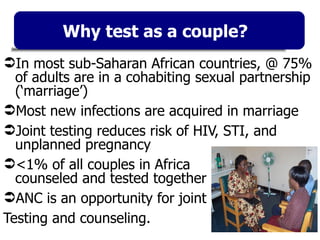
Why test as a couple? In most sub-Saharan African countries, @ 75% of adults are in a cohabiting sexual partnership (‘marriage’) Most new infections are acquired in marriage Joint testing reduces risk of HIV, STI, and unplanned pregnancy <1% of all couples in Africa  counseled and tested together ANC is an opportunity for joint Testing and counseling.
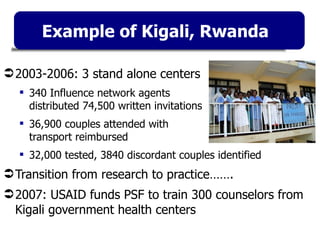
Example of Kigali, Rwanda 2003-2006: 3 stand alone centers 340 Influence network agents  distributed 74,500 written invitations 36,900 couples attended with  transport reimbursed 32,000 tested, 3840 discordant couples identified Transition from research to practice……. 2007: USAID funds PSF to train 300 counselors from Kigali government health centers
40,000 couples tested at Projet San Francisco:  half were cohabiting couples,  @15% of the city’s cohabiting couples had participated MOH endorsed routine testing of male partners in ANC Weekend programs set up to accommodate both partners together By 2008 – Kigali, Rwanda
2006-2008: male partners tested separately from wives in government clinics 2009: CDC/NIMH/LSTM procedures adopted as National Guidelines www.cdc.gov/globalaids/CHCTintervention Weekend programs in clinics facilitated the transition to integrated weekday services Lessons learned from Kigali, Rwanda
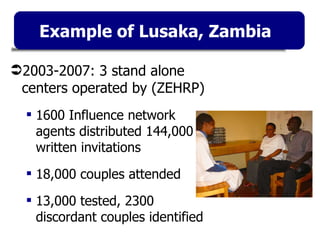
Example of Lusaka, Zambia 2003-2007: 3 stand alone centers operated by (ZEHRP) 1600 Influence network agents distributed 144,000 written invitations 18,000 couples attended 13,000 tested, 2300 discordant couples identified
3 fixed sites closed (NIMH funding ended)  3% of Lusaka’s cohabiting couples had been tested transition to weekend programs in ANC clinics; target 20% of ANC visitors to bring male partners Couple transport paid, clinic promoters paid a nominal sum (not performance based) Couple transport cut in half, clinic promoter pay reduced—attendance dropped >50% In clinics with no couple transport, <1% of ANC visitors return with partners By 2008 – Lusaka, Zambia
Couples’ testing still not a social norm, need continued promotions and incentives Sustainability will occur at a social level once enough couples have been tested (>15%) Sustainability CANNOT occur if efforts are limited to ‘supply side’ without support for ‘demand side’ Lessons learned from Lusaka,  Zambia
Couples’ testing is possible  in ANC Successfully implemented in 2001 in 2 ANC clinics in Lusaka and 2 clinics in Kigali No HIV testing was available at the outset, within 8 months >2000 women were tested alone during the week and >1600 women with partners on weekends
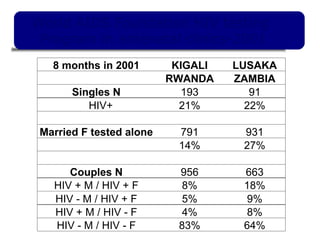
World AIDS Foundation HIV testing  Program in antenatal clinics-2001 8 months in 2001 KIGALI LUSAKA   RWANDA ZAMBIA Singles N 193 91 HIV+ 21% 22%       Married F tested alone 791 931   14% 27%       Couples N 956 663 HIV + M / HIV + F 8% 18% HIV - M / HIV + F 5% 9% HIV + M / HIV - F 4% 8% HIV - M / HIV - F 83% 64%
Obstacles in CHCT Provision Lack of vision and commitment among funding agencies and policymakers Lack of indicators, mandates, and budgets to incentivize CVCT Re-invention of the wheel with dysfunctional models (ex separate testing, no incentives). Competing messages in clinics and community (e.g. malaria, HAART) Lack of demand resulted in lack of CVCT supply, which in turn discourages demand
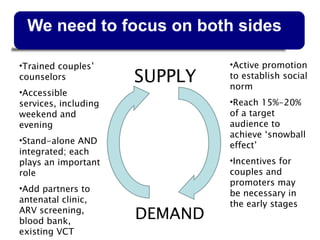
We need to focus on both sides SUPPLY DEMAND Trained couples’ counselors Accessible services, including weekend and evening Stand-alone AND integrated; each plays an important role Add partners to antenatal clinic, ARV screening, blood bank, existing VCT Active promotion to establish social norm Reach 15%-20% of a target audience to achieve ‘snowball effect’ Incentives for couples and promoters may be necessary in the early stages
Technical assistance available RZHRG is a COE in CHCT with 20+ years of experience Counseled couples and follow-up of >10,000 discordant couples CDC funding RZHRG to provide TA French and English speaking trainers Didactic and practicum training for counselors, Promoters and program managers, Lab techs and Data mangers
Acknowledgments Center for Disease Control (CDC) US National Institutes of Mental Health (NIMH) International AIDS Vaccine Initiative (IAVI) National Institutes for Allergy and Infectious Diseases (NIAID) Home office at Emory School of Public Health Rwanda-Zambia HIV Research Group

HIV Testing for Couples

  • 1.
    HIV testing forcouples William Kilembe MD MSc Rwanda Zambia HIV Research Group 19 July 2010
  • 2.
    Why test asa couple? In most sub-Saharan African countries, @ 75% of adults are in a cohabiting sexual partnership (‘marriage’) Most new infections are acquired in marriage Joint testing reduces risk of HIV, STI, and unplanned pregnancy <1% of all couples in Africa counseled and tested together ANC is an opportunity for joint Testing and counseling.
  • 3.
    Example of Kigali,Rwanda 2003-2006: 3 stand alone centers 340 Influence network agents distributed 74,500 written invitations 36,900 couples attended with transport reimbursed 32,000 tested, 3840 discordant couples identified Transition from research to practice……. 2007: USAID funds PSF to train 300 counselors from Kigali government health centers
  • 4.
    40,000 couples testedat Projet San Francisco: half were cohabiting couples, @15% of the city’s cohabiting couples had participated MOH endorsed routine testing of male partners in ANC Weekend programs set up to accommodate both partners together By 2008 – Kigali, Rwanda
  • 5.
    2006-2008: male partnerstested separately from wives in government clinics 2009: CDC/NIMH/LSTM procedures adopted as National Guidelines www.cdc.gov/globalaids/CHCTintervention Weekend programs in clinics facilitated the transition to integrated weekday services Lessons learned from Kigali, Rwanda
  • 6.
    Example of Lusaka,Zambia 2003-2007: 3 stand alone centers operated by (ZEHRP) 1600 Influence network agents distributed 144,000 written invitations 18,000 couples attended 13,000 tested, 2300 discordant couples identified
  • 7.
    3 fixed sitesclosed (NIMH funding ended) 3% of Lusaka’s cohabiting couples had been tested transition to weekend programs in ANC clinics; target 20% of ANC visitors to bring male partners Couple transport paid, clinic promoters paid a nominal sum (not performance based) Couple transport cut in half, clinic promoter pay reduced—attendance dropped >50% In clinics with no couple transport, <1% of ANC visitors return with partners By 2008 – Lusaka, Zambia
  • 8.
    Couples’ testing stillnot a social norm, need continued promotions and incentives Sustainability will occur at a social level once enough couples have been tested (>15%) Sustainability CANNOT occur if efforts are limited to ‘supply side’ without support for ‘demand side’ Lessons learned from Lusaka, Zambia
  • 9.
    Couples’ testing ispossible in ANC Successfully implemented in 2001 in 2 ANC clinics in Lusaka and 2 clinics in Kigali No HIV testing was available at the outset, within 8 months >2000 women were tested alone during the week and >1600 women with partners on weekends
  • 10.
    World AIDS FoundationHIV testing Program in antenatal clinics-2001 8 months in 2001 KIGALI LUSAKA   RWANDA ZAMBIA Singles N 193 91 HIV+ 21% 22%       Married F tested alone 791 931   14% 27%       Couples N 956 663 HIV + M / HIV + F 8% 18% HIV - M / HIV + F 5% 9% HIV + M / HIV - F 4% 8% HIV - M / HIV - F 83% 64%
  • 11.
    Obstacles in CHCTProvision Lack of vision and commitment among funding agencies and policymakers Lack of indicators, mandates, and budgets to incentivize CVCT Re-invention of the wheel with dysfunctional models (ex separate testing, no incentives). Competing messages in clinics and community (e.g. malaria, HAART) Lack of demand resulted in lack of CVCT supply, which in turn discourages demand
  • 12.
    We need tofocus on both sides SUPPLY DEMAND Trained couples’ counselors Accessible services, including weekend and evening Stand-alone AND integrated; each plays an important role Add partners to antenatal clinic, ARV screening, blood bank, existing VCT Active promotion to establish social norm Reach 15%-20% of a target audience to achieve ‘snowball effect’ Incentives for couples and promoters may be necessary in the early stages
  • 13.
    Technical assistance availableRZHRG is a COE in CHCT with 20+ years of experience Counseled couples and follow-up of >10,000 discordant couples CDC funding RZHRG to provide TA French and English speaking trainers Didactic and practicum training for counselors, Promoters and program managers, Lab techs and Data mangers
  • 14.
    Acknowledgments Center forDisease Control (CDC) US National Institutes of Mental Health (NIMH) International AIDS Vaccine Initiative (IAVI) National Institutes for Allergy and Infectious Diseases (NIAID) Home office at Emory School of Public Health Rwanda-Zambia HIV Research Group

Editor's Notes

  • #3 most effective HIV prevention intervention for cohabitating couples in Africa, the largest group at risk for HIV infection in the world. very few couples in high-prevalence areas have been tested together. couples will come together for testing if financial and logistical obstacles are overcome. VCT is becoming increasingly available with the advent of perinatal prevention efforts and antiretroviral medication provision programs, but these programs prioritize the individual and generally do not accommodate couples
  • #4 IN KIGALI, RWANDA, HIV TESTING FOR COUPLES FIRST BEGAN IN 1988 AS PART OF PROJET SAN FRANCISCO, A RESEARCH PROJECT EVIDENCE OF REDUCED HIV, STI, AND UNPLANNED PREGNANCY WAS PUBLISHED AS EARLY AS 1991-1993, WITH SIMILAR PUBLICATIONS FROM GROUPS IN OTHER AFRICAN COUNTRIES.
  • #11 Stepping back, couples’ testing was successful early on, prior to availability of any PMTCT drug regimens: in both Kigali and Lusaka, our World AIDS Foundation program was able to train counselors to provide HIV testing for women during the week and with their partners on weekends. The publication detailing the findings is available, but of note on this slide are the couples with HIV+ men and HIV- women; these couples contribute to 85% of the new infections that occur in pregnant and breastfeeding women.
  • #12 Lack of trained staff to promote and deliver couples counseling