Basic I nf or mat ion about
HI V/ AI DS
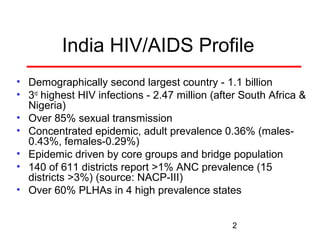
India HIV/AIDS Profile
• Demographically second largest country - 1.1 billion
• 3rd highest HIV infections - 2.47 million (after South Africa &
Nigeria)
• Over 85% sexual transmission
• Concentrated epidemic, adult prevalence 0.36% (males0.43%, females-0.29%)
• Epidemic driven by core groups and bridge population
• 140 of 611 districts report >1% ANC prevalence (15
districts >3%) (source: NACP-III)
• Over 60% PLHAs in 4 high prevalence states
2
Basics about HI V / AI DS
•
•
•
•

What is HIV/AIDS
How HIV/AIDS can be transmitted
How HIV/AIDS cannot be transmitted
People that are especially vulnerable
to HIV/AIDS
3
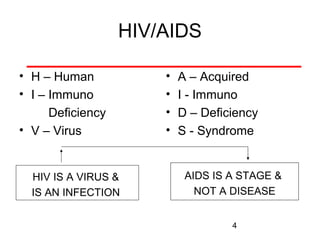
HIV/AIDS
• H – Human
• I – Immuno
Deficiency
• V – Virus

HIV IS A VIRUS &
IS AN INFECTION

•
•
•
•

A – Acquired
I - Immuno
D – Deficiency
S - Syndrome

AIDS IS A STAGE &
NOT A DISEASE
4
What is HI V?
HIV is short for Human Immunodeficiency Virus.
Once infected with HIV, a person is
referred to as HIV positive. However, this
does not necessarily mean that (s)he has
symptoms or feels sick. An HIV positive
person can feel and look healthy for a long
time after first becoming infected.
5
What is AI DS?
AIDS, or Acquired Immune Deficiency
Syndrome, can take many years to
develop.
Eventually, the virus kills or impairs more
and more cells in the immune system and
the body loses the ability to fight off common
infections, such as diarrhea or colds. People
with AIDS can die from diseases that are
usually not dangerous for people with
healthy immune systems.
6
From HIV to AIDS
• Aids is diagnosed when your CD 4 blood
count is at 200 or lower and you have an
opportunistic infection (i.e. Kaposi’s
Sarcoma or PCP (This is a set point for
medical diagnosis)
• A healthy blood count may range from 800
to 1200 CD4
7
How HI V can be
t r ansmit t ed
• Unprotected sexual contact – be it vaginal,
oral, or anal - with an infected partner
• Sharing unsterilized needles or syringes
with an HIV positive person, for example,
when using drugs or in a healthcare setting.
• During pregnancy or birth and through
breastfeeding from an HIV positive mother to
her baby.
• Blood transfusions with infected blood
8
Major Symptoms
• Loss of more than 10% of body weight
• Chronic diarrhea
• Prolonged fever

9
Minor Symptoms
•
•
•
•
•

Cough for more than a month
Generalised itchy skin rash
Painful group of blisters all over the body
Generalised swollen lymph glands
White curd like patched on tongue/throat

10
DIAGNOSIS
• HIV – Two major signs + one minor sign +
positive blood test
• AIDS – Two major signs + one minor sign
+ AIDS specific opportunistic infection +
positive blood test

11
HIV/AIDS - MYTHS
• There is a cure for HIV/AIDS
• Restricted to certain group/
community/country
• Sex with virgin can cure AIDS
• Is not a major problem in India
• Presence of STD is a pre requisite for HIV
infection
12
HIV/AIDS – THE
DIFFICULTIES
•
•
•
•

Sensitive issue
Non availability of true information/Data
Very low level of awareness/concern
Socio-economically marginalized people
are the most vulnerable,
– who are difficult to approach
– they are unable to access
13
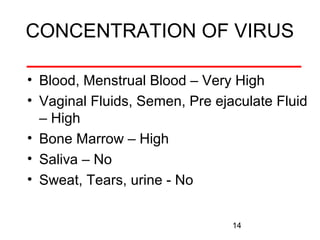
CONCENTRATION OF VIRUS
• Blood, Menstrual Blood – Very High
• Vaginal Fluids, Semen, Pre ejaculate Fluid
– High
• Bone Marrow – High
• Saliva – No
• Sweat, Tears, urine - No
14
How HI V can NOT be
t r ansmit t ed
•
•
•
•
•
•
•
•
•

Through air or by coughing and sneezing
Through food or water
Through sweat and tears
By sharing cups, plates, and utensils with an infected person
By touching, hugging and kissing an infected person
By sharing clothes or shaking hands with an infected person
By sharing toilets and bathrooms with an infected person
By living with an infected person
By mosquitoes, fleas, or other insects

15
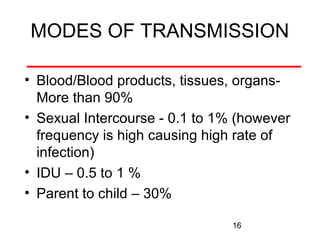
MODES OF TRANSMISSION
• Blood/Blood products, tissues, organsMore than 90%
• Sexual Intercourse - 0.1 to 1% (however
frequency is high causing high rate of
infection)
• IDU – 0.5 to 1 %
• Parent to child – 30%
16
HIV Test
Common Method of HIV test is • ELISA (common method of HIV test in
India)
• Western Blot
• PCR

17
Populat ions par t icular ly at
r isk
A person who:
– Uses shared/contaminated needles and
syringes
– Has a sexually transmitted infections(STIs)
– Has anal sex with her/his partner(s)
– Exchanges sex for money or drugs
– Has many sex partners
– Leads life separated from spouse due to
professional obligations (e.g., truck drivers,
laborers, migrants)
18
Women and HIV
Social R
isk Factors
– Illiteracy
– Lack of awareness of preventive measures
B
iological risk f actors
– Twice as easy for women to contract HIV from
men
– Physiology of women (e.g., menstruation,
intercourse)
– Pregnancy-associated conditions (e.g., anemia,
hemorrhage) increase the need for blood
19
transfusion
Taboo and St igma
• Stigma derives from the association of
HIV/AIDS with sex, disease and death,
and with behaviours that may be illegal,
forbidden or taboo, such as pre- and
extramarital sex, sex work, sex between
men, and injecting drug use.
• Stigma builds upon, and reinforces,
existing prejudices.
20
PREVENTION
•
•
•
•
•

Take blood from licensed blood bank
Make sure the blood has the stamp of HIV FREE on it
Avoid single unit BT
Avoid sharing needles
Take your own disposable syringe

Safer sex practices
•
•
•
•
•
•
•

Abstinence
Delay first intercourse
Less number of partners
Be faithful to each other
Masturbation
Non penetrative sex
Proper & consistent use of condom

Creating awareness on HIV/AIDS and safe sex
21
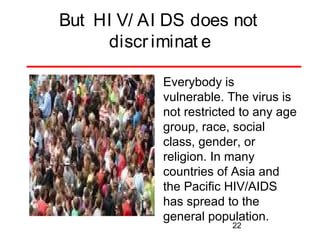
But HI V/ AI DS does not
discr iminat e
Everybody is
vulnerable. The virus is
not restricted to any age
group, race, social
class, gender, or
religion. In many
countries of Asia and
the Pacific HIV/AIDS
has spread to the
general population.
22
No count r y is immune
t o t he epidemic
• The HIV/AIDS epidemic can spread very
quickly
• Low HIV prevalence rates in the general
population of a country can conceal
serious epidemics in smaller, high-risk
groups or in certain areas
• The epidemic can quickly cross over from
high-risk groups to the general population
23
I mpact of HI V/ AI DS
HIV/AIDS has an impact on all bodies
responsible f or planning and allocation of
resources and education services such as. . .








Schools and Universities
Ministries
Departments
Agencies / Organisations
Policy makers
Religious and Faith based organizations
24
What t he Communit y Leader s
can and should do
• The consequences of inaction
• There is hope
• Why education is crucial in the fight
against HIV/AIDS
• Approaches to take Next steps

25
How t o f ight HI V/ AI DS
• Develop appropriate policies
• Ensure adequate planning and
management
• Focus on prevention/awareness
• Reduce vulnerability
• Introduce or upgrade life skills
education
• Promote a culture of compassion and
26
care
Awar eness is t he only
way
• There are no cures or vaccines for HIV/AIDS.
Currently awareness/education is the only way
to prevent infection.
• Preventive education also means preventing
stigma, denial, and discrimination.
• HIV/ADS is associated with sex, disease, and
death, and with behaviours that may be illegal,
forbidden or taboo, such as pre- and
extramarital sex, sex work, sex between men,
and injecting drug use. Awareness will reduce
27
the HIV vulnerability.
Pr event ive st ep is cr ucial
R
esearch in several countries has
shown that well- inf ormed young
people



Delay starting sexual activity and
Are more likely to protect themselves once they start
having sex.

28
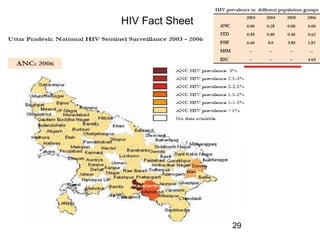
HIV Fact Sheet

29
30
Thank You

31

Hiv presentation

  • 1.
    Basic I nfor mat ion about HI V/ AI DS
  • 2.
    India HIV/AIDS Profile •Demographically second largest country - 1.1 billion • 3rd highest HIV infections - 2.47 million (after South Africa & Nigeria) • Over 85% sexual transmission • Concentrated epidemic, adult prevalence 0.36% (males0.43%, females-0.29%) • Epidemic driven by core groups and bridge population • 140 of 611 districts report >1% ANC prevalence (15 districts >3%) (source: NACP-III) • Over 60% PLHAs in 4 high prevalence states 2
  • 3.
    Basics about HIV / AI DS • • • • What is HIV/AIDS How HIV/AIDS can be transmitted How HIV/AIDS cannot be transmitted People that are especially vulnerable to HIV/AIDS 3
  • 4.
    HIV/AIDS • H –Human • I – Immuno Deficiency • V – Virus HIV IS A VIRUS & IS AN INFECTION • • • • A – Acquired I - Immuno D – Deficiency S - Syndrome AIDS IS A STAGE & NOT A DISEASE 4
  • 5.
    What is HIV? HIV is short for Human Immunodeficiency Virus. Once infected with HIV, a person is referred to as HIV positive. However, this does not necessarily mean that (s)he has symptoms or feels sick. An HIV positive person can feel and look healthy for a long time after first becoming infected. 5
  • 6.
    What is AIDS? AIDS, or Acquired Immune Deficiency Syndrome, can take many years to develop. Eventually, the virus kills or impairs more and more cells in the immune system and the body loses the ability to fight off common infections, such as diarrhea or colds. People with AIDS can die from diseases that are usually not dangerous for people with healthy immune systems. 6
  • 7.
    From HIV toAIDS • Aids is diagnosed when your CD 4 blood count is at 200 or lower and you have an opportunistic infection (i.e. Kaposi’s Sarcoma or PCP (This is a set point for medical diagnosis) • A healthy blood count may range from 800 to 1200 CD4 7
  • 8.
    How HI Vcan be t r ansmit t ed • Unprotected sexual contact – be it vaginal, oral, or anal - with an infected partner • Sharing unsterilized needles or syringes with an HIV positive person, for example, when using drugs or in a healthcare setting. • During pregnancy or birth and through breastfeeding from an HIV positive mother to her baby. • Blood transfusions with infected blood 8
  • 9.
    Major Symptoms • Lossof more than 10% of body weight • Chronic diarrhea • Prolonged fever 9
  • 10.
    Minor Symptoms • • • • • Cough formore than a month Generalised itchy skin rash Painful group of blisters all over the body Generalised swollen lymph glands White curd like patched on tongue/throat 10
  • 11.
    DIAGNOSIS • HIV –Two major signs + one minor sign + positive blood test • AIDS – Two major signs + one minor sign + AIDS specific opportunistic infection + positive blood test 11
  • 12.
    HIV/AIDS - MYTHS •There is a cure for HIV/AIDS • Restricted to certain group/ community/country • Sex with virgin can cure AIDS • Is not a major problem in India • Presence of STD is a pre requisite for HIV infection 12
  • 13.
    HIV/AIDS – THE DIFFICULTIES • • • • Sensitiveissue Non availability of true information/Data Very low level of awareness/concern Socio-economically marginalized people are the most vulnerable, – who are difficult to approach – they are unable to access 13
  • 14.
    CONCENTRATION OF VIRUS •Blood, Menstrual Blood – Very High • Vaginal Fluids, Semen, Pre ejaculate Fluid – High • Bone Marrow – High • Saliva – No • Sweat, Tears, urine - No 14
  • 15.
    How HI Vcan NOT be t r ansmit t ed • • • • • • • • • Through air or by coughing and sneezing Through food or water Through sweat and tears By sharing cups, plates, and utensils with an infected person By touching, hugging and kissing an infected person By sharing clothes or shaking hands with an infected person By sharing toilets and bathrooms with an infected person By living with an infected person By mosquitoes, fleas, or other insects 15
  • 16.
    MODES OF TRANSMISSION •Blood/Blood products, tissues, organsMore than 90% • Sexual Intercourse - 0.1 to 1% (however frequency is high causing high rate of infection) • IDU – 0.5 to 1 % • Parent to child – 30% 16
  • 17.
    HIV Test Common Methodof HIV test is • ELISA (common method of HIV test in India) • Western Blot • PCR 17
  • 18.
    Populat ions part icular ly at r isk A person who: – Uses shared/contaminated needles and syringes – Has a sexually transmitted infections(STIs) – Has anal sex with her/his partner(s) – Exchanges sex for money or drugs – Has many sex partners – Leads life separated from spouse due to professional obligations (e.g., truck drivers, laborers, migrants) 18
  • 19.
    Women and HIV SocialR isk Factors – Illiteracy – Lack of awareness of preventive measures B iological risk f actors – Twice as easy for women to contract HIV from men – Physiology of women (e.g., menstruation, intercourse) – Pregnancy-associated conditions (e.g., anemia, hemorrhage) increase the need for blood 19 transfusion
  • 20.
    Taboo and Stigma • Stigma derives from the association of HIV/AIDS with sex, disease and death, and with behaviours that may be illegal, forbidden or taboo, such as pre- and extramarital sex, sex work, sex between men, and injecting drug use. • Stigma builds upon, and reinforces, existing prejudices. 20
  • 21.
    PREVENTION • • • • • Take blood fromlicensed blood bank Make sure the blood has the stamp of HIV FREE on it Avoid single unit BT Avoid sharing needles Take your own disposable syringe Safer sex practices • • • • • • • Abstinence Delay first intercourse Less number of partners Be faithful to each other Masturbation Non penetrative sex Proper & consistent use of condom Creating awareness on HIV/AIDS and safe sex 21
  • 22.
    But HI V/AI DS does not discr iminat e Everybody is vulnerable. The virus is not restricted to any age group, race, social class, gender, or religion. In many countries of Asia and the Pacific HIV/AIDS has spread to the general population. 22
  • 23.
    No count ry is immune t o t he epidemic • The HIV/AIDS epidemic can spread very quickly • Low HIV prevalence rates in the general population of a country can conceal serious epidemics in smaller, high-risk groups or in certain areas • The epidemic can quickly cross over from high-risk groups to the general population 23
  • 24.
    I mpact ofHI V/ AI DS HIV/AIDS has an impact on all bodies responsible f or planning and allocation of resources and education services such as. . .       Schools and Universities Ministries Departments Agencies / Organisations Policy makers Religious and Faith based organizations 24
  • 25.
    What t heCommunit y Leader s can and should do • The consequences of inaction • There is hope • Why education is crucial in the fight against HIV/AIDS • Approaches to take Next steps 25
  • 26.
    How t of ight HI V/ AI DS • Develop appropriate policies • Ensure adequate planning and management • Focus on prevention/awareness • Reduce vulnerability • Introduce or upgrade life skills education • Promote a culture of compassion and 26 care
  • 27.
    Awar eness ist he only way • There are no cures or vaccines for HIV/AIDS. Currently awareness/education is the only way to prevent infection. • Preventive education also means preventing stigma, denial, and discrimination. • HIV/ADS is associated with sex, disease, and death, and with behaviours that may be illegal, forbidden or taboo, such as pre- and extramarital sex, sex work, sex between men, and injecting drug use. Awareness will reduce 27 the HIV vulnerability.
  • 28.
    Pr event ivest ep is cr ucial R esearch in several countries has shown that well- inf ormed young people   Delay starting sexual activity and Are more likely to protect themselves once they start having sex. 28
  • 29.
  • 30.
  • 31.

Editor's Notes