HIV/ AIDS
The 21st
century pandemic
Dr C B NarayanDr C B Narayan
CMO(SG)CMO(SG)
CH BSF HazaribaghCH BSF Hazaribagh
A Acquired
2
AA Acquired
II Immuno
3
AA Acquired
II Immuno
DD Deficiency
4
AA Acquired
II Immuno
DD Deficiency
SS Syndrome
5
HH Human
6
HH Human
II Immunodeficiency
7
HH Human
II Immunodeficiency
VV Virus
8
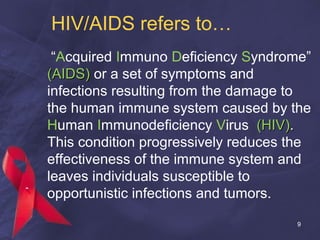
HIV/AIDS refers to…
“Acquired Immuno Deficiency Syndrome”
(AIDS)(AIDS) or a set of symptoms and
infections resulting from the damage to
the human immune system caused by the
Human Immunodeficiency Virus (HIV)(HIV)..
This condition progressively reduces the
effectiveness of the immune system and
leaves individuals susceptible to
opportunistic infections and tumors.
9
Basic Definitions And Meanings
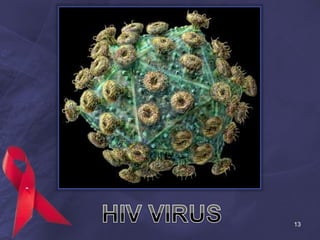
What is HIV?
HIV is “Human Immunodeficiency Virus”,it is the
virus that cause AIDS.
Human means that it affects only humans and
lives only in humans.
The virus does not live in toilets, mosquitoes,
cups, spoons, on bed sheets or towels that people
with HIV might have used.
Immunodeficiency refers to lack(deficiency) or
breakdown of immune system. The “immune
system” is the body’s resistance or the body’s
defense force for fighting off infections. 10
The virus attacks and eventually overcomes
the body’s immune system. The immune
system is usually able to defend the body
against infections.
A virus is a germ.
What is AIDS?
• AIDS means “Acquired Immunodeficiency
Syndrome”
• To acquire means to “get or develop over a
period of time”
• The immune system breaks down gradually
over time. 11
It gets deficient or less and less efficient,
under relentless attack by the multiplying
number of virus in the body.
Syndrome refers to the group or collection of
signs and symptoms of indication of
diseases in a person who has AIDS.
HIV is the infectious stage of the condition,HIV is the infectious stage of the condition,
AIDS is the disease phase.AIDS is the disease phase.
12
13
The Origin of AIDS and HIV
HIV came from a similar virus found in
chimpanzees - SIV.
HIV probably entered the United States
around 1970.the first recognized case
of AIDS was in the early 1980s.
HIV is a lentevirus (slow virus),which in
turn is a part of a larger group of viruses
known as retro virus
14
Epidemiology
Males>females
Occurs in all ages and ethnic groups
All areas of the country are affected
In some city inner areas, as many as 50% of
males are HIV positive
AIDS is now the second leading cause of death
for all men aged 25-44 years
(Unintended injuries is #1 and heart disease is
#3 for this age group)
15
HIV Transmission
• HIV enters the bloodstream through:
Open Cuts
Breaks in the skin
Mucous membranes
Direct injection 16
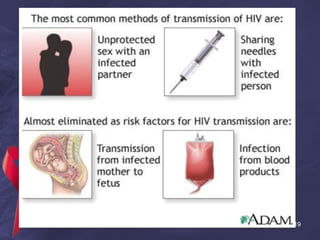
Routes of Transmission of HIV
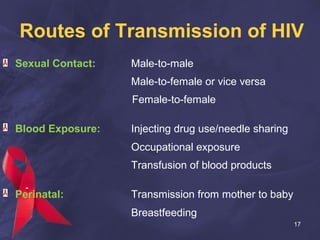
Sexual Contact: Male-to-male
Male-to-female or vice versa
Female-to-female
Blood Exposure: Injecting drug use/needle sharing
Occupational exposure
Transfusion of blood products
Perinatal: Transmission from mother to baby
Breastfeeding
17
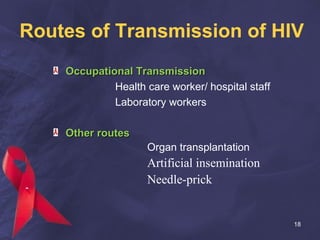
Routes of Transmission of HIV
Occupational TransmissionOccupational Transmission
Health care worker/ hospital staff
Laboratory workers
Other routesOther routes
Organ transplantation
Artificial insemination
Needle-prick
18
19
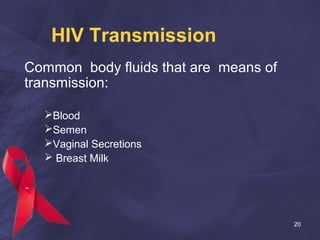
HIV Transmission
Common body fluids that are means of
transmission:
Blood
Semen
Vaginal Secretions
 Breast Milk
20
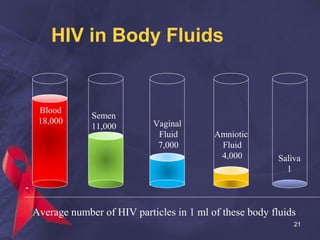
HIV in Body Fluids
Semen
11,000 Vaginal
Fluid
7,000
Blood
18,000
Amniotic
Fluid
4,000 Saliva
1
Average number of HIV particles in 1 ml of these body fluids
21
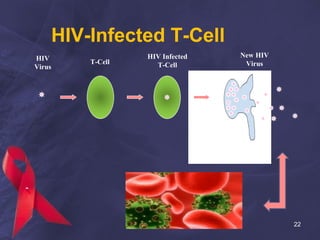
HIV-Infected T-Cell
HIV
Virus
T-Cell
HIV Infected
T-Cell
New HIV
Virus
22
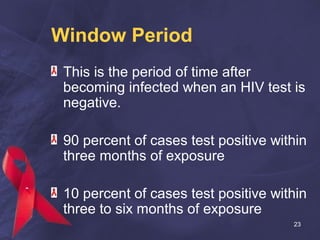
Window Period
This is the period of time after
becoming infected when an HIV test is
negative.
90 percent of cases test positive within
three months of exposure
10 percent of cases test positive within
three to six months of exposure
23
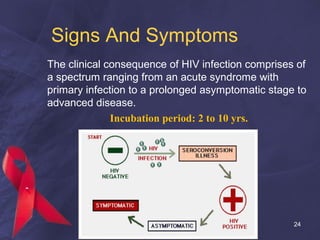
Signs And Symptoms
The clinical consequence of HIV infection comprises of
a spectrum ranging from an acute syndrome with
primary infection to a prolonged asymptomatic stage to
advanced disease.
Incubation period: 2 to 10 yrs.
24
The Acute HIV Syndrome
Follows 3-6 wks following primary infection
25
Signs And Symptoms
Second phase-
Asymptomatic contact
Initial HIV inf. or after illness of inf.
No symptoms
Last 2 to 10 yrs.
26
Signs And Symptoms
Third phase-
PGL (Persistent Generalized Lymphadenopathy)
Enlargement of lymph nodes.
outside the inguinal area
more than 2 areas
more that 3 months
27
Signs And Symptoms
Fourth phage-Overt Manifestation of AIDS
ARC(AIDS-related complex): fever, loss of
weight, anorexia, diarrhea plus PGL
Nervous system symptoms: headache,
convulsion, paralysis, progressive
dementia
Rare opportunistic infection.
Unusual malignant tumors.
Pneumonia.
28
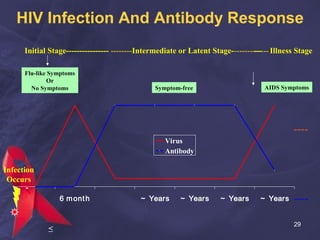
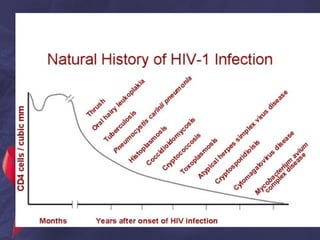
HIV Infection And Antibody Response
6 month ~ Years ~ Years ~ Years ~ Years
Virus
Antibody
Infection
Occurs
AIDS Symptoms
Initial Stage---------------- --------Intermediate or Latent Stage----------------- Illness Stage
Flu-like Symptoms
Or
No Symptoms Symptom-free
<
----
----
29
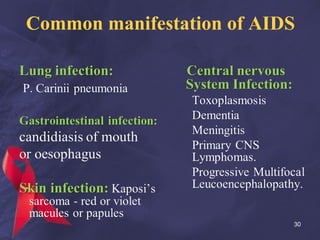
Common manifestation of AIDS
30
31
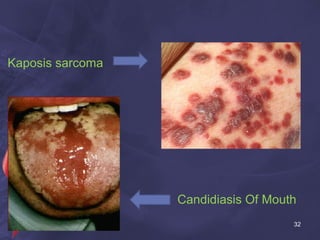
Kaposis sarcoma
Candidiasis Of Mouth
32
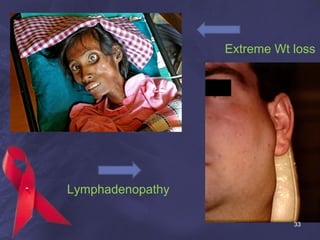
Extreme Wt loss
Lymphadenopathy
33
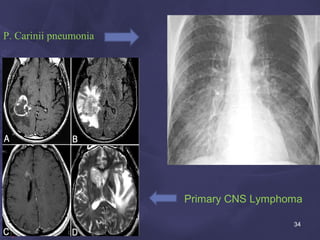
P. Carinii pneumonia
Primary CNS Lymphoma
34
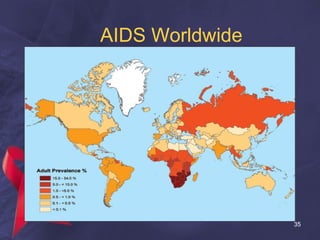
AIDS Worldwide
35
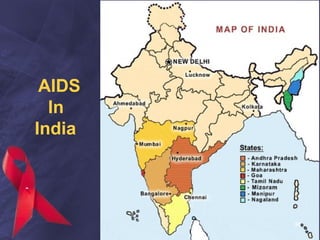
AIDS
In
India
36
Prevention Of HIV/AIDS
Risk factors
Anyone of any age, race, sex or sexual orientation can
be infected with HIV, but you're at greatest risk of
HIV/AIDS if you:
Have unprotected sex with multiple partners. Unprotected sex
means having sex without using a new latex or polyurethane
condom every time.
Have unprotected sex with someone who is HIV-positive.
Have another sexually transmitted disease, such as syphilis,
herpes, Chlamydia, gonorrhea or bacterial vaginosis.
Share needles during intravenous drug use.
Received a blood transfusion or blood products before 1985.
37
Prevention Of HIV/AIDS
Newborns or nursing infants whose mothers tested
positive for HIV but did not receive treatment also are at
high risk.
Fastest growing method of HIV transmission:
heterosexual contact.
Heterosexual transmission is easier from men to women
than from women to men
Risk of acquiring for men is greater if contact occurs
during menstruation
Uncircumcised men are more likely to be seropositive
and contract HIV during sex
38
Prevention Of HIV/AIDS
If mother is HIV positive, 100% of children will
test positive at birth
Breast feeding increases transmission
rate
39
Prevention Of HIV/AIDS
There's no vaccine to prevent HIV infection and no cure for AIDS.
Prevention includes educating yourself about HIV and avoiding any
behavior that allows HIV-infected fluids — blood, semen, vaginal
secretions and breast milk — into your body.
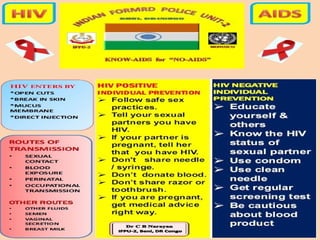
HIV-negative Individual prevention:HIV-negative Individual prevention:
Educate yourself and others.Educate yourself and others.
Know the HIV status of any sexual partner.
Use a new latex or polyurethane condom every time you
have sex.
Consider male circumcision.
Use a clean needle.
Be cautious about blood products.
Get regular screening tests.
40
Prevention Of HIV/AIDS
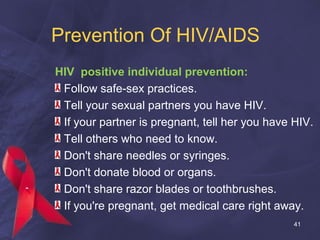
HIV positive individual prevention:
Follow safe-sex practices.
Tell your sexual partners you have HIV.
If your partner is pregnant, tell her you have HIV.
Tell others who need to know.
Don't share needles or syringes.
Don't donate blood or organs.
Don't share razor blades or toothbrushes.
If you're pregnant, get medical care right away.
41
42
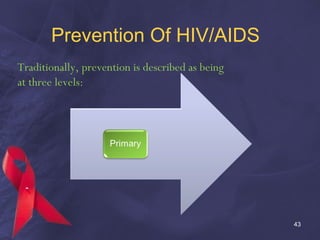
Prevention Of HIV/AIDS
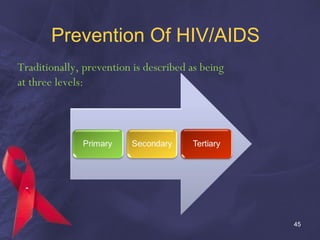
Traditionally, prevention is described as being
at three levels:
43
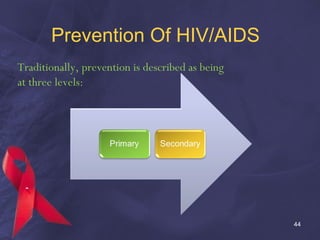
Prevention Of HIV/AIDS
Traditionally, prevention is described as being
at three levels:
44
Prevention Of HIV/AIDS
Traditionally, prevention is described as being
at three levels:
45
46
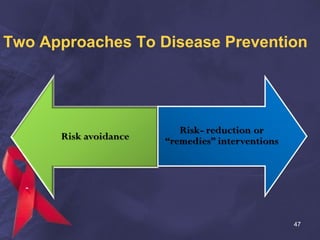
Two Approaches To Disease Prevention
47
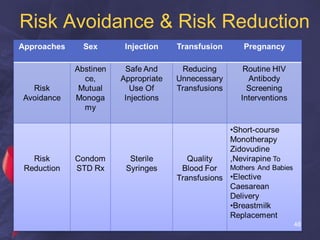
Risk Avoidance & Risk Reduction
48
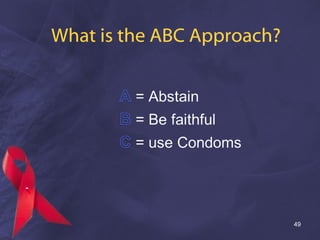
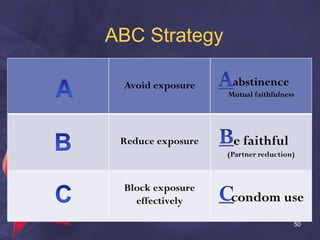
What is the ABC Approach?
49
ABC Strategy
50
51
52
You Cannot Get Aids FromYou Cannot Get Aids From
KissingKissing
Tear, Sweat, Saliva, Nasal secretion, Faeces,Tear, Sweat, Saliva, Nasal secretion, Faeces,
Urine, Sputum & Vomiting.Urine, Sputum & Vomiting.
Sneezing, coughing, sharing glasses/cups, etcSneezing, coughing, sharing glasses/cups, etc
HIV is unable to reproduce outside its living host, except underHIV is unable to reproduce outside its living host, except under
strictly controlled laboratory conditions. HIV does not survive wellstrictly controlled laboratory conditions. HIV does not survive well
in the open air, and dies soon.in the open air, and dies soon.
•This means that HIV cannot be transmitted through spitting,This means that HIV cannot be transmitted through spitting,
sneezing, sharing glasses, cutlery, or musical instruments. You alsosneezing, sharing glasses, cutlery, or musical instruments. You also
can't be infected in swimming pools, showers or by sharingcan't be infected in swimming pools, showers or by sharing
washing facilities or toilet seatswashing facilities or toilet seats..
Insects -Insects - HIV only lives for a short time and cannot reproduceHIV only lives for a short time and cannot reproduce
inside an insect.inside an insect.
Injecting drugs with sterile needlesInjecting drugs with sterile needles
Protected sexProtected sex 53
54
HIV is unable to reproduce outside its living
host, except under strictly controlled
laboratory conditions. HIV does not survive well
in the open air, and dies soon.
This means that HIV cannot be transmitted
through spitting, sneezing, sharing glasses,
cutlery, or musical instruments. You also can't be
infected in swimming pools, showers or by sharing
washing facilities or toilet seats.
55

HIV By Dr CB Narayan

  • 1.
    HIV/ AIDS The 21st centurypandemic Dr C B NarayanDr C B Narayan CMO(SG)CMO(SG) CH BSF HazaribaghCH BSF Hazaribagh
  • 2.
  • 3.
  • 4.
  • 5.
    AA Acquired II Immuno DDDeficiency SS Syndrome 5
  • 6.
  • 7.
  • 8.
  • 9.
    HIV/AIDS refers to… “AcquiredImmuno Deficiency Syndrome” (AIDS)(AIDS) or a set of symptoms and infections resulting from the damage to the human immune system caused by the Human Immunodeficiency Virus (HIV)(HIV).. This condition progressively reduces the effectiveness of the immune system and leaves individuals susceptible to opportunistic infections and tumors. 9
  • 10.
    Basic Definitions AndMeanings What is HIV? HIV is “Human Immunodeficiency Virus”,it is the virus that cause AIDS. Human means that it affects only humans and lives only in humans. The virus does not live in toilets, mosquitoes, cups, spoons, on bed sheets or towels that people with HIV might have used. Immunodeficiency refers to lack(deficiency) or breakdown of immune system. The “immune system” is the body’s resistance or the body’s defense force for fighting off infections. 10
  • 11.
    The virus attacksand eventually overcomes the body’s immune system. The immune system is usually able to defend the body against infections. A virus is a germ. What is AIDS? • AIDS means “Acquired Immunodeficiency Syndrome” • To acquire means to “get or develop over a period of time” • The immune system breaks down gradually over time. 11
  • 12.
    It gets deficientor less and less efficient, under relentless attack by the multiplying number of virus in the body. Syndrome refers to the group or collection of signs and symptoms of indication of diseases in a person who has AIDS. HIV is the infectious stage of the condition,HIV is the infectious stage of the condition, AIDS is the disease phase.AIDS is the disease phase. 12
  • 13.
  • 14.
    The Origin ofAIDS and HIV HIV came from a similar virus found in chimpanzees - SIV. HIV probably entered the United States around 1970.the first recognized case of AIDS was in the early 1980s. HIV is a lentevirus (slow virus),which in turn is a part of a larger group of viruses known as retro virus 14
  • 15.
    Epidemiology Males>females Occurs in allages and ethnic groups All areas of the country are affected In some city inner areas, as many as 50% of males are HIV positive AIDS is now the second leading cause of death for all men aged 25-44 years (Unintended injuries is #1 and heart disease is #3 for this age group) 15
  • 16.
    HIV Transmission • HIVenters the bloodstream through: Open Cuts Breaks in the skin Mucous membranes Direct injection 16
  • 17.
    Routes of Transmissionof HIV Sexual Contact: Male-to-male Male-to-female or vice versa Female-to-female Blood Exposure: Injecting drug use/needle sharing Occupational exposure Transfusion of blood products Perinatal: Transmission from mother to baby Breastfeeding 17
  • 18.
    Routes of Transmissionof HIV Occupational TransmissionOccupational Transmission Health care worker/ hospital staff Laboratory workers Other routesOther routes Organ transplantation Artificial insemination Needle-prick 18
  • 19.
  • 20.
    HIV Transmission Common bodyfluids that are means of transmission: Blood Semen Vaginal Secretions  Breast Milk 20
  • 21.
    HIV in BodyFluids Semen 11,000 Vaginal Fluid 7,000 Blood 18,000 Amniotic Fluid 4,000 Saliva 1 Average number of HIV particles in 1 ml of these body fluids 21
  • 22.
  • 23.
    Window Period This isthe period of time after becoming infected when an HIV test is negative. 90 percent of cases test positive within three months of exposure 10 percent of cases test positive within three to six months of exposure 23
  • 24.
    Signs And Symptoms Theclinical consequence of HIV infection comprises of a spectrum ranging from an acute syndrome with primary infection to a prolonged asymptomatic stage to advanced disease. Incubation period: 2 to 10 yrs. 24
  • 25.
    The Acute HIVSyndrome Follows 3-6 wks following primary infection 25
  • 26.
    Signs And Symptoms Secondphase- Asymptomatic contact Initial HIV inf. or after illness of inf. No symptoms Last 2 to 10 yrs. 26
  • 27.
    Signs And Symptoms Thirdphase- PGL (Persistent Generalized Lymphadenopathy) Enlargement of lymph nodes. outside the inguinal area more than 2 areas more that 3 months 27
  • 28.
    Signs And Symptoms Fourthphage-Overt Manifestation of AIDS ARC(AIDS-related complex): fever, loss of weight, anorexia, diarrhea plus PGL Nervous system symptoms: headache, convulsion, paralysis, progressive dementia Rare opportunistic infection. Unusual malignant tumors. Pneumonia. 28
  • 29.
    HIV Infection AndAntibody Response 6 month ~ Years ~ Years ~ Years ~ Years Virus Antibody Infection Occurs AIDS Symptoms Initial Stage---------------- --------Intermediate or Latent Stage----------------- Illness Stage Flu-like Symptoms Or No Symptoms Symptom-free < ---- ---- 29
  • 30.
  • 31.
  • 32.
  • 33.
  • 34.
  • 35.
  • 36.
  • 37.
    Prevention Of HIV/AIDS Riskfactors Anyone of any age, race, sex or sexual orientation can be infected with HIV, but you're at greatest risk of HIV/AIDS if you: Have unprotected sex with multiple partners. Unprotected sex means having sex without using a new latex or polyurethane condom every time. Have unprotected sex with someone who is HIV-positive. Have another sexually transmitted disease, such as syphilis, herpes, Chlamydia, gonorrhea or bacterial vaginosis. Share needles during intravenous drug use. Received a blood transfusion or blood products before 1985. 37
  • 38.
    Prevention Of HIV/AIDS Newbornsor nursing infants whose mothers tested positive for HIV but did not receive treatment also are at high risk. Fastest growing method of HIV transmission: heterosexual contact. Heterosexual transmission is easier from men to women than from women to men Risk of acquiring for men is greater if contact occurs during menstruation Uncircumcised men are more likely to be seropositive and contract HIV during sex 38
  • 39.
    Prevention Of HIV/AIDS Ifmother is HIV positive, 100% of children will test positive at birth Breast feeding increases transmission rate 39
  • 40.
    Prevention Of HIV/AIDS There'sno vaccine to prevent HIV infection and no cure for AIDS. Prevention includes educating yourself about HIV and avoiding any behavior that allows HIV-infected fluids — blood, semen, vaginal secretions and breast milk — into your body. HIV-negative Individual prevention:HIV-negative Individual prevention: Educate yourself and others.Educate yourself and others. Know the HIV status of any sexual partner. Use a new latex or polyurethane condom every time you have sex. Consider male circumcision. Use a clean needle. Be cautious about blood products. Get regular screening tests. 40
  • 41.
    Prevention Of HIV/AIDS HIVpositive individual prevention: Follow safe-sex practices. Tell your sexual partners you have HIV. If your partner is pregnant, tell her you have HIV. Tell others who need to know. Don't share needles or syringes. Don't donate blood or organs. Don't share razor blades or toothbrushes. If you're pregnant, get medical care right away. 41
  • 42.
  • 43.
    Prevention Of HIV/AIDS Traditionally,prevention is described as being at three levels: 43
  • 44.
    Prevention Of HIV/AIDS Traditionally,prevention is described as being at three levels: 44
  • 45.
    Prevention Of HIV/AIDS Traditionally,prevention is described as being at three levels: 45
  • 46.
  • 47.
    Two Approaches ToDisease Prevention 47
  • 48.
    Risk Avoidance &Risk Reduction 48
  • 49.
    What is theABC Approach? 49
  • 50.
  • 51.
  • 52.
  • 53.
    You Cannot GetAids FromYou Cannot Get Aids From KissingKissing Tear, Sweat, Saliva, Nasal secretion, Faeces,Tear, Sweat, Saliva, Nasal secretion, Faeces, Urine, Sputum & Vomiting.Urine, Sputum & Vomiting. Sneezing, coughing, sharing glasses/cups, etcSneezing, coughing, sharing glasses/cups, etc HIV is unable to reproduce outside its living host, except underHIV is unable to reproduce outside its living host, except under strictly controlled laboratory conditions. HIV does not survive wellstrictly controlled laboratory conditions. HIV does not survive well in the open air, and dies soon.in the open air, and dies soon. •This means that HIV cannot be transmitted through spitting,This means that HIV cannot be transmitted through spitting, sneezing, sharing glasses, cutlery, or musical instruments. You alsosneezing, sharing glasses, cutlery, or musical instruments. You also can't be infected in swimming pools, showers or by sharingcan't be infected in swimming pools, showers or by sharing washing facilities or toilet seatswashing facilities or toilet seats.. Insects -Insects - HIV only lives for a short time and cannot reproduceHIV only lives for a short time and cannot reproduce inside an insect.inside an insect. Injecting drugs with sterile needlesInjecting drugs with sterile needles Protected sexProtected sex 53
  • 54.
    54 HIV is unableto reproduce outside its living host, except under strictly controlled laboratory conditions. HIV does not survive well in the open air, and dies soon. This means that HIV cannot be transmitted through spitting, sneezing, sharing glasses, cutlery, or musical instruments. You also can't be infected in swimming pools, showers or by sharing washing facilities or toilet seats.
  • 55.

Editor's Notes