and the Ongoing Struggles of
Controversy, Accessibility, and Control

   A presentation by Rory Mallette
HINT: Click or press →, ↓,
  or SPACE to advance!


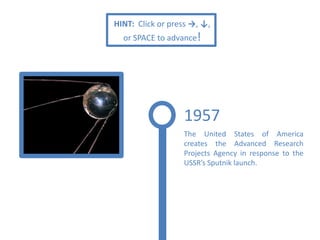
                  1957
                  The United States of America
                  creates the Advanced Research
                  Projects Agency in response to the
                  USSR’s Sputnik launch.
1968
ARPANET is launched as a data
packet sharing network for
ARPA projects.


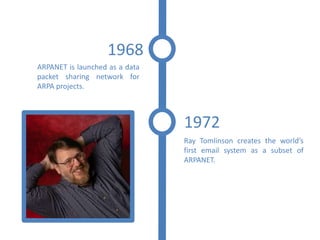
                                1972
                                Ray Tomlinson creates the world’s
                                first email system as a subset of
                                ARPANET.
1973
Work begins on TCP/IP, the next step
from ARPANET, which allows for
different computers and networks to
communicate with each other.


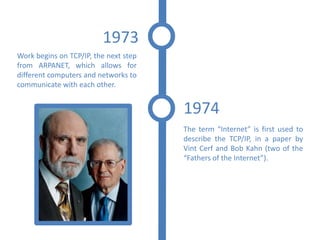
                                       1974
                                       The term “Internet” is first used to
                                       describe the TCP/IP, in a paper by
                                       Vint Cerf and Bob Kahn (two of the
                                       “Fathers of the Internet”).
1984
Now more developed,          a new
section of APARNET is created for
military usage, called MILNET.
NSFNET follows shortly thereafter,
for the National Science Foundation.


                                       1990
                                       Advanced Network & Services, a
                                       non-profit corporation, was founded
                                       to    progress      research     and
                                       development       of      high-speed
                                       networking.
1992
The “World-Wide Web” is released,
soon followed by an internet
directory for the hundreds of
thousands of new domains that
were added within the next few
years.                              1996
                                    Sprint, AT&T, and various other ISPs
                                    have begun carrying the majority of
                                    internet traffic.


                                    1998

                                    launches, soon becoming the
                                    world’s most popular online search
                                    engine, surpassing Yahoo! (launched
                                    in 1995)
1999
802.11b, commonly known today as
Wi-Fi, is introduced and soon
becomes a standard feature of
portable computers and handhelds.
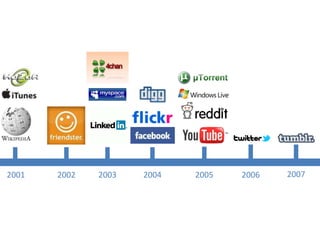
2001   2002   2003   2004   2005   2006   2007
Present-Day Statistics:
• ~800,000,000 active Facebook users

• ~170,000,000 active Twitter users

• ~34,000 Google searches per second

• ~8 years of content uploaded to YouTube per day

• 4,110,045 English-language articles on Wikipedia
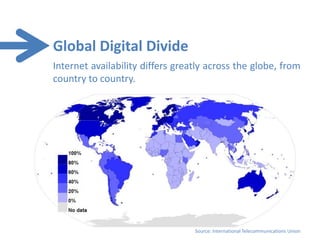
Global Digital Divide
Internet availability differs greatly across the globe, from
country to country.


                                  Source: International Telecommunications Union
Canada


Internet users: 27,757,450

% of population: 81.6%
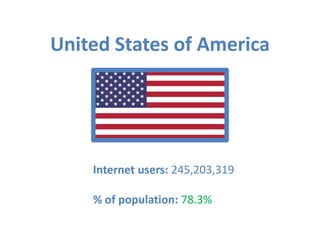
United States of America


    Internet users: 245,203,319

    % of population: 78.3%
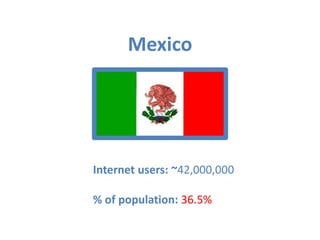
Mexico


Internet users: ~42,000,000

% of population: 36.5%
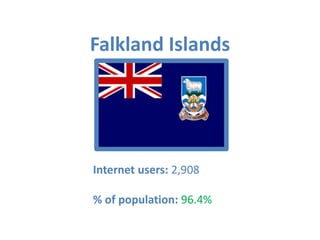
Falkland Islands


Internet users: 2,908

% of population: 96.4%
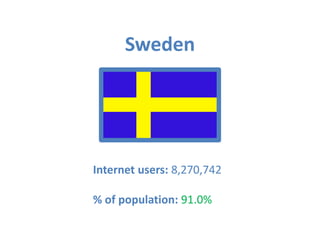
Sweden


Internet users: 8,270,742

% of population: 91.0%
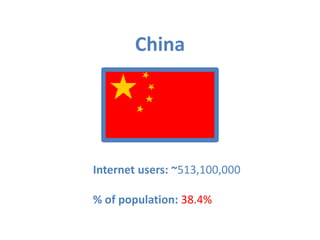
China


Internet users: ~513,100,000

% of population: 38.4%
Internet Censorship
A serious social justice issue, internet censorship is the
suppression of publication or access to the internet.

This can be done through a variety of different means,
such as IP blocking (preventing access to specific
websites), URL filtering, and connection resets – all of
which are used as part of the “Great Firewall of China,”
the colloquial name for the government of China’s strict
control over internet censorship.

Other notable examples of internet censorship include
its usage by the Egyptian government during the Arab
Spring movement and its current employment by the
Syrian government.
LEARN MORE ABOUT
RECENT INTERNET CONTROVERSIES
         HINT: Click the hyperlinks for more information.


Stop Online Piracy Act (SOPA)
http://news.nationalpost.com/2012/01/17/why-is-there-going-to-be-a-wikipedia-
blackout-and-what-is-sopa/


Internet Service Blackout in Syria
http://articles.washingtonpost.com/2012-11-29/world/35585439_1_syrian-people-
hama-opposition-coalition


United Nations Control over the Internet
http://thehill.com/blogs/floor-action/house/271153-house-approves-resolution-to-
keep-internet-control-out-of-un-hands
REFERENCES AND ADDITIONAL INFORMATION
http://www.itu.int/ITU-
D/ict/statistics/material/excel/Individuals%20using%20the%20Internet2000-2011.xls
“Percentage of Individuals using the Internet 2000-2011”, International Telecommunication
Union


http://www.investintech.com/content/historyinternet/
“The History of the Internet”, Investintech PDF Solutions


Dutton, William H.; Dopatka, Anna; Law, Ginette; Nash, Victoria. (2011). Freedom of
         connection, freedom of expression: the changing legal and regulatory ecology
         shaping the internet. 1-103. UNESCO, Paris, France.


Wells, John; Lewis, Laurie. (2006). Internet access in U.S. public schools and classrooms:
          1994-2005. 1-83. Westat, Inc., Rockville, MD.

Media, Techology, and Education Final

  • 1.
    and the OngoingStruggles of Controversy, Accessibility, and Control A presentation by Rory Mallette
  • 2.
    HINT: Click orpress →, ↓, or SPACE to advance! 1957 The United States of America creates the Advanced Research Projects Agency in response to the USSR’s Sputnik launch.
  • 3.
    1968 ARPANET is launchedas a data packet sharing network for ARPA projects. 1972 Ray Tomlinson creates the world’s first email system as a subset of ARPANET.
  • 4.
    1973 Work begins onTCP/IP, the next step from ARPANET, which allows for different computers and networks to communicate with each other. 1974 The term “Internet” is first used to describe the TCP/IP, in a paper by Vint Cerf and Bob Kahn (two of the “Fathers of the Internet”).
  • 5.
    1984 Now more developed, a new section of APARNET is created for military usage, called MILNET. NSFNET follows shortly thereafter, for the National Science Foundation. 1990 Advanced Network & Services, a non-profit corporation, was founded to progress research and development of high-speed networking.
  • 6.
    1992 The “World-Wide Web”is released, soon followed by an internet directory for the hundreds of thousands of new domains that were added within the next few years. 1996 Sprint, AT&T, and various other ISPs have begun carrying the majority of internet traffic. 1998 launches, soon becoming the world’s most popular online search engine, surpassing Yahoo! (launched in 1995)
  • 7.
    1999 802.11b, commonly knowntoday as Wi-Fi, is introduced and soon becomes a standard feature of portable computers and handhelds.
  • 8.
    2001 2002 2003 2004 2005 2006 2007
  • 9.
    Present-Day Statistics: • ~800,000,000active Facebook users • ~170,000,000 active Twitter users • ~34,000 Google searches per second • ~8 years of content uploaded to YouTube per day • 4,110,045 English-language articles on Wikipedia
  • 10.
    Global Digital Divide Internetavailability differs greatly across the globe, from country to country. Source: International Telecommunications Union
  • 11.
  • 12.
    United States ofAmerica Internet users: 245,203,319 % of population: 78.3%
  • 13.
  • 14.
    Falkland Islands Internet users:2,908 % of population: 96.4%
  • 15.
  • 16.
  • 17.
    Internet Censorship A serioussocial justice issue, internet censorship is the suppression of publication or access to the internet. This can be done through a variety of different means, such as IP blocking (preventing access to specific websites), URL filtering, and connection resets – all of which are used as part of the “Great Firewall of China,” the colloquial name for the government of China’s strict control over internet censorship. Other notable examples of internet censorship include its usage by the Egyptian government during the Arab Spring movement and its current employment by the Syrian government.
  • 18.
    LEARN MORE ABOUT RECENTINTERNET CONTROVERSIES HINT: Click the hyperlinks for more information. Stop Online Piracy Act (SOPA) http://news.nationalpost.com/2012/01/17/why-is-there-going-to-be-a-wikipedia- blackout-and-what-is-sopa/ Internet Service Blackout in Syria http://articles.washingtonpost.com/2012-11-29/world/35585439_1_syrian-people- hama-opposition-coalition United Nations Control over the Internet http://thehill.com/blogs/floor-action/house/271153-house-approves-resolution-to- keep-internet-control-out-of-un-hands
  • 19.
    REFERENCES AND ADDITIONALINFORMATION http://www.itu.int/ITU- D/ict/statistics/material/excel/Individuals%20using%20the%20Internet2000-2011.xls “Percentage of Individuals using the Internet 2000-2011”, International Telecommunication Union http://www.investintech.com/content/historyinternet/ “The History of the Internet”, Investintech PDF Solutions Dutton, William H.; Dopatka, Anna; Law, Ginette; Nash, Victoria. (2011). Freedom of connection, freedom of expression: the changing legal and regulatory ecology shaping the internet. 1-103. UNESCO, Paris, France. Wells, John; Lewis, Laurie. (2006). Internet access in U.S. public schools and classrooms: 1994-2005. 1-83. Westat, Inc., Rockville, MD.